Recognition: 2 theorem links
· Lean TheoremPathPainter: Transferring the Generalization Ability of Image Generation Models to Embodied Navigation
Pith reviewed 2026-05-11 02:02 UTC · model grok-4.3
The pith
Image generation models interpret natural language to create traversability masks on bird's-eye-view images for guiding robot navigation.
A machine-rendered reading of the paper's core claim, the machinery that carries it, and where it could break.
Core claim
An image generation model processes bird's-eye-view images conditioned on natural language input to produce traversability masks that identify safe paths to a target; when paired with cross-view localization that registers the robot's current view against the map to correct odometry drift, the resulting global prior allows a standard local planner to execute long-range navigation successfully.
What carries the argument
The PathPainter pipeline in which an image generation model produces traversability masks from bird's-eye-view images given text intent, augmented by cross-view localization to maintain map alignment.
If this is right
- A conventional local planner suffices for long-range outdoor navigation when supplied with global masks from the image model.
- Natural language commands can directly drive target selection and path constraints without custom reward functions or maps.
- The same pipeline works for both ground robots and UAVs, as shown by the 160-meter flight experiment.
- Foundation model generalization reduces the need for robot-specific training data in new environments.
Where Pith is reading between the lines
- Real-time mask updates from streaming bird's-eye-view images could support navigation in changing scenes.
- Combining the masks with depth or semantic segmentation from onboard sensors might correct errors in the generated priors.
- The method could scale to indoor settings if bird's-eye-view images are synthesized from multiple camera views rather than assumed available.
Load-bearing premise
The image generation model produces accurate traversability masks from bird's-eye-view images that match the actual environment and the stated natural language goal.
What would settle it
A run in which the generated mask marks an obstacle as traversable and the robot collides while following the local planner.
Figures



read the original abstract
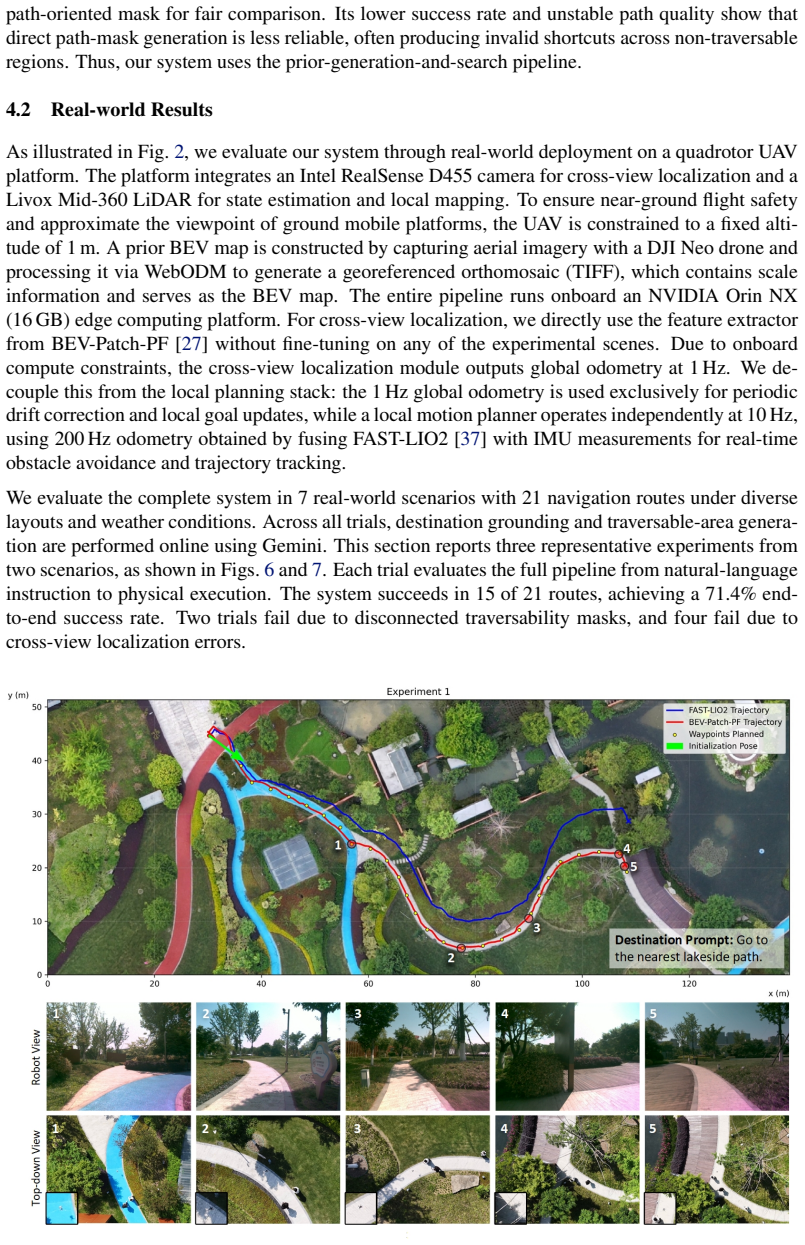
Bird's-eye-view (BEV) images have been widely demonstrated to provide valuable prior information for navigation. Given the global information provided by such views, two key challenges remain: how to fully exploit this information and how to reliably use it during execution. In this paper, we propose a navigation system that uses BEV images as global priors and is designed for ground and near-ground robotic platforms. The system employs an image generation model to interpret human intent from natural language, identify the target destination, and generate traversability masks. During execution, we introduce cross-view localization to align the robot's odometry with the BEV map and mitigate long-term drift in conventional odometry. We conduct extensive benchmark experiments to evaluate the proposed method and further validate it on a UAV platform. Using only a conventional local motion planner, the UAV successfully completes a 160-meter outdoor long-range navigation task. This work demonstrates how the world-understanding capabilities of foundation models can be transferred to embodied navigation, enabling robots to benefit from the strong generalization ability of existing image generation models.
Editorial analysis
A structured set of objections, weighed in public.
Referee Report
Summary. The paper proposes PathPainter, a navigation system for ground and near-ground robots that uses bird's-eye-view (BEV) images as global priors. An image generation model interprets natural language intent to identify targets and produce traversability masks; cross-view localization aligns robot odometry with the BEV map to reduce drift. The system is benchmarked and demonstrated on a UAV that completes a 160-meter outdoor task using only a conventional local planner, claiming to transfer the generalization ability of foundation image generation models to embodied navigation.
Significance. If the central claims hold, the work would offer a practical route to leverage large-scale image generation models for long-range navigation without task-specific training of the planner or perception stack. The 160 m UAV demonstration, if supported by controlled evidence, would indicate that BEV priors plus language-conditioned mask generation can enable reliable performance over distances where standard odometry fails. This could influence future designs that treat foundation models as drop-in world-understanding modules rather than end-to-end trained policies.
major comments (2)
- [Abstract] Abstract: the claim that the UAV 'successfully completes a 160-meter outdoor long-range navigation task' using only a conventional local planner is load-bearing for the central thesis, yet no quantitative metrics (success rate, path deviation, completion time, or failure modes) or baselines are supplied. Without these, it is impossible to attribute success to the generated traversability masks rather than the BEV prior, cross-view localization, or planner robustness alone.
- [Method / Experimental Evaluation] Method and experimental sections: the paper does not report mask-level accuracy metrics (IoU, precision/recall) on held-out BEV images, nor ablations that disable the image-generation component while keeping localization and the planner fixed. These omissions leave open the possibility that the observed performance does not stem from transferred generalization of the foundation model.
minor comments (2)
- [Method] Notation for the cross-view localization transform and the precise conditioning of the image generation model on language intent plus BEV image should be defined explicitly with equations or pseudocode.
- [Abstract / Results] The abstract states 'extensive benchmark experiments' but provides no table or figure summarizing quantitative results; a results table with means, standard deviations, and comparisons would improve clarity.
Simulated Author's Rebuttal
We thank the referee for the thoughtful and constructive comments. The feedback highlights important aspects of evidence presentation that strengthen the central claims. We address each major comment below and have revised the manuscript to incorporate additional quantitative results and analyses.
read point-by-point responses
-
Referee: [Abstract] Abstract: the claim that the UAV 'successfully completes a 160-meter outdoor long-range navigation task' using only a conventional local planner is load-bearing for the central thesis, yet no quantitative metrics (success rate, path deviation, completion time, or failure modes) or baselines are supplied. Without these, it is impossible to attribute success to the generated traversability masks rather than the BEV prior, cross-view localization, or planner robustness alone.
Authors: We agree that quantitative metrics are necessary to rigorously support the UAV demonstration and to isolate the contribution of the traversability masks. In the revised manuscript we have added success rate, path deviation, completion time, and failure-mode statistics for the 160 m outdoor task. We also include a controlled baseline that uses the same BEV prior and cross-view localization but disables the language-conditioned mask generation, allowing direct attribution of performance gains to the image-generation component. revision: yes
-
Referee: [Method / Experimental Evaluation] Method and experimental sections: the paper does not report mask-level accuracy metrics (IoU, precision/recall) on held-out BEV images, nor ablations that disable the image-generation component while keeping localization and the planner fixed. These omissions leave open the possibility that the observed performance does not stem from transferred generalization of the foundation model.
Authors: We acknowledge that intermediate mask accuracy and targeted ablations provide clearer evidence for the transfer of generalization. The revised version now reports IoU, precision, and recall of the generated traversability masks on held-out BEV images. We further include an ablation that removes only the image-generation module while retaining cross-view localization and the conventional planner, demonstrating that navigation performance degrades without the language-conditioned masks and thereby supporting the role of the foundation model. revision: yes
Circularity Check
No significant circularity in system design or claims
full rationale
The paper proposes a practical navigation pipeline that applies pre-existing image generation models to interpret language and produce traversability masks on BEV images, then combines this with standard cross-view localization and a conventional local planner. No mathematical derivations, equations, or fitted parameters are presented that reduce claims to self-defined inputs. Experimental validation on benchmarks and a 160 m UAV task provides independent evidence rather than circular self-reference. No load-bearing self-citations or ansatzes imported from prior author work are evident in the described chain.
Axiom & Free-Parameter Ledger
Lean theorems connected to this paper
-
IndisputableMonolith/Foundation/RealityFromDistinction.leanreality_from_one_distinction unclear?
unclearRelation between the paper passage and the cited Recognition theorem.
We formulate the path planning problem as an image-to-image generation process... the image generation model is responsible for two main tasks: goal position prediction and traversability-mask segmentation.
-
IndisputableMonolith/Cost/FunctionalEquation.leanwashburn_uniqueness_aczel unclear?
unclearRelation between the paper passage and the cited Recognition theorem.
A* search is performed on the binary mask... boundary-distance-based penalty term into the A* cost function
What do these tags mean?
- matches
- The paper's claim is directly supported by a theorem in the formal canon.
- supports
- The theorem supports part of the paper's argument, but the paper may add assumptions or extra steps.
- extends
- The paper goes beyond the formal theorem; the theorem is a base layer rather than the whole result.
- uses
- The paper appears to rely on the theorem as machinery.
- contradicts
- The paper's claim conflicts with a theorem or certificate in the canon.
- unclear
- Pith found a possible connection, but the passage is too broad, indirect, or ambiguous to say the theorem truly supports the claim.
Reference graph
Works this paper leans on
- [1]
-
[2]
C. Klammer and M. Kaess. Bevloc: Cross-view localization and matching via birds-eye-view synthesis. In2024 IEEE/RSJ International Conference on Intelligent Robots and Systems (IROS), pages 5656–5663. IEEE, 2024
work page 2024
-
[3]
J. Zhang, H. Dong, J. Yang, J. Liu, S. Huang, K. Li, X. Tang, X. Wei, and X. You. Dual- bev nav: Dual-layer bev-based heuristic path planning for robotic navigation in unstructured outdoor environments. In2025 IEEE International Conference on Robotics and Automation (ICRA), pages 8872–8879. IEEE, 2025
work page 2025
-
[4]
J. Lee, T. Miyanishi, S. Kurita, K. Sakamoto, D. Azuma, Y . Matsuo, and N. Inoue. City- nav: A large-scale dataset for real-world aerial navigation. InProceedings of the IEEE/CVF International Conference on Computer Vision, pages 5912–5922, 2025
work page 2025
- [5]
-
[6]
F. Cladera, Z. Ravichandran, J. Hughes, V . Murali, C. Nieto-Granda, M. A. Hsieh, G. J. Pap- pas, C. J. Taylor, and V . Kumar. Air-ground collaboration for language-specified missions in unknown environments.IEEE Transactions on Field Robotics, 2025
work page 2025
-
[7]
H. Liu, Z. Ma, Y . Li, J. Sugihara, Y . Chen, J. Li, and M. Zhao. Hierarchical language models for semantic navigation and manipulation in an aerial-ground robotic system.Advanced Intelligent Systems, 8(2):e202500640, 2026. doi:https://doi.org/10.1002/aisy.202500640. URLhttps: //advanced.onlinelibrary.wiley.com/doi/abs/10.1002/aisy.202500640
-
[8]
Z. Li, R. Mao, N. Chen, C. Xu, F. Gao, and Y . Cao. Colag: A collaborative air-ground framework for perception-limited ugvs’ navigation. In2024 IEEE International Conference on Robotics and Automation (ICRA), pages 16781–16787. IEEE, 2024
work page 2024
-
[9]
J. Deng, J. Liu, and J. Hu. Tightly-coupled air-ground collaborative system for autonomous ugv navigation in gps-denied environments.Drones, 9(9):614, 2025
work page 2025
- [10]
-
[11]
R. Wu, Y . Zhang, J. Chen, L. Huang, S. Zhang, X. Zhou, L. Wang, and S. Liu. Aeroduo: Aerial duo for uav-based vision and language navigation. InProceedings of the 33rd ACM International Conference on Multimedia, pages 2576–2585, 2025
work page 2025
-
[12]
I. Munasinghe, A. Perera, and R. C. Deo. A comprehensive review of uav-ugv collaboration: Advancements and challenges.Journal of Sensor and Actuator Networks, 13(6):81, 2024
work page 2024
- [13]
-
[14]
Introducing nano banana pro.https://blog.google/innovation-and-ai/ products/nano-banana-pro/, Nov
Google. Introducing nano banana pro.https://blog.google/innovation-and-ai/ products/nano-banana-pro/, Nov. 2025. Google Blog. Accessed: 2026-04-27
work page 2025
-
[15]
OpenAI. Chatgpt images 2.0 is now available.https://openai.com/zh-Hans-CN/index/ introducing-chatgpt-images-2-0/, Apr. 2026. Accessed: 2026-04-27. 9
work page 2026
-
[16]
Image Generators are Generalist Vision Learners
V . Gabeur, S. Long, S. Peng, P. V oigtlaender, S. Sun, Y . Bao, K. Truong, Z. Wang, W. Zhou, J. T. Barron, K. Genova, N. Kannen, S. Ben, Y . Li, M. Guo, S. Yogin, Y . Gu, H. Chen, O. Wang, S. Xie, H. Zhou, K. He, T. Funkhouser, J.-B. Alayrac, and R. Soricut. Image generators are generalist vision learners, 2026. URLhttps://arxiv.org/abs/2604.20329
work page internal anchor Pith review Pith/arXiv arXiv 2026
- [17]
-
[18]
A. H. Tan, A. Fung, H. Wang, and G. Nejat. Mobile robot navigation using hand-drawn maps: A vision language model approach.IEEE Robotics and Automation Letters, 2025
work page 2025
- [19]
- [20]
-
[21]
Navid: Video-based vlm plans the next step for vision-and-language navigation,
J. Zhang, K. Wang, R. Xu, G. Zhou, Y . Hong, X. Fang, Q. Wu, Z. Zhang, and H. Wang. Navid: Video-based vlm plans the next step for vision-and-language navigation.arXiv preprint arXiv:2402.15852, 2024
- [22]
-
[23]
H. Zhang, S. Liang, L. Chen, Y . Li, Y . Xu, Y . Zhong, F. Zhang, and H. Li. Sparse video generation propels real-world beyond-the-view vision-language navigation.arXiv preprint arXiv:2602.05827, 2026
- [24]
-
[25]
J. Hu, J. Chen, H. Bai, M. Luo, S. Xie, Z. Chen, F. Liu, Z. Chu, X. Xue, B. Ren, et al. Astranav- world: World model for foresight control and consistency.arXiv preprint arXiv:2512.21714, 2025
work page internal anchor Pith review Pith/arXiv arXiv 2025
-
[26]
X. Zhou, Z. Wang, H. Ye, C. Xu, and F. Gao. Ego-planner: An esdf-free gradient-based local planner for quadrotors.IEEE Robotics and Automation Letters, 6(2):478–485, 2020
work page 2020
- [27]
-
[28]
SAM 3: Segment Anything with Concepts
N. Carion, L. Gustafson, Y .-T. Hu, S. Debnath, R. Hu, D. Suris, C. Ryali, K. V . Alwala, H. Khedr, A. Huang, J. Lei, T. Ma, B. Guo, A. Kalla, M. Marks, J. Greer, M. Wang, P. Sun, R. R¨adle, T. Afouras, E. Mavroudi, K. Xu, T.-H. Wu, Y . Zhou, L. Momeni, R. Hazra, S. Ding, S. Vaze, F. Porcher, F. Li, S. Li, A. Kamath, H. K. Cheng, P. Doll ´ar, N. Ravi, K. ...
work page internal anchor Pith review Pith/arXiv arXiv 2025
-
[29]
Z. Xu, Y . Liu, Y . Sun, M. Liu, and L. Wang. Rngdet++: Road network graph detection by transformer with instance segmentation and multi-scale features enhancement.IEEE Robotics and Automation Letters, 8(5):2991–2998, 2023
work page 2023
- [30]
-
[31]
I. Demir, K. Koperski, D. Lindenbaum, G. Pang, J. Huang, S. Basu, F. Hughes, D. Tuia, and R. Raskar. Deepglobe 2018: A challenge to parse the earth through satellite images. In Proceedings of the IEEE conference on computer vision and pattern recognition workshops, pages 172–181, 2018
work page 2018
-
[32]
Y . Lyu, G. V osselman, G.-S. Xia, A. Yilmaz, and M. Y . Yang. Uavid: A semantic segmentation dataset for uav imagery.ISPRS journal of photogrammetry and remote sensing, 165:108–119, 2020
work page 2020
-
[33]
A. Yeshchenko, J. Mendling, C. Di Ciccio, and A. Polyvyanny. Vdd: A visual drift detection system for process mining. 2020
work page 2020
- [34]
-
[35]
S. He, F. Bastani, S. Jagwani, M. Alizadeh, H. Balakrishnan, S. Chawla, M. M. Elshrif, S. Mad- den, and M. A. Sadeghi. Sat2graph: Road graph extraction through graph-tensor encoding. In European Conference on Computer Vision, pages 51–67. Springer, 2020
work page 2020
- [36]
-
[37]
W. Xu, Y . Cai, D. He, J. Lin, and F. Zhang. Fast-lio2: Fast direct lidar-inertial odometry.IEEE Transactions on Robotics, 38(4):2053–2073, 2022. 11
work page 2053
discussion (0)
Sign in with ORCID, Apple, or X to comment. Anyone can read and Pith papers without signing in.