Recognition: 2 theorem links
· Lean TheoremBeyond GSD-as-Token: Continuous Scale Conditioning for Remote Sensing VLMs
Pith reviewed 2026-05-11 01:49 UTC · model grok-4.3
The pith
Remote sensing VLMs can route their computations dynamically by treating ground sampling distance as a continuous conditioning variable rather than a discrete token or ignored input.
A machine-rendered reading of the paper's core claim, the machinery that carries it, and where it could break.
Core claim
ScaleEarth replaces discrete GSD tokens with CS-HLoRA, a hyper-LoRA whose low-rank updates are gated by a continuous ground-sampling-distance variable. This allows the 8B Qwen3-VL backbone, fine-tuned with QLoRA, to route computation according to physical scale. SSE-U, a heteroscedastic sub-head, infers GSD and its uncertainty directly from image features, removing the need for metadata at test time. The system is closed by the GeoScale-VQA corpus of 1.5M scale-layered VQA pairs whose generation is conditioned on the same scalar used to drive CS-HLoRA. The trained model sets new state-of-the-art results on XLRS-Bench and OmniEarth-Bench.
What carries the argument
CS-HLoRA (Continuous Scale-Conditioned Hyper-LoRA), which modulates the low-rank adaptation matrices through a GSD-driven gate so that scale determines the active computation subspace.
If this is right
- The model maintains performance even on images whose scale is not supplied at inference because SSE-U supplies the missing value.
- Question-answer pairs generated at the same physical scale as the image provide consistent supervision that matches the conditioning signal.
- Parameter-efficient adaptation can embed physical priors such as scale without expanding the full parameter count.
- Diverse Earth-system tasks benefit simultaneously once scale-dependent routing is available.
Where Pith is reading between the lines
- The same continuous-conditioning idea could be applied to other physical variables such as acquisition time or sensor type by replacing the GSD gate with an analogous scalar.
- Because the gate operates inside the low-rank update, the approach may transfer to other parameter-efficient methods beyond LoRA.
- The visual GSD predictor opens the possibility of scale-aware models for imagery that lacks any metadata, such as historical or crowdsourced remote-sensing data.
Load-bearing premise
Modulating the LoRA subspace with a continuous GSD gate will produce stable, beneficial routing across all scales without harming performance when scale is ambiguous or missing.
What would settle it
Train an otherwise identical model that receives only a discrete GSD token or no scale input at all; if its accuracy on XLRS-Bench and OmniEarth-Bench equals or exceeds the CS-HLoRA version, the continuous-conditioning claim is falsified.
Figures




read the original abstract
Remote sensing vision-language models (RS-VLMs) face a fundamental mismatch with natural-image counterparts: the same geographic object exhibits radically different visual evidence across ground sampling distances (GSDs) spanning multiple orders of magnitude. Yet existing RS-VLMs often discard GSD or inject it as a discrete text token, forcing a single static parameter set to absorb the entire scale spectrum. We introduce ScaleEarth, a parameter-efficient fine-tuning framework built on Qwen3-VL that treats GSD as a continuous conditioning variable governing the model's computation path. At its core, CS-HLoRA (Continuous Scale-Conditioned Hyper-LoRA) modulates the LoRA low-rank subspace through a GSD-driven gate, enabling the model to dynamically route computation by physical scale. To remove reliance on sensor metadata at deployment, we pair CS-HLoRA with SSE-U, a lightweight heteroscedastic sub-head that predicts GSD and its uncertainty from visual features. To provide matching supervision, we construct GeoScale-VQA, a 1.5M-sample scale-layered RS-VQA corpus whose question-answer generation is conditioned on the same physical scalar that drives CS-HLoRA, forming a closed method-data loop. Trained with QLoRA on an 8B backbone, ScaleEarth achieves state-of-the-art results on remote-sensing benchmarks covering diverse Earth-system tasks, including XLRS-Bench and OmniEarth-Bench.
Editorial analysis
A structured set of objections, weighed in public.
Referee Report
Summary. The paper introduces ScaleEarth, a parameter-efficient fine-tuning framework for remote sensing VLMs built on Qwen3-VL. It proposes CS-HLoRA to treat GSD as a continuous conditioning variable that modulates the LoRA subspace via a GSD-driven gate for dynamic scale-aware routing, paired with SSE-U (a heteroscedastic predictor) to estimate GSD and uncertainty from visual features alone. A 1.5M-sample GeoScale-VQA dataset is constructed with QA pairs generated conditioned on the same GSD scalar, and the method is trained via QLoRA on an 8B backbone, claiming SOTA results on remote-sensing benchmarks including XLRS-Bench and OmniEarth-Bench.
Significance. If the central claims hold, the work meaningfully advances RS-VLMs by replacing discrete GSD tokens or metadata ignorance with continuous, learned scale conditioning in a PEFT setting. The closed-loop design linking data generation to model conditioning and the addition of uncertainty-aware GSD prediction are technically interesting and address a real domain mismatch. Parameter efficiency on an 8B model is a practical strength. However, without quantitative results or robustness checks, the practical impact on diverse Earth-system tasks remains unverified.
major comments (3)
- [Abstract] Abstract: the SOTA claim on XLRS-Bench and OmniEarth-Bench is asserted without any performance metrics, baseline comparisons, ablation tables, or statistical tests, which is load-bearing for the central contribution and prevents verification of whether CS-HLoRA + SSE-U actually outperforms static QLoRA.
- [Method] Method (CS-HLoRA and SSE-U integration): the assumption that the GSD-driven gate will deliver stable dynamic routing when SSE-U supplies predicted (rather than oracle) GSD is unsupported; no ablation with noisy GSD inputs, MAE of SSE-U, or comparison of oracle vs. predicted GSD performance is provided, directly undermining the no-metadata deployment claim.
- [Dataset construction] Dataset construction: GeoScale-VQA question-answer pairs are generated conditioned on the identical physical GSD scalar that drives the CS-HLoRA gate, creating a closed loop; this risks optimistic bias and requires explicit testing with SSE-U predictions at both training and evaluation time to confirm generalization.
minor comments (2)
- The abstract introduces CS-HLoRA and SSE-U without first-use expansion or a one-sentence overview of the gate mechanism, reducing immediate clarity for readers unfamiliar with the acronyms.
- Implementation details such as the exact form of the GSD-driven gate (e.g., functional form, initialization) and the heteroscedastic loss for SSE-U are referenced but not shown in the provided text, complicating reproducibility.
Simulated Author's Rebuttal
We thank the referee for the constructive and detailed review. We address each major comment point by point below. Where the comments identify gaps in supporting evidence or potential biases, we have incorporated revisions and additional experiments to strengthen the manuscript.
read point-by-point responses
-
Referee: [Abstract] Abstract: the SOTA claim on XLRS-Bench and OmniEarth-Bench is asserted without any performance metrics, baseline comparisons, ablation tables, or statistical tests, which is load-bearing for the central contribution and prevents verification of whether CS-HLoRA + SSE-U actually outperforms static QLoRA.
Authors: We agree that the abstract should include concrete quantitative support for the SOTA claims to allow immediate verification. In the revised manuscript we have updated the abstract to report key metrics, including absolute performance and relative gains over static QLoRA and other baselines on XLRS-Bench and OmniEarth-Bench. The full experimental section already contains the corresponding tables, ablations, and statistical details; the abstract revision simply surfaces the most salient numbers. revision: yes
-
Referee: [Method] Method (CS-HLoRA and SSE-U integration): the assumption that the GSD-driven gate will deliver stable dynamic routing when SSE-U supplies predicted (rather than oracle) GSD is unsupported; no ablation with noisy GSD inputs, MAE of SSE-U, or comparison of oracle vs. predicted GSD performance is provided, directly undermining the no-metadata deployment claim.
Authors: This is a fair critique of the robustness evidence. We have added a dedicated ablation subsection that reports the MAE of SSE-U on held-out data, directly compares end-to-end performance when the CS-HLoRA gate receives oracle versus predicted GSD, and includes controlled noise-injection experiments on the predicted GSD values. The new results show only marginal degradation and confirm that dynamic routing remains stable, thereby supporting the no-metadata deployment scenario. revision: yes
-
Referee: [Dataset construction] Dataset construction: GeoScale-VQA question-answer pairs are generated conditioned on the identical physical GSD scalar that drives the CS-HLoRA gate, creating a closed loop; this risks optimistic bias and requires explicit testing with SSE-U predictions at both training and evaluation time to confirm generalization.
Authors: We acknowledge the risk of optimistic bias inherent in the closed-loop construction. The revised manuscript now contains two additional experimental protocols: (1) training with oracle GSD but evaluating exclusively with SSE-U predictions, and (2) using SSE-U predictions for both training and evaluation. Performance remains consistent across these settings, indicating that the model does not overfit to the oracle conditioning and generalizes when the predictor is used end-to-end. revision: yes
Circularity Check
No significant circularity in claimed method or results
full rationale
The paper presents an empirical PEFT framework (CS-HLoRA + SSE-U) trained on a custom dataset (GeoScale-VQA) whose generation uses the same GSD scalar for supervision. This is explicitly described as providing 'matching supervision' rather than a mathematical derivation or first-principles prediction. No equations, uniqueness theorems, or self-cited load-bearing premises are shown that reduce the SOTA claims on XLRS-Bench/OmniEarth-Bench to inputs by construction. The inference-time use of predicted GSD is a separate deployment assumption, not a definitional loop. The work is self-contained against external benchmarks with no identified self-definitional, fitted-prediction, or ansatz-smuggling patterns.
Axiom & Free-Parameter Ledger
free parameters (1)
- CS-HLoRA gate parameters
axioms (1)
- domain assumption GSD can be treated as a continuous scalar that meaningfully governs visual feature computation across orders of magnitude
invented entities (2)
-
CS-HLoRA
no independent evidence
-
SSE-U
no independent evidence
Lean theorems connected to this paper
-
IndisputableMonolith/Cost/FunctionalEquation.leanwashburn_uniqueness_aczel (J-cost uniqueness) unclear?
unclearRelation between the paper passage and the cited Recognition theorem.
CS-HLoRA ... ΔW(s)=αlora/r B diag(h(s)) A, hk(s)=σ(α(τk−s)), s=log10(GSD)
-
IndisputableMonolith/Foundation/DimensionForcing.leanalexander_duality_circle_linking (D=3 forcing) unclear?
unclearRelation between the paper passage and the cited Recognition theorem.
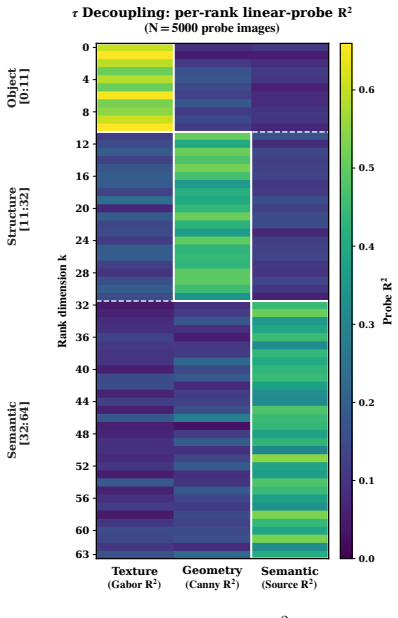
three physically motivated tiers ... object ranks 0–10 ... structure ranks 11–31 ... semantic ranks 32–63
What do these tags mean?
- matches
- The paper's claim is directly supported by a theorem in the formal canon.
- supports
- The theorem supports part of the paper's argument, but the paper may add assumptions or extra steps.
- extends
- The paper goes beyond the formal theorem; the theorem is a base layer rather than the whole result.
- uses
- The paper appears to rely on the theorem as machinery.
- contradicts
- The paper's claim conflicts with a theorem or certificate in the canon.
- unclear
- Pith found a possible connection, but the passage is too broad, indirect, or ambiguous to say the theorem truly supports the claim.
Reference graph
Works this paper leans on
-
[1]
Large language model. Shuai Bai, Yuxuan Cai, Ruizhe Chen, Keqin Chen, Xionghui Chen, Zesen Cheng, Lianghao Deng, Wei Ding, Chang Gao, Chunjiang Ge, et al. Qwen3-vl technical report.arXiv preprint arXiv:2511.21631,
work page internal anchor Pith review Pith/arXiv arXiv
-
[2]
Gated Relational Alignment via Confidence-based Distillation for Efficient VLMs
Yanlong Chen, Amirhossein Habibian, Luca Benini, and Yawei Li. Gated relational alignment via confidence-based distillation for efficient vlms.arXiv preprint arXiv:2601.22709,
work page internal anchor Pith review Pith/arXiv arXiv
-
[3]
Zhe Chen, Weiyun Wang, Yue Cao, Yangzhou Liu, Zhangwei Gao, Erfei Cui, Jinguo Zhu, Shenglong Ye, Hao Tian, Zhaoyang Liu, et al. Expanding performance boundaries of open-source multimodal models with model, data, and test-time scaling.arXiv preprint arXiv:2412.05271,
work page internal anchor Pith review Pith/arXiv arXiv
-
[4]
Loramoe: Alleviate world knowledge for- getting in large language models via moe-style plugin,
Shihan Dou, Enyu Zhou, Yan Liu, Songyang Gao, Jun Zhao, Wei Shen, Yuhao Zhou, Zhiheng Xi, Xiao Wang, Xiaoran Fan, et al. Loramoe: Alleviate world knowledge forgetting in large language models via moe-style plugin.arXiv preprint arXiv:2312.09979,
-
[5]
Rsgpt: A remote sensing vision language model and benchmark.ArXiv, abs/2307.15266, 2023
Y Hu, J Yuan, C Wen, X Lu, and X RSGPT Li. A remote sensing vision language model and benchmark. arxiv 2023.arXiv preprint arXiv:2307.15266,
-
[6]
Aaron Hurst, Adam Lerer, Adam P Goucher, Adam Perelman, Aditya Ramesh, Aidan Clark, AJ Os- trow, Akila Welihinda, Alan Hayes, Alec Radford, et al. Gpt-4o system card.arXiv preprint arXiv:2410.21276,
work page internal anchor Pith review Pith/arXiv arXiv
-
[7]
LLaVA-OneVision: Easy Visual Task Transfer
Bo Li, Peiyuan Zhang, Kaichen Zhang, Fanyi Pu, Xinrun Du, Yuhao Dong, Haotian Liu, Yuanhan Zhang, Ge Zhang, Chunyuan Li, and Ziwei Liu. Lmms-eval: Accelerating the development of large multimodal models, March 2024a. URL https://github.com/EvolvingLMMs-Lab/ lmms-eval. Equal contribution: Bo Li, Peiyuan Zhang, Kaichen Zhang, and Fanyi Pu. Bo Li, Yuanhan Zh...
work page internal anchor Pith review Pith/arXiv arXiv
-
[8]
Jialin Luo, Yuanzhi Wang, Ziqi Gu, Yide Qiu, Shuaizhen Yao, Fuyun Wang, Chunyan Xu, Wenhua Zhang, Dan Wang, and Zhen Cui. Mmm-rs: A multi-modal, multi-gsd, multi-scene remote sensing dataset and benchmark for text-to-image generation.Advances in Neural Information Processing Systems, 37:12151–12163, 2024a. Junwei Luo, Zhen Pang, Yongjun Zhang, Tingzhu Wan...
-
[9]
Aaditya Singh, Adam Fry, Adam Perelman, Adam Tart, Adi Ganesh, Ahmed El-Kishky, Aidan McLaughlin, Aiden Low, AJ Ostrow, Akhila Ananthram, et al. Openai gpt-5 system card.arXiv preprint arXiv:2601.03267,
work page internal anchor Pith review Pith/arXiv arXiv
-
[10]
Gemini: A Family of Highly Capable Multimodal Models
Gemini Team, Rohan Anil, Sebastian Borgeaud, Jean-Baptiste Alayrac, Jiahui Yu, Radu Soricut, Johan Schalkwyk, Andrew M Dai, Anja Hauth, Katie Millican, et al. Gemini: a family of highly capable multimodal models.arXiv preprint arXiv:2312.11805,
work page internal anchor Pith review Pith/arXiv arXiv
-
[11]
Fengxiang Wang, Mingshuo Chen, Xuming He, Yi-Fan Zhang, Yueying Li, Feng Liu, Zijie Guo, Zhenghao Hu, Jiong Wang, Jingyi Xu, et al. Omniearth-bench: Towards holistic evaluation of earth’s six spheres and cross-spheres interactions with multimodal observational earth data.arXiv preprint arXiv:2505.23522, 2025a. 12 Fengxiang Wang, Mingshuo Chen, Yueying Li,...
-
[12]
Qwen2-VL: Enhancing Vision-Language Model's Perception of the World at Any Resolution
Peng Wang, Shuai Bai, Sinan Tan, Shijie Wang, Zhihao Fan, Jinze Bai, Keqin Chen, Xuejing Liu, Jialin Wang, Wenbin Ge, et al. Qwen2-vl: Enhancing vision-language model’s perception of the world at any resolution.arXiv preprint arXiv:2409.12191,
work page internal anchor Pith review Pith/arXiv arXiv
-
[13]
Xun Wu, Shaohan Huang, and Furu Wei. Mixture of lora experts.arXiv preprint arXiv:2404.13628,
-
[14]
Linrui Xu, Ling Zhao, Wang Guo, Qiujun Li, Kewang Long, Kaiqi Zou, Yuhan Wang, and Haifeng Li. Rs-gpt4v: A unified multimodal instruction-following dataset for remote sensing image understanding.arXiv preprint arXiv:2406.12479,
-
[15]
Pan Zhang, Xiaoyi Dong, Yuhang Zang, Yuhang Cao, Rui Qian, Lin Chen, Qipeng Guo, Haodong Duan, Bin Wang, Linke Ouyang, et al. Internlm-xcomposer-2.5: A versatile large vision language model supporting long-contextual input and output.arXiv preprint arXiv:2407.03320, 2024a. Wei Zhang, Miaoxin Cai, Tong Zhang, Yin Zhuang, and Xuerui Mao. Earthgpt: A univers...
-
[16]
InternVL3: Exploring Advanced Training and Test-Time Recipes for Open-Source Multimodal Models
Jinguo Zhu, Weiyun Wang, Zhe Chen, Zhaoyang Liu, Shenglong Ye, Lixin Gu, Hao Tian, Yuchen Duan, Weijie Su, Jie Shao, et al. Internvl3: Exploring advanced training and test-time recipes for open-source multimodal models.arXiv preprint arXiv:2504.10479,
work page internal anchor Pith review Pith/arXiv arXiv
- [17]
-
[18]
3.92 4.82 22.43 16.27 5.88 14.91 8.63 10.98 Qwen3-VL-8B (backbone, zero-shot) Bai et al. [2025]18.42 21.55 26.31 19.74 43.1822.06 18.93 24.31 Adapted from the same Qwen3-VL-8B backbone Stage-1 only (RS-GPT4V SFT) 28.74 26.91 32.40 24.06 41.5528.83 25.62 29.73 Stage-1 + Standard LoRA (r=64) [B2] 33.51 29.40 35.18 26.74 39.6230.97 28.45 31.98 Stage-1 + LoRA...
work page 2025
-
[19]
24.78 22.08 38.62 31.17 15.23 20.22 16.87 24.14 Headline result.Table 2 reports per-sphere VQA accuracy on OmniEarth-Bench. Under the protocol-matched multiple-choice setting, ScaleEarth attains an average accuracy of40.71%, exceed- ing the strongest zero-shot open-source baseline, InternVL3-72B (33.26%), by +7.45 percentage points. It also outperforms th...
work page 2023
-
[20]
Stage 2 dynamics and optimisation knobs.Figures 8 and 9 jointly summarise the behaviour of the CS-HLoRA and SSE-U joint-training stage. The multi-task objective is not a zero-sum trade-off between language modelling and scale estimation: the VLM cross-entropy decreases monotonically from approximately 0.6 to 0.18, while the GSD negative log-likelihood als...
work page 2000
-
[21]
Protocol.We use the RSVQA-HR test split, whose ground-truth ground sample distance is g⋆=0.15 m
Figure 10:GSD-spoofing test on RSVQA-HR.The true GSD is 0.15 m.Ours (CS-HLoRA) peaks near the true GSD and degrades smoothly under scale mismatch, producing a clean bell on log-GSD.B4 (Bucketed MoE-LoRA)is parameter-matched and also peaks in the correct (high) bucket, confirming that conditional capacity helps; however its response is piecewise-constant w...
work page 2023
-
[22]
The vision tower, multimodal projector, and LLM backbone remain frozen at their Stage 1 values. CS-HLoRA uses rank r=64, scaling factor α=32, and zero dropout, and is attached to all linear projections in the LLM. 25 Source # Samples GSD Annotation Role RSVQA family∼1.14 M precise dominant VQA supervision from LR, HR, and xBEN subsets MtSCCD-VQA∼194 K pre...
work page 2024
discussion (0)
Sign in with ORCID, Apple, or X to comment. Anyone can read and Pith papers without signing in.