Information Density as a Quantitative Measure for AI-enabled Virtual Sensing: Feasibility and Limits
Pith reviewed 2026-05-12 01:26 UTC · model grok-4.3
The pith
Information density metrics allow AI to replace physical sensors with mean error below 3.21 percent.
A machine-rendered reading of the paper's core claim, the machinery that carries it, and where it could break.
Core claim
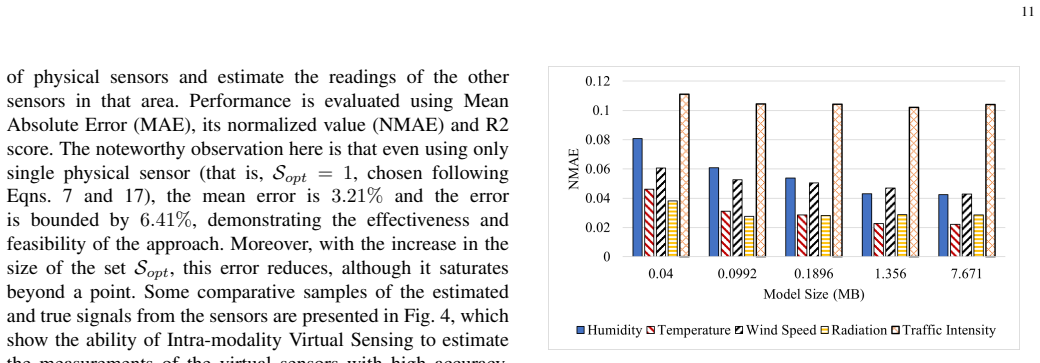
The central discovery is that information density, computed via Phase in Eigen Space and Mutual Information, serves as a reliable indicator for selecting sensor configurations that enable virtual sensing with bounded error, as demonstrated by the Madrid dataset where virtual sensing achieves less than 3.21% mean error using only one physical sensor.
What carries the argument
Information Density, defined through two complementary measures of Phase in Eigen Space and Mutual Information that quantify correlations to support virtual sensing decisions.
If this is right
- Optimal sensor placement can be determined systematically rather than by trial and error.
- Virtual sensing becomes feasible across both same-type and different-type sensor networks.
- Large-scale IoT deployments can operate with fewer physical sensors while maintaining data fidelity.
- Energy consumption and maintenance costs for sensor networks decrease as a direct result of sparser physical deployments.
Where Pith is reading between the lines
- These density measures might be combined with online learning to adapt when correlations shift over time.
- Similar principles could extend to selecting which data streams to transmit in bandwidth-limited settings.
- The framework opens a path to quantitative trade-offs between sensor density and acceptable error bounds in smart infrastructure.
Load-bearing premise
The correlations between sensor readings stay consistent enough across space, time, and sensor types for the two density measures to reliably point to low-error virtual sensing setups.
What would settle it
A field test in a different city or during unusual weather events where the recommended single-sensor configuration produces mean reconstruction errors exceeding 5 percent would falsify the practical utility of the measures.
Figures



read the original abstract
Modern IoT and sensor networks generate vast amounts of data, posing significant challenges for storage, transmission, and real-time processing. Traditional approaches, such as compressive sensing and machine learning-based compression, often suffer from computational inefficiencies and irreversible data loss. This paper introduces Information Density as a quantitative metric to support sensor deployment and enable AI-driven virtual sensing. We propose a framework that leverages spatial, temporal and inter-modal correlations among sensor signals to perform sensing tasks even in the absence of physical sensors. Two complementary measures: (i) Phase in Eigen Space and (ii) Mutual Information, are developed to quantify and assess information density, enabling the selection of optimal sensor configurations across both intra-modality and cross-modality scenarios. Validated using real-world data from Madrid's smart city infrastructure, this framework demonstrates the feasibility of replacing physical sensors with virtual ones under bounded error conditions (e.g., achieving $<3.21\%$ mean error with a single sensor). The results highlight the potential for scalable and energy-efficient sensing systems in smart environments.
Editorial analysis
A structured set of objections, weighed in public.
Referee Report
Summary. The paper introduces 'Information Density' as a metric for sensor networks, quantified via two measures (Phase in Eigen Space and Mutual Information) that exploit spatial, temporal, and inter-modal correlations. It claims this enables AI-driven virtual sensing to replace physical sensors while bounding error, demonstrated by achieving under 3.21% mean error with a single sensor on real Madrid smart-city data.
Significance. If the central claim holds after proper controls, the work could meaningfully advance efficient IoT deployment by providing a quantitative basis for minimizing physical sensors in correlated environments. The use of real-world data is a positive; however, without evidence that the proposed measures outperform simpler redundancy checks, the contribution risks being incremental rather than foundational.
major comments (2)
- [Abstract] Abstract: the reported <3.21% mean error with one sensor is presented as evidence that the density measures enable bounded-error virtual sensing, yet no baseline comparisons (random sensor selection, simple pairwise correlation thresholds, or redundancy-only selection) are described. Without these, it is impossible to determine whether the measures themselves locate the low-error regime or whether the Madrid traces simply exhibit strong correlations.
- [Validation/Results] Validation section (implied by the abstract's empirical claim): mutual information and eigen-phase are computed directly from the same sensor traces later used to measure virtual-sensing error. This creates a circularity risk; the manuscript must report held-out test sets, cross-validation protocol, or explicit out-of-sample evaluation to show the error bound is predictive rather than an in-sample fit.
minor comments (1)
- [Abstract] Abstract: the phrase 'information density' is used before any equation or definition appears; a compact mathematical statement of the two measures would improve immediate clarity.
Simulated Author's Rebuttal
We thank the referee for the constructive comments, which help strengthen the validation of our Information Density framework. We address each major comment below and will make the indicated revisions to improve the manuscript's rigor.
read point-by-point responses
-
Referee: [Abstract] Abstract: the reported <3.21% mean error with one sensor is presented as evidence that the density measures enable bounded-error virtual sensing, yet no baseline comparisons (random sensor selection, simple pairwise correlation thresholds, or redundancy-only selection) are described. Without these, it is impossible to determine whether the measures themselves locate the low-error regime or whether the Madrid traces simply exhibit strong correlations.
Authors: We agree that baseline comparisons are required to demonstrate that the proposed measures add value beyond the inherent correlations in the Madrid data. In the revised manuscript we will add explicit comparisons against random sensor selection, pairwise correlation thresholds, and redundancy-only selection, reporting the resulting virtual-sensing errors on the same dataset. This will clarify the incremental benefit of the eigen-phase and mutual-information metrics. revision: yes
-
Referee: [Validation/Results] Validation section (implied by the abstract's empirical claim): mutual information and eigen-phase are computed directly from the same sensor traces later used to measure virtual-sensing error. This creates a circularity risk; the manuscript must report held-out test sets, cross-validation protocol, or explicit out-of-sample evaluation to show the error bound is predictive rather than an in-sample fit.
Authors: The referee correctly notes the circularity risk in the current evaluation. We will revise the validation section to adopt a cross-validation protocol or held-out test-set split: Information Density measures will be computed on training folds, and virtual-sensing error will be measured on unseen test portions of the Madrid traces. This change will establish that the reported error bounds are predictive. revision: yes
Circularity Check
Validation shows low error but does not test whether the density measures (vs. data redundancy alone) are what bound the virtual-sensing error
specific steps
-
fitted input called prediction
[Abstract]
"Validated using real-world data from Madrid's smart city infrastructure, this framework demonstrates the feasibility of replacing physical sensors with virtual ones under bounded error conditions (e.g., achieving <3.21% mean error with a single sensor)."
The two density measures are derived from the same sensor traces whose virtual-sensing error is then measured. The reported bounded-error result is therefore obtained by construction from the input data used to compute the densities, rather than serving as an independent prediction of the framework's ability to identify low-error sensor configurations.
full rationale
The framework computes Phase in Eigen Space and Mutual Information directly from the Madrid sensor traces, then reports virtual-sensing error (<3.21% mean with one sensor) on the identical traces. This reduces the central feasibility claim to an in-sample demonstration of existing correlations rather than an independent test that the density measures themselves locate bounded-error configurations. No baseline controls or out-of-sample splits are described in the provided text, so the result is consistent with data redundancy but does not establish the measures as the load-bearing selector.
Axiom & Free-Parameter Ledger
free parameters (1)
- error threshold
axioms (1)
- domain assumption Sensor signals exhibit sufficient and stable spatial, temporal and inter-modal correlations to support virtual sensing
invented entities (1)
-
Information Density
no independent evidence
Reference graph
Works this paper leans on
-
[1]
Deep learning for reducing redundancy in madrid’s traffic sensor network,
L. Ding, P. Rajapaksha, R. Minerva, and N. Crespi, “Deep learning for reducing redundancy in madrid’s traffic sensor network,” in2024 IEEE 49th Conference on Local Computer Networks (LCN). IEEE, 2024, pp. 1–9
work page 2024
-
[2]
A survey on data aggregation techniques in iot sensor networks,
S. Abbasian Dehkordi, K. Farajzadeh, J. Rezazadeh, R. Farahbakhsh, K. Sandrasegaran, and M. Abbasian Dehkordi, “A survey on data aggregation techniques in iot sensor networks,”Wireless Networks, vol. 26, no. 2, pp. 1243–1263, 2020
work page 2020
-
[3]
Lossless compres- sion algorithm for energy efficient wireless sensor network,
M. S. Ahmad, S. Lata, S. Mehfuz, and A. Ahmad, “Lossless compres- sion algorithm for energy efficient wireless sensor network,” in2019 International Conference on Power Electronics, Control and Automation (ICPECA). IEEE, 2019, pp. 1–4
work page 2019
-
[4]
Ee-leach: development of energy-efficient leach protocol for data gathering in wsn,
G. S. Arumugam and T. Ponnuchamy, “Ee-leach: development of energy-efficient leach protocol for data gathering in wsn,”EURASIP Journal on Wireless Communications and Networking, vol. 2015, pp. 1–9, 2015
work page 2015
-
[5]
Multi-model z-compression for high speed data streaming and low-power wireless sensor networks,
X. Cao, S. Madria, and T. Hara, “Multi-model z-compression for high speed data streaming and low-power wireless sensor networks,” Distributed and Parallel Databases, vol. 38, no. 1, pp. 153–191, 2020
work page 2020
-
[6]
A new lossy compression al- gorithm for wireless sensor networks using bayesian predictive coding,
C. Chen, L. Zhang, and R. L. K. Tiong, “A new lossy compression al- gorithm for wireless sensor networks using bayesian predictive coding,” Wireless Networks, vol. 26, no. 8, pp. 5981–5995, 2020
work page 2020
-
[7]
A hierarchical adaptive spatio-temporal data compression scheme for wireless sensor networks,
S. Chen, J. Liu, K. Wang, and M. Wu, “A hierarchical adaptive spatio-temporal data compression scheme for wireless sensor networks,” Wireless Networks, vol. 25, pp. 429–438, 2019
work page 2019
-
[8]
S. Chen, S. Zhang, X. Zheng, and X. Ruan, “Layered adaptive com- pression design for efficient data collection in industrial wireless sensor networks,”Journal of Network and Computer Applications, vol. 129, pp. 37–45, 2019. 13
work page 2019
-
[9]
L. Gao, B. Zhang, T. Jiang, and Z. He, “Application of a lossless compression algorithm based on dynamic huffman in smart ammunition wireless sensor network,” in2022 2nd International Conference on Consumer Electronics and Computer Engineering (ICCECE). IEEE, 2022, pp. 643–647
work page 2022
-
[10]
Limca: an optimal clustering algorithm for lifetime maximization of internet of things,
S. Halder, A. Ghosal, and M. Conti, “Limca: an optimal clustering algorithm for lifetime maximization of internet of things,”Wireless Networks, vol. 25, pp. 4459–4477, 2019
work page 2019
-
[11]
Data transmission reduction schemes in wsns for efficient iot systems,
A. Jarwan, A. Sabbah, and M. Ibnkahla, “Data transmission reduction schemes in wsns for efficient iot systems,”IEEE Journal on Selected Areas in Communications, vol. 37, no. 6, pp. 1307–1324, 2019
work page 2019
-
[12]
Data compression algorithms for wireless sensor networks: A review and comparison,
K. L. Ketshabetswe, A. M. Zungeru, B. Mtengi, C. K. Lebekwe, and S. Prabaharan, “Data compression algorithms for wireless sensor networks: A review and comparison,”IEEE Access, vol. 9, pp. 136 872– 136 891, 2021
work page 2021
-
[13]
Limited size lossy compression for wsns,
S. K. Roy and I. Nikolaidis, “Limited size lossy compression for wsns,” in2022 IEEE 47th Conference on Local Computer Networks (LCN). IEEE, 2022, pp. 359–362
work page 2022
-
[14]
A new lossless compression scheme for wsns using rle algorithm,
A. Saidani, J. Xiang, and D. Mansouri, “A new lossless compression scheme for wsns using rle algorithm,” in2019 20th Asia-Pacific Network Operations and Management Symposium (APNOMS). IEEE, 2019, pp. 1–6
work page 2019
-
[15]
Adaptive multivariate data compression in smart metering internet of things,
M. R. Chowdhury, S. Tripathi, and S. De, “Adaptive multivariate data compression in smart metering internet of things,”IEEE Transactions on Industrial Informatics, vol. 17, no. 2, pp. 1287–1297, 2020
work page 2020
-
[16]
A cluster prediction model-based data collection for energy efficient wireless sensor net- work,
S. Diwakaran, B. Perumal, and K. Vimala Devi, “A cluster prediction model-based data collection for energy efficient wireless sensor net- work,”The Journal of Supercomputing, vol. 75, pp. 3302–3316, 2019
work page 2019
-
[17]
K. Yang, S. Kim, and J. B. Harley, “Guidelines for effective unsupervised guided wave compression and denoising in long-term guided wave structural health monitoring,”Structural Health Monitoring, vol. 22, no. 4, pp. 2516–2530, 2023
work page 2023
-
[18]
Error-control truncated svd technique for in-network data compression in wireless sensor networks,
M. K. Alam, A. Abd Aziz, S. Abd Latif, and A. Abd Aziz, “Error-control truncated svd technique for in-network data compression in wireless sensor networks,”IEEE Access, vol. 9, pp. 13 829–13 844, 2021
work page 2021
-
[19]
J. He, Y . Zhou, G. Sun, and T. Geng, “Multi-attribute data recovery in wireless sensor networks with joint sparsity and low-rank constraints based on tensor completion,”IEEE Access, vol. 7, pp. 135 220–135 230, 2019
work page 2019
-
[20]
S. D. Fabiyi, P. Murray, J. Zabalza, and J. Ren, “Folded lda: extending the linear discriminant analysis algorithm for feature extraction and data reduction in hyperspectral remote sensing,”IEEE Journal of selected topics in applied earth observations and remote sensing, vol. 14, pp. 12 312–12 331, 2021
work page 2021
-
[21]
Wsn sampling optimiza- tion for signal reconstruction using spatiotemporal autoencoder,
J. Chen, T. Li, J. Wang, and C. W. de Silva, “Wsn sampling optimiza- tion for signal reconstruction using spatiotemporal autoencoder,”IEEE Sensors Journal, vol. 20, no. 23, pp. 14 290–14 301, 2020
work page 2020
-
[22]
Convolutional autoencoder model for hyperspectral multi-sensor satellite data compression,
J. Kuester, W. Groß, S. Schreiner, W. Middelmann, and M. Heiz- mann, “Convolutional autoencoder model for hyperspectral multi-sensor satellite data compression,” inIGARSS 2023-2023 IEEE International Geoscience and Remote Sensing Symposium. IEEE, 2023, pp. 5383– 5386
work page 2023
-
[23]
W.-K. Yun and S.-J. Yoo, “Q-learning-based data-aggregation-aware energy-efficient routing protocol for wireless sensor networks,”IEEE Access, vol. 9, pp. 10 737–10 750, 2021
work page 2021
-
[24]
Data adaptive semantic communication systems for intelligent tasks and image transmission,
Z. Feng, D. Cai, Z. Liu, J. Shan, and W. Wang, “Data adaptive semantic communication systems for intelligent tasks and image transmission,” in International Conference on AI-generated Content. Springer, 2023, pp. 105–117
work page 2023
-
[25]
Semantic-aware video compres- sion for automotive cameras,
Y . Wang, P. H. Chan, and V . Donzella, “Semantic-aware video compres- sion for automotive cameras,”IEEE Transactions on Intelligent Vehicles, vol. 8, no. 6, pp. 3712–3722, 2023
work page 2023
-
[26]
Synthetic sensors: Towards general-purpose sensing,
G. Laput, Y . Zhang, and C. Harrison, “Synthetic sensors: Towards general-purpose sensing,” inProceedings of the 2017 CHI Conference on Human Factors in Computing Systems, 2017, pp. 3986–3999
work page 2017
-
[27]
Sensing fine-grained hand activity with smartwatches,
G. Laput and C. Harrison, “Sensing fine-grained hand activity with smartwatches,” inProceedings of the 2019 CHI Conference on Human Factors in Computing Systems, 2019, pp. 1–13
work page 2019
-
[28]
Vibrosight: Long-range vibrom- etry for smart environment sensing,
Y . Zhang, G. Laput, and C. Harrison, “Vibrosight: Long-range vibrom- etry for smart environment sensing,” inProceedings of the 31st Annual ACM Symposium on User Interface Software and Technology, 2018, pp. 225–236
work page 2018
-
[29]
Data-driven modality fusion: An ai-enabled framework for large-scale sensor network man- agement,
H. Dutta, R. Minerva, M. Alvi, and N. Crespi, “Data-driven modality fusion: An ai-enabled framework for large-scale sensor network man- agement,”arXiv preprint arXiv:2502.04937, 2025
-
[30]
M. Farid and D. Solav, “Data-driven sensor placement optimization for accurate and early prediction of stochastic complex systems,”Journal of Sound and Vibration, vol. 543, p. 117317, 2023
work page 2023
-
[31]
Sensor placement optimization using random sample consensus for best views estimation,
C. M. Costa, G. Veiga, A. Sousa, U. Thomas, and L. Rocha, “Sensor placement optimization using random sample consensus for best views estimation,” in2023 IEEE International Conference on Autonomous Robot Systems and Competitions (ICARSC). IEEE, 2023, pp. 29–36
work page 2023
-
[32]
D. Song, J. Shen, T. Ma, and F. Xu, “Multi-objective acoustic sensor placement optimization for crack detection of compressor blade based on reinforcement learning,”Mechanical Systems and Signal Processing, vol. 197, p. 110350, 2023
work page 2023
-
[33]
Submodularity of optimal sensor placement for traffic networks,
R. Li, N. Mehr, and R. Horowitz, “Submodularity of optimal sensor placement for traffic networks,”Transportation research part B: method- ological, vol. 171, pp. 29–43, 2023
work page 2023
-
[34]
H. Dutta, A. K. Bhuyan, K. Gao, and S. Biswas, “Cross-modality multivariate regression for energy-bandwidth economy in resource- constrained agricultural iots,” in2025 IEEE 22nd Consumer Commu- nications & Networking Conference (CCNC). IEEE, 2025, pp. 1–6
work page 2025
-
[35]
M. Zhao, C. Taal, S. Baggerohr, and O. Fink, “Graph neural networks for virtual sensing in complex systems: Addressing heterogeneous temporal dynamics,”Mechanical Systems and Signal Processing, vol. 230, p. 112544, 2025
work page 2025
-
[36]
R. Hossain, F. Ahmed, K. Kobayashi, S. Koric, D. Abueidda, and S. B. Alam, “Virtual sensing-enabled digital twin framework for real-time monitoring of nuclear systems leveraging deep neural operators,”npj Materials Degradation, vol. 9, no. 1, p. 21, 2025
work page 2025
-
[37]
Assessment and deployment of a lstm-based virtual sensor in an industrial process control loop,
R. Gonz ´alez-Herb´on, G. Gonz ´alez-Mateos, J. R. Rodr ´ıguez-Ossorio, M. A. Prada, A. Mor ´an, S. Alonso, J. J. Fuertes, and M. Dom ´ınguez, “Assessment and deployment of a lstm-based virtual sensor in an industrial process control loop,”Neural Computing and Applications, vol. 37, no. 17, pp. 10 507–10 519, 2025
work page 2025
-
[38]
M. Hu, H. Li, J. Lu, H. Zou, and Q. Ma, “An online modeling virtual sensing technique based on kriging interpolation for active noise control,”Mechanical Systems and Signal Processing, vol. 224, p. 112186, 2025
work page 2025
-
[39]
Divergence measures based on the shannon entropy,
J. Lin, “Divergence measures based on the shannon entropy,”IEEE Transactions on Information theory, vol. 37, no. 1, pp. 145–151, 1991
work page 1991
-
[40]
I. La ˜na, J. Del Ser, A. Padr ´o, M. V ´elez, and C. Casanova-Mateo, “The role of local urban traffic and meteorological conditions in air pollution: A data-based case study in madrid, spain,”Atmospheric Environment, vol. 145, pp. 424–438, 2016
work page 2016
-
[41]
D. N ´u˜nez-Alonso, L. V . P´erez-Arribas, S. Manzoor, and J. O. C ´aceres, “Statistical tools for air pollution assessment: multivariate and spatial analysis studies in the madrid region,”Journal of analytical methods in chemistry, vol. 2019, no. 1, p. 9753927, 2019
work page 2019
-
[42]
Changes in noise levels in the city of madrid during covid-19 lockdown in 2020,
C. Asensio, I. Pav ´on, and G. De Arcas, “Changes in noise levels in the city of madrid during covid-19 lockdown in 2020,”The Journal of the Acoustical Society of America, vol. 148, no. 3, pp. 1748–1755, 2020
work page 2020
-
[43]
Adam: A Method for Stochastic Optimization
D. P. Kingma, “Adam: A method for stochastic optimization,”arXiv preprint arXiv:1412.6980, 2014
work page internal anchor Pith review Pith/arXiv arXiv 2014
-
[44]
Dynamic sparse pca: a dimensional reduction method for sensor data in virtual metrology,
T. Wang, Y . Xie, Y .-S. Jeong, and M. K. Jeong, “Dynamic sparse pca: a dimensional reduction method for sensor data in virtual metrology,” Expert Systems with Applications, vol. 251, p. 123995, 2024. Hrishikesh Duttais a Postdoctoral Research Scientist in the Data Intelligence and Communication Engineering Laboratory of Institut Polytechnique de Paris. H...
work page 2024
discussion (0)
Sign in with ORCID, Apple, or X to comment. Anyone can read and Pith papers without signing in.