Recognition: 2 theorem links
· Lean TheoremApparent double-T_c from a single BKT transition in anisotropic phase-only models
Pith reviewed 2026-05-12 03:10 UTC · model grok-4.3
The pith
Anisotropic phase-only models yield a single BKT transition yet produce apparent double-Tc in linear resistance curves under nonequilibrium dynamics.
A machine-rendered reading of the paper's core claim, the machinery that carries it, and where it could break.
Core claim
In the equilibrium anisotropic phase-only Josephson-junction array there is a single Berezinskii-Kosterlitz-Thouless transition. When the same array is driven out of equilibrium under resistively shunted junction dynamics with anisotropic dissipation and fluctuating twist boundary conditions, the linear R-T curves in the finite-size finite-current regime are reshaped so that curve-shape criteria indicate an apparent double-Tc, whereas critical-scaling criteria (the exponent alpha equals three together with dynamic finite-size scaling) continue to signal only the single TBKT.
What carries the argument
The minimal anisotropic phase-only Josephson-junction array governed by resistively shunted junction dynamics with fluctuating twist boundary conditions, whose equilibrium state supports a single BKT transition while its nonequilibrium transport is sensitive to anisotropy.
If this is right
- Curve-shape analyses of linear R-T data can produce misleading reports of multiple transitions in anisotropic systems.
- Universal scaling criteria remain reliable indicators of a single underlying BKT transition even when linear curves appear split.
- Any splitting that survives into the nonlinear critical regime lies outside the physics captured by this minimal anisotropic baseline.
Where Pith is reading between the lines
- The baseline can be used to test whether additional ingredients such as amplitude fluctuations or disorder are required to explain experimental reports of persistent double-Tc.
- Similar anisotropy-induced distortions may appear in other two-dimensional systems whose transport is governed by vortex unbinding.
- Extending the model to include weak amplitude fluctuations would provide a direct check on whether the apparent double-Tc survives or is altered.
Load-bearing premise
The minimal anisotropic phase-only Josephson-junction array under resistively shunted junction dynamics captures the essential transport physics without amplitude fluctuations or additional microscopic details.
What would settle it
An experiment on an anisotropic two-dimensional superconductor that measures both linear resistance curves and the dynamic finite-size scaling or the exponent alpha equals three; consistency of the scaling diagnostics with a single transition while the curve-shape methods show splitting would support the claim.
Figures



read the original abstract
Transport experiments on two-dimensional superconductors often yield direction-dependent transition temperatures, raising the question of whether such a ``double-$T_c$'' reflects a true thermodynamic splitting or a transport artifact. To establish a baseline, we study a minimal anisotropic phase-only Josephson-junction array in equilibrium and under resistively shunted junction dynamics with fluctuating twist boundary conditions. The equilibrium model exhibits a single Berezinskii--Kosterlitz--Thouless (BKT) transition. Out of equilibrium, anisotropic Josephson couplings and anisotropic dissipation reshape the linear $R$--$T$ curves in a finite-size, finite-current crossover regime, so that curve-shape criteria such as Halperin--Nelson fits and fixed-resistance thresholds yield an apparent double-$T_c$. In contrast, critical-scaling criteria -- the universal exponent $\alpha=3$ and dynamic finite-size scaling -- remain consistent with the single $T_{\mathrm{BKT}}$. A robust splitting that persists in the nonlinear critical scaling, such as that recently reported at KTaO$_3$ interfaces, therefore points to physics beyond this clean anisotropic baseline.
Editorial analysis
A structured set of objections, weighed in public.
Referee Report
Summary. The manuscript studies a minimal anisotropic phase-only Josephson-junction array to address whether direction-dependent transition temperatures in 2D superconductors reflect a true thermodynamic double-Tc or a transport artifact. Equilibrium simulations establish a single Berezinskii-Kosterlitz-Thouless (BKT) transition. Under resistively shunted junction dynamics with anisotropic Josephson couplings, anisotropic dissipation, and fluctuating twist boundary conditions, the linear R-T curves are reshaped in the finite-size/finite-current crossover regime such that curve-shape criteria (Halperin-Nelson fits, fixed-resistance thresholds) produce an apparent double-Tc, while critical-scaling criteria (universal exponent α=3 and dynamic finite-size scaling) remain consistent with a single TBKT. The work concludes that any splitting persisting into nonlinear scaling (as reported at KTaO3 interfaces) requires physics beyond this clean anisotropic baseline.
Significance. If the results hold, the paper supplies a useful parameter-free baseline for interpreting anisotropic 2D superconductor transport data. It cleanly separates apparent effects arising from anisotropy in the crossover regime from true thermodynamic splitting, using only standard Josephson-array and BKT ingredients. The explicit demonstration that universal scaling criteria survive while curve-shape criteria do not is of direct experimental relevance. Credit is given for the absence of free parameters or ad-hoc axioms and for combining equilibrium and dynamical simulations.
major comments (2)
- [Dynamical simulations and scaling analysis] The central distinction between curve-shape and scaling criteria is load-bearing. The dynamical simulations section should quantify the finite-size crossover more explicitly: state the linear sizes L simulated, the current densities employed, and the precise metric used to demarcate the crossover regime so that readers can verify that the reported α=3 and dynamic FSS analyses are performed outside that regime.
- [Model definition and limitations] The phase-only truncation is the model's defining approximation. While the manuscript correctly presents the result as a baseline, the discussion should briefly address whether amplitude fluctuations (omitted here) could renormalize the effective anisotropy or modify the I-V exponent near TBKT, citing relevant literature on amplitude-inclusive anisotropic models.
minor comments (2)
- [Notation] Notation for the BKT temperature is inconsistent (T_BKT vs. T_{BKT}); adopt a single form throughout text and figures.
- [Figures] Figure captions for R-T and scaling plots should explicitly state the anisotropy ratios (J_x/J_y and dissipation anisotropy) used in each panel.
Simulated Author's Rebuttal
We thank the referee for the positive assessment of our manuscript and for the constructive suggestions. We address each major comment below and will revise the manuscript accordingly to improve clarity.
read point-by-point responses
-
Referee: [Dynamical simulations and scaling analysis] The central distinction between curve-shape and scaling criteria is load-bearing. The dynamical simulations section should quantify the finite-size crossover more explicitly: state the linear sizes L simulated, the current densities employed, and the precise metric used to demarcate the crossover regime so that readers can verify that the reported α=3 and dynamic FSS analyses are performed outside that regime.
Authors: We agree that explicitly quantifying the finite-size crossover will strengthen the manuscript and help readers verify the separation between curve-shape and scaling criteria. In the revised version, we will add a dedicated paragraph in the dynamical simulations section that states the linear sizes L simulated, the current densities employed, and the precise metric (e.g., the temperature window in which the linear resistance deviates from the Halperin-Nelson form or where finite-size effects begin to dominate) used to demarcate the crossover regime. We will also explicitly confirm that the α=3 exponent and dynamic finite-size scaling analyses are performed outside this regime, where the scaling is robust. This addition will allow readers to independently assess the distinction. revision: yes
-
Referee: [Model definition and limitations] The phase-only truncation is the model's defining approximation. While the manuscript correctly presents the result as a baseline, the discussion should briefly address whether amplitude fluctuations (omitted here) could renormalize the effective anisotropy or modify the I-V exponent near TBKT, citing relevant literature on amplitude-inclusive anisotropic models.
Authors: We agree that a brief discussion of the phase-only approximation is appropriate to contextualize the baseline nature of our results. In the revised manuscript, we will add a short paragraph (in the model section or conclusions) noting that amplitude fluctuations, while omitted here, could in principle renormalize the effective anisotropy ratio in certain regimes. However, near TBKT in clean 2D systems, the I-V exponent remains close to the universal value according to existing studies. We will cite relevant literature on amplitude-inclusive anisotropic models (e.g., works extending the XY model to include amplitude dynamics and anisotropic Ginzburg-Landau simulations) to support this point. This will reinforce that any experimentally observed splitting persisting into the nonlinear scaling regime requires physics beyond the clean anisotropic phase-only baseline. revision: yes
Circularity Check
No significant circularity; results follow from explicit simulation of a standard phase-only model
full rationale
The paper defines a minimal anisotropic Josephson-junction array from standard BKT and RSJ ingredients, then reports numerical results for equilibrium (single BKT) and driven transport (apparent double-Tc only in curve-shape criteria). No equations reduce a claimed prediction to a fitted input by construction, no load-bearing self-citation chain is invoked to establish the single-TBKT premise, and no ansatz is smuggled via prior work. The central distinction between criteria is obtained directly from the model's dynamics rather than by renaming or self-definition.
Axiom & Free-Parameter Ledger
axioms (2)
- domain assumption Phase-only approximation is valid (amplitude fluctuations negligible).
- domain assumption Resistively shunted junction dynamics with fluctuating twist boundary conditions adequately represent out-of-equilibrium transport.
Lean theorems connected to this paper
-
IndisputableMonolith/Cost/FunctionalEquation.leanwashburn_uniqueness_aczel (J uniqueness) unclear?
unclearRelation between the paper passage and the cited Recognition theorem.
The equilibrium model exhibits a single Berezinskii–Kosterlitz–Thouless (BKT) transition... geometric mean of the directional stiffnesses... universal exponent α=3 and dynamic finite-size scaling
-
IndisputableMonolith/Foundation/AlexanderDuality.leanalexander_duality_circle_linking (D=3) unclear?
unclearRelation between the paper passage and the cited Recognition theorem.
long-wavelength free energy... Kx(∂xθ)² + Ky(∂yθ)²... coordinate rescaling... ¯K0 = √(Kx Ky)
What do these tags mean?
- matches
- The paper's claim is directly supported by a theorem in the formal canon.
- supports
- The theorem supports part of the paper's argument, but the paper may add assumptions or extra steps.
- extends
- The paper goes beyond the formal theorem; the theorem is a base layer rather than the whole result.
- uses
- The paper appears to rely on the theorem as machinery.
- contradicts
- The paper's claim conflicts with a theorem or certificate in the canon.
- unclear
- Pith found a possible connection, but the passage is too broad, indirect, or ambiguous to say the theorem truly supports the claim.
Reference graph
Works this paper leans on
-
[1]
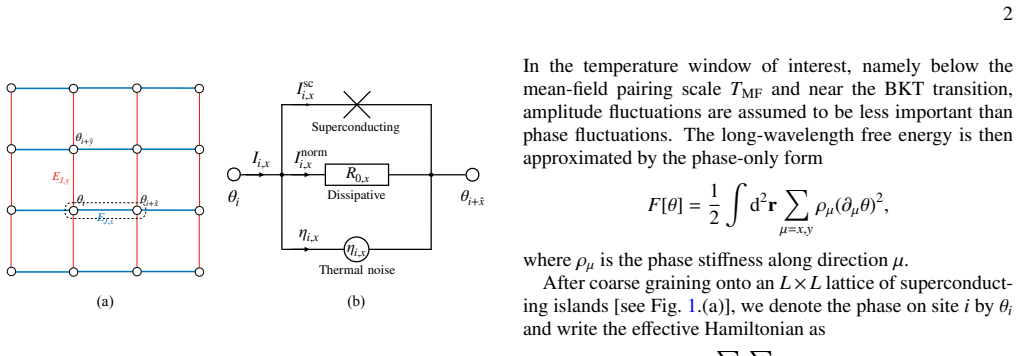
Single BKT transition from the long-wavelength theory The equilibrium question is whether anisotropy can split the BKT transition into two distinct transitions. To address this, we expand Eq. (1) for smoothly varying phase configurations withA i,µ =0. The spin-wave part of the dimensionless energy is Fsw T = 1 2 Z d2r h Kx(∂xθ)2 +K y(∂yθ)2i ,(4) where Kx ...
-
[2]
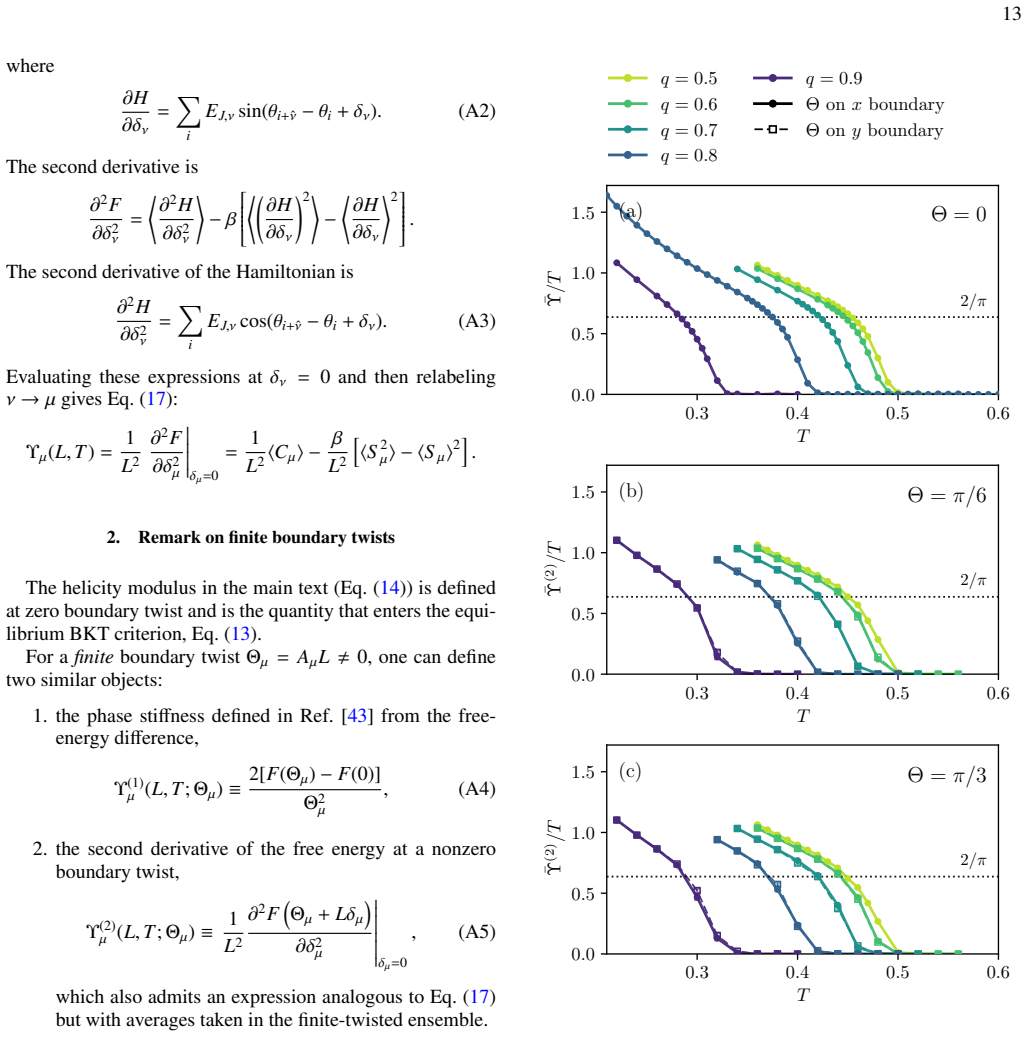
Directional helicity modulus In the numerical simulations we evaluate the directional he- licity moduli, which are defined by Υµ(L,T)≡ ∂2F ∂Φµ2 Φµ=0 ,(14) as the free-energy response to an infinitesimal extra boundary twistΦ µ along theµdirection[5, 24, 25] under given system sizeL, temperatureTand most importantly, under PBC, i.e., Θµ =0. It is convenien...
-
[3]
Equations of motion To study finite-current transport, we evolve the same phase- only model with RSJD under FTBC [14–18, 28]. In FTBC the local phases remain periodic, θi+Lˆx=θ i, θ i+Lˆy=θ i, while the uniform twist variables∆ µ are absorbed into the bond phase differences, ϕi,µ =θ i+ˆµ−θ i −∆ µ.(21) The “fluctuating twist” means that∆ µ will also be evo...
-
[4]
(27) and (28) for currents applied alongxandy
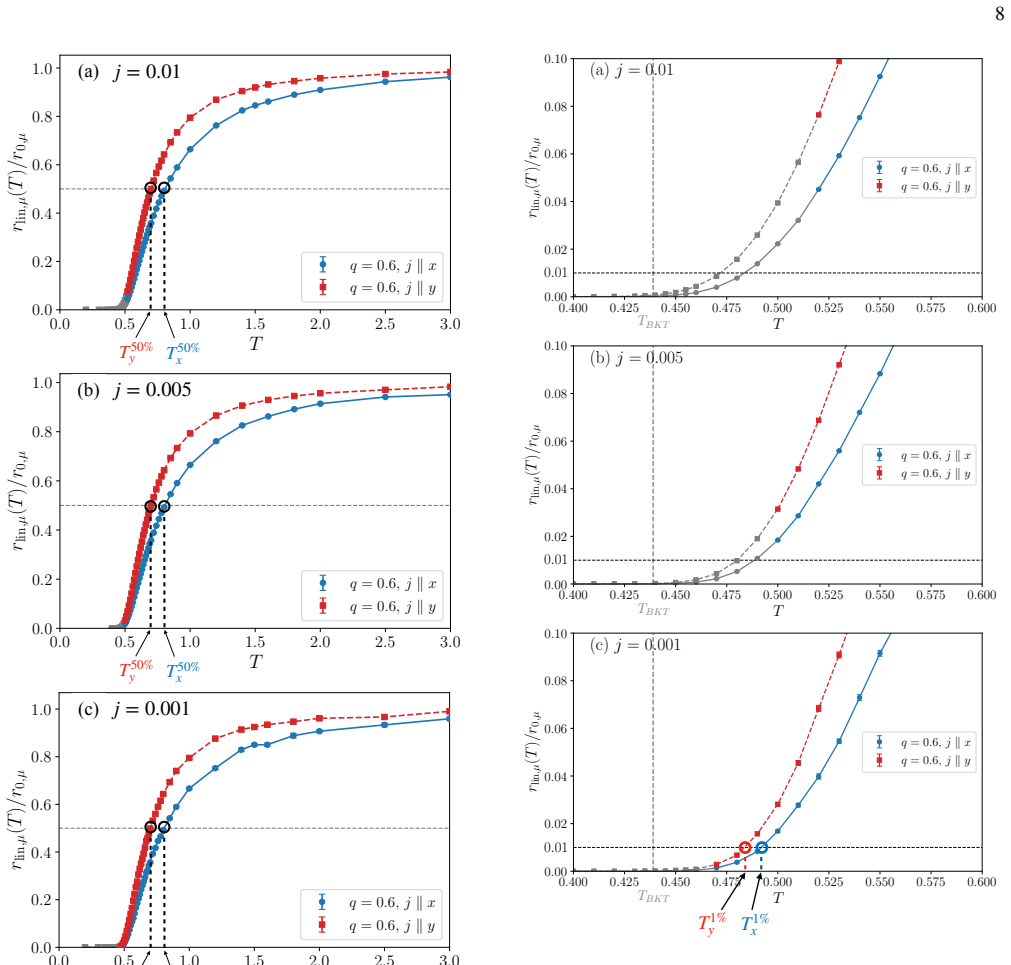
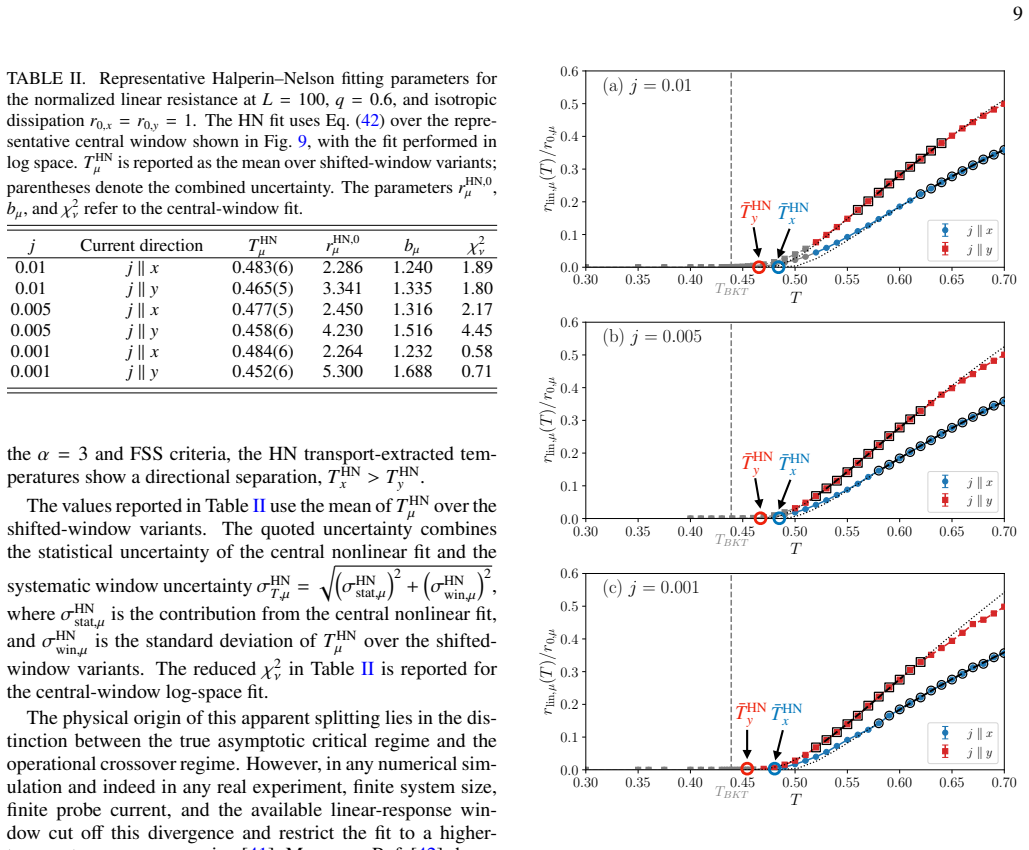
Transport criteria: q=0.6as an example The nonequilibrium analysis begins from theE–jcurves obtained by integrating Eqs. (27) and (28) for currents applied alongxandy. The integration is performed by the second- order Runge-Kutta-Helfand-Greenside algorithm for stochas- tic dynamics[34, 35]. The time step∆τis set to be 0.02, and the long-time average in E...
-
[5]
Varying the anisotropy parameter q We now keep the dissipative channel isotropic,r0,x =r 0,y = 1, and compareq=0.6 withq=0.7 on the sameL=100 lattice, usingq=0.5 as the isotropic reference. The critical- scaling criteria are collected in Table III, while the curve- shape-based temperatures extracted from ther lin–Tcurves are collected in Table IV. Theα=3 ...
-
[6]
Turning on anisotropy in the dissipative channel We next introduce anisotropy in the dissipative channel by setting r0,x =1,r 0,y = 1 2 , and studyq=0.5, 0.6, and 0.7 on the sameL=100 lattice. Becauser 0,µ enters only the RSJD dynamics, based on the analysis in Sec. II B, this change does not modify the equilib- rium transition. However, it can further re...
-
[7]
Derivation of Equation(17) Starting from Eq. (14), we fix the direction of the extra twist to beν=x,yand write the free energy as F=−TlnZ,Z= Z Dθexp[−βH(θ,Φ ν)], whereH(θ,Φ ν) incorporates a uniform twist per bondδ ν ≡ Φν/Lonly on bonds parallel to the chosen directionν: H(θ,Φ ν)=− X i X µ=x,y EJ,µ cos θi+ˆµ−θ i +δ νδµν .(A1) The first derivative of the f...
-
[8]
Remark on finite boundary twists The helicity modulus in the main text (Eq. (14)) is defined at zero boundary twist and is the quantity that enters the equi- librium BKT criterion, Eq. (13). For afiniteboundary twistΘ µ =A µL,0, one can define two similar objects:
-
[9]
[43] from the free- energy difference, Υ(1) µ (L,T;Θ µ)≡ 2[F(Θ µ)−F(0)] Θ2µ ,(A4)
the phase stiffness defined in Ref. [43] from the free- energy difference, Υ(1) µ (L,T;Θ µ)≡ 2[F(Θ µ)−F(0)] Θ2µ ,(A4)
-
[10]
(17) but with averages taken in the finite-twisted ensemble
the second derivative of the free energy at a nonzero boundary twist, Υ(2) µ (L,T;Θ µ)≡ 1 L2 ∂2F Θµ +Lδ µ ∂δ2µ δµ=0 ,(A5) which also admits an expression analogous to Eq. (17) but with averages taken in the finite-twisted ensemble. These need not coincide with the standardΥµ defined under zero boundary twist. Indeed, Ref. [43] demonstrated that in the two...
-
[11]
V . L. Berezinskii, Sov. Phys. JETP32, 493 (1971). [2] J. M. Kosterlitz and D. J. Thouless, Journal of Physics C: Solid 15 State Physics6, 1181 (1973)
work page 1971
-
[12]
J. M. Kosterlitz, Journal of Physics C: Solid State Physics7, 1046 (1974)
work page 1974
-
[13]
D. R. Nelson and J. M. Kosterlitz, Phys. Rev. Lett.39, 1201 (1977)
work page 1977
-
[14]
M. E. Fisher, M. N. Barber, and D. Jasnow, Phys. Rev. A8, 1111 (1973)
work page 1973
- [15]
-
[16]
V . Ambegaokar, B. I. Halperin, D. R. Nelson, and E. D. Siggia, Phys. Rev. Lett.40, 783 (1978)
work page 1978
-
[17]
V . Ambegaokar, B. I. Halperin, D. R. Nelson, and E. D. Siggia, Phys. Rev. B21, 1806 (1980)
work page 1980
-
[18]
B. I. Halperin and D. R. Nelson, J. Low Temp. Phys.36, 599 (1979)
work page 1979
-
[19]
X. Hua, Z. Zeng, F. Meng, H. Yao, Z. Huang, X. Long, Z. Li, Y . Wang, Z. Wang, T. Wu, Z. Weng, Y . Wang, Z. Liu, Z. Xiang, and X. Chen, Nature Physics20, 957 (2024)
work page 2024
- [20]
- [21]
- [22]
-
[23]
K. K. Mon and S. Teitel, Phys. Rev. Lett.62, 673 (1989)
work page 1989
-
[24]
J. S. Chung, K. H. Lee, and D. Stroud, Phys. Rev. B40, 6570 (1989)
work page 1989
-
[25]
B. J. Kim, P. Minnhagen, and P. Olsson, Phys. Rev. B59, 11506 (1999)
work page 1999
-
[26]
M. Y . Choi, G. S. Jeon, and M. Yoon, Phys. Rev. B62, 5357 (2000)
work page 2000
-
[27]
K. Medvedyeva, B. J. Kim, and P. Minnhagen, Phys. Rev. B62, 14531 (2000)
work page 2000
- [28]
- [29]
- [30]
-
[31]
D. M. H ¨ubscher and S. Wessel, Phys. Rev. E87, 062112 (2013)
work page 2013
-
[32]
M. R. Beasley, J. E. Mooij, and T. P. Orlando, Phys. Rev. Lett. 42, 1165 (1979)
work page 1979
- [33]
- [34]
-
[35]
J. V . Jos´e, L. P. Kadanoff, S. Kirkpatrick, and D. R. Nelson, Phys. Rev. B16, 1217 (1977)
work page 1977
- [36]
-
[37]
C. J. Lobb, D. W. Abraham, and M. Tinkham, Phys. Rev. B27, 150 (1983)
work page 1983
-
[38]
W. C. Stewart, Applied Physics Letters12, 277 (1968)
work page 1968
-
[39]
D. E. McCumber, Journal of Applied Physics39, 3113 (1968)
work page 1968
-
[40]
A. A. Golubov, M. Y . Kupriyanov, and E. Il’ichev, Rev. Mod. Phys.76, 411 (2004)
work page 2004
- [41]
- [42]
-
[43]
Helfand, Bell System Technical Journal58, 2289 (1979)
E. Helfand, Bell System Technical Journal58, 2289 (1979)
work page 1979
-
[44]
H. S. Greenside and E. Helfand, Bell System Technical Journal 60, 1927 (1981)
work page 1927
-
[45]
D. S. Fisher, M. P. A. Fisher, and D. A. Huse, Phys. Rev. B43, 130 (1991)
work page 1991
-
[46]
K. Medvedyeva, B. J. Kim, and P. Minnhagen, Physica C: Su- perconductivity355, 6 (2001)
work page 2001
-
[47]
P. C. Hohenberg and B. I. Halperin, Rev. Mod. Phys.49, 435 (1977)
work page 1977
-
[48]
Using a narrower tolerance gives fewer accepted data points near the low-resistance side of the transition, whereas a broader tolerance gives a larger operational window. The qualitative comparison between the two current directions is based on the anisotropic shape of the underlying transport curves, rather than the special value of this tolerance
-
[49]
This procedure gives up to 25 window variants for each current direction
If the central window contains the temperature interval [Tleft,T right], we generate shifted windows by moving the left and right endpoints independently by 0,±1,±2 temperature- grid points, while retaining only successful fits with positive resistance data and with all points inside the linear-response regime. This procedure gives up to 25 window variant...
-
[50]
M. V . Simkin and J. M. Kosterlitz, Phys. Rev. B55, 11646 (1997)
work page 1997
-
[51]
L. Benfatto, C. Castellani, and T. Giamarchi, Phys. Rev. B80, 214506 (2009)
work page 2009
- [52]
-
[53]
N. Metropolis and S. Ulam, Journal of the American Statistical Association44, 335 (1949), pMID: 18139350
work page 1949
-
[54]
N. Metropolis, A. W. Rosenbluth, M. N. Rosenbluth, A. H. Teller, and E. Teller, The Journal of Chemical Physics21, 1087 (1953)
work page 1953
discussion (0)
Sign in with ORCID, Apple, or X to comment. Anyone can read and Pith papers without signing in.