Recognition: 2 theorem links
· Lean TheoremInfrared spectra of some strongly--coupled chiral gauge theories
Pith reviewed 2026-05-12 05:04 UTC · model grok-4.3
The pith
Chiral gauge theories with chosen gauge groups and fermion representations develop diverse infrared effective theories and light spectra.
A machine-rendered reading of the paper's core claim, the machinery that carries it, and where it could break.
Core claim
In these chiral gauge theories the infrared effective theories, renormalization-group flows, and light spectra turn out to be rich and varied. The dynamics are fixed by the choice of gauge group and matter representations together with the relative magnitudes of the renormalization-group-invariant scales associated with each group. Generalized symmetry arguments and anomaly matching, supplemented by lessons from QCD and supersymmetric Yang-Mills, determine the possible light composite states and the pattern of symmetry breaking or confinement in each case.
What carries the argument
Generalized symmetries combined with anomaly-matching conditions applied to asymptotically free chiral gauge theories that have no nontrivial nonabelian global symmetries.
If this is right
- Different choices of gauge groups produce distinct infrared phases whose light-particle content is fixed by the anomaly constraints.
- The relative magnitudes of the strong scales control the hierarchy of masses and the sequence of RG flows between different effective theories.
- The absence of family-like global symmetries still permits a variety of confined or Higgs-like infrared regimes with specific composite fermions and bosons.
- The resulting light spectra can be compared directly with expectations from vectorlike theories such as QCD.
Where Pith is reading between the lines
- The same method could be applied to models that include multiple gauge factors to generate more elaborate mass hierarchies.
- Lattice studies of the simplest cases would provide a direct test of whether the anomaly-matching predictions survive in the strong-coupling regime.
- The patterns found here may serve as templates for constructing chiral sectors in extensions of the Standard Model.
Load-bearing premise
Generalized symmetries and anomaly matching determine the infrared dynamics and spectra of these specific chiral gauge theories.
What would settle it
An explicit computation or lattice simulation of one of the studied models that finds a different light spectrum or a different pattern of infrared phases than the one predicted by the anomaly-matching analysis would falsify the central claim.
Figures


read the original abstract
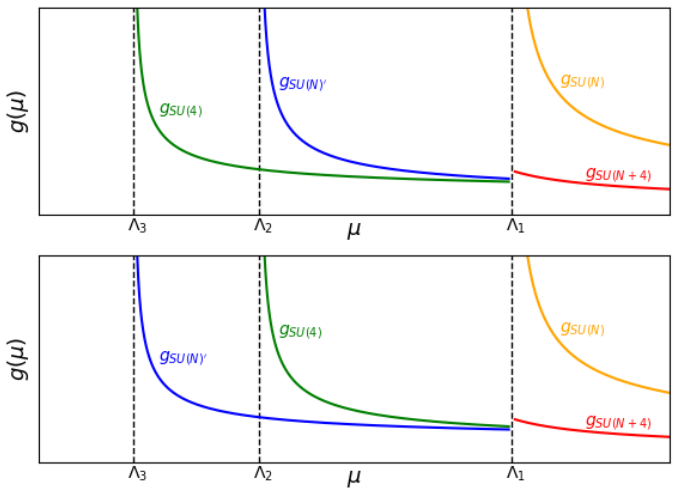
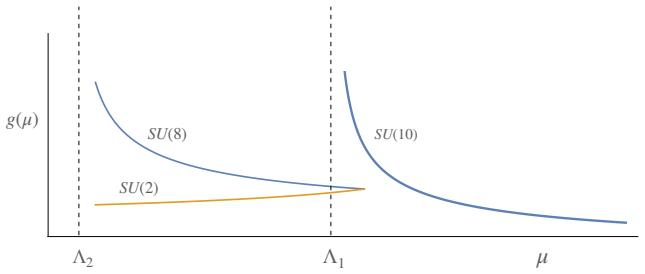
Several simple asymptotically-free chiral gauge theories are studied. The only ``free parameters'' of our models are the choice of the gauge group and the matter Weyl fermion representations, and the relative magnitudes of the renormalization-group-invariant scales $\Lambda_i$ associated with each gauge group. None of our models has nontrivial nonabelian global symmetries (``family''--like fermion representations). We rely on some recent theoretical developments on the dynamics of strongly--coupled chiral gauge theories, based on the generalized symmetries and associated new types of anomaly-matching consideration, but also on the solid knowledge on vectorlike gauge theories such as QCD and supersymmetric Yang-Mills theories. The structures of the infrared effective theories, the RG flows, and the light spectra found in these models are surprisingly rich and intriguing.
Editorial analysis
A structured set of objections, weighed in public.
Referee Report
Summary. The manuscript examines several simple asymptotically-free chiral gauge theories without nontrivial nonabelian global symmetries. The only inputs are the gauge group, Weyl fermion representations, and the relative magnitudes of the renormalization-group-invariant scales Λ_i. Drawing on generalized symmetries, anomaly matching, and analogies to vectorlike theories (QCD, supersymmetric Yang-Mills), the authors derive the structures of the infrared effective theories, the RG flows, and the light spectra, which they describe as surprisingly rich and intriguing.
Significance. If the anomaly-matching arguments and dynamical analogies hold, the work provides an exploratory but systematic catalog of IR behaviors in chiral gauge theories. The explicit treatment of relative Λ_i scales as inputs allows concrete predictions for spectra and flows that could guide lattice simulations or model-building efforts in strongly coupled regimes.
major comments (1)
- [Abstract] Abstract and introductory discussion of model construction: the relative magnitudes of the Λ_i scales are explicitly treated as free parameters that directly control the RG flows and resulting light spectra. This parameter dependence is load-bearing for the claim of rich and intriguing structures, since different orderings of the Λ_i can alter which composites remain light or which effective theories emerge; a dedicated subsection quantifying the sensitivity of the spectra to these ratios (or demonstrating robustness) is required.
minor comments (2)
- Ensure that all cited results on generalized symmetries and anomaly matching are accompanied by explicit references and brief statements of the relevant theorems or matching conditions used for each model.
- A summary table listing the gauge groups, representations, and chosen Λ_i hierarchies for each example would improve readability and allow readers to track the mapping from inputs to predicted spectra.
Simulated Author's Rebuttal
We thank the referee for their careful review and constructive feedback on our manuscript. We address the major comment below.
read point-by-point responses
-
Referee: [Abstract] Abstract and introductory discussion of model construction: the relative magnitudes of the Λ_i scales are explicitly treated as free parameters that directly control the RG flows and resulting light spectra. This parameter dependence is load-bearing for the claim of rich and intriguing structures, since different orderings of the Λ_i can alter which composites remain light or which effective theories emerge; a dedicated subsection quantifying the sensitivity of the spectra to these ratios (or demonstrating robustness) is required.
Authors: We appreciate the referee's point regarding the role of the relative Λ_i scales. In our analysis, we indeed treat these relative magnitudes as inputs and systematically consider the different possible orderings for each gauge theory model. This leads to the variety of IR behaviors and light spectra that we find intriguing. The different orderings correspond to distinct dynamical regimes, and we discuss the resulting effective theories and spectra for each case. While a continuous sensitivity analysis is not feasible or necessary given the exponential separation of scales, we agree that explicitly summarizing the dependence on the ordering in a dedicated subsection would improve clarity. We will add such a subsection in the revised version, tabulating the possible spectra for the main orderings considered. revision: yes
Circularity Check
No circularity: inputs explicitly declared and derivation relies on external anomaly matching plus known vectorlike results
full rationale
The paper states its only free parameters upfront (gauge group, Weyl representations, and relative Λ_i scales) and derives IR structures, RG flows, and spectra by applying generalized symmetries, anomaly-matching constraints, and analogies to established vectorlike theories (QCD, SYM). No step reduces a claimed prediction or uniqueness result to a fit of the target quantity itself, nor does any load-bearing premise collapse to a self-citation whose validity is presupposed by the present work. The analysis is therefore self-contained against its stated inputs and external benchmarks.
Axiom & Free-Parameter Ledger
free parameters (1)
- relative magnitudes of Λ_i
axioms (2)
- domain assumption Recent developments on generalized symmetries and anomaly-matching apply to the dynamics of the studied chiral gauge theories
- domain assumption Knowledge from vectorlike gauge theories such as QCD and supersymmetric Yang-Mills informs the infrared structures of these chiral models
Lean theorems connected to this paper
-
IndisputableMonolith/Cost/FunctionalEquation.leanwashburn_uniqueness_aczel unclear?
unclearRelation between the paper passage and the cited Recognition theorem.
We rely on some recent theoretical developments on the dynamics of strongly–coupled chiral gauge theories, based on the generalized symmetries and associated new types of anomaly-matching consideration, but also on the solid knowledge on vectorlike gauge theories such as QCD and supersymmetric Yang-Mills theories.
-
IndisputableMonolith/Foundation/RealityFromDistinction.leanreality_from_one_distinction unclear?
unclearRelation between the paper passage and the cited Recognition theorem.
The structures of the infrared effective theories, the RG flows, and the light spectra found in these models are surprisingly rich and intriguing.
What do these tags mean?
- matches
- The paper's claim is directly supported by a theorem in the formal canon.
- supports
- The theorem supports part of the paper's argument, but the paper may add assumptions or extra steps.
- extends
- The paper goes beyond the formal theorem; the theorem is a base layer rather than the whole result.
- uses
- The paper appears to rely on the theorem as machinery.
- contradicts
- The paper's claim conflicts with a theorem or certificate in the canon.
- unclear
- Pith found a possible connection, but the passage is too broad, indirect, or ambiguous to say the theorem truly supports the claim.
Reference graph
Works this paper leans on
-
[1]
S. Raby, S. Dimopoulos and L. Susskind, “Tumbling Gauge Theories”, Nucl. Phys. B169, 373-383 (1980) [INSPIRE]
work page 1980
-
[2]
S. Dimopoulos, S. Raby and L. Susskind, “Light Composite Fermion”, Nucl. Phys. B173, 208 (1980) [INSPIRE]
work page 1980
-
[3]
Composite quarks and leptons as solutions of anomaly con- straints
I. Bars and S. Yankielowicz, “Composite quarks and leptons as solutions of anomaly con- straints”, Phys. Lett. B101, 159-165 (1981) [INSPIRE]
work page 1981
-
[4]
Chiral Gauge Theories on the Lattice
E. Eichten and J. Preskill, “Chiral Gauge Theories on the Lattice”, Nucl. Phys. B268, 179-208 (1986) [INSPIRE]
work page 1986
-
[5]
Tumbling and Complementarity in a Chiral Gauge Theory
J. Goity, R. D. Peccei and D. Zeppenfeld, “Tumbling and Complementarity in a Chiral Gauge Theory”, Nucl. Phys. B262, 95-106 (1985) [INSPIRE]
work page 1985
-
[6]
Chiral Gauge Theories in the 1/n Expansion
E. Eichten, R. D. Peccei, J. Preskill and D. Zeppenfeld, “Chiral Gauge Theories in the 1/n Expansion”, Nucl. Phys. B268, 161-178 (1986) [INSPIRE]
work page 1986
-
[7]
New constraints on chiral gauge theories
T. Appelquist, A. G. Cohen, M. Schmaltz and R. Shrock, “New constraints on chiral gauge theories”, Phys. Lett. B459, 235 (1999) [arXiv:hep-th/9904172 [hep-th]]
-
[8]
Phases of chiral gauge theories
T. Appelquist, Z. y. Duan and F. Sannino, “Phases of chiral gauge theories”, Phys. Rev. D 61, 125009 (2000) [arXiv:hep-ph/0001043 [hep-ph]]
-
[9]
Chiral Lattice Gauge Theories Via Mirror-Fermion Decoupling: A Mission (im)Possible?
E. Poppitz and Y. Shang, “Chiral Lattice Gauge Theories Via Mirror-Fermion Decoupling: A Mission (im)Possible?”, Int. J. Mod. Phys. A25, 2761 (2010) [arXiv:1003.5896 [hep-lat]]
-
[10]
A Chiral SU(N) Gauge Theory Planar Equivalent to Super- Yang-Mills
A. Armoni and M. Shifman, “A Chiral SU(N) Gauge Theory Planar Equivalent to Super- Yang-Mills”, Phys. Rev. D85, 105003 (2012) [arXiv:1202.1657 [hep-th]]
-
[11]
Ultraviolet to infrared evolution of chiral gauge theories
T. Appelquist and R. Shrock, “Ultraviolet to infrared evolution of chiral gauge theories”, Phys. Rev. D88, 105012 (2013) [arXiv:1310.6076 [hep-th]]
-
[12]
Y. L. Shi and R. Shrock, “Ak ¯Fchiral gauge theories”, Phys. Rev. D92, no.10, 105032 (2015) [arXiv:1510.07663 [hep-th]]
-
[13]
Y.L.ShiandR.Shrock, “Renormalization-GroupEvolutionandNonperturbativeBehavior of Chiral Gauge Theories with Fermions in Higher-Dimensional Representations”, Phys. Rev. D92, no.12, 125009 (2015) [arXiv:1509.08501 [hep-th]]. 21
-
[14]
β′ IR at an infrared fixed point in chiral gauge theories
T. A. Ryttov and R. Shrock, “β′ IR at an infrared fixed point in chiral gauge theories”, Phys. Rev. D97, no.1, 016020 (2018) [arXiv:1710.00096 [hep-th]]
-
[15]
Naturalness, chiral symmetry, and spontaneous chiral symmetry breaking
G. ’t Hooft, “Naturalness, chiral symmetry, and spontaneous chiral symmetry breaking”, NATO Sci. Ser. B59, 135-157 (1980) [INSPIRE]
work page 1980
-
[16]
C. Csáki and H. Murayama, “Discrete anomaly matching”, Nucl. Phys. B515, 114-162 (1998) [arXiv:hep-th/9710105 [hep-th]]
-
[17]
Patterns of symmetry breaking in chiral QCD
S. Bolognesi, K. Konishi and M. Shifman, “Patterns of symmetry breaking in chiral QCD”, Phys. Rev. D97, no.9, 094007 (2018) [arXiv:1712.04814 [hep-th]]
-
[18]
Dynamics and symmetries in chiralSU(N)gauge theories
S. Bolognesi and K. Konishi, “Dynamics and symmetries in chiralSU(N)gauge theories”, Phys. Rev. D100, no.11, 114008 (2019) [arXiv:1906.01485 [hep-th]]
-
[19]
’t Hooft anomaly matching condition and chiral symmetry breaking with- out bilinear condensate
S. Yamaguchi, “’t Hooft anomaly matching condition and chiral symmetry breaking with- out bilinear condensate”, JHEP1901, 014 (2019) [arXiv:1811.09390 [hep-th]]
-
[20]
Gauging1-formcentersymmetriesinsimpleSU(N) gauge theories
S.Bolognesi, K.KonishiandA.Luzio, “Gauging1-formcentersymmetriesinsimpleSU(N) gauge theories”, JHEP01, 048 (2020) [arXiv:1909.06598 [hep-th]]
-
[21]
Dynamics from symmetries in chiralSU(N)gauge theories
S. Bolognesi, K. Konishi and A. Luzio, “Dynamics from symmetries in chiralSU(N)gauge theories”, JHEP09, 001 (2020) [arXiv:2004.06639 [hep-th]]
-
[22]
Probing the dynamics of chiralSU(N) gauge theories via generalized anomalies
S. Bolognesi, K. Konishi, and A. Luzio, “Probing the dynamics of chiralSU(N) gauge theories via generalized anomalies”, Phys. Rev. D103, no. 9, p. 094016 (2021) [arXiv:2101.02601 [hep-th]]
-
[23]
Strong anomaly and phases of chiral gauge theo- ries
S. Bolognesi, K. Konishi and A. Luzio, “Strong anomaly and phases of chiral gauge theo- ries”, JHEP08, 028 (2021) [arXiv:2105.03921 [hep-th]]
-
[24]
Anomalies and phases of strongly–coupled chiral gauge theories: recent developments
S. Bolognesi, K. Konishi, and A. Luzio, “Anomalies and phases of strongly–coupled chiral gauge theories: recent developments”, International Journal of Modern Physics A,37, pp. 36, 2230014 (2022) [arXiv:2110.02104 [hep-th]]
-
[25]
Dynamical Abelianization and anomalies in chiral gauge theories
S. Bolognesi, K. Konishi and A. Luzio, “Dynamical Abelianization and anomalies in chiral gauge theories”, JHEP12, 110 (2022) [arXiv:2206.00538 [hep-th]]
-
[26]
Dynamics of strongly–coupled chiral gauge theo- ries
S. Bolognesi, K. Konishi and A. Luzio, “Dynamics of strongly–coupled chiral gauge theo- ries”, J. Phys. Conf. Ser.2531, no.1, 012006 (2023) [arXiv:2304.03357 [hep-th]]
-
[27]
TheZ2 anomaly in some chiral gauge theories
S. Bolognesi, K. Konishi and A. Luzio, “TheZ2 anomaly in some chiral gauge theories”, JHEP08, 125 (2023) [arXiv:2307.03822 [hep-th]]
-
[28]
K. Konishi, S. Bolognesi and A. Luzio, “Anomalies and Dynamics in Strongly–coupled Gauge Theories. New Criteria for Different Phases and Lessons from Supersymmetric The- ories”, PoSCORFU2023, 126 (2024) [arXiv:2403.15775 [hep-th]]
-
[29]
New anomalies, TQFTs, and confinement in bosonic chiral gauge theories
M. M. Anber, S. Hong and M. Son, “New anomalies, TQFTs, and confinement in bosonic chiral gauge theories”, JHEP02, 062 (2022) [arXiv:2109.03245 [hep-th]]
-
[30]
M. M. Anber and S. Y. L. Chan, “2-index chiral gauge theories”, JHEP10, 025 (2023) [arXiv:2308.08052 [hep-th]]
-
[31]
S. Bolognesi, K. Konishi, A. Luzio and M. Orso, “Natural anomaly matching”, Phys. Rev. D110, no.11, 114037 (2024) [arXiv:2410.01315 [hep-th]]. 22
-
[32]
S. Bolognesi, K. Konishi, A. Luzio and M. Orso, “Chiral gauge theories, generalized anoma- lies and breakdown of the color-flavor-locked center symmetry”, JHEP05, 062 (2025) [arXiv:2410.14598 [hep-th]]
-
[33]
Modifying the Sum Over Topological Sector s and Constraints on Super- gravity,
N. Seiberg, “Modifying the Sum Over Topological Sectors and Constraints on Supergrav- ity”, JHEP07, 070 (2010) [arXiv:1005.0002 [hep-th]]
-
[34]
Coupling a QFT to a TQFT and Duality
A. Kapustin and N. Seiberg, “Coupling a QFT to a TQFT and Duality”, JHEP04, 001 (2014) [arXiv:1401.0740 [hep-th]]
work page Pith review arXiv 2014
-
[35]
O. Aharony, N. Seiberg and Y. Tachikawa, “Reading between the lines of four-dimensional gauge theories”, JHEP08, 115 (2013) [arXiv:1305.0318 [hep-th]]
-
[36]
D. Gaiotto, A. Kapustin, N. Seiberg and B. Willett, “Generalized Global Symmetries”, JHEP1502, 172 (2015) [arXiv:1412.5148 [hep-th]]
work page internal anchor Pith review arXiv 2015
-
[37]
Theta, Time Reversal, and Temperature
D. Gaiotto, A. Kapustin, Z. Komargodski and N. Seiberg, “Theta, Time Reversal, and Temperature”, JHEP1705, 091 (2017) [arXiv:1703.00501 [hep-th]]
work page Pith review arXiv 2017
-
[38]
Anomaly constraints on deconfinement and chiral phase transition
H. Shimizu and K. Yonekura, “Anomaly constraints on deconfinement and chiral phase transition”, Phys. Rev. D97, no. 10, 105011 (2018) [arXiv:1706.06104 [hep-th]]
-
[39]
Anomaly matching for the phase diagram of masslessZ N-QCD
Y. Tanizaki, Y. Kikuchi, T. Misumi and N. Sakai, “Anomaly matching for the phase diagram of masslessZ N-QCD”, Phys. Rev. D97, no. 5, 054012 (2018) [arXiv:1711.10487 [hep-th]]
-
[40]
Walls, anomalies, and deconfinement in quantum antiferromagnets
Z. Komargodski, T. Sulejmanpasic and M. Ünsal, “Walls, anomalies, and deconfinement in quantum antiferromagnets”, Phys. Rev. B97, no.5, 054418 (2018) [arXiv:1706.05731 [cond-mat.str-el]]
-
[41]
M. M. Anber and E. Poppitz, “Two-flavor adjoint QCD”, Phys. Rev. D98, no. 3, 034026 (2018) [arXiv:1805.12290 [hep-th]]
-
[42]
Anomaly matching, (axial) Schwinger models, and high-T super Yang-Mills domain walls
M. M. Anber and E. Poppitz, “Anomaly matching, (axial) Schwinger models, and high-T super Yang-Mills domain walls”, JHEP1809, 076 (2018) [arXiv:1807.00093 [hep-th]]
-
[43]
Anomaly constraint on massless QCD and the role of Skyrmions in chiral symmetry breaking
Y. Tanizaki, “Anomaly constraint on massless QCD and the role of Skyrmions in chiral symmetry breaking”, JHEP1808, 171 (2018) [arXiv:1807.07666 [hep-th]]
-
[44]
Instanton Effects in Supersymmetric Gauge Theories
D. Amati, G. C. Rossi and G. Veneziano, “Instanton Effects in Supersymmetric Gauge Theories”, Nucl. Phys. B249, 1-41 (1985) [INSPIRE]
work page 1985
-
[45]
INSTANTONS IN SUPERSYMMETRIC THEORIES
V. A. Novikov, M. A. Shifman, A. I. Vainshtein and V. I. Zakharov, “INSTANTONS IN SUPERSYMMETRIC THEORIES”, Nucl. Phys. B223, 445-473 (1983) [INSPIRE]
work page 1983
-
[46]
Dynamical Supersymmetry Breaking in Supersym- metric QCD
I. Affleck, M. Dine and N. Seiberg, “Dynamical Supersymmetry Breaking in Supersym- metric QCD”, Nucl. Phys. B241, 493-534 (1984) [INSPIRE]
work page 1984
-
[47]
Supersymmetric Instanton Calculus (Gauge Theories with Matter)
V. A. Novikov, M. A. Shifman, A. I. Vainshtein and V. I. Zakharov, “Supersymmetric Instanton Calculus (Gauge Theories with Matter)”, Nucl. Phys. B260, 157-181 (1985) [INSPIRE]
work page 1985
-
[48]
Nonperturbative As- pects in Supersymmetric Gauge Theories
D. Amati, K. Konishi, Y. Meurice, G. C. Rossi and G. Veneziano, “Nonperturbative As- pects in Supersymmetric Gauge Theories”, Phys. Rept.162, 169-248 (1988) [INSPIRE]. 23
work page 1988
-
[49]
Gluino condensate and magnetic monopoles in supersymmetric gluodynamics
N. M. Davies, T. J. Hollowood, V. V. Khoze and M. P. Mattis, “Gluino condensate and magnetic monopoles in supersymmetric gluodynamics”, Nucl. Phys. B559, 123-142 (1999) [arXiv:hep-th/9905015 [hep-th]]
-
[50]
Instanton calculations versus exact results in four-dimensional SUSY gauge theories
D. Finnell and P. Pouliot, “Instanton calculations versus exact results in four-dimensional SUSY gauge theories”, Nucl. Phys. B453, 225-239 (1995) [arXiv:hep-th/9503115 [hep-th]]
-
[51]
Calculating gluino condensates in N=1 SYM from Seiberg- Witten curves
K. Konishi and A. Ricco, “Calculating gluino condensates in N=1 SYM from Seiberg- Witten curves”, Phys. Lett. B570, 118-122 (2003) [arXiv:hep-th/0306128 [hep-th]]
-
[52]
The Generation Problem and the Symplectic Group
T. K. Kuo and N. Nakagawa, “The Generation Problem and the Symplectic Group”, Nucl. Phys. B250, 641-665 (1985) [INSPIRE]
work page 1985
-
[53]
Electroweak flavour unification
J. Davighi and J. Tooby-Smith, “Electroweak flavour unification”, JHEP09, 193 (2022) [arXiv:2201.07245 [hep-ph]]
-
[54]
E. Witten, “An SU(2) Anomaly”, Phys. Lett. B117, 324-328 (1982) [INSPIRE]
work page 1982
-
[55]
Radiative Corrections as the Origin of Spontaneous Symmetry Breaking
S. R. Coleman and E. J. Weinberg, “Radiative Corrections as the Origin of Spontaneous Symmetry Breaking”, Phys. Rev. D7, 1888-1910 (1973) [INSPIRE]
work page 1910
-
[56]
Composite vector mesons from QCD to the little Higgs
M. Piai, A. Pierce and J. G. Wacker, “Composite vector mesons from QCD to the little Higgs”, [arXiv:hep-ph/0405242 [hep-ph]]
work page internal anchor Pith review arXiv
-
[57]
Group Theory of the Spontaneously Broken Gauge Symmetries
L. F. Li, “Group Theory of the Spontaneously Broken Gauge Symmetries”, Phys. Rev. D 9, 1723-1739 (1974) [INSPIRE]
work page 1974
-
[58]
The Symmetry Breaking Pattern of Scalars in Low Dimension Representations
D. d. Wu, “The Symmetry Breaking Pattern of Scalars in Low Dimension Representations”, Nucl. Phys. B199, 523 (1982) [erratum: Nucl. Phys. B213, 545 (1983)] [INSPIRE]
work page 1982
-
[59]
Possibility of SU(n) Antisymmetric Tensor Higgs Fields
J. E. Kim, “Possibility of SU(n) Antisymmetric Tensor Higgs Fields”, Phys. Rev. D26, 2009 (1982) [INSPIRE]
work page 2009
-
[60]
Possible Symmetry Breaking Patterns With To- tally Symmetric and Antisymmetric Representations
P. Jetzer, J. M. Gerard and D. Wyler, “Possible Symmetry Breaking Patterns With To- tally Symmetric and Antisymmetric Representations”, Nucl. Phys. B241, 204-220 (1984) [INSPIRE]
work page 1984
-
[61]
Theory of group representations and applications
A. O. Barut, R. Raczka, “Theory of group representations and applications”, PWN - Polish Scientific Publishers, Warszawa, 1980 [INSPIRE]
work page 1980
-
[62]
Conformal window of SU(N) gauge theories with fermions in higher dimensional representations
D. D. Dietrich and F. Sannino, “Conformal window of SU(N) gauge theories with fermions in higher dimensional representations”, Phys. Rev. D75, 085018 (2007) [arXiv:hep- ph/0611341 [hep-ph]]. A The gauge-field mixing in theSU(N)−SU(N+ 4)model In the dynamical Higgs phenomenon, an appropriate set of NG bosons are absorbed by the originalSU(N)gauge fields, m...
-
[63]
= =U 3 (∂µϕ)U † 2 +U 3 ← −∂µ ϕ U † 2 +U 3 ϕ ∂µU † 2 = =U 3 (∂µϕ)U † 2 −U 3 ∂µ U † 3 U3 ϕ U † 2 +U 3 ϕ U † 2 U2∂µU † 2 (B.3) In order to have a locallySU(N) 2 ×SU(N) 3 invariant kinematic term, one must write the covariant derivative as Dµϕ=∂ µϕ−ig 3 A(3) µ ϕ+ ig 2 ϕ A(2) µ ,(B.4) with the gauge field transformations, A(2) µ →U 2 (A(2) µ + i g2 ∂µ)U † 2 , ...
discussion (0)
Sign in with ORCID, Apple, or X to comment. Anyone can read and Pith papers without signing in.