Recognition: 1 theorem link
· Lean TheoremBirth of Inflationary Universes via Wineglass Wormholes and their No-Boundary Relatives
Pith reviewed 2026-05-12 04:44 UTC · model grok-4.3
The pith
Wineglass wormholes can nucleate inflationary spacetimes from asymptotically flat or AdS regions via analytic continuation.
A machine-rendered reading of the paper's core claim, the machinery that carries it, and where it could break.
Core claim
Explicit numerical wormhole solutions supported by an axionic field or a magnetic gauge field, in conjunction with a self-interacting scalar field, demonstrate that wineglass wormholes mediate the nucleation of inflationary spacetimes from an existing spacetime with asymptotically flat or Anti-de Sitter regions. In the limit of small axionic or magnetic charge, these solutions split into two separate geometries consisting of the background spacetime and a disconnected no-boundary instanton.
What carries the argument
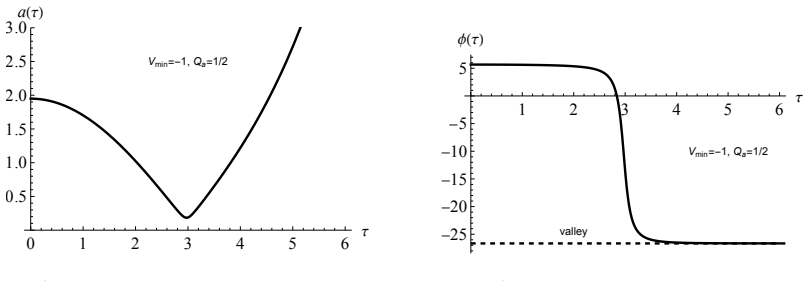
The wineglass wormhole geometry, identified by its local maximum of the scale factor that enables post-tunneling expansion in the Lorentzian continuation.
If this is right
- These wormholes provide a mechanism for the birth of inflating universes from preexisting spacetimes.
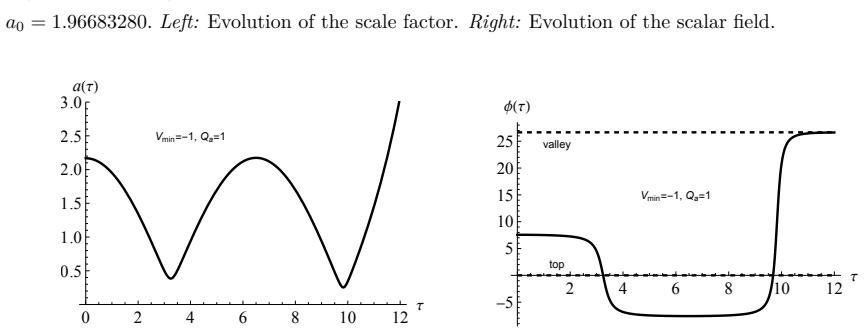
- More exotic solutions with multiple extrema of the scale factor can be constructed.
- The topology changing transition links wineglass wormholes to no-boundary instantons.
- The analytic continuation leads to expanding Lorentzian spacetimes after materialization.
Where Pith is reading between the lines
- This suggests that no-boundary instantons may not be entirely disconnected but can emerge from modifications of wormhole geometries.
- Such transitions might offer insights into how quantum effects allow topology change in gravity.
- Further study could examine the stability of these solutions under perturbations.
Load-bearing premise
The analytic continuation from the Euclidean wineglass geometry to a Lorentzian expanding spacetime is valid and that the local maximum of the scale factor indeed triggers inflation after materialization.
What would settle it
A demonstration that the Lorentzian continuation from the scale factor maximum does not produce an inflating universe, or that no stable numerical solutions exist for the supporting fields, would falsify the proposed nucleation mechanism.
Figures






read the original abstract
We study Euclidean wineglass wormholes, which mediate the nucleation of inflationary spacetimes from an existing spacetime with asymptotically flat or Anti-de Sitter regions. These wormholes are distinguished by the presence of a local maximum of the scale factor, which allows the analytically continued Lorentzian spacetime to expand after materialization. We present explicit numerical wormhole solutions supported either by an axionic field or a magnetic gauge field, in both cases in conjunction with a self-interacting scalar field. More exotic solutions, with multiple extrema of the scale factor, are also described. As we discovered recently, in the limit of small axionic or magnetic charge, wineglass wormhole solutions split into two separate geometries, one being the background spacetime and the other a disconnected no-boundary instanton. We study the associated topology changing transition in detail and provide an extensive discussion of both the properties and puzzles exhibited by this common family of wineglass/no-boundary instantons.
Editorial analysis
A structured set of objections, weighed in public.
Referee Report
Summary. The manuscript claims that Euclidean wineglass wormholes, distinguished by a local maximum in the scale factor, mediate the nucleation of inflationary Lorentzian spacetimes from asymptotically flat or AdS regions. It presents explicit numerical solutions for wormholes supported by an axionic field or a magnetic gauge field, each coupled to a self-interacting scalar field. In the small-charge limit these solutions split into a background spacetime plus a disconnected no-boundary instanton; the associated topology-changing transition is analyzed, along with more exotic multi-extrema solutions.
Significance. If the analytic continuation is shown to be consistent, the work would supply concrete numerical realizations of wormhole-mediated inflation nucleation and a topology-change mechanism linking to the no-boundary proposal. The explicit numerical constructions and the small-charge splitting constitute a technical contribution that could be used for further stability or semiclassical analyses in quantum cosmology.
major comments (1)
- [§4] §4 (analytic continuation and Lorentzian matching): the central claim that a local maximum of a(τ) in the Euclidean wineglass metric permits a valid Wick rotation to an expanding, inflationary Lorentzian geometry is load-bearing, yet the manuscript provides no explicit verification that the continued axion winding number or magnetic flux yields a stress-energy tensor satisfying the Lorentzian Einstein equations at the nucleation surface; without this check the splitting into a disconnected no-boundary instanton cannot be guaranteed to remain nonsingular or to produce inflation rather than recollapse.
minor comments (2)
- [§2] The metric ansatz for the wineglass deformation is introduced without an early, self-contained equation; adding an explicit line element in §2 would improve readability for readers outside the immediate subfield.
- [§3] Numerical convergence tests or residual errors for the axion and magnetic solutions are not tabulated; including a short table of shooting-parameter tolerances would strengthen the claim of 'explicit numerical solutions'.
Simulated Author's Rebuttal
We thank the referee for their careful reading of the manuscript and for identifying the need for an explicit verification of the analytic continuation. We address this point directly below.
read point-by-point responses
-
Referee: [§4] §4 (analytic continuation and Lorentzian matching): the central claim that a local maximum of a(τ) in the Euclidean wineglass metric permits a valid Wick rotation to an expanding, inflationary Lorentzian geometry is load-bearing, yet the manuscript provides no explicit verification that the continued axion winding number or magnetic flux yields a stress-energy tensor satisfying the Lorentzian Einstein equations at the nucleation surface; without this check the splitting into a disconnected no-boundary instanton cannot be guaranteed to remain nonsingular or to produce inflation rather than recollapse.
Authors: We agree that an explicit check strengthens the central claim. The Euclidean equations are satisfied by construction, and the local maximum of a(τ) ensures that its first derivative vanishes at the nucleation surface, allowing a smooth Wick rotation to a Lorentzian geometry in which the scale factor has a minimum and subsequently expands. The axionic winding number and magnetic flux are continued analytically in the standard manner (the former becoming a time-dependent axion, the latter a magnetic field in the Lorentzian section). Nevertheless, the original manuscript did not include a direct substitution of these continued fields into the Lorentzian Einstein equations at the matching hypersurface. In the revised version we will add this verification in §4, confirming that the stress-energy tensor remains consistent, the geometry is nonsingular, and the subsequent evolution is inflationary rather than recollapsing. This addition will also make the small-charge splitting into a background spacetime plus a standard no-boundary instanton fully rigorous. revision: yes
Circularity Check
No significant circularity; numerical constructions are independent
full rationale
The paper's central results consist of new explicit numerical solutions to the Euclidean Einstein equations for wineglass wormholes, supported by axionic or magnetic gauge fields together with a self-interacting scalar. These are obtained by direct integration of the field equations rather than by fitting parameters to data subsets and then relabeling the outputs as predictions. The analytic continuation from the Euclidean metric (with its local scale-factor maximum) to a Lorentzian expanding spacetime is invoked as a standard procedure in instanton physics and is not derived from or equivalent to the solutions themselves by construction. The reference to a recent discovery of the small-charge splitting into background spacetime plus disconnected no-boundary instanton is a self-citation, but the present work independently computes the solutions and examines the topology change in detail; the main claims do not reduce to that prior reference. No self-definitional loops, smuggled ansatze, imported uniqueness theorems, or renaming of known empirical patterns occur. The derivation chain is therefore self-contained.
Axiom & Free-Parameter Ledger
axioms (2)
- domain assumption Euclidean Einstein equations with matter admit regular wormhole solutions that can be analytically continued to Lorentzian expanding cosmologies
- domain assumption The local maximum of the scale factor triggers post-materialization inflation
invented entities (1)
-
wineglass wormhole
no independent evidence
Lean theorems connected to this paper
-
IndisputableMonolith/Foundation/AlexanderDuality.leanalexander_duality_circle_linking echoes?
echoesECHOES: this paper passage has the same mathematical shape or conceptual pattern as the Recognition theorem, but is not a direct formal dependency.
Euclidean metric ds² = dτ² + a(τ)² dΩ₃² with local maximum of scale factor enabling Lorentzian expansion after continuation
What do these tags mean?
- matches
- The paper's claim is directly supported by a theorem in the formal canon.
- supports
- The theorem supports part of the paper's argument, but the paper may add assumptions or extra steps.
- extends
- The paper goes beyond the formal theorem; the theorem is a base layer rather than the whole result.
- uses
- The paper appears to rely on the theorem as machinery.
- contradicts
- The paper's claim conflicts with a theorem or certificate in the canon.
- unclear
- Pith found a possible connection, but the passage is too broad, indirect, or ambiguous to say the theorem truly supports the claim.
Reference graph
Works this paper leans on
-
[1]
for a review. No-boundary solutions require a positive vacuum energy (otherwise the geo- metry cannot be smoothly rounded off), so that they quite naturally provide initial conditions that are suitable for a subsequent inflationary period. A priori, the processes of creation of an inflating universe from nothing or creation via wormholes appear to be enti...
-
[2]
or radiation for which the magnetic component is larger than the electric one [27, 28]. For consistency, the axionic chargesQa or magnetic chargesQ m must also be distributed in a spherically symmetric manner. In a previous paper [24] we reviewed in detail how this can be done in the axionic case. In appendix A we review an example of how this can be done...
-
[3]
The Inflationary Universe: A Possible Solution to the Horizon and Flatness Problems,
A. H. Guth, “The Inflationary Universe: A Possible Solution to the Horizon and Flatness Problems,”Phys. Rev. D23(1981) 347–356
work page 1981
-
[4]
A. D. Linde, “A New Inflationary Universe Scenario: A Possible Solution of the Horizon, Flatness, Homogeneity, Isotropy and Primordial Monopole Problems,”Phys. Lett. B108(1982) 389–393
work page 1982
-
[5]
Cosmology for Grand Unified Theories with Radiatively Induced Symmetry Breaking,
A. Albrecht and P. J. Steinhardt, “Cosmology for Grand Unified Theories with Radiatively Induced Symmetry Breaking,”Phys. Rev. Lett.48(1982) 1220–1223
work page 1982
- [6]
-
[7]
An Obstacle to Creating a Universe in the Laboratory,
E. Farhi and A. H. Guth, “An Obstacle to Creating a Universe in the Laboratory,”Phys. Lett. B 183(1987) 149–155
work page 1987
- [8]
-
[9]
Kerr-NUT-de Sitter as an Inhomogeneous Non-Singular Bouncing Cosmology,
A. Anabalón, S. F. Bramberger, and J.-L. Lehners, “Kerr-NUT-de Sitter as an Inhomogeneous Non-Singular Bouncing Cosmology,”JHEP09(2019) 096,arXiv:1904.07285 [hep-th]
-
[10]
Is It Possible to Create a Universe in the Laboratory by Quantum Tunneling?,
E. Farhi, A. H. Guth, and J. Guven, “Is It Possible to Create a Universe in the Laboratory by Quantum Tunneling?,”Nucl. Phys. B339(1990) 417–490
work page 1990
-
[11]
Gravitational Effects on and of Vacuum Decay,
S. R. Coleman and F. De Luccia, “Gravitational Effects on and of Vacuum Decay,”Phys. Rev. D 21(1980) 3305
work page 1980
-
[12]
Axion-induced topology change in quantum gravity and string theory,
S. B. Giddings and A. Strominger, “Axion-induced topology change in quantum gravity and string theory,”Nuclear Physics B306no. 4, (1988) 890–907
work page 1988
-
[13]
Loss of Quantum Coherence Due to Topological Changes: A Toy Model,
G. Lavrelashvili, V. A. Rubakov, and P. G. Tinyakov, “Loss of Quantum Coherence Due to Topological Changes: A Toy Model,”Mod. Phys. Lett. A3(1988) 1231–1242
work page 1988
-
[14]
The Boundary Conditions of the Universe,
S. W. Hawking, “The Boundary Conditions of the Universe,”Pontif. Acad. Sci. Scr. Varia48 (1982) 563–574
work page 1982
-
[15]
Wave Function of the Universe,
J. B. Hartle and S. W. Hawking, “Wave Function of the Universe,”Phys. Rev. D28(1983) 2960–2975
work page 1983
-
[16]
Hurdles for recent measures in eternal inflation,
A. Aguirre, S. Gratton, and M. C. Johnson, “Hurdles for recent measures in eternal inflation,” Phys. Rev. D75(2007) 123501,arXiv:hep-th/0611221
-
[17]
Rudelius,Conditions for (No) Eternal Inflation,JCAP08(2019) 009, [1905.05198]
T. Rudelius, “Conditions for (No) Eternal Inflation,”JCAP08(2019) 009,arXiv:1905.05198 [hep-th]
-
[18]
Cosmological consequences of a principle of finite amplitudes,
C. Jonas, J.-L. Lehners, and J. Quintin, “Cosmological consequences of a principle of finite amplitudes,”Phys. Rev. D103no. 10, (2021) 103525,arXiv:2102.05550 [hep-th]
-
[19]
The Large N Limit of Superconformal Field Theories and Supergravity
J. M. Maldacena, “The LargeNlimit of superconformal field theories and supergravity,”Adv. Theor. Math. Phys.2(1998) 231–252,arXiv:hep-th/9711200
work page internal anchor Pith review Pith/arXiv arXiv 1998
-
[20]
P. Betzios and O. Papadoulaki, “Inflationary Cosmology from Anti-de Sitter Wormholes,”Phys. Rev. Lett.133no. 2, (2024) 021501,arXiv:2403.17046 [hep-th]
-
[21]
Prepare inflationary universe via the Euclidean charged wormhole,
Q.-Y. Lan and Y.-S. Piao, “Prepare inflationary universe via the Euclidean charged wormhole,” arXiv:2411.13844 [gr-qc]
-
[22]
P. Betzios, I. D. Gialamas, and O. Papadoulaki, “Magnetic anti–de Sitter wormholes as seeds for Higgs inflation,”Phys. Rev. D111no. 12, (2025) 123542,arXiv:2412.03639 [hep-th]
-
[23]
A Menagerie of Wormholes and Cosmologies in the Gravitational Path Integral
P. Betzios, P. Ghiringhelli, I. D. Gialamas, and O. Papadoulaki, “A Menagerie of Wormholes and Cosmologies in the Gravitational Path Integral,”arXiv:2602.23432 [hep-th]
work page internal anchor Pith review Pith/arXiv arXiv
-
[24]
G. Lavrelashvili and J.-L. Lehners, “Nucleating an Inflationary Universe: Euclidean Wormholes and their No-Boundary Limit,”arXiv:2603.11003 [hep-th]
-
[25]
Gravitational Instantons and Creation of Expanding Universes,
V. A. Rubakov and P. G. Tinyakov, “Gravitational Instantons and Creation of Expanding Universes,”Phys. Lett. B214(1988) 334–338
work page 1988
-
[26]
C. Jonas, G. Lavrelashvili, and J.-L. Lehners, “Zoo of axionic wormholes,”Phys. Rev. D108no. 6, (2023) 066012
work page 2023
-
[27]
Lehners,Review of the no-boundary wave function,Phys
J.-L. Lehners, “Review of the no-boundary wave function,”Phys. Rept.1022(2023) 1–82, arXiv:2303.08802 [hep-th]. [26]PlanckCollaboration, Y. Akramiet al., “Planck 2018 results. X. Constraints on inflation,” Astron. Astrophys.641(2020) A10,arXiv:1807.06211 [astro-ph.CO]
-
[28]
Wormhole Instanton Solution in the Einstein Yang-Mills System,
A. Hosoya and W. Ogura, “Wormhole Instanton Solution in the Einstein Yang-Mills System,” Phys. Lett. B225(1989) 117–120
work page 1989
-
[29]
Magnetic Wormholes and Topological Symmetry,
A. K. Gupta, J. Hughes, J. Preskill, and M. B. Wise, “Magnetic Wormholes and Topological Symmetry,”Nucl. Phys. B333(1990) 195–220. 25
work page 1990
-
[30]
Consistent Evaluation of the No-Boundary Proposal,
A. I. Abdalla, S. Antonini, R. Bousso, L. V. Iliesiu, A. Levine, and A. Shahbazi-Moghaddam, “Consistent Evaluation of the No-Boundary Proposal,”arXiv:2602.02682 [hep-th]
-
[31]
O. Y. Shvedov, “On the exponentially large probability of transition through the Lavrelashvili-Rubakov-Tinyakov wormhole,”Phys. Lett. B381(1996) 45–48, arXiv:gr-qc/9602049
-
[32]
Why does inflation start at the top of the hill?,
S. W. Hawking and T. Hertog, “Why does inflation start at the top of the hill?,”Phys. Rev. D66 (2002) 123509,arXiv:hep-th/0204212
-
[33]
V. Balasubramanian, P. Kraus, and A. E. Lawrence, “Bulk versus boundary dynamics in anti-de Sitter space-time,”Phys. Rev. D59(1999) 046003,arXiv:hep-th/9805171
-
[34]
On the Holographic Renormalization Group
J. de Boer, E. P. Verlinde, and H. L. Verlinde, “On the holographic renormalization group,”JHEP 08(2000) 003,arXiv:hep-th/9912012
work page Pith review arXiv 2000
-
[35]
A Practical Approach to the Hamilton-Jacobi Formulation of Holographic Renormalization
H. Elvang and M. Hadjiantonis, “A Practical Approach to the Hamilton-Jacobi Formulation of Holographic Renormalization,”JHEP06(2016) 046,arXiv:1603.04485 [hep-th]
work page Pith review arXiv 2016
-
[36]
D. Marolf and J. E. Santos, “AdS Euclidean wormholes,”Class. Quant. Grav.38no. 22, (2021) 224002,arXiv:2101.08875 [hep-th]
-
[37]
Complex solutions for the scalar field model of the universe,
G. W. Lyons, “Complex solutions for the scalar field model of the universe,”Phys. Rev. D46 (1992) 1546–1550
work page 1992
-
[38]
M. Kontsevich and G. Segal, “Wick Rotation and the Positivity of Energy in Quantum Field Theory,”Quart. J. Math. Oxford Ser.72no. 1-2, (2021) 673–699,arXiv:2105.10161 [hep-th]
-
[39]
Witten,A Note On Complex Spacetime Metrics,2111.06514
E. Witten, “A Note On Complex Spacetime Metrics,”arXiv:2111.06514 [hep-th]
-
[40]
Allowable complex scalars from Kaluza-Klein compactifications and metric rescalings,
J.-L. Lehners, “Allowable complex scalars from Kaluza-Klein compactifications and metric rescalings,”Phys. Rev. D107no. 4, (2023) 046004,arXiv:2209.14669 [hep-th]
-
[41]
Kontsevich-Segal Criterion in the No-Boundary State Constrains Inflation,
T. Hertog, O. Janssen, and J. Karlsson, “Kontsevich-Segal Criterion in the No-Boundary State Constrains Inflation,”Phys. Rev. Lett.131no. 19, (2023) 191501,arXiv:2305.15440 [hep-th]
-
[42]
J.-L. Lehners and J. Quintin, “A small Universe,”Phys. Lett. B850(2024) 138488, arXiv:2309.03272 [hep-th]
-
[43]
Note on KSW-allowability of Wine-Glass Geometry,
M. Ailiga and G. Narain, “Note on KSW-allowability of Wine-Glass Geometry,” arXiv:2603.23457 [hep-th]
-
[44]
J. Cotler and K. Jensen, “Norm of the no-boundary state,”JHEP03(2026) 180, arXiv:2506.20547 [hep-th]
-
[45]
V. Chandrasekaran, R. Longo, G. Penington, and E. Witten, “An algebra of observables for de Sitter space,”JHEP02(2023) 082,arXiv:2206.10780 [hep-th]
-
[46]
The Hilbert space of de Sitter quantum gravity,
T. Chakraborty, J. Chakravarty, V. Godet, P. Paul, and S. Raju, “The Hilbert space of de Sitter quantum gravity,”JHEP01(2024) 132,arXiv:2303.16315 [hep-th]
-
[47]
Black holes as red herrings: Topological fluctuations and the loss of quantum coherence,
S. Coleman, “Black holes as red herrings: Topological fluctuations and the loss of quantum coherence,”Nuclear Physics B307no. 4, (1988) 867–882
work page 1988
-
[48]
Stability of axion-dilaton wormholes,
C. Jonas, G. Lavrelashvili, and J.-L. Lehners, “Stability of axion-dilaton wormholes,”Phys. Rev. D 109no. 8, (2024) 086022,arXiv:2312.08971 [hep-th]
-
[49]
J. Feldbrugge, J.-L. Lehners, and N. Turok, “Lorentzian Quantum Cosmology,”Phys. Rev. D95 no. 10, (2017) 103508,arXiv:1703.02076 [hep-th]. 26
work page Pith review arXiv 2017
discussion (0)
Sign in with ORCID, Apple, or X to comment. Anyone can read and Pith papers without signing in.