Recognition: 2 theorem links
· Lean TheoremOn the origin of variability in α Cygni variable ε Ori (HD 37128) using TESS observations and modelling
Pith reviewed 2026-05-12 04:44 UTC · model grok-4.3
The pith
Instabilities from strange modes in models of ε Ori produce irregular pulsations and envelope inflation matching its observed α Cygni variability.
A machine-rendered reading of the paper's core claim, the machinery that carries it, and where it could break.
Core claim
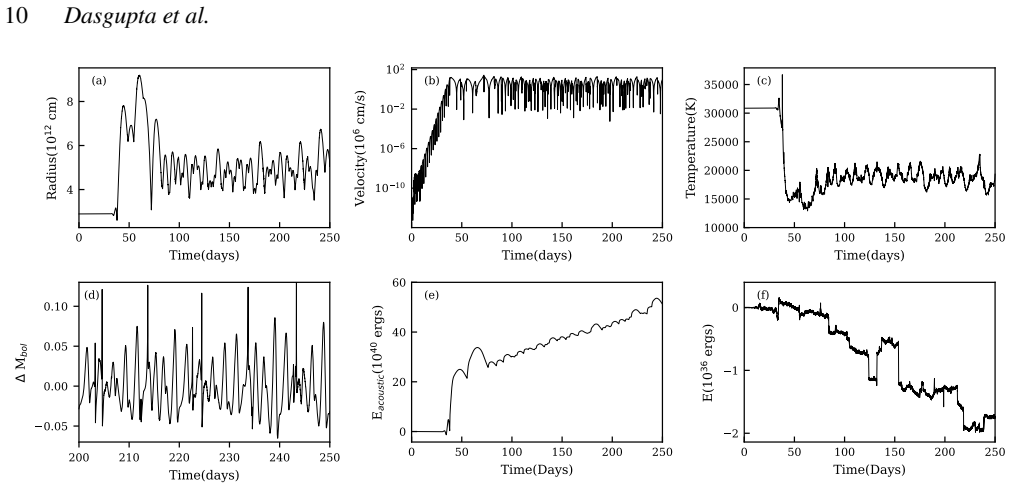
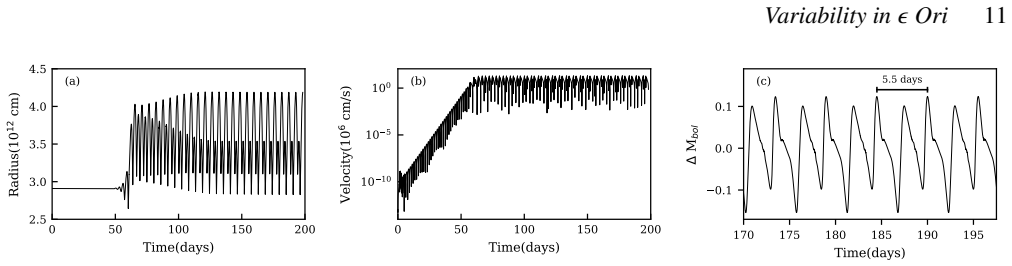
Linear stability analysis shows low-order radial modes excited in models below 62 solar masses with periods from 6.8 days for the fundamental down to hours for higher-order modes, while non-radial modes including a strongly unstable l=2 and l=4 mode appear in higher luminosity-to-mass models. The non-adiabatic reversible approximation identifies the instabilities as strange modes. Nonlinear numerical simulations of the unstable models produce envelope inflation together with finite-amplitude regular and irregular pulsations that reproduce the character of an α Cygni variable.
What carries the argument
Strange modes, a class of non-adiabatic pulsation modes that become unstable in high-luminosity massive stars and whose growth in nonlinear simulations drives envelope inflation and the observed finite-amplitude pulsations.
If this is right
- Models below 62 solar masses excite radial modes with periods spanning 6.8 days to a few hours.
- Non-radial modes with l=2 and l=4 become strongly unstable in models below 40 solar masses.
- The same instabilities operate across a range of masses and produce both regular and irregular pulsations once nonlinearity is included.
- Envelope inflation accompanies the finite-amplitude variability in the nonlinear regime.
Where Pith is reading between the lines
- The same strange-mode mechanism may operate in other α Cygni variables whose parameters overlap the unstable model sequence.
- Repeated envelope inflation episodes could gradually alter the star's radius and surface gravity over evolutionary timescales.
- Longer baseline photometry could reveal whether the irregular pulsations recur with a characteristic recurrence time set by the nonlinear saturation.
Load-bearing premise
Linear stability results remain representative when the models are evolved into the nonlinear regime without extra damping or driving mechanisms.
What would settle it
A high-precision light curve of ε Ori showing no stochastic low-frequency variability at the amplitudes or periods predicted by the nonlinear simulations, or a measured effective temperature and luminosity that place the star outside the unstable model region.
Figures





read the original abstract
$\epsilon$ Ori (HD 37128) is an $\alpha$ Cygni variable characterized by irregular and small amplitude variations. From TESS observations, we find the presence of stochastic low-frequency variability in this star. We have constructed a sequence of models for this star in the mass range of 30 to 70 M$_{\odot}$, using recently derived values of luminosity (log $(L/L_{\odot})$ = 5.92) and effective temperature. In these considered models, both radial and non-radial linear stability analyses have been performed. Low-order radial modes are excited in models having mass below 62 M$_{\odot}$. These radially excited modes have periods ranging from 6.8 days for the fundamental mode to a few hours for higher-order modes. Similar to the case of radial modes, several non-radial modes are found to be unstable in models having higher luminosity-to-mass ratios. Linear stability analysis for the case of $l$ = 2 and $l$ = 4 reveals the presence of a strongly unstable mode in models having a mass below 40 M$_{\odot}$. This mode is found to be unstable in all the considered models and the strength of the instability varies as a function of harmonic degree. The non-adiabatic reversible approximation reveals that the origin of instabilities associated with the low-order modes is indeed linked with strange modes. To find out the consequence of radial instabilities, non-linear numerical simulations have been performed in selected models of $\epsilon$ Ori. In the non-linear regime, these instabilities lead to the envelope inflation, finite amplitude regular and irregular pulsations consistent with an $\alpha$ Cygni variable.
Editorial analysis
A structured set of objections, weighed in public.
Referee Report
Summary. The paper reports TESS photometry of the α Cygni variable ε Ori (HD 37128) showing stochastic low-frequency variability. It constructs a 30–70 M⊙ model grid at fixed log(L/L⊙)=5.92 and corresponding Teff, performs linear non-adiabatic stability analysis finding unstable low-order radial modes below 62 M⊙ (periods 6.8 d to hours) and strongly unstable non-radial strange modes (l=2,4) below 40 M⊙, and carries out non-linear simulations in selected models that are stated to produce envelope inflation together with finite-amplitude regular and irregular pulsations consistent with the observed α Cygni behavior.
Significance. If the non-linear results can be shown quantitatively to saturate at the small, irregular amplitudes seen in TESS, the work would provide a concrete physical link between strange-mode instabilities and the observed variability of α Cygni stars, strengthening the case that linear theory plus non-linear evolution can explain the class without additional ad-hoc damping.
major comments (3)
- [Abstract and non-linear simulations] Abstract and non-linear simulations section: the central claim that the instabilities produce 'finite amplitude regular and irregular pulsations consistent with an α Cygni variable' is unsupported by any reported quantitative outputs (saturated velocity or magnitude amplitudes, post-saturation period content, or statistical match to the TESS low-frequency power spectrum).
- [Stellar models and linear stability analysis] Stellar models and linear stability analysis: the instability thresholds are mass-dependent (radial modes below 62 M⊙, non-radial below 40 M⊙), yet the manuscript provides neither a mass estimate for ε Ori nor an exploration of how the results change across the quoted luminosity and Teff uncertainties.
- [Non-linear regime discussion] Non-linear regime discussion: the extrapolation from linear growth rates to non-linear saturation is presented without any mention of possible additional damping (convective, wind, or radiative) or of the numerical resolution and time-stepping used in the simulations.
minor comments (2)
- [Introduction / Model construction] The source of the adopted luminosity and effective temperature values is described only as 'recently derived' and should be cited explicitly.
- [Linear stability analysis] Growth rates, eigenfunctions, or specific mode identifications for the unstable radial and non-radial modes are not tabulated or plotted, making it difficult to reproduce or extend the linear results.
Simulated Author's Rebuttal
We thank the referee for the constructive and detailed report. The comments identify important areas for improvement, particularly in providing quantitative support for the non-linear results, addressing parameter uncertainties, and documenting numerical methods. We address each major comment below and will revise the manuscript to strengthen these aspects while preserving the core findings on strange-mode instabilities.
read point-by-point responses
-
Referee: [Abstract and non-linear simulations] Abstract and non-linear simulations section: the central claim that the instabilities produce 'finite amplitude regular and irregular pulsations consistent with an α Cygni variable' is unsupported by any reported quantitative outputs (saturated velocity or magnitude amplitudes, post-saturation period content, or statistical match to the TESS low-frequency power spectrum).
Authors: We agree that the manuscript would be strengthened by explicit quantitative outputs from the non-linear simulations. In the revised version we will report the saturated radial velocity amplitudes, the corresponding photometric variability amplitudes, the dominant periods after saturation, and a direct comparison (including power spectrum statistics) to the TESS observations of ε Ori. These additions will make the consistency with α Cygni-type variability quantitative rather than qualitative. revision: yes
-
Referee: [Stellar models and linear stability analysis] Stellar models and linear stability analysis: the instability thresholds are mass-dependent (radial modes below 62 M⊙, non-radial below 40 M⊙), yet the manuscript provides neither a mass estimate for ε Ori nor an exploration of how the results change across the quoted luminosity and Teff uncertainties.
Authors: The current grid is computed at the observed luminosity with a mass range chosen to bracket plausible values for ε Ori. We will add the literature mass estimate for the star and include a short sensitivity study showing how the radial and strange-mode instability boundaries shift when luminosity and effective temperature are varied within the observational error bars. This will clarify the robustness of the reported thresholds. revision: yes
-
Referee: [Non-linear regime discussion] Non-linear regime discussion: the extrapolation from linear growth rates to non-linear saturation is presented without any mention of possible additional damping (convective, wind, or radiative) or of the numerical resolution and time-stepping used in the simulations.
Authors: We will expand the non-linear section to discuss possible additional damping from convection, line-driven winds, and radiative diffusion, and how these might influence the final saturation amplitudes. We will also document the spatial resolution (number of zones in the envelope) and the adaptive time-stepping criteria employed in the hydrodynamical code, together with a brief convergence test. revision: yes
Circularity Check
No circularity; modeling chain is independent of its own outputs.
full rationale
The paper adopts externally supplied log(L/L⊙)=5.92 and Teff to build a grid of 30–70 M⊙ models, then applies standard linear non-adiabatic stability analysis and non-linear hydrodynamical simulations. Unstable radial and strange modes are identified, and the non-linear runs are reported to produce envelope inflation and finite-amplitude pulsations. None of these steps re-uses a fitted parameter or self-citation as the sole justification for the final consistency claim; the derivation remains self-contained against external benchmarks and does not reduce any prediction to its inputs by construction.
Axiom & Free-Parameter Ledger
free parameters (2)
- stellar mass grid
- luminosity and effective temperature
axioms (2)
- domain assumption Linear adiabatic and non-adiabatic pulsation equations remain valid for the initial growth phase of strange modes.
- standard math Opacity and equation-of-state tables from standard libraries are adequate for the temperature and density regime of the models.
Lean theorems connected to this paper
-
IndisputableMonolith/Cost/FunctionalEquation.lean (J-uniqueness, Aczél classification)washburn_uniqueness_aczel unclear?
unclearRelation between the paper passage and the cited Recognition theorem.
The non-adiabatic reversible approximation reveals that the origin of instabilities associated with the low-order modes is indeed linked with strange modes
What do these tags mean?
- matches
- The paper's claim is directly supported by a theorem in the formal canon.
- supports
- The theorem supports part of the paper's argument, but the paper may add assumptions or extra steps.
- extends
- The paper goes beyond the formal theorem; the theorem is a base layer rather than the whole result.
- uses
- The paper appears to rely on the theorem as machinery.
- contradicts
- The paper's claim conflicts with a theorem or certificate in the canon.
- unclear
- Pith found a possible connection, but the passage is too broad, indirect, or ambiguous to say the theorem truly supports the claim.
Reference graph
Works this paper leans on
-
[1]
, year = 1968, month = dec, volume =
The Kinematics of the Gould Belt: an Expanding Group?. , year = 1968, month = dec, volume =. doi:10.1086/190179 , adsurl =
-
[2]
Non-Lte Model Atmospheres. VII. The Hydrogen and Helium Spectra of the O Stars. , year = 1972, month = feb, volume =. doi:10.1086/190253 , adsurl =
-
[3]
The A-Star Puzzle , year = 2004, editor =
Period04: A software package to extract multiple frequencies from real data. The A-Star Puzzle , year = 2004, editor =. doi:10.1017/S1743921305009750 , adsurl =
-
[4]
Low-frequency gravity waves in blue supergiants revealed by high-precision space photometry. Nature Astronomy , keywords =. doi:10.1038/s41550-019-0768-1 , archivePrefix =. 1905.02120 , primaryClass =
-
[5]
Variability in the CoRoT photometry of three hot O-type stars - HD 46223, HD 46150, and HD 46966⋆⋆⋆ , DOI= "10.1051/0004-6361/201116949", url= "https://doi.org/10.1051/0004-6361/201116949", journal =
-
[6]
BRITE photometry of the massive post-RLOF system HD149 404⋆ , DOI= "10.1051/0004-6361/201833594", url= "https://doi.org/10.1051/0004-6361/201833594", journal =
-
[7]
The non-radial stability of Wolf-Rayet stars. , keywords =. doi:10.1046/j.1365-8711.2002.05965.x , adsurl =
-
[8]
An analysis of the variable radial velocity of Alpha Cygni. , keywords =. doi:10.1086/154405 , adsurl =
-
[9]
Least-Squares Frequency Analysis of Unequally Spaced Data. , keywords =. doi:10.1007/BF00648343 , adsurl =
-
[10]
Studies in astronomical time series analysis. II. Statistical aspects of spectral analysis of unevenly spaced data. , keywords =. doi:10.1086/160554 , adsurl =
-
[11]
emcee: The MCMC Hammer , journal =. 1202.3665 , doi =
work page internal anchor Pith review arXiv
-
[12]
VanderPlas, Jacob T. , title =. The Astrophysical Journal Supplement Series , abstract =. 2018 , month =. doi:10.3847/1538-4365/aab766 , url =
work page internal anchor Pith review doi:10.3847/1538-4365/aab766 2018
-
[13]
M., et al., 2016, in Chiozzi G., Guzman J
The TESS science processing operations center. Software and Cyberinfrastructure for Astronomy IV , year = 2016, editor =. doi:10.1117/12.2233418 , adsurl =
-
[14]
, year = 1994, month = nov, volume =
On the origin of strange modes and the mechanism of related instabilities. , year = 1994, month = nov, volume =. doi:10.1093/mnras/271.1.66 , adsurl =
-
[15]
On the stability and pulsation in models of B[e] star MWC 137. , keywords =. doi:10.1093/mnras/stad3626 , archivePrefix =. 2311.12549 , primaryClass =
-
[16]
The spectrum of the supergiant epsilon Ori (B0 Ia). III. The basic parameters. , year = 1974, month = dec, volume =
work page 1974
-
[17]
Helium enhancements in luminous OB-type stars: the effect of microturbulence. , keywords =
-
[18]
The wind momentum-luminosity relationship of galactic A- and B-supergiants. , keywords =. doi:10.48550/arXiv.astro-ph/9910449 , archivePrefix =. astro-ph/9910449 , primaryClass =
work page internal anchor Pith review doi:10.48550/arxiv.astro-ph/9910449
-
[19]
Physical parameters and wind properties of galactic early B supergiants. , keywords =. doi:10.1051/0004-6361:20053685 , archivePrefix =. astro-ph/0509436 , primaryClass =
-
[20]
Quantitative studies of the optical and UV spectra of Galactic early B supergiants. I. Fundamental parameters. , keywords =. doi:10.1051/0004-6361:20077125 , archivePrefix =. 0801.4289 , primaryClass =
-
[21]
X-ray, UV and optical analysis of supergiants: ɛ Ori. , keywords =. doi:10.1093/mnras/stv2783 , archivePrefix =. 1511.09365 , primaryClass =
-
[22]
, year = 1997, month = jul, volume =
The HIPPARCOS Catalogue. , year = 1997, month = jul, volume =
work page 1997
-
[23]
Validation of the new Hipparcos reduction. , keywords =. doi:10.1051/0004-6361:20078357 , archivePrefix =. 0708.1752 , primaryClass =
-
[24]
Journal of the British Astronomical Association , year = 1999, month = dec, volume =
Book Review: Introduction to stellar winds / Cambridge U Press, 1999. Journal of the British Astronomical Association , year = 1999, month = dec, volume =
work page 1999
-
[25]
Radio and submillimetre observations of <ASTROBJ>epsilon Ori</ASTROBJ>. , keywords =. doi:10.1051/0004-6361:20011612 , adsurl =
-
[26]
Quantitative H and K band spectroscopy of Galactic OB-stars at medium resolution. , keywords =. doi:10.1051/0004-6361:20052739 , archivePrefix =. astro-ph/0501606 , primaryClass =
-
[27]
L-band spectroscopy of Galactic OB-stars. , keywords =. doi:10.1051/0004-6361/201016003 , archivePrefix =. 1108.5752 , primaryClass =
-
[28]
Photospheric and stellar wind variability in ɛ Ori (B0 Ia). , keywords =. doi:10.1051/0004-6361:20035638 , adsurl =
-
[29]
Variability in Optical Spectra of epsilon Orionis. , keywords =. doi:10.1088/0004-6256/145/4/95 , archivePrefix =. 1301.5368 , primaryClass =
-
[30]
Radial dependence of line profile variability in seven O9-B0.5 stars. , keywords =. doi:10.1051/0004-6361/201423882 , archivePrefix =. 1409.5057 , primaryClass =
-
[31]
Transiting Exoplanet Survey Satellite (TESS). Journal of Astronomical Telescopes, Instruments, and Systems , year = 2015, month = jan, volume =. doi:10.1117/1.JATIS.1.1.014003 , adsurl =
work page internal anchor Pith review doi:10.1117/1.jatis.1.1.014003 2015
-
[32]
Variability of OB stars from TESS southern Sectors 1-13 and high-resolution IACOB and OWN spectroscopy. , keywords =. doi:10.1051/0004-6361/202037700 , archivePrefix =. 2005.09658 , primaryClass =
-
[33]
The structure and variability of H alf emission in early-type supergiants. , keywords =. doi:10.1086/190783 , adsurl =
-
[34]
2004, MNRAS, 351, 1379, doi: 10.1111/j.1365-2966.2004.07876.x
Large-scale wind structures in OB supergiants: a search for rotationally modulated H variability. , keywords =. doi:10.1111/j.1365-2966.2004.07799.x , archivePrefix =. astro-ph/0403155 , primaryClass =
-
[35]
U ber die Wasserstoffkonvektionszone in Sternen verschiedener Effektivtemperaturen und Leuchtkr \
\"U ber die Wasserstoffkonvektionszone in Sternen verschiedener Effektivtemperaturen und Leuchtkr \"a fte. Mit 5 Textabbildungen. , year = 1958, month = jan, volume =
work page 1958
-
[36]
Lightkurve: Kepler and TESS time series analysis in Python. ascl:1812.013 , adsurl =
-
[37]
Rosseland Mean Opacities for Variable Compositions. , keywords =. doi:10.1086/172066 , adsurl =
-
[38]
Updated Opal Opacities. , keywords =. doi:10.1086/177381 , adsurl =
-
[39]
OPAL Equation-of-State Tables for Astrophysical Applications. , keywords =. doi:10.1086/176705 , adsurl =
- [40]
-
[41]
, year = 1990, month = aug, volume =
On Highly Non-Adiabatic Stellar Pulsations and the Origin of Strange Modes. , year = 1990, month = aug, volume =. doi:10.1093/mnras/245.4.597 , adsurl =
-
[42]
The Pulsations of Models of Delta Cephei Stars. II. , year = 1965, month = oct, volume =. doi:10.1086/148359 , adsurl =
-
[43]
A., Ramsay, G., Andronov, I., et al
On the properties of strange modes. , keywords =. doi:10.1111/j.1365-8711.1998.01195.x10.1046/j.1365-8711.1998.01195.x , adsurl =
work page doi:10.1111/j.1365-8711.1998.01195.x10.1046/j.1365-8711.1998.01195.x 1998
-
[44]
Stability analysis, non-linear pulsations and mass loss of models for 55 Cygni (HD 198478). , keywords =. doi:10.1093/mnras/stw236 , adsurl =
-
[45]
Strange mode instabilities and mass loss in evolved massive primordial stars. , keywords =. doi:10.1093/mnras/sty092 , adsurl =
-
[46]
Instabilities and pulsations in models of the B-type supergiant Cassiopeiae (HD 2905). , keywords =. doi:10.1093/mnras/staa3611 , adsurl =
-
[47]
The simulation of non-linear stellar pulsations. , keywords =. doi:10.1111/j.1365-2966.2005.09162.x , adsurl =
-
[48]
The treatment of highly non-adiabatic, non-radial pulsations by application of the Riccati method to the example of hydrogen-deficient carbon stars. , keywords =. doi:10.1093/mnras/256.2.209 , adsurl =
-
[49]
Linear analyses for the stability of radial and non-radial oscillations of massive stars. , keywords =. doi:10.1111/j.1365-2966.2010.18019.x , archivePrefix =. 1011.4729 , primaryClass =
-
[50]
arXiv preprint arXiv:2410.23985 , year=
Deneb and the alpha Cygni Variables , author=. arXiv preprint arXiv:2410.23985 , year=
-
[51]
Photometric detection of internal gravity waves in upper main-sequence stars. II. Combined TESS photometry and high-resolution spectroscopy. , keywords =. doi:10.1051/0004-6361/202038224 , archivePrefix =. 2006.03012 , primaryClass =
-
[52]
Monthly Notices of the Royal Astronomical Society , volume=
Pulsation of high luminosity helium stars , author=. Monthly Notices of the Royal Astronomical Society , volume=. 1976 , publisher=
work page 1976
-
[53]
Instabilities in the yellow hypergiant domain. , keywords =. doi:10.1093/mnras/stae861 , archivePrefix =. 2403.14315 , primaryClass =
-
[54]
Instability, finite amplitude pulsation and mass-loss in models of massive OB-type stars. , keywords =. doi:10.1093/mnras/stx1808 , archivePrefix =. 1802.01495 , primaryClass =
-
[55]
Communications in Asteroseismology , year = 2009, month = jul, volume =
Nonlinear strange-mode pulsations. Communications in Asteroseismology , year = 2009, month = jul, volume =
work page 2009
-
[56]
Exciting alpha Cygni. , keywords =. doi:10.1093/mnras/259.1.82 , adsurl =
-
[57]
Deneb's variability: a hint of a deep-lying convection zone?. , keywords =. doi:10.1051/0004-6361/200911666 , adsurl =
-
[58]
Evolution of blue supergiants and Cygni variables: puzzling CNO surface abundances. , keywords =. doi:10.1093/mnras/stt796 , archivePrefix =. 1305.2474 , primaryClass =
-
[59]
The stability of massive stars and its dependence on metallicity and opacity. , keywords =. doi:10.1093/mnras/264.1.50 , adsurl =
- [60]
-
[61]
The Astrophysical Journal , volume=
The contour method: a new approach to finding modes of nonadiabatic stellar pulsations , author=. The Astrophysical Journal , volume=. 2020 , publisher=
work page 2020
-
[62]
The stability of Wolf-Rayet stars. , keywords =. doi:10.1093/mnras/281.2.406 , adsurl =
-
[63]
Long-term spectroscopic monitoring of BA-type supergiants. I. H _ alpha \_ line-profile variability. , keywords =
-
[64]
Long-term spectroscopic monitoring of BA-type supergiants. III. Variability of photospheric lines. , keywords =
-
[65]
Light variations of massive stars (Alpha Cygni variables). IX , author=. Astronomy and Astrophysics Supplement Series (ISSN 0365-0138), vol. 79, no. 2, Aug. 1989, p. 263-282. , volume=
work page 1989
-
[66]
HIPPARCOS photometry of 24 variable massive stars (alpha Cygni variables). , keywords =. doi:10.1051/aas:1998129 , adsurl =
-
[67]
, year = 1957, month = jul, volume =
The Variability of Supergiants. , year = 1957, month = jul, volume =. doi:10.1086/146379 , adsurl =
-
[68]
A systematic study of variability among OB-stars based on HIPPARCOS photometry. , keywords =. doi:10.1051/0004-6361/200912304 , adsurl =
-
[69]
On the stability and pulsations of Wolf-Rayet stars. , keywords =. doi:10.1093/mnras/262.1.L7 , adsurl =
-
[70]
MOST Detects g- and p-Modes in the B Supergiant HD 163899 (B2 Ib/II). , keywords =. doi:10.1086/507409 , archivePrefix =. astro-ph/0606712 , primaryClass =
-
[71]
Collective pulsational velocity broadening due to gravity modes as a physical explanation for macroturbulence in hot massive stars. , keywords =. doi:10.1051/0004-6361/200810471 , archivePrefix =. 0909.3585 , primaryClass =
-
[72]
Evidence for opacity-driven gravity-mode oscillations
Statistical properties of a sample of periodically variable B-type supergiants. Evidence for opacity-driven gravity-mode oscillations. , keywords =. doi:10.1051/0004-6361:20066038 , archivePrefix =. astro-ph/0611484 , primaryClass =
-
[73]
Strange mode instability driven finite amplitude pulsations and mass-loss in models of massive zero-age main-sequence stars. , keywords =. doi:10.1093/mnras/stw2734 , adsurl =
-
[74]
2011, ApJS, 192, 3, doi: 10.1088/0067-0049/192/1/3
, archivePrefix =. 2011 , month =. doi:10.1088/0067-0049/192/1/3 , adsurl =. 1009.1622 , primaryClass =
-
[75]
2013, ApJS, 208, 4, doi: 10.1088/0067-0049/208/1/4 10
, archivePrefix =. 2013 , month =. doi:10.1088/0067-0049/208/1/4 , adsurl =. 1301.0319 , primaryClass =
work page internal anchor Pith review Pith/arXiv arXiv doi:10.1088/0067-0049/208/1/4 2013
-
[76]
2015, ApJS, 220, 15, doi: 10.1088/0067-0049/220/1/15
, archivePrefix =. 2015 , month =. doi:10.1088/0067-0049/220/1/15 , adsurl =. 1506.03146 , primaryClass =
work page internal anchor Pith review doi:10.1088/0067-0049/220/1/15 2015
-
[77]
, archivePrefix =. 2018 , month =. doi:10.3847/1538-4365/aaa5a8 , adsurl =. 1710.08424 , primaryClass =
-
[78]
2019, ApJS, 243, 10, doi: 10.3847/1538-4365/ab2241
Modules for Experiments in Stellar Astrophysics (MESA): Pulsating Variable Stars, Rotation, Convective Boundaries, and Energy Conservation. , keywords =. 2019. doi:10.3847/1538-4365/ab2241 , archivePrefix =. 1903.01426 , primaryClass =
-
[79]
Modules for Experiments in Stellar Astrophysics (MESA): Time-dependent Convection, Energy Conservation, Automatic Differentiation, and Infrastructure. , keywords =. doi:10.3847/1538-4365/acae8d , archivePrefix =. 2208.03651 , primaryClass =
-
[80]
Non-radial pulsations and stability of massive stars. , keywords =. doi:10.1093/mnras/282.4.1470 , adsurl =
discussion (0)
Sign in with ORCID, Apple, or X to comment. Anyone can read and Pith papers without signing in.