Recognition: 2 theorem links
· Lean TheoremExploring Token-Space Manipulation in Latent Audio Tokenizers
Pith reviewed 2026-05-13 02:35 UTC · model grok-4.3
The pith
Appending fixed learnable tokens creates a global audio bottleneck for unsupervised editing by swaps.
A machine-rendered reading of the paper's core claim, the machinery that carries it, and where it could break.
Core claim
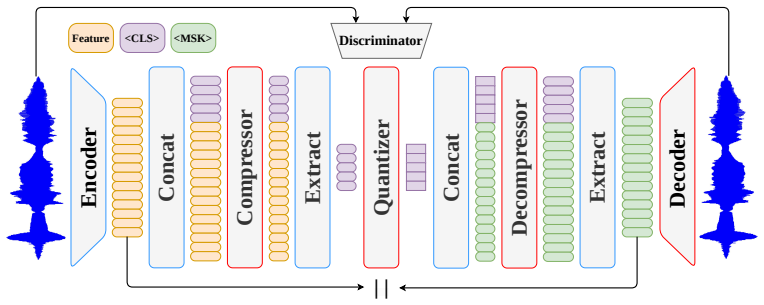
By appending a fixed set of learnable latent tokens to the audio feature sequence and retaining only these tokens for quantization and decoding, the tokenizer produces a compact non-temporally aligned bottleneck in which each token aggregates global information across the full utterance. This preserves competitive reconstruction quality in low-bitrate speech coding settings while enabling simple token-space interventions that modify global attributes such as speaker identity and background noise.
What carries the argument
The LATTE design of appending and retaining only a fixed set of learnable latent tokens as the quantization input, which forms a non-temporally aligned global information bottleneck.
If this is right
- Swapping tokens transfers speaker identity for voice conversion without additional models.
- Swapping tokens alters background noise for denoising tasks.
- Global attributes become directly editable through token manipulation in the latent space.
- Controllable audio manipulation is possible without supervision or task-specific training.
- Reconstruction remains competitive with existing low-bitrate neural codecs.
Where Pith is reading between the lines
- The same fixed-token approach might allow independent control over additional factors such as emotion or prosody by using more tokens.
- Existing neural audio codecs could be adapted with this bottleneck to add editing capabilities.
- Varying the number of retained tokens offers a way to test how many independent global attributes can be isolated.
- The design may reduce the need for complex conditional generators in downstream audio synthesis systems.
Load-bearing premise
That a fixed set of learnable latent tokens will aggregate enough global utterance information to support effective unsupervised editing of attributes like speaker identity without degrading reconstruction.
What would settle it
Token swaps between utterances produce no measurable change in speaker identity metrics or background noise levels, or reconstruction quality falls below standard frame-level codecs at the same bitrate.
Figures


read the original abstract
Neural audio codecs provide compact discrete representations for speech generation and manipulation. However, most codecs organize tokens as frame-level sequences, making it difficult to study or intervene on global factors of variation. In this work, we propose the Latent Audio Tokenizer for Token-space Editing (LATTE) that appends a fixed set of learnable latent tokens to the audio feature sequence and retains only these tokens for quantization and decoding. This design produces a compact, non-temporally aligned bottleneck in which each token can aggregate global information across the full utterance. We show that the resulting tokenizer preserves competitive reconstruction quality in low-bitrate speech coding settings while enabling simple token-space interventions. In particular, we find that swapping selected latent token positions between utterances can modify global attributes, such as speaker identity and background noise, and we evaluate these interventions on voice conversion and denoising tasks. Our results suggest that compact latent audio tokenizers can support controllable audio manipulation without supervision in task-specific editing models.
Editorial analysis
A structured set of objections, weighed in public.
Referee Report
Summary. The paper proposes LATTE, a latent audio tokenizer that appends a fixed set of learnable latent tokens to the audio feature sequence, retains only these tokens for quantization and decoding, and thereby creates a compact non-temporally aligned bottleneck. Each latent token is intended to aggregate global utterance-level information. The central claims are that this design preserves competitive reconstruction quality in low-bitrate speech coding while enabling simple unsupervised token-space interventions, specifically that swapping selected latent token positions between utterances can modify global attributes such as speaker identity and background noise, with evaluations on voice conversion and denoising tasks.
Significance. If the empirical claims are substantiated, the work would offer a lightweight, supervision-free mechanism for controllable global editing directly in the discrete token space of neural audio codecs. This could simplify downstream tasks in speech synthesis, voice conversion, and denoising by avoiding the need for task-specific editing models or explicit disentanglement objectives. The architectural choice of a fixed learnable latent-token bottleneck is a clean departure from frame-aligned token sequences and merits attention if reconstruction fidelity and editing efficacy are both demonstrated.
major comments (3)
- [Abstract] Abstract: The claim that the tokenizer 'preserves competitive reconstruction quality in low-bitrate speech coding settings' is presented without any quantitative metrics, baselines, error bars, or dataset details. Because reconstruction fidelity is load-bearing for the assertion that the latent-token bottleneck does not degrade performance relative to standard codecs, the absence of these numbers prevents verification of the central claim.
- [Architecture] Architecture (presumably §3): The design relies on the encoder's existing mixing layers to aggregate global factors (speaker, noise) into the fixed latent tokens without an explicit global-attention mechanism, auxiliary disentanglement loss, or requirement that the tokens remain sufficiently independent. If the encoder is convolutional or the token count is small, aggregation may be incomplete; swapping could then entangle attributes or lose local temporal detail. An ablation on token count, attention maps, or reconstruction quality versus number of latent tokens is required to secure this step.
- [Evaluation] Evaluation section: The reported success of token-swapping interventions on voice conversion and denoising lacks quantitative results, speaker-similarity scores, noise-reduction measures, data-exclusion criteria, or comparison to supervised baselines. Without these, the claim that simple position swaps achieve controllable unsupervised editing remains unverified.
minor comments (2)
- The acronym LATTE is introduced in the title and abstract; confirm it is expanded on first use and used consistently.
- Notation for the latent tokens (e.g., how many are appended, their initialization, and the precise quantization step) should be formalized with an equation or diagram for clarity.
Simulated Author's Rebuttal
We thank the referee for the detailed and constructive comments. We address each major point below and describe the revisions planned for the next version of the manuscript.
read point-by-point responses
-
Referee: [Abstract] Abstract: The claim that the tokenizer 'preserves competitive reconstruction quality in low-bitrate speech coding settings' is presented without any quantitative metrics, baselines, error bars, or dataset details. Because reconstruction fidelity is load-bearing for the assertion that the latent-token bottleneck does not degrade performance relative to standard codecs, the absence of these numbers prevents verification of the central claim.
Authors: We agree that the abstract would be strengthened by including key quantitative support for the reconstruction claim. Section 4.1 of the manuscript already reports these results (PESQ, STOI, and Mel-spectrogram distances versus EnCodec and SoundStream on LibriSpeech, with error bars and dataset details). In the revised manuscript we will add a concise reference to these metrics and baselines directly in the abstract while respecting length constraints. revision: yes
-
Referee: [Architecture] Architecture (presumably §3): The design relies on the encoder's existing mixing layers to aggregate global factors (speaker, noise) into the fixed latent tokens without an explicit global-attention mechanism, auxiliary disentanglement loss, or requirement that the tokens remain sufficiently independent. If the encoder is convolutional or the token count is small, aggregation may be incomplete; swapping could then entangle attributes or lose local temporal detail. An ablation on token count, attention maps, or reconstruction quality versus number of latent tokens is required to secure this step.
Authors: The encoder employs transformer layers with self-attention (detailed in Section 3), which permit the appended learnable tokens to receive information from the full sequence. We acknowledge that an explicit ablation would better substantiate the aggregation claim. The revised manuscript will include an ablation varying the number of latent tokens (2, 4, and 8) together with corresponding reconstruction metrics, plus selected attention-map visualizations showing global aggregation into the latent positions. revision: yes
-
Referee: [Evaluation] Evaluation section: The reported success of token-swapping interventions on voice conversion and denoising lacks quantitative results, speaker-similarity scores, noise-reduction measures, data-exclusion criteria, or comparison to supervised baselines. Without these, the claim that simple position swaps achieve controllable unsupervised editing remains unverified.
Authors: The current evaluation provides qualitative examples and task-level outcomes for voice conversion and denoising. We agree that additional quantitative grounding is warranted. The revised version will report speaker-similarity scores (cosine similarity of speaker embeddings), objective noise-reduction metrics, explicit data-exclusion criteria, and comparisons against at least one supervised baseline for each task. revision: yes
Circularity Check
Architectural design with empirical evaluation; minor self-citations not load-bearing
full rationale
The paper proposes an architectural modification (appending learnable latent tokens and retaining only those for quantization/decoding) and evaluates it empirically on reconstruction, voice conversion, and denoising tasks. No equations or derivations are presented that reduce a claimed prediction to a fitted parameter or self-defined quantity by construction. Self-citations appear in the full text but do not serve as the sole justification for the central claims; the results rest on standard training and objective metrics rather than self-referential uniqueness theorems or ansatzes. This yields a low circularity score consistent with normal non-circular empirical work.
Axiom & Free-Parameter Ledger
free parameters (2)
- number of latent tokens
- latent token initialization and training objective weights
axioms (1)
- domain assumption Audio feature sequences can be augmented with learnable tokens that aggregate global utterance-level information when retained for quantization.
invented entities (1)
-
LATTE latent token bottleneck
no independent evidence
Lean theorems connected to this paper
-
IndisputableMonolith/Cost/FunctionalEquation.leanwashburn_uniqueness_aczel unclear?
unclearRelation between the paper passage and the cited Recognition theorem.
appends a fixed set of learnable latent tokens to the audio feature sequence and retains only these tokens for quantization and decoding
-
IndisputableMonolith/Foundation/ArithmeticFromLogic.leanembed_injective unclear?
unclearRelation between the paper passage and the cited Recognition theorem.
slot-importance scoring... Jaccard-relevance analysis
What do these tags mean?
- matches
- The paper's claim is directly supported by a theorem in the formal canon.
- supports
- The theorem supports part of the paper's argument, but the paper may add assumptions or extra steps.
- extends
- The paper goes beyond the formal theorem; the theorem is a base layer rather than the whole result.
- uses
- The paper appears to rely on the theorem as machinery.
- contradicts
- The paper's claim conflicts with a theorem or certificate in the canon.
- unclear
- Pith found a possible connection, but the passage is too broad, indirect, or ambiguous to say the theorem truly supports the claim.
Reference graph
Works this paper leans on
-
[1]
Gheorghe Comanici, Eric Bieber, Mike Schaekermann, Ice Pasupat, Noveen Sachdeva, Inderjit Dhillon, Marcel Blistein, Ori Ram, Dan Zhang, Evan Rosen, et al. Gemini 2.5: Pushing the frontier with advanced reasoning, multimodality, long context, and next generation agentic capabilities. arXiv preprint arXiv:2507.06261,
work page internal anchor Pith review Pith/arXiv arXiv
-
[2]
Joris Cosentino, Manuel Pariente, Samuele Cornell, Antoine Deleforge, and Emmanuel Vin- cent. LibriMix: An open-source dataset for generalizable speech separation.arXiv preprint arXiv:2005.11262,
-
[3]
DeepSeek-AI, Aixin Liu, Bei Feng, Bing Xue, Bingxuan Wang, Bochao Wu, Chengda Lu, Chenggang Zhao, Chengqi Deng, Chenyu Zhang, et al. DeepSeek-V3 technical report.arXiv preprint arXiv:2412.19437,
work page internal anchor Pith review Pith/arXiv arXiv
-
[4]
Moshi: a speech-text foundation model for real-time dialogue
Alexandre Défossez, Laurent Mazaré, Manu Orsini, Amélie Royer, Patrick Pérez, Hervé Jégou, Edouard Grave, and Neil Zeghidour. Moshi: A speech-text foundation model for real-time dialogue.arXiv preprint arXiv:2410.00037,
work page internal anchor Pith review Pith/arXiv arXiv
-
[5]
Aaron Grattafiori, Abhimanyu Dubey, Abhinav Jauhri, Abhinav Pandey, Abhishek Kadian, Ahmad Al-Dahle, Aiesha Letman, Akhil Mathur, Alan Schelten, Alex Vaughan, Amy Yang, Angela Fan, et al. The Llama 3 herd of models.arXiv preprint arXiv:2407.21783,
work page internal anchor Pith review Pith/arXiv arXiv
-
[6]
Albert Q. Jiang, Alexandre Sablayrolles, Antoine Roux, Arthur Mensch, Blanche Savary, Chris Bamford, Devendra Singh Chaplot, Diego de las Casas, and Emma Bou Hanna others. Mixtral of experts.arXiv preprint arXiv:2401.04088,
work page internal anchor Pith review Pith/arXiv arXiv
-
[7]
Haohe Liu, Xuenan Xu, Yi Yuan, Mengyue Wu, Wenwu Wang, and Mark D Plumbley. SemantiCodec: An ultra low bitrate semantic audio codec for general sound.arXiv preprint arXiv:2405.00233,
-
[8]
Tu Anh Nguyen, Benjamin Muller, Bokai Yu, Marta R. Costa-jussa, Maha Elbayad, Sravya Popuri, Paul-Ambroise Duquenne, Robin Algayres, Ruslan Mavlyutov, Itai Gat, Gabriel Synnaeve, Juan Pino, Benoit Sagot, and Emmanuel Dupoux. SpiRit-LM: Interleaved spoken and written language model.arXiv preprint arXiv:2402.05755,
-
[9]
Aaditya Singh, Adam Fry, Adam Perelman, Adam Tart, Adi Ganesh, Ahmed El-Kishky, Aidan McLaughlin, Aiden Low, AJ Ostrow, Akhila Ananthram, et al. OpenAI GPT-5 system card.arXiv preprint arXiv:2601.03267,
work page internal anchor Pith review Pith/arXiv arXiv
-
[10]
Neural Codec Language Models are Zero-Shot Text to Speech Synthesizers
11 Chengyi Wang, Sanyuan Chen, Yu Wu, Ziqiang Zhang, Long Zhou, Shujie Liu, Zhuo Chen, Yanqing Liu, Huaming Wang, Jinyu Li, Lei He, Sheng Zhao, and Furu Wei. Neural codec language models are zero-shot text to speech synthesizers.arXiv preprint arXiv:2301.02111,
work page internal anchor Pith review Pith/arXiv arXiv
-
[11]
BigCodec: Pushing the limits of low-bitrate neural speech codec.arXiv preprint arXiv:2409.05377,
Detai Xin, Xu Tan, Shinnosuke Takamichi, and Hiroshi Saruwatari. BigCodec: Pushing the limits of low-bitrate neural speech codec.arXiv preprint arXiv:2409.05377,
-
[12]
Neil Zeghidour, Eugene Kharitonov, Manu Orsini, Václav V olhejn, Gabriel de Marmiesse, Edouard Grave, Patrick Pérez, Laurent Mazaré, and Alexandre Défossez. Streaming sequence-to-sequence learning with delayed streams modeling.arXiv preprint arXiv:2509.08753,
-
[13]
We use the utmos22_strong model loaded via torch.hub from tarepan/SpeechMOS:v1.2.0
UTMOS.For LibriSpeech test-clean, we report UTMOS as a non-reference perceptual speech-quality metric. We use the utmos22_strong model loaded via torch.hub from tarepan/SpeechMOS:v1.2.0. UTMOS is computed directly on the hypothesis waveform at 16 kHz. DNSMOS.For V oiceBank and Libri1Mix, we report DNSMOS. We use the implementation bundled with the evaluat...
work page 2026
discussion (0)
Sign in with ORCID, Apple, or X to comment. Anyone can read and Pith papers without signing in.