Recognition: no theorem link
Epistemic Uncertainty for Test-Time Discovery
Pith reviewed 2026-05-13 01:49 UTC · model grok-4.3
The pith
Maintaining disagreement among low-rank adapters via epistemic uncertainty increases the maximum reward achieved in automated scientific discovery.
A machine-rendered reading of the paper's core claim, the machinery that carries it, and where it could break.
Core claim
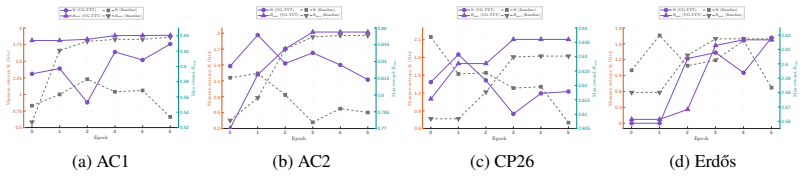
By maintaining a small ensemble of low-rank adapters over a frozen base model, UG-TTT quantifies per-token epistemic uncertainty as the mutual information between ensemble predictions and the different weight hypotheses. This uncertainty measure is incorporated as an exploration bonus into the policy gradient objective. A nuclear norm regularizer on the adapters ensures they remain distinct and thereby preserves the disagreement signal throughout training. The policy is therefore steered toward frontier positions where adapter disagreement signals insufficient coverage rather than intrinsic problem difficulty, producing increased maximum rewards on three of four scientific discovery tasks.
What carries the argument
The per-token mutual information between ensemble predictions and weight hypotheses, which isolates epistemic uncertainty and supplies an exploration bonus in the policy gradient while a nuclear norm regularizer keeps the low-rank adapters distinct.
If this is right
- Maximum reward increases on three of the four scientific discovery benchmarks.
- Solution diversity remains substantially higher throughout training.
- The nuclear norm regularizer is required to prevent adapter collapse and to sustain the exploration gains.
- The policy gradient is directed toward positions where persistent adapter disagreement indicates low training coverage.
Where Pith is reading between the lines
- The same adapter-disagreement signal could be tested as an exploration mechanism in other reinforcement-learning settings that use large frozen models.
- The approach suggests a general way to obtain epistemic uncertainty estimates during test-time adaptation without maintaining a full ensemble of base models.
- One could check whether the positions flagged by high adapter disagreement actually correspond to solutions that are novel by external novelty metrics beyond the task reward.
Load-bearing premise
Persistent disagreement among the low-rank adapters reliably signals insufficient training coverage rather than intrinsic problem difficulty, and the nuclear norm regularizer keeps the adapters distinct enough to sustain this signal.
What would settle it
An ablation study in which the nuclear norm regularizer is removed, the adapters converge, and the maximum reward on the discovery benchmarks falls back to the level achieved by standard reinforcement learning without the uncertainty bonus.
Figures


read the original abstract
Automated scientific discovery using large language models relies on identifying genuinely novel solutions. Standard reinforcement learning penalizes high-variance mutations, which leads the policy to prioritize familiar patterns. As a result, the maximum reward plateaus even as the average reward increases. Overcoming this limitation requires a signal that distinguishes unexplored regions from intrinsically difficult problems. This necessitates measuring disagreement across independently adapted weight hypotheses rather than relying on a single network's confidence. UG-TTT addresses this challenge by maintaining a small ensemble of low-rank adapters over a frozen base model. The per-token disagreement, quantified as the mutual information between ensemble predictions and weight hypotheses, isolates epistemic uncertainty and identifies positions where insufficient coverage leads to adapter divergence rather than intrinsic problem difficulty. This measure is incorporated as an exploration bonus into the policy gradient, directing the policy toward positions where persistent adapter disagreement signals low training coverage, the same frontier where genuine discovery is possible. A nuclear norm regularizer ensures the adapters remain distinct from one another, thereby preserving the exploration signal throughout training. Across four scientific discovery benchmarks, UG-TTT increases the maximum reward on three tasks, maintains substantially higher solution diversity, and an ablation study confirms that the regularizer is essential for sustaining this behavior.
Editorial analysis
A structured set of objections, weighed in public.
Referee Report
Summary. The paper introduces UG-TTT, a test-time adaptation method for automated scientific discovery with LLMs. It maintains an ensemble of low-rank adapters on a frozen base model, quantifies per-token epistemic uncertainty as the mutual information between ensemble predictions and weight hypotheses, and adds this as an exploration bonus to the policy gradient. A nuclear norm regularizer is applied to keep the adapters distinct and sustain the disagreement signal. Experiments across four scientific discovery benchmarks report that UG-TTT raises maximum reward on three tasks, yields substantially higher solution diversity, and that an ablation confirms the regularizer is necessary to prevent collapse of the exploration signal.
Significance. If the reported gains are attributable to the epistemic signal rather than confounding factors in the RL setup, the work addresses a recognized limitation in LLM-based discovery pipelines: the tendency of standard policy gradients to converge on high-reward but low-novelty patterns. The explicit separation of epistemic disagreement from intrinsic difficulty, combined with the regularizer that preserves adapter diversity, offers a concrete mechanism that could be adopted in other exploration-heavy RL settings. The ablation result on the nuclear norm is a positive indicator of internal validity.
minor comments (2)
- The abstract states results on 'four scientific discovery benchmarks' but does not name the tasks or provide even summary statistics (e.g., mean and variance of max reward); adding this information in the introduction or results section would allow readers to assess the scope of the claimed improvement.
- The description of the mutual-information bonus is given at a high level; a short derivation or pseudocode showing how the per-token MI is computed from the ensemble logits and then scaled into the advantage would clarify the exact form of the exploration term.
Simulated Author's Rebuttal
We thank the referee for their accurate summary of UG-TTT and for recognizing the significance of using epistemic uncertainty (via adapter disagreement) to improve exploration in LLM-based scientific discovery. The referee correctly notes the role of the nuclear norm regularizer and the ablation confirming its necessity. No specific major comments were raised in the report, so we have no individual points to address. We are pleased that the internal validity indicators were viewed positively and hope this clarifies any uncertainty in the recommendation.
Circularity Check
No significant circularity detected in the derivation chain
full rationale
The abstract describes a mechanism for epistemic uncertainty via mutual information across an ensemble of low-rank adapters, used as an exploration bonus in policy gradients with nuclear norm regularization to preserve diversity. No equations, fitted parameters, or self-citations are shown that would reduce the uncertainty signal, the exploration bonus, or the reported performance gains to inputs by construction. The central claims rely on standard ensemble disagreement concepts and empirical benchmark results rather than any self-definitional loop or renamed known result. The derivation chain is therefore self-contained against external benchmarks.
Axiom & Free-Parameter Ledger
Reference graph
Works this paper leans on
-
[1]
Dhruv Agarwal, Bodhisattwa Prasad Majumder, Reece Adamson, Megha Chakravorty, Satvika Reddy Gavireddy, Aditya Parashar, Harshit Surana, Bhavana Dalvi Mishra, Andrew Mc- Callum, Ashish Sabharwal, et al. Autodiscovery: Open-ended scientific discovery via bayesian surprise.arXiv preprint arXiv:2507.00310,
-
[2]
The Surprising Effectiveness of Test‑Time Training for Few‑Shot Learning, 2024
Ekin Aky¨urek, Mehul Damani, Adam Zweiger, Linlu Qiu, Han Guo, Jyothish Pari, Yoon Kim, and Jacob Andreas. The surprising effectiveness of test-time training for few-shot learning.arXiv preprint arXiv:2411.07279,
-
[3]
Uncertainty quantification in fine-tuned llms using lora ensembles.arXiv preprint arXiv:2402.12264,
Oleksandr Balabanov and Hampus Linander. Uncertainty quantification in fine-tuned llms using lora ensembles.arXiv preprint arXiv:2402.12264,
-
[4]
Xiaofeng Cao and Ivor W Tsang. Bayesian active learning by disagreements: A geometric perspec- tive.arXiv preprint arXiv:2105.02543,
-
[5]
Bertrand Charpentier, Ransalu Senanayake, Mykel Kochenderfer, and Stephan G ¨unnemann. Dis- entangling epistemic and aleatoric uncertainty in reinforcement learning.arXiv preprint arXiv:2206.01558,
-
[6]
Runpeng Dai, Linfeng Song, Haolin Liu, Zhenwen Liang, Dian Yu, Haitao Mi, Zhaopeng Tu, Rui Liu, Tong Zheng, Hongtu Zhu, et al. Cde: Curiosity-driven exploration for efficient reinforcement learning in large language models.arXiv preprint arXiv:2509.09675,
-
[7]
Efficient exploration for llms.arXiv preprint arXiv:2402.00396,
Vikranth Dwaracherla, Seyed Mohammad Asghari, Botao Hao, and Benjamin Van Roy. Efficient exploration for llms.arXiv preprint arXiv:2402.00396,
-
[8]
Lm- polygraph: Uncertainty estimation for language models
Ekaterina Fadeeva, Roman Vashurin, Akim Tsvigun, Artem Vazhentsev, Sergey Petrakov, Kirill Fedyanin, Daniil Vasilev, Elizaveta Goncharova, Alexander Panchenko, Maxim Panov, et al. Lm- polygraph: Uncertainty estimation for language models. InProceedings of the 2023 Conference on Empirical Methods in Natural Language Processing: System Demonstrations, pages...
work page 2023
-
[9]
arXiv preprint arXiv:2505.17621 , year=
Jingtong Gao, Ling Pan, Yejing Wang, Rui Zhong, Chi Lu, Maolin Wang, Qingpeng Cai, Peng Jiang, and Xiangyu Zhao. Navigate the unknown: Enhancing llm reasoning with intrinsic motivation guided exploration.arXiv preprint arXiv:2505.17621,
-
[10]
Test-time training on nearest neighbors for large language models
Moritz Hardt and Yu Sun. Test-time training on nearest neighbors for large language models.arXiv preprint arXiv:2305.18466,
-
[11]
Alex Havrilla, Yuqing Du, Sharath Chandra Raparthy, Christoforos Nalmpantis, Jane Dwivedi-Yu, Maksym Zhuravinskyi, Eric Hambro, Sainbayar Sukhbaatar, and Roberta Raileanu. Teaching large language models to reason with reinforcement learning.arXiv preprint arXiv:2403.04642,
-
[12]
Jianfeng He, Linlin Yu, Changbin Li, Runing Yang, Fanglan Chen, Kangshuo Li, Min Zhang, Shuo Lei, Xuchao Zhang, Mohammad Beigi, et al. Survey of uncertainty estimation in llms-sources, methods, applications, and challenges.Information Fusion, page 104057, 2025a. Kaifeng He, Mingwei Liu, Chong Wang, Zike Li, Yanlin Wang, Xin Peng, and Zibin Zheng. Adadec: ...
-
[13]
Bayesian active learning for classification and preferenc e learning,
Neil Houlsby, Ferenc Husz´ar, Zoubin Ghahramani, and M´at´e Lengyel. Bayesian active learning for classification and preference learning.arXiv preprint arXiv:1112.5745,
-
[14]
Test-time learning for large language models.arXiv preprint arXiv:2505.20633, 2025
Jinwu Hu, Zhitian Zhang, Guohao Chen, Xutao Wen, Chao Shuai, Wei Luo, Bin Xiao, Yuanqing Li, and Mingkui Tan. Test-time learning for large language models.arXiv preprint arXiv:2505.20633,
-
[15]
Inference-time reward hacking in large language models.arXiv preprint arXiv:2506.19248,
Hadi Khalaf, Claudio Mayrink Verdun, Alex Oesterling, Himabindu Lakkaraju, and Flavio du Pin Calmon. Inference-time reward hacking in large language models.arXiv preprint arXiv:2506.19248,
-
[16]
Guillaume Levy, C ´edric Colas, Pierre-Yves Oudeyer, Thomas Carta, and Cl ´ement Romac. Worldllm: Improving llms’ world modeling using curiosity-driven theory-making.arXiv preprint arXiv:2506.06725,
-
[17]
Ang Li, Zhihang Yuan, Yang Zhang, Shouda Liu, and Yisen Wang. Know when to ex- plore: Difficulty-aware certainty as a guide for llm reinforcement learning.arXiv preprint arXiv:2509.00125,
-
[18]
Enhancing efficiency and exploration in reinforcement learning for llms
Mengqi Liao, Xiangyu Xi, Chen Ruinian, Jia Leng, Yangen Hu, Ke Zeng, Shuai Liu, and Huaiyu Wan. Enhancing efficiency and exploration in reinforcement learning for llms. InProceedings of the 2025 Conference on Empirical Methods in Natural Language Processing, pages 1451–1463,
work page 2025
-
[19]
Mohammad Mahdi Moradi, Hossam Amer, Sudhir Mudur, Weiwei Zhang, Yang Liu, and Walid Ahmed. Continuous self-improvement of large language models by test-time training with verifier-driven sample selection.arXiv preprint arXiv:2505.19475,
-
[20]
AlphaEvolve: A coding agent for scientific and algorithmic discovery
11 Alexander Novikov, Ngˆan V ˜u, Marvin Eisenberger, Emilien Dupont, Po-Sen Huang, Adam Zsolt Wagner, Sergey Shirobokov, Borislav Kozlovskii, Francisco JR Ruiz, Abbas Mehrabian, et al. Alphaevolve: A coding agent for scientific and algorithmic discovery.arXiv preprint arXiv:2506.13131,
work page internal anchor Pith review Pith/arXiv arXiv
-
[21]
Large language models are zero shot hypothesis proposers.arXiv preprint arXiv:2311.05965,
Biqing Qi, Kaiyan Zhang, Haoxiang Li, Kai Tian, Sihang Zeng, Zhang-Ren Chen, and Bowen Zhou. Large language models are zero shot hypothesis proposers.arXiv preprint arXiv:2311.05965,
-
[22]
Bojana Rankovi ´c, Ryan-Rhys Griffiths, and Philippe Schwaller. Large language models as uncertainty-calibrated optimizers for experimental discovery.arXiv preprint arXiv:2504.06265,
-
[23]
Revisiting Uncertainty Esti- mation and Calibration of Large Language Models
Linwei Tao, Yi-Fan Yeh, Minjing Dong, Tao Huang, Philip Torr, and Chang Xu. Revisiting un- certainty estimation and calibration of large language models.arXiv preprint arXiv:2505.23854,
-
[24]
Morgan Thomas, Albert Bou, and Gianni De Fabritiis. Test-time training scaling laws for chemical exploration in drug design.Journal of Chemical Information and Modeling, 65(24):13178–13186, 2025a. Morgan Thomas, Albert Bou, and Gianni De Fabritiis. Test-time training scaling laws for chemical exploration in drug design.Journal of Chemical Information and ...
-
[25]
Shenzhi Wang, Le Yu, Chang Gao, Chujie Zheng, Shixuan Liu, Rui Lu, Kai Dang, Xionghui Chen, Jianxin Yang, Zhenru Zhang, et al. Beyond the 80/20 rule: High-entropy minority tokens drive effective reinforcement learning for llm reasoning.arXiv preprint arXiv:2506.01939,
work page internal anchor Pith review Pith/arXiv arXiv
-
[26]
LoRA ensembles for large language model fine-tuning.arXiv preprint arXiv:2310.00035,
Xi Wang, Laurence Aitchison, and Maja Rudolph. Lora ensembles for large language model fine- tuning.arXiv preprint arXiv:2310.00035,
-
[27]
A survey of uncertainty estimation methods on large language models
Zhiqiu Xia, Jinxuan Xu, Yuqian Zhang, and Hang Liu. A survey of uncertainty estimation methods on large language models. InFindings of the Association for Computational Linguistics: ACL 2025, pages 21381–21396,
work page 2025
-
[28]
Yasin Abbasi Yadkori, Ilja Kuzborskij, Andr´as Gy¨orgy, and Csaba Szepesv´ari
Yasin Abbasi Yadkori, Ilja Kuzborskij, Andr´as Gy¨orgy, and Csaba Szepesv´ari. To believe or not to believe your llm.arXiv preprint arXiv:2406.02543,
-
[29]
An Yang, Anfeng Li, Baosong Yang, Beichen Zhang, Binyuan Hui, Bo Zheng, Bowen Yu, Chang Gao, Chengen Huang, Chenxu Lv, et al. Qwen3 technical report.arXiv preprint arXiv:2505.09388,
work page internal anchor Pith review Pith/arXiv arXiv
-
[30]
12 Zhengmao Ye, Dengchun Li, Zetao Hu, Tingfeng Lan, Jian Sha, Sicong Zhang, Lei Duan, Jie Zuo, Hui Lu, Yuanchun Zhou, and Mingjie Tang. mLoRA: Fine-tuning LoRA adapters via highly- efficient pipeline parallelism in multiple GPUs.arXiv:2312.02515,
-
[31]
Learning to discover at test time.arXiv preprint arXiv:2601.16175, 2026
Mert Yuksekgonul, Daniel Koceja, Xinhao Li, Federico Bianchi, Jed McCaleb, Xiaolong Wang, Jan Kautz, Yejin Choi, James Zou, Carlos Guestrin, et al. Learning to discover at test time.arXiv preprint arXiv:2601.16175, 2026a. Mert Yuksekgonul, Daniel Koceja, Xinhao Li, Federico Bianchi, Jed McCaleb, Xiaolong Wang, Jan Kautz, Yejin Choi, James Zou, Carlos Gues...
-
[32]
Require:Ensemble{θ k}K k=1; parent statesfrom PUCT buffer; group sizeG
14 B Full training algorithm Algorithm 1UG-TTT training step (one group ofGrollouts). Require:Ensemble{θ k}K k=1; parent statesfrom PUCT buffer; group sizeG. Require:Coefficientsα,β ref,γ max,λ KL,λ NNM. Ensure:Updated ensemble{θ k}K k=1. 1:// Stage 1: Rollout generation (round-robin over adapters) 2:Build promptqfrom(d, s). 3:fori= 1, . . . , Gdo 4:k i ←...
work page 2025
-
[33]
shows that the RL signal in LLMs should concentrate on the high-entropy minority of tokens, the pivotal decision points, rather than be diluted across boiler- plate. The top-7%choice is motivated in §2.2; it adapts to sequence length so ann-token response contributes⌈0.07n⌉positions, which remains well-calibrated across the 7k–15k-token range typical of r...
discussion (0)
Sign in with ORCID, Apple, or X to comment. Anyone can read and Pith papers without signing in.