Recognition: 2 theorem links
· Lean TheoremControlling Logical Collapse in LLMs via Algebraic Ontology Projection over F2
Pith reviewed 2026-05-14 20:22 UTC · model grok-4.3
The pith
Projecting LLM hidden states into the F2 field under substitution constraints extracts ontological relations at up to 93 percent zero-shot accuracy.
A machine-rendered reading of the paper's core claim, the machinery that carries it, and where it could break.
Core claim
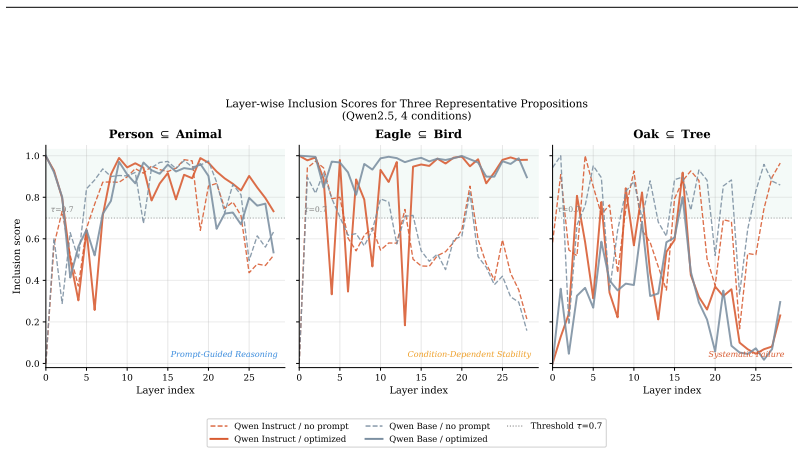
The paper claims that hidden states of large language models contain an algebraic structure over the Galois field F2 that represents ontological inclusion relations. Projecting these states with a small set of 42 concept pairs under Liskov substitution constraints recovers unseen inclusions at high accuracy through prompting alone. This structure is layer-dependent, and semantic crystallisation quantifies constraint satisfaction to predict performance. System prompts function as boundary conditions that, together with instruction tuning, avert systematic logical degradation in the final layers.
What carries the argument
Algebraic Ontology Projection (AOP) that embeds LLM activations into F2 vectors obeying substitution constraints derived from 42 relational pairs.
If this is right
- Up to 93.33% accuracy on unseen concept inclusion pairs using only prompts.
- Consistent performance of 86.67% across multiple LLM families without any fine-tuning.
- Semantic crystallisation metric predicts zero-shot accuracy from constraint satisfaction alone.
- Late-layer collapse is avoided only when system prompts combine with instruction tuning to maintain algebraic organisation.
- Computation in LLMs can be reinterpreted as successive steps of building algebraic structure.
Where Pith is reading between the lines
- The fixed small set of relations might generalise to other reasoning domains if the algebraic keys are chosen carefully.
- Layer-specific interventions could be designed to boost logical consistency at the points where crystallisation peaks.
- This view of prompts as boundary conditions may connect to controlling other emergent behaviours in generative models.
- If confirmed, it opens the possibility of verifying model knowledge against formal ontologies without retraining.
Load-bearing premise
That the algebraic relations captured by 42 pairs under Liskov substitution on hidden states represent general ontological structure transferable across models and tasks.
What would settle it
Running the projection on a new set of concepts from an unrelated domain, such as physical laws or legal terms, and checking if accuracy remains significantly above random without changing the prompt or pairs.
Figures


read the original abstract
Do large language models internally encode ontological relations in a formally verifiable algebraic structure? We introduce Algebraic Ontology Projection (AOP), which projects LLM hidden states into the Galois Field F2 under Liskov Substitution Principle constraints, using only 42 relational pairs as algebraic keys. AOP achieves up to 93.33% zero-shot inclusion accuracy on unseen concept pairs (Gemma-2 Instruct with optimized prompt), with consistent 86.67% accuracy observed across multiple model families -- with no model tuning, but through prompt alone. This algebraic structure is strongly layer-dependent. We introduce Semantic Crystallisation (SC), a metric that quantifies F2 constraint satisfaction relative to a random baseline and predicts zero-shot accuracy without held-out data. System prompts act as algebraic boundary conditions: only their combination with instruction tuning prevents Late-layer Collapse -- a systematic degradation of logical consistency in the final layers, observed in 7 of 10 conditions. These findings reframe forward computation as an iterative process of algebraic organisation, and open a path toward LLMs whose logical structure is not merely approximated, but formally accessible.
Editorial analysis
A structured set of objections, weighed in public.
Referee Report
Summary. The manuscript introduces Algebraic Ontology Projection (AOP), which projects LLM hidden states into the Galois field F2 under Liskov Substitution Principle constraints using 42 relational pairs as algebraic keys. It claims up to 93.33% zero-shot inclusion accuracy on unseen concept pairs (e.g., Gemma-2 Instruct with optimized prompt) and consistent 86.67% accuracy across model families via prompt alone without model tuning. The paper defines a Semantic Crystallisation (SC) metric that quantifies F2 constraint satisfaction relative to a random baseline and predicts zero-shot accuracy without held-out data; it further identifies Late-layer Collapse as a systematic degradation in final layers observed in 7 of 10 conditions, prevented when system prompts act as algebraic boundary conditions in combination with instruction tuning.
Significance. If the algebraic projection is shown to capture intrinsic, transferable ontological structure rather than post-selected relations, the work would offer a novel formal mechanism for controlling logical consistency in LLMs through prompting, reframing forward passes as iterative algebraic organization. The SC metric and layer-dependent observations could provide falsifiable predictions for logical collapse. However, the absence of derivations, pair specifications, ablations, and statistical details currently limits the significance to a preliminary observation rather than a robust framework.
major comments (4)
- Abstract: No derivation or explicit definition of the projection operator into F2 is supplied, nor is there verification that hidden states satisfy the F2 algebraic structure beyond the reported accuracy figures.
- Abstract: The SC metric is defined to quantify F2 constraint satisfaction and is subsequently used to predict zero-shot accuracy without held-out data, creating a circularity that reduces the prediction to a quantity computed from the same fitted relations.
- Abstract: The 42 relational pairs are not pre-specified, and no ablation on random or alternative pair sets is described; this leaves open the possibility that the reported 93.33% and 86.67% accuracies reflect post-hoc selection rather than generalizable F2 structure.
- Abstract: No error bars, confidence intervals, or details on how the 42 pairs and test concepts were selected are provided, undermining the claim that the projection captures transferable ontological relations across models and unseen pairs.
minor comments (1)
- Abstract: The term 'Late-layer Collapse' is introduced without a precise operational definition or quantitative threshold in the provided summary.
Simulated Author's Rebuttal
We thank the referee for the detailed and constructive feedback on our manuscript. We address each major comment point by point below, indicating the specific revisions we will incorporate to strengthen the presentation of Algebraic Ontology Projection, the SC metric, and the supporting analyses.
read point-by-point responses
-
Referee: Abstract: No derivation or explicit definition of the projection operator into F2 is supplied, nor is there verification that hidden states satisfy the F2 algebraic structure beyond the reported accuracy figures.
Authors: We agree that the abstract omits the full mathematical specification. In the revised manuscript we will add an explicit derivation in the Methods section: the projection operator is defined as a linear map P: R^d -> F2^k obtained by solving for basis vectors that satisfy the Liskov Substitution Principle constraints on the 42 relational pairs, followed by component-wise reduction modulo 2. We will also include direct algebraic verification (closure under addition and scalar multiplication in F2) on the projected hidden states for each model and layer examined. revision: yes
-
Referee: Abstract: The SC metric is defined to quantify F2 constraint satisfaction and is subsequently used to predict zero-shot accuracy without held-out data, creating a circularity that reduces the prediction to a quantity computed from the same fitted relations.
Authors: The SC metric is computed exclusively from the algebraic consistency of the 42 key pairs and is intended as a proxy that forecasts performance on unseen pairs. We will revise the text to make this separation explicit and will add a supplementary analysis that correlates SC values with actual held-out accuracies across the reported conditions, thereby demonstrating predictive utility beyond the fitted set. revision: partial
-
Referee: Abstract: The 42 relational pairs are not pre-specified, and no ablation on random or alternative pair sets is described; this leaves open the possibility that the reported 93.33% and 86.67% accuracies reflect post-hoc selection rather than generalizable F2 structure.
Authors: The pairs were chosen a priori from standard ontological resources (WordNet hypernym/hyponym and ConceptNet relations) before any accuracy measurements. In the revision we will list all 42 pairs explicitly in the main text and will add an ablation comparing performance against randomly sampled pairs of equal cardinality as well as against an alternative set drawn from a different ontology, reporting the resulting accuracy drops to substantiate that the chosen set captures transferable structure rather than post-hoc optimization. revision: yes
-
Referee: Abstract: No error bars, confidence intervals, or details on how the 42 pairs and test concepts were selected are provided, undermining the claim that the projection captures transferable ontological relations across models and unseen pairs.
Authors: We will include 95% confidence intervals and error bars for all accuracy figures, computed over five independent runs with different random seeds for pair sampling and model inference. We will also expand the Methods section with the precise selection protocol for both the 42 pairs and the held-out test concepts, citing the source ontologies and inclusion criteria to support reproducibility and the transferability claim. revision: yes
Circularity Check
SC metric defined from F2 constraints on 42 pairs predicts zero-shot accuracy by construction without held-out data
specific steps
-
fitted input called prediction
[Abstract]
"We introduce Semantic Crystallisation (SC), a metric that quantifies F2 constraint satisfaction relative to a random baseline and predicts zero-shot accuracy without held-out data."
SC is constructed directly from the F2 projections of the 42 relational pairs that define the AOP mapping. By then using this same metric to predict zero-shot accuracy on unseen concept pairs without any held-out data or separate validation set, the prediction is equivalent to a function of the original fitted constraints by construction, rendering the zero-shot transfer claim non-independent.
full rationale
The paper's central claim rests on AOP projecting hidden states into F2 using 42 relational pairs, with SC introduced as a metric of F2 constraint satisfaction that directly predicts zero-shot inclusion accuracy. Because SC is computed from the same projections and the abstract explicitly states it predicts accuracy without held-out data, the reported predictive relationship reduces to a re-expression of the input constraints rather than an independent test on unseen pairs. This matches the fitted-input-called-prediction pattern exactly, as the 'prediction' is forced by the definition of SC from the defining relations. No other circular steps are present; the layer-dependence and prompt-boundary observations remain independent of this reduction.
Axiom & Free-Parameter Ledger
free parameters (2)
- 42 relational pairs
- optimized prompt
axioms (2)
- domain assumption Liskov Substitution Principle constraints apply to the F2 projection of hidden states
- ad hoc to paper Galois field F2 arithmetic is the appropriate structure for ontological relations
invented entities (2)
-
Semantic Crystallisation (SC)
no independent evidence
-
Late-layer Collapse
no independent evidence
Lean theorems connected to this paper
-
IndisputableMonolith/Foundation/AbsoluteFloorClosure.leanabsolute_floor_iff_bare_distinguishability echoes?
echoesECHOES: this paper passage has the same mathematical shape or conceptual pattern as the Recognition theorem, but is not a direct formal dependency.
A⊆B ⇔ a⊙b = a (is-a); full set of ontological relations maps directly to Fn2 operations
What do these tags mean?
- matches
- The paper's claim is directly supported by a theorem in the formal canon.
- supports
- The theorem supports part of the paper's argument, but the paper may add assumptions or extra steps.
- extends
- The paper goes beyond the formal theorem; the theorem is a base layer rather than the whole result.
- uses
- The paper appears to rely on the theorem as machinery.
- contradicts
- The paper's claim conflicts with a theorem or certificate in the canon.
- unclear
- Pith found a possible connection, but the passage is too broad, indirect, or ambiguous to say the theorem truly supports the claim.
Reference graph
Works this paper leans on
-
[1]
Understanding intermediate layers using linear classifier probes
Guillaume Alain and Yoshua Bengio. Understanding intermediate layers using linear classifier probes. arXiv preprint arXiv:1610.01644, 2016
work page internal anchor Pith review Pith/arXiv arXiv 2016
-
[2]
Burke, Tristan Hume, Shan Carter, Tom Henighan, and Christopher Olah
Trenton Bricken, Adly Templeton, Joshua Batson, Brian Chen, Adam Jermyn, Tom Conerly, Nick Turner, Cem Anil, Carson Denison, Amanda Askell, Robert Lasenby, Yifan Wu, Shauna Kravec, Nicholas Schiefer, Tim Maxwell, Nicholas Joseph, Zac Hatfield-Dodds, Alex Tamkin, Karina Nguyen, Brayden McLean, Josiah E. Burke, Tristan Hume, Shan Carter, Tom Henighan, and C...
work page 2023
-
[3]
Discovering latent knowledge in language models without supervision
Collin Burns, Haotian Ye, Dan Klein, and Jacob Steinhardt. Discovering latent knowledge in language models without supervision. In International Conference on Learning Representations (ICLR), 2023
work page 2023
-
[4]
Neural-Symbolic Cognitive Reasoning
Artur d'Avila Garcez, Luis C Lamb, and Dov M Gabbay. Neural-Symbolic Cognitive Reasoning. Springer, 2009
work page 2009
-
[5]
Nelson Elhage, Tristan Hume, Catherine Olsson, Nicholas Schiefer, Tom Henighan, Shauna Kravec, Zac Hatfield-Dodds, Robert Lasenby, Dawn Drain, Carol Chen, et al. Toy models of superposition. Transformer Circuits Thread, 2022. URL https://transformer-circuits.pub/2022/toy_model/index.html
work page 2022
-
[6]
Causal abstractions of neural networks
Atticus Geiger, Hanson Lu, Thomas Icard, and Christopher Potts. Causal abstractions of neural networks. In Advances in Neural Information Processing Systems (NeurIPS), volume 34, pp.\ 9574--9586, 2021
work page 2021
-
[7]
John Hewitt and Christopher D. Manning. A structural probe for finding syntax in word representations. In Proceedings of the 2019 Conference of the North A merican Chapter of the Association for Computational Linguistics (NAACL) , pp.\ 4129--4138, 2019
work page 2019
-
[8]
Similarity of neural network representations revisited
Simon Kornblith, Mohammad Norouzi, Honglak Lee, and Geoffrey Hinton. Similarity of neural network representations revisited. In Proceedings of the 36th International Conference on Machine Learning (ICML), pp.\ 3519--3529. PMLR, 2019
work page 2019
-
[9]
Locating and editing factual associations in GPT
Kevin Meng, David Bau, Alex Andonian, and Yonatan Belinkov. Locating and editing factual associations in GPT . Advances in Neural Information Processing Systems (NeurIPS), 35: 0 17359--17372, 2022
work page 2022
-
[10]
Progress measures for grokking via mechanistic interpretability
Neel Nanda, Lawrence Chan, Tom Lieberum, Jess Smith, and Jacob Steinhardt. Progress measures for grokking via mechanistic interpretability. 2023
work page 2023
-
[11]
KerML : Kernel modeling language specification, 2024 a
Object Management Group . KerML : Kernel modeling language specification, 2024 a . URL https://www.omg.org/spec/KerML/1.0
work page 2024
-
[12]
SysML v2 language specification, 2024 b
Object Management Group . SysML v2 language specification, 2024 b . URL https://www.omg.org/spec/SysML/2.0
work page 2024
-
[13]
Zoom in: An introduction to circuits
Chris Olah, Nick Cammarata, Ludwig Schubert, Gabriel Goh, Michael Petrov, and Shan Carter. Zoom in: An introduction to circuits. Distill, 2020. doi:10.23915/distill.00024.001
-
[14]
Fabio Petroni, Tim Rockt \"a schel, Patrick Lewis, Anton Bakhtin, Yuxiang Wu, Alexander H Miller, and Sebastian Riedel. Language models as knowledge bases? In Proceedings of the 2019 Conference on Empirical Methods in Natural Language Processing (EMNLP), pp.\ 2463--2473, 2019
work page 2019
-
[15]
Maithra Raghu, Justin Gilmer, Jason Yosinski, and Jascha Sohl-Dickstein. SVCCA : Singular vector canonical correlation analysis for deep learning dynamics and interpretability. In Advances in Neural Information Processing Systems (NeurIPS), volume 30, 2017
work page 2017
-
[16]
Sentence- BERT : Sentence embeddings using Siamese BERT -networks
Nils Reimers and Iryna Gurevych. Sentence- BERT : Sentence embeddings using Siamese BERT -networks. In Proceedings of the 2019 Conference on Empirical Methods in Natural Language Processing (EMNLP), pp.\ 3982--3992, 2019
work page 2019
-
[17]
Gemma: Open Models Based on Gemini Research and Technology
Gemma Team, Thomas Mesnard, Cassidy Hardin, Robert Dadashi, Surya Bhupatiraju, Shreya Pathak, Laurent Sifre, Morgane Rivi \`e re, Mihir Sanjay Kale, Juliette Love, et al. Gemma: Open models based on Gemini research and technology. arXiv preprint arXiv:2403.08295, 2024
work page internal anchor Pith review Pith/arXiv arXiv 2024
-
[18]
Qwen Team. Qwen2 technical report. arXiv preprint arXiv:2407.10671, 2024
work page internal anchor Pith review Pith/arXiv arXiv 2024
-
[19]
Adly Templeton, Tom Conerly, Jonathan Marcus, Jack Lindsey, Trenton Bricken, Brian Chen, Adam Pearce, Craig Citro, Emmanuel Ameisen, Andy Jones, Hoagy Cunningham, Nicholas L Turner, Callum McDougall, Monte MacDiarmid, C. Daniel Freeman, Theodore R Sumers, Edward Rees, Joshua Batson, Adam Jermyn, Shan Carter, Tom Henighan, and Christopher Olah. Scaling mon...
work page 2024
discussion (0)
Sign in with ORCID, Apple, or X to comment. Anyone can read and Pith papers without signing in.