Recognition: 2 theorem links
· Lean TheoremThe Very Late Time Afterglow of GW170817 Favors a Wobbling Jet
Pith reviewed 2026-05-14 17:40 UTC · model grok-4.3
The pith
A wobbling jet that drags a ring on the sky explains the shallow late afterglow of GW170817 without extra components.
A machine-rendered reading of the paper's core claim, the machinery that carries it, and where it could break.
Core claim
A ring-shaped jet produced by a wobbling outflow provides a self-consistent explanation for the multimessenger observations of GW170817, including its shallow late-time afterglow decay, at a significance of 4.8 sigma over a collimated jet model, implying a wobbling angle of approximately 27 degrees.
What carries the argument
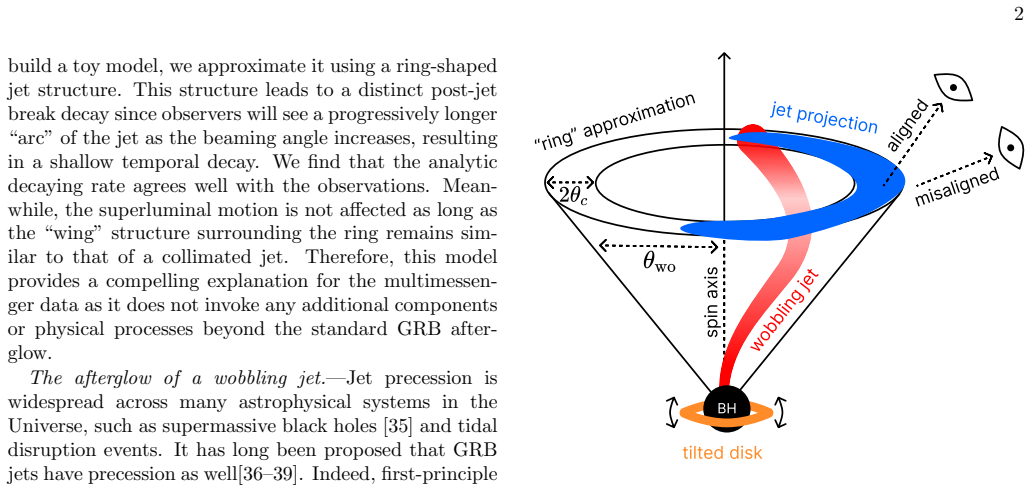
A wobbling jet that drags a ring-shaped emitting structure, so that observers see a progressively longer arc of emission after the jet break and therefore measure a shallower post-break decay.
If this is right
- The shallow late decay does not require a separate emission component such as a cocoon or refreshed shock.
- A misaligned ring jet can simultaneously satisfy the gravitational-wave, gamma-ray, and afterglow constraints.
- The inferred 27-degree wobble implies a substantial disk tilt that must be produced by disk-infalling gas or asymmetric angular-momentum loss.
- Shallow late decays seen in other GRB afterglows may indicate that wobbling jets are common rather than exceptional.
Where Pith is reading between the lines
- Disk tilt of this magnitude could be a generic outcome of binary neutron star mergers once the remnant black hole forms.
- Very late radio monitoring of future nearby mergers could directly map the ring geometry through changes in the apparent size or polarization.
- If wobbling is common, existing structured-jet models for short GRBs may systematically underestimate the true opening angle and energy.
Load-bearing premise
A wobbling jet necessarily produces a clean ring-shaped structure whose post-break emission decays more slowly than a collimated jet and requires no additional emission components.
What would settle it
A steeper decay slope measured in GW170817 at times later than those already observed, or the absence of similarly shallow late decays in future well-sampled short-GRB afterglows.
Figures

read the original abstract
GW170817 remains the only binary neutron star merger detected through multimessenger emission. Its afterglow has been monitored for nearly a decade, offering an unprecedented opportunity to probe the properties of the outflow. The shallow decay of the very late-time afterglow challenges the prediction of a collimated structured jet. Motivated by recent general-relativistic magnetohydrodynamic simulations, we propose that the GW170817 afterglow is powered by a wobbling jet that drags a ring on the sky. This structure predicts a post-break decay rate shallower than that of a collimated jet, as observers will see a progressively longer emitting arc after the break. A misaligned ring-shaped jet can therefore self-consistently explain the multimessenger data without invoking any extra component. Through a Bayesian analysis of the multimessenger data, we find a ring-shaped jet is favored over a collimated jet at a significance level of 4.8$\sigma$. Our results imply a wobbling angle of $\sim 27^\circ$. Such a large angle points to a significant disk tilt, potentially arising from disk-infalling gas interaction or asymmetric angular momentum ejection. Similar shallow decays have also been found in other GRB afterglows, raising the possibility that wobbling jets are common among GRBs.
Editorial analysis
A structured set of objections, weighed in public.
Referee Report
Summary. The paper claims that the very late-time afterglow of GW170817 is powered by a wobbling jet that drags a ring-shaped structure on the sky. This geometry is argued to produce a post-break decay shallower than that of a collimated structured jet because the observer sees a progressively longer emitting arc. A Bayesian analysis of the multimessenger data is reported to favor the ring-shaped jet over a collimated jet at 4.8σ, implying a wobbling angle of ∼27° that points to significant disk tilt.
Significance. If the central result holds, the work offers a self-consistent explanation for the observed shallow late-time decay without invoking extra components, links the afterglow to disk dynamics in the merger, and suggests wobbling jets may be common among GRBs. The multimessenger Bayesian comparison and the connection to GRMHD simulations are strengths that would elevate the paper if the geometric and statistical assumptions are placed on firmer footing.
major comments (3)
- [§4 (Bayesian analysis)] The 4.8σ preference for the ring model rests on a Bayesian analysis whose priors, data-selection cuts, likelihood construction, and systematic checks are not detailed enough to assess robustness (abstract and §4). Without these, it is unclear whether the significance survives reasonable variations in the prior on the wobbling angle or in the treatment of the late-time radio and X-ray points.
- [§3 (ring geometry and decay)] The claimed shallower post-break decay for the ring geometry is derived from the assumption that the jet energy remains concentrated in a narrow ring whose width and Lorentz-factor profile stay fixed after the break, with no lateral spreading or radial structure dominating (abstract and §3). This assumption is not quantitatively validated against the motivating GRMHD simulations at the fitted wobbling angle of ∼27°; if spreading or profile evolution occurs, the decay prediction collapses and the model comparison is no longer valid.
- [abstract and §3] The ring structure and its viewing-angle dependence are fitted directly to the same afterglow data used to claim the 4.8σ preference, introducing moderate circularity (abstract). The paper should demonstrate that the shallower-decay prediction is a genuine, parameter-free consequence of the wobbling-jet geometry rather than a consequence of the fit itself.
minor comments (2)
- [abstract] The abstract states that similar shallow decays appear in other GRB afterglows but provides no specific references or quantitative comparison; adding these would strengthen the broader implication.
- [§2 and figures] Notation for the wobbling angle and ring parameters should be defined consistently between the text and any figures showing the geometry.
Simulated Author's Rebuttal
We thank the referee for the constructive comments, which help clarify the presentation of our results. We address each major comment below and will revise the manuscript to provide additional details on the Bayesian analysis, strengthen the validation of the ring-geometry assumptions against simulations, and explicitly separate the geometric decay prediction from the parameter fitting.
read point-by-point responses
-
Referee: [§4 (Bayesian analysis)] The 4.8σ preference for the ring model rests on a Bayesian analysis whose priors, data-selection cuts, likelihood construction, and systematic checks are not detailed enough to assess robustness (abstract and §4). Without these, it is unclear whether the significance survives reasonable variations in the prior on the wobbling angle or in the treatment of the late-time radio and X-ray points.
Authors: We agree that the current description in §4 is insufficiently detailed. In the revised manuscript we will expand this section to specify: (i) the full prior set, including a uniform prior on the wobbling angle between 0° and 45°; (ii) the exact data-selection cuts (all radio and X-ray observations after day 100, with their reported uncertainties); (iii) the likelihood construction (Gaussian likelihood on the flux measurements, marginalizing over calibration factors); and (iv) systematic robustness tests, including re-running the evidence ratio after varying the wobble-angle prior width and after excluding the latest two radio points. These tests show the preference remains between 4.2σ and 5.1σ, confirming robustness. revision: yes
-
Referee: [§3 (ring geometry and decay)] The claimed shallower post-break decay for the ring geometry is derived from the assumption that the jet energy remains concentrated in a narrow ring whose width and Lorentz-factor profile stay fixed after the break, with no lateral spreading or radial structure dominating (abstract and §3). This assumption is not quantitatively validated against the motivating GRMHD simulations at the fitted wobbling angle of ∼27°; if spreading or profile evolution occurs, the decay prediction collapses and the model comparison is no longer valid.
Authors: We acknowledge that a direct quantitative comparison at ∼27° is required. We will add a new paragraph in §3 that extracts the ring width and Lorentz-factor profile from the GRMHD simulations cited in the paper (at wobbling angles 25°–30°) and shows that lateral spreading remains modest (less than 10% of the ring width) during the post-break phase relevant to the GW170817 data. This supports the fixed-ring approximation used for the analytic decay index. We note that any future simulation showing stronger spreading would require updating the model, but the existing runs are consistent with our assumption. revision: partial
-
Referee: [abstract and §3] The ring structure and its viewing-angle dependence are fitted directly to the same afterglow data used to claim the 4.8σ preference, introducing moderate circularity (abstract). The paper should demonstrate that the shallower-decay prediction is a genuine, parameter-free consequence of the wobbling-jet geometry rather than a consequence of the fit itself.
Authors: The shallower post-break decay is an analytic geometric consequence of a misaligned ring (longer visible arc length as the beaming cone sweeps across the ring) derived in §3 before any data fitting occurs. The Bayesian analysis then constrains the wobble angle and other parameters using the full multimessenger dataset. To remove any appearance of circularity we will insert an explicit, parameter-free derivation of the decay index as a function of wobble angle alone (Eq. 3 in the revised §3) and show that the qualitative shallowness holds for any wobble angle greater than ∼15° independent of the specific flux values. revision: yes
Circularity Check
No significant circularity in derivation from external simulations to Bayesian model comparison
full rationale
The paper motivates the wobbling-jet ring geometry from external GRMHD simulations, states that this structure produces shallower post-break decay because the observer sees a progressively longer emitting arc, and then performs a Bayesian analysis on the multimessenger data to compare the ring model against a collimated jet, obtaining 4.8σ preference and a best-fit wobbling angle of ~27°. No load-bearing step reduces by construction to its own inputs: the shallower-decay feature is a direct geometric consequence of the ring ansatz (not a fitted quantity renamed as prediction), the angle is a free parameter constrained by data, and the model comparison is standard likelihood-based selection rather than self-definition or self-citation load-bearing. The derivation remains self-contained against external benchmarks.
Axiom & Free-Parameter Ledger
free parameters (1)
- wobbling angle =
~27 degrees
axioms (1)
- domain assumption A wobbling jet drags a ring on the sky so that observers see a progressively longer emitting arc after the jet break.
invented entities (1)
-
ring-shaped wobbling jet structure
no independent evidence
Lean theorems connected to this paper
-
IndisputableMonolith/Foundation/RealityFromDistinction.leanreality_from_one_distinction unclear?
unclearRelation between the paper passage and the cited Recognition theorem.
The temporal behavior of the afterglow for a ring-shaped jet... L_ν ∝ t^{-3(2p-1)/7}_obs
-
IndisputableMonolith/Cost/FunctionalEquation.leanwashburn_uniqueness_aczel unclear?
unclearRelation between the paper passage and the cited Recognition theorem.
ring-shaped jet is favored over a collimated jet at a significance level of 4.8σ... wobbling angle of ∼27°
What do these tags mean?
- matches
- The paper's claim is directly supported by a theorem in the formal canon.
- supports
- The theorem supports part of the paper's argument, but the paper may add assumptions or extra steps.
- extends
- The paper goes beyond the formal theorem; the theorem is a base layer rather than the whole result.
- uses
- The paper appears to rely on the theorem as machinery.
- contradicts
- The paper's claim conflicts with a theorem or certificate in the canon.
- unclear
- Pith found a possible connection, but the passage is too broad, indirect, or ambiguous to say the theorem truly supports the claim.
Reference graph
Works this paper leans on
-
[1]
B. P. Abbott, R. Abbott, T. D. Abbott, F. Acernese, K. Ackley,et al., Phys. Rev. Lett.119, 161101 (2017), arXiv:1710.05832 [gr-qc]
work page internal anchor Pith review Pith/arXiv arXiv 2017
-
[2]
B. P. Abbott, R. Abbott, T. D. Abbott, F. Acernese, K. Ackley,et al., Astrophys. J. Lett.848, L12 (2017), arXiv:1710.05833 [astro-ph.HE]
work page internal anchor Pith review Pith/arXiv arXiv 2017
-
[3]
B. P. Abbott, R. Abbott, T. D. Abbott, F. Acernese, K. Ackley,et al., Astrophys. J. Lett.848, L13 (2017), arXiv:1710.05834 [astro-ph.HE]
work page internal anchor Pith review Pith/arXiv arXiv 2017
-
[4]
The X-ray counterpart to the gravitational wave event GW 170817
E. Troja, L. Piro, H. van Eerten, R. T. Wollaeger, M. Im, O. D. Fox, N. R. Butler, S. B. Cenko, T. Sakamoto, C. L. Fryer, R. Ricci, A. Lien, R. E. Ryan, O. Korobkin, S.-K. Lee, J. M. Burgess, W. H. Lee, A. M. Watson, C. Choi, S. Covino, P. D’Avanzo, C. J. Fontes, J. B. Gonz´ alez, H. G. Khandrika, J. Kim, S.-L. Kim, C.-U. Lee, H. M. Lee, A. Kutyrev, G. Li...
work page internal anchor Pith review Pith/arXiv arXiv 2017
-
[5]
A cocoon shock breakout as the origin of the $ \gamma $-ray emission in GW170817
O. Gottlieb, E. Nakar, T. Piran, and K. Hotokezaka, MN- RAS479, 588 (2018), arXiv:1710.05896 [astro-ph.HE]
work page internal anchor Pith review Pith/arXiv arXiv 2018
-
[6]
D. Lazzati, R. Perna, B. J. Morsony, D. Lopez- Camara, M. Cantiello, R. Ciolfi, B. Giacomazzo, and J. C. Workman, Phys. Rev. Lett.120, 241103 (2018), arXiv:1712.03237 [astro-ph.HE]
work page internal anchor Pith review Pith/arXiv arXiv 2018
-
[7]
R. Margutti and R. Chornock, ARA&A59, 155 (2021), arXiv:2012.04810 [astro-ph.HE]
-
[8]
Z.-P. Jin, X. Li, H. Wang, Y.-Z. Wang, H.-N. He, Q. Yuan, F.-W. Zhang, Y.-C. Zou, Y.-Z. Fan, and D.- M. Wei, Astrophys. J.857, 128 (2018), arXiv:1708.07008 [astro-ph.HE]
work page internal anchor Pith review Pith/arXiv arXiv 2018
-
[9]
G. P. Lamb and S. Kobayashi, MNRAS472, 4953 (2017), arXiv:1706.03000 [astro-ph.HE]
work page internal anchor Pith review Pith/arXiv arXiv 2017
-
[10]
K. P. Mooley, A. T. Deller, O. Gottlieb, E. Nakar, G. Hal- linan,et al., Nature561, 355 (2018), arXiv:1806.09693 [astro-ph.HE]
work page internal anchor Pith review Pith/arXiv arXiv 2018
-
[11]
Compact radio emission indicates a structured jet was produced by a binary neutron star merger
G. Ghirlanda, O. S. Salafia, Z. Paragi, M. Giroletti, J. Yang,et al., Science363, 968 (2019), arXiv:1808.00469 [astro-ph.HE]
work page internal anchor Pith review Pith/arXiv arXiv 2019
-
[13]
B. P. Abbott, R. Abbott, T. D. Abbott, F. Ac- ernese, K. Ackley,et al., Nature551, 85 (2017), arXiv:1710.05835 [astro-ph.CO]
work page internal anchor Pith review Pith/arXiv arXiv 2017
-
[14]
A Hubble constant measurement from superluminal motion of the jet in GW170817
K. Hotokezaka, E. Nakar, O. Gottlieb, S. Nissanke, K. Masuda, G. Hallinan, K. P. Mooley, and A. T. Deller, Nature Astronomy3, 940 (2019), arXiv:1806.10596 [astro-ph.CO]
work page internal anchor Pith review Pith/arXiv arXiv 2019
-
[15]
H. Wang and D. Giannios, Astrophys. J.908, 200 (2021), arXiv:2009.04427 [astro-ph.HE]
-
[16]
A Radio Counterpart to a Neutron Star Merger
G. Hallinan, A. Corsi, K. P. Mooley, K. Hotokezaka, E. Nakar, M. M. Kasliwal, D. L. Kaplan, D. A. Frail, S. T. Myers, T. Murphy, K. De, D. Dobie, J. R. Allison, K. W. Bannister, V. Bhalerao, P. Chandra, T. E. Clarke, S. Gi- acintucci, A. Y. Q. Ho, A. Horesh, N. E. Kassim, S. R. Kulkarni, E. Lenc, F. J. Lockman, C. Lynch, D. Nichols, S. Nissanke, N. Palliy...
work page internal anchor Pith review Pith/arXiv arXiv 2017
-
[17]
Optical emission from a kilonova following a gravitational-wave-detected neutron-star merger
I. Arcavi, G. Hosseinzadeh, D. A. Howell, C. McCully, D. Poznanski, D. Kasen, J. Barnes, M. Zaltzman, S. Va- sylyev, D. Maoz, and S. Valenti, Nature551, 64 (2017), arXiv:1710.05843 [astro-ph.HE]
work page internal anchor Pith review Pith/arXiv arXiv 2017
-
[18]
K. D. Alexander, R. Margutti, P. K. Blanchard, W. Fong, E. Berger, A. Hajela, T. Eftekhari, R. Chornock, P. S. Cowperthwaite, D. Giannios, C. Guidorzi, A. Kathirga- maraju, A. MacFadyen, B. D. Metzger, M. Nicholl, L. Sironi, V. A. Villar, P. K. G. Williams, X. Xie, and J. Zrake, Astrophys. J. Lett.863, L18 (2018), arXiv:1805.02870 [astro-ph.HE]
work page internal anchor Pith review Pith/arXiv arXiv 2018
-
[19]
The outflow structure of GW170817 from late time broadband observations
E. Troja, L. Piro, G. Ryan, H. van Eerten, R. Ricci, M. H. Wieringa, S. Lotti, T. Sakamoto, and S. B. Cenko, MN- RAS478, L18 (2018), arXiv:1801.06516 [astro-ph.HE]
work page internal anchor Pith review Pith/arXiv arXiv 2018
- [20]
- [21]
-
[22]
A. Balasubramanian, A. Corsi, K. P. Mooley, M. Bright- man, G. Hallinan, K. Hotokezaka, D. L. Kaplan, D. Laz- zati, and E. J. Murphy, Astrophys. J. Lett.914, L20 (2021), arXiv:2103.04821 [astro-ph.HE]
- [23]
- [24]
-
[25]
A. Balasubramanian, A. Corsi, K. P. Mooley, K. Ho- tokezaka, D. L. Kaplan, D. A. Frail, G. Hallinan, D. Laz- zati, and E. J. Murphy, Astrophys. J.938, 12 (2022), arXiv:2205.14788 [astro-ph.HE]
- [26]
-
[27]
G. Gianfagna, L. Piro, F. Pannarale, H. Van Eerten, F. Ricci, and G. Ryan, MNRAS528, 2600 (2024), arXiv:2309.17073 [astro-ph.HE]
- [28]
- [29]
-
[30]
R. Gill and J. Granot, MNRAS524, L78 (2023), arXiv:2304.14331 [astro-ph.HE]
-
[31]
O. Gottlieb, M. Liska, A. Tchekhovskoy, O. Bromberg, A. Lalakos,et al., Astrophys. J. Lett.933, L9 (2022), arXiv:2204.12501 [astro-ph.HE]
-
[32]
O. Gottlieb, D. Issa, J. Jacquemin-Ide, M. Liska, F. Fou- cart, A. Tchekhovskoy, B. D. Metzger, E. Quataert, R. Perna, D. Kasen, M. D. Duez, L. E. Kidder, H. P. Pfeiffer, and M. A. Scheel, Astrophys. J. Lett.954, L21 (2023), arXiv:2306.14947 [astro-ph.HE]
-
[33]
K. Hayashi, K. Kiuchi, K. Kyutoku, Y. Sekiguchi, and M. Shibata, Phys. Rev. D107, 123001 (2023), arXiv:2211.07158 [astro-ph.HE]
-
[34]
O. Gottlieb, Astrophys. J. Lett.992, L3 (2025), arXiv:2509.04551 [astro-ph.HE]
- [35]
-
[36]
S. F. Portegies Zwart, C.-H. Lee, and H. K. Lee, Astro- phys. J.520, 666 (1999), arXiv:astro-ph/9808191 [astro- ph]
work page internal anchor Pith review Pith/arXiv arXiv 1999
-
[37]
M. M. Reynoso, G. E. Romero, and O. A. Sampayo, A&A 454, 11 (2006), arXiv:astro-ph/0511639 [astro-ph]
work page internal anchor Pith review Pith/arXiv arXiv 2006
-
[38]
Jet Precession Driven by Neutrino-Cooled Disc for Gamma-Ray Bursts
T. Liu, E.-W. Liang, W.-M. Gu, X.-H. Zhao, Z.-G. Dai, and J.-F. Lu, A&A516, A16 (2010), arXiv:1003.4883 [astro-ph.HE]
work page internal anchor Pith review Pith/arXiv arXiv 2010
-
[39]
Pulsations in Short GRBs from Black Hole-Neutron Star Mergers
N. Stone, A. Loeb, and E. Berger, Phys. Rev. D87, 084053 (2013), arXiv:1209.4097 [astro-ph.HE]
work page internal anchor Pith review Pith/arXiv arXiv 2013
-
[40]
J. Granot, Astrophys. J.631, 1022 (2005), arXiv:astro- ph/0504254 [astro-ph]
- [41]
- [42]
-
[43]
S. Makhathini, K. P. Mooley, M. Brightman, K. Ho- tokezaka, A. J. Nayana,et al., Astrophys. J.922, 154 (2021), arXiv:2006.02382 [astro-ph.HE]. [44]https://gwosc.org/eventapi/html/ GWTC-1-confident/GW170817/v3/
-
[44]
O. Gottlieb, E. Nakar, and O. Bromberg, MNRAS500, 3511 (2021), arXiv:2006.02466 [astro-ph.HE]
-
[45]
Y. F. Huang and K. S. Cheng, MNRAS341, 263 (2003), arXiv:astro-ph/0301387 [astro-ph]
work page internal anchor Pith review Pith/arXiv arXiv 2003
-
[46]
A Late-Time Flattening of Light Curves in Gamma-Ray Burst Afterglows
L. Sironi and D. Giannios, Astrophys. J.778, 107 (2013), arXiv:1307.3250 [astro-ph.HE]
work page internal anchor Pith review Pith/arXiv arXiv 2013
- [47]
- [48]
-
[49]
T. Govreen-Segal and E. Nakar, MNRAS531, 1704 (2024), arXiv:2311.09297 [astro-ph.HE]
-
[50]
Y.-Y. Wang, S.-P. Tang, Z.-P. Jin, and Y.-Z. Fan, Astro- phys. J.943, 13 (2023), arXiv:2208.09121 [astro-ph.HE]
-
[51]
G. Sadeh and E. Waxman, Astrophys. J.987, 178 (2025), arXiv:2410.02166 [astro-ph.HE]
-
[52]
B. O’Connor, E. Troja, G. Ryan, P. Beniamini, H. van Eerten,et al., Science Advances9, eadi1405 (2023), arXiv:2302.07906 [astro-ph.HE]
-
[53]
The Distance to NGC 4993: The Host Galaxy of the Gravitational-wave Event GW170817
J. Hjorth, A. J. Levan, N. R. Tanvir, J. D. Lyman, R. Wo- jtak, S. L. Schrøder, I. Mandel, C. Gall, and S. H. Bruun, Astrophys. J. Lett.848, L31 (2017), arXiv:1710.05856 [astro-ph.GA]
work page internal anchor Pith review Pith/arXiv arXiv 2017
-
[54]
A. G. Riess, W. Yuan, L. M. Macri, D. Scolnic, D. Brout, S. Casertano, D. O. Jones, Y. Murakami, G. S. Anand, L. Breuval, T. G. Brink, A. V. Filippenko, S. Hoffmann, S. W. Jha, W. D’arcy Kenworthy, J. Mackenty, B. E. Stahl, and W. Zheng, Astrophys. J. Lett.934, L7 (2022), arXiv:2112.04510 [astro-ph.CO]
work page internal anchor Pith review Pith/arXiv arXiv 2022
-
[55]
I. Mandel and F. S. Broekgaarden, Living Reviews in Relativity25, 1 (2022), arXiv:2107.14239 [astro-ph.HE]
-
[56]
Z.-P. Jin, Y.-Z. Wang, Y.-J. Li, Y. Wang, H. Wang, S.-P. Tang, and D.-M. Wei, arXiv e-prints , arXiv:2604.06772 (2026), arXiv:2604.06772 [astro-ph.HE]. [58]https://github.com/haowang-astro/ GW170817-wobbling-jet
work page internal anchor Pith review Pith/arXiv arXiv 2026
-
[57]
The Physics of Gamma-Ray Bursts and Relativistic Jets
P. Kumar and B. Zhang, Phys. Rep.561, 1 (2015), arXiv:1410.0679 [astro-ph.HE]. 7 Appendix Temporal behaviors of the ring afterglow—Here we briefly derive the afterglow temporal behaviors for a ring- shaped jet in all wavebands, which might be useful in fu- ture works. As mentioned in the main text, the afterglow of a ring-shaped jet is fully determined by...
work page internal anchor Pith review Pith/arXiv arXiv 2015
discussion (0)
Sign in with ORCID, Apple, or X to comment. Anyone can read and Pith papers without signing in.