Recognition: no theorem link
Inpainting over the cracks: challenges of applying pre-merger searches for massive black hole binaries to realistic LISA datasets
Pith reviewed 2026-05-14 17:38 UTC · model grok-4.3
The pith
Inpainting recovers 14 pre-merger massive black hole binary signals in realistic LISA data even with gaps.
A machine-rendered reading of the paper's core claim, the machinery that carries it, and where it could break.
Core claim
The authors show that an inpainting technique can identify pre-merger signals from massive black hole binaries in realistic LISA datasets even when data gaps are present. They recover all 14 expected signals from the Sangria-HM dataset at least half a day before merger. The method also allows identification of quieter signals in regions with overlapping mergers by subtracting previously detected ones.
What carries the argument
The inpainting technique, which fills missing data segments to enable continuous searches for gravitational-wave signals.
If this is right
- Pre-merger alerts for electromagnetic follow-up become feasible even with realistic data interruptions.
- Overlapping signals can be separated by sequential detection and subtraction of louder events.
- The zero-latency filter provides a baseline that inpainting extends to gapped data.
- Early sky localization estimates can be updated as more data arrives before merger.
Where Pith is reading between the lines
- Real LISA data pipelines will require robust gap-filling to achieve reliable early-warning science.
- The approach could extend to other space-based gravitational-wave observatories facing similar data interruptions.
- Further tests on varied overlap configurations would clarify how many signals can be peeled away sequentially.
Load-bearing premise
The Sangria-HM simulated dataset captures the essential noise properties and signal overlaps of real LISA data without introducing artificial biases.
What would settle it
Applying the inpainting search to actual LISA flight data and failing to recover a known massive black hole binary at the predicted pre-merger time would show the method does not generalize.
Figures


read the original abstract
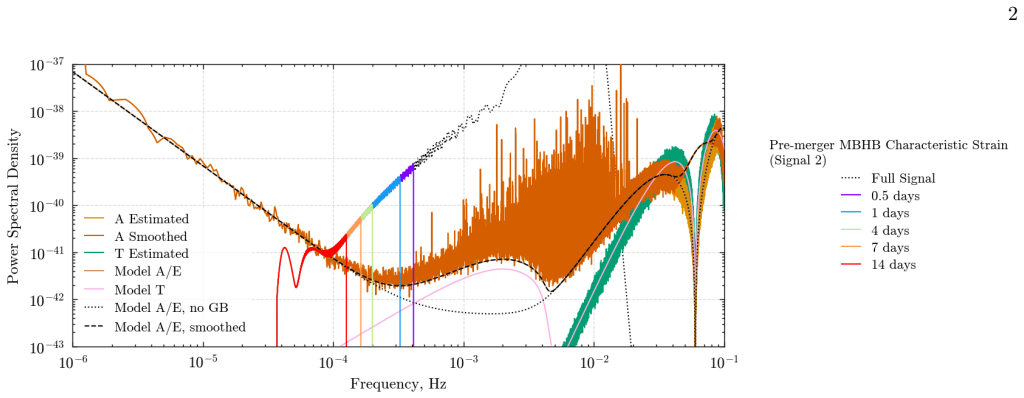
A key science target of the Large Interferometer Space Antenna (LISA) is to carry out multi-messenger observations of massive black hole binaries, observing the merger simultaneously in gravitational waves and with electromagnetic observatories. Identifying that a merger is happening and providing an updating estimate of the sky location in the hours, days and weeks before the merger is critical to enable electromagnetic observations of the merger event. In this work we demonstrate and compare two methods for premerger identification of massive black hole binaries; a zero-latency filter approach and, for the first time, an approach using an ``inpainting'' technique. We apply these methods to the LISA Data Challenge dataset 2a--Sangria-HM--and demonstrate the successful recovery of the 14 signals in the dataset that we expected to be identifiable at least half a day before merger. We show that the inpainting method can identify premerger signals even when gaps are present in the data, demonstrating the recovery of a signal even when 3 day-long data gaps are added to the 14 days preceding merger. Finally, we explore the challenge of overlapping signals, using a region of overlapping signals in the Sangria-HM dataset, all of which merge within a 10-day window, and show how removing signals that have been confidently identified from the data allows us to identify quieter signals in the same period.
Editorial analysis
A structured set of objections, weighed in public.
Referee Report
Summary. The manuscript presents and compares two methods—a zero-latency filter and an inpainting technique—for identifying massive black hole binary mergers in LISA data prior to merger. Using the Sangria-HM dataset from the LISA Data Challenge, the authors demonstrate recovery of 14 pre-selected signals at least half a day before merger, show that inpainting allows recovery even with 3-day data gaps inserted in the 14 days before merger, and illustrate how removing confidently identified signals aids in detecting overlapping quieter signals within a 10-day window.
Significance. If the results hold, this work provides practical tools for early warning of LISA mergers, enabling multi-messenger observations. The application to a public data challenge dataset and the handling of realistic features like gaps and overlaps are strengths, offering a foundation for operational LISA data analysis pipelines.
major comments (3)
- [Results on Sangria-HM dataset] The central empirical support consists of recovery demonstrations on a single controlled injection campaign (Sangria-HM) with fixed noise model and gap statistics. No cross-checks against alternative LISA simulations or injected real-data proxies are described, which is load-bearing for the claim that the methods address 'realistic LISA challenges'.
- [Overlapping signals analysis] The section exploring overlapping signals shows qualitative improvement by removing identified signals, but lacks quantitative metrics such as detection thresholds, false alarm rates, or SNR improvements to substantiate the claim of identifying quieter signals.
- [Methods and results] Detailed error analysis, validation metrics (e.g., recovery time distributions, false positive rates), and comparison baselines to existing search methods are not visible in the reported results, weakening the assessment of the methods' performance.
minor comments (2)
- [Abstract] The abstract states 'successful recovery' without specifying the criteria or metrics used to define success.
- [Notation and terminology] Ensure consistent use of terms like 'inpainting' and 'zero-latency filter' throughout, with clear definitions in the methods section.
Simulated Author's Rebuttal
We thank the referee for their thoughtful review and constructive feedback on our manuscript. We address each of the major comments below, providing clarifications and outlining revisions to improve the paper.
read point-by-point responses
-
Referee: [Results on Sangria-HM dataset] The central empirical support consists of recovery demonstrations on a single controlled injection campaign (Sangria-HM) with fixed noise model and gap statistics. No cross-checks against alternative LISA simulations or injected real-data proxies are described, which is load-bearing for the claim that the methods address 'realistic LISA challenges'.
Authors: The Sangria-HM dataset is specifically constructed to simulate realistic LISA data challenges, including instrumental noise and data gaps, as part of the LISA Data Challenge. While we agree that additional validation on other datasets would be valuable, this work focuses on demonstrating the methods on this public benchmark. In the revised manuscript, we will expand the discussion section to explicitly address the scope of our claims and the need for future cross-validation with other simulations. revision: partial
-
Referee: [Overlapping signals analysis] The section exploring overlapping signals shows qualitative improvement by removing identified signals, but lacks quantitative metrics such as detection thresholds, false alarm rates, or SNR improvements to substantiate the claim of identifying quieter signals.
Authors: We acknowledge that the analysis of overlapping signals is presented qualitatively. To address this, we will add quantitative metrics in the revised version, including estimated SNR improvements and approximate false alarm rate reductions for the quieter signals after subtracting the confidently identified ones. revision: yes
-
Referee: [Methods and results] Detailed error analysis, validation metrics (e.g., recovery time distributions, false positive rates), and comparison baselines to existing search methods are not visible in the reported results, weakening the assessment of the methods' performance.
Authors: Some validation is included, such as the recovery of all 14 expected signals at least half a day before merger. However, we agree that more detailed metrics would strengthen the presentation. We will revise the results section to include recovery time distributions, estimates of false positive rates derived from the dataset, and comparisons to standard search techniques like matched filtering. revision: yes
Circularity Check
No significant circularity; empirical demonstration on external public dataset
full rationale
The paper applies zero-latency filtering and inpainting to recover 14 pre-selected signals from the external LISA Data Challenge Sangria-HM dataset (including a test with added 3-day gaps). Recovery is measured directly against the known injected signals in that fixed public benchmark. No derivation chain exists that reduces by construction to fitted parameters, self-definitions, or self-citations; the reported success rates are falsifiable against the external injections. The methods are therefore self-contained against an independent data challenge.
Axiom & Free-Parameter Ledger
free parameters (1)
- Detection thresholds
axioms (1)
- domain assumption The LISA Data Challenge dataset 2a Sangria-HM accurately represents realistic LISA observations including noise and signal characteristics.
Reference graph
Works this paper leans on
-
[1]
Laser Interferometer Space Antenna
P. Amaro-Seoaneet al.(LISA), Laser Interferometer Space Antenna (2017), arXiv:1702.00786 [astro-ph.IM]
work page internal anchor Pith review Pith/arXiv arXiv 2017
-
[2]
M. Colpiet al., LISA Definition Study Report (2024), arXiv:2402.07571 [astro-ph.CO]
work page internal anchor Pith review Pith/arXiv arXiv 2024
- [3]
- [4]
-
[5]
K. A. Arnaudet al.(Mock LISA Data Challenge Task Force), A How-To for the Mock LISA Data Challenges, 12 AIP Conf. Proc.873, 625 (2006), arXiv:gr-qc/0609106
work page internal anchor Pith review Pith/arXiv arXiv 2006
-
[6]
K. A. Arnaudet al., Report on the first round of the Mock LISA data challenges, Class. Quant. Grav.24, S529 (2007), arXiv:gr-qc/0701139
work page internal anchor Pith review Pith/arXiv arXiv 2007
-
[7]
Report on the second Mock LISA Data Challenge
S. Babaket al.(Mock LISA Data Challenge Task Force), Report on the second Mock LISA Data Challenge, Class. Quant. Grav.25, 114037 (2008), arXiv:0711.2667 [gr-qc]
work page internal anchor Pith review Pith/arXiv arXiv 2008
-
[8]
The Mock LISA Data Challenges: from Challenge 1B to Challenge 3
S. Babaket al., The Mock LISA Data Challenges: From Challenge 1B to Challenge 3, Class. Quant. Grav.25, 184026 (2008), arXiv:0806.2110 [gr-qc]
work page internal anchor Pith review Pith/arXiv arXiv 2008
-
[9]
K. A. Arnaudet al., An Overview of the second round of the Mock LISA Data Challenges, Class. Quant. Grav. 24, S551 (2007), arXiv:gr-qc/0701170
work page internal anchor Pith review Pith/arXiv arXiv 2007
-
[10]
The Mock LISA Data Challenges: from Challenge 3 to Challenge 4
S. Babaket al.(Mock LISA Data Challenge Task Force), The Mock LISA Data Challenges: From Challenge 3 to Challenge 4, Class. Quant. Grav.27, 084009 (2010), arXiv:0912.0548 [gr-qc]
work page internal anchor Pith review Pith/arXiv arXiv 2010
-
[11]
Q. Baghi (LDC Working Group), The LISA Data Chal- lenges, in56th Rencontres de Moriond on Gravitation (2022) arXiv:2204.12142 [gr-qc]
-
[12]
lal.in2p3.fr/()
The New LISA Data Challenges,https://lisa-ldc. lal.in2p3.fr/()
-
[13]
G. Cabourn Davieset al., Premerger observation and characterization of massive black hole binaries, Phys. Rev. D111, 043045 (2025), arXiv:2411.07020 [hep-ex]
- [14]
-
[15]
W.-H. Ruan and Z.-K. Guo, Premerger detection of mas- sive black hole binaries using deep learning, Phys. Rev. D109, 123031 (2024), arXiv:2402.16282 [astro-ph.IM]
-
[16]
B. Kocsis, Z. Haiman, and K. Menou, Pre-Merger Lo- calization of Gravitational-Wave Standard Sirens With LISA: Triggered Search for an Electromagnetic Coun- terpart, Astrophys. J.684, 870 (2008), arXiv:0712.1144 [astro-ph]
work page internal anchor Pith review Pith/arXiv arXiv 2008
-
[17]
S. T. McWilliams, R. N. Lang, J. G. Baker, and J. I. Thorpe, Sky localization of complete inspiral-merger- ringdown signals for nonspinning massive black hole bi- naries, Phys. Rev. D84, 064003 (2011), arXiv:1104.5650 [gr-qc]
work page internal anchor Pith review Pith/arXiv arXiv 2011
- [18]
-
[19]
T. Dal Canton, A. Mangiagli, S. C. Noble, J. Schnittman, A. Ptak, A. Klein, A. Sesana, and J. Camp, De- tectability of modulated X-rays from LISA’s supermas- sive black hole mergers, Astrophys. J.886, 146 (2019), arXiv:1902.01538 [astro-ph.HE]
-
[20]
E. Castelli, Q. Baghi, J. G. Baker, J. Slutsky, J. Bobin, N. Karnesis, A. Petiteau, O. Sauter, P. Wass, and W. J. Weber, Extracting gravitational wave signals from LISA data in the presence of artifacts, Class. Quant. Grav.42, 065018 (2025), arXiv:2411.13402 [gr-qc]
- [21]
-
[22]
in2p3.fr/challenge2a()
The New LISA Data Challenges,https://lisa-ldc. in2p3.fr/challenge2a()
-
[23]
C. Garc´ ıa-Quir´ os, M. Colleoni, S. Husa, H. Estell´ es, G. Pratten, A. Ramos-Buades, M. Mateu-Lucena, and R. Jaume, Multimode frequency-domain model for the gravitational wave signal from nonprecessing black-hole binaries, Phys. Rev. D102, 064002 (2020), arXiv:2001.10914 [gr-qc]
-
[24]
Annual modulation of the Galactic binary confusion noise bakground and LISA data analysis
N. Seto, Annual modulation of the galactic binary con- fusion noise background and LISA data analysis, Phys. Rev. D69, 123005 (2004), arXiv:gr-qc/0403014
work page internal anchor Pith review Pith/arXiv arXiv 2004
-
[25]
A Solution to the Galactic Foreground Problem for LISA
J. Crowder and N. Cornish, A Solution to the Galactic Foreground Problem for LISA, Phys. Rev. D75, 043008 (2007), arXiv:astro-ph/0611546
work page internal anchor Pith review Pith/arXiv arXiv 2007
- [26]
-
[27]
C. J. Moore, R. H. Cole, and C. P. L. Berry, Gravitational-wave sensitivity curves, Class. Quant. Grav.32, 015014 (2015), arXiv:1408.0740 [gr-qc]
work page internal anchor Pith review Pith/arXiv arXiv 2015
- [28]
-
[29]
Building a stochastic template bank for detecting massive black hole binaries
S. Babak, Building a stochastic template bank for detect- ing massive black hole binaries, Class. Quant. Grav.25, 195011 (2008), arXiv:0801.4070 [gr-qc]
work page internal anchor Pith review Pith/arXiv arXiv 2008
-
[30]
I. W. Harry, B. Allen, and B. S. Sathyaprakash, A Stochastic template placement algorithm for gravita- tional wave data analysis, Phys. Rev. D80, 104014 (2009), arXiv:0908.2090 [gr-qc]
work page internal anchor Pith review Pith/arXiv arXiv 2009
-
[31]
A chi-squared time-frequency discriminator for gravitational wave detection
B. Allen,χ 2 time-frequency discriminator for gravita- tional wave detection, Phys. Rev. D71, 062001 (2005), arXiv:gr-qc/0405045
work page internal anchor Pith review Pith/arXiv arXiv 2005
-
[32]
L. Tsukada, K. Cannon, C. Hanna, D. Keppel, D. Meacher, and C. Messick, Application of a Zero- latency Whitening Filter to Compact Binary Coalescence Gravitational-wave Searches, Phys. Rev. D97, 103009 (2018), arXiv:1708.04125 [astro-ph.IM]
work page internal anchor Pith review Pith/arXiv arXiv 2018
- [33]
- [34]
-
[35]
Katz and J
M. Katz and J. Roberts, mikekatz04/bbhx: New release! (2023)
2023
-
[36]
K. Cannon, S. Caudill, C. Chan, B. Cousins, J. D. Creighton, B. Ewing, H. Fong, P. Godwin, C. Hanna, S. Hooper, R. Huxford, R. Magee, D. Meacher, C. Mes- sick, S. Morisaki, D. Mukherjee, H. Ohta, A. Pace, S. Privitera, I. de Ruiter, S. Sachdev, L. Singer, D. Singh, R. Tapia, L. Tsukada, D. Tsuna, T. Tsutsui, K. Ueno, A. Viets, L. Wade, and M. Wade, Gstlal...
-
[37]
J. D. Hunter, Matplotlib: A 2d graphics environment, Computing in Science & Engineering9, 90 (2007)
2007
-
[38]
C. R. Harris, K. J. Millman, S. J. van der Walt, R. Gom- mers, P. Virtanen, D. Cournapeau, E. Wieser, J. Tay- lor, S. Berg, N. J. Smith, R. Kern, M. Picus, S. Hoyer, 13 M. H. van Kerkwijk, M. Brett, A. Haldane, J. F. del R´ ıo, M. Wiebe, P. Peterson, P. G´ erard-Marchant, K. Shep- pard, T. Reddy, W. Weckesser, H. Abbasi, C. Gohlke, and T. E. Oliphant, Arr...
2020
-
[39]
A. Nitz, I. Harry, D. Brown, C. M. Biwer, J. Willis, T. D. Canton, C. Capano, T. Dent, L. Pekowsky, G. S. C. Davies, S. De, M. Cabero, S. Wu, A. R. Williamson, B. Machenschalk, D. Macleod, F. Pannarale, P. Kumar, S. Reyes, dfinstad, S. Kumar, M. T´ apai, L. Singer, P. Ku- mar, veronica villa, maxtrevor, B. U. V. Gadre, S. Khan, S. Fairhurst, and A. Tolley...
2024
-
[40]
Virtanen, R
P. Virtanen, R. Gommers, T. E. Oliphant, M. Haber- land, T. Reddy, D. Cournapeau, E. Burovski, P. Pe- terson, W. Weckesser, J. Bright, S. J. van der Walt, M. Brett, J. Wilson, K. J. Millman, N. Mayorov, A. R. J. Nelson, E. Jones, R. Kern, E. Larson, C. J. Carey, ˙I. Po- lat, Y. Feng, E. W. Moore, J. VanderPlas, D. Laxalde, J. Perktold, R. Cimrman, I. Henr...
2020
discussion (0)
Sign in with ORCID, Apple, or X to comment. Anyone can read and Pith papers without signing in.