Recognition: 2 theorem links
· Lean TheoremElastic Spiking Transformers for Efficient Gesture Understanding
Pith reviewed 2026-05-15 06:25 UTC · model grok-4.3
The pith
A single Elastic Spiking Transformer dynamically resizes at runtime to match hardware budgets while matching baseline accuracy in gesture recognition.
A machine-rendered reading of the paper's core claim, the machinery that carries it, and where it could break.
Core claim
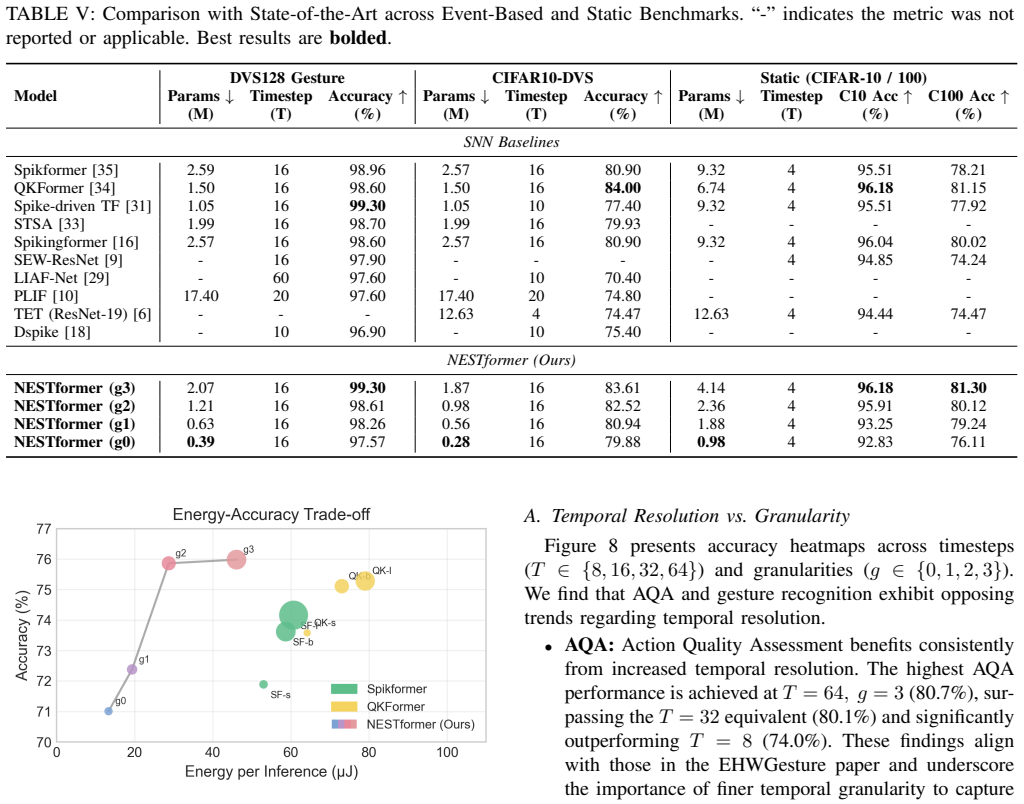
Through granularity-aware weight sharing, the Elastic Spiking Transformer embeds nested elasticity in its spiking blocks so that one universal model can dynamically adjust network width and attention heads at inference time, spanning a wide range of complexity-accuracy trade-offs and delivering proportional reductions in synaptic operations on datasets such as CIFAR10-DVS and EHWGesture.
What carries the argument
Granularity-aware weight sharing that creates Matryoshka-style nested slices across the Feature Extractor, Spiking Self-Attention, and Feed-Forward blocks.
Load-bearing premise
Granularity-aware weight sharing preserves accuracy across every dynamic slice without retraining or degradation.
What would settle it
Measuring accuracy on the EHWGesture dataset for a sliced version of the elastic model and finding it lower than an independently trained model of the same size would falsify the claim.
Figures




read the original abstract
Spiking Neural Networks (SNNs), particularly Spiking Transformers, offer energy-efficient processing of event-based sensor data for healthcare applications. Yet current architectures are rigid: they are trained and deployed as static networks with fixed parameter counts and computational graphs. This limits deployment on neuromorphic hardware such as Loihi and SpiNNaker, where on-chip constraints often require smaller models that trade accuracy for feasibility. We introduce the Elastic Spiking Transformer, a runtime-adaptive architecture that brings elasticity into the spiking paradigm. Inspired by Matryoshka-style representation learning, it embeds nested elasticity in the Feature Extractor, Spiking Self-Attention, and Feed-Forward blocks. Through granularity-aware weight sharing, a single universal model can dynamically slice network width and attention heads at inference time without retraining. This design provides two key advantages for SNNs. First, it allows the model to adjust its parameter footprint to different hardware memory budgets. Second, reducing active neurons also lowers spike firing rates, yielding proportional reductions in synaptic operations, an energy benefit not directly available in standard artificial neural networks. We evaluate the approach on CIFAR10/100, CIFAR10-DVS, and the EHWGesture clinical gesture understanding dataset. Results show that one Elastic Spiking Transformer spans a broad range of complexity-accuracy trade-offs, matching or surpassing independently trained baselines while supporting adaptive, real-time gesture recognition on resource-constrained edge devices.
Editorial analysis
A structured set of objections, weighed in public.
Referee Report
Summary. The paper introduces the Elastic Spiking Transformer, a runtime-adaptive SNN architecture that embeds nested elasticity via granularity-aware weight sharing in the Feature Extractor, Spiking Self-Attention, and Feed-Forward blocks. Inspired by Matryoshka representation learning, a single model can dynamically slice network width and attention heads at inference without retraining. This enables adaptation to hardware memory budgets on neuromorphic chips and yields energy savings through reduced spike firing rates. Evaluations on CIFAR10/100, CIFAR10-DVS, and EHWGesture claim that the model spans broad complexity-accuracy trade-offs while matching or surpassing fixed baselines for adaptive gesture recognition.
Significance. If the central claims hold, the work would advance practical deployment of spiking transformers on resource-constrained neuromorphic hardware by providing a single model that trades compute for accuracy on the fly, with SNN-specific energy benefits from lower spiking activity. This addresses a key limitation of rigid SNN architectures for edge healthcare applications.
major comments (2)
- [Abstract] Abstract (granularity-aware weight sharing description): the claim that shared weights in Spiking Self-Attention and Feed-Forward blocks support arbitrary dynamic slices without accuracy loss is load-bearing for the central result. In SNNs, altering active heads or channels changes effective fan-in and synaptic drive, which can shift membrane potential integration and firing rates without threshold re-tuning; the manuscript must supply spike-rate or membrane-potential measurements across slices to confirm preservation of the trained operating regime.
- [Evaluation section] Evaluation (CIFAR10-DVS and EHWGesture results): the abstract asserts that one model matches or surpasses independently trained baselines across trade-offs, yet no tables, quantitative metrics, error bars, or per-slice ablations are referenced. Without these, the absence of degradation from weight sharing cannot be verified and the adaptive real-time claim remains ungrounded.
minor comments (2)
- [Abstract] Add a citation to the original Matryoshka representation learning work when first referencing the inspiration.
- [Method description] Clarify the exact mechanism and any runtime overhead for selecting slice widths/heads at inference time.
Simulated Author's Rebuttal
We thank the referee for the constructive and detailed feedback on our manuscript. We address each major comment point by point below and will revise the paper to incorporate the suggested analyses and results.
read point-by-point responses
-
Referee: [Abstract] Abstract (granularity-aware weight sharing description): the claim that shared weights in Spiking Self-Attention and Feed-Forward blocks support arbitrary dynamic slices without accuracy loss is load-bearing for the central result. In SNNs, altering active heads or channels changes effective fan-in and synaptic drive, which can shift membrane potential integration and firing rates without threshold re-tuning; the manuscript must supply spike-rate or membrane-potential measurements across slices to confirm preservation of the trained operating regime.
Authors: We agree that verifying preservation of the trained operating regime is essential given the sensitivity of SNN dynamics to changes in fan-in and synaptic drive. While the original submission emphasized accuracy and spike-operation reductions, we will add spike-rate histograms and membrane-potential statistics across multiple slice widths and head counts in the revised evaluation section. These measurements will be reported for the Spiking Self-Attention and Feed-Forward blocks to confirm that the granularity-aware sharing maintains the original firing regime without threshold re-tuning. revision: yes
-
Referee: [Evaluation section] Evaluation (CIFAR10-DVS and EHWGesture results): the abstract asserts that one model matches or surpasses independently trained baselines across trade-offs, yet no tables, quantitative metrics, error bars, or per-slice ablations are referenced. Without these, the absence of degradation from weight sharing cannot be verified and the adaptive real-time claim remains ungrounded.
Authors: We acknowledge that the current manuscript does not present explicit per-slice tables or ablations for CIFAR10-DVS and EHWGesture. In the revision we will add detailed tables reporting accuracy, spike operations, and energy metrics for each dynamic slice, together with error bars from repeated runs and direct side-by-side comparisons against independently trained fixed-width baselines at matching complexity levels. These additions will substantiate the claim that a single Elastic Spiking Transformer matches or exceeds the fixed models across the reported trade-offs. revision: yes
Circularity Check
No circularity: architectural proposal with independent empirical validation
full rationale
The paper describes an Elastic Spiking Transformer as a runtime-adaptive extension of Matryoshka-style nested representations applied to SNN blocks via granularity-aware weight sharing. No equations, derivations, or fitted parameters are presented that reduce any claimed prediction or result to the inputs by construction. Central claims rest on evaluations across CIFAR10/100, CIFAR10-DVS, and EHWGesture rather than self-definitional loops or load-bearing self-citations. The approach is self-contained against external benchmarks and does not invoke uniqueness theorems or ansatzes that collapse back to the authors' prior unverified work.
Axiom & Free-Parameter Ledger
axioms (1)
- domain assumption Matryoshka-style nested representations can be directly embedded into spiking self-attention and feed-forward blocks while preserving spike-based computation
Lean theorems connected to this paper
-
IndisputableMonolith/Cost/FunctionalEquation.leanwashburn_uniqueness_aczel unclear?
unclearRelation between the paper passage and the cited Recognition theorem.
hg=round(hmin·2^{g·log2(hmax/hmin)/(G−1)}) with widths {64,160,416,1024}; row-wise LIF attention replacing GEMM
-
IndisputableMonolith/Foundation/DimensionForcing.leanreality_from_one_distinction unclear?
unclearRelation between the paper passage and the cited Recognition theorem.
Table II: spike counts and energy scale with granularity g0–g3; no 8-tick or φ reference
What do these tags mean?
- matches
- The paper's claim is directly supported by a theorem in the formal canon.
- supports
- The theorem supports part of the paper's argument, but the paper may add assumptions or extra steps.
- extends
- The paper goes beyond the formal theorem; the theorem is a base layer rather than the whole result.
- uses
- The paper appears to rely on the theorem as machinery.
- contradicts
- The paper's claim conflicts with a theorem or certificate in the canon.
- unclear
- Pith found a possible connection, but the passage is too broad, indirect, or ambiguous to say the theorem truly supports the claim.
Reference graph
Works this paper leans on
-
[1]
A. Amir, B. Taba, D. Berg, T. Melano, J. McKinstry, C. Di Nolfo, T. Marelli, A. Hsu, G. Sherbondy, and D. S. Modha. A low power, fully event-based gesture recognition system. InProceedings of the IEEE Conference on Computer Vision and Pattern Recognition (CVPR), pages 7243–7252, 2017
work page 2017
-
[2]
G. Amprimo, A. Ancilotto, A. Savino, F. Quazzolo, C. Ferraris, G. Olmo, E. Farella, and S. Di Carlo. Ehwgesture-a dataset for multimodal understanding of clinical gestures. InProceedings of the IEEE/CVF International Conference on Computer Vision, pages 2701– 2710, 2025
work page 2025
-
[3]
A. Ancilotto, F. Paissan, and E. Farella. Xinet: Efficient neural networks for tinyml.2023 IEEE/CVF International Conference on Computer Vision (ICCV), pages 16922–16931, 2023
work page 2023
-
[4]
A. Carpegna, A. Savino, and S. D. Carlo. Spiker+: A framework for the generation of efficient spiking neural networks fpga accelerators for inference at the edge.IEEE Transactions on Emerging Topics in Computing, 13(3):784–798, 2025
work page 2025
- [5]
-
[6]
S. Deng, Y . Li, S. Zhang, and S. Gu. Temporal efficient training of spiking neural network via gradient re-weighting. InThe Tenth International Conference on Learning Representations (ICLR), 2022
work page 2022
-
[7]
F. Devvrit, D. Kuznedelev, H. Rofouei, Mahdi andad Raghavan, B. Kulkarni, and A. Kusupati. Matformer: Nested transformer for elastic inference. InAdvances in Neural Information Processing Systems (NeurIPS), volume 36, 2023
work page 2023
-
[8]
P. U. Diehl, D. Neil, J. Bindner, M. Pfeiffer, and G. Indiveri. Fast-classifying, high-accuracy spiking deep neural networks through weight and threshold balancing. InInternational Joint Conference on Neural Networks (IJCNN), pages 1–8. IEEE, 2015
work page 2015
-
[9]
W. Fang, Z. Yu, Y . Chen, T. Huang, T. Masquelier, and Y . Tian. Deep residual learning in spiking neural networks. InAdvances in Neural Information Processing Systems (NeurIPS), volume 34, pages 21056– 21069, 2021
work page 2021
-
[10]
W. Fang, Z. Yu, Y . Chen, T. Masquelier, T. Huang, and Y . Tian. Incorporating learnable membrane time constant to enhance learning of spiking neural networks. InProceedings of the IEEE/CVF Inter- national Conference on Computer Vision (ICCV), pages 2661–2671, 2021
work page 2021
-
[11]
S. B. Furber, F. Galluppi, S. Temple, and L. A. Plana. The spinnaker project.Proceedings of the IEEE, 102(5):652–665, 2014
work page 2014
-
[12]
A. G. Howard, M. Zhu, B. Chen, D. Kalenichenko, W. Wang, T. Weyand, M. Andreetto, and H. Adam. Mobilenets: Efficient convolutional neural networks for mobile vision applications.arXiv preprint arXiv:1704.04861, 2017
work page internal anchor Pith review Pith/arXiv arXiv 2017
-
[13]
A. Krizhevsky. Learning multiple layers of features from tiny images. Technical report, University of Toronto, 2009. Cited for CIFAR-10
work page 2009
-
[14]
A. Krizhevsky. Learning multiple layers of features from tiny images. Technical report, University of Toronto, 2009. Cited for CIFAR-100
work page 2009
-
[15]
A. Kusupati, G. Gant, H. Malvar, and A. Sabharwal. Matryoshka representation learning. InAdvances in Neural Information Processing Systems (NeurIPS), volume 35, pages 30233–30249, 2022
work page 2022
- [16]
-
[17]
H. Li, H. Liu, X. Ji, G. Li, and L. Shi. CIFAR10-DVS: An event- stream dataset for object classification.Frontiers in Neuroscience, 11:309, 2017
work page 2017
-
[18]
Y . Li, Y . Guo, S. Zhang, S. Deng, Y . Hai, and S. Gu. Dspike: Differentiable spike learning for high-performance spiking neural networks. InAdvances in Neural Information Processing Systems (NeurIPS), volume 34, pages 24268–24279, 2021
work page 2021
-
[19]
Y . Lu, Z. Li, and T. T.-H. Kim. An ultra-low-power real-time hand- gesture recognition system for edge applications. In2021 IEEE 3rd International Conference on Artificial Intelligence Circuits and Systems (AICAS), pages 1–1, 2021
work page 2021
-
[20]
G. Masi, S. Tonti, C. Ferraris, G. Olmo, L. Priano, and G. Amprimo. Usability Assessment in Parkinson’s Disease: the Case Study of the FarmExergame . In2025 IEEE International Conference on Perva- sive Computing and Communications Workshops and other Affiliated Events (PerCom Workshops), pages 464–469, Los Alamitos, CA, USA, Mar. 2025. IEEE Computer Society
work page 2025
-
[21]
P. A. Merolla, J. V . Arthur, R. Alvarez-Icaza, A. S. Cassidy, J. Sawada, F. Akopyan, B. L. Jackson, N. Imam, C. Guo, Y . Nakamura, et al. A million spiking-neuron integrated circuit with a scalable communica- tion network and interface.Science, 345(6197):668–673, 2014
work page 2014
-
[22]
D. S. Modha, F. Akopyan, K. Andra, A. Andreopoulos, R. Ap- puswamy, J. V . Arthur, S. Asaad, A. Bagchi, P. Bartol, D. Boag, et al. Neural inference at the frontier of energy, space, and time.Science, 382(6667):205–211, 2023
work page 2023
-
[23]
E. O. Neftci, H. Mostafa, and F. Zenke. Surrogate gradient learning in spiking neural networks.IEEE Signal Processing Magazine, 36(6):51– 63, 2019
work page 2019
-
[24]
F. Paissan, A. Ancilotto, and E. Farella. Phinets: A scalable backbone for low-power ai at the edge.ACM Transactions on Embedded Computing Systems, 21:1 – 18, 2021
work page 2021
-
[25]
R. Rastgoo, K. Kiani, and S. Escalera. Sign language recognition: A deep survey.Expert Systems with Applications, 164:113794, 2021
work page 2021
-
[26]
B. Rueckauer, I.-A. Lungu, Y . Hu, M. Pfeiffer, and S.-C. Liu. Con- version of continuous-valued deep networks to efficient event-driven networks for image classification.Frontiers in Neuroscience, 11:682, 2017
work page 2017
-
[27]
B. van Amsterdam, M. J. Clarkson, and D. Stoyanov. Gesture recognition in robotic surgery: A review.IEEE Transactions on Biomedical Engineering, 68(6):2021–2035, 2021
work page 2021
-
[28]
Y . Wu, L. Deng, G. Li, J. Zhu, and L. Shi. Spatio-temporal back- propagation for training high-performance spiking neural networks. InProceedings of the AAAI Conference on Artificial Intelligence, volume 32, 2018
work page 2018
-
[29]
Z. Wu, H. Zhang, Y . Lin, G. Li, M. Wang, and H. Tang. LIAF-Net: Leaky integrate and analog fire network for lightweight and efficient spatiotemporal processing.IEEE Transactions on Neural Networks and Learning Systems, 32(11):4749–4761, 2021
work page 2021
-
[30]
C.-Y . Yang, Y .-N. Lin, S.-K. Wang, V . R. Shen, Y .-C. Tung, F. H. Shen, and C.-H. Huang. Smart control of home appliances using hand gesture recognition in an iot-enabled system.Applied Artificial Intelligence, 37(1):2176607, 2023
work page 2023
-
[31]
M. Yao, J. Hu, Z. Zhou, L. Yuan, Y . Tian, B. Xu, and G. Li. Spike- driven transformer. InAdvances in Neural Information Processing Systems (NeurIPS), volume 36, 2023
work page 2023
-
[32]
J. Yu, L. Yang, N. Xu, J. Yang, and T. Huang. Slimmable neural networks. InInternational Conference on Learning Representations (ICLR), 2019
work page 2019
- [33]
-
[34]
Z. Zhou, K. Chen, W. Li, Y . Wang, Y . Zhu, and L. Yuan. Qkformer: Hierarchical spiking transformer using q-k attention. InAdvances in Neural Information Processing Systems (NeurIPS), 2024
work page 2024
-
[35]
Z. Zhou, Y . Zhu, C. He, Y . Wang, S. Yan, Y . Tian, and L. Yuan. Spikformer: When spiking neural network meets transformer. In The Eleventh International Conference on Learning Representations (ICLR), 2023
work page 2023
discussion (0)
Sign in with ORCID, Apple, or X to comment. Anyone can read and Pith papers without signing in.