Recognition: 2 theorem links
· Lean TheoremHeavy Vector Triplets at a Muon Collider
Pith reviewed 2026-05-15 02:37 UTC · model grok-4.3
The pith
A muon collider can probe heavy vector triplets up to 12 TeV masses for almost any perturbative coupling.
A machine-rendered reading of the paper's core claim, the machinery that carries it, and where it could break.
Core claim
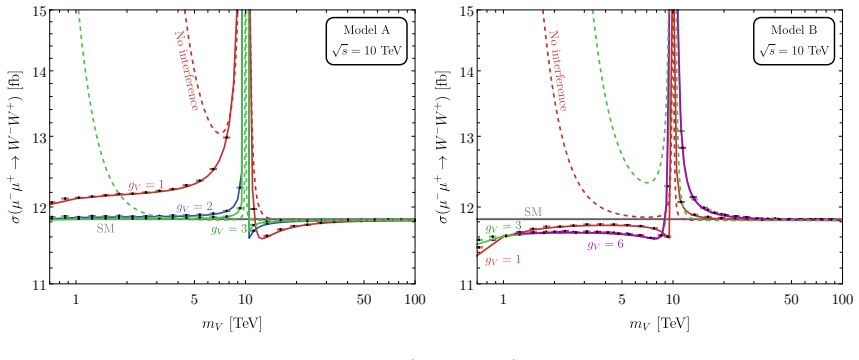
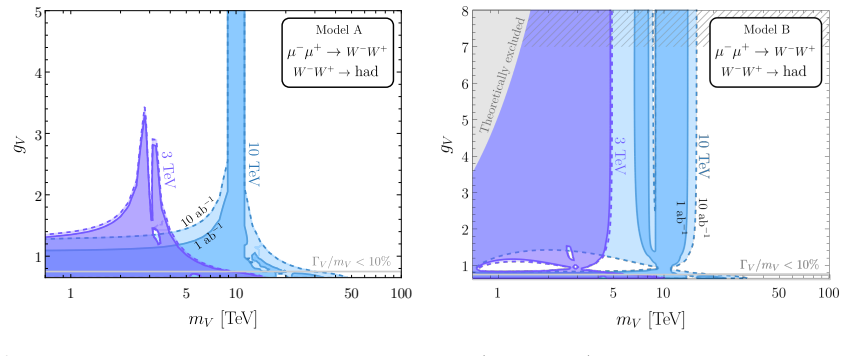
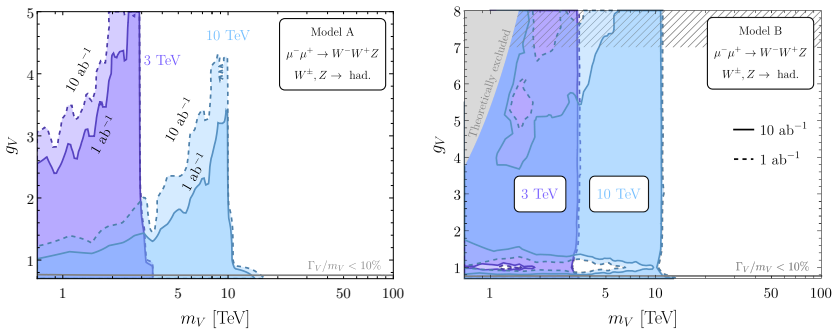
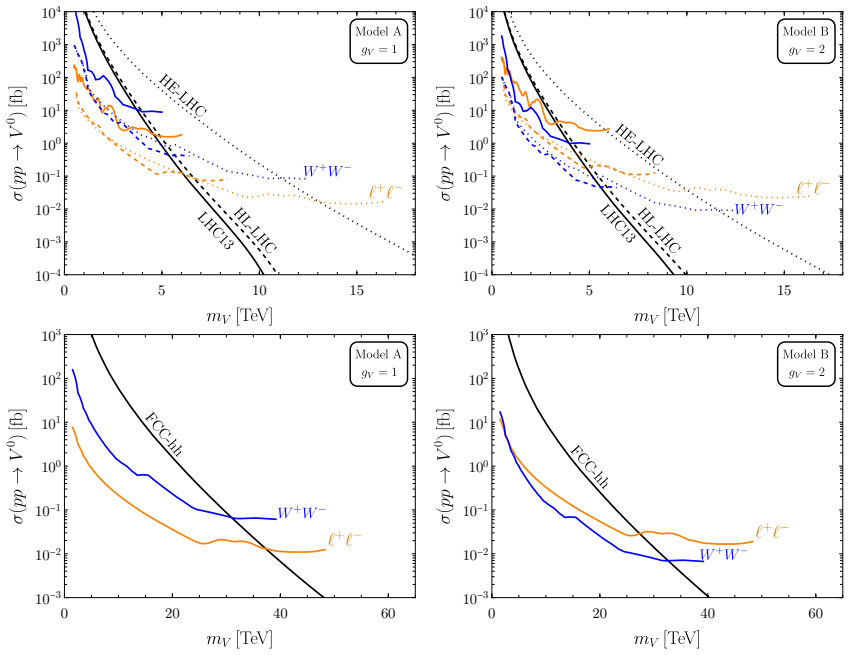
Heavy vector triplets could be probed up to masses of around 12 TeV for almost any perturbative value of the coupling by performing a detailed collider analysis of a variety of 2 to 2 and 2 to 3 processes at a proposed muon collider, focusing on decays into leptons and Standard Model gauge bosons, with projected sensitivities competitive with future hadron colliders though not reaching the FCC-hh.
What carries the argument
Detailed simulation of 2-to-2 and 2-to-3 production and decay channels at a muon collider for vector triplet signals in lepton and gauge boson final states.
If this is right
- A muon collider offers projected sensitivities that are competitive with future hadron colliders for heavy vector triplets.
- The muon collider reach exceeds that projected for the HE-LHC in the scenarios considered.
- Indirect limits from future electroweak precision observables strengthen the overall constraints when combined with direct searches.
- The results apply across weakly coupled gauge extensions and strongly coupled composite Higgs models.
Where Pith is reading between the lines
- Muon colliders may offer an advantage for vector triplet searches because their clean environment reduces QCD backgrounds that affect hadron colliders.
- The broad coupling-independent reach suggests that non-observation at a muon collider would tightly constrain many motivated UV completions at high scales.
- Similar analysis techniques could be extended to other heavy vector states or to precision measurements of diboson resonances.
- If the collider is built, early runs at lower energies could already test parts of the parameter space before full luminosity is reached.
Load-bearing premise
The muon collider detector performance, background rejection, and luminosity assumptions used in the 2-to-2 and 2-to-3 simulations are taken as given without detailed validation against real data or full detector simulation.
What would settle it
A full detector simulation or real data showing substantially higher irreducible backgrounds or lower signal efficiency than the paper's assumptions would reduce the projected 12 TeV mass reach.
Figures








read the original abstract
Heavy spin-one particles are well-motivated new physics candidates that can have their origin in weakly coupled extensions of the Standard Model gauge group or in strongly coupled Composite Higgs models. Due to the variety of production and decay modes, heavy vector triplets are a useful benchmark for the study and comparison of future colliders. Here we perform a detailed collider analysis of a variety of $2 \to 2$ and $2 \to 3$ processes at a proposed future muon collider. We focus on decays into leptons and Standard Model gauge bosons, and find that heavy vector triplets could be probed up to masses of around $12\,$TeV for almost any (perturbative) value of the coupling. We compare the direct reach of a muon collider to the LHC and to updated projections for the HL-LHC, HE-LHC and FCC-hh, and include indirect limits from future measurements of electroweak precision observables. We find that a muon collider offers projected sensitivities that are competitive with future hadron colliders, exceeding those of the HE-LHC in the scenarios considered though not reaching the projected sensitivity of the FCC-hh.
Editorial analysis
A structured set of objections, weighed in public.
Referee Report
Summary. The manuscript performs a detailed collider analysis of 2→2 and 2→3 processes at a proposed muon collider for heavy vector triplets, focusing on decays into leptons and Standard Model gauge bosons. It concludes that such particles can be probed up to masses of around 12 TeV for almost any perturbative value of the coupling, with direct sensitivities competitive with or exceeding the HE-LHC (though below the FCC-hh) and supplemented by indirect limits from future electroweak precision observables.
Significance. If the projected sensitivities are robust, the work provides a useful benchmark for comparing the reach of future colliders on heavy spin-1 resonances, highlighting the clean environment of a muon collider for multi-TeV searches. The explicit comparison to HL-LHC, HE-LHC, and FCC-hh projections, together with the inclusion of indirect electroweak constraints, strengthens its value as a reference for new-physics phenomenology.
major comments (2)
- [Abstract and analysis sections] Abstract and analysis sections: The headline claim that heavy vector triplets can be probed up to 12 TeV for almost any perturbative coupling rests on Monte Carlo simulations of 2→2 and 2→3 processes whose specific inputs (integrated luminosity, lepton/photon reconstruction efficiencies, and background rejection factors) are taken from design studies without reported validation against full detector simulation or sensitivity scans to variations in these parameters.
- [Analysis sections] Analysis sections: No error bars, background estimates, or efficiency tables are referenced in support of the 12 TeV reach, which is required to assess whether the signal significances remain above threshold at m_V ≈ 12 TeV when irreducible backgrounds (e.g., μ⁺μ⁻ → W⁺W⁻, ZZ) or luminosity assumptions are revised.
minor comments (1)
- [Abstract] Abstract: Consider adding a short clause specifying the assumed muon-collider center-of-mass energy and integrated luminosity to immediately contextualize the 12 TeV reach.
Simulated Author's Rebuttal
We thank the referee for the constructive comments and for recognizing the potential value of this work as a benchmark for future collider comparisons. We have revised the manuscript to strengthen the presentation of our assumptions and to provide additional quantitative support for the projected sensitivities.
read point-by-point responses
-
Referee: [Abstract and analysis sections] Abstract and analysis sections: The headline claim that heavy vector triplets can be probed up to 12 TeV for almost any perturbative coupling rests on Monte Carlo simulations of 2→2 and 2→3 processes whose specific inputs (integrated luminosity, lepton/photon reconstruction efficiencies, and background rejection factors) are taken from design studies without reported validation against full detector simulation or sensitivity scans to variations in these parameters.
Authors: We agree that the robustness of the projections benefits from explicit discussion of the input parameters. In the revised manuscript we now cite the specific muon collider design studies from which the luminosity, efficiency, and rejection factors are taken. We have added a new subsection that reports sensitivity scans in which the lepton/photon efficiencies and background rejection factors are varied by ±20 % and ±30 %. These scans show that the 12 TeV reach is preserved under nominal and moderately pessimistic assumptions, with only modest degradation in the most conservative cases. While a complete detector simulation lies outside the scope of this phenomenological study, the additional scans provide a quantitative measure of stability. revision: yes
-
Referee: [Analysis sections] Analysis sections: No error bars, background estimates, or efficiency tables are referenced in support of the 12 TeV reach, which is required to assess whether the signal significances remain above threshold at m_V ≈ 12 TeV when irreducible backgrounds (e.g., μ⁺μ⁻ → W⁺W⁻, ZZ) or luminosity assumptions are revised.
Authors: We accept that the original presentation lacked sufficient quantitative backing. The revised version includes a new table that lists the assumed reconstruction efficiencies, background rejection factors, and the resulting signal significances at the highest masses. Irreducible backgrounds from μ⁺μ⁻ → W⁺W⁻ and ZZ are already incorporated in our Monte Carlo samples; the updated text now explicitly states the significance calculation and shows that the 5σ threshold is maintained at 12 TeV under the baseline luminosity. Error bands reflecting the parameter variations from the new scans have been added to the relevant sensitivity figures. revision: yes
Circularity Check
No circularity: reach from forward Monte Carlo simulation
full rationale
The paper derives its 12 TeV mass reach claim via explicit Monte Carlo simulation of 2-to-2 and 2-to-3 production and decay channels, using standard cross-section and branching-ratio calculations together with externally stated luminosity and detector-efficiency assumptions taken from muon-collider design studies. No equation reduces a fitted parameter to a renamed prediction, no central premise rests on a self-citation chain, and no ansatz or uniqueness theorem is smuggled in from prior author work. The derivation chain is therefore self-contained and does not collapse to its inputs by construction.
Axiom & Free-Parameter Ledger
free parameters (1)
- vector triplet mass and coupling
axioms (1)
- standard math Standard Model gauge interactions and parton distribution functions remain valid at muon collider energies
Lean theorems connected to this paper
-
IndisputableMonolith/Foundation/RealityFromDistinction.leanreality_from_one_distinction unclear?
unclearRelation between the paper passage and the cited Recognition theorem.
We perform a detailed collider analysis of a variety of 2→2 and 2→3 processes... heavy vector triplets could be probed up to masses of around 12 TeV
-
IndisputableMonolith/Cost/FunctionalEquation.leanwashburn_uniqueness_aczel unclear?
unclearRelation between the paper passage and the cited Recognition theorem.
We use MadGraph to simulate signal, background and interference... statistical analysis for 2→2 and 2→3 processes
What do these tags mean?
- matches
- The paper's claim is directly supported by a theorem in the formal canon.
- supports
- The theorem supports part of the paper's argument, but the paper may add assumptions or extra steps.
- extends
- The paper goes beyond the formal theorem; the theorem is a base layer rather than the whole result.
- uses
- The paper appears to rely on the theorem as machinery.
- contradicts
- The paper's claim conflicts with a theorem or certificate in the canon.
- unclear
- Pith found a possible connection, but the passage is too broad, indirect, or ambiguous to say the theorem truly supports the claim.
Reference graph
Works this paper leans on
-
[1]
J. P. Delahaye, M. Diemoz, K. Long, B. Mansouli´ e, N. Pastrone, L. Rivkin, D. Schulte, A. Skrinsky, and A. Wulzer,Muon Colliders,arXiv:1901.06150
work page internal anchor Pith review Pith/arXiv arXiv 1901
-
[2]
Al Ali et al.,The muon Smasher’s guide,Rept
H. Al Ali et al.,The muon Smasher’s guide,Rept. Prog. Phys.85(2022), no. 8 084201, [arXiv:2103.14043]
-
[3]
Accettura et al.,Towards a muon collider,Eur
C. Accettura et al.,Towards a muon collider,Eur. Phys. J. C83(2023), no. 9 864, [arXiv:2303.08533]. [Erratum: Eur.Phys.J.C 84, 36 (2024)]
-
[4]
R. B. Palmer,Muon colliders,Reviews of Accelerator Science and Technology07(2014) 137–159, [https://doi.org/10.1142/S1793626814300072]
- [5]
-
[6]
M. Narain et al.,The Future of US Particle Physics - The Snowmass 2021 Energy Frontier Report,arXiv:2211.11084. [8]P5Collaboration, S. Asai et al.,Exploring the Quantum Universe: Pathways to Innovation and Discovery in Particle Physics,arXiv:2407.19176. [9]International Muon ColliderCollaboration, C. Accettura et al.,Interim report for the International M...
-
[7]
M. Begel et al.,United States Muon Collider Community White Paper for the European Strategy for Particle Physics Update,arXiv:2503.23695
-
[8]
M. Ruhdorfer, E. Salvioni, and A. Wulzer,Invisible Higgs boson decay from forward muons at a muon collider,Phys. Rev. D107(2023), no. 9 095038, [arXiv:2303.14202]
-
[9]
P. Andreetto et al.,Aspects of Higgs Physics at a √s= 3TeV Muon Collider with detailed detector simulation,Eur. Phys. J. C85(2025), no. 3 221, [arXiv:2405.19314]
-
[10]
D. Marzocca, F. Montagno, M. Morales-Alvarado, and A. Wulzer,Quark mixing from muon collider neutrinos,arXiv:2511.23288
-
[11]
A. Costantini, F. De Lillo, F. Maltoni, L. Mantani, O. Mattelaer, R. Ruiz, and X. Zhao, Vector boson fusion at multi-TeV muon colliders,JHEP09(2020) 080, [arXiv:2005.10289]
- [12]
- [13]
-
[14]
J. de Blas, Y. Du, C. Grojean, J. Gu, V. Miralles, M. E. Peskin, J. Tian, M. Vos, and E. Vryonidou,Global SMEFT Fits at Future Colliders, inSnowmass 2021, 6, 2022. arXiv:2206.08326
- [15]
-
[16]
M. Forslund and P. Meade,High precision higgs from high energy muon colliders,JHEP08 (2022) 185, [arXiv:2203.09425]
-
[17]
S. Dawson et al.,Report of the Topical Group on Higgs Physics for Snowmass 2021: The Case for Precision Higgs Physics, inSnowmass 2021, 9, 2022.arXiv:2209.07510
- [18]
- [19]
-
[20]
S. Airen and R. Franceschini,Top quark FCNC in Randall-Sundrum models: post-LHC allowed rates and searches ate +e− andµ +µ− colliders,arXiv:2601.14966
- [21]
-
[22]
M. Ruhdorfer, E. Salvioni, and A. Weiler,A Global View of the Off-Shell Higgs Portal, SciPost Phys.8(2020) 027, [arXiv:1910.04170]
- [23]
-
[24]
R. Capdevilla, D. Curtin, Y. Kahn, and G. Krnjaic,No-lose theorem for discovering the new physics of(g−2) µ at muon colliders,Phys. Rev. D105(2022), no. 1 015028, [arXiv:2101.10334]
-
[25]
R. Capdevilla, D. Curtin, Y. Kahn, and G. Krnjaic,Systematically testing singlet models for(g−2) µ,JHEP04(2022) 129, [arXiv:2112.08377]
-
[26]
D. Buttazzo and P. Paradisi,Probing the muong−2anomaly with the Higgs boson at a muon collider,Phys. Rev. D104(2021), no. 7 075021, [arXiv:2012.02769]
- [27]
- [28]
-
[29]
C. Cesarotti, S. Homiller, R. K. Mishra, and M. Reece,Probing New Gauge Forces with a High-Energy Muon Beam Dump,Phys. Rev. Lett.130(2023), no. 7 071803, [arXiv:2202.12302]
-
[30]
R. Capdevilla, F. Meloni, R. Simoniello, and J. Zurita,Hunting wino and higgsino dark matter at the muon collider with disappearing tracks,JHEP06(2021) 133, [arXiv:2102.11292]
- [31]
- [32]
-
[33]
V. D. Barger, W.-Y. Keung, and E. Ma,A Gauge Model With LightWandZBosons, Phys. Rev. D22(1980) 727
work page 1980
-
[34]
J. L. Hewett and T. G. Rizzo,Low-Energy Phenomenology of Superstring Inspired E(6) Models,Phys. Rept.183(1989) 193
work page 1989
-
[35]
Discovery and Identification of Extra Gauge Bosons
M. Cvetic and S. Godfrey,Discovery and identification of extra gauge bosons, pp. 383–415. 3, 1995.hep-ph/9504216
work page internal anchor Pith review Pith/arXiv arXiv 1995
-
[36]
T. G. Rizzo,Z ′ Phenomenology and the LHC,hep-ph/0610104. [Inspire]
work page internal anchor Pith review Pith/arXiv arXiv
-
[37]
LHC Signals for Warped Electroweak Neutral Gauge Bosons
K. Agashe, H. Davoudiasl, S. Gopalakrishna, T. Han, G.-Y. Huang, G. Perez, Z.-G. Si, and A. Soni,LHC Signals for Warped Electroweak Neutral Gauge Bosons,Phys. Rev.D 76 (2007) 115015, [arXiv:0709.0007]. [Inspire]
work page internal anchor Pith review Pith/arXiv arXiv 2007
-
[38]
The Physics of Heavy Z' Gauge Bosons
P. Langacker,The Physics of HeavyZ ′ Gauge Bosons,Rev. Mod. Phys.81(2009) 1199–1228, [arXiv:0801.1345]. – 46 –
work page internal anchor Pith review Pith/arXiv arXiv 2009
-
[39]
Non-universal minimal Z' models: present bounds and early LHC reach
E. Salvioni, A. Strumia, G. Villadoro, and F. Zwirner,Non-universal minimal Z’ models: present bounds and early LHC reach,JHEP03(2010) 010, [arXiv:0911.1450]. [Inspire]
work page internal anchor Pith review Pith/arXiv arXiv 2010
-
[41]
LHC Signals for Warped Electroweak Charged Gauge Bosons
K. Agashe, S. Gopalakrishna, T. Han, G.-Y. Huang, and A. Soni,LHC signals for warped electroweak charged gauge bosons,Phys. Rev.D 80(2009) 075007, [arXiv:0810.1497]. [Inspire]
work page internal anchor Pith review Pith/arXiv arXiv 2009
-
[42]
Two Simple W' Models for the Early LHC
M. Schmaltz and C. Spethmann,Two SimpleW ′ Models for the Early LHC,JHEP07 (2011) 046, [arXiv:1011.5918]. [Inspire]
work page internal anchor Pith review Pith/arXiv arXiv 2011
-
[43]
A weakly constrained W' at the early LHC
C. Grojean, E. Salvioni, and R. Torre,A weakly constrained W’ at the early LHC,JHEP07 (2011) 002, [arXiv:1103.2761]
work page internal anchor Pith review Pith/arXiv arXiv 2011
-
[44]
P. Langacker and S. U. Sankar,Bounds on the Mass of W(R) and the W(L)-W(R) Mixing Angle xi in General SU(2)-L x SU(2)-R x U(1) Models,Phys. Rev. D40(1989) 1569–1585
work page 1989
-
[45]
Production and Decays of $W_R$ bosons at the LHC
M. Frank, A. Hayreter, and I. Turan,Production and Decays ofW R bosons at the LHC, Phys. Rev.D 83(2011) 035001, [arXiv:1010.5809]. [Inspire]
work page internal anchor Pith review Pith/arXiv arXiv 2011
-
[47]
W' production at the LHC in the 4-site Higgsless model
E. Accomando, D. Becciolini, S. D. Curtis, D. Dominici, and L. Fedeli,W ′ production at the LHC in the 4-site Higgsless model,Phys. Rev.D 84(2011) 115014, [arXiv:1107.4087]. [Inspire]
work page internal anchor Pith review Pith/arXiv arXiv 2011
- [48]
-
[49]
M. S. Chanowitz and W. Kilgore,Complementarity of Resonant and Nonresonant Strong W WScattering at the LHC,Phys. Lett.B 322(1993) 147–153, [hep-ph/9311336]. [Inspire]
work page internal anchor Pith review Pith/arXiv arXiv 1993
-
[50]
Heavy Vectors in Higgs-less models
R. Barbieri, G. Isidori, V. S. Rychkov, and E. Trincherini,Heavy Vectors in Higgs-less models,Phys. Rev. D78(2008) 036012, [arXiv:0806.1624]
work page internal anchor Pith review Pith/arXiv arXiv 2008
-
[51]
Composite Vectors at the Large Hadron Collider
R. Barbieri, A. E. C´ arcamo Hern´ andez, G. Corcella, R. Torre, and E. Trincherini,Composite vectors at the large hadron collider,JHEP03(2010) 068, [arXiv:0911.1942]. [Inspire]
work page internal anchor Pith review Pith/arXiv arXiv 2010
-
[52]
K. Agashe and R. Contino,Composite Higgs-Mediated FCNC,Phys. Rev.D 80(2009) 075016, [arXiv:0906.1542]. [Inspire]
work page internal anchor Pith review Pith/arXiv arXiv 2009
-
[53]
LHC Signals for Coset Electroweak Gauge Bosons in Warped/Composite PGB Higgs Models
K. Agashe, A. Azatov, T. Han, Y. Li, Z.-G. Si, and L. Zhu,LHC Signals for Coset Electroweak Gauge Bosons in Warped/Composite PGB Higgs Models,Phys. Rev.D 81 (2010) 096002, [arXiv:0911.0059]. [Inspire]
work page internal anchor Pith review Pith/arXiv arXiv 2010
-
[54]
O. Cata, G. Isidori, and J. F. Kamenik,Drell-Yan production of Heavy Vectors in Higgsless models,Nucl. Phys. B822(2009) 230–244, [arXiv:0905.0490]
work page internal anchor Pith review Pith/arXiv arXiv 2009
-
[55]
Signals of composite electroweak-neutral Dark Matter: LHC/Direct Detection interplay
R. Barbieri, S. Rychkov, and R. Torre,Signals of composite electroweak-neutral Dark Matter: LHC/Direct Detection interplay,Phys. Lett. B688(2010) 212–215, [arXiv:1001.3149]. – 47 –
work page internal anchor Pith review Pith/arXiv arXiv 2010
-
[56]
A. E. Carcamo Hernandez,Top quark effects in composite vector pair production at the LHC,Eur. Phys. J. C72(2012) 2154, [arXiv:1008.1039]
work page internal anchor Pith review Pith/arXiv arXiv 2012
-
[57]
A. E. Carcamo Hernandez and R. Torre,A ’Composite’ scalar-vector system at the LHC, Nucl. Phys. B841(2010) 188–204, [arXiv:1005.3809]
work page internal anchor Pith review Pith/arXiv arXiv 2010
-
[58]
A. Falkowski, C. Grojean, A. Kaminska, S. Pokorski, and A. Weiler,If no Higgs then what?, JHEP11(2011) 028, [arXiv:1108.1183]. [Inspire]
work page internal anchor Pith review Pith/arXiv arXiv 2011
-
[59]
On the effect of resonances in composite Higgs phenomenology
R. Contino, D. Marzocca, D. Pappadopulo, and R. Rattazzi,On the effect of resonances in composite Higgs phenomenology,JHEP10(2011) 081, [arXiv:1109.1570]
work page internal anchor Pith review Pith/arXiv arXiv 2011
-
[60]
M. S. Chanowitz,A Heavy little Higgs and a light Z’ under the radar,Phys. Rev. D84 (2011) 035014, [arXiv:1102.3672]
work page internal anchor Pith review Pith/arXiv arXiv 2011
-
[61]
B. Bellazzini, C. Csaki, J. Hubisz, J. Serra, and J. Terning,Composite Higgs Sketch,JHEP 11(2012) 003, [arXiv:1205.4032]
work page internal anchor Pith review Pith/arXiv arXiv 2012
-
[62]
Charged di-boson production at the LHC in a 4-site model with a composite Higgs boson
E. Accomando, L. Fedeli, S. Moretti, S. D. Curtis, and D. Dominici,Charged di-boson production at the LHC in a 4-site model with a composite Higgs boson,Phys.Rev.D86 (2012) 115006, [arXiv:1208.0268]. [Inspire]
work page internal anchor Pith review Pith/arXiv arXiv 2012
-
[63]
D. Greco and D. Liu,Hunting composite vector resonances at the LHC: naturalness facing data,JHEP12(2014) 126, [arXiv:1410.2883]
-
[64]
M. Low, A. Tesi, and L.-T. Wang,Composite spin-1 resonances at the LHC,Phys. Rev. D 92(2015), no. 8 085019, [arXiv:1507.07557]
work page internal anchor Pith review Pith/arXiv arXiv 2015
-
[65]
E. Accomando, D. Barducci, S. De Curtis, J. Fiaschi, S. Moretti, and C. H. Shepherd-Themistocleous,Drell-Yan production of multi Z ′ -bosons at the LHC within Non-Universal ED and 4D Composite Higgs Models,JHEP07(2016) 068, [arXiv:1602.05438]
work page internal anchor Pith review Pith/arXiv arXiv 2016
-
[66]
Prospects of searching for composite resonances at the LHC and beyond
D. Liu, L.-T. Wang, and K.-P. Xie,Prospects of searching for composite resonances at the LHC and beyond,JHEP01(2019) 157, [arXiv:1810.08954]
work page internal anchor Pith review Pith/arXiv arXiv 2019
- [67]
-
[68]
S. De Curtis and D. Dominici,Spin-1 resonances,Eur. Phys. J. ST231(2022), no. 7 1299–1308, [arXiv:2110.01907]
- [69]
-
[70]
Heavy Vector Triplets: Bridging Theory and Data
D. Pappadopulo, A. Thamm, R. Torre, and A. Wulzer,Heavy Vector Triplets: Bridging Theory and Data,JHEP09(2014) 060, [arXiv:1402.4431]
work page internal anchor Pith review Pith/arXiv arXiv 2014
- [71]
-
[72]
Y. Hosseini and M. M. Najafabadi,Unitarity constraints and collider searches for dark photons,Phys. Rev. D106(2022), no. 1 015028, [arXiv:2202.10058]
-
[73]
A. Dasgupta, P. S. B. Dev, T. Han, R. Padhan, S. Wang, and K. Xie,Searching for heavy leptophilic Z’: from lepton colliders to gravitational waves,JHEP12(2023) 011, [arXiv:2308.12804]. – 48 –
- [74]
- [75]
-
[76]
Strong Higgs Interactions at a Linear Collider
R. Contino, C. Grojean, D. Pappadopulo, R. Rattazzi, and A. Thamm,Strong Higgs Interactions at a Linear Collider,JHEP02(2014) 006, [arXiv:1309.7038]
work page internal anchor Pith review Pith/arXiv arXiv 2014
-
[77]
Zurbano Fernandez et al.,High-Luminosity Large Hadron Collider (HL-LHC): Technical design report,
I. Zurbano Fernandez et al.,High-Luminosity Large Hadron Collider (HL-LHC): Technical design report, . [82]FCCCollaboration, A. Abada et al.,HE-LHC: The High-Energy Large Hadron Collider: Future Circular Collider Conceptual Design Report Volume 4,Eur. Phys. J. ST228(2019), no. 5 1109–1382
work page 2019
-
[78]
X. Cid Vidal et al.,Report from Working Group 3: Beyond the Standard Model physics at the HL-LHC and HE-LHC,CERN Yellow Rep. Monogr.7(2019) 585–865, [arXiv:1812.07831]. [84]FCCCollaboration, A. Abada et al.,FCC-hh: The Hadron Collider: Future Circular Collider Conceptual Design Report Volume 3,Eur. Phys. J. ST228(2019), no. 4 755–1107
-
[79]
Future tests of Higgs compositeness: direct vs indirect
A. Thamm, R. Torre, and A. Wulzer,Future tests of Higgs compositeness: direct vs indirect, JHEP07(2015) 100, [arXiv:1502.01701]
work page internal anchor Pith review Pith/arXiv arXiv 2015
- [80]
-
[81]
D. Buttazzo, R. Franceschini, and A. Wulzer,Two Paths Towards Precision at a Very High Energy Lepton Collider,JHEP05(2021) 219, [arXiv:2012.11555]
- [82]
discussion (0)
Sign in with ORCID, Apple, or X to comment. Anyone can read and Pith papers without signing in.