Recognition: 1 theorem link
· Lean TheoremA Twist on Scattering from Defect Anomalies
Pith reviewed 2026-05-15 02:35 UTC · model grok-4.3
The pith
Localized 't Hooft anomalies on defects drive scattering into exotic twist states.
A machine-rendered reading of the paper's core claim, the machinery that carries it, and where it could break.
Core claim
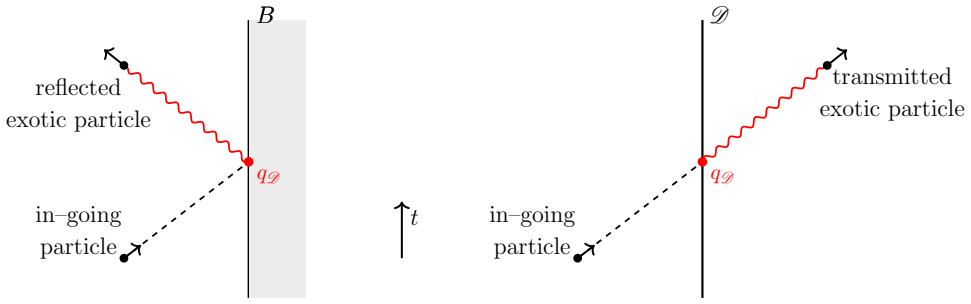
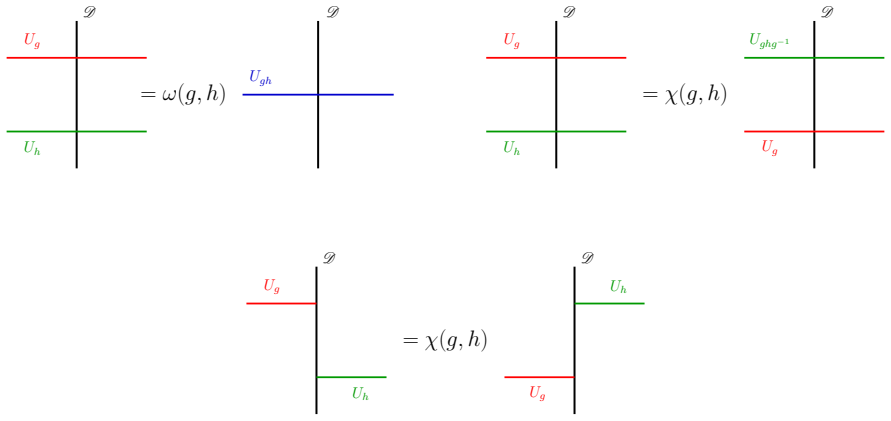
We show that one possible mechanism driving these 'categorical scattering' processes is the presence of localized 't Hooft anomalies on the defect's worldvolume. Defect anomalies trap non-trivial charges at junctions between the symmetry lines and the interface, opening new transmission channels that would naively appear to violate selection rules. After outlining the general mechanism, we investigate several concrete examples with defects, interfaces, and boundaries.
What carries the argument
Localized 't Hooft anomalies on the defect's worldvolume, which trap non-trivial charges at junctions between symmetry lines and the interface, thereby enabling new scattering channels into twist operator states.
If this is right
- Scattering amplitudes must include twist operators as allowed outcomes when defects carry these anomalies.
- New massive integrable theories admit explicit solutions with modified transmission channels due to the anomalies.
- Chiral fermion models exhibit twist operators directly as a result of their defect anomalies.
- Lattice spin chains with defects are expected to display analogous scattering physics.
Where Pith is reading between the lines
- This could extend to dynamical defects or higher-dimensional interfaces where anomalies might alter transport properties.
- It suggests a way to engineer scattering rules in quantum simulators by controlling anomaly placement.
- Connections to anyonic excitations in condensed matter may arise from the trapped charges at junctions.
Load-bearing premise
The defects in the models considered host localized 't Hooft anomalies capable of trapping non-trivial charges at junctions between symmetry lines and the interface.
What would settle it
A calculation showing twist operators in scattering for a defect without localized anomalies, or their absence in a model with such anomalies, would falsify the mechanism.
Figures




read the original abstract
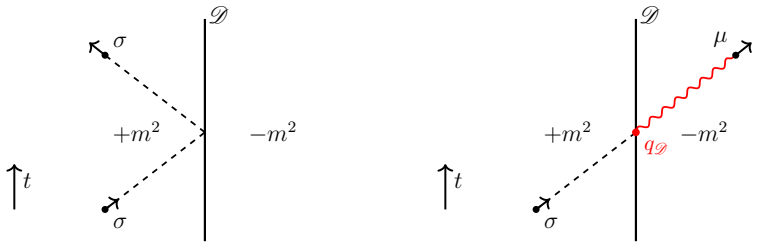
In the presence of extended defects, familiar incoming particles can scatter into exotic outgoing states created by twist operators. We show that one possible mechanism driving these "categorical scattering" processes is the presence of localized 't Hooft anomalies on the defect's worldvolume. Defect anomalies trap non-trivial charges at junctions between the symmetry lines and the interface, opening new transmission channels that would naively appear to violate selection rules. After outlining the general mechanism, we investigate several concrete examples with defects, interfaces, and boundaries. For models of massless chiral fermions already studied in the literature, we show that the emergence of twist operators can be understood as a consequence of defect anomalies. We then introduce new massive integrable theories in which a similar phenomenon occurs, and we explicitly solve the associated scattering problem, obtaining new integrable solutions. Finally, we construct lattice spin chains with defects where similar physics is expected to arise.
Editorial analysis
A structured set of objections, weighed in public.
Referee Report
Summary. The paper claims that localized 't Hooft anomalies on defect worldvolumes drive categorical scattering processes, in which familiar particles scatter into exotic states created by twist operators. After outlining the general mechanism of charge trapping at symmetry-line junctions, the authors show that twist operators in known chiral-fermion models arise from defect anomalies, construct new massive integrable theories where the same phenomenon occurs, explicitly solve the associated scattering problems to obtain new integrable S-matrices, and discuss lattice spin-chain realizations.
Significance. If the derivations hold, the work supplies a concrete anomaly-based mechanism for exotic scattering channels that would otherwise violate naive selection rules, together with explicit new integrable S-matrices and lattice constructions. The explicit solutions for the massive theories and the link between anomaly inflow and modified transmission rules constitute the main advance.
major comments (1)
- [§4] §4 (new massive theories): the integrability of the reported S-matrices is asserted via the anomaly-induced selection-rule modification, but the manuscript does not display an explicit check that the obtained amplitudes satisfy the Yang-Baxter equation or factorization property beyond the anomaly argument; this verification is load-bearing for the claim of new integrable solutions.
minor comments (2)
- The notation for the twist operators and the defect anomaly coefficients is introduced without a consolidated table; a short summary table would improve readability.
- Several references to prior literature on defect anomalies (e.g., the chiral-fermion examples) are cited only by author-year; full bibliographic details should be added for completeness.
Simulated Author's Rebuttal
We thank the referee for their careful reading of the manuscript and for the constructive comment on the integrability verification. We address the point raised in the major comment below.
read point-by-point responses
-
Referee: [§4] §4 (new massive theories): the integrability of the reported S-matrices is asserted via the anomaly-induced selection-rule modification, but the manuscript does not display an explicit check that the obtained amplitudes satisfy the Yang-Baxter equation or factorization property beyond the anomaly argument; this verification is load-bearing for the claim of new integrable solutions.
Authors: We agree that an explicit verification of the Yang-Baxter equation strengthens the integrability claim. In the revised manuscript we have added, in §4, a direct check that the obtained S-matrices satisfy the Yang-Baxter equation by explicit computation of the three-particle amplitudes in the charge sectors permitted by the anomaly selection rules. The factorization property follows from the underlying construction of the massive theories, which we now support by exhibiting the first few conserved charges that commute with the defect-modified scattering. revision: yes
Circularity Check
No significant circularity detected
full rationale
The derivation begins from the established anomaly inflow mechanism (cited from prior literature) and applies it to both known chiral-fermion models and newly constructed massive integrable theories. Explicit scattering solutions and lattice constructions are supplied with independent derivations; no equation reduces by construction to a fitted parameter, self-defined quantity, or load-bearing self-citation chain. The central claim retains external content from the anomaly selection rules and the new S-matrix calculations.
Axiom & Free-Parameter Ledger
axioms (1)
- standard math Standard axioms of relativistic quantum field theory and anomaly inflow/matching conditions.
Lean theorems connected to this paper
-
IndisputableMonolith/Foundation/AbsoluteFloorClosure.leanreality_from_one_distinction unclear?
unclearRelation between the paper passage and the cited Recognition theorem.
We show that one possible mechanism driving these 'categorical scattering' processes is the presence of localized 't Hooft anomalies on the defect's worldvolume.
What do these tags mean?
- matches
- The paper's claim is directly supported by a theorem in the formal canon.
- supports
- The theorem supports part of the paper's argument, but the paper may add assumptions or extra steps.
- extends
- The paper goes beyond the formal theorem; the theorem is a base layer rather than the whole result.
- uses
- The paper appears to rely on the theorem as machinery.
- contradicts
- The paper's claim conflicts with a theorem or certificate in the canon.
- unclear
- Pith found a possible connection, but the passage is too broad, indirect, or ambiguous to say the theorem truly supports the claim.
Reference graph
Works this paper leans on
-
[1]
Defects in conformal field theory
M. Bill` o, V. Gon¸ calves, E. Lauria, and M. Meineri, “Defects in conformal field theory,”JHEP04 (2016) 091,arXiv:1601.02883 [hep-th]
work page internal anchor Pith review Pith/arXiv arXiv 2016
-
[2]
Boundary Conformal Field Theory and a Boundary Central Charge
C. P. Herzog and K.-W. Huang, “Boundary Conformal Field Theory and a Boundary Central Charge,”JHEP10(2017) 189,arXiv:1707.06224 [hep-th]
work page internal anchor Pith review Pith/arXiv arXiv 2017
-
[3]
Line and surface defects for the free scalar field,
E. Lauria, P. Liendo, B. C. Van Rees, and X. Zhao, “Line and surface defects for the free scalar field,”JHEP01(2021) 060,arXiv:2005.02413 [hep-th]
-
[4]
Renormalization Group Flows on Line Defects,
G. Cuomo, Z. Komargodski, and A. Raviv-Moshe, “Renormalization Group Flows on Line Defects,”Phys. Rev. Lett.128no. 2, (2022) 021603,arXiv:2108.01117 [hep-th]
- [5]
-
[6]
A scaling limit for line and surface defects,
D. Rodriguez-Gomez, “A scaling limit for line and surface defects,”JHEP06(2022) 071, arXiv:2202.03471 [hep-th]
-
[7]
Phases of Wilson Lines in Conformal Field Theories,
O. Aharony, G. Cuomo, Z. Komargodski, M. Mezei, and A. Raviv-Moshe, “Phases of Wilson Lines in Conformal Field Theories,”Phys. Rev. Lett.130no. 15, (2023) 151601,arXiv:2211.11775 [hep-th]
-
[8]
O. Aharony, G. Cuomo, Z. Komargodski, M. Mezei, and A. Raviv-Moshe, “Phases of Wilson lines: conformality and screening,”JHEP12(2023) 183,arXiv:2310.00045 [hep-th]
-
[9]
Disclinations, Dislocations, and Emanant Flux at Dirac Criticality,
M. Barkeshli, C. Fechisin, Z. Komargodski, and S. Zhong, “Disclinations, Dislocations, and Emanant Flux at Dirac Criticality,”Phys. Rev. X16no. 1, (2026) 011017,arXiv:2501.13866 [cond-mat.str-el]
-
[10]
Factorizing Defects from Generalized Pinning Fields,
F. K. Popov and Y. Wang, “Factorizing Defects from Generalized Pinning Fields,” (4, 2025) , arXiv:2504.06203 [hep-th]
-
[11]
Defect Anomalies, a Spin-Flux Duality, and Boson-Kondo Problems,
Z. Komargodski, F. K. Popov, and B. C. Rayhaun, “Defect Anomalies, a Spin-Flux Duality, and Boson-Kondo Problems,”arXiv:2508.14963 [hep-th]
-
[12]
Extraordinary Surface Criticalities for Interacting Fermions
O. Diatlyk, Z. Sun, and Y. Wang, “Extraordinary Surface Criticalities for Interacting Fermions,” arXiv:2604.15187 [hep-th]
work page internal anchor Pith review Pith/arXiv arXiv
-
[13]
The Proton Decay — Magnetic Monopole Connection,
C. G. Callan, Jr., “The Proton Decay — Magnetic Monopole Connection,”AIP Conf. Proc.98 (1983) 24–34
work page 1983
-
[14]
Monopole catalysis of proton decay,
V. A. Rubakov, “Monopole catalysis of proton decay,”Reports on Progress in Physics51no. 2, (Feb, 1988) 189
work page 1988
-
[15]
C. G. Callan, “Disappearing dyons,”Phys. Rev. D25(Apr, 1982) 2141–2146
work page 1982
-
[16]
Adler-bell-jackiw anomaly and fermion-number breaking in the presence of a magnetic monopole,
V. Rubakov, “Adler-bell-jackiw anomaly and fermion-number breaking in the presence of a magnetic monopole,”Nuclear Physics B203no. 2, (1982) 311–348
work page 1982
-
[17]
M. van Beest, P. Boyle Smith, D. Delmastro, Z. Komargodski, and D. Tong, “Monopoles, Scattering, and Generalized Symmetries,”arXiv:2306.07318 [hep-th]
-
[18]
M. van Beest, P. Boyle Smith, D. Delmastro, R. Mouland, and D. Tong, “Fermion-monopole scattering in the Standard Model,”JHEP08(2024) 004,arXiv:2312.17746 [hep-th]. 58
-
[19]
Monopole-Fermion Scattering and the Solution to the Semiton–Unitarity Puzzle,
V. Loladze and T. Okui, “Monopole-Fermion Scattering and the Solution to the Semiton–Unitarity Puzzle,”Phys. Rev. Lett.134no. 5, (2025) 051602,arXiv:2408.04577 [hep-th]
-
[20]
Monopole-fermion scattering in a chiral gauge theory,
S. Bolognesi, B. Bucciotti, and A. Luzio, “Monopole-fermion scattering in a chiral gauge theory,” Phys. Rev. D110no. 12, (2024) 125017,arXiv:2406.15552 [hep-th]
-
[21]
V. Loladze, T. Okui, and D. Tong, “Dynamics of the Fermion-Rotor System,”arXiv:2508.21059 [hep-th]
-
[22]
Perfect Particle Transmission through Duality Defects,
A. Ueda, V. V. Linden, L. Lootens, J. Haegeman, P. Fendley, and F. Verstraete, “Perfect Particle Transmission through Duality Defects,”arXiv:2510.26780 [hep-th]
-
[23]
What happens to wavepackets of fermions when scattered by the Maldacena-Ludwig wall?,
Y. Tachikawa, K. Tsuji, and M. Watanabe, “What happens to wavepackets of fermions when scattered by the Maldacena-Ludwig wall?,”arXiv:2603.25508 [hep-th]
-
[24]
Exact Solution of a Boundary Conformal Field Theory
C. G. Callan, I. R. Klebanov, A. W. W. Ludwig, and J. M. Maldacena, “Exact solution of a boundary conformal field theory,”Nucl. Phys. B422(1994) 417–448,arXiv:hep-th/9402113
work page internal anchor Pith review Pith/arXiv arXiv 1994
-
[25]
J. M. Maldacena and A. W. W. Ludwig, “Majorana fermions, exact mapping between quantum impurity fixed points with four bulk fermion species, and solution of the ’unitarity puzzle’,”Nucl. Phys. B506(1997) 565–588,arXiv:cond-mat/9502109
work page internal anchor Pith review Pith/arXiv arXiv 1997
-
[26]
D. Tong and C. Turner, “Notes on 8 Majorana Fermions,”SciPost Phys. Lect. Notes14(2020) 1, arXiv:1906.07199 [hep-th]
-
[27]
P. B. Smith and D. Tong, “Boundary States for Chiral Symmetries in Two Dimensions,”JHEP09 (2020) 018,arXiv:1912.01602 [hep-th]
-
[28]
P. Dorey, “Exact S matrices,” inEotvos Summer School in Physics: Conformal Field Theories and Integrable Models, pp. 85–125. 8, 1996.arXiv:hep-th/9810026
work page internal anchor Pith review Pith/arXiv arXiv 1996
-
[29]
Topological Defect Lines and Renormalization Group Flows in Two Dimensions
C.-M. Chang, Y.-H. Lin, S.-H. Shao, Y. Wang, and X. Yin, “Topological Defect Lines and Renormalization Group Flows in Two Dimensions,”JHEP01(2019) 026,arXiv:1802.04445 [hep-th]
work page internal anchor Pith review Pith/arXiv arXiv 2019
-
[30]
ICTP lectures on (non-)invertible generalized symmetries,
S. Schafer-Nameki, “ICTP Lectures on (Non-)Invertible Generalized Symmetries,” arXiv:2305.18296 [hep-th]
-
[31]
What’s Done CannotBe Undone: TASILectures on Non-InvertibleSymmetries,
S.-H. Shao, “What’s Done Cannot Be Undone: TASI Lectures on Non-Invertible Symmetry,” arXiv:2308.00747 [hep-th]
-
[32]
Introduction to Generalized Symmetries,
J. Kaidi, “Introduction to Generalized Symmetries,”arXiv:2603.08798 [hep-th]
-
[33]
Topological constraints on defect dynamics,
A. Antinucci, C. Copetti, G. Galati, and G. Rizi, “Topological constraints on defect dynamics,” Phys. Rev. D111no. 6, (2025) 065025,arXiv:2412.18652 [hep-th]
-
[34]
L. Bhardwaj, C. Copetti, D. Pajer, and S. Schafer-Nameki, “Boundary SymTFT,” (9, 2024) , arXiv:2409.02166 [hep-th]
-
[35]
Generalized Tube Algebras, Symmetry-Resolved Partition Functions, and Twisted Boundary States,
Y. Choi, B. C. Rayhaun, and Y. Zheng, “Generalized Tube Algebras, Symmetry-Resolved Partition Functions, and Twisted Boundary States,” (9, 2024) ,arXiv:2409.02159 [hep-th]
-
[36]
Defect Charges, Gapped Boundary Conditions, and the Symmetry TFT
C. Copetti, “Defect Charges, Gapped Boundary Conditions, and the Symmetry TFT,” (8, 2024) , arXiv:2408.01490 [hep-th]
work page internal anchor Pith review Pith/arXiv arXiv 2024
-
[37]
Beyond Wigner: Non-Invertible Symmetries Preserve Probabilities,
T. Bartsch, Y. Gai, and S. Schafer-Nameki, “Beyond Wigner: Non-Invertible Symmetries Preserve Probabilities,”arXiv:2602.07110 [quant-ph]
-
[38]
Symmetries and strings of adjoint QCD2,
Z. Komargodski, K. Ohmori, K. Roumpedakis, and S. Seifnashri, “Symmetries and strings of adjoint QCD2,”JHEP03(2021) 103,arXiv:2008.07567 [hep-th]
-
[39]
S-matrix bootstrap and non-invertible symmetries,
C. Copetti, L. Cordova, and S. Komatsu, “S-matrix bootstrap and non-invertible symmetries,” JHEP03(2025) 204,arXiv:2408.13132 [hep-th]
-
[40]
S. Prembabu, S.-H. Shao, and R. Verresen, “Non-Invertible Interfaces Between Symmetry-Enriched Critical Phases,”arXiv:2512.23706 [cond-mat.str-el]
-
[41]
Scattering approach to parametric pumping,
P. Brouwer, “Scattering approach to parametric pumping,”Physical Review B58no. 16, (1998) R10135. 59
work page 1998
-
[42]
Equivalence of topological and scattering approaches to quantum pumping,
G. Br¨ aunlich, G. Graf, and G. Ortelli, “Equivalence of topological and scattering approaches to quantum pumping,”Communications in Mathematical Physics295no. 1, (2010) 243–259
work page 2010
-
[43]
Detecting Higher Berry Phase via Boundary Scattering,
C.-Y. Lo and X. Wen, “Detecting Higher Berry Phase via Boundary Scattering,” arXiv:2602.21301 [cond-mat.str-el]
-
[44]
Non-Invertible Symmetries and Boundaries for Two-Dimensional Fermions,
G. Arias-Tamargo, P. Boyle Smith, R. Mouland, and M. L. Velasquez Cotini Hutt, “Non-Invertible Symmetries and Boundaries for Two-Dimensional Fermions,”
-
[45]
J. Padayasi, A. Krishnan, M. A. Metlitski, I. A. Gruzberg, and M. Meineri, “The extraordinary boundary transition in the 3d O(N) model via conformal bootstrap,”SciPost Phys.12no. 6, (2022) 190,arXiv:2111.03071 [cond-mat.stat-mech]
-
[46]
Broken Global Symmetries and Defect Conformal Manifolds,
N. Drukker, Z. Kong, and G. Sakkas, “Broken Global Symmetries and Defect Conformal Manifolds,”Phys. Rev. Lett.129no. 20, (2022) 201603,arXiv:2203.17157 [hep-th]
-
[47]
Tilting space of boundary conformal field theories,
C. P. Herzog and V. Schaub, “Tilting space of boundary conformal field theories,”Phys. Rev. D 109no. 6, (2024) L061701,arXiv:2301.10789 [hep-th]
-
[48]
Consequences of Symmetry Fractionalization without 1-Form Global Symmetries,
T. D. Brennan, T. Jacobson, and K. Roumpedakis, “Consequences of Symmetry Fractionalization without 1-Form Global Symmetries,” (4, 2025) ,arXiv:2504.08036 [hep-th]
-
[49]
C. Copetti, “’t Hooft Anomalies and Defect Conformal Manifolds: Topological Signatures from Modulated Effective Actions,”arXiv:2507.15466 [hep-th]
-
[50]
Models for gapped boundaries and domain walls
A. Kitaev and L. Kong, “Models for Gapped Boundaries and Domain Walls,”Commun. Math. Phys.313no. 2, (2012) 351–373,arXiv:1104.5047 [cond-mat.str-el]
work page internal anchor Pith review Pith/arXiv arXiv 2012
-
[51]
Representation theory of solitons,
C. Cordova, N. Holfester, and K. Ohmori, “Representation Theory of Solitons,” (8, 2024) , arXiv:2408.11045 [hep-th]
-
[52]
Topological Defects on the Lattice: Dualities and Degeneracies,
D. Aasen, P. Fendley, and R. S. K. Mong, “Topological Defects on the Lattice: Dualities and Degeneracies,”arXiv:2008.08598 [cond-mat.stat-mech]
-
[53]
Asymptotic density of states in 2d CFTs with non-invertible symmetries,
Y.-H. Lin, M. Okada, S. Seifnashri, and Y. Tachikawa, “Asymptotic density of states in 2d CFTs with non-invertible symmetries,”JHEP03(2023) 094,arXiv:2208.05495 [hep-th]
-
[54]
Generalized Charges, Part II: Non-Invertible Symmetries and the Symmetry TFT,
L. Bhardwaj and S. Schafer-Nameki, “Generalized Charges, Part II: Non-Invertible Symmetries and the Symmetry TFT,”arXiv:2305.17159 [hep-th]
-
[55]
Higher representations for extended operators,
T. Bartsch, M. Bullimore, and A. Grigoletto, “Higher representations for extended operators,” arXiv:2304.03789 [hep-th]
-
[56]
P. Etingof, S. Gelaki, D. Nikshych, and V. Ostrik,Tensor categories, vol. 205 ofMathematical Surveys and Monographs. American Math. Soc., 2015. https://math.mit.edu/~etingof/tenscat.pdf
work page 2015
-
[57]
TFT construction of RCFT correlators I: Partition functions
J. Fuchs, I. Runkel, and C. Schweigert, “TFT construction of RCFT correlators. 1. Partition functions,”Nucl. Phys. B646(2002) 353–497,arXiv:hep-th/0204148
work page internal anchor Pith review Pith/arXiv arXiv 2002
- [58]
-
[59]
Defect Conformal Manifolds from Phantom (Non-Invertible) Symmetries,
A. Antinucci, C. Copetti, G. Galati, and G. Rizi, “Defect Conformal Manifolds from Phantom (Non-Invertible) Symmetries,” (5, 2025) ,arXiv:2505.09668 [hep-th]
-
[60]
Domain Walls for Two-Dimensional Renormalization Group Flows
D. Gaiotto, “Domain Walls for Two-Dimensional Renormalization Group Flows,”JHEP12(2012) 103,arXiv:1201.0767 [hep-th]
work page internal anchor Pith review Pith/arXiv arXiv 2012
-
[61]
Lattice models from CFT on surfaces with holes II: Cloaking boundary conditions and loop models,
E. M. Brehm and I. Runkel, “Lattice models from CFT on surfaces with holes II: Cloaking boundary conditions and loop models,”arXiv:2410.19938 [math-ph]
-
[62]
Noninvertible Symmetries, Anomalies, and Scattering Amplitudes,
C. Copetti, L. Cordova, and S. Komatsu, “Noninvertible Symmetries, Anomalies, and Scattering Amplitudes,”Phys. Rev. Lett.133no. 18, (2024) 181601,arXiv:2403.04835 [hep-th]
-
[63]
Topological Field Theory and Matrix Product States,
A. Kapustin, A. Turzillo, and M. You, “Topological Field Theory and Matrix Product States,” Phys. Rev. B96no. 7, (2017) 075125,arXiv:1607.06766 [cond-mat.str-el]
-
[64]
Fusion category symmetry. Part I. Anomaly in-flow and gapped phases,
R. Thorngren and Y. Wang, “Fusion Category Symmetry I: Anomaly In-Flow and Gapped Phases,”arXiv:1912.02817 [hep-th]. 60
-
[65]
On lattice models of gapped phases with fusion category symmetries,
K. Inamura, “On lattice models of gapped phases with fusion category symmetries,”JHEP03 (2022) 036,arXiv:2110.12882 [cond-mat.str-el]
-
[66]
Monopole Catalysis: The Fermion Rotor System,
J. Polchinski, “Monopole Catalysis: The Fermion Rotor System,”Nucl. Phys. B242(1984) 345–363
work page 1984
-
[67]
P. B. Smith and D. Tong, “What Symmetries are Preserved by a Fermion Boundary State?,” arXiv:2006.07369 [hep-th]
-
[68]
Scattering Theory and Correlation Functions in Statistical Models with a Line of Defect
G. Delfino, G. Mussardo, and P. Simonetti, “Scattering theory and correlation functions in statistical models with a line of defect,”Nucl. Phys. B432(1994) 518–550, arXiv:hep-th/9409076
work page internal anchor Pith review Pith/arXiv arXiv 1994
-
[69]
Statistical Models with a Line of Defect
G. Delfino, G. Mussardo, and P. Simonetti, “Statistical models with a line of defect,”Phys. Lett. B 328(1994) 123–129,arXiv:hep-th/9403049
work page internal anchor Pith review Pith/arXiv arXiv 1994
-
[70]
Fermion Path Integrals And Topological Phases
E. Witten, “Fermion Path Integrals And Topological Phases,”Rev. Mod. Phys.88no. 3, (2016) 035001,arXiv:1508.04715 [cond-mat.mes-hall]
work page internal anchor Pith review Pith/arXiv arXiv 2016
-
[71]
Mussardo,Statistical field theory: an introduction to exactly solved models in statistical physics
G. Mussardo,Statistical field theory: an introduction to exactly solved models in statistical physics. Oxford Univ. Press, New York, NY, 2010
work page 2010
-
[72]
Boundary S-Matrix and Boundary State in Two-Dimensional Integrable Quantum Field Theory
S. Ghoshal and A. B. Zamolodchikov, “Boundary S matrix and boundary state in two-dimensional integrable quantum field theory,”Int. J. Mod. Phys. A9(1994) 3841–3886, arXiv:hep-th/9306002. [Erratum: Int.J.Mod.Phys.A 9, 4353 (1994)]
work page internal anchor Pith review Pith/arXiv arXiv 1994
-
[73]
Boundary scattering and non-invertible symmetries in 1 + 1 dimensions,
S. Shimamori and S. Yamaguchi, “Boundary scattering and non-invertible symmetries in 1 + 1 dimensions,”JHEP02(2026) 088,arXiv:2504.08375 [hep-th]
-
[74]
T. R. Klassen and E. Melzer, “Kinks in finite volume,”Nucl. Phys. B382(1992) 441–485, arXiv:hep-th/9202034
work page internal anchor Pith review Pith/arXiv arXiv 1992
-
[75]
S matrix of the subleading magnetic perturbation of the tricritical Ising model,
A. B. Zamolodchikov, “S matrix of the subleading magnetic perturbation of the tricritical Ising model,”
-
[76]
Exact S matrices for phi(1,2) perturbated minimal models of conformal field theory,
F. A. Smirnov, “Exact S matrices for phi(1,2) perturbated minimal models of conformal field theory,”Int. J. Mod. Phys. A6(1991) 1407–1428
work page 1991
-
[77]
F. Colomo, A. Koubek, and G. Mussardo, “On the S matrix of the subleading magnetic deformation of the tricritical Ising model in two-dimensions,”Int. J. Mod. Phys. A7(1992) 5281–5306,arXiv:hep-th/9108024
work page internal anchor Pith review Pith/arXiv arXiv 1992
-
[78]
F. Colomo, A. Koubek, and G. Mussardo, “The subleading magnetic deformation of the tricritical Ising model in 2-D as RSOS restriction of the Izergin-Korepin model,”Phys. Lett. B274(1992) 367–373,arXiv:hep-th/9203003
work page internal anchor Pith review Pith/arXiv arXiv 1992
-
[79]
Lieb-Schultz-Mattis, Luttinger, and ’t Hooft - anomaly matching in lattice systems,
M. Cheng and N. Seiberg, “Lieb-Schultz-Mattis, Luttinger, and ’t Hooft - anomaly matching in lattice systems,”SciPost Phys.15no. 2, (2023) 051,arXiv:2211.12543 [cond-mat.str-el]
-
[80]
Lieb-Schultz-Mattis anomalies as obstructions to gauging (non-on-site) symmetries,
S. Seifnashri, “Lieb-Schultz-Mattis anomalies as obstructions to gauging (non-on-site) symmetries,”SciPost Phys.16no. 4, (2024) 098,arXiv:2308.05151 [cond-mat.str-el]
discussion (0)
Sign in with ORCID, Apple, or X to comment. Anyone can read and Pith papers without signing in.