Recognition: 2 theorem links
· Lean TheoremDual Shapiro steps and fundamental transconductance in dc driven Bloch transistor
Pith reviewed 2026-05-15 05:26 UTC · model grok-4.3
The pith
A dc-driven Bloch transistor produces dual Shapiro steps and exact transconductance of 1/R_Q via phase-locked Josephson and Bloch oscillations.
A machine-rendered reading of the paper's core claim, the machinery that carries it, and where it could break.
Core claim
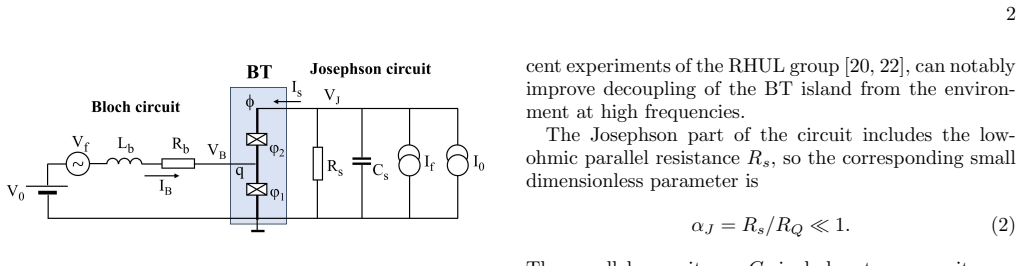
In the Bloch transistor, dc bias controls both Josephson oscillations of frequency f_J = 2e V_J / h on the transistor and Bloch oscillations of frequency f_B = I_B / 2e on the island. The circuit topology and charging effects permit mutual phase locking that enforces f_J = f_B. This produces current steps at I_B = 2e f_J analogous to dual Shapiro steps and sets the transconductance I_B / V_J precisely to 1/R_Q.
What carries the argument
Mutual phase locking of Josephson oscillations and Bloch oscillations that forces exact frequency equality f_J = f_B and generates quantized current steps together with fundamental transconductance.
If this is right
- Current steps form at I_B = 2e f_J on the dc I-V curve, matching the positions of dual Shapiro steps.
- Transconductance I_B / V_J equals exactly 1/R_Q with R_Q = h/4e^2.
- The circuit functions with only two dc sources and no microwave drive or external magnetic field.
- The locking provides an alternative route to a quantum resistance standard based on superconducting elements.
Where Pith is reading between the lines
- The same locking mechanism may allow the Bloch transistor to serve as a compact on-chip reference for both current and voltage standards simultaneously.
- Step widths could be used to quantify the stability of phase locking against small variations in island capacitance or junction asymmetry.
- Integration with other superconducting elements might extend the effect to multi-terminal circuits for direct realization of resistance ratios.
Load-bearing premise
Josephson and Bloch oscillations lock perfectly and stably under pure dc drive without noise, quasiparticles, or parasitics breaking the frequency equality.
What would settle it
Measurement of the I-V curve of a fabricated Bloch transistor under pure dc bias showing (or failing to show) current steps located exactly at I_B = 2e f_J with transconductance fixed at 1/R_Q independent of bias values.
Figures


read the original abstract
We propose a superconducting circuit based on the Bloch transistor, a quantum device consisting of two small-capacitance Josephson junctions connected in series and having a small island in between. This device is driven by two dc electrical sources controlling Josephson oscillations of frequency $f_J = 2e\overline{V_J}/h$, related to the average voltage $\overline{V_J}$ on the transistor, and Bloch oscillations of frequency $f_B = \overline{I_B}/2e$, related to the average current $\overline{I_B}$ injected into the transistor island. Due to the Bloch transistor properties, these two types of oscillations can mutually phase lock, i.e., $f_J = f_B$. This leads to formation of current steps on the current-voltage curve at $\overline{I}_B = 2ef_J$, which are similar to the dual Shapiro steps appearing at current $\overline{I}=2ef$ under microwave irradiation of frequency $f$. Moreover, transconductance $\overline{I_B}/\overline{V_J}$ takes the fundamental value of $1/R_Q$, where $R_Q = h/4e^2$ is the resistance quantum. The obtained results pave the way to the alternative quantum standard of resistance, based on the superconducting circuit and operating without applying strong magnetic field.
Editorial analysis
A structured set of objections, weighed in public.
Referee Report
Summary. The manuscript proposes a dc-driven Bloch transistor circuit in which Josephson oscillations (frequency f_J = 2e V_J / h) and Bloch oscillations (frequency f_B = I_B / 2e) mutually phase-lock under pure dc bias. This locking produces current steps at I_B = 2e f_J on the I-V curve and yields an exact transconductance I_B / V_J = 1/R_Q = 4e²/h, offering a potential magnetic-field-free quantum resistance standard based on the Bloch transistor Hamiltonian.
Significance. If the exact locking and transconductance result can be rigorously derived, the work would provide a conceptually new route to the resistance quantum in superconducting circuits, complementary to existing Shapiro-step or quantum-Hall approaches and potentially simpler for metrology applications.
major comments (2)
- [Abstract and main text derivation of locking] The central claim that mutual phase locking enforces f_J = f_B with zero residual average deviation (yielding exactly I_B = 2e f_J and transconductance 1/R_Q) is asserted from the known properties of the Bloch transistor but is not supported by explicit time-averaged equations of motion, stability analysis, or numerical integration under pure dc drive. The manuscript must derive the locking condition from the circuit Hamiltonian and show that damping, charging energy, and island charge dynamics produce no net frequency offset.
- [Discussion of robustness] No discussion or estimate is given of quasiparticle poisoning, thermal noise, or circuit parasitics that would limit the locking bandwidth and cause the time-averaged transconductance to deviate from exactly 4e²/h. A quantitative error budget tied to the charging energy E_C and Josephson energy E_J is required to substantiate the 'fundamental value' claim.
minor comments (1)
- [Abstract] Notation for time-averaged quantities (overline{V_J}, overline{I_B}) should be introduced consistently at first use and used uniformly in all equations.
Simulated Author's Rebuttal
We thank the referee for their thorough review and valuable comments on our manuscript. We have carefully considered each point and revised the manuscript to address the concerns raised, improving the rigor of the derivations and adding discussion on practical limitations.
read point-by-point responses
-
Referee: [Abstract and main text derivation of locking] The central claim that mutual phase locking enforces f_J = f_B with zero residual average deviation (yielding exactly I_B = 2e f_J and transconductance 1/R_Q) is asserted from the known properties of the Bloch transistor but is not supported by explicit time-averaged equations of motion, stability analysis, or numerical integration under pure dc drive. The manuscript must derive the locking condition from the circuit Hamiltonian and show that damping, charging energy, and island charge dynamics produce no net frequency offset.
Authors: We agree that an explicit derivation strengthens the presentation. Although the result follows from the known Bloch transistor properties, in the revised manuscript we now include a detailed derivation starting from the circuit Hamiltonian. We derive the time-averaged equations of motion, demonstrating that the mutual phase-locking condition f_J = f_B is enforced with zero average frequency deviation. The damping and charging energy contributions average to zero over the periodic locked cycle due to the conjugate nature of phase and charge variables, as confirmed by a stability analysis for relevant parameter regimes. revision: yes
-
Referee: [Discussion of robustness] No discussion or estimate is given of quasiparticle poisoning, thermal noise, or circuit parasitics that would limit the locking bandwidth and cause the time-averaged transconductance to deviate from exactly 4e²/h. A quantitative error budget tied to the charging energy E_C and Josephson energy E_J is required to substantiate the 'fundamental value' claim.
Authors: We thank the referee for highlighting this aspect. In the revised manuscript, we have added a new subsection discussing the robustness. We provide order-of-magnitude estimates for the effects of thermal noise and quasiparticle poisoning on the locking bandwidth, parameterized by E_C and E_J. While a full quantitative error budget depends on specific experimental details not covered in this theoretical work, we show that the deviation from 1/R_Q can be made arbitrarily small in the limit of large E_C/E_J and low temperature, supporting the fundamental nature of the transconductance. revision: partial
Circularity Check
No significant circularity; result follows algebraically from locking assumption and frequency definitions
full rationale
The paper states that Bloch transistor properties enable mutual phase locking f_J = f_B, which produces current steps at I_B = 2e f_J and transconductance I_B / V_J = 1/R_Q. This follows directly from the standard definitions f_J = 2e V_J / h and f_B = I_B / 2e without any fitting, self-referential parameter definition, or load-bearing self-citation chain. The locking condition is presented as a physical property of the device rather than derived from the target result itself. No equations reduce the claimed transconductance to an input by construction, and the derivation remains self-contained against external benchmarks.
Axiom & Free-Parameter Ledger
axioms (3)
- standard math Josephson relation f_J = 2e V_J / h
- standard math Bloch relation f_B = I_B / 2e
- domain assumption Mutual phase locking occurs when f_J = f_B
Lean theorems connected to this paper
-
IndisputableMonolith/Cost/FunctionalEquation.leanwashburn_uniqueness_aczel unclear?
unclearRelation between the paper passage and the cited Recognition theorem.
Due to the Bloch transistor properties, these two types of oscillations can mutually phase lock, i.e., f_J = f_B. This leads to formation of current steps ... at I_B = 2e f_J ... transconductance I_B / V_J takes the fundamental value of 1/R_Q
-
IndisputableMonolith/Foundation/AlphaCoordinateFixation.leanalpha_pin_under_high_calibration unclear?
unclearRelation between the paper passage and the cited Recognition theorem.
the egg box potential ... synchronous motion ... along the diagonal path
What do these tags mean?
- matches
- The paper's claim is directly supported by a theorem in the formal canon.
- supports
- The theorem supports part of the paper's argument, but the paper may add assumptions or extra steps.
- extends
- The paper goes beyond the formal theorem; the theorem is a base layer rather than the whole result.
- uses
- The paper appears to rely on the theorem as machinery.
- contradicts
- The paper's claim conflicts with a theorem or certificate in the canon.
- unclear
- Pith found a possible connection, but the passage is too broad, indirect, or ambiguous to say the theorem truly supports the claim.
Reference graph
Works this paper leans on
-
[1]
Y. A. Pashkin, O. Astafiev, T. Yamamoto, Y. Nakamura, and J. S. Tsai, Josephson charge qubits: a brief review, Quantum Inf. Processing8, 55 (2009)
work page 2009
-
[2]
J. Koch, T. M. Yu, J. Gambetta, A. A. Houck, D. I. Schuster, J. Majer, A. Blais, M. H. Devoret, S. M. Girvin, and R. J. Schoelkopf, Charge-insensitive qubit design de- rived from the Cooper pair box, Phys. Rev. A76, 042319 (2007)
work page 2007
-
[3]
J. Clarke and F. Wilhelm, Superconducting quantum bits, Nature453, 1031 (2008)
work page 2008
-
[4]
V. E. Manucharyan, J. Koch, L. I. Glazman, and M. H. Devoret, Fluxonium: Single Cooper-pair circuit free of charge offsets, Science326, 113 (2009)
work page 2009
-
[5]
Y. Makhlin, G. Sch¨ on, and A. Shnirman, Quantum-state engineering with Josephson-junction devices, Rev. Mod. Phys.73, 357 (2001)
work page 2001
-
[6]
I. V. Pechenezhskiy, R. A. Mencia, L. B. Nguyen, Y. H. Lin, and V. E. Manucharyan, The superconducting qua- sicharge qubit, Nature585, 368 (2020)
work page 2020
-
[7]
D. V. Averin, A. B. Zorin, and K. K. Likharev, Bloch os- cillations in small Josephson junctions, Zh. Eksp. Teor. Fiz.88, 692 (1985), [Sov. Phys. JETP61, 407-413 (1985)]
work page 1985
-
[8]
K. K. Likharev and A. B. Zorin, Theory of the Bloch- wave oscillations in small Josephson junctions, J. Low Temp. Phys.59, 347–382 (1985)
work page 1985
-
[9]
B. D. Josephson, Possible new effects in superconductive tunnelling, Physics Letters1, 251 (1962)
work page 1962
-
[10]
L. S. Kuzmin and D. B. Haviland, Observation of the Bloch oscillations in an ultrasmall Josephson junction, Phys. Rev. Lett.67, 2890 (1991)
work page 1991
-
[11]
L. S. Kuzmin and D. B. Haviland, Bloch oscillations and Coulomb blockade of Cooper pair tunneling in ultrasmall Josephson junctions, Phys. Scripta1992, 171 (1992)
work page 1992
-
[12]
L. S. Kuzmin, Y. A. Pashkin, and T. Claeson, Bloch os- cillations in a double Josephson junction biased via high- ohmic resistors, Supercond. Sci. Technol.7, 324 (1994)
work page 1994
-
[13]
Y. A. Pashkin, C. D. Chen, D. B. Haviland, and L. S. Kuzmin, Magnetic field dependence of the current- voltage curve of a superconducting single electron tran- sistor in a high impedance environment, Czech. J. Phys. 46, 2291 (1996)
work page 1996
-
[14]
M. Watanabe and D. B. Haviland, Coulomb blockade and coherent single-Cooper-pair tunneling in single Joseph- son junctions, Phys. Rev. Lett.86, 5120 (2001)
work page 2001
-
[15]
S. V. Lotkhov, Ultra-high-ohmic microstripline resis- tors for Coulomb blockade devices, Nanotechnology24, 235201 (2013)
work page 2013
-
[16]
L. Gr¨ unhaupt, M. Spiecker, D. Gusenkova, N. Maleeva, S. T. Skacel, I. Takmakov, F. Valenti, P. Winkel, H. Rotzinger, W. Wernsdorfer, A. V. Ustinov, and I. M. Pop, Granular aluminium as a superconducting material for high-impedance quantum circuits, Nat. Materials18, 816 (2019)
work page 2019
-
[17]
F. Kaap, D. Scheer, F. Hassler, and S. Lotkhov, Synchro- nization of Bloch oscillations in a strongly coupled pair of small Josephson junctions: Evidence for a Shapiro-like current step, Phys. Rev. Lett.132, 027001 (2024)
work page 2024
-
[18]
F. Kaap, C. Kissling, V. Gaydamachenko, L. Gr¨ unhaupt, and S. Lotkhov, Demonstration of dual Shapiro steps in small Josephson junctions, Nat. Commun.15, 8726 (2024)
work page 2024
-
[19]
N. Crescini, S. Cailleaux, W. Guichard, C. Naud, O. Buisson, K. W. Murch, and N. Roch, Evidence of dual Shapiro steps in a Josephson junction array, Nat. Phys. 19, 851 (2023)
work page 2023
-
[20]
R. S. Shaikhaidarov, K. H. Kim, J. Dunstan, I. Antonov, V. N. Antonov, and O. V. Astafiev, Quantized current steps due to the synchronization of microwaves with Bloch oscillations in small Josephson junctions, Nat. Commun.15, 9326 (2024)
work page 2024
-
[21]
R. S. Shaikhaidarov, K. H. Kim, J. W. Dunstan, I. V. Antonov, S. Linzen, M. Ziegler, D. S. Golubev, V. N. Antonov, E. V. Il’ichev, and O. V. Astafiev, Quantized current steps due to the a.c. coherent quantum phase-slip effect, Nature608, 45 (2022)
work page 2022
-
[22]
I. Antonov, R. S. Shaikhaidarov, K. H. Kim, D. Gol- ubev, S. Linzen, E. V. Il’ichev, V. N. Antonov, and O. V. Astafiev, Demonstration of dual Shapiro steps in small Josephson junctions, Nat. Commun.17, 1264 (2026)
work page 2026
-
[23]
K. K. Likharev, Coexistence of Bloch and Josephson ef- fects, and resistance quantization in small-area layered superconducting structureds, M. V. Lomonosov Moscow State University, Department of Physics (1986), preprint No. 29/1986
work page 1986
-
[24]
K. K. Likharev and A. B. Zorin, Simultaneous Bloch and Josephson oscillations, and resistance quantization in small superconducting double junctions, Jpn. J. Appl. Phys.26, 1407 (1987)
work page 1987
-
[25]
A. B. Zorin, Quantum-limited electrometer based on sin- gle Cooper pair tunneling, Phys. Rev. Lett.76, 4408 (1996)
work page 1996
-
[26]
K. v. Klitzing, G. Dorda, and M. Pepper, New method for high-accuracy determination of the fine-structure con- stant based on quantized Hall resistance, Phys. Rev. Lett. 45, 494 (1980)
work page 1980
-
[27]
K. v. Klitzing, The quantized Hall effect, Rev. Mod. Phys.58, 519 (1986)
work page 1986
- [28]
-
[29]
E. Eriksson, R.-P. Riwar, M. Houzet, J. S. Meyer, and Y. V. Nazarov, Topological transconductance quantiza- tion in a four-terminal Josephson junction, Phys. Rev. B 95, 075417 (2017)
work page 2017
-
[30]
A. M. Hriscu and V. V. Nazarov, Quantum synchroniza- tion of conjugated variables in a superconducting device leads to the fundamental resistance quantization, Phys. Rev. Lett.110, 097002 (2013)
work page 2013
-
[31]
R. S. Shaikhaidarov, I. Antonov, K. H. Kim, A. Shes- 13 terikov, S. Linzen, E. V. Il’ichev, V. N. Antonov, and O. V. Astafiev, Feasibility of the Josephson voltage and current standards on a single chip, Appl. Phys. Lett.125, 122602 (2024)
work page 2024
-
[32]
K. K. Likharev,Dynamics of Josephson junctions and circuits(Gordon and Breach, New York, 1986)
work page 1986
-
[33]
D. E. McCumber, Effect of ac impedance on dc voltage- current characteristics of superconductor weak-link junc- tions, J. Appl. Phys.39, 3113 (1968)
work page 1968
-
[34]
W. C. Stewart, Current-voltage characteristics of Joseph- son junctions, Appl. Phys. Lett.12, 277 (1968)
work page 1968
-
[35]
J. Aumentado, M. W. Keller, J. M. Martinis, and M. H. Devoret, Nonequilibrium quasiparticles and 2eperiodic- ity in single-Cooper-pair transistors, Phys. Rev. Lett.92, 066802 (2004)
work page 2004
-
[36]
H. Q. Nguyen, T. Aref, V. J. Kauppila, M. Meschke, C. B. Winkelmann, H. Courtois, and J. P. Pekola, Trap- ping hot quasi-particles in a high-power superconduct- ing electronic cooler, New Journal of Physics15, 085013 (2013)
work page 2013
-
[37]
V. Iaia, J. Ku, A. Ballard, C. P. Larson, E. Yelton, C. H. Liu, S. Patel, R. McDermott, and B. L. T. Plourde, Phonon downconversion to suppress correlated errors in superconducting qubits, Nat. Commun.13, 6425 (2022)
work page 2022
-
[38]
A. B. Zorin, Radio-frequency Bloch-transistor electrom- eter, Phys. Rev. Lett.86, 3388 (2001)
work page 2001
-
[39]
D. Vion, A. Aassime, A. Cottet, P. Joyez, H. Pothier, C. Urbina, D. Esteve, and M. H. Devoret, Manipulating the quantum state of an electrical circuit, Science296, 886 (2002)
work page 2002
-
[40]
A. B. Zorin, Cooper-pair qubit and Cooper-pair elec- trometer in one device, Physica C368, 284 (2002)
work page 2002
-
[41]
A. B. Zorin, Josephson charge-phase qubit with the ra- dio frequency readout: coupling and decoherence, Zh. Eksp. Teor. Fiz.125, 1423 (2004), [JETP98, 1250-1261 (2004)]
work page 2004
-
[42]
A. Barone and G. Paterno,Physics and Applications of the Josephson Effect(John Wiley & Sons Inc., New York, 1982)
work page 1982
-
[43]
A. B. Zorin, Y. A. Pashkin, V. A. Krupenin, and H. Scherer, Coulomb blockade electrometer based on single Cooper pair tunneling, Appl. Supercond.6, 453 (1998)
work page 1998
-
[44]
A. B. Zorin, S. V. Lotkhov, Y. A. Pashkin, H. Zangerle, V. A. Kruperin, T. Weimann, H. Scherer, and J. Niemeyer, Highly sensitive electrometers based on sin- gle Cooper pair tunneling, J. Supercond.12, 747 (1999)
work page 1999
- [45]
-
[46]
V. Bouchiat, D. Vion, P. Joyez, D. Esteve, and M. H. Devoret, Quantum coherence with a single Cooper pair, Phys. Scripta1998, 165 (1998)
work page 1998
-
[47]
E. M. Lifshitz and L. P. Pitaevskii,Statistical Physics, Part 2: Theory of the Condensed State (Course of The- oretical Physics Vol. 9)(Pergamon Press / Butterworth- Heinemann, 1980)
work page 1980
-
[48]
K. A. Matveev, M. Gisself¨ alt, L. I. Glazman, M. Jonson, and R. I. Shekhter, Parity-induced suppression of the Coulomb blockade of Josephson tunneling, Phys. Rev. Lett.70, 2940 (1993)
work page 1993
- [49]
-
[50]
T. M. Eiles and J. M. Martinis, Combined Josephson and charging behavior of the supercurrent in the super- conducting single-electron transistor, Phys. Rev. B50, 627 (1994)
work page 1994
-
[51]
V. V. Migulin, V. I. Medvedev, E. R. Mustel, and V. N. Parygin,Basic Theory of Oscillations(Mir, Moscow, 1983)
work page 1983
-
[52]
S. A. Akhmanov, Y. E. Djakov, and A. S. Chirkin,Vve- denije v statisticheskuju radiofiziku i optiku (Introduction to Statistical Radiophysics and Optics(Nauka, Moscow,
-
[53]
C. Vanneste, A. Gilabert, P. Sibillot, and D. B. Os- trowsky, Josephson steps produced by critical current amplitude modulation, J. Low Temp. Phys.45, 517–530 (1981)
work page 1981
-
[54]
C. Vanneste, C. C. Chi, W. J. Gallagher, A. W. Klein- sasser, S. I. Raider, and R. L. Sandstrom, Shapiro steps on currentvoltage curves of dc SQUIDs, J. Appl. Phys. 64, 242 (1988)
work page 1988
-
[55]
N. N. Bogoliubov and Y. A. Mitropolski,Asymptotic Methods in the Theory of Non-Linear Oscillations(Gor- don and Breach, New York, 1961)
work page 1961
-
[56]
M. J. Stephen, Noise in a driven Josephson oscillator, Phys. Rev.186, 393 (1969)
work page 1969
-
[57]
A. D. Marco, F. W. J. Hekking, and G. Rastelli, Quan- tum phase-slip junction under microwave irradiation, Phys. Rev. B91, 184512 (2015)
work page 2015
- [58]
- [59]
-
[60]
F. Maibaum, S. V. Lotkhov, and A. B. Zorin, Towards the observation of phase-locked Bloch oscillations in arrays of small Josephson junctions, Phys. Rev. B84, 174514 (2011)
work page 2011
-
[61]
K. K. Likharev and V. K. Semenov, Electrody- namic properties of superconducting point contacts, Ra- diotekhnika i elektronika [in Russian]16, 2167 (1971), [Radio Eng. Electron. Phys. (USSR) (Engl. Transl.)16, 1917 (1971)]
work page 1971
-
[62]
D. S. Wiersma and G. Mana, The fundamental constants of physics and the international system of units, Rend. Fis. Acc. Lincei32, 655 (2021)
work page 2021
discussion (0)
Sign in with ORCID, Apple, or X to comment. Anyone can read and Pith papers without signing in.