Recognition: 2 theorem links
· Lean TheoremSwitchable Surface Linear Photogalvanic Effect in the Magnetic Weyl Semimetal Co3Sn2S2
Pith reviewed 2026-05-15 01:55 UTC · model grok-4.3
The pith
Unitary crystal symmetries on the surface of Co3Sn2S2 force sign reversals in the linear photogalvanic photocurrent at specific light polarization angles when magnetization flips, while extrinsic contributions stay large from Fermi-arc DOS.
A machine-rendered reading of the paper's core claim, the machinery that carries it, and where it could break.
Core claim
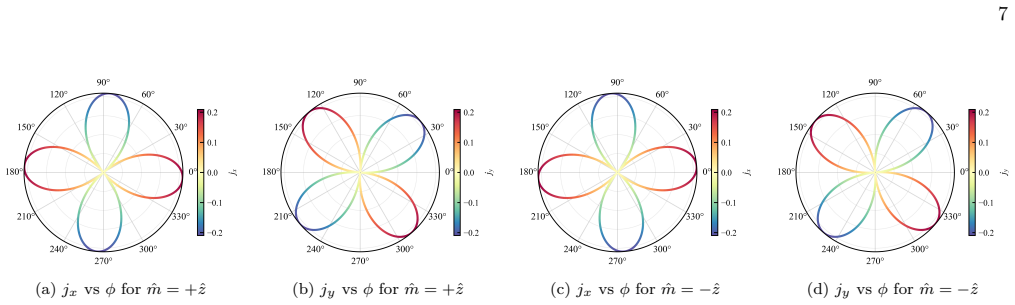
The central discovery is that unitary crystal symmetries on the surface produce characteristic sign reversals of the total photocurrent at certain polarization angles upon flipping the magnetization, while an antiunitary mirror symmetry forces several intrinsic nonlinear response tensor elements to vanish; the extrinsic contribution remains unconstrained and reaches large magnitude owing to the enhanced density of states of Fermi-arc surface states, yielding approximately linear temperature dependence and low-frequency scaling |j_y| proportional to omega to the power of -2.2 with weak temperature dependence of the exponent.
What carries the argument
Green's-function diagrammatic formalism for the surface nonlinear current response tensor, subject to constraints from unitary crystal symmetries and an antiunitary mirror symmetry.
If this is right
- Magnetization reversal can switch the direction of the generated surface current at fixed polarization angles.
- The large extrinsic response makes the total photocurrent observable even when intrinsic terms are symmetry-forbidden.
- Linear temperature dependence combined with omega to the -2.2 scaling gives concrete predictions for low-frequency, finite-temperature experiments.
- Co3Sn2S2 becomes a concrete platform where magnetic fields control nonlinear surface transport without bulk contributions.
Where Pith is reading between the lines
- Similar sign-reversal behavior under magnetization flip may appear in other magnetic Weyl semimetals that host Fermi arcs and comparable surface symmetries.
- Device designs could exploit the extrinsic dominance for magnetically tunable photodetectors or current switches operating at room temperature.
- The weak temperature dependence of the frequency exponent suggests the scaling may be robust across a range of realistic disorder levels.
- Angle-resolved photocurrent maps could directly image the unitary symmetry operations that enforce the reversals.
Load-bearing premise
The Green's-function and diagrammatic calculation captures the full nonlinear response without important higher-order corrections or overlooked material-specific band details that would change the reported symmetry constraints and scaling.
What would settle it
Measurement of photocurrent versus light polarization angle that shows no sign reversal upon magnetization flip at the angles where unitary symmetries are predicted to enforce it, or failure of the extrinsic magnitude to follow the reported omega to the -2.2 scaling.
Figures


read the original abstract
We investigate the linear photogalvanic effect (LPGE) on the surface of the magnetic Weyl semimetal Co3Sn2S2 using a Green's-function and diagrammatic formalism. While the LPGE vanishes in the centrosymmetric bulk, it is symmetry-allowed on the surface where inversion symmetry is broken. We show that unitary crystal symmetries on the surface produce characteristic sign reversals of the total photocurrent at certain polarization angles upon flipping the magnetization. We further find that the intrinsic contribution to the LPGE is strongly constrained by an antiunitary mirror symmetry, which forces several nonlinear response tensor elements to vanish. In contrast, the extrinsic contribution is not subject to these constraints and displays a large magnitude which, we argue, is due to the enhanced density of states associated with Fermi-arc surface states. The current exhibits an approximately linear temperature dependence and a low-frequency power-law scaling, |jy| proportional to omega^-2.2, with weak temperature dependence of the scaling exponent. Our results identify Co3Sn2S2 as a promising platform for experimentally accessing symmetry-controlled nonlinear transport in realistic systems and for applications in magnetically controlled optoelectronic devices.
Editorial analysis
A structured set of objections, weighed in public.
Referee Report
Summary. The manuscript investigates the linear photogalvanic effect (LPGE) on the surface of the magnetic Weyl semimetal Co3Sn2S2 using a Green's-function and diagrammatic formalism. It shows that LPGE vanishes in the centrosymmetric bulk but is symmetry-allowed on the surface. Unitary crystal symmetries produce sign reversals of the total photocurrent at specific polarization angles upon magnetization reversal. An antiunitary mirror symmetry constrains the intrinsic contribution by forcing several nonlinear response tensor elements to vanish, while the extrinsic contribution is unconstrained, large in magnitude due to enhanced density of states from Fermi-arc surface states, exhibits approximately linear temperature dependence, and follows |j_y| ∝ ω^{-2.2} with weak temperature dependence of the exponent.
Significance. If the central claims hold, the work provides a concrete platform for symmetry-controlled, magnetically switchable nonlinear transport in a realistic material, with testable predictions for sign reversals and power-law scaling that could guide experiments on Co3Sn2S2. The symmetry analysis for unitary and antiunitary constraints is a clear strength, offering falsifiable signatures independent of microscopic details.
major comments (1)
- [Sec. III–IV] The leading-order diagrammatic Green's-function treatment of the extrinsic LPGE (Sec. III and IV) omits vertex corrections that are typically required to restore gauge invariance and current conservation for surface states. This truncation can modify both the absolute magnitude and the reported frequency scaling |j_y| ∝ ω^{-2.2} by O(1) factors; no explicit check against the full Kubo formula or inclusion of ladder diagrams is described, which is load-bearing for the claim of extrinsic dominance.
minor comments (1)
- [Abstract/Introduction] The abstract and introduction would benefit from a brief statement of the specific surface termination and Fermi-arc dispersion parameters used in the numerical evaluation of the extrinsic term.
Simulated Author's Rebuttal
We thank the referee for the detailed and constructive report. The single major comment raises a valid technical point about our diagrammatic treatment. We address it below and will incorporate a clarifying discussion in the revised manuscript.
read point-by-point responses
-
Referee: [Sec. III–IV] The leading-order diagrammatic Green's-function treatment of the extrinsic LPGE (Sec. III and IV) omits vertex corrections that are typically required to restore gauge invariance and current conservation for surface states. This truncation can modify both the absolute magnitude and the reported frequency scaling |j_y| ∝ ω^{-2.2} by O(1) factors; no explicit check against the full Kubo formula or inclusion of ladder diagrams is described, which is load-bearing for the claim of extrinsic dominance.
Authors: We agree that vertex corrections are generally required to enforce current conservation and gauge invariance in diagrammatic calculations of nonlinear conductivities. Our calculation employs the leading-order bubble diagram for the extrinsic LPGE, which is a standard first step for such responses in complex materials. This approximation captures the dominant contribution arising from the high density of states of the Fermi-arc surface states. While inclusion of ladder diagrams could renormalize the overall magnitude by O(1) factors and introduce small corrections to the effective exponent, the reported ω^{-2.2} scaling originates from the interplay between the linear dispersion of the arcs and the energy-dependent scattering rate; we expect the power-law character to remain qualitatively intact. The central claims—symmetry-enforced sign reversals upon magnetization reversal and extrinsic dominance—are protected by symmetry and the enhanced DOS rather than by precise prefactors. We have not performed an explicit full-Kubo or ladder-diagram calculation, as it lies beyond the present scope. In the revision we will add an explicit paragraph stating this limitation, qualifying the frequency scaling as approximate within the leading-order treatment, and noting that quantitative magnitudes should be viewed as indicative. revision: partial
Circularity Check
Symmetry constraints and diagrammatic LPGE calculation remain independent of fitted photocurrent values
full rationale
The derivation relies on material symmetries (unitary crystal symmetries and antiunitary mirror symmetry) to constrain the nonlinear response tensor elements, which are stated to force several components to vanish by direct application of the symmetry operations to the surface states of Co3Sn2S2. The extrinsic contribution's large magnitude is attributed to the enhanced DOS of Fermi-arc states via a standard physical argument within the Green's-function formalism, without any parameter fitting to the reported |jy| ~ omega^{-2.2} scaling or temperature dependence. No self-citation chains, self-definitional loops, or ansatze smuggled from prior author work are load-bearing in the abstract or described formalism; the central claims follow from the stated symmetries and leading-order diagrammatic expansion rather than reducing to input data by construction.
Axiom & Free-Parameter Ledger
axioms (2)
- domain assumption Inversion symmetry is broken on the surface allowing LPGE
- domain assumption Antiunitary mirror symmetry forces several nonlinear response tensor elements to vanish for intrinsic contribution
Lean theorems connected to this paper
-
IndisputableMonolith/Cost/FunctionalEquation.leanwashburn_uniqueness_aczel unclear?
unclearRelation between the paper passage and the cited Recognition theorem.
We investigate the linear photogalvanic effect (LPGE) on the surface of the magnetic Weyl semimetal Co3Sn2S2 using a Green's-function and diagrammatic formalism... χ^μ_αβ = e³/(ℏω)² ∑_{a,b,c} ∫_k [1/2 f_a h^μ_αβ + ... ]
-
IndisputableMonolith/Foundation/AlexanderDuality.leanalexander_duality_circle_linking unclear?
unclearRelation between the paper passage and the cited Recognition theorem.
The intrinsic contribution is strongly constrained by an antiunitary mirror symmetry... χ^μ_αβ_{m_x m_y m_z} → (−1)^{N_y+1} χ^μ_αβ_{m_x −m_y m_z}
What do these tags mean?
- matches
- The paper's claim is directly supported by a theorem in the formal canon.
- supports
- The theorem supports part of the paper's argument, but the paper may add assumptions or extra steps.
- extends
- The paper goes beyond the formal theorem; the theorem is a base layer rather than the whole result.
- uses
- The paper appears to rely on the theorem as machinery.
- contradicts
- The paper's claim conflicts with a theorem or certificate in the canon.
- unclear
- Pith found a possible connection, but the passage is too broad, indirect, or ambiguous to say the theorem truly supports the claim.
Reference graph
Works this paper leans on
-
[1]
Defining ˆHk as the Bloch Hamiltonian for a WSM slab FIG. 1. The four Feynman diagrams used to calculateχ µαβ. The dotted lines represent the output currentjwhile the wavy solid lines represent external fields. consisting ofLatomic layers, wherekis the 2D momen- tum parallel to the surface, the mathematical expressions corresponding to the four diagrams a...
work page 2019
-
[2]
O. Vafek and A. Vishwanath, Dirac Fermions in Solids: From High-Tc Cuprates and Graphene to Topological In- sulators and Weyl Semimetals, Annual Review of Con- densed Matter Physics5, 83 (2014)
work page 2014
-
[3]
A. A. Burkov, Weyl Metals, Annual Review of Condensed Matter Physics9, 359 (2018). 9
work page 2018
-
[4]
A. A. Burkov, Topological semimetals, Nature Materials 15, 1145 EP (2016)
work page 2016
-
[5]
Topological Materials: Weyl Semimetals
B. Yan and C. Felser, Topological Materials: Weyl Semimetals, Annual Review of Condensed Matter Physics8, 337 (2017), arXiv:1611.04182
work page internal anchor Pith review Pith/arXiv arXiv 2017
-
[6]
N. P. Armitage, E. J. Mele, and A. Vishwanath, Weyl and Dirac semimetals in three-dimensional solids, Rev. Mod. Phys.90, 15001 (2018)
work page 2018
-
[7]
Shen, Topological Dirac and Weyl Semimetals (2017)
S.-Q. Shen, Topological Dirac and Weyl Semimetals (2017)
work page 2017
-
[8]
I. Belopolski, D. S. Sanchez, Y. Ishida, X. Pan, P. Yu, S.- Y. Xu, G. Chang, T.-R. Chang, H. Zheng, N. Alidoust, G. Bian, M. Neupane, S.-M. Huang, C.-C. Lee, Y. Song, H. Bu, G. Wang, S. Li, G. Eda, H.-T. Jeng, T. Kondo, H. Lin, Z. Liu, F. Song, S. Shin, and M. Z. Hasan, Discov- ery of a new type of topological Weyl fermion semimetal state in MoxW1-xTe2, N...
work page 2016
-
[9]
Z. P. Guo, P. C. Lu, T. Chen, J. F. Wu, J. Sun, and D. Y. Xing, High-pressure phases of Weyl semimetals NbP, NbAs, TaP, and TaAs, Science China: Physics, Mechan- ics and Astronomy 10.1007/s11433-017-9126-6 (2018)
-
[10]
G. Chang, S.-Y. Xu, H. Zheng, C.-C. Lee, S.-M. Huang, I. Belopolski, D. S. Sanchez, G. Bian, N. Alidoust, T.-R. Chang, C.-H. Hsu, H.-T. Jeng, A. Bansil, H. Lin, and M. Z. Hasan, Signatures of Fermi Arcs in the Quasiparti- cle Interferences of the Weyl Semimetals TaAs and NbP, Phys. Rev. Lett.116, 66601 (2016)
work page 2016
-
[11]
A. Gyenis, H. Inoue, S. Jeon, B. B. Zhou, B. E. Feld- man, Z. Wang, J. Li, S. Jiang, Q. D. Gibson, S. K. Kush- waha, J. W. Krizan, N. Ni, R. J. Cava, B. A. Bernevig, and A. Yazdani, Imaging electronic states on topologi- cal semimetals using scanning tunneling microscopy, New Journal of Physics18, 105003 (2016)
work page 2016
-
[12]
S.-M. Huang, S.-Y. Xu, I. Belopolski, C.-C. Lee, G. Chang, B. Wang, N. Alidoust, G. Bian, M. Neupane, C. Zhang, S. Jia, A. Bansil, H. Lin, and M. Z. Hasan, A Weyl Fermion semimetal with surface Fermi arcs in the transition metal monopnictide TaAs class, Nature Com- munications6, 7373 (2015)
work page 2015
- [13]
-
[14]
B. Q. Lv, N. Xu, H. M. Weng, J. Z. Ma, P. Richard, X. C. Huang, L. X. Zhao, G. F. Chen, C. E. Matt, F. Bisti, V. N. Strocov, J. Mesot, Z. Fang, X. Dai, T. Qian, M. Shi, and H. Ding, Observation of Weyl nodes in TaAs, Nature Physics11, 724 EP (2015)
work page 2015
-
[15]
Y. Sun, S. C. Wu, and B. Yan, Topological surface states and Fermi arcs of the noncentrosymmetric Weyl semimet- als TaAs, TaP, NbAs, and NbP, Physical Review B - Condensed Matter and Materials Physics 10.1103/Phys- RevB.92.115428 (2015)
-
[16]
A. S.-y. Xu, I. Belopolski, N. Alidoust, M. Neupane, C. Zhang, R. Sankar, G. Chang, Z. Yuan, C.-c. Lee, S.- m. Huang, H. Zheng, J. Ma, D. S. Sanchez, B. Wang, F. Chou, P. P. Shibayev, H. Lin, S. Jia, and M. Zahid, Discovery of a Weyl Fermion Semimetal, Science (2015)
work page 2015
-
[17]
S. Y. Xu, I. Belopolski, D. S. Sanchez, M. Neupane, G. Chang, K. Yaji, Z. Yuan, C. Zhang, K. Kuroda, G. Bian, C. Guo, H. Lu, T. R. Chang, N. Alidoust, H. Zheng, C. C. Lee, S. M. Huang, C. H. Hsu, H. T. Jeng, A. Bansil, T. Neupert, F. Komori, T. Kondo, S. Shin, H. Lin, S. Jia, and M. Z. Hasan, Spin Polariza- tion and Texture of the Fermi Arcs in the Weyl F...
work page internal anchor Pith review Pith/arXiv arXiv 2016
-
[18]
S.-Y. Xu, I. Belopolski, N. Alidoust, M. Neupane, G. Bian, C. Zhang, R. Sankar, G. Chang, Z. Yuan, C.- C. Lee, S.-M. Huang, H. Zheng, J. Ma, D. S. Sanchez, B. Wang, A. Bansil, F. Chou, P. P. Shibayev, H. Lin, S. Jia, and M. Z. Hasan, Discovery of a Weyl fermion semimetal and topological Fermi arcs, Science349, 613 (2015)
work page 2015
-
[19]
L. X. Yang, Z. K. Liu, Y. Sun, H. Peng, H. F. Yang, T. Zhang, B. Zhou, Y. Zhang, Y. F. Guo, M. Rahn, D. Prabhakaran, Z. Hussain, S. K. Mo, C. Felser, B. Yan, and Y. L. Chen, Weyl semimetal phase in the non- centrosymmetric compound TaAs, Nature Physics11, 728 EP (2015)
work page 2015
-
[20]
H. Zheng, S. Y. Xu, G. Bian, C. Guo, G. Chang, D. S. Sanchez, I. Belopolski, C. C. Lee, S. M. Huang, X. Zhang, R. Sankar, N. Alidoust, T. R. Chang, F. Wu, T. Neupert, F. Chou, H. T. Jeng, N. Yao, A. Bansil, S. Jia, H. Lin, and M. Z. Hasan, Atomic-scale visualization of quantum interference on a weyl semimetal surface by scanning tun- neling microscopy, AC...
work page 2016
-
[21]
P. Hosur and X. Qi, Recent developments in trans- port phenomena in Weyl semimetals, Comptes Rendus Physique14, 10.1016/j.crhy.2013.10.010 (2013)
-
[22]
H. Wang and J. Wang, Electron transport in Dirac and Weyl semimetals, Chinese Physics B27, 107402 (2018)
work page 2018
- [23]
-
[24]
A. A. Zyuzin and A. A. Burkov, Topological response in Weyl semimetals and the chiral anomaly, Phys. Rev. B 86, 115133 (2012)
work page 2012
-
[25]
Y. Chen, S. Wu, and A. A. Burkov, Axion response in Weyl semimetals, Phys. Rev. B88, 125105 (2013)
work page 2013
-
[26]
M. M. Vazifeh and M. Franz, Electromagnetic Response of Weyl Semimetals, Phys. Rev. Lett.111, 27201 (2013)
work page 2013
-
[27]
A. A. Burkov, Chiral anomaly and transport in Weyl metals, Journal of Physics: Condensed Matter27, 113201 (2015)
work page 2015
-
[28]
P. Hosur, S. Parameswaran, and A. Vishwanath, Charge transport in Weyl semimetals, Physical Review Letters 108, 10.1103/PhysRevLett.108.046602 (2012)
-
[29]
S. Wang, B. C. Lin, A. Q. Wang, D. P. Yu, and Z. M. Liao, Quantum transport in Dirac and Weyl semimetals: a review, Advances in Physics: X2, 518 (2017)
work page 2017
-
[30]
K. Halterman, M. Alidoust, and A. Zyuzin, Epsilon-near- zero response and tunable perfect absorption in weyl semimetals, Phys. Rev. B98, 085109 (2018)
work page 2018
-
[31]
K. Halterman and M. Alidoust, Waveguide modes in weyl semimetals with tilted dirac cones, Opt. Express 27, 36164 (2019)
work page 2019
-
[32]
N. Nagaosa, T. Morimoto, and Y. Tokura, Transport, magnetic and optical properties of Weyl materials, Na- ture Reviews Materials5, 621 (2020)
work page 2020
-
[33]
H. B. Nielsen and M. Ninomiya, The Adler-Bell-Jackiw anomaly and Weyl fermions in a crystal, Physics Letters B130, 389 (1983)
work page 1983
-
[34]
M. V. Isachenkov and A. V. Sadofyev, The chiral mag- netic effect in hydrodynamical approach, Physics Letters B697, 404 (2011)
work page 2011
-
[35]
A. V. Sadofyev, V. I. Shevchenko, and V. I. Zakharov, 10 Notes on chiral hydrodynamics within the effective the- ory approach, Phys. Rev. D83, 105025 (2011)
work page 2011
-
[36]
R. Loganayagam and P. Sur´ owka, Anomaly/transport in an Ideal Weyl gas, Journal of High Energy Physics2012, 97 (2012)
work page 2012
-
[37]
P. Goswami and S. Tewari, Axionic field theory of $(3+1)$-dimensional Weyl semimetals, Phys. Rev. B88, 245107 (2013)
work page 2013
-
[38]
Z. Wang and S.-C. Zhang, Chiral anomaly, charge density waves, and axion strings from Weyl semimetals, Phys. Rev. B87, 161107 (2013)
work page 2013
- [39]
-
[40]
Landsteiner, Anomalous transport of Weyl fermions in Weyl semimetals, Phys
K. Landsteiner, Anomalous transport of Weyl fermions in Weyl semimetals, Phys. Rev. B89, 75124 (2014)
work page 2014
-
[41]
E. Liu, Y. Sun, N. Kumar, L. Muechler, A. Sun, L. Jiao, S.-Y. Yang, D. Liu, A. Liang, Q. Xu, J. Kroder, V. S, H. Borrmann, C. Shekhar, Z. Wang, C. Xi, W. Wang, W. Schnelle, S. Wirth, Y. Chen, S. T. B. Goennenwein, and C. Felser, Giant anomalous hall effect in a ferromag- netic kagome-lattice semimetal, Nature Physics14, 1125 (2018)
work page 2018
-
[42]
Y. Okamura, S. Minami, Y. Kato, Y. Fujishiro, Y. Kaneko, J. Ikeda, J. Muramoto, R. Kaneko, K. Ueda, V. Kocsis, N. Kanazawa, Y. Taguchi, T. Koretsune, K. Fujiwara, A. Tsukazaki, R. Arita, Y. Tokura, and Y. Takahashi, Giant magneto-optical responses in mag- netic Weyl semimetal Co3Sn2S2, Nature Communica- tions11, 4619 (2020)
work page 2020
-
[43]
H. Yang, W. You, J. Wang, J. Huang, C. Xi, X. Xu, C. Cao, M. Tian, Z.-A. Xu, J. Dai, and Y. Li, Giant anomalous nernst effect in the magnetic weyl semimetal Co3Sn2S2, Phys. Rev. Mater.4, 024202 (2020)
work page 2020
- [44]
-
[45]
J. Yang, Y. Shang, X. Liu, Y. Wang, X. Dong, Q. Zeng, M. Lyu, S. Zhang, Y. Liu, B. Wang, H. Wei, Y. Wu, S. Parkin, G. Liu, C. Felser, E. Liu, and B. Shen, Mod- ulation of the anomalous hall angle in a magnetic topo- logical semimetal, Nature Electronics (2025)
work page 2025
-
[46]
L. Ye, J. I. Facio, M. P. Ghimire, M. K. Chan, J.-S. You, D. C. Bell, M. Richter, J. van den Brink, and J. G. Check- elsky, Magnetization orientation-dependent shubnikov- de haas oscillations in ferromagnetic weyl semimetal Co3Sn2S2, npj Quantum Materials11, 14 (2026)
work page 2026
-
[47]
H. K. Pal, O. E. Obakpolor, and P. Hosur, Anomalous surface conductivity of weyl semimetals, Phys. Rev. B 106, 245410 (2022)
work page 2022
-
[48]
M. Surez-Rodrguez, F. de Juan, I. Souza, M. Gobbi, F. Casanova, and L. E. Hueso, Nonlinear transport in non-centrosymmetric systems, Nature Materials24, 10051018 (2025)
work page 2025
-
[49]
O. Shvetsov, V. Esin, A. Timonina, N. N. Kolesnikov, and E. V. Deviatov, Nonlinear hall effect in three- dimensional weyl and dirac semimetals, Jetp Lett.109, 715721 (2019)
work page 2019
-
[50]
V. Kalappattil, C. Liu, Z. Chen, V. Sharma, K. Liu, J. Tang, S. S.-L. Zhang, and M. Wu, Quantum oscil- lations of nonlinear electrical transport in a topological dirac semimetal, Phys. Rev. Lett.136, 096603 (2026)
work page 2026
-
[51]
A. A. Zyuzin, M. Silaev, and V. A. Zyuzin, Nonlinear chiral transport in dirac semimetals, Phys. Rev. B98, 205149 (2018)
work page 2018
-
[52]
T. Morimoto and N. Nagaosa, Topological nature of nonlinear optical effects in solids, Sci.Adv.2, e1501524 (2016)
work page 2016
-
[53]
J. F. Steiner, A. V. Andreev, and M. Breitkreiz, Surface photogalvanic effect in weyl semimetals, Phys. Rev. Re- search4, 023021 (2022)
work page 2022
-
[54]
J. Cao, M. Wang, Z.-M. Yu, and Y. Yao, Bulk fermi arc transition induced large photogalvanic effect in weyl semimetals, Phys. Rev. B106, 125416 (2022)
work page 2022
-
[55]
Z. Ji, G. Liu, Z. Addison, W. Liu, P. Yu, H. Gao, Z. Liu, A. M. Rappe, C. L. Kane, E. J. Mele, and R. Agarwal, Spatially dispersive circular photogalvanic effect in a weyl semimetal, Nat. Mater.18, 955962 (2019)
work page 2019
-
[56]
Y. Li, Q. Gu, C. Chen, J. Zhang, Q. Liu, X. Hu, J. Liu, Y. Liu, L. Ling, M. Tian, Y. Wang, N. Samarth, S. Li, T. Zhang, J. Feng, and J. Wang, Nontrivial superconduc- tivity in topological MoTe2-xSx crystals, Proceedings of the National Academy of Sciences115, 9503 (2018)
work page 2018
- [57]
-
[58]
F. de Juan, A. G. Grushin, T. Morimoto, and J. E. Moore, Quantized circular photogalvanic effect in weyl semimetals, Nature Communications8, 15995 (2017)
work page 2017
-
[59]
D. Rees, K. Manna, B. Lu, T. Morimoto, H. Borrmann, C. Felser, J. E. Moore, D. H. Torchinsky, and J. Oren- stein, Helicity-dependent photocurrents in the chiral weyl semimetal rhsi., Sci. Adv.6, eaba0509 (2020)
work page 2020
- [60]
-
[61]
Y.-Y. Lv, J. Xu, S. Han, C. Zhang, Y. Han, J. Zhou, S.-H. Yao, X.-P. Liu, M.-H. Lu, H. Weng, Z. Xie, Y. B. Chen, J. Hu, Y.-F. Chen, and S. Zhu, High-harmonic genera- tion in weyl semimetalβ-wp 2 crystals, Nature Commu- nications12, 6437 (2021)
work page 2021
-
[62]
B. Lu, S. Sayyad, M. . Snchez-Martnez, K. Manna, C. Felser, A. G. Grushin, and D. H. Torchinsky, Second-harmonic generation in the topological multifold semimetal rhsi, Phys. Rev. Research4, L022022 (2022)
work page 2022
- [63]
-
[64]
S. Patankar, L. Wu, B. Lu, M. Rai, J. D. Tran, T. Mo- rimoto, D. E. Parker, A. G. Grushin, N. L. Nair, J. G. Analytis, J. E. Moore, J. Orenstein, and D. H. Torchin- sky, Resonance-enhanced optical nonlinearity in the weyl semimetal taas, Phys. Rev. B98, 165113 (2018)
work page 2018
- [65]
-
[66]
G. B. Osterhoudt, L. K. Diebel, M. J. Gray, X. Yang, J. Stanco, X. Huang, B. Shen, N. Ni, P. J. W. Moll, Y. Ran, and K. S. Burch, Colossal mid-infrared bulk pho- tovoltaic effect in a type-i weyl semimetal, Nature Mate- rials18, 471 (2019)
work page 2019
-
[67]
P. Hosur, Circular photogalvanic effect on topological insulator surfaces: Berry-curvature-dependent response, 11 Physical Review B - Condensed Matter and Materials Physics83, 10.1103/PhysRevB.83.035309 (2011)
- [68]
-
[69]
W. Schnelle, A. Leithe-Jasper, H. Rosner, F. M. Schap- pacher, R. Pttgen, F. Pielnhofer, and R. Weihrich, Fer- romagnetic ordering and half-metallic state of sn2co3s2 with the shandite-type structure, PRB88, 144404 (2013)
work page 2013
- [70]
-
[71]
O. Akihiro and N. Kentaro, Two-Orbital Effective Model for Magnetic Weyl Semimetal in Kagome-Lattice Shan- dite, Journal of the Physical Society of Japan88, 123703 (2019)
work page 2019
discussion (0)
Sign in with ORCID, Apple, or X to comment. Anyone can read and Pith papers without signing in.