Recognition: 2 theorem links
· Lean TheoremScattered light noise at LIGO Livingston Observatory during O4
Pith reviewed 2026-05-15 01:50 UTC · model grok-4.3
The pith
High-SNR scattered light glitches at LIGO Livingston are driven solely by microseismic ground motion at the corner station in the X direction.
A machine-rendered reading of the paper's core claim, the machinery that carries it, and where it could break.
Core claim
Scattered light glitches in the 10-40 Hz band at LIGO Livingston during the fourth observation run divide into high-SNR and low-SNR groups. The high-SNR group is modulated solely by microseismic ground motion in the 0.1-1.0 Hz range at the corner station along the X direction, with presented models of coupling mechanisms and correlation analysis confirming this as the dominant source. The low-SNR group is modulated by 10-30 Hz vertical ground motion coupling through a specific vacuum chamber at the corner station. Baffles installed close to the test mass mirrors produced a significant reduction in rate and SNR of the high-SNR glitches, while an additional seismic isolation platform in the真空
What carries the argument
Statistical correlation analysis between specific ground-motion channels and glitch rates, identifying the corner station X-direction microseismic motion as the primary modulator for high-SNR glitches and a particular vacuum chamber for low-SNR glitches.
If this is right
- Baffles near test mass mirrors can substantially reduce high-SNR scattered light glitches.
- Seismic isolation platforms in affected vacuum chambers can eliminate low-SNR glitches.
- Monitoring microseismic motion in the 0.1-1 Hz X direction at the corner station can help predict and mitigate high-SNR noise.
- Correlation studies validate direct coupling from ground motion to scattered light in the detector.
- These mitigations improve data quality in the 10-40 Hz frequency band for gravitational wave searches.
Where Pith is reading between the lines
- Real-time monitoring of ground motion could enable predictive noise subtraction algorithms in future observing runs.
- Similar scattered light issues in other gravitational wave detectors might be mitigated using comparable baffle and isolation techniques.
- The identification of specific coupling paths suggests that redesigning vacuum chambers could further minimize scattering opportunities.
- If these mechanisms generalize, they could inform site selection or construction standards for next-generation detectors.
Load-bearing premise
That the statistical correlations observed between particular ground motion channels and glitch rates reflect direct causal coupling rather than indirect or coincidental links.
What would settle it
Recording a period of high microseismic motion in the X direction at the corner station without a corresponding increase in high-SNR glitch rate, or observing no reduction in glitches after baffle installation despite unchanged motion levels.
Figures




read the original abstract
Scattered light is one of the most common sources of noise in the LIGO gravitational wave detectors. Light scattering is a highly non-linear process through which motion at low frequencies gets up-converted and creates noise in a higher frequency band in the detector data. From the beginning of the fourth observation run, many glitches appeared in the data of LIGO Livingston detector in the frequency range 10-40 Hz, and the morphology of these glitches suggested that they were produced by scattered light. From our analysis, we identified two different populations of scattered light glitches, one group having higher SNR than the other. The glitches of the high- SNR group were solely modulated by microseismic ground motion (ground motion in 0.1-1.0 Hz) and in this paper, we present models of possible coupling mechanisms for these glitches. We also present results of a statistical correlation analysis based on our models, which indicates that the microseismic ground motion at the corner station along the X direction is the one most correlated with the noise which create these high SNR glitches. After installing baffles very close to the test mass mirrors, we have noticed a significant reduction in the rate and SNR of these glitches. The low-SNR glitches were primarily modulated by high frequency (10-30 Hz) vertical ground motion at the corner station, and this motion was coupling through a specific vacuum chamber at the corner station. After installing an additional seismic isolation platform in that vacuum chamber, these glitches have disappeared.
Editorial analysis
A structured set of objections, weighed in public.
Referee Report
Summary. The manuscript analyzes scattered light glitches in LIGO Livingston data during O4, identifying two populations in the 10-40 Hz band. High-SNR glitches are claimed to be modulated solely by microseismic ground motion (0.1-1 Hz) at the corner station along the X direction, with supporting coupling models and statistical correlations; low-SNR glitches are modulated by 10-30 Hz vertical ground motion through a specific vacuum chamber. The authors report significant reductions in rate and SNR after installing baffles near test-mass mirrors and an isolation platform in the vacuum chamber.
Significance. If the results hold, the work is significant for LIGO noise mitigation and data quality. The before-after intervention results provide direct empirical tests of the proposed coupling paths, and the separation into distinct glitch populations with specific ground-motion drivers offers actionable insights for reducing scattered-light noise in current and future runs. The observational basis (sensor correlations plus hardware changes) is a strength.
major comments (2)
- [Coupling mechanism models] Coupling mechanism models: the paper states that models were developed for how microseismic motion produces the high-SNR glitches, but no explicit equations, transfer functions, or quantitative predictions are given (e.g., no relation between ground displacement amplitude and up-converted SNR). This is load-bearing for the claim that the X-direction microseismic motion is the sole modulator.
- [Statistical correlation analysis] Statistical correlation results: the claim that corner-station X microseismic motion is 'the one most correlated' requires the full set of tested channels, the exact correlation statistic, and the significance threshold used. Without these, it is difficult to evaluate whether the ranking is robust or sensitive to analysis choices.
minor comments (3)
- [Abstract and §1] The abstract and introduction should briefly state the time periods (pre- and post-intervention) over which the rate reductions were measured.
- [Figures showing glitch rates] Figure captions for the before-after comparisons should include the exact dates or run segments and the number of glitches in each population.
- [Glitch identification section] The definition of 'SNR' for the glitch populations should reference the specific LIGO pipeline or algorithm used to compute it.
Simulated Author's Rebuttal
We thank the referee for their thoughtful review and for recognizing the significance of our analysis of scattered-light glitches during O4. We address the two major comments below with clarifications and revisions to strengthen the presentation of the coupling models and statistical results.
read point-by-point responses
-
Referee: Coupling mechanism models: the paper states that models were developed for how microseismic motion produces the high-SNR glitches, but no explicit equations, transfer functions, or quantitative predictions are given (e.g., no relation between ground displacement amplitude and up-converted SNR). This is load-bearing for the claim that the X-direction microseismic motion is the sole modulator.
Authors: We agree that the manuscript would be strengthened by explicit mathematical detail. The models in the original text were described qualitatively through the observed frequency up-conversion and phase relationships; in the revision we will add the transfer functions relating microseismic displacement (0.1–1 Hz) to the resulting 10–40 Hz scattered-light amplitude, including the approximate scaling SNR ∝ (ground displacement)^2 derived from the nonlinear scattering process. These additions will make the sole-modulator claim quantitatively testable. revision: yes
-
Referee: Statistical correlation results: the claim that corner-station X microseismic motion is 'the one most correlated' requires the full set of tested channels, the exact correlation statistic, and the significance threshold used. Without these, it is difficult to evaluate whether the ranking is robust or sensitive to analysis choices.
Authors: We will expand the relevant section to list all channels tested (ground-motion sensors at corner station in X/Y/Z, end stations, and auxiliary optics), specify the statistic as the maximum cross-correlation coefficient over a 1-hour sliding window, and report the significance threshold (p < 0.01 after Bonferroni correction for the number of channels). The revised text will also include a brief sensitivity check confirming that the corner-station X channel remains the highest-ranked under reasonable variations in window length and frequency band. revision: yes
Circularity Check
No significant circularity detected
full rationale
The paper performs an empirical observational study: it catalogs glitches, computes statistical correlations between independent ground-motion sensor channels and glitch rates, proposes physical coupling models, and reports rate/SNR reductions after hardware interventions (baffles and an isolation platform). No step fits parameters to the target glitch population and then re-labels the fit as a prediction; no result is obtained by definition or by self-citation chain; the before-after changes serve as external falsification tests. The derivation chain is therefore self-contained against external benchmarks.
Axiom & Free-Parameter Ledger
axioms (2)
- domain assumption Glitches with the observed morphology in the 10-40 Hz band are produced by scattered light
- domain assumption Ground motion at specific frequencies and locations couples linearly to the scattered-light noise amplitude
Lean theorems connected to this paper
-
IndisputableMonolith/Cost/FunctionalEquation.leanwashburn_uniqueness_aczel unclear?
unclearRelation between the paper passage and the cited Recognition theorem.
Spearman correlation coefficients ... 0.73 ... microseismic ground motion at the corner station along the X direction
What do these tags mean?
- matches
- The paper's claim is directly supported by a theorem in the formal canon.
- supports
- The theorem supports part of the paper's argument, but the paper may add assumptions or extra steps.
- extends
- The paper goes beyond the formal theorem; the theorem is a base layer rather than the whole result.
- uses
- The paper appears to rely on the theorem as machinery.
- contradicts
- The paper's claim conflicts with a theorem or certificate in the canon.
- unclear
- Pith found a possible connection, but the passage is too broad, indirect, or ambiguous to say the theorem truly supports the claim.
Reference graph
Works this paper leans on
-
[1]
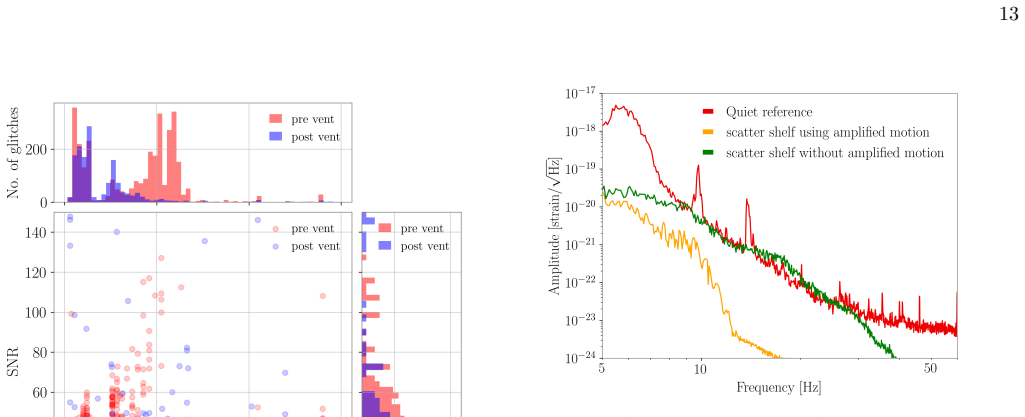
and another group was correlated with a structural resonance of the arm cavity baffle (ACB) at 1.6 Hz [11]. However, in O4, the scattered light noise did not seem to be correlated with any particular frequency. We ob- served the scattered light noise in the data as long as the ground motion in the band 0.1-0.5 Hz was above a cer- tain threshold. This can ...
work page 2024
-
[2]
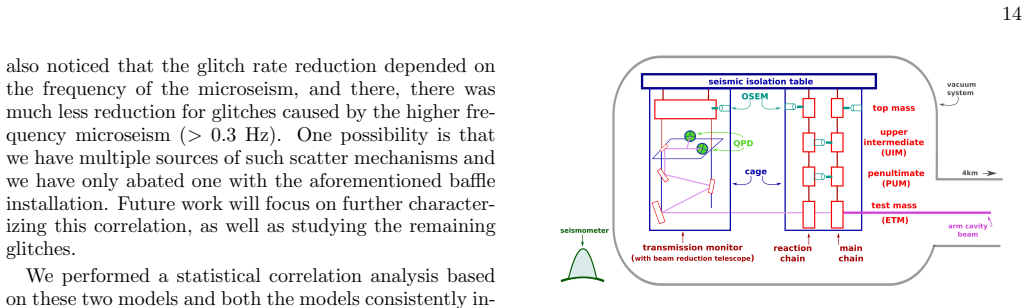
is the one which holds the optics table from which the test mass mirrors are suspended with quadruple pendu- lums and the beam splitter (BS) is suspended using a triple suspension. A baffle (Arm Cavity Baffle (ACB)), suspended from the HEPI in front of the test mass mir- rors towards the main beam side, helps to capture any scattered beam from the test ma...
work page 2025
-
[3]
after completing the instrumental upgrades. Com- paring the top panels of the figures 17a and 17b, we can see a significant reduction in the hourly glitch rate given the same amount of microseismic ground motion. Figure 18 compares two scatter shelves, one from be- fore the baffles were installed (figure 18a) and the other from after baffle installation (...
work page 2024
-
[4]
B. P. Abbottet al.(LIGO Scientific, Virgo), Observation of Gravitational Waves from a Binary Black Hole Merger, Phys. Rev. Lett.116, 061102 (2016), arXiv:1602.03837 [gr-qc]
work page internal anchor Pith review Pith/arXiv arXiv 2016
-
[5]
A. G. Abacet al.(LIGO Scientific, VIRGO, KAGRA), GWTC-4.0: Updating the Gravitational-Wave Transient Catalog with Observations from the First Part of the Fourth LIGO-Virgo-KAGRA Observing Run, (2025), arXiv:2508.18082 [gr-qc]
work page internal anchor Pith review Pith/arXiv arXiv 2025
-
[6]
E. Capoteet al., Advanced LIGO detector performance in the fourth observing run, Phys. Rev. D111, 062002 (2025), arXiv:2411.14607 [gr-qc]
-
[7]
S. Soniet al.(LIGO), LIGO Detector Characterization in the first half of the fourth Observing run, Class. Quant. Grav.42, 085016 (2025), arXiv:2409.02831 [astro-ph.IM]
-
[8]
J. Glanzeret al., Data quality up to the third observing run of advanced LIGO: Gravity Spy glitch classifications, Class. Quant. Grav.40, 065004 (2023), arXiv:2208.12849 [gr-qc]
- [9]
-
[10]
Accadiaet al., Noise from scattered light in Virgo’s second science run data, Class
T. Accadiaet al., Noise from scattered light in Virgo’s second science run data, Class. Quant. Grav.27, 194011 (2010)
work page 2010
-
[11]
B. Canuel, E. Genin, G. Vajente, and J. Marque, Dis- placement noise from back scattering and specular re- flection of input optics in advanced gravitational wave detectors, Opt. Express21, 10.1364/oe.21.010546 (2013)
-
[12]
D. J. Ottaway, P. Fritschel, and S. J. Waldman, Impact of upconverted scattered light on advanced interferomet- ric gravitational wave detectors, Opt. Express20, 8329 (2012)
work page 2012
-
[13]
Soniet al.(LIGO), Reducing scattered light in LIGO’s third observing run, Class
S. Soniet al.(LIGO), Reducing scattered light in LIGO’s third observing run, Class. Quant. Grav.38, 025016 (2020), arXiv:2007.14876 [astro-ph.IM]
- [14]
- [15]
-
[16]
F. Robinet, N. Arnaud, N. Leroy, A. Lundgren, D. Macleod, and J. McIver, Omicron: a tool to char- acterize transient noise in gravitational-wave detectors, SoftwareX12, 100620 (2020), arXiv:2007.11374 [astro- ph.IM]
-
[17]
Nguyenet al.(AdvLIGO), Environmental noise in ad- vanced LIGO detectors, Class
P. Nguyenet al.(AdvLIGO), Environmental noise in ad- vanced LIGO detectors, Class. Quant. Grav.38, 145001 (2021), arXiv:2101.09935 [astro-ph.IM]
-
[18]
Seismic isolation of Advanced LIGO: Review of strategy, instrumentation and performance
F. Matichardet al., Seismic isolation of Advanced LIGO: Review of strategy, instrumentation and performance, Class. Quant. Grav.32, 185003 (2015), arXiv:1502.06300 [physics.ins-det]
work page internal anchor Pith review Pith/arXiv arXiv 2015
-
[19]
S. M. Astonet al., Update on quadruple suspension de- sign for Advanced LIGO, Class. Quant. Grav.29, 235004 (2012)
work page 2012
-
[20]
J. R. Smith, T. Abbott, E. Hirose, N. Leroy, D. Macleod, J. McIver, P. Saulson, and P. Shawhan, A Hierarchi- cal method for vetoing noise transients in gravitational- wave detectors, Class. Quant. Grav.28, 235005 (2011), arXiv:1107.2948 [gr-qc]
work page internal anchor Pith review Pith/arXiv arXiv 2011
discussion (0)
Sign in with ORCID, Apple, or X to comment. Anyone can read and Pith papers without signing in.