Recognition: no theorem link
Opportunities for Gravitational Wave Physics at the South Pole
Pith reviewed 2026-05-15 02:37 UTC · model grok-4.3
The pith
A long-baseline atom interferometer at the South Pole could detect gravitational waves in the decihertz band and improve global source localization.
A machine-rendered reading of the paper's core claim, the machinery that carries it, and where it could break.
Core claim
A long-baseline atom interferometer deployed at the South Pole would access the decihertz gravitational-wave band by exploiting the low seismic noise environment and would strengthen source localization through its contribution to global triangulation, thereby expanding the reach of existing detector networks and enabling new tests of fundamental physics.
What carries the argument
Long-baseline atom interferometer, which senses spacetime strain through interference of cold atomic matter waves over kilometer-scale baselines.
Load-bearing premise
The engineering demands of operating a large atom interferometer in extreme Antarctic conditions can be met at acceptable cost while seismic noise remains low enough to achieve the required sensitivity.
What would settle it
Extended seismic noise recordings at the South Pole showing ground motion levels that exceed the strain sensitivity needed for decihertz-band detection.
Figures


read the original abstract
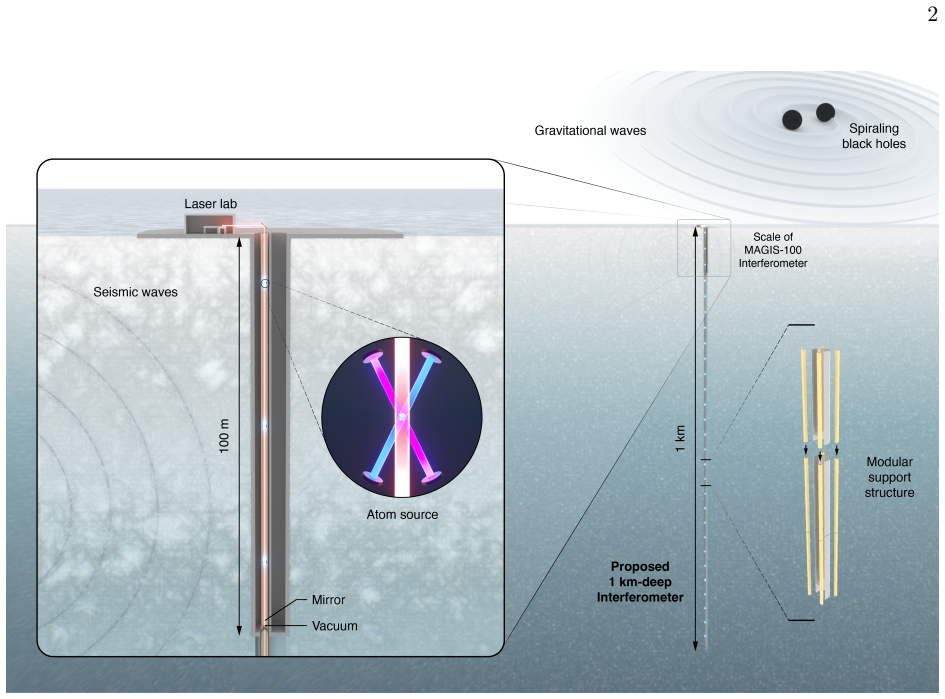
Atom interferometers represent a promising approach for gravitational wave detection in the decihertz frequency band, complementary to existing light-based detectors. The South Pole offers unique advantages for such experiments: exceptionally low seismic noise, established infrastructure for large scientific projects, and a location that strengthens gravitational wave source localization through global triangulation. Here we discuss the scientific case and practical considerations for deploying a long-baseline atom interferometer at the South Pole, which has the potential to expand the global network of gravitational wave detectors while enabling precision tests of fundamental physics.
Editorial analysis
A structured set of objections, weighed in public.
Referee Report
Summary. The manuscript discusses the scientific case and practical considerations for deploying a long-baseline atom interferometer at the South Pole for gravitational wave detection in the decihertz frequency band. It highlights the site's exceptionally low seismic noise, established infrastructure for large projects, and strategic location for improving source localization via global triangulation, with the potential to expand the global GW detector network and enable precision tests of fundamental physics.
Significance. If realized, the proposed experiment would provide complementary coverage in the decihertz band, where current detectors have limited reach, while enhancing network triangulation for better localization and offering a platform for fundamental physics tests; this aligns with ongoing efforts to broaden gravitational wave astronomy capabilities.
major comments (1)
- [Abstract] Abstract and practical considerations section: the feasibility claim rests on low seismic noise and solvable engineering challenges, but no quantitative noise levels, sensitivity estimates, or error budgets are provided to demonstrate that the required performance can be reached without additional mitigations.
Simulated Author's Rebuttal
We thank the referee for their supportive review and recommendation for minor revision. We address the single major comment below.
read point-by-point responses
-
Referee: [Abstract] Abstract and practical considerations section: the feasibility claim rests on low seismic noise and solvable engineering challenges, but no quantitative noise levels, sensitivity estimates, or error budgets are provided to demonstrate that the required performance can be reached without additional mitigations.
Authors: We agree that quantitative support strengthens the feasibility discussion. The manuscript is framed as an opportunities paper rather than a full technical design study, so it emphasizes site advantages and scientific motivation with qualitative arguments. In the revised version we have added (i) references to published South Pole seismic noise spectra in the decihertz band, (ii) order-of-magnitude strain sensitivity projections for a 1 km baseline atom interferometer based on existing atom-interferometer literature, and (iii) a concise discussion of the dominant noise terms and standard mitigation approaches (vibration isolation, laser phase noise control) that do not require new techniques. These additions provide concrete numbers without expanding the paper beyond its intended scope. revision: yes
Circularity Check
No significant circularity
full rationale
The manuscript is a conceptual discussion paper outlining scientific opportunities for a long-baseline atom interferometer at the South Pole. It contains no derivations, equations, fitted parameters, or quantitative predictions that could reduce to inputs by construction. Claims rest on established site properties (low seismic noise, infrastructure) and global network triangulation benefits, presented as exploratory rather than derived. No self-citations, ansatzes, or uniqueness theorems are invoked in a load-bearing manner. The argument structure is self-contained against external benchmarks with no internal reductions.
Axiom & Free-Parameter Ledger
Reference graph
Works this paper leans on
-
[1]
S. Dimopoulos, P. W. Graham, J. M. Hogan, M. A. Kasevich, and S. Rajendran, Phys. Rev. D78, 122002 (2008)
work page 2008
-
[2]
P. W. Graham, J. M. Hogan, M. A. Kasevich, and S. Rajendran, Phys. Rev. Lett.110, 171102 (2013). 9
work page 2013
- [3]
-
[4]
A. Abdalla, M. Abe, S. Abend, M. Abidi, M. Aidelsburger, A. Alibabaei, B. Allard, J. Antoniadis, G. Arduini, N. Augst, P. Balamatsias, A. Balaˇ z, H. Banks, R. L. Barcklay, M. Barone, M. Barsanti, M. G. Bason, A. Bassi, J.-B. Bayle, C. F. A. Baynham, Q. Beaufils, S. Beldjoudi, A. Beli´ c, S. Bennetts, J. Bernabeu, A. Bertoldi, C. Bigard, N. P. Bigelow, R....
work page 2025
-
[5]
B. P. Abbottet al.(LIGO Scientific Collaboration and Virgo Collaboration), Phys. Rev. Lett.116, 061102 (2016)
work page 2016
-
[6]
T. A. Prince, M. Tinto, S. L. Larson, and J. Armstrong, Physical Review D66, 122002 (2002)
work page 2002
-
[7]
P. W. Graham and S. Jung, Phys. Rev. D97, 024052 (2018)
work page 2018
- [8]
-
[9]
P. W. Graham, J. M. Hogan, M. A. Kasevich, S. Rajendran, and R. W. Romani (MAGIS), arXiv e-prints (2017), arXiv:1711.02225 [astro-ph.IM]
work page internal anchor Pith review Pith/arXiv arXiv 2017
-
[10]
R. E. Anthony, A. T. Ringler, M. DuVernois, K. R. Anderson, and D. C. Wilson, Seismol. Res. Lett. 92, 2718 (2021)
work page 2021
-
[11]
Richter, Science391, 10.1126/science.za4rn1l (2026)
H. Richter, Science391, 10.1126/science.za4rn1l (2026)
- [12]
-
[13]
P. B. Price, O. V. Nagornov, R. Bay, D. Chirkin, Y. He, P. Miocinovic, A. Richards, K. Woschnagg, B. Koci, and V. Zagorodnov, Proceedings of the National Academy of Sciences99, 7844 (2002), https://www.pnas.org/doi/pdf/10.1073/pnas.082238999
-
[14]
M. Abe, P. Adamson, M. Borcean, D. Bortoletto, K. Bridges, S. P. Carman, S. Chattopadhyay, J. Cole- man, N. M. Curfman, K. DeRose,et al., Quantum Sci. Technol.6, 044003 (2021)
work page 2021
-
[15]
Harms, Living Reviews in Relativity22, 6 (2019)
J. Harms, Living Reviews in Relativity22, 6 (2019)
work page 2019
-
[16]
B. Canuel, A. Bertoldi, L. Amand, E. Pozzo di Borgo, T. Chantrait, C. Danquigny, M. Dovale ´Alvarez, B. Fang, A. Freise, R. Geiger, J. Gillot, S. Henry, J. Hinderer, D. Holleville, J. Junca, G. Lef` evre, M. Merzougui, N. Mielec, T. Monfret, S. Pelisson, M. Prevedelli, S. Reynaud, I. Riou, Y. Rogister, S. Rosat, E. Cormier, A. Landragin, W. Chaibi, S. Gaf...
work page 2018
-
[17]
J. Mitchell, T. Kovachy, S. Hahn, P. Adamson, and S. Chattopadhyay, Journal of Instrumentation17 (01), P01007
-
[18]
L. Badurina, V. Gibson, C. McCabe, and J. Mitchell, Physical Review D107, 055002 (2023)
work page 2023
-
[19]
L. Badurina, E. Bentine, D. Blas, K. Bongs, D. Bortoletto, T. Bowcock, K. Bridges, W. Bowden, O. Buchmueller, C. Burrage, J. Coleman,et al., J. Cosmol. Astropart. Phys.2020(05), 011
work page 2020
-
[20]
B. Canuel, S. Abend, P. Amaro-Seoane, F. Badaracco, Q. Beaufils, A. Bertoldi, K. Bongs, P. Bouyer, C. Braxmaier, W. Chaibi, N. Christensen, F. Fitzek, G. Flouris, N. Gaaloul, S. Gaffet, C. L. G. Alzar, R. Geiger, S. Guellati-Khelifa, K. Hammerer, J. Harms, J. Hinderer, M. Holynski, J. Junca, S. Kat- sanevas, C. Klempt, C. Kozanitis, M. Krutzik, A. Landrag...
work page 2020
-
[21]
C. Baynham, A. Bertoldi, D. Blas, O. Buchmueller, S. Calatroni, V. Charmandaris, M. L. Chiofalo, P. Clad´ e, J. Coleman, F. Di Pumpo,et al., arXiv preprint arXiv:2509.11867 (2025)
-
[22]
M.-S. Zhan, J. Wang, W.-T. Ni, D.-F. Gao, G. Wang, L.-X. He, R.-B. Li, L. Zhou, X. Chen, J.-Q. Zhong, B. Tang, Z.-W. Yao, L. Zhu, Z.-Y. Xiong, S.-B. Lu, G.-H. Yu, Q.-F. Cheng, M. Liu, Y.-R. Liang, P. Xu, X.-D. He, M. Ke, Z. Tan, and J. Luo, International Journal of Modern Physics D29, 1940005 (2020)
work page 2020
-
[23]
S. Baum, Z. Bogorad, and P. W. Graham, Journal of Cosmology and Astroparticle Physics2024(05), 027
- [24]
-
[25]
S. M. Dickerson, J. M. Hogan, A. Sugarbaker, D. M. S. Johnson, and M. A. Kasevich, Physical Review Letters111, 083001 (2013)
work page 2013
- [26]
- [27]
-
[28]
Y. Wang, J. Glick, T. Deshpande, K. DeRose, S. Saraf, N. Sachdeva, K. Jiang, Z. Chen, and T. Kovachy, Physical review letters133, 243403 (2024)
work page 2024
-
[29]
Methodological note, Gravity gradient noise model parameters (), rayleigh waves are dominant surface seismic waves in the decihertz frequency band with an exponential ampitude decay with depth. Wave model depends on local site parameters such as ground density and wave speed which need to be measured locally. Here stand in estimated parameters were used. ...
work page 2026
- [30]
-
[31]
J. R. Peterson,Observations and Modeling of Seismic Background Noise, USGS Numbered Series 93- 322 (U.S. Geological Survey, 1993). 12
work page 1993
-
[32]
Methodological note, Sky localization fisher-matrix analysis (), sky localization used Fisher information analysis method for a network of 1 km vertical baseline atom interferometers. Model binary black hole source parameters used chirp mass of 25M ⊙, luminosity distance 100 Mpc, binary inclination angle of π/4 and polarization angleπ/3. The Fisher inform...
discussion (0)
Sign in with ORCID, Apple, or X to comment. Anyone can read and Pith papers without signing in.