Anisotropic Surface Spin Waves as Signature of A-type Altermagnets
Pith reviewed 2026-06-30 20:27 UTC · model grok-4.3
The pith
Anisotropic surface spin waves serve as a signature of A-type altermagnets
A machine-rendered reading of the paper's core claim, the machinery that carries it, and where it could break.
Core claim
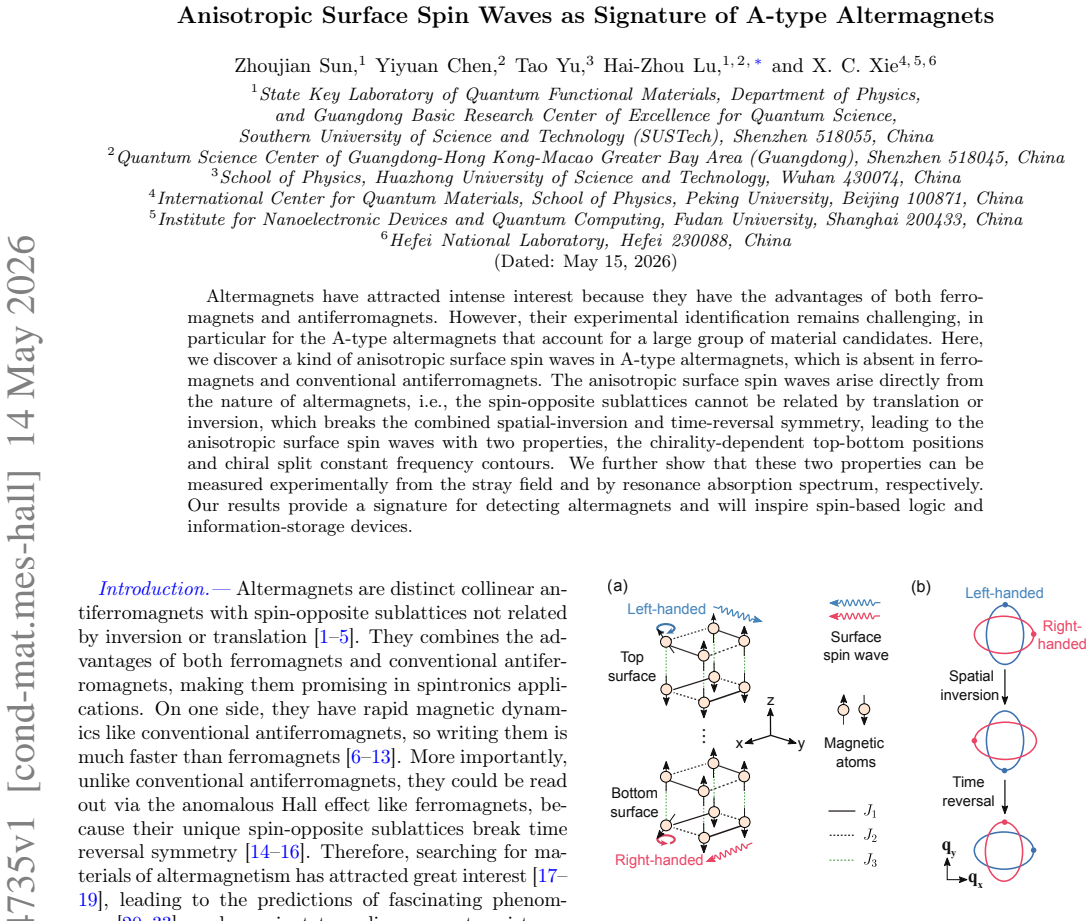
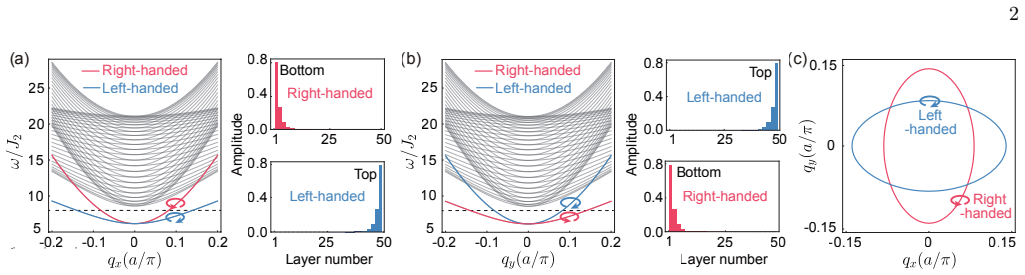
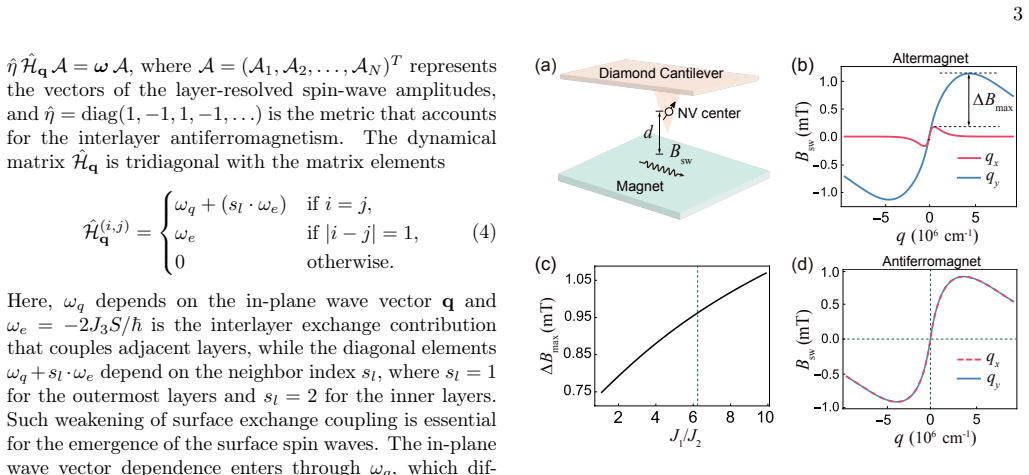
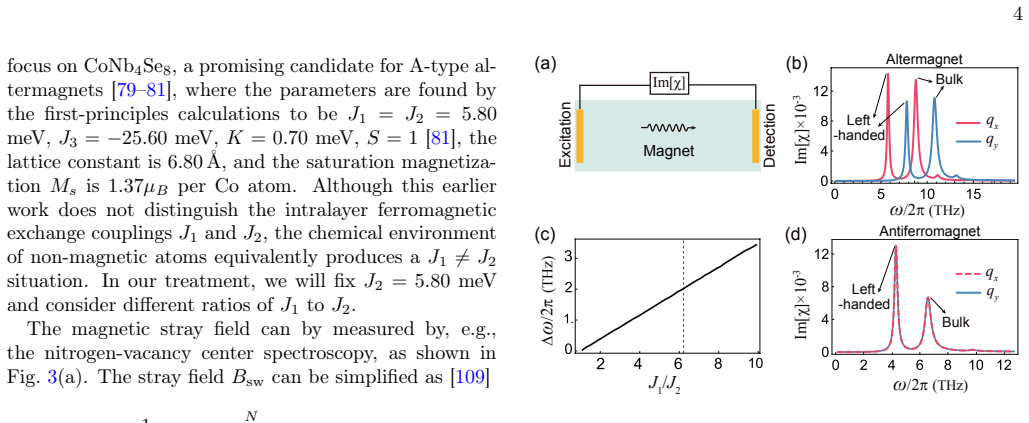
We discover a kind of anisotropic surface spin waves in A-type altermagnets, which is absent in ferromagnets and conventional antiferromagnets. The anisotropic surface spin waves arise directly from the nature of altermagnets, i.e., the spin-opposite sublattices cannot be related by translation or inversion, which breaks the combined spatial-inversion and time-reversal symmetry, leading to the anisotropic surface spin waves with two properties, the chirality-dependent top-bottom positions and chiral split constant frequency contours. We further show that these two properties can be measured experimentally from the stray field and by resonance absorption spectrum, respectively. Our results pr
What carries the argument
Anisotropic surface spin waves generated by altermagnetic symmetry breaking in which spin-opposite sublattices cannot be related by translation or inversion
If this is right
- Chirality-dependent top-bottom positions of the surface spin waves appear in the stray field.
- Chiral split constant frequency contours appear in the resonance absorption spectrum.
- The two properties together supply an experimental signature for identifying A-type altermagnets.
- The signature can guide development of spin-based logic and information-storage devices.
Where Pith is reading between the lines
- Device concepts could use the chirality dependence to encode information in the top versus bottom surface response.
- The same symmetry argument might predict analogous surface-wave features in other altermagnet classes that share the relevant sublattice property.
- Thin-film or nanostructured samples would be natural platforms for testing because surface effects dominate in reduced dimensions.
Load-bearing premise
The anisotropic surface spin waves with chirality-dependent top-bottom positions and chiral split constant frequency contours arise directly and uniquely from altermagnetic symmetry breaking and are absent in ferromagnets and conventional antiferromagnets.
What would settle it
Observation of the same chirality-dependent top-bottom positions and chiral split constant frequency contours for surface spin waves in a ferromagnet or conventional antiferromagnet would falsify the claim of uniqueness to A-type altermagnets.
Figures
read the original abstract
Altermagnets have attracted intense interest because they have the advantages of both ferromagnets and antiferromagnets. However, their experimental identification remains challenging, in particular for the A-type altermagnets that account for a large group of material candidates. Here, we discover a kind of anisotropic surface spin waves in A-type altermagnets, which is absent in ferromagnets and conventional antiferromagnets. The anisotropic surface spin waves arise directly from the nature of altermagnets, i.e., the spin-opposite sublattices cannot be related by translation or inversion, which breaks the combined spatial-inversion and time-reversal symmetry, leading to the anisotropic surface spin waves with two properties, the chirality-dependent top-bottom positions and chiral split constant frequency contours. We further show that these two properties can be measured experimentally from the stray field and by resonance absorption spectrum, respectively. Our results provide a signature for detecting altermagnets and will inspire spin-based logic and information-storage devices.
Editorial analysis
A structured set of objections, weighed in public.
Referee Report
Summary. The manuscript claims that A-type altermagnets host anisotropic surface spin waves absent in ferromagnets and conventional antiferromagnets. These waves arise from the breaking of combined PT symmetry because opposite-spin sublattices cannot be related by translation or inversion. The waves exhibit two properties: chirality-dependent top-bottom positions and chiral split constant-frequency contours. The authors propose these can be measured via stray-field imaging and resonance absorption spectra, respectively, providing an experimental signature for A-type altermagnets.
Significance. If the symmetry-based derivation holds, the result supplies a concrete, falsifiable experimental signature for a large class of altermagnetic candidates whose identification remains difficult. The absence of free parameters or fitted quantities in the central symmetry argument is a strength. The work could stimulate both fundamental studies of altermagnetic surface states and applications in spin-based logic.
minor comments (3)
- The abstract and introduction would benefit from a one-sentence definition of 'A-type altermagnet' for readers outside the immediate subfield.
- Figure captions should explicitly state the material parameters (exchange constants, anisotropy, etc.) used to generate the plotted dispersions and stray-field maps.
- A brief comparison table or paragraph contrasting the predicted surface-wave features with those of a conventional antiferromagnet (e.g., MnF2 or NiO) under identical boundary conditions would strengthen the uniqueness claim.
Simulated Author's Rebuttal
We thank the referee for the positive assessment of our work, the accurate summary of our claims, and the recommendation for minor revision. The referee's evaluation highlights the potential value of the proposed signature for A-type altermagnets. No specific major comments were provided in the report.
Circularity Check
No significant circularity detected
full rationale
The paper's central derivation rests on a symmetry argument: A-type altermagnets are defined by spin-opposite sublattices that cannot be related by translation or inversion, which breaks combined PT symmetry and produces the stated anisotropic surface spin-wave properties (chirality-dependent positions and split constant-frequency contours). These features are shown to be absent by construction in ferromagnets and conventional antiferromagnets due to their differing symmetries. No equations, parameters, or predictions are shown to reduce to fitted inputs or self-citations; the experimental signatures follow directly from the symmetry-derived properties without self-referential loops. The derivation is therefore self-contained against external symmetry benchmarks.
Axiom & Free-Parameter Ledger
axioms (1)
- domain assumption Spin-opposite sublattices in A-type altermagnets cannot be related by translation or inversion, breaking combined spatial-inversion and time-reversal symmetry.
Forward citations
Cited by 1 Pith paper
-
Synthetic Altermagnetism Beyond the Crystal Limit
Synthetic altermagnetism is realized in a continuum platform of antiferromagnetically coupled ferromagnetic films with alternating in-plane exchange anisotropies, reproducing momentum-dependent magnon splitting, nodal...
Reference graph
Works this paper leans on
-
[1]
Emerging research landscape of altermagnetism
L. Šmejkal, J. Sinova, and T. Jungwirth, “Emerging research landscape of altermagnetism”, Phys. Rev. X 12, 040501 (2022)
2022
-
[2]
Beyond con- ventional ferromagnetism and antiferromagnetism: A phasewithnonrelativisticspinandcrystalrotationsym- metry
L. Šmejkal, J. Sinova, and T. Jungwirth, “Beyond con- ventional ferromagnetism and antiferromagnetism: A phasewithnonrelativisticspinandcrystalrotationsym- metry”, Phys. Rev. X12, 031042 (2022)
2022
-
[3]
Observation of time- reversal symmetry breaking in the band structure of altermagnetic RuO2
O. Fedchenko, J. Minár, A. Akashdeep, S. W. D’Souza, D. Vasilyev, O. Tkach,et al., “Observation of time- reversal symmetry breaking in the band structure of altermagnetic RuO2”, Sci. Adv.10, eadj4883 (2024)
2024
-
[4]
Unconventional magnons in collinear mag- nets dictated by spin space groups
X. Chen, Y. Liu, P. Liu, Y. Yu, J. Ren, J. Li, A. Zhang, and Q. Liu, “Unconventional magnons in collinear mag- nets dictated by spin space groups”, Nature640, 349 (2025)
2025
-
[5]
Chiral magnons in altermagnetic RuO2
L. Šmejkal, A. Marmodoro, K.-H. Ahn, R. González- Hernández, I. Turek, S. Mankovsky,et al., “Chiral magnons in altermagnetic RuO2”, Phys. Rev. Lett.131, 256703 (2023)
2023
-
[6]
Electrical switching of an anti- ferromagnet
P. Wadley, B. Howells, J. Železn` y, C. Andrews, V. Hills, R. P. Campion,et al., “Electrical switching of an anti- ferromagnet”, Science351, 587 (2016)
2016
-
[7]
Subtera- hertzspinpumpingfromaninsulatingantiferromagnet
P. Vaidya, S. A. Morley, J. van Tol, Y. Liu, R. Cheng, A. Brataas, D. Lederman, and E. Del Barco, “Subtera- hertzspinpumpingfromaninsulatingantiferromagnet”, Science368, 160 (2020)
2020
-
[8]
A spin-valve-like mag- netoresistance of an antiferromagnet-based tunnel junc- tion
B. G. Park, J. Wunderlich, X. Martí, V. Hol` y, Y. Kurosaki, M. Yamada,et al., “A spin-valve-like mag- netoresistance of an antiferromagnet-based tunnel junc- tion”, Nat. Mater.10, 347 (2011)
2011
-
[9]
Room-temperature perpendicular exchange couplingandtunnelinganisotropicmagnetoresistancein an antiferromagnet-based tunnel junction
Y. Y. Wang, C. Song, B. Cui, G. Y. Wang, F. Zeng, and F. Pan, “Room-temperature perpendicular exchange couplingandtunnelinganisotropicmagnetoresistancein an antiferromagnet-based tunnel junction”, Phys. Rev. Lett.109, 137201 (2012)
2012
-
[10]
Room-temperature antiferromagnetic memory resistor
X. Marti, I. Fina, C. Frontera, J. Liu, P. Wadley, Q. He, et al., “Room-temperature antiferromagnetic memory resistor”, Nat. Mater.13, 367 (2014)
2014
-
[11]
Electrical switching of altermagnetism
Y. Chen, X. Liu, H.-Z. Lu, and X. Xie, “Electrical switching of altermagnetism”, Phys. Rev. Lett.135, 016701 (2025)
2025
-
[12]
Antiferroelectric altermagnets: An- tiferroelectricity alters magnets
X. Duan, J. Zhang, Z. Zhu, Y. Liu, Z. Zhang, I. Žu- tić, and T. Zhou, “Antiferroelectric altermagnets: An- tiferroelectricity alters magnets”, Phys. Rev. Lett.134, 106801 (2025)
2025
-
[13]
Ferroelectric switchable alter- magnetism
M. Gu, Y. Liu, H. Zhu, K. Yananose, X. Chen, Y. Hu, A. Stroppa, and Q. Liu, “Ferroelectric switchable alter- magnetism”, Phys. Rev. Lett.134, 106802 (2025)
2025
-
[14]
Spin-group symmetry in magnetic materials with negligible spin- orbit coupling
P. Liu, J. Li, J. Han, X. Wan, and Q. Liu, “Spin-group symmetry in magnetic materials with negligible spin- orbit coupling”, Phys. Rev. X12, 021016 (2022)
2022
-
[15]
Spin current generation in organic antiferromagnets
M. Naka, S. Hayami, H. Kusunose, Y. Yanagi, Y. Mo- tome, and H. Seo, “Spin current generation in organic antiferromagnets”, Nat. Commun.10, 4305 (2019)
2019
-
[16]
anomalous Hall effect inκ-type organic antiferromagnets
M. Naka, S. Hayami, H. Kusunose, Y. Yanagi, Y. Mo- tome, and H. Seo, “anomalous Hall effect inκ-type organic antiferromagnets”, Phys. Rev. B102, 075112 (2020)
2020
-
[17]
Altermagnetism: Exploring new frontiers in magnetism and spintronics
L. Bai, W. Feng, S. Liu, L. Šmejkal, Y. Mokrousov, and Y. Yao, “Altermagnetism: Exploring new frontiers in magnetism and spintronics”, Adv. Funct. Mater.34, 2409327 (2024)
2024
-
[18]
Altermagnets as a new class of functional materials
C. Song, H. Bai, Z. Zhou, L. Han, H. Reichlova, J. H. Dil, J. Liu, X. Chen, and F. Pan, “Altermagnets as a new class of functional materials”, Nat. Rev. Mater.10, 473 (2025)
2025
-
[19]
Altermagnetism: An unconventional spin-ordered phase of matter
T. Jungwirth, R. M. Fernandes, E. Fradkin, A. H. Mac- Donald, J. Sinova, and L. Šmejkal, “Altermagnetism: An unconventional spin-ordered phase of matter”, New- ton1, 100162 (2025)
2025
-
[20]
Predictable gate-field control of spin in altermagnets with spin-layer coupling
R.-W. Zhang, C. Cui, R. Li, J. Duan, L. Li, Z.-M. Yu, and Y. Yao, “Predictable gate-field control of spin in altermagnets with spin-layer coupling”, Phys. Rev. Lett. 133, 056401 (2024)
2024
-
[21]
Realizing al- termagnetism in Fermi-Hubbard models with ultracold atoms
P. Das, V. Leeb, J. Knolle, and M. Knap, “Realizing al- termagnetism in Fermi-Hubbard models with ultracold atoms”, Phys. Rev. Lett.132, 263402 (2024)
2024
-
[22]
Discovery of a metallic room-temperature d-wave al- termagnet KV2Se2O
B. Jiang, M. Hu, J. Bai, Z. Song, C. Mu, G. Qu,et al., “Discovery of a metallic room-temperature d-wave al- termagnet KV2Se2O”, arXiv:2408.00320 (2024)
-
[23]
Topologi- cal superconductivity in two-dimensional altermagnetic metals
D. Zhu, Z.-Y. Zhuang, Z. Wu, and Z. Yan, “Topologi- cal superconductivity in two-dimensional altermagnetic metals”, Phys. Rev. B108, 184505 (2023)
2023
-
[24]
Crystal thermal transport in altermagnetic RuO2
X. Zhou, W. Feng, R.-W. Zhang, L. Šmejkal, J. Sinova, Y. Mokrousov, and Y. Yao, “Crystal thermal transport in altermagnetic RuO2”, Phys. Rev. Lett.132, 056701 (2024)
2024
-
[25]
Gapless superconducting state and mirage gap in altermagnets
M. Wei, L. Xiang, F. Xu, L. Zhang, G. Tang, and J. Wang, “Gapless superconducting state and mirage gap in altermagnets”, Phys. Rev. B109, L201404 (2024)
2024
-
[26]
dcJosephson effect in altermagnets
J.A.Ouassou, A.Brataas, andJ.Linder,“dcJosephson effect in altermagnets”, Phys. Rev. Lett.131, 076003 (2023)
2023
-
[27]
RKKY in- teraction in Rashba altermagnets
M. Amundsen, A. Brataas, and J. Linder, “RKKY in- teraction in Rashba altermagnets”, Phys. Rev. B110, 054427 (2024)
2024
-
[28]
Spin pumping from a ferromag- netic insulator into an altermagnet
C. Sun and J. Linder, “Spin pumping from a ferromag- netic insulator into an altermagnet”, Phys. Rev. B108, L140408 (2023)
2023
-
[29]
Skyrmion Hall 6 effect in altermagnets
Z. Jin, Z. Zeng, Y. Cao, and P. Yan, “Skyrmion Hall 6 effect in altermagnets”, Phys. Rev. Lett.133, 196701 (2024)
2024
-
[30]
Tunable second harmonic in altermagnetic Josephson junctions
H.-P. Sun, S.-B. Zhang, C.-A. Li, and B. Trauzettel, “Tunable second harmonic in altermagnetic Josephson junctions”, Phys. Rev. B111, 165406 (2025)
2025
-
[31]
Diagnos- ing altermagnetic phases through quantum oscillations
Z.-X. Li, H. Zhou, X. Wan, and W. Chen, “Diagnos- ing altermagnetic phases through quantum oscillations”, Phys. Rev. B111, 125119 (2025)
2025
-
[32]
Anoma- lous Hall effects in magnetic weak topological insulator films
R. Chen, X.-X. Yi, B. Zhou, and D.-H. Xu, “Anoma- lous Hall effects in magnetic weak topological insulator films”, Phys. Rev. B111, 045409 (2025)
2025
-
[33]
Distin- guishing between topological Majorana and trivial zero modes via transport and shot noise study in an alter- magnet heterostructure
D. Mondal, A. Pal, A. Saha, and T. Nag, “Distin- guishing between topological Majorana and trivial zero modes via transport and shot noise study in an alter- magnet heterostructure”, Phys. Rev. B111, L121401 (2025)
2025
-
[34]
Giant and tunneling magnetoresistance in unconventional collinear antiferro- magnets with nonrelativistic spin-momentum coupling
L. Šmejkal, A. B. Hellenes, R. González-Hernández, J. Sinova, and T. Jungwirth, “Giant and tunneling magnetoresistance in unconventional collinear antiferro- magnets with nonrelativistic spin-momentum coupling”, Phys. Rev. X12, 011028 (2022)
2022
-
[35]
Spin-neutral currents for spintronics
D.-F. Shao, S.-H. Zhang, M. Li, C.-B. Eom, and E. Y. Tsymbal, “Spin-neutral currents for spintronics”, Nat. Commun.12, 7061 (2021)
2021
-
[36]
Multifunctional antiferromagnetic mate- rials with giant piezomagnetism and noncollinear spin current
H.-Y. Ma, M. Hu, N. Li, J. Liu, W. Yao, J.-F. Jia, and J. Liu, “Multifunctional antiferromagnetic mate- rials with giant piezomagnetism and noncollinear spin current”, Nat. Commun.12, 2846 (2021)
2021
-
[37]
Efficient electrical spin splitter based on nonrelativis- tic collinear antiferromagnetism
R.González-Hernández, L.Šmejkal, K.Výborný, Y.Ya- hagi, J. Sinova, T. c. v. Jungwirth, and J. Železný, “Efficient electrical spin splitter based on nonrelativis- tic collinear antiferromagnetism”, Phys. Rev. Lett.126, 127701 (2021)
2021
-
[38]
Tilted spin current generated by the collinear antiferromagnet ruthenium dioxide
A. Bose, N. J. Schreiber, R. Jain, D.-F. Shao, H. P. Nair, J. Sun,et al., “Tilted spin current generated by the collinear antiferromagnet ruthenium dioxide”, Nat. Electron.5, 267 (2022)
2022
-
[39]
Finite- momentum Cooper pairing in proximitized altermag- nets
S.-B. Zhang, L.-H. Hu, and T. Neupert, “Finite- momentum Cooper pairing in proximitized altermag- nets”, Nat. Commun.15, 1801 (2024)
2024
-
[40]
Fulde-ferrell-larkin- ovchinnikov state induced by antiferromagnetic order in κ-type organic conductors
S. Sumita, M. Naka, and H. Seo, “Fulde-ferrell-larkin- ovchinnikov state induced by antiferromagnetic order in κ-type organic conductors”, Phys. Rev. Res.5, 043171 (2023)
2023
-
[41]
Zero-field finite-momentum and field-induced superconductivity in altermagnets
D. Chakraborty and A. M. Black-Schaffer, “Zero-field finite-momentum and field-induced superconductivity in altermagnets”, Phys. Rev. B110, L060508 (2024)
2024
-
[42]
Unconventional p-waveandfinite-momentumsuperconductivityinduced by altermagnetism through the formation of Bogoliubov Fermi surface
S. Hong, M. J. Park, and K.-M. Kim, “Unconventional p-waveandfinite-momentumsuperconductivityinduced by altermagnetism through the formation of Bogoliubov Fermi surface”, Phys. Rev. B111, 054501 (2025)
2025
-
[43]
Pair density waves and super- current diode effect in altermagnets
G. Sim and J. Knolle, “Pair density waves and super- current diode effect in altermagnets”, Phys. Rev. B112, L020502 (2025)
2025
-
[44]
Coulomb drag in altermagnets
H.-J. Lin, S.-B. Zhang, H.-Z. Lu, and X. C. Xie, “Coulomb drag in altermagnets”, Phys. Rev. Lett.134, 136301 (2025)
2025
-
[45]
Altermagnetic lifting of Kramers spin degeneracy
J. Krempask` y, L. Šmejkal, S. D’souza, M. Hajlaoui, G. Springholz, K. Uhlířová,et al., “Altermagnetic lifting of Kramers spin degeneracy”, Nature626, 517 (2024)
2024
-
[46]
Observation of a giant band splitting in altermagnetic MnTe
T. Osumi, S. Souma, T. Aoyama, K. Yamauchi, A. Honma, K. Nakayama, T. Takahashi, K. Ohgushi, and T. Sato, “Observation of a giant band splitting in altermagnetic MnTe”, Phys. Rev. B109, 115102 (2024)
2024
-
[47]
Broken Kramers degeneracy in altermagnetic MnTe
S. Lee, S. Lee, S. Jung, J. Jung, D. Kim, Y. Lee,et al., “Broken Kramers degeneracy in altermagnetic MnTe”, Phys. Rev. Lett.132, 036702 (2024)
2024
-
[48]
Observation of plaid-like spin splitting in a non- coplanar antiferromagnet
Y.-P. Zhu, X. Chen, X.-R. Liu, Y. Liu, P. Liu, H. Zha, et al., “Observation of plaid-like spin splitting in a non- coplanar antiferromagnet”, Nature626, 523 (2024)
2024
-
[49]
Observation of spin splitting in room- temperature metallic antiferromagnet CrSb
M. Zeng, M.-Y. Zhu, Y.-P. Zhu, X.-R. Liu, X.-M. Ma, Y.-J. Hao,et al., “Observation of spin splitting in room- temperature metallic antiferromagnet CrSb”, Adv. Sci. 11, 2406529 (2024)
2024
-
[50]
Three-dimensional mapping of the altermagnetic spin splitting in CrSb
G. Yang, Z. Li, S. Yang, J. Li, H. Zheng, W. Zhu,et al., “Three-dimensional mapping of the altermagnetic spin splitting in CrSb”, Nat. Commun.16, 1442 (2025)
2025
-
[51]
Large band splitting ing-wave altermagnet CrSb
J. Ding, Z. Jiang, X. Chen, Z. Tao, Z. Liu, T. Li,et al., “Large band splitting ing-wave altermagnet CrSb”, Phys. Rev. Lett.133, 206401 (2024)
2024
-
[52]
Topological weyl altermagnetism in CrSb
C. Li, M. Hu, Z. Li, Y. Wang, W. Chen, B. Thiagara- jan,et al., “Topological weyl altermagnetism in CrSb”, Commun. Phys.8, 311 (2025)
2025
-
[53]
Crystal-symmetry-paired spin–valley locking in a layered room-temperature metallic altermagnet can- didate
F. Zhang, X. Cheng, Z. Yin, C. Liu, L. Deng, Y. Qiao, et al., “Crystal-symmetry-paired spin–valley locking in a layered room-temperature metallic altermagnet can- didate”, Nat. Phys.21, 760 (2025)
2025
-
[54]
A metallic room-temperature d-wave altermag- net
B. Jiang, M. Hu, J. Bai, Z. Song, C. Mu, G. Qu, et al., “A metallic room-temperature d-wave altermag- net”, Nat. Phys.21, 754 (2025)
2025
-
[55]
Nanoscale imaging and control of altermagnetism in MnTe
O. Amin, A. Dal Din, E. Golias, Y. Niu, A. Zakharov, S. Fromage,et al., “Nanoscale imaging and control of altermagnetism in MnTe”, Nature636, 348 (2024)
2024
-
[56]
X-ray magnetic circular dichroism in altermagneticα-MnTe
A. Hariki, A. Dal Din, O. Amin, T. Yamaguchi, A. Badura, D. Kriegner,et al., “X-ray magnetic circular dichroism in altermagneticα-MnTe”, Phys. Rev. Lett. 132, 176701 (2024)
2024
-
[57]
Revealing the altermagnetism in hematite via XMCD imaging and anomalous Hall electrical transport
E. Galindez-Ruales, R. Gonzalez-Hernandez, C. Schmitt, S. Das, F. Fuhrmann, A. Ross,et al., “Revealing the altermagnetism in hematite via XMCD imaging and anomalous Hall electrical transport”, Adv. Mater.37, e05019 (2025)
2025
-
[58]
Large anisotropic x-ray magnetic circular dichroism in altermagnetic CrSb with collinear antiferromagnetic structure at room tempera- ture
W. Li, W. Li, M. Zou, Y. Yin, H. Li, G. Qu, Y. Huang, R. Yu, H. Yang, and B. Wang, “Large anisotropic x-ray magnetic circular dichroism in altermagnetic CrSb with collinear antiferromagnetic structure at room tempera- ture”, Phys. Rev. B111, 224417 (2025)
2025
-
[59]
Altermagnetic nanotextures revealed in bulk MnTe
R. Yamamoto, L. A. Turnbull, M. Schmidt, J. C. Cor- saletti Filho, H. J. Binger, M. Di Pietro Martínez,et al., “Altermagnetic nanotextures revealed in bulk MnTe”, Phys. Rev. Appl.24, 034037 (2025)
2025
-
[60]
An anomalous Hall effect in altermagnetic ruthe- nium dioxide
Z. Feng, X. Zhou, L. Šmejkal, L. Wu, Z. Zhu, H. Guo, et al., “An anomalous Hall effect in altermagnetic ruthe- nium dioxide”, Nat. Electron.5, 735 (2022)
2022
-
[61]
Spontaneous anomalous Hall effect arising from an unconventional compensated magnetic phase in a semiconductor
R. D. Gonzalez Betancourt, J. Zubáč, R. Gonzalez- Hernandez, K. Geishendorf, Z. Šobáň, G. Springholz, et al., “Spontaneous anomalous Hall effect arising from an unconventional compensated magnetic phase in a semiconductor”, Phys. Rev. Lett.130, 036702 (2023)
2023
-
[62]
Quantum geometry induced nonlinear transport in altermagnets
Y. Fang, J. Cano, and S. A. A. Ghorashi, “Quantum geometry induced nonlinear transport in altermagnets”, Phys. Rev. Lett.133, 106701 (2024)
2024
-
[63]
Intrinsic anomalous Hall effect in altermagnets
L. Attias, A. Levchenko, and M. Khodas, “Intrinsic anomalous Hall effect in altermagnets”, Phys. Rev. B 110, 094425 (2024)
2024
-
[64]
Saturation of the anomalous Hall effect at high magnetic fields in 7 altermagnetic RuO2
T. Tschirner, P. Keßler, R. D. Gonzalez Betancourt, T. Kotte, D. Kriegner, B. Büchner,et al., “Saturation of the anomalous Hall effect at high magnetic fields in 7 altermagnetic RuO2”, APL Mater.11, 101103 (2023)
2023
-
[65]
Coexistence of anomalousHalleffectandweakmagnetizationinanom- inally collinear antiferromagnet MnTe
K. P. Kluczyk, K. Gas, M. J. Grzybowski, P. Skupiński, M. A. Borysiewicz, T. Fąs,et al., “Coexistence of anomalousHalleffectandweakmagnetizationinanom- inally collinear antiferromagnet MnTe”, Phys. Rev. B 110, 155201 (2024)
2024
-
[66]
Observation ofa spontaneousanomalous Hall response inthe Mn5Si3 d-wave altermagnet candidate
H. Reichlova, R. Lopes Seeger, R. González-Hernández, I. Kounta, R. Schlitz, D. Kriegner,et al., “Observation ofa spontaneousanomalous Hall response inthe Mn5Si3 d-wave altermagnet candidate”, Nat. Commun.15, 4961 (2024)
2024
-
[67]
Anisotropic magnetoresistance in altermagnetic MnTe
R. D. Gonzalez Betancourt, J. Zubáč, K. Geishendorf, P.Ritzinger, B.Růžičková, T.Kotte,et al.,“Anisotropic magnetoresistance in altermagnetic MnTe”, npj Spin- tronics2, 45 (2024)
2024
-
[68]
Observation of the anoma- lous Nernst effect in altermagnetic candidate Mn5Si3
A.Badura, W.H.Campos, V.K.Bharadwaj, I.Kounta, L. Michez, M. Petit,et al., “Observation of the anoma- lous Nernst effect in altermagnetic candidate Mn5Si3”, Nat. Commun.16, 7111 (2025)
2025
-
[69]
Third-order nonlinear Hall effect in alter- magnet RuO2
R. Y. Chu, L. Han, Z. H. Gong, X. Z. Fu, H. Bai, S. X. Liang,et al., “Third-order nonlinear Hall effect in alter- magnet RuO2”, Phys. Rev. Lett.135, 216703 (2025)
2025
-
[70]
Separation of inverse altermagnetic spin- splitting effect from inverse spin Hall effect in RuO2
C.-T. Liao, Y.-C. Wang, Y.-C. Tien, S.-Y. Huang, and D. Qu, “Separation of inverse altermagnetic spin- splitting effect from inverse spin Hall effect in RuO2”, Phys. Rev. Lett.133, 056701 (2024)
2024
-
[71]
Efficient spin-to-charge conversion via altermagnetic spin splitting effect in antiferromagnet RuO2
H. Bai, Y. C. Zhang, Y. J. Zhou, P. Chen, C. H. Wan, L. Han,et al., “Efficient spin-to-charge conversion via altermagnetic spin splitting effect in antiferromagnet RuO2”, Phys. Rev. Lett.130, 216701 (2023)
2023
-
[72]
Altermagnet-driven magnon spin split- ting Nernst effect
Y. Yang, D. Wang, B. Yang, P. Wang, Y. Mu, Y. Tian,et al., “Altermagnet-driven magnon spin split- ting Nernst effect”, Phys. Rev. Lett.136, 026701 (2026)
2026
-
[73]
Chi- ral split magnon in altermagnetic MnTe
Z. Liu, M. Ozeki, S. Asai, S. Itoh, and T. Masuda, “Chi- ral split magnon in altermagnetic MnTe”, Phys. Rev. Lett.133, 156702 (2024)
2024
-
[74]
Observation of chiral magnon band split- ting in altermagnetic Hematite
Q. Sun, J. Guo, D. Wang, D. L. Abernathy, W. Tian, and C. Li, “Observation of chiral magnon band split- ting in altermagnetic Hematite”, Phys. Rev. Lett.135, 186703 (2025)
2025
-
[75]
Coherent high-velocity chiral magnons in the metallic altermagnet CrSb
A. K. Singh, N. Heinsdorf, A. A. Mancilla, J. Ban- nies, A. Maity, A. I. Kolesnikov,et al., “Chiral spin-split magnons in the metallic altermagnet CrSb”, arXiv:2511.16086 (2025)
work page internal anchor Pith review Pith/arXiv arXiv 2025
-
[76]
Systematic mapping of altermagnetic magnons by resonant inelas- tic x-ray circular dichroism
N. Biniskos, M. dos Santos Dias, S. Agrestini, D. Sviták, K.-J. Zhou, J. Pospíšil, and P. Čermák, “Systematic mapping of altermagnetic magnons by resonant inelas- tic x-ray circular dichroism”, Nat. Commun.16, 9311 (2025)
2025
-
[77]
Circular dichroism inresonantinelasticx-rayscattering: Probingaltermag- netic domains in MnTe
D. Takegami, T. Aoyama, T. Okauchi, T. Yamaguchi, S. Tippireddy, S. Agrestini,et al., “Circular dichroism inresonantinelasticx-rayscattering: Probingaltermag- netic domains in MnTe”, Phys. Rev. Lett.135, 196502 (2025)
2025
-
[78]
General stacking theory for altermagnetism in bilayer systems
B. Pan, P. Zhou, P. Lyu, H. Xiao, X. Yang, and L. Sun, “General stacking theory for altermagnetism in bilayer systems”, Phys. Rev. Lett.133, 166701 (2024)
2024
-
[79]
Non-relativistic spin splitting above and below the Fermi level in a g-wave altermagnet
N. Dale, O. A. Ashour, M. Vila, R. B. Regmi, J. Fox, C. W. Johnson, A. Fedorov, A. Stibor, N. J. Ghimire, and S. M. Griffin, “Non-relativistic spin splitting above and below the Fermi level in a g-wave altermagnet”, arXiv:2411.18761 (2024)
-
[80]
Electronic structure of a layered altermagnetic compound CoNb4Se8
A. P. Sakhya, M. I. Mondal, M. Sprague, R. B. Regmi, A. K. Kumay, H. Sheokand, I. Mazin, N. J. Ghimire, M. Neupane,et al., “Electronic structure of a layered altermagnetic compound CoNb4Se8”, arXiv:2503.16670 (2025)
discussion (0)
Sign in with ORCID, Apple, or X to comment. Anyone can read and Pith papers without signing in.