Denoising-GS: Gaussian Splatting with Spatial-aware Denoising
Pith reviewed 2026-06-30 21:18 UTC · model grok-4.3
The pith
Treating 3D Gaussian Splatting optimization as spatial denoising of primitives raises novel view synthesis fidelity while keeping the representation compact.
A machine-rendered reading of the paper's core claim, the machinery that carries it, and where it could break.
Core claim
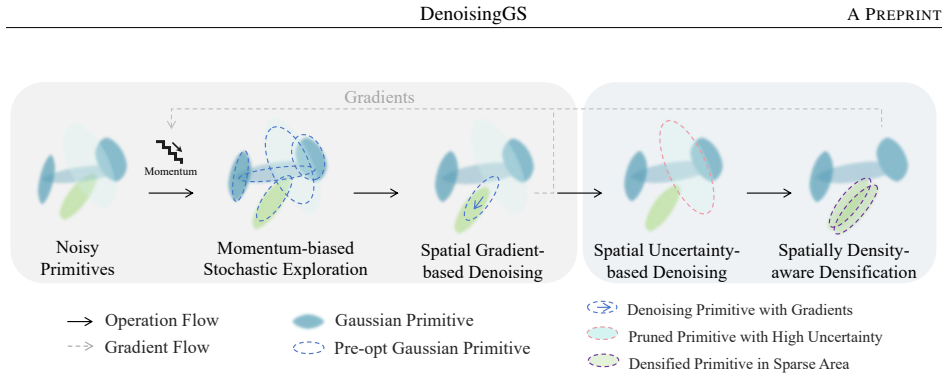
The authors formulate the optimization of 3D Gaussian Splatting as a primitive denoising process that accounts for both positions and spatial structure. They introduce an optimizer preserving spatial optimization flow, a Spatial Gradient-based Denoising strategy that ensures gradient-consistent updates by considering spatial supports, an Uncertainty-based Denoising module that prunes noisy or redundant primitives, and a Spatial Coherence Refinement strategy that selectively splits primitives in sparse regions. Experiments on three benchmark datasets show consistent gains in NVS fidelity with maintained compactness and state-of-the-art results.
What carries the argument
The spatial-aware denoising framework that jointly uses gradient consistency, primitive-wise uncertainty estimation, and selective splitting to guide updates.
If this is right
- NVS fidelity increases on all tested benchmarks while the number of primitives stays the same or decreases.
- Optimization produces coherent updates instead of random perturbations to primitive positions.
- Redundant or noisy primitives are removed via uncertainty estimates without manual post-hoc exclusions.
- Sparse regions receive additional primitives through targeted splitting to preserve structural completeness.
Where Pith is reading between the lines
- The same spatial signals might reduce the number of input views needed for high-quality reconstruction.
- Similar gradient-consistency and uncertainty checks could transfer to other point-based or primitive-based scene representations.
- The method's emphasis on structural completeness suggests it may handle scenes with varying density better than position-only optimizers.
Load-bearing premise
The spatial structure among primitives supplies reliable signals for gradient consistency and uncertainty that enable denoising without introducing new artifacts.
What would settle it
Applying the full set of denoising steps on the three benchmark datasets and measuring no gain or a drop in PSNR, SSIM, or LPIPS relative to standard 3DGS would falsify the central claim.
Figures
read the original abstract
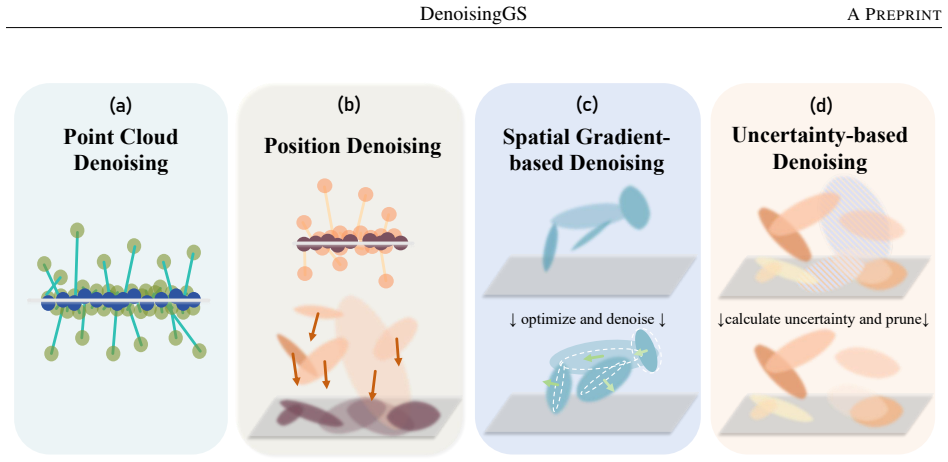
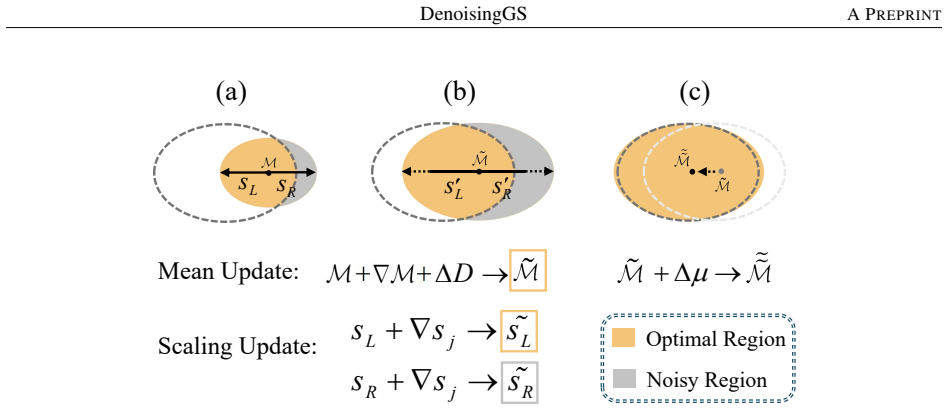
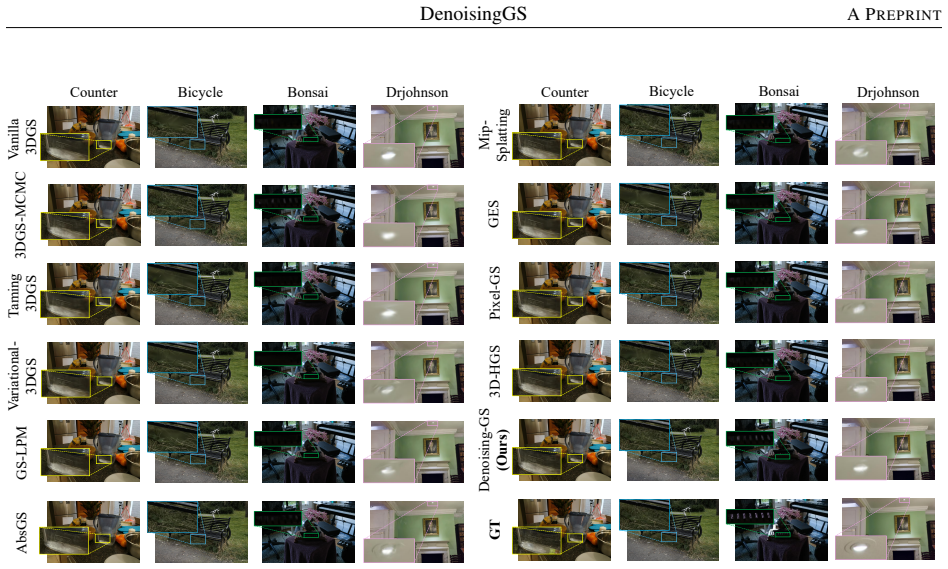
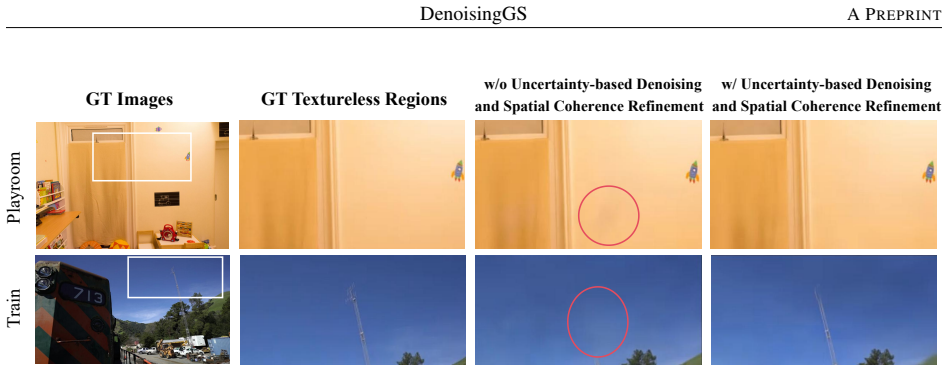
Recent advances in 3D Gaussian Splatting (3DGS) have achieved remarkable success in high-fidelity Novel View Synthesis (NVS), yet the optimization process inevitably introduces noisy Gaussian primitives due to the sparse and incomplete initialization from Structure-from-Motion (SfM) point clouds. Most existing methods focus solely on adjusting the positions of primitives during optimization, while neglecting the underlying spatial structure. To this end, we introduce a new perspective by formulating the optimization of 3DGS as a primitive denoising process and propose Denoising-GS, a spatial-aware denoising framework for Gaussian primitives by taking both the positions and spatial structure into consideration. Specifically, we design an optimizer that preserves the spatial optimization flow of primitives, facilitating coherent and directed denoising rather than random perturbations. Building upon this, the Spatial Gradient-based Denoising strategy jointly considers the spatial supports of primitives to ensure gradient-consistent updates. Furthermore, the Uncertainty-based Denoising module estimates primitive-wise uncertainty to prune redundant or noisy primitives, while the Spatial Coherence Refinement strategy selectively splits primitives in sparse regions to maintain structural completeness. Experiments conducted on three benchmark datasets demonstrate that Denoising-GS consistently enhances NVS fidelity while maintaining representation compactness, achieving state-of-the-art performance across all benchmarks. Source code and models will be made publicly available.
Editorial analysis
A structured set of objections, weighed in public.
Referee Report
Summary. The paper formulates 3D Gaussian Splatting optimization as a primitive denoising process and introduces Denoising-GS, a spatial-aware framework with three modules: an optimizer that preserves spatial optimization flow, Spatial Gradient-based Denoising for gradient-consistent updates, Uncertainty-based Denoising for pruning noisy or redundant primitives, and Spatial Coherence Refinement for selective splitting in sparse regions. It claims this yields higher-fidelity novel view synthesis while preserving compactness and achieves state-of-the-art results on three benchmark datasets.
Significance. If the empirical gains hold under scrutiny, the work offers a practical engineering refinement to 3DGS by explicitly leveraging spatial structure to mitigate SfM initialization noise, without introducing obvious circularity or hidden parameters. The high-level logic is internally consistent and targets plausible failure modes of standard 3DGS.
major comments (2)
- The central empirical claim (SOTA performance across all benchmarks while maintaining compactness) cannot be assessed because the manuscript provides no equations, implementation details, ablation studies, quantitative tables, or error analysis to verify that reported gains arise from the proposed modules rather than post-hoc choices or implementation artifacts.
- The weakest assumption—that gradient consistency, uncertainty estimation, and coherence-based splitting produce coherent denoising without new artifacts—remains untested in the provided text; no analysis of failure cases or sensitivity to the three modules is available.
Simulated Author's Rebuttal
We thank the referee for the constructive comments on our work. We address the major concerns point by point below and commit to revisions that strengthen the empirical support and validation of the proposed approach.
read point-by-point responses
-
Referee: The central empirical claim (SOTA performance across all benchmarks while maintaining compactness) cannot be assessed because the manuscript provides no equations, implementation details, ablation studies, quantitative tables, or error analysis to verify that reported gains arise from the proposed modules rather than post-hoc choices or implementation artifacts.
Authors: We agree that the manuscript as presented requires additional detail to allow full verification of the claims. The full paper contains the governing equations for the spatial optimizer, gradient-consistent updates, uncertainty pruning, and coherence refinement, plus implementation specifics, ablations, and benchmark tables. To address the concern directly, we will expand the main text with the core equations, add explicit ablation tables isolating each module, and include error analysis in the revision. revision: yes
-
Referee: The weakest assumption—that gradient consistency, uncertainty estimation, and coherence-based splitting produce coherent denoising without new artifacts—remains untested in the provided text; no analysis of failure cases or sensitivity to the three modules is available.
Authors: We acknowledge that explicit testing of the assumption and sensitivity analysis would strengthen the paper. While the reported results show consistent gains without obvious artifacts, we did not provide dedicated failure-case studies or per-module sensitivity experiments in the initial version. We will add these analyses, including qualitative failure examples and quantitative sensitivity plots, in the revised manuscript. revision: yes
Circularity Check
No significant circularity detected
full rationale
The paper formulates 3DGS optimization as a denoising process and introduces three spatial modules (gradient-consistent updates, uncertainty pruning, coherence-based splitting) whose effects are evaluated empirically on benchmarks. No equations, fitted parameters renamed as predictions, or self-citation chains are present in the provided text that would reduce any claimed result to its inputs by construction. The contribution is positioned as an engineering improvement whose validity rests on reproducible experiments rather than a parameter-free derivation or uniqueness theorem, rendering the argument self-contained.
Axiom & Free-Parameter Ledger
Reference graph
Works this paper leans on
-
[1]
B. Fei, J. Xu, R. Zhang, Q. Zhou, W. Yang, Y . He, 3D Gaussian splatting as new era: A survey, IEEE Transactions on Visualization and Computer Graphics 31 (2025) 4429–4449
2025
-
[2]
Y . Bao, T. Ding, J. Huo, Y . Liu, Y . Li, W. Li, Y . Gao, J. Luo, 3d gaussian splatting: Survey, technologies, challenges, and opportunities, IEEE Transactions on Circuits and Systems for Video Technology (2025). 10 DenoisingGSA PREPRINT
2025
-
[3]
K. Gao, Y . Gao, H. He, D. Lu, L. Xu, J. Li, Nerf: Neural radiance field in 3d vision, a comprehensive review, arXiv preprint arXiv:2210.00379 (2022)
work page internal anchor Pith review Pith/arXiv arXiv 2022
-
[4]
Kerbl, G
B. Kerbl, G. Kopanas, T. Leimkühler, G. Drettakis, 3d gaussian splatting for real-time radiance field rendering., ACM Trans. Graph. 42 (4) (2023) 139–1
2023
- [5]
-
[6]
Liang, H
Z. Liang, H. Li, K. Jia, K. Guo, Q. Zhang, Gus-ir: Gaussian splatting with unified shading for inverse rendering, IEEE Transactions on Pattern Analysis and Machine Intelligence (2025)
2025
-
[7]
Y . Shi, Y . Wu, C. Wu, X. Liu, C. Zhao, H. Feng, J. Zhang, B. Zhou, E. Ding, J. Wang, Gir: 3d gaussian inverse rendering for relightable scene factorization, IEEE Transactions on Pattern Analysis and Machine Intelligence (2025)
2025
-
[8]
Huang, Z
B. Huang, Z. Yu, A. Chen, A. Geiger, S. Gao, 2d gaussian splatting for geometrically accurate radiance fields, in: ACM SIGGRAPH 2024 conference papers, 2024, pp. 1–11
2024
-
[9]
Q. Zhou, Y . Gong, W. Yang, J. Li, Y . Luo, B. Xu, S. Li, B. Fei, Y . He, MGSR: 2d/3d mutual-boosted Gaussian splatting for high-fidelity surface reconstruction under various light conditions, in: Proceedings of the IEEE/CVF International Conference on Computer Vision (ICCV), 2025, pp. 27295–27304
2025
-
[10]
D. Chen, H. Li, W. Ye, Y . Wang, W. Xie, S. Zhai, N. Wang, H. Liu, H. Bao, G. Zhang, Pgsr: Planar-based gaussian splatting for efficient and high-fidelity surface reconstruction, IEEE Transactions on Visualization and Computer Graphics (2024)
2024
-
[11]
Matsuki, R
H. Matsuki, R. Murai, P. H. Kelly, A. J. Davison, Gaussian splatting slam, in: Proceedings of the IEEE/CVF Conference on Computer Vision and Pattern Recognition, 2024, pp. 18039–18048
2024
-
[12]
C. Yan, D. Qu, D. Xu, B. Zhao, Z. Wang, D. Wang, X. Li, Gs-slam: Dense visual slam with 3d gaussian splatting, in: Proceedings of the IEEE/CVF Conference on Computer Vision and Pattern Recognition, 2024, pp. 19595–19604
2024
-
[13]
J. Zhou, W. Zhang, Y .-S. Liu, Diffgs: Functional gaussian splatting diffusion, Advances in Neural Information Processing Systems 37 (2024) 37535–37560
2024
-
[14]
Z. Chen, F. Wang, Y . Wang, H. Liu, Text-to-3d using gaussian splatting, in: Proceedings of the IEEE/CVF conference on computer vision and pattern recognition, 2024, pp. 21401–21412
2024
-
[15]
J. Chung, S. Lee, H. Nam, J. Lee, K. M. Lee, Luciddreamer: Domain-free generation of 3d gaussian splatting scenes, arXiv preprint arXiv:2311.13384 (2023)
-
[16]
X. Liu, X. Zhan, J. Tang, Y . Shan, G. Zeng, D. Lin, X. Liu, Z. Liu, Humangaussian: Text-driven 3d human generation with gaussian splatting, in: Proceedings of the IEEE/CVF Conference on Computer Vision and Pattern Recognition, 2024, pp. 6646–6657
2024
-
[17]
Kocabas, J.-H
M. Kocabas, J.-H. R. Chang, J. Gabriel, O. Tuzel, A. Ranjan, Hugs: Human gaussian splats, in: Proceedings of the IEEE/CVF conference on computer vision and pattern recognition, 2024, pp. 505–515
2024
-
[18]
Kheradmand, D
S. Kheradmand, D. Rebain, G. Sharma, W. Sun, Y .-C. Tseng, H. Isack, A. Kar, A. Tagliasacchi, K. M. Yi, 3d gaussian splatting as markov chain monte carlo, Advances in Neural Information Processing Systems 37 (2024) 80965–80986
2024
-
[19]
Welling, Y
M. Welling, Y . W. Teh, Bayesian learning via stochastic gradient langevin dynamics, in: Proceedings of the 28th international conference on machine learning (ICML-11), 2011, pp. 681–688
2011
- [20]
-
[21]
de Silva Edirimuni, X
D. de Silva Edirimuni, X. Lu, Z. Shao, G. Li, A. Robles-Kelly, Y . He, Iterativepfn: True iterative point cloud filtering, in: Proceedings of the IEEE/CVF Conference on Computer Vision and Pattern Recognition, 2023, pp. 13530–13539
2023
-
[22]
Q. Zhou, W. Yang, B. Fei, J. Xu, R. Zhang, K. Liu, Y . Luo, Y . He, 3dmambaipf: A state space model for iterative point cloud filtering via differentiable rendering, in: Proceedings of the AAAI Conference on Artificial Intelligence, V ol. 39, 2025, pp. 10843–10851
2025
-
[23]
P. Dai, J. Xu, W. Xie, X. Liu, H. Wang, W. Xu, High-quality surface reconstruction using gaussian surfels, in: ACM SIGGRAPH 2024 conference papers, 2024, pp. 1–11
2024
-
[24]
J. T. Barron, B. Mildenhall, D. Verbin, P. P. Srinivasan, P. Hedman, Mip-nerf 360: Unbounded anti-aliased neural radiance fields, in: Proceedings of the IEEE/CVF conference on computer vision and pattern recognition, 2022, pp. 5470–5479
2022
-
[25]
Knapitsch, J
A. Knapitsch, J. Park, Q.-Y . Zhou, V . Koltun, Tanks and temples: Benchmarking large-scale scene reconstruction, ACM Transactions on Graphics (ToG) 36 (4) (2017) 1–13
2017
-
[26]
Hedman, J
P. Hedman, J. Philip, T. Price, J.-M. Frahm, G. Drettakis, G. Brostow, Deep blending for free-viewpoint image-based rendering, ACM Transactions on Graphics (ToG) 37 (6) (2018) 1–15
2018
-
[27]
Wu, Y .-J
T. Wu, Y .-J. Yuan, L.-X. Zhang, J. Yang, Y .-P. Cao, L.-Q. Yan, L. Gao, Recent advances in 3d gaussian splatting, Computational Visual Media 10 (4) (2024) 613–642
2024
-
[28]
Z. Yu, A. Chen, B. Huang, T. Sattler, A. Geiger, Mip-splatting: Alias-free 3d gaussian splatting, in: Proceedings of the IEEE/CVF conference on computer vision and pattern recognition, 2024, pp. 19447–19456. 11 DenoisingGSA PREPRINT
2024
-
[29]
Z. Yan, W. F. Low, Y . Chen, G. H. Lee, Multi-scale 3d gaussian splatting for anti-aliased rendering, in: Proceedings of the IEEE/CVF Conference on Computer Vision and Pattern Recognition, 2024, pp. 20923–20931
2024
-
[30]
Steiner, T
M. Steiner, T. Köhler, L. Radl, F. Windisch, D. Schmalstieg, M. Steinberger, Aaa-gaussians: Anti-aliased and artifact-free 3d gaussian rendering, in: Proceedings of the IEEE/CVF International Conference on Computer Vision, 2025, pp. 27650–27659
2025
-
[31]
Cheng, X
K. Cheng, X. Long, K. Yang, Y . Yao, W. Yin, Y . Ma, W. Wang, X. Chen, Gaussianpro: 3d gaussian splatting with progressive propagation, in: Forty-first International Conference on Machine Learning, 2024
2024
-
[32]
H. Yang, C. Zhang, W. Wang, M. V olino, A. Hilton, L. Zhang, X. Zhu, Improving gaussian splatting with localized points management, in: Proceedings of the Computer Vision and Pattern Recognition Conference, 2025, pp. 21696–21705
2025
-
[33]
Zhang, W
Z. Zhang, W. Hu, Y . Lao, T. He, H. Zhao, Pixel-gs: Density control with pixel-aware gradient for 3d gaussian splatting, in: European Conference on Computer Vision, Springer, 2024, pp. 326–342
2024
-
[34]
Y . Lyu, K. Cheng, X. Kang, X. Chen, Resgs: Residual densification of 3d gaussian for efficient detail recovery, in: Proceedings of the IEEE/CVF International Conference on Computer Vision, 2025, pp. 28093–28102
2025
-
[35]
Z. Ye, W. Li, S. Liu, P. Qiao, Y . Dou, Absgs: Recovering fine details in 3d gaussian splatting, in: Proceedings of the 32nd ACM International Conference on Multimedia, 2024, pp. 1053–1061
2024
-
[36]
S. S. Mallick, R. Goel, B. Kerbl, M. Steinberger, F. V . Carrasco, F. De La Torre, Taming 3dgs: High-quality radiance fields with limited resources, in: SIGGRAPH Asia 2024 Conference Papers, 2024, pp. 1–11
2024
-
[37]
Hanson, A
A. Hanson, A. Tu, G. Lin, V . Singla, M. Zwicker, T. Goldstein, Speedy-splat: Fast 3d gaussian splatting with sparse pixels and sparse primitives, in: Proceedings of the Computer Vision and Pattern Recognition Conference, 2025, pp. 21537–21546
2025
-
[38]
T. Lu, M. Yu, L. Xu, Y . Xiangli, L. Wang, D. Lin, B. Dai, Scaffold-gs: Structured 3d gaussians for view-adaptive rendering, in: Proceedings of the IEEE/CVF Conference on Computer Vision and Pattern Recognition, 2024, pp. 20654–20664
2024
-
[39]
Zhang, F
J. Zhang, F. Zhan, L. Shao, S. Lu, Sogs: Second-order anchor for advanced 3d gaussian splatting, in: Proceedings of the Computer Vision and Pattern Recognition Conference, 2025, pp. 11167–11176
2025
-
[40]
Y . Xie, Y . Lin, L. Li, L. Liu, X. Wei, Y . Liu, J. Lv, Hash-gs: Anchor-based 3d gaussian splatting with multi-resolution hash encoding for efficient scene reconstruction, in: 2025 IEEE International Conference on Robotics and Automation (ICRA), IEEE, 2025, pp. 13964–13971
2025
-
[41]
G. Feng, S. Chen, R. Fu, Z. Liao, Y . Wang, T. Liu, B. Hu, L. Xu, Z. Pei, H. Li, et al., Flashgs: Efficient 3d gaussian splatting for large-scale and high-resolution rendering, in: Proceedings of the Computer Vision and Pattern Recognition Conference, 2025, pp. 26652–26662
2025
-
[42]
L. Radl, M. Steiner, M. Parger, A. Weinrauch, B. Kerbl, M. Steinberger, Stopthepop: Sorted gaussian splatting for view- consistent real-time rendering, ACM Transactions on Graphics (TOG) 43 (4) (2024) 1–17
2024
-
[43]
S. R. Bulo, N. Bartolovic, L. Porzi, P. Kontschieder, Hardware-rasterized ray-based gaussian splatting, in: Proceedings of the Computer Vision and Pattern Recognition Conference, 2025, pp. 485–494
2025
-
[44]
Hamdi, L
A. Hamdi, L. Melas-Kyriazi, J. Mai, G. Qian, R. Liu, C. V ondrick, B. Ghanem, A. Vedaldi, Ges: Generalized exponential splatting for efficient radiance field rendering, in: Proceedings of the IEEE/CVF Conference on Computer Vision and Pattern Recognition, 2024, pp. 19812–19822
2024
-
[45]
H. Li, J. Liu, M. Sznaier, O. Camps, 3d-hgs: 3d half-gaussian splatting, in: Proceedings of the Computer Vision and Pattern Recognition Conference, 2025, pp. 10996–11005
2025
-
[46]
J. Zhu, J. Yue, F. He, H. Wang, 3d student splatting and scooping, in: Proceedings of the Computer Vision and Pattern Recognition Conference, 2025, pp. 21045–21054
2025
-
[47]
Höllein, A
L. Höllein, A. Božiˇc, M. Zollhöfer, M. Nießner, 3dgs-lm: Faster gaussian-splatting optimization with levenberg-marquardt, in: Proceedings of the IEEE/CVF International Conference on Computer Vision, 2025, pp. 26740–26750
2025
-
[48]
Li, Y .-m
R. Li, Y .-m. Cheung, Variational multi-scale representation for estimating uncertainty in 3d gaussian splatting, Advances in Neural Information Processing Systems 37 (2024) 87934–87958
2024
-
[49]
Jiang, B
W. Jiang, B. Lei, K. Daniilidis, Fisherrf: Active view selection and mapping with radiance fields using fisher information, in: European Conference on Computer Vision, Springer, 2024, pp. 422–440
2024
-
[50]
Huang, R
X. Huang, R. Li, Y .-m. Cheung, K. C. Cheung, S. See, R. Wan, Gaussianmarker: Uncertainty-aware copyright protection of 3d gaussian splatting, Advances in Neural Information Processing Systems 37 (2024) 33037–33060
2024
-
[51]
Hanson, A
A. Hanson, A. Tu, V . Singla, M. Jayawardhana, M. Zwicker, T. Goldstein, Pup 3d-gs: Principled uncertainty pruning for 3d gaussian splatting, in: Proceedings of the Computer Vision and Pattern Recognition Conference, 2025, pp. 5949–5958. 12
2025
discussion (0)
Sign in with ORCID, Apple, or X to comment. Anyone can read and Pith papers without signing in.