SteerSeg: Attention Steering for Reasoning Video Segmentation
Pith reviewed 2026-06-30 20:55 UTC · model grok-4.3
The pith
Input conditioning with soft prompts and chain-of-thought steers attention to improve video object segmentation in large vision-language models.
A machine-rendered reading of the paper's core claim, the machinery that carries it, and where it could break.
Core claim
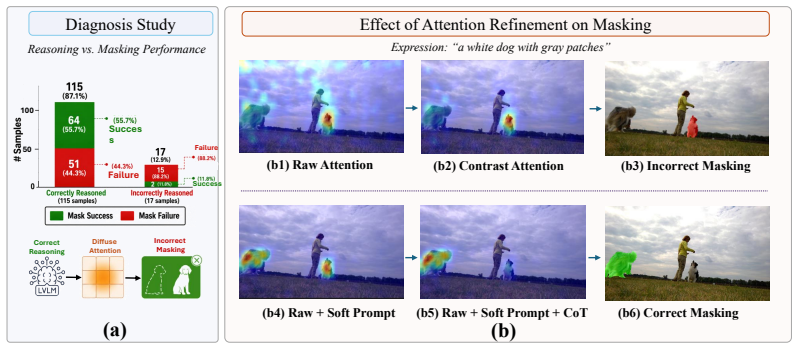
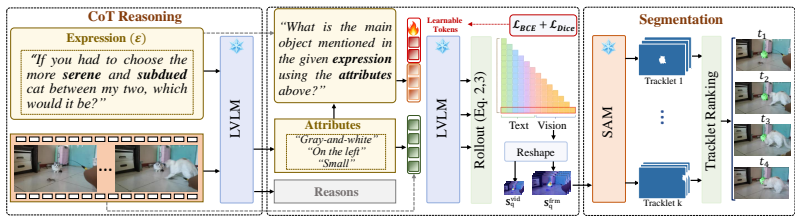
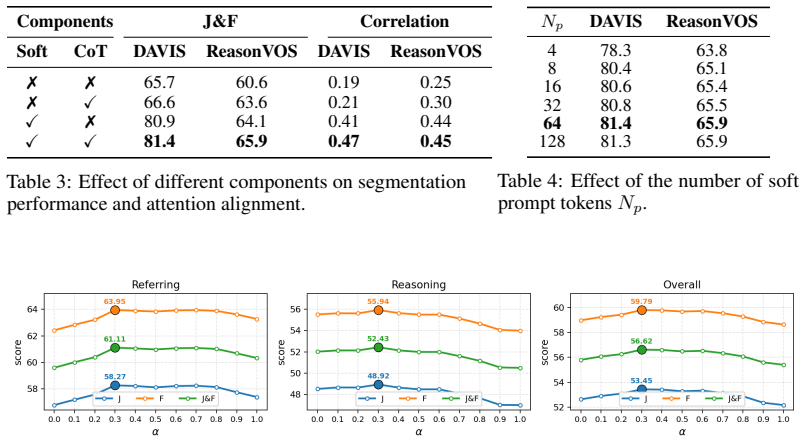
Attention misalignment is the key bottleneck in attention-based grounding for video reasoning segmentation. SteerSeg steers attention at its source through input-level conditioning that combines learnable soft prompts with reasoning-guided Chain-of-Thought prompting. The soft prompts concentrate the attention distribution while the CoT attributes disambiguate among similar objects. The resulting maps supply point prompts to a segmentation model across keyframes, and candidate tracklets are ranked by correlation-based scoring. Only the soft prompts are trained; the LVLM and segmentation model remain frozen.
What carries the argument
Learnable soft prompts combined with Chain-of-Thought prompting that reshape the attention distribution inside the frozen LVLM.
If this is right
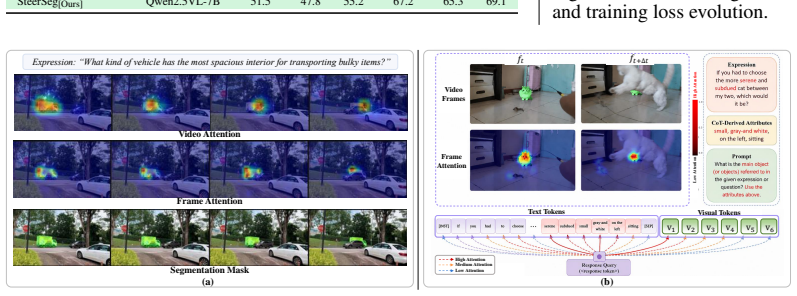
- Attention maps shift from diffuse to spatially concentrated.
- Ambiguity among visually similar objects is reduced by directing attention to the correct instance.
- Pretrained reasoning capabilities remain available because the LVLM weights are untouched.
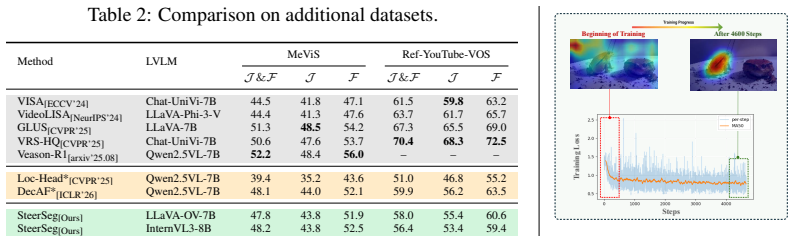
- Performance rises on multiple video segmentation benchmarks after training only on Ref-YouTube-VOS.
- The same frozen models generalize to new benchmarks without additional task-specific training.
Where Pith is reading between the lines
- The same input-conditioning pattern could be tested on static-image grounding or referring-expression tasks.
- If soft prompts prove sufficient, full-model fine-tuning might be avoidable for other multimodal localization problems.
- Extending the tracklet-ranking step to handle longer videos with frequent occlusions would test the method's temporal robustness.
- Measuring whether the steered attention also improves downstream tasks such as action recognition could reveal broader utility.
Load-bearing premise
Attention misalignment is the main cause of weak grounding and can be fixed by input-level conditioning without creating new localization errors or damaging the model's original reasoning ability.
What would settle it
Applying the soft prompts and CoT prompts on held-out videos and measuring that the attention maps stay as diffuse or produce lower segmentation accuracy than the unconditioned baseline would show the steering does not work.
Figures
read the original abstract
Video reasoning segmentation requires localizing objects across video frames from natural language expressions, often involving spatial reasoning and implicit references. Recent approaches leverage frozen large vision-language models (LVLMs) by extracting attention maps and using them as spatial priors for segmentation, enabling training-free grounding. However, these attention maps are optimized for text generation rather than spatial localization, often resulting in diffuse and ambiguous grounding signals. In this work, we introduce SteerSeg, a lightweight framework that identifies attention misalignment as the key bottleneck in attention-based grounding and proposes to steer attention at its source through input-level conditioning. SteerSeg combines learnable soft prompts with reasoning-guided Chain-of-Thought (CoT) prompting. The soft prompts reshape the attention distribution to produce more spatially concentrated maps, while CoT-derived attributes resolve ambiguity among similar objects by guiding attention toward the correct instance. The resulting attention maps are converted into point prompts across keyframes to guide a segmentation model, while candidate tracklets are ranked and selected using correlation-based scoring. Our approach freezes the LVLM and segmentation model parameters and learns only a small set of soft prompts, preserving the model's pretrained reasoning capabilities while significantly improving grounding. Despite being trained only on Ref-YouTube-VOS, SteerSeg generalizes well across diverse benchmarks, significantly improving the spatial grounding capability of LVLMs. Project page: https://steerseg.github.io
Editorial analysis
A structured set of objections, weighed in public.
Referee Report
Summary. The paper proposes SteerSeg, a lightweight framework for reasoning video segmentation that identifies attention misalignment in frozen LVLMs as the central bottleneck. It steers attention via input-level conditioning using a small set of learnable soft prompts combined with reasoning-guided Chain-of-Thought (CoT) prompting, converts the resulting maps to point prompts for a segmentation model, and ranks tracklets via correlation scoring. The approach freezes the LVLM and segmentation model, trains only the soft prompts on Ref-YouTube-VOS, and claims more concentrated attention maps plus strong generalization across benchmarks while preserving pretrained reasoning.
Significance. If the empirical claims hold, the method would offer a parameter-efficient, training-free route to improve spatial grounding in attention-based LVLM pipelines without altering the core model weights. The explicit separation of soft-prompt steering from CoT attribute extraction and the correlation-based tracklet ranking are potentially reusable components, but the absence of any reported metrics prevents assessment of whether these elements deliver measurable gains over prior attention-extraction baselines.
major comments (3)
- [Abstract] Abstract: the central claim that attention misalignment is the dominant failure mode (rather than reasoning errors, object ambiguity, or downstream segmentation) is asserted without any supporting evidence, ablation, or isolation experiment; the joint presentation of soft prompts + CoT leaves open the possibility that gains, if any, arise from improved attribute extraction rather than attention reshaping.
- [Abstract] Abstract: the assertion that the method 'generalizes well across diverse benchmarks' after training exclusively on Ref-YouTube-VOS is unsupported by any cross-dataset numbers, protocol details, or analysis of whether the learned soft prompts overfit to that single training distribution.
- [Abstract] Abstract: no quantitative metrics, tables, figures, error analysis, or experimental protocol are supplied to substantiate the repeated claims of 'more spatially concentrated maps' or 'significantly improving the spatial grounding capability of LVLMs'.
minor comments (1)
- The project page URL is referenced but no additional implementation or reproducibility details are provided in the manuscript text.
Simulated Author's Rebuttal
We thank the referee for the detailed and constructive feedback. We address each major comment below and commit to revisions that strengthen the manuscript's claims with additional evidence and analysis.
read point-by-point responses
-
Referee: [Abstract] Abstract: the central claim that attention misalignment is the dominant failure mode (rather than reasoning errors, object ambiguity, or downstream segmentation) is asserted without any supporting evidence, ablation, or isolation experiment; the joint presentation of soft prompts + CoT leaves open the possibility that gains, if any, arise from improved attribute extraction rather than attention reshaping.
Authors: We agree that the abstract asserts attention misalignment as the central bottleneck without dedicated isolation experiments or ablations. The manuscript includes qualitative attention map visualizations contrasting baseline LVLM outputs with our steered results, but these do not fully isolate the factors. We will add an ablation study in the revised version that separately evaluates soft-prompt steering and CoT attribute extraction, reporting their individual effects on attention concentration and downstream segmentation accuracy to clarify the source of gains. revision: yes
-
Referee: [Abstract] Abstract: the assertion that the method 'generalizes well across diverse benchmarks' after training exclusively on Ref-YouTube-VOS is unsupported by any cross-dataset numbers, protocol details, or analysis of whether the learned soft prompts overfit to that single training distribution.
Authors: We acknowledge that the generalization claim in the abstract lacks quantitative cross-dataset support and protocol details. The manuscript currently presents qualitative results on additional benchmarks, but this is insufficient. In the revision we will include quantitative results on held-out datasets, specify the evaluation protocol, and analyze soft-prompt transfer to assess overfitting risks. revision: yes
-
Referee: [Abstract] Abstract: no quantitative metrics, tables, figures, error analysis, or experimental protocol are supplied to substantiate the repeated claims of 'more spatially concentrated maps' or 'significantly improving the spatial grounding capability of LVLMs'.
Authors: We agree that the abstract repeats claims of improved spatial concentration and grounding without quantitative backing, tables, or protocol details. While the manuscript contains illustrative figures of attention maps, it lacks numerical metrics. We will add quantitative measures (e.g., attention entropy, spatial IoU with ground-truth regions), performance tables with baselines, an error analysis, and a full experimental protocol section in the revised manuscript. revision: yes
Circularity Check
No significant circularity; standard empirical method with held-out evaluation
full rationale
The paper presents an empirical framework that learns a small set of soft prompts on Ref-YouTube-VOS to reshape LVLM attention maps, then evaluates the resulting point-prompted segmentation pipeline on other benchmarks. This is ordinary supervised training followed by cross-dataset testing rather than any derivation that reduces to its own inputs by construction. No self-definitional equations, fitted parameters renamed as independent predictions, load-bearing self-citations, or imported uniqueness theorems appear in the abstract or described approach. The identification of attention misalignment as a bottleneck is an empirical premise tested by the experiments, not a circular premise.
Axiom & Free-Parameter Ledger
free parameters (1)
- soft prompts
axioms (1)
- domain assumption Attention misalignment between text-generation optimization and spatial localization is the key bottleneck in current attention-based grounding methods.
Reference graph
Works this paper leans on
-
[1]
Abnar and W
S. Abnar and W. Zuidema. Quantifying attention flow in transformers. InAnnual Meeting of the Association for Computational Linguistics (ACL), 2020
2020
-
[2]
Alayrac, J
J.-B. Alayrac, J. Donahue, P. Luc, A. Miech, I. Barr, Y . Hasson, K. Lenc, A. Mensch, K. Millican, M. Reynolds, et al. Flamingo: A visual language model for few-shot learning. InAdvances in Neural Information Processing Systems (NeurIPS), 2022
2022
-
[3]
Unleashing hierarchical reasoning: An LLM-driven framework for training-free referring video object segmentation
Anonymous. Unleashing hierarchical reasoning: An LLM-driven framework for training-free referring video object segmentation. InAAAI Conference on Artificial Intelligence (AAAI), 2026
2026
-
[4]
S. Bai, K. Chen, X. Liu, J. Wang, W. Ge, S. Song, K. Dang, P. Wang, S. Wang, J. Tang, et al. Qwen2.5-VL technical report.arXiv preprint arXiv:2502.13923, 2025
work page internal anchor Pith review Pith/arXiv arXiv 2025
-
[5]
Z. Bai, T. He, H. Mei, P. Wang, Z. Gao, J. Chen, L. Liu, Z. Zhang, and M. Z. Shou. One token to seg them all: Language instructed reasoning segmentation in videos.Advances in Neural Information Processing Systems, 37:6833–6859, 2024
2024
-
[6]
T. B. Brown, B. Mann, N. Ryder, M. Subbiah, J. Kaplan, P. Dhariwal, A. Neelakantan, et al. Language models are few-shot learners. InAdvances in Neural Information Processing Systems (NeurIPS), 2020
2020
-
[7]
Z. Chen, J. Wu, W. Wang, W. Su, G. Chen, S. Xing, M. Zhong, Q. Zhang, X. Zhu, L. Lu, B. Li, P. Luo, T. Lu, Y . Qiao, and J. Dai. InternVL: Scaling up vision foundation models and aligning for generic visual-linguistic tasks. InIEEE/CVF Conference on Computer Vision and Pattern Recognition (CVPR), 2024
2024
-
[8]
Deitke, C
M. Deitke, C. Clark, S. Lee, R. Tripathi, Y . Yang, J. S. Park, M. Salehi, N. Muennighoff, K. Lo, L. Soldaini, et al. Molmo and PixMo: Open weights and open data for state-of-the-art vision-language models. InIEEE/CVF Conference on Computer Vision and Pattern Recognition (CVPR), 2025
2025
-
[9]
H. Ding, C. Liu, S. He, X. Jiang, and C. C. Loy. Mevis: A large-scale benchmark for video segmentation with motion expressions. InProceedings of the IEEE/CVF international conference on computer vision, pages 2694–2703, 2023
2023
-
[10]
A. Dubey, A. Jauhri, A. Pandey, et al. The Llama 3 herd of models.arXiv preprint arXiv:2407.21783, 2024
work page internal anchor Pith review Pith/arXiv arXiv 2024
- [11]
-
[12]
S. Gong, Y . Zhuge, L. Zhang, Z. Yang, P. Zhang, and H. Lu. The devil is in temporal token: High quality video reasoning segmentation. InIEEE/CVF Conference on Computer Vision and Pattern Recognition (CVPR), 2025
2025
-
[13]
S. H. Han, J. Hyun, P. Lee, M. Shim, D. Wee, and S. J. Kim. Decomposed attention fusion in MLLMs for training-free video reasoning segmentation. InInternational Conference on Learning Representations (ICLR), 2026
2026
-
[14]
E. J. Hu, yelong shen, P. Wallis, Z. Allen-Zhu, Y . Li, S. Wang, L. Wang, and W. Chen. LoRA: Low-rank adaptation of large language models. InInternational Conference on Learning Representations, 2022. URLhttps://openreview.net/forum?id=nZeVKeeFYf9. 10
2022
-
[15]
P. Jin, R. Takanobu, W. Zhang, X. Cao, and L. Yuan. Chat-UniVi: Unified visual representation empowers large language models with image and video understanding. InIEEE/CVF Conference on Computer Vision and Pattern Recognition (CVPR), 2024
2024
-
[16]
S. Kang, J. Kim, J. Kim, and S. J. Hwang. Your large vision-language model only needs a few attention heads for visual grounding. InIEEE/CVF Conference on Computer Vision and Pattern Recognition (CVPR), 2025
2025
-
[17]
S. Kang, J. Kim, J. Kim, and S. J. Hwang. See what you are told: Visual attention sink in large multimodal models. InThe Thirteenth International Conference on Learning Representations,
-
[18]
URLhttps://openreview.net/forum?id=7uDI7w5RQA
-
[19]
Kao, Y .-W
S.-h. Kao, Y .-W. Tai, and C.-K. Tang. CoT-RVS: Zero-shot chain-of-thought reasoning segmen- tation for videos. InInternational Conference on Learning Representations (ICLR), 2026
2026
-
[20]
Khoreva, A
A. Khoreva, A. Rohrbach, and B. Schiele. Video object segmentation with language referring expressions. InAsian conference on computer vision, pages 123–141. Springer, 2018
2018
-
[21]
Kirillov, E
A. Kirillov, E. Mintun, N. Ravi, H. Mao, C. Rolland, L. Gustafson, T. Xiao, S. Whitehead, A. C. Berg, W.-Y . Lo, P. Dollár, and R. Girshick. Segment anything. InIEEE/CVF International Conference on Computer Vision (ICCV), 2023
2023
-
[22]
X. Lai, Z. Tian, Y . Chen, Y . Li, Y . Yuan, S. Liu, and J. Jia. LISA: Reasoning segmentation via large language model. InIEEE/CVF Conference on Computer Vision and Pattern Recognition (CVPR), 2024
2024
-
[23]
B. Li, Y . Zhang, D. Guo, R. Zhang, F. Li, H. Zhang, K. Zhang, P. Zhang, Y . Li, Z. Liu, et al. Llava-onevision: Easy visual task transfer.arXiv preprint arXiv:2408.03326, 2024
work page internal anchor Pith review Pith/arXiv arXiv 2024
-
[24]
J. Li, D. Li, S. Savarese, and S. Hoi. BLIP-2: Bootstrapping language-image pre-training with frozen image encoders and large language models. InInternational Conference on Machine Learning (ICML), 2023
2023
-
[25]
Y . Li, C. Wang, and J. Jia. LLaMA-VID: An image is worth 2 tokens in large language models. InEuropean Conference on Computer Vision (ECCV), 2024
2024
-
[26]
L. Lin, X. Yu, Z. Pang, and Y .-X. Wang. GLUS: Global-local reasoning unified into a single large language model for video segmentation. InIEEE/CVF Conference on Computer Vision and Pattern Recognition (CVPR), 2025
2025
-
[27]
Z. Lin, Y . Wang, and Z. Tang. Training-free open-ended object detection and segmentation via attention as prompts. InAdvances in Neural Information Processing Systems (NeurIPS), 2024
2024
-
[28]
H. Liu, C. Li, Q. Wu, and Y . J. Lee. Visual instruction tuning. InAdvances in Neural Information Processing Systems (NeurIPS), 2023
2023
-
[29]
H. Liu, C. Li, Y . Li, and Y . J. Lee. Improved baselines with visual instruction tuning. In IEEE/CVF Conference on Computer Vision and Pattern Recognition (CVPR), 2024
2024
-
[30]
Z. Liu, Y . Dong, Z. Liu, W. Hu, J. Lu, and Y . Rao. Oryx MLLM: On-demand spatial-temporal understanding at arbitrary resolution. InInternational Conference on Learning Representations (ICLR), 2025
2025
-
[31]
S. Ma, Q. Fang, S. Guo, Y . Zhang, and Y . Feng. LLaV A-Mini: Efficient image and video large multimodal models with one vision token. InInternational Conference on Learning Representations (ICLR), 2025
2025
-
[32]
M. Maaz, H. Rasheed, S. Khan, and F. S. Khan. Video-ChatGPT: Towards detailed video understanding via large vision and language models. InAnnual Meeting of the Association for Computational Linguistics (ACL), 2024
2024
-
[33]
Radford, J
A. Radford, J. W. Kim, C. Hallacy, A. Ramesh, G. Goh, S. Agarwal, G. Sastry, A. Askell, P. Mishkin, J. Clark, G. Krueger, and I. Sutskever. Learning transferable visual models from natural language supervision. InInternational Conference on Machine Learning (ICML), 2021. 11
2021
-
[34]
Rasheed, M
H. Rasheed, M. Maaz, S. Shaji, A. Shaker, S. Khan, H. Cholakkal, R. M. Anwer, E. Xing, M.-H. Yang, and F. S. Khan. GLaMM: Pixel grounding large multimodal model. InIEEE/CVF Conference on Computer Vision and Pattern Recognition (CVPR), 2024
2024
-
[35]
N. Ravi, V . Gabeur, Y .-T. Hu, R. Hu, C. Ryali, T. Ma, H. Khedr, R. Rädle, C. Rolland, L. Gustafson, E. Mintun, J. Pan, K. V . Alwala, N. Carion, C.-Y . Wu, R. Girshick, P. Dollar, and C. Feichtenhofer. SAM 2: Segment anything in images and videos. InThe Thirteenth International Conference on Learning Representations, 2025. URL https://openreview. net/fo...
2025
-
[36]
Z. Ren, Z. Huang, Y . Wei, Y . Zhao, D. Fu, J. Feng, and X. Jin. PixelLM: Pixel reasoning with large multimodal model. InIEEE/CVF Conference on Computer Vision and Pattern Recognition (CVPR), 2024
2024
-
[37]
Seo, J.-Y
S. Seo, J.-Y . Lee, and B. Han. Urvos: Unified referring video object segmentation network with a large-scale benchmark. InEuropean conference on computer vision, pages 208–223. Springer, 2020
2020
-
[38]
X. Shen, Y . Xiong, C. Zhao, L. Wu, J. Chen, C. Zhu, Z. Liu, F. Xiao, B. Varadarajan, F. Bordes, Z. Liu, H. Xu, H. J. Kim, B. Soran, R. Krishnamoorthi, M. Elhoseiny, and V . Chandra. LongVU: Spatiotemporal adaptive compression for long video-language understanding. InIEEE/CVF Conference on Computer Vision and Pattern Recognition (CVPR), 2025
2025
-
[39]
E. Song, W. Chai, G. Wang, Y . Zhang, H. Zhou, F. Wu, H. Chi, X. Guo, T. Ye, Y . Zhang, Y . Lu, J.-N. Hwang, and G. Wang. MovieChat: From dense token to sparse memory for long video understanding. InIEEE/CVF Conference on Computer Vision and Pattern Recognition (CVPR), 2024
2024
-
[40]
S. Tong, E. Brown, P. Wu, S. Woo, M. Middepogu, S. C. Akula, J. Yang, S. Yang, A. Iyer, X. Pan, A. Wang, R. Fergus, Y . LeCun, and S. Xie. Cambrian-1: A fully open, vision-centric exploration of multimodal LLMs. InAdvances in Neural Information Processing Systems (NeurIPS), 2024
2024
-
[41]
Vaswani, N
A. Vaswani, N. Shazeer, N. Parmar, J. Uszkoreit, L. Jones, A. N. Gomez, Ł. Kaiser, and I. Polosukhin. Attention is all you need. InAdvances in Neural Information Processing Systems (NeurIPS), 2017
2017
-
[42]
P. Wang, S. Bai, S. Tan, S. Wang, Z. Fan, J. Bai, K. Chen, X. Liu, J. Wang, W. Ge, Y . Fan, K. Dang, M. Du, X. Ren, R. Men, D. Liu, C. Zhou, J. Zhou, and J. Lin. Qwen2-VL: En- hancing vision-language model’s perception of the world at any resolution.arXiv preprint arXiv:2409.12191, 2024
work page internal anchor Pith review Pith/arXiv arXiv 2024
-
[43]
M. Wu, X. Cai, J. Ji, J. Li, O. Huang, G. Luo, H. Fei, G. Jiang, X. Sun, and R. Ji. ControlMLLM: Training-free visual prompt learning for multimodal large language models. InAdvances in Neural Information Processing Systems (NeurIPS), 2024
2024
-
[44]
S. Wu, S. Jin, W. Zhang, L. Xu, W. Liu, W. Li, and C. C. Loy. F-LMM: Grounding frozen large multimodal models. InIEEE/CVF Conference on Computer Vision and Pattern Recognition (CVPR), 2025
2025
-
[45]
C. Yan, H. Wang, S. Yan, X. Jiang, Y . Hu, G. Kang, W. Xie, and E. Gavves. Visa: Reasoning video object segmentation via large language models. InEuropean Conference on Computer Vision, pages 98–115. Springer, 2024
2024
-
[46]
A. Yang, B. Yang, B. Hui, et al. Qwen2 technical report.arXiv preprint arXiv:2407.10671, 2024
work page internal anchor Pith review Pith/arXiv arXiv 2024
-
[47]
Zhang, M
J. Zhang, M. Khayatkhoei, P. Chhikara, and F. Ilievski. MLLMs know where to look: Training- free perception of small visual details with multimodal LLMs. InInternational Conference on Learning Representations (ICLR), 2025
2025
-
[48]
Zhang, J
Y . Zhang, J. Wu, W. Li, B. Li, Z. Ma, Z. Liu, and C. Li. Video instruction tuning with synthetic data. InInternational Conference on Learning Representations (ICLR), 2025. 12
2025
-
[49]
J. Zhu, W. Wang, Z. Chen, Z. Liu, S. Ye, L. Gu, H. Tian, Y . Duan, W. Su, J. Shao, et al. InternVL3: Exploring advanced training and test-time recipes for open-source multimodal models.arXiv preprint arXiv:2504.10479, 2025
work page internal anchor Pith review Pith/arXiv arXiv 2025
-
[50]
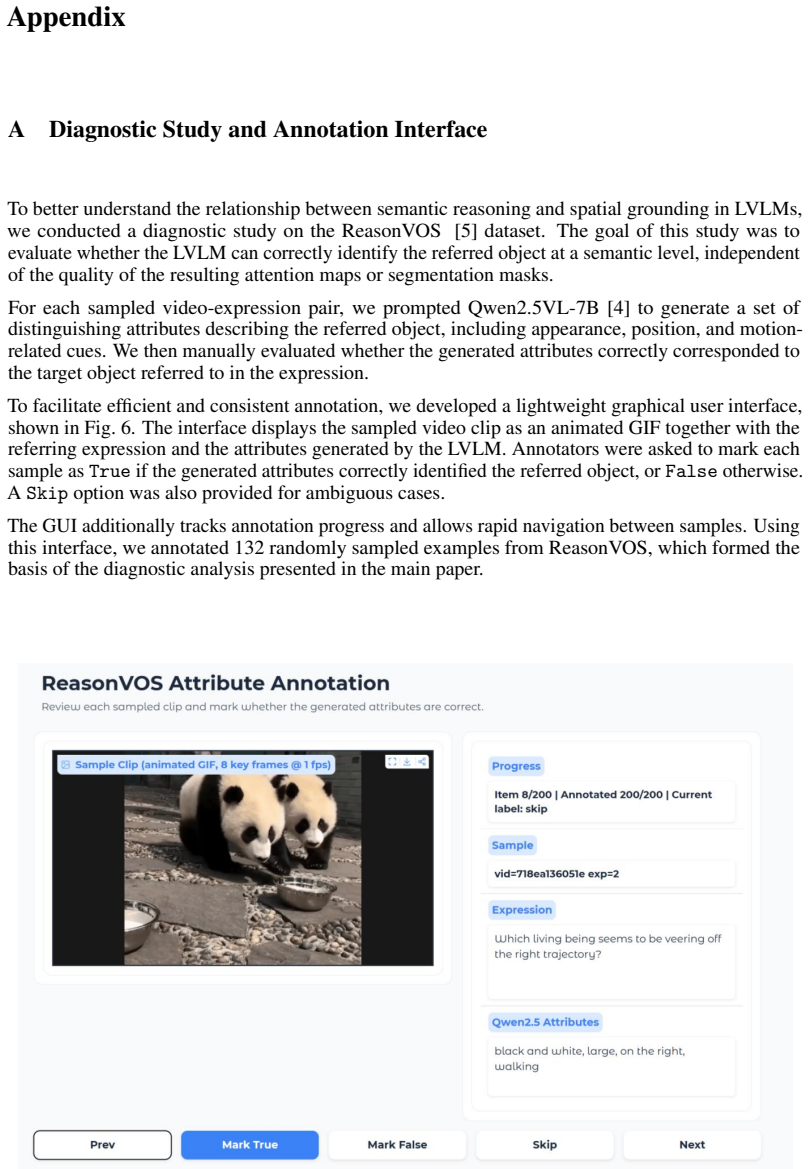
Z. Zhu, J. Fan, Z. Liu, and F. Li. Training-free spatio-temporal decoupled reasoning video segmentation with adaptive object memory. InAAAI Conference on Artificial Intelligence (AAAI), 2026. 13 Appendix A Diagnostic Study and Annotation Interface To better understand the relationship between semantic reasoning and spatial grounding in LVLMs, we conducted...
2026
discussion (0)
Sign in with ORCID, Apple, or X to comment. Anyone can read and Pith papers without signing in.