Can a late-time cosmological model based on baby universe absorption explain the z-variation of w?
Pith reviewed 2026-06-30 19:55 UTC · model grok-4.3
The pith
A model where our universe absorbs baby universes explains accelerating expansion without a cosmological constant and produces w(z) less than -1 at high redshift.
A machine-rendered reading of the paper's core claim, the machinery that carries it, and where it could break.
Core claim
The central claim is that a simple late-time cosmological model where our Universe can absorb baby universes explains the exponential expansion of our universe without the need of a cosmological constant and leads to a z-dependence of the parameter w(z) in the equation of state, with w(z) less than -1 for z sufficiently large.
What carries the argument
Absorption of baby universes at a rate that produces an effective negative pressure driving acceleration and the claimed variation in w(z).
If this is right
- Exponential expansion occurs naturally from the absorption process alone.
- The equation-of-state parameter w varies with redshift z.
- w(z) drops below -1 once redshift exceeds a threshold set by the absorption rate.
- No separate cosmological constant term is needed to match late-time acceleration data.
Where Pith is reading between the lines
- Observational surveys that map w(z) at progressively higher redshift could distinguish this mechanism from a constant dark-energy density.
- The absorption rate itself might be constrained by matching the model to supernova or BAO data at intermediate z.
- The picture suggests a possible link between quantum-gravity baby-universe effects and observable cosmology at late times.
- Extensions could explore whether the same absorption process alters the growth of structure or the Hubble tension.
Load-bearing premise
The absorption of baby universes occurs at a rate and in a manner that produces an effective negative pressure driving acceleration and the claimed w(z) less than -1 behavior.
What would settle it
High-redshift measurements of the dark-energy equation of state that find w(z) greater than or equal to -1 at all observed z would contradict the model's prediction.
Figures
read the original abstract
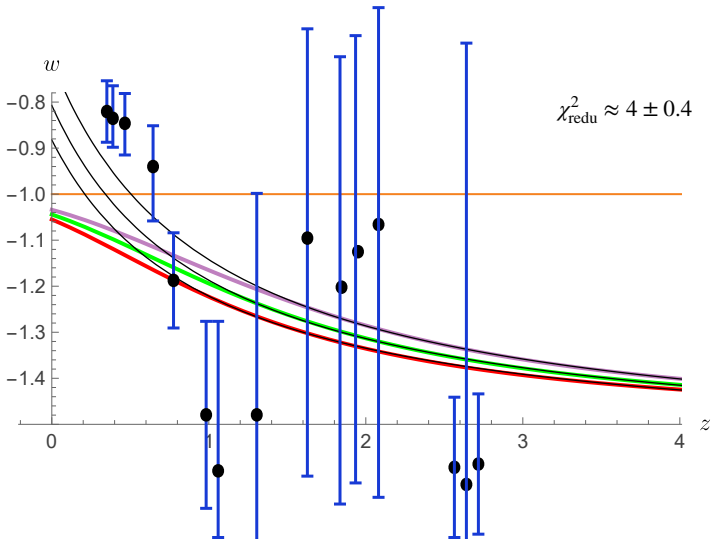
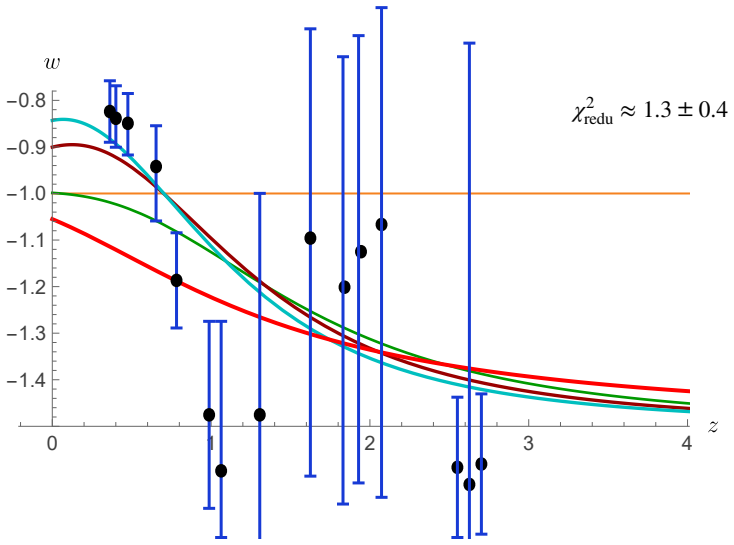
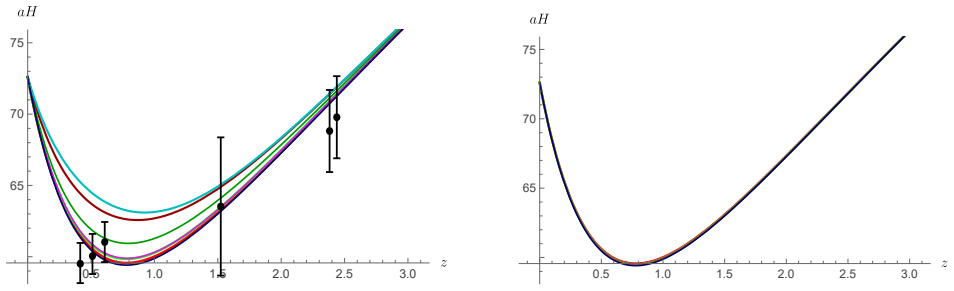
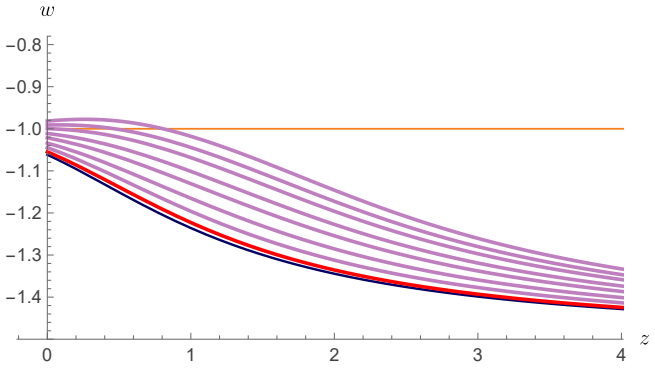
We point out that a simple late-time cosmological model where our Universe can absorb "baby universes" explains the exponential expansion of our universe without the need of a cosmological constant and leads to a z-dependence of the parameter w(z) in the equation of state. In this model w(z) is less than -1 for z sufficiently large.
Editorial analysis
A structured set of objections, weighed in public.
Referee Report
Summary. The manuscript proposes a late-time cosmological model in which our Universe absorbs 'baby universes,' claiming this mechanism accounts for the observed exponential expansion without a cosmological constant and produces a redshift-dependent equation-of-state parameter w(z) that satisfies w(z) < -1 for sufficiently large z.
Significance. If the absorption process were shown via explicit dynamics to replace Λ and yield the stated w(z) behavior from first principles, the result would be of interest as an alternative to dark-energy models with potentially testable z-dependence. The current manuscript supplies no such derivation, so significance cannot be evaluated.
major comments (2)
- [Abstract] Abstract: the central claim that baby-universe absorption 'explains the exponential expansion' and 'leads to a z-dependence of w(z)' with w(z) < -1 is asserted without any absorption term in the continuity equation, any functional form for the absorption rate, or any solution of the modified Friedmann equations; the mapping from the model to the equation-of-state behavior is therefore unsupported.
- [Entire manuscript] Entire manuscript: no section introduces the stress-energy modification due to absorption, derives the resulting w(z), or demonstrates that the claimed w(z) < -1 follows independently rather than by construction from an ad-hoc rate chosen to match data.
Simulated Author's Rebuttal
We thank the referee for the report. The comments accurately note that the manuscript, which is a brief conceptual note, asserts the effects of baby-universe absorption without providing the supporting derivations or modifications to the continuity and Friedmann equations. We respond to each major comment below and indicate revisions.
read point-by-point responses
-
Referee: [Abstract] Abstract: the central claim that baby-universe absorption 'explains the exponential expansion' and 'leads to a z-dependence of w(z)' with w(z) < -1 is asserted without any absorption term in the continuity equation, any functional form for the absorption rate, or any solution of the modified Friedmann equations; the mapping from the model to the equation-of-state behavior is therefore unsupported.
Authors: We agree that the abstract states these outcomes without the requested elements. The manuscript text contains only the conceptual claim and supplies neither an absorption term, a rate function, nor solutions of the modified equations. The mapping to w(z) < -1 is therefore not demonstrated. We will revise by adding a dedicated section that introduces the stress-energy modification, specifies an absorption rate, solves the resulting Friedmann equations, and derives the z-dependence of w(z) from the dynamics rather than by assumption. revision: yes
-
Referee: [Entire manuscript] Entire manuscript: no section introduces the stress-energy modification due to absorption, derives the resulting w(z), or demonstrates that the claimed w(z) < -1 follows independently rather than by construction from an ad-hoc rate chosen to match data.
Authors: The referee correctly observes that no such section exists. The manuscript does not modify the continuity equation, derive w(z), or show that w(z) < -1 emerges independently of an ad-hoc choice. Revision will incorporate the missing derivation: we will define the absorption contribution to the stress-energy tensor, obtain the modified continuity equation, solve for the scale factor and effective w(z), and verify that the phantom-like behavior arises from the absorption process itself. revision: yes
Circularity Check
No circularity; model proposal asserts consequence without shown reduction to inputs
full rationale
The provided abstract asserts that a baby-universe absorption model explains late-time acceleration and produces w(z) < -1, but supplies no equations, rate terms, continuity-equation modifications, or explicit mapping from absorption to the equation-of-state behavior. No derivation chain is visible that reduces a claimed prediction to a fitted parameter or self-citation by construction. Per the rules, circularity requires a quotable specific reduction (e.g., Eq. X = Eq. Y); none is present, so the finding is no significant circularity.
Axiom & Free-Parameter Ledger
axioms (1)
- domain assumption Our universe can absorb baby universes at late times in a way that produces effective negative pressure.
invented entities (1)
-
baby universes
no independent evidence
Reference graph
Works this paper leans on
-
[2]
The large scale structure of the Universe from a modified Friedmann equation,
J. Ambjorn and Y. Watabiki, “The large scale structure of the Universe from a modified Friedmann equation,” Mod.Phys.Lett. A,38(2023) 12n13, 2350068, [arXiv:2208.02607 [gr-qc]]
arXiv 2023
-
[3]
Putting a cap on causality violations in CDT
J. Ambjorn, R. Loll, W. Westra and S. Zohren, “Putting a cap on causality violations in CDT,” JHEP12(2007), 017 doi:10.1088/1126-6708/2007/12/017 [arXiv:0709.2784 [gr-qc]]
work page internal anchor Pith review Pith/arXiv arXiv doi:10.1088/1126-6708/2007/12/017 2007
-
[4]
A. G. Riess, D. Scolnic, G. S. Anand, L. Breuval, S. Casertano, L. M. Macri, S. Li, W. Yuan, C. D. Huang and S. Jha,et al. “JWST Validates HST Distance Measurements: Selection of Supernova Sub- sample Explains Differences in JWST Estimates of Local H 0,’ Astrophys. J. 977(2024) no.1, 120 doi:10.3847/1538-4357/ad8c21 [arXiv:2408.11770 [astro- ph.CO]]
-
[5]
Can baby universe absorption explain dark energy?,
V. Muralidharan and J. M. Cline, “Can baby universe absorption explain dark energy?,” Phys. Rev. D111(2025) no.2, 2 doi:10.1103/PhysRevD.111.023516 [arXiv:2408.13306 [astro-ph.CO]]. 14
-
[6]
A. G. Adameet al.[DESI], JCAP02(2025), 021 doi:10.1088/1475-7516/2025/02/021 [arXiv:2404.03002 [astro-ph.CO]]
work page internal anchor Pith review Pith/arXiv arXiv doi:10.1088/1475-7516/2025/02/021 2025
-
[7]
Extended Dark Energy analysis using DESI DR2 BAO measurements
K. Lodhaet al.[DESI], “Extended dark energy analysis using DESI DR2 BAO measurements,” Phys. Rev. D112(2025) no.8, 083511 doi:10.1103/w4c6-1r5j [arXiv:2503.14743 [astro-ph.CO]]
work page internal anchor Pith review Pith/arXiv arXiv doi:10.1103/w4c6-1r5j 2025
-
[8]
Simple quintessence models in light of DESI- BAO observations,
J. M. Cline and V. Muralidharan, “Simple quintessence models in light of DESI- BAO observations,” Phys. Rev. D112(2025) no.6, 063539 doi:10.1103/8z2m- nbv6 [arXiv:2506.13047 [astro-ph.CO]]
-
[9]
R. Chen, J. M. Cline, V. Muralidharan and B. Salewicz, “Quintessential dark energy crossing the phantom divide,” JCAP03(2026), 044 doi:10.1088/1475- 7516/2026/03/044 [arXiv:2508.19101 [astro-ph.CO]]
-
[10]
The Pantheon+ Analysis: Cosmological Constraints
D. Brout, D. Scolnic, B. Popovic, A. G. Riess, J. Zuntz, R. Kessler, A. Carr, T. M. Davis, S. Hinton and D. Jones,et al. “The Pantheon+ Analysis: Cosmological Constraints,” Astrophys. J.938 (2022) no.2, 110 doi:10.3847/1538-4357/ac8e04 [arXiv:2202.04077 [astro- ph.CO]]
work page internal anchor Pith review Pith/arXiv arXiv doi:10.3847/1538-4357/ac8e04 2022
-
[11]
A String Field Theory based on Causal Dynamical Triangulations
J. Ambjorn, R. Loll, Y. Watabiki, W. Westra and S. Zohren, “A String Field Theory based on Causal Dynamical Triangulations,” JHEP05 (2008), 032 doi:10.1088/1126-6708/2008/05/032 [arXiv:0802.0719 [hep-th]]
work page internal anchor Pith review Pith/arXiv arXiv doi:10.1088/1126-6708/2008/05/032 2008
-
[12]
A Matrix Model for 2D Quantum Gravity defined by Causal Dynamical Triangulations
J. Ambjorn, R. Loll, Y. Watabiki, W. Westra and S. Zohren, “A Matrix Model for 2D Quantum Gravity defined by Causal Dynamical Triangulations,” Phys. Lett. B665(2008), 252-256 doi:10.1016/j.physletb.2008.06.026 [arXiv:0804.0252 [hep-th]]
work page internal anchor Pith review Pith/arXiv arXiv doi:10.1016/j.physletb.2008.06.026 2008
-
[13]
Summing over all Topologies in CDT String Field Theory
J. Ambjorn, R. Loll, W. Westra and S. Zohren, “Summing over all Topologies in CDT String Field Theory,” Phys. Lett. B678 (2009), 227-232 doi:10.1016/j.physletb.2009.06.031 [arXiv:0905.2108 [hep-th]]
work page internal anchor Pith review Pith/arXiv arXiv doi:10.1016/j.physletb.2009.06.031 2009
-
[14]
S. Tsujikawa, “Quintessence: A Review,” Class. Quant. Grav.30(2013), 214003 doi:10.1088/0264-9381/30/21/214003 [arXiv:1304.1961 [gr-qc]]
work page internal anchor Pith review Pith/arXiv arXiv doi:10.1088/0264-9381/30/21/214003 2013
-
[15]
The emergence of our Universe,
J. Ambjorn and Y. Watabiki, “The emergence of our Universe,” [arXiv:2601.10499 [gr-qc]]
-
[16]
Multicritical Dynamical Triangulations and Topological Recursion,
H. Fuji, M. Manabe and Y. Watabiki, “Multicritical Dynamical Triangulations and Topological Recursion,” [arXiv:2512.10519 [hep-th]]. 15
discussion (0)
Sign in with ORCID, Apple, or X to comment. Anyone can read and Pith papers without signing in.