A Prototyping Framework for Distributed Control of Multi-Robot Systems
Pith reviewed 2026-06-30 20:14 UTC · model grok-4.3
The pith
A single-computer SPMD setup emulates distributed multi-robot control to validate algorithms at low cost.
A machine-rendered reading of the paper's core claim, the machinery that carries it, and where it could break.
Core claim
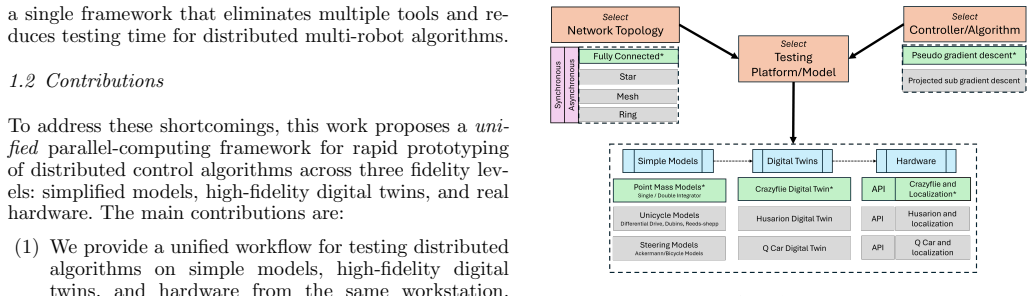
The framework emulates distributed control of multi-robot systems on a single computer by applying the Single Program Multiple Data paradigm, so that each core executes the identical algorithm on local states with explicit neighbor-to-neighbor message passing; when applied to a four-quadrotor game-theoretic position swap, the resulting computational times and trajectories remain consistent from point-mass simulation through high-fidelity dynamics to physical Crazyflie experiments.
What carries the argument
The Single Program Multiple Data (SPMD) paradigm, which partitions execution across cores while restricting each to local state and simulated neighbor communication.
If this is right
- Algorithm validation becomes possible before committing to a full multi-robot testbed.
- The same code base can be exercised at point-mass, high-fidelity, and hardware fidelity without rewriting the controller.
- Computational effort and trajectory metrics can be compared directly across abstraction levels.
- Non-cooperative game-theoretic distributed methods can be checked for consistency before field deployment.
Where Pith is reading between the lines
- The approach could be extended by injecting configurable delay or loss models to better approximate real wireless conditions.
- Larger teams could be prototyped simply by allocating additional cores on the same machine.
- The framework might serve as a common test harness for comparing different distributed optimization methods on identical robot geometries.
Load-bearing premise
Simulated neighbor communication on one machine reproduces the timing, delays, and packet losses that occur over real wireless links between separate robots.
What would settle it
A side-by-side run in which the same algorithm on actual wireless Crazyflie quadcopters produces trajectory errors or completion times that differ by more than the observed variation across the three modeled dynamics levels.
Figures


read the original abstract
This paper presents a prototyping framework for distributed control of multi-robot systems, aimed at bridging theory and practical testing of distributed optimization algorithms. Using the Single Program, Multiple Data (SPMD) paradigm, the framework emulates distributed control on a single computer, with each core running the same algorithm using local states and neighbour-to-neighbour communication. We demonstrate the framework on a four-quadrotor position-swapping task using a non-cooperative game-theoretic distributed algorithm. Computational time and trajectory data are compared across the supported dynamics levels: a point-mass model, a high-fidelity quadrotor model, and an experimental hardware testbed using Crazyflie quadcopters. The results show that the framework provides a low-cost and accessible approach for validating distributed algorithms.
Editorial analysis
A structured set of objections, weighed in public.
Referee Report
Summary. The paper presents a prototyping framework for distributed control of multi-robot systems that uses the Single Program, Multiple Data (SPMD) paradigm to emulate distributed algorithms on a single computer, with each instance using local states and simulated neighbor communication. It demonstrates the approach on a four-quadrotor position-swapping task employing a non-cooperative game-theoretic distributed algorithm, and reports comparisons of computational time and trajectories across a point-mass model, a high-fidelity quadrotor model, and Crazyflie hardware experiments. The central claim is that this provides a low-cost and accessible method for validating distributed algorithms.
Significance. If the SPMD emulation accurately reproduces the execution semantics that determine distributed correctness, the framework could meaningfully lower the barrier to initial testing of distributed optimization algorithms before hardware deployment. The inclusion of direct hardware comparisons on the same task adds practical grounding to the validation claim.
major comments (2)
- [Framework description and experimental setup] The SPMD emulation relies on idealized neighbor communication (zero-delay, lossless, synchronous exchanges on a single machine). The manuscript does not provide analysis or experiments showing that this reproduces the timing, packet-loss, or partial asynchrony effects of real wireless networks that can alter convergence or safety of the same game-theoretic algorithm; the hardware comparison therefore does not isolate whether the emulation step itself is representative.
- [Results and comparisons] The results section reports computational-time and trajectory comparisons across the three dynamics levels, yet supplies no information on the number of trials, error bars, data-exclusion criteria, or statistical tests used to support claims of similarity or difference between the SPMD runs and hardware.
Simulated Author's Rebuttal
Thank you for the opportunity to respond to the referee's report. We address each major comment point by point below and indicate planned revisions to the manuscript.
read point-by-point responses
-
Referee: [Framework description and experimental setup] The SPMD emulation relies on idealized neighbor communication (zero-delay, lossless, synchronous exchanges on a single machine). The manuscript does not provide analysis or experiments showing that this reproduces the timing, packet-loss, or partial asynchrony effects of real wireless networks that can alter convergence or safety of the same game-theoretic algorithm; the hardware comparison therefore does not isolate whether the emulation step itself is representative.
Authors: The SPMD framework is intended to emulate the logical execution of distributed algorithms via multiple program instances with local states and simulated neighbor exchanges on a single machine. Its goal is to enable low-cost validation of algorithm correctness and behavior prior to hardware deployment, rather than to model full wireless network dynamics. The hardware experiments confirm that the game-theoretic algorithm executes successfully on physical quadrotors but do not isolate emulation-specific effects. We will revise the manuscript to explicitly articulate the idealized communication assumptions, clarify the framework's scope as an intermediate prototyping tool, and outline how network simulators could be integrated for future extensions addressing timing and asynchrony. revision: yes
-
Referee: [Results and comparisons] The results section reports computational-time and trajectory comparisons across the three dynamics levels, yet supplies no information on the number of trials, error bars, data-exclusion criteria, or statistical tests used to support claims of similarity or difference between the SPMD runs and hardware.
Authors: The reported comparisons are based on single representative runs for each dynamics level, selected to illustrate trajectory consistency and computational scaling across the point-mass model, high-fidelity simulator, and Crazyflie hardware. No repeated trials, error bars, or statistical tests were performed, as the emphasis lies on demonstrating the framework's utility rather than on statistical claims of equivalence. We will revise the results section to state these details explicitly, describe the runs as illustrative examples, and avoid any implication of statistical validation. revision: yes
Circularity Check
No circularity; framework is self-contained empirical demonstration
full rationale
The paper presents a SPMD-based prototyping framework for emulating distributed multi-robot control on a single machine and validates it by comparing runtimes and trajectories on point-mass models, high-fidelity models, and Crazyflie hardware for a quadrotor swapping task. No equations, fitted parameters, or derivation steps are offered that reduce by construction to the inputs; the central claim is an engineering demonstration of accessibility rather than a mathematical prediction or uniqueness result. No self-citations are invoked as load-bearing premises, and the work does not rename known results or smuggle ansatzes. The derivation chain is therefore independent of its own outputs.
Axiom & Free-Parameter Ledger
Reference graph
Works this paper leans on
-
[1]
Agrawal, A. and Sreenath, K. (2017). Discrete Control Barrier Functions for Safety-Critical Control of Discrete Systems with Application to Bipedal Robot Navigation. InRobotics: Science and Systems XIII. Robotics: Sci- ence and Systems Foundation. doi:10.15607/RSS.2017. XIII.073
- [2]
-
[3]
Carnevale, G., Fabiani, F., Fele, F., Margellos, K., and No- tarstefano, G. (2024). Tracking-Based Distributed Equi- librium Seeking for Aggregative Games.IEEE Trans- actions on Automatic Control, 69(9), 6026–6041. doi: 10.1109/TAC.2024.3368967. Conference Name: IEEE Transactions on Automatic Control
-
[4]
Deng, H., Fu, Q., Quan, Q., Yang, K., and Cai, K.Y. (2020). Indoor Multi-Camera-Based Testbed for 3-D Tracking and Control of UAVs.IEEE Transactions on Instrumentation and Measurement, 69(6), 3139–3156. doi:10.1109/TIM.2019.2928615. do Nascimento, A.A., Papachristodoulou, A., and Margel- los, K. (2023). A Game Theoretic Approach for Safe and Distributed C...
- [5]
-
[6]
(1995).Designing and Building Parallel Pro- grams
Foster, I. (1995).Designing and Building Parallel Pro- grams. Addison-Wesley Longman Publishing Co., Inc. F¨ orster, J. (2015).System Identification of the Crazyflie 2.0 Nano Quadrocopter. Bachelor Thesis, ETH Zurich. doi:10.3929/ethz-b-000214143
-
[7]
(2014).Using MPI: Portable Parallel Programming with the Message- Passing Interface
Gropp, W., Lusk, E., and Skjellum, A. (2014).Using MPI: Portable Parallel Programming with the Message- Passing Interface. MIT Press, Cambridge, UNITED STATES
2014
-
[8]
Dorigo, M., and Heinrich, M.K. (2025). Centralization vs. decentralization in multi-robot sweep coverage with ground robots and uavs.Artificial Life and Robotics, 1–22
2025
-
[9]
Kim, W. (2017). Crazyflie quadcopter simulation using simmechanics. MATLAB Central File Exchange. URL https://tinyurl.com/matlab-cf-model
2017
-
[10]
(2004).Distributed coordination and con- trol experiments on a multi-UAV testbed
King, E.T.E.T. (2004).Distributed coordination and con- trol experiments on a multi-UAV testbed. Thesis, Mas- sachusetts Institute of Technology. Accepted: 2005-09- 27T18:55:19Z
2004
-
[11]
Bang, H., Le, V.A., Ulhas, S., Betz, J., Wilson, S., et al. (2024). A survey on small-scale testbeds for connected and automated vehicles and robot swarms: A guide for creating a new testbed.IEEE Robotics & Automation Magazine
2024
-
[12]
Notarstefano, G., Notarnicola, I., Camisa, A., et al. (2019). Distributed optimization for smart cyber-physical net- works.Foundations and Trends®in Systems and Con- trol, 7(3), 253–383
2019
-
[13]
Cap, M., Chen, Y.F., Choi, C., Dusek, J., Fang, Y., et al. (2017). Duckietown: an open, inexpensive and flexible platform for autonomy education and research. In2017 IEEE International Conference on Robotics and Automation (ICRA), 1497–1504. IEEE
2017
-
[14]
Feron, E., and Egerstedt, M. (2017). The Robotarium: A remotely accessible swarm robotics research testbed. In2017 IEEE International Conference on Robotics and Automation (ICRA), 1699–1706. doi:10.1109/ICRA. 2017.7989200
-
[15]
Nagpal, R. (2014). Kilobot: A low cost robot with scalable operations designed for collective behaviors. Robotics and Autonomous Systems, 62(7), 966–975
2014
-
[16]
Khattab, T., Al-Ali, A.K., Harras, K.A., and Guizani, M. (2019). Design challenges of multi-uav systems in cyber-physical applications: A comprehensive survey and future directions.IEEE Communications Surveys & Tutorials, 21(4), 3340–3385
2019
-
[17]
Shorinwa, O., Halsted, T., Yu, J., and Schwager, M. (2024). Distributed optimization methods for multi- robot systems: Part 2—a survey.IEEE Robotics & Automation Magazine, 31(3), 154–169
2024
-
[18]
Stager, A., Bhan, L., Malikopoulos, A., and Zhao, L. (2018). A Scaled Smart City for Experimental Vali- dation of Connected and Automated Vehicles.IFAC- PapersOnLine, 51(9), 130–135. doi:10.1016/j.ifacol. 2018.07.022
-
[19]
Stomberg, G., Ebel, H., Faulwasser, T., and Eberhard, P. (2023). Cooperative distributed mpc via decentralized real-time optimization: Implementation results for robot formations.Control Engineering Practice, 138, 105579
2023
-
[20]
Stomberg, G., Engelmann, A., Diehl, M., and Faulwasser, T. (2025). Decentralized real-time iterations for dis- tributed nmpc.IEEE Trans. on Automatic Control
2025
-
[21]
Richardsson, K., Eliasson, M., Antonsson, T., and H¨ onig, W. (2021). Lighthouse Positioning System:
2021
-
[22]
Dataset, Accuracy, and Precision for UAV Research. doi:10.48550/arXiv.2104.11523. ArXiv:2104.11523 [cs]
-
[23]
Wilson, S., Glotfelter, P., Wang, L., Mayya, S., Notomista, G., Mote, M., and Egerstedt, M. (2020). The Robotar- ium: Globally Impactful Opportunities, Challenges, and Lessons Learned in Remote-Access, Distributed Control of Multirobot Systems.IEEE Control Systems Maga- zine, 40(1), 26–44. doi:10.1109/MCS.2019.2949973
-
[24]
Hong, Y., Wang, H., Lin, Z., and Johansson, K.H. (2019). A survey of distributed optimization.Annual Reviews in Control, 47, 278–305
2019
discussion (0)
Sign in with ORCID, Apple, or X to comment. Anyone can read and Pith papers without signing in.