On the Cultural Anachronism and Temporal Reasoning in Vision Language Models
Pith reviewed 2026-06-30 21:10 UTC · model grok-4.3
The pith
Vision-language models misinterpret historical artifacts by applying temporally inappropriate modern concepts.
A machine-rendered reading of the paper's core claim, the machinery that carries it, and where it could break.
Core claim
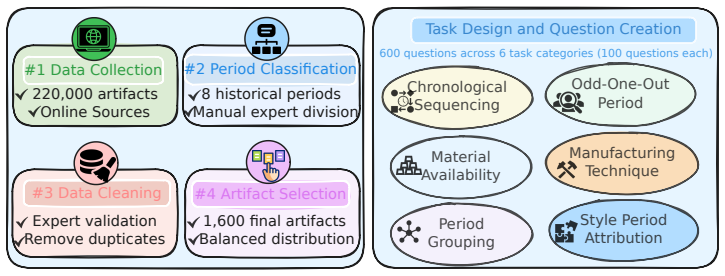
The authors define cultural anachronism as the tendency to misinterpret historical objects using temporally inappropriate concepts, materials, or cultural frameworks. They introduce the Temporal Anachronism Benchmark for Vision-Language Models (TAB-VLM), a dataset of 600 questions across six categories on 1,600 Indian cultural artifacts. Systematic evaluations reveal significant deficiencies, with even GPT-5.2 achieving only 58.7 percent overall accuracy, and the performance gap persisting across architectures and scales.
What carries the argument
The TAB-VLM benchmark, which quantifies cultural anachronism through 600 questions in six categories on Indian artifacts from different historical periods.
If this is right
- VLMs cannot be relied upon for accurate interpretation of cultural heritage materials without targeted improvements in temporal reasoning.
- The deficiency appears independent of model scale or architecture, affecting all current systems equally.
- Non-Western visual cultures face particular disadvantages due to underrepresentation in training data.
- The TAB-VLM benchmark supplies a concrete tool for measuring and guiding progress in multimodal temporal cognition.
- Applications such as digital archives and educational platforms that use VLMs on historical items will inherit these interpretation errors.
Where Pith is reading between the lines
- Success on TAB-VLM may not transfer directly to artifacts from other regions if the benchmark remains India-specific.
- Targeted additions of temporally diverse examples to training sets could raise scores and reduce real-world anachronism errors.
- The six-category structure points to distinct error types that future work could address separately rather than as a single general problem.
Load-bearing premise
The 600 questions and six categories in TAB-VLM accurately isolate and quantify cultural anachronism without introducing design biases in question phrasing or artifact selection.
What would settle it
A model achieving above 90 percent accuracy on the full TAB-VLM set while using only standard training data and still exhibiting anachronistic errors on independent historical artifacts would indicate the benchmark does not capture a fundamental limitation.
Figures


read the original abstract
Vision-Language Models (VLMs) are increasingly applied to cultural heritage materials, from digital archives to educational platforms. This work identifies a fundamental issue in how these models interpret historical artifacts. We define this phenomenon as cultural anachronism, the tendency to misinterpret historical objects using temporally inappropriate concepts, materials, or cultural frameworks. To quantify this phenomenon, we introduce the Temporal Anachronism Benchmark for Vision-Language Models (TAB-VLM), a dataset of 600 questions across six categories, designed to evaluate temporal reasoning on 1,600 Indian cultural artifacts spanning prehistoric to modern periods. Systematic evaluations of ten state-of-the-art models reveal significant deficiencies on our benchmark, and even the best model (GPT-5.2) achieves only 58.7% overall accuracy. The performance gap persists across varying architectures and scales, suggesting that cultural anachronism represents a significant limitation in visual AI systems, regardless of model size. These findings highlight the disparity between current VLM capabilities and the requirements for accurately interpreting cultural heritage materials, particularly for non-Western visual cultures underrepresented in training data. Our benchmark provides a foundation for enhancing temporal cognition in multimodal AI systems that interact with historical artifacts. The dataset and code are available in our project page.
Editorial analysis
A structured set of objections, weighed in public.
Referee Report
Summary. The manuscript defines 'cultural anachronism' as the misinterpretation of historical artifacts using temporally inappropriate concepts and introduces the TAB-VLM benchmark (600 questions across six categories on 1,600 Indian artifacts spanning prehistoric to modern periods). It evaluates ten state-of-the-art VLMs, reports that the best model (GPT-5.2) reaches only 58.7% overall accuracy, and concludes that this performance gap indicates a fundamental limitation in temporal reasoning for cultural heritage materials that persists across architectures and scales.
Significance. If the benchmark is shown to isolate the claimed phenomenon, the work would identify a practically relevant limitation for VLMs applied to digital archives and non-Western cultural materials, while supplying a new evaluation resource. The empirical nature of the study and release of dataset/code are positive features, but the current lack of validation evidence prevents assessing whether the headline accuracy figure supports the broader claim.
major comments (2)
- [TAB-VLM benchmark description] The section introducing TAB-VLM (and the abstract) provides no information on question generation process, artifact selection criteria from the 1,600 items, expert validation, inter-annotator agreement, or human performance baselines. This information is required to establish that low model scores measure cultural anachronism rather than question ambiguity or selection bias, directly undermining the central claim that the 58.7% result demonstrates a model limitation.
- [Evaluation and results] Results reporting (including the claim of a persistent gap across scales) does not include per-category breakdowns, statistical significance tests against human baselines, or controls for potential confounds such as language or visual artifact quality. Without these, the conclusion that the limitation is independent of model size cannot be evaluated.
minor comments (2)
- [Benchmark construction] Clarify the exact definitions of the six categories and how they map to the concept of cultural anachronism.
- [Evaluation setup] Ensure all model names and version numbers (e.g., GPT-5.2) are consistently referenced with citations to their technical reports.
Simulated Author's Rebuttal
We thank the referee for the constructive feedback highlighting the need for greater transparency in benchmark construction and evaluation reporting. We will revise the manuscript to address these points directly.
read point-by-point responses
-
Referee: [TAB-VLM benchmark description] The section introducing TAB-VLM (and the abstract) provides no information on question generation process, artifact selection criteria from the 1,600 items, expert validation, inter-annotator agreement, or human performance baselines. This information is required to establish that low model scores measure cultural anachronism rather than question ambiguity or selection bias, directly undermining the central claim that the 58.7% result demonstrates a model limitation.
Authors: We agree these details are necessary to substantiate the benchmark's validity. The revised manuscript will add a dedicated methods subsection describing the question generation process (template-based with cultural expert input), artifact selection criteria ensuring temporal and cultural diversity across the 1,600 items, the expert validation workflow, inter-annotator agreement scores, and human performance baselines from qualified annotators. These additions will confirm that the reported accuracies reflect temporal reasoning limitations. revision: yes
-
Referee: [Evaluation and results] Results reporting (including the claim of a persistent gap across scales) does not include per-category breakdowns, statistical significance tests against human baselines, or controls for potential confounds such as language or visual artifact quality. Without these, the conclusion that the limitation is independent of model size cannot be evaluated.
Authors: We acknowledge the need for expanded reporting. The revision will incorporate per-category accuracy tables, statistical significance tests versus human baselines, and confound analyses for language and visual quality. The existing evaluation of ten models across scales already shows the gap, and the added tests will allow direct assessment of independence from model size. revision: yes
Circularity Check
Empirical benchmark paper with no derivations or self-referential reductions
full rationale
The paper introduces the TAB-VLM benchmark of 600 questions on 1,600 artifacts and reports accuracy numbers from evaluating ten existing VLMs (best result GPT-5.2 at 58.7%). No equations, fitted parameters, predictions, or derivation chain exist. The central claim is a direct empirical measurement; it does not reduce to any input by construction, self-definition, or self-citation load-bearing step. Benchmark validity is a separate correctness question, not circularity.
Axiom & Free-Parameter Ledger
axioms (1)
- domain assumption The 1600 selected Indian cultural artifacts and 600 questions accurately represent temporal reasoning challenges without selection or phrasing bias.
invented entities (1)
-
cultural anachronism
no independent evidence
Reference graph
Works this paper leans on
-
[1]
Bias and fairness in large language models: A survey.Computational Linguistics, 50(3):1097– 1179. Sara Ghaboura, Ketan More, Ritesh Thawkar, Wafa Al- ghallabi, Omkar Thawakar, Fahad Shahbaz Khan, Hisham Cholakkal, Salman Khan, and Rao Muham- mad Anwer. 2025. Time travel: A comprehensive benchmark to evaluate lmms on historical and cul- tural artifacts.arX...
-
[2]
Do language models have a common sense regarding time? revisiting temporal commonsense reasoning in the era of large language models. InPro- ceedings of the 2023 Conference on Empirical Meth- ods in Natural Language Processing, pages 6750– 6774. Nithish Kannen, Arif Ahmad, Marco Andreetto, Vinod- kumar Prabhakaran, Utsav Prabhu, Adji Bousso Di- eng, Pushp...
-
[3]
arXiv preprint arXiv:2505.00030 , year=
Can language models represent the past with- out anachronism?arXiv preprint arXiv:2505.00030. Ujjwal Upadhyay, Mukul Ranjan, Zhiqiang Shen, and Mohamed Elhoseiny. 2025. Time blindness: Why video-language models can’t see what humans can? arXiv preprint arXiv:2505.24867. Peng Wang, Shuai Bai, Sinan Tan, Shijie Wang, Zhi- hao Fan, Jinze Bai, Keqin Chen, Xue...
-
[4]
InternVL3: Exploring Advanced Training and Test-Time Recipes for Open-Source Multimodal Models
Internvl3: Exploring advanced training and test-time recipes for open-source multimodal models. arXiv preprint arXiv:2504.10479. Appendix A Task Specifications 600 multiple-choice questions in our benchmark is equally distributed across six temporal reasoning task categories (100 questions per category). Each task type evaluates different aspects of tempo...
work page internal anchor Pith review Pith/arXiv arXiv 1977
discussion (0)
Sign in with ORCID, Apple, or X to comment. Anyone can read and Pith papers without signing in.