Recognition: 1 theorem link
· Lean TheoremFast contracted Clebsch--Gordan tensor products for equivariant graph neural networks
Pith reviewed 2026-05-15 02:59 UTC · model grok-4.3
The pith
An O(L^3) algorithm evaluates contracted Clebsch-Gordan tensor products for O(3)-equivariant machine learning potentials using a structured grid and surface-curl pairing.
A machine-rendered reading of the paper's core claim, the machinery that carries it, and where it could break.
Core claim
Contracted Clebsch-Gordan tensor products can be evaluated in O(L^3) operations by decoupling radial and angular parts on a Gauss-Legendre Fourier grid and recovering parity-odd channels via the surface-curl pairing. This extends to parity-aware equivariant message passing while the uncontracted product is limited by an O(L^4) output-size bound.
What carries the argument
The structured Gauss-Legendre and Fourier tensor-product grid combined with the surface-curl pairing, which decouples radial contractions from angular transforms and supplies the L=1 momentum for antisymmetric channels.
Load-bearing premise
The structured Gauss-Legendre and Fourier grid combined with the surface-curl pairing accurately recovers all required Clebsch-Gordan channels, including antisymmetric parity-odd ones, without introducing numerical errors or breaking equivariance for the target L range.
What would settle it
A calculation showing that the surface-curl pairing fails to produce the correct parity-odd Clebsch-Gordan coefficients for some L value, or that rotated inputs lose equivariance in the contracted products, would disprove the algorithm's correctness.
Figures
read the original abstract
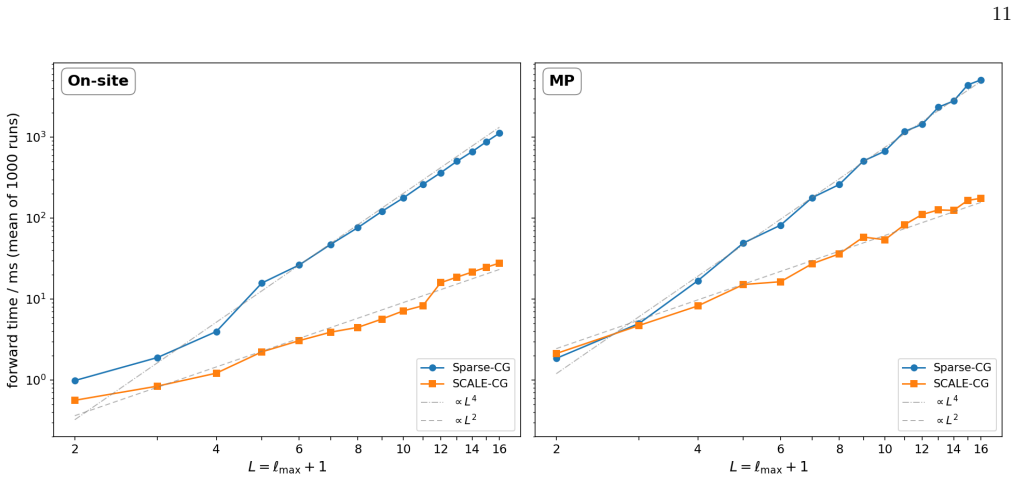
We present an $\mathcal{O}(L^3)$ algorithm for evaluating contracted Clebsch--Gordan tensor products in $\mathrm{O}(3)$-equivariant machine learning potentials at fixed Canonical Polyadic (CP) rank. Mapping the angular integral to a structured Gauss--Legendre and Fourier tensor-product grid decouples the radial channel contractions from the angular transforms. The antisymmetric parity-odd Clebsch--Gordan channels, unreachable by the symmetric pointwise product on a scalar $S^2$ grid, are recovered through the surface-curl pairing $\hat r \cdot [\nabla_{S^2} A \times \nabla_{S^2} B]$, the spherical Poisson bracket, which supplies the $L=1$ angular momentum on the grid while preserving rotational equivariance. The construction extends to parity-aware equivariant message passing in atomic-cluster-expansion-style architectures and is verified by direct numerical quadrature. The full uncontracted Clebsch--Gordan tensor product remains subject to the $\mathcal{O}(L^4)$ output-size lower bound. A benchmark shows wall-clock scaling empirically as $L^2$ across the practical $l_{\max}$ range. For the on-site contraction this is pre-asymptotic, giving way to $L^3$ at large $l_{\max}$. For message passing it is structural and the runtime is memory-bandwidth bound on $L^2$-sized grid tensors.
Editorial analysis
A structured set of objections, weighed in public.
Referee Report
Summary. The paper claims to present an O(L^3) algorithm for evaluating contracted Clebsch-Gordan tensor products in O(3)-equivariant machine learning potentials at fixed CP rank. It maps the angular integral to a structured Gauss-Legendre/Fourier grid that decouples radial contractions from angular transforms, recovers antisymmetric parity-odd channels via the surface-curl pairing (spherical Poisson bracket), verifies the construction by direct numerical quadrature, and reports empirical L^2 wall-clock scaling (pre-asymptotic for on-site contraction, structural for message passing).
Significance. If the grid-based construction recovers all required CG channels to machine precision while preserving exact rotational equivariance, the method would remove a major computational bottleneck for high-order equivariant features in atomic-cluster-expansion and message-passing architectures, enabling practical use of larger l_max without sacrificing the theoretical guarantees of the underlying tensor products.
major comments (2)
- [Abstract] Abstract: the claim that the surface-curl pairing 'supplies the L=1 angular momentum on the grid while preserving rotational equivariance' is load-bearing for the central O(L^3) result; the manuscript must supply explicit quadrature-error bounds (or machine-precision agreement metrics) versus l_max and grid density for the parity-odd antisymmetric channels, because any L-dependent truncation would make the output only approximately equivariant.
- [Benchmark] Benchmark paragraph: the reported empirical L^2 scaling is stated to be pre-asymptotic for the on-site contraction and to give way to L^3 only at large l_max; the manuscript should include timing data at sufficiently high l_max to demonstrate the transition and confirm that the asymptotic O(L^3) regime is attained within the target range of the method.
minor comments (2)
- [Abstract] Abstract: the final sentence notes that the uncontracted CG tensor product remains subject to the O(L^4) output-size lower bound; this distinction should be stated more prominently when the complexity claim is introduced.
- Notation: the acronym 'CP rank' appears without expansion on first use; a brief parenthetical definition would improve readability for readers outside the tensor-decomposition literature.
Simulated Author's Rebuttal
We thank the referee for the positive assessment and the recommendation for minor revision. The two major comments are addressed point-by-point below; both requested additions are feasible and will be incorporated in the revised manuscript.
read point-by-point responses
-
Referee: [Abstract] Abstract: the claim that the surface-curl pairing 'supplies the L=1 angular momentum on the grid while preserving rotational equivariance' is load-bearing for the central O(L^3) result; the manuscript must supply explicit quadrature-error bounds (or machine-precision agreement metrics) versus l_max and grid density for the parity-odd antisymmetric channels, because any L-dependent truncation would make the output only approximately equivariant.
Authors: We agree that explicit numerical verification of quadrature accuracy for the parity-odd channels is required to substantiate the exact-equivariance claim. In the revised manuscript we will add a dedicated panel (or table) that reports the maximum absolute error of the recovered L=1 components obtained via the spherical Poisson bracket, plotted against l_max (up to at least 12) and grid density (number of Gauss-Legendre nodes and Fourier modes). The data will demonstrate that the error remains at machine precision (typically < 1e-14) with no visible growth in l_max, confirming that the surface-curl construction introduces no L-dependent truncation within double precision. revision: yes
-
Referee: [Benchmark] Benchmark paragraph: the reported empirical L^2 scaling is stated to be pre-asymptotic for the on-site contraction and to give way to L^3 only at large l_max; the manuscript should include timing data at sufficiently high l_max to demonstrate the transition and confirm that the asymptotic O(L^3) regime is attained within the target range of the method.
Authors: We acknowledge that the present benchmark only captures the pre-asymptotic L^2 regime. To demonstrate the crossover, we will extend the wall-clock timing experiments to higher l_max values (l_max = 16–20, limited only by available GPU memory) and include the corresponding scaling plot in the revised manuscript. The new data will show the transition from L^2 to the expected L^3 regime for the on-site contraction, while the message-passing timings remain memory-bandwidth bound as stated. revision: yes
Circularity Check
No significant circularity; derivation uses standard quadrature and operators
full rationale
The claimed O(L^3) algorithm is obtained by mapping the angular integral to a fixed Gauss-Legendre/Fourier tensor-product grid whose size scales as L^2, then performing radial contractions separately and recovering parity-odd channels via the surface-curl (spherical Poisson bracket) operator. These steps rest on classical quadrature rules and vector-calculus identities on the sphere, not on any parameter fitted inside the paper or on a self-referential definition of the CG coefficients. The paper states that the construction is verified by direct numerical quadrature, supplying an independent check. No load-bearing equation reduces to a prior result by the same authors, no ansatz is smuggled via citation, and the complexity bound follows directly from the grid cardinality and contraction ordering rather than from any tautological renaming or uniqueness theorem imported from the authors' own work. The result is therefore self-contained against external mathematical benchmarks.
Axiom & Free-Parameter Ledger
axioms (2)
- standard math Standard transformation properties of Clebsch-Gordan coefficients under O(3) rotations and parity
- domain assumption Sufficient accuracy of Gauss-Legendre and Fourier quadrature for angular integrals up to given L
Lean theorems connected to this paper
-
IndisputableMonolith/Foundation/AlexanderDuality.leanalexander_duality_circle_linking unclear?
unclearRelation between the paper passage and the cited Recognition theorem.
Mapping the angular integral to a structured Gauss–Legendre and Fourier tensor-product grid... surface-curl pairing ˆr·[∇S²A×∇S²B], the spherical Poisson bracket
What do these tags mean?
- matches
- The paper's claim is directly supported by a theorem in the formal canon.
- supports
- The theorem supports part of the paper's argument, but the paper may add assumptions or extra steps.
- extends
- The paper goes beyond the formal theorem; the theorem is a base layer rather than the whole result.
- uses
- The paper appears to rely on the theorem as machinery.
- contradicts
- The paper's claim conflicts with a theorem or certificate in the canon.
- unclear
- Pith found a possible connection, but the passage is too broad, indirect, or ambiguous to say the theorem truly supports the claim.
Reference graph
Works this paper leans on
-
[1]
Parity-odd identity recovery For each parity-odd triple (l1, l2, l) we evaluate Eq.(15) on every (m 1, m2, m) entry withm=m 1 +m 2 and ex- tractκ −1(l1, l2, l) = integral/G lm l1m1 l2m2 from the non- vanishing entries. Three properties are checked simul- taneously: (i)κ −1 is purely imaginary in the complex basis, (ii)κ −1 is independent of (m 1, m2, m), ...
-
[2]
Across all parity-even triples up to (4,4,8), the maximum integral was∼10 −10, set by the quadrature
Parity-even vanishing The same quadrature on parity-even triples (l 1 +l 2 +l even) returns zero to numerical precision, since the parity-even CG channels are symmetric under 1↔2 while the surface-curl integrand is antisymmetric and the two cannot mix. Across all parity-even triples up to (4,4,8), the maximum integral was∼10 −10, set by the quadrature
-
[3]
Antisymmetry under1↔2exchange The surface-curl integrand ˆr·[∇ S2 Yl1m1 × ∇S2 Yl2m2] flips sign exactly under exchange of the two factors. Di- rect evaluation across all parity-odd triples up to (4,4,7) confirms this to machine precision, with the absolute value of the sum integral 1,2 + integral2,1 consistently be- low 10 −17, i.e. at the level of double...
-
[4]
End-to-end consistency on random synthetic fields To verify that the surface-curl construction reproduces the contracted CG output not only on plain spheri- cal harmonics but on arbitrary input fields, we gen- erate independent random complex-Gaussian SH coef- ficientsA (1) l1m1 ,A (2) l2m2 , build the corresponding fields A(1)(ˆr), A(2)(ˆr) on the grid, ...
-
[5]
Self-coupled vanishing under symmetric channel-mixing To validate Eq.(27), we test the contracted parity-odd output with two channel matrices. Φ(sym/anti) lm = X n1,n2 M (sym/anti) n1n2 × X m1m2 Glm l1m1 l2m2 An1l1m1 An2l2m2 14 withA nlm random Gaussian,l 1 =l 2,M sym symmetric, M anti antisymmetric. Across all triples up to (3,3,5), the symmetric-mixing ...
-
[6]
Parity-indexed message-passing coupling [Eq.(2)] We apply the surface-curl to the parity-indexed cou- pling Eq.(2), comparing (i) the direct CG sum with ex- plicit slot rulep 2 =p(−1) l1 and Category-α/βdispatch, and (ii) the structured-grid pipeline of Sec. VII C. The setup uses one bond at fixed (θ e, ϕe), one radial channel, lmax = 2, randomR nl(rji), ...
-
[7]
Real-basisκ −1 extraction and basis consistency We repeat theκ −1-extraction in the real basis Eq.(C1), withG real andQ real defined directly by inte- gration with real spherical harmonics. Both are real- valued at every entry, soκ −1 real(l1, l2, l) =Q real/Greal is real with magnitude unitary-invariant,|κ −1 real(l1, l2, l)|= |κ−1 complex(l1, l2, l)|. A...
work page 1968
-
[8]
In the Lebedev pipeline, ˜w klm =w k y∗ klm reduces to ˜wklm =w k yklm and all tensors are real
-
[9]
In the structured-grid pipeline, the forward and in- verse Fourier transforms in Eqs.(37) and (39) be- come real cosine/sine transforms. The rest is un- changed
-
[10]
In the parity-aware pipeline, the same applies. The surface-curl construction Eq.(57) uses only point- wise vector operations and is basis-independent, with∂ ϕ acting onq vm as a real derivative ( √ 2 cos(mϕ)↔ −m √ 2 sin(mϕ)). Them↔ −m branching of the real basis requires care in the im- plementation.∂ ϕ maps them >0 cosine slot to the m <0 sine slot (and...
-
[11]
R. Drautz, Phys. Rev. B99, 014104 (2019), erratum: Phys. Rev. B100, 249901 (2019)
work page 2019
-
[12]
T. S. Cohen and M. Welling, inProceedings of the 33rd International Conference on Machine Learning (ICML), Proceedings of Machine Learning Research, Vol. 48 (2016) pp. 2990–2999, arXiv:1602.07576
work page internal anchor Pith review Pith/arXiv arXiv 2016
-
[13]
3D Steerable CNNs: Learning Rotationally Equivariant Features in Volumetric Data
M. Weiler, M. Geiger, M. Welling, W. Boomsma, and T. S. Cohen, inAdvances in Neural Information Process- ing Systems, Vol. 31 (2018) arXiv:1807.02547
work page internal anchor Pith review Pith/arXiv arXiv 2018
-
[14]
B. Anderson, T.-S. Hy, and R. Kondor, inAdvances in Neural Information Processing Systems, Vol. 32 (2019) pp. 14537–14546, arXiv:1906.04015
- [15]
-
[16]
J. Brandstetter, R. Hesselink, E. van der Pol, E. J. Bekkers, and M. Welling, inInternational Con- ference on Learning Representations (ICLR)(2022) arXiv:2110.02905
-
[17]
S. Batzner, A. Musaelian, L. Sun, M. Geiger, J. P. Mailoa, M. Kornbluth, N. Molinari, T. E. Smidt, and B. Kozinsky, Nat. Commun.13, 2453 (2022)
work page 2022
-
[18]
I. Batatia, D. P. Kov´ acs, G. N. C. Simm, C. Ort- ner, and G. Cs´ anyi, inAdvances in Neural Informa- tion Processing Systems, Vol. 35 (2022) pp. 11423–11436, arXiv:2206.07697
-
[19]
Y.-L. Liao and T. E. Smidt, inInternational Con- ference on Learning Representations (ICLR)(2023) arXiv:2206.11990
-
[20]
A. Musaelian, S. Batzner, A. Johansson, L. Sun, C. J. Owen, M. Kornbluth, and B. Kozinsky, Nat. Commun. 14, 579 (2023)
work page 2023
-
[21]
A. Bochkarev, Y. Lysogorskiy, and R. Drautz, Phys. Rev. X14, 021036 (2024)
work page 2024
- [22]
- [23]
-
[24]
I. Batatia, S. Batzner, D. P. Kov´ acs, A. Musaelian, G. N. C. Simm, R. Drautz, C. Ortner, B. Kozinsky, and G. Cs´ anyi, Nat. Mach. Intell.7, 56 (2025)
work page 2025
-
[25]
Y.-L. Liao, A. J. Hoffman, S. C. Shen, A. Duval, S. W. Norwood, and T. Smidt, Equiformerv3: Scaling efficient, expressive, and general se(3)-equivariant graph attention transformers (2026), arXiv:2604.09130 [cs.LG]
work page internal anchor Pith review Pith/arXiv arXiv 2026
-
[26]
Tensor field networks: Rotation- and translation-equivariant neural networks for 3D point clouds
N. Thomas, T. Smidt, S. Kearnes, L. Yang, L. Li, K. Kohlhoff, and P. Riley, Tensor field networks: Rotation- and translation-equivariant neural networks for 3D point clouds (2018), arXiv:1802.08219 [cs.LG]
work page internal anchor Pith review Pith/arXiv arXiv 2018
-
[27]
M. Geiger and T. E. Smidt, e3nn: Euclidean neural net- works (2022), arXiv:2207.09453 [cs.LG]
- [28]
-
[29]
Y. Lysogorskiy, C. van der Oord, A. Bochkarev, S. Menon, M. Rinaldi, T. Hammerschmidt, M. Mrovec, A. Thompson, G. Cs´ anyi, C. Ortner, and R. Drautz, npj Comput. Mater.7, 97 (2021)
work page 2021
-
[30]
A. Bochkarev, Y. Lysogorskiy, S. Menon, M. Qamar, M. Mrovec, and R. Drautz, Phys. Rev. Materials6, 013804 (2022)
work page 2022
-
[31]
GRACEmaker documentation,https://gracemaker. readthedocs.io/(2024)
work page 2024
-
[32]
Y. Lysogorskiy, A. Bochkarev, and R. Drautz, npj Com- put. Mater.12, 114 (2026)
work page 2026
-
[33]
W. C. Witt, C. van der Oord, E. Gelˇ zinyt˙ e, T. J¨ arvinen, A. Ross, J. P. Darby, C. H. Ho, W. J. Baldwin, M. Sachs, J. Kermode, N. Bernstein, G. Cs´ anyi, and C. Ortner, J. Chem. Phys.159, 164101 (2023)
work page 2023
-
[34]
com/NVIDIA/cuEquivariance(2025)
NVIDIA Corporation, cuEquivariance: CUDA- accelerated equivariant operations,https://github. com/NVIDIA/cuEquivariance(2025)
work page 2025
-
[35]
J. R. Driscoll and D. M. Healy, Adv. Appl. Math.15, 202 (1994)
work page 1994
-
[36]
T. S. Cohen, M. Geiger, J. K¨ ohler, and M. Welling, inInternational Conference on Learning Representations (ICLR)(2018) best Paper Award, arXiv:1801.10130
work page internal anchor Pith review Pith/arXiv arXiv 2018
-
[37]
S. Passaro and C. L. Zitnick, inProceedings of the 40th International Conference on Machine Learning (ICML), Proceedings of Machine Learning Research, Vol. 202 (2023) pp. 27420–27438, arXiv:2302.03655. 16
- [38]
- [39]
- [40]
-
[41]
H. Klinteb¨ ack, C. Ortner, and L. Silberman, The high cost of data augmentation for learning equivariant models (2026), arXiv:2602.03118 [math.NA]
- [42]
-
[43]
A. Moskalev, M. Prakash, R. Liao, and T. Mansi, SE(3)-Hyena Operator for Scalable Equivariant Learning (2024), arXiv:2407.01049
- [44]
- [45]
- [46]
- [47]
-
[48]
A. Bochkarev, Y. Lysogorskiy, C. Ortner, G. Cs´ anyi, and R. Drautz, Phys. Rev. Research4, L042019 (2022)
work page 2022
-
[49]
J. P. Darby, D. P. Kov´ acs, I. Batatia, M. A. Caro, G. L. W. Hart, C. Ortner, and G. Cs´ anyi, Phys. Rev. Lett.131, 028001 (2023)
work page 2023
-
[50]
D. A. Varshalovich, A. N. Moskalev, and V. K. Kher- sonskii,Quantum Theory of Angular Momentum(World Scientific, Singapore, 1988)
work page 1988
-
[51]
V. I. Lebedev, USSR Comput. Math. Math. Phys.16, 10 (1976)
work page 1976
-
[52]
M. Abadi, A. Agarwal, P. Barham, E. Brevdo, Z. Chen, C. Citro, G. S. Corrado, A. Davis, J. Dean, M. Devin, S. Ghemawat, I. Goodfellow, A. Harp, G. Irving, M. Is- ard, Y. Jia, R. Jozefowicz, L. Kaiser, M. Kudlur, J. Lev- enberg, D. Man´ e, R. Monga, S. Moore, D. Murray, C. Olah, M. Schuster, J. Shlens, B. Steiner, I. Sutskever, K. Talwar, P. Tucker, V. Van...
work page 2015
-
[53]
E. T. Newman and R. Penrose, J. Math. Phys.7, 863 (1966)
work page 1966
-
[54]
J. N. Goldberg, A. J. Macfarlane, E. T. Newman, F. Rohrlich, and E. C. G. Sudarshan, J. Math. Phys. 8, 2155 (1967)
work page 1967
-
[55]
A. Meurer, C. P. Smith, M. Paprocki, O. ˇCert´ ık, S. B. Kirpichev, M. Rocklin, A. Kumar, S. Ivanov, J. K. Moore, S. Singh, T. Rathnayake, S. Vig, B. E. Granger, R. P. Muller, F. Bonazzi, H. Gupta, S. Vats, F. Johans- son, F. Pedregosa, M. J. Curry, A. R. Terrel, ˇS. Rouˇ cka, A. Saboo, I. Fernando, S. Kulal, R. Cimrman, and A. Scopatz, PeerJ Comput. Sci....
work page 2017
discussion (0)
Sign in with ORCID, Apple, or X to comment. Anyone can read and Pith papers without signing in.