Operator-Controlled 6G: From Connectivity Infrastructure to Guaranteed Digital Services
Pith reviewed 2026-05-20 16:54 UTC · model grok-4.3
The pith
Rakuten Mobile's cloud-native Open RAN deployment shows operator-controlled 6G can deliver guaranteed digital services.
A machine-rendered reading of the paper's core claim, the machinery that carries it, and where it could break.
Core claim
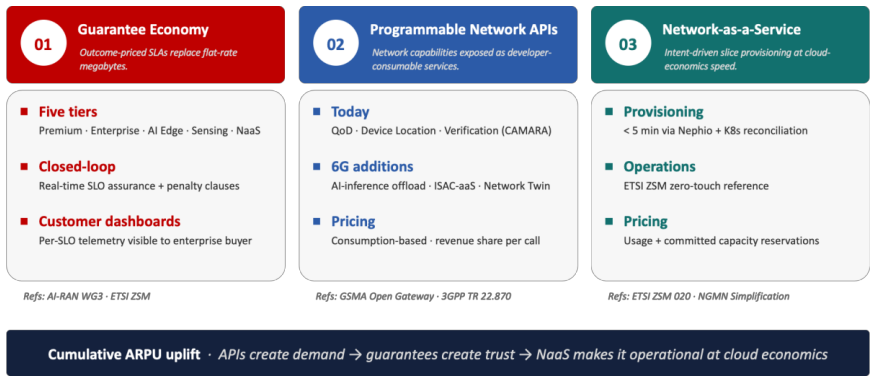
The central claim is that Rakuten Mobile's national-scale, fully cloud-native, fully Open RAN deployment, which reached full-year EBITDA profitability in FY2025, demonstrates the feasibility of operator-controlled 6G. This feasibility rests on reordering priorities to Control First, Customer First, Business First, Operations First, and Technology Last. The 6G Control Compact supplies a three-layer ownership taxonomy that allocates architectural sovereignty according to strategic value, while the Guarantee Economy supplies a five-tier outcome-priced commercial model that converts operator control into enforceable service-level objectives.
What carries the argument
The 6G Control Compact, a three-layer ownership taxonomy of own, federate, and consume that allocates control over network elements according to their strategic value to the operator.
Load-bearing premise
The operational and financial results from Rakuten Mobile's single national-scale deployment can be transferred to operator-controlled 6G architectures in other markets and regulatory environments.
What would settle it
A second large operator in a different regulatory market adopting similar cloud-native Open RAN principles but failing to achieve comparable profitability or full architectural control by 2028 would undermine the claim of general feasibility.
Figures







read the original abstract
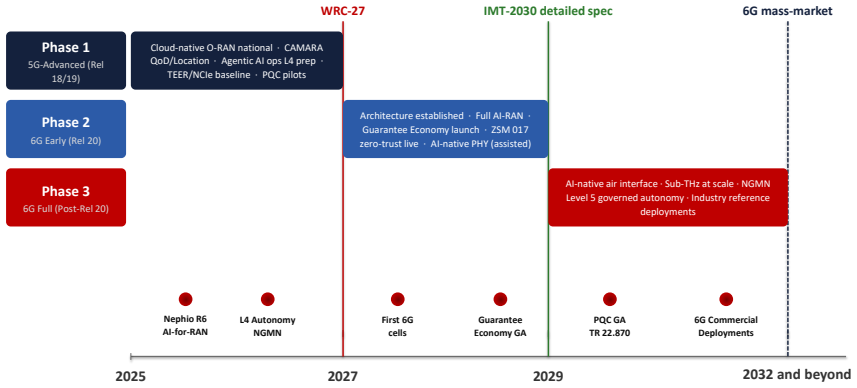
Sixth-generation mobile networks (6G) are approaching a structural inflection point. Five generations of vendor-led architectures have left operators procuring and operating networks they do not own, on platforms they cannot modify, with AI layers they cannot audit. This paper argues that 6G must reverse this trajectory by reordering operator priorities: Control First, Customer First, Business First, Operations First, and Technology Last. Technology should serve operator control, customer outcomes, monetizable guarantees, and software-driven operations, not dictate them.Two contributions operationalize this thesis. The 6G Control Compact defines a three-layer ownership taxonomy--own, federate, and consume--that allocates architectural sovereignty according to strategic value. The Guarantee Economy defines a five-tier, outcome-priced commercial model that converts operator control into enforceable service-level objectives. The framework is grounded in operational evidence from Rakuten Mobile, the world's first national-scale, fully cloud-native, fully Open RAN deployment, which reached full-year EBITDA profitability in FY2025. It is aligned with the ITU-R IMT-2030 framework, 3GPP 6G use cases and service requirements, NGMN recommendations, ETSI standards, O-RAN Alliance and AI-RAN Alliance specifications, IOWN Global Forum sustainability metrics, Linux Foundation initiatives, and leading industry and academic programs. A three-phase roadmap covering 2025-2027, 2027-2029, and 2029-2032 and beyond, together with seven stakeholder-specific calls to action, translates the architecture into industry commitments. The central claim is that Rakuten Mobile's deployment demonstrates the feasibility of operator-controlled 6G. Decisions made during 2026-2028 will determine whether 6G becomes a platform for guaranteed digital services or another vendor-dependent infrastructure cycle.
Editorial analysis
A structured set of objections, weighed in public.
Referee Report
Summary. The paper argues that 6G must prioritize operator control over vendor-led architectures by reversing the historical trajectory of five generations of networks. It introduces two main contributions: the 6G Control Compact, a three-layer ownership taxonomy (own, federate, consume) that allocates architectural sovereignty by strategic value, and the Guarantee Economy, a five-tier outcome-priced commercial model that converts control into enforceable service-level objectives. These are grounded in operational evidence from Rakuten Mobile's national-scale cloud-native Open RAN deployment, which achieved full-year EBITDA profitability in FY2025. The framework is aligned with ITU-R IMT-2030, 3GPP, NGMN, ETSI, O-RAN, and other bodies; a three-phase roadmap (2025-2032+) and seven stakeholder calls to action are provided. The central claim is that Rakuten Mobile demonstrates the feasibility of operator-controlled 6G, with 2026-2028 decisions determining whether 6G becomes a platform for guaranteed digital services or remains vendor-dependent.
Significance. If the transferability of the single-deployment evidence holds and the proposed taxonomies prove generalizable, the work could provide a useful framing for shifting 6G discussions toward operator sovereignty and outcome-based monetization. Explicit credit is due for the comprehensive alignment with existing standards bodies and the inclusion of a phased roadmap with stakeholder-specific actions, which could help translate conceptual priorities into industry commitments.
major comments (3)
- [Abstract / Rakuten Mobile deployment evidence] Abstract and Rakuten Mobile grounding section: the central feasibility claim that Rakuten Mobile's cloud-native Open RAN deployment demonstrates operator-controlled 6G rests on a single national-scale example reaching EBITDA profitability in FY2025, yet provides no detailed metrics, error analysis, comparative baselines against alternative architectures, or sensitivity analysis for transferability to other regulatory, spectrum, or competitive environments.
- [6G Control Compact definition] 6G Control Compact section: the three-layer (own/federate/consume) taxonomy is presented as allocating sovereignty according to strategic value, but the manuscript does not include quantitative modeling or validation showing how this taxonomy would perform under varying legacy infrastructure or vendor lock-in levels, leaving the generalization from the Rakuten case untested.
- [Guarantee Economy definition] Guarantee Economy section: the five-tier outcome-priced model is defined to convert operator control into SLO-based guarantees, but no concrete pricing examples, validation data, or falsifiable predictions are supplied beyond the single Rakuten reference, making the commercial model's load-bearing role for the feasibility claim difficult to assess.
minor comments (2)
- [Abstract] The abstract lists alignments with multiple standards bodies but does not provide specific section mappings or excerpts showing how the Control Compact or Guarantee Economy directly satisfies particular ITU-R or 3GPP requirements.
- [Framework sections] Notation for the three-layer taxonomy and five-tier model could be clarified with a summary table or diagram to improve readability for readers unfamiliar with the proposed terms.
Simulated Author's Rebuttal
We thank the referee for the constructive and detailed report, which highlights important areas for strengthening the manuscript's claims. We respond to each major comment below, indicating where revisions will be incorporated in the next version.
read point-by-point responses
-
Referee: [Abstract / Rakuten Mobile deployment evidence] Abstract and Rakuten Mobile grounding section: the central feasibility claim that Rakuten Mobile's cloud-native Open RAN deployment demonstrates operator-controlled 6G rests on a single national-scale example reaching EBITDA profitability in FY2025, yet provides no detailed metrics, error analysis, comparative baselines against alternative architectures, or sensitivity analysis for transferability to other regulatory, spectrum, or competitive environments.
Authors: The manuscript presents Rakuten Mobile as an existence proof of a national-scale, cloud-native Open RAN deployment that achieved full-year EBITDA profitability, rather than as a comprehensive empirical study with comparative baselines or sensitivity analysis. Public financial disclosures from Rakuten Mobile provide the basis for the profitability statement. We agree that the current presentation would benefit from greater transparency on scope and limitations. In revision, we will expand the grounding section with additional citations to Rakuten's technical and financial reports, add an explicit discussion of transferability considerations across regulatory and competitive contexts, and include a dedicated limitations subsection. revision: yes
-
Referee: [6G Control Compact definition] 6G Control Compact section: the three-layer (own/federate/consume) taxonomy is presented as allocating sovereignty according to strategic value, but the manuscript does not include quantitative modeling or validation showing how this taxonomy would perform under varying legacy infrastructure or vendor lock-in levels, leaving the generalization from the Rakuten case untested.
Authors: The 6G Control Compact is offered as a conceptual ownership taxonomy derived from observed practices and aligned with existing standards bodies, not as a quantitative performance model requiring simulation under varying legacy conditions. Its role is to structure decision-making around strategic value rather than to predict outcomes numerically. We will revise the section to clarify this scope explicitly and add a forward-looking paragraph on potential empirical validation methods, while retaining the taxonomy as a framing contribution grounded in the Rakuten deployment. revision: partial
-
Referee: [Guarantee Economy definition] Guarantee Economy section: the five-tier outcome-priced model is defined to convert operator control into SLO-based guarantees, but no concrete pricing examples, validation data, or falsifiable predictions are supplied beyond the single Rakuten reference, making the commercial model's load-bearing role for the feasibility claim difficult to assess.
Authors: The Guarantee Economy is proposed as a five-tier commercial framework that links operator control to enforceable SLOs, with the Rakuten deployment serving as the operational foundation rather than a source of specific pricing data. We acknowledge that the section would be strengthened by illustrative examples. In revision, we will incorporate hypothetical but grounded pricing structures drawn from current 5G outcome-based offerings and add a statement clarifying that operator-specific pricing implementations lie outside the scope of this position paper. revision: yes
Axiom & Free-Parameter Ledger
axioms (2)
- domain assumption Rakuten Mobile results are representative of operator-controlled 6G feasibility across markets
- domain assumption Alignment with ITU-R IMT-2030, 3GPP, NGMN, ETSI, O-RAN, and other bodies validates the framework
invented entities (2)
-
6G Control Compact
no independent evidence
-
Guarantee Economy
no independent evidence
Lean theorems connected to this paper
-
IndisputableMonolith/Foundation/RealityFromDistinction.leanreality_from_one_distinction unclear?
unclearRelation between the paper passage and the cited Recognition theorem.
The 6G Control Compact defines a three-layer ownership taxonomy--own, federate, and consume--that allocates architectural sovereignty according to strategic value. The Guarantee Economy defines a five-tier, outcome-priced commercial model that converts operator control into enforceable service-level objectives.
What do these tags mean?
- matches
- The paper's claim is directly supported by a theorem in the formal canon.
- supports
- The theorem supports part of the paper's argument, but the paper may add assumptions or extra steps.
- extends
- The paper goes beyond the formal theorem; the theorem is a base layer rather than the whole result.
- uses
- The paper appears to rely on the theorem as machinery.
- contradicts
- The paper's claim conflicts with a theorem or certificate in the canon.
- unclear
- Pith found a possible connection, but the passage is too broad, indirect, or ambiguous to say the theorem truly supports the claim.
Reference graph
Works this paper leans on
-
[1]
Future Technology Trends of Terrestrial IMT towards 2030 and Beyond,
ITU-R, “Future Technology Trends of Terrestrial IMT towards 2030 and Beyond,” ITU-R Report M.2516-0, International Telecommunication Union, Geneva, Nov. 2022
work page 2030
-
[2]
Framework and Overall Objectives of the Future Development of IMT for 2030 and Beyond,
ITU-R, “Framework and Overall Objectives of the Future Development of IMT for 2030 and Beyond,” ITU-R Recommendation M.2160-0, International Telecommunication Union, Geneva, Nov. 2023
work page 2030
-
[3]
6G Technical Performance Requirements (TPR),
ITU-R WP5D, "6G Technical Performance Requirements (TPR)," ITU-R Working Party 5D, International Telecommunication Union, Feb. 2026
work page 2026
-
[4]
Ericsson, “Network for AI Experiences,” Ericsson AB, Stockholm, 2025
work page 2025
-
[5]
Framework for Network Simplification – An Operator View,
NGMN Alliance, “Framework for Network Simplification – An Operator View,” v1.0, NGMN, Frankfurt, Feb. 2026
work page 2026
-
[6]
5G Evolution and 6G White Paper,
NTT DOCOMO, “5G Evolution and 6G White Paper,” Version 5.0, NTT DOCOMO, Tokyo, Jan. 2023
work page 2023
-
[7]
FY2025 Full Year Financial Results Presentation,
Rakuten Group, Inc., “FY2025 Full Year Financial Results Presentation,” Rakuten Group, Inc., Tokyo, Feb. 2026
work page 2026
-
[8]
Study on 6G Use Cases and Service Requirements – Stage 1,
3GPP, “Study on 6G Use Cases and Service Requirements – Stage 1,” 3GPP TR 22.870 v2.0.0, 3rd Generation Partnership Project, 2026
work page 2026
-
[9]
A Survey on AI for 6G: Challenges and Opportunities,
C. Chatzieleftheriou and E. Liotou, "A Survey on AI for 6G: Challenges and Opportunities," IEEE Open Journal of the Communications Society, vol. 7, pp. 3189–, 2026. DOI: 10.1109/OJCOMS.2026.3677293
-
[10]
AI-Native 6G Physical Layer with Cross-Module Optimization and Cooperative Control Agents,
X. Zheng, H. Xiao, S. Jin, Z. Wang, W. Tian, W. Liu, J. Cao, J. Shen, Z. Shi, Z. Zhang, and N. Yang, "AI-Native 6G Physical Layer with Cross-Module Optimization and Cooperative Control Agents," arXiv:2601.02827v2 [eess.SP], Jan. 2026. Available at: https://arxiv.org/abs/2601.02827
-
[12]
State-of-the-Art AI/ML Applications for Improvements in RAN Performance,
AI-RAN Alliance, “State-of-the-Art AI/ML Applications for Improvements in RAN Performance,” WG1 AI-for-RAN Technical Report, AI-RAN Alliance, 2024
work page 2024
-
[13]
AI on RAN: Enabling Monetizable Differentiated Connectivity for AI,
AI-RAN Alliance, “AI on RAN: Enabling Monetizable Differentiated Connectivity for AI,” Working Group 3 White Paper, AI-RAN Alliance, 2024
work page 2024
-
[14]
S. Salmi, M. A. Ouameur, M. Bagaa, G. C. Alexandropoulos, A. Tahenni, D. Massicotte, and A. Ksentini, "AI-Native O-RAN Architectures for 6G: Towards Real-Time Adaptation, Conflict Resolution, and Efficient Resource Management," TechRxiv (preprint), posted Sep. 2025. DOI: 10.36227/techrxiv.175825547.74922399/v1
-
[15]
Evolution of Near-Real-Time RAN Intelligent Controller Towards 6G,
O-RAN Alliance nGRG, “Evolution of Near-Real-Time RAN Intelligent Controller Towards 6G,” Technical Report nGRG-RR-2025-04, O-RAN Alliance, Jan. 2026
work page 2025
-
[16]
dApps: Distributed Applications for Open RAN,
O-RAN Alliance nGRG, “dApps: Distributed Applications for Open RAN,” Technical Report nGRG-RR-2025-05 v2.0, O-RAN Alliance, Jan. 2026
work page 2025
-
[17]
Scalable and User-Centric RAN Architecture: Service Requirements and Design Considerations,
O-RAN Alliance nGRG, “Scalable and User-Centric RAN Architecture: Service Requirements and Design Considerations,” Technical Report nGRG-RS02, O-RAN Alliance, Jan. 2026
work page 2026
-
[18]
Flat UP: Toward RAN-Core Convergence for the 6G User Plane,
H. Harkous, A. Kak, A. Urie, H. Straulino, H. Wu, M. Laitila, H.-T. Thieu, N. Choi, T. Van de Velde, and M. Kanerva, "Flat UP: Toward RAN-Core Convergence for the 6G User Plane," IEEE Communications Magazine, vol. 63, pp. 62–68, May 2025. DOI: 10.1109/MCOM.003.2400403
-
[19]
Zero-touch Network and Service Management (ZSM); Reference Architecture,
ETSI, “Zero-touch Network and Service Management (ZSM); Reference Architecture,” ETSI GS ZSM 002 v1.1.1, ETSI, Sophia Antipolis, Aug. 2019
work page 2019
-
[20]
Zero-touch Network and Service Management (ZSM); ZSM Framework for Network- as-a-Service (NaaS),
ETSI, “Zero-touch Network and Service Management (ZSM); ZSM Framework for Network- as-a-Service (NaaS),” ETSI GR ZSM 019 v1.1.1, ETSI, Sophia Antipolis, Jan. 2026
work page 2026
-
[21]
ETSI, “Zero-touch Network and Service Management (ZSM); Study on the Utilization of Agents in Autonomous Networks,” ETSI GR ZSM 020 v1.1.1, ETSI, Sophia Antipolis, Jan. 2026
work page 2026
-
[22]
Autonomous Networks Levels Evaluation Methodology,
TM Forum, “Autonomous Networks Levels Evaluation Methodology,” IG1252 v3.0.0, TM Forum, May 2025. Available at: https://www.tmforum.org/resources/standard/ig1252- autonomous-networks-levels-evaluation-methodology/
work page 2025
-
[23]
Agentic AI-Based Operating Models,
NGMN Alliance, “Agentic AI-Based Operating Models,” V1.0, NGMN, Frankfurt, Mar. 2026
work page 2026
-
[24]
Advancing 6G: Survey for Explainable AI on Communications and Network Slicing,
H. Sun, Y. Liu, A. Al-Tahmeesschi, A. Nag, M. Soleimanpour, B. Canberk, H. Arslan, and H. Ahmadi, "Advancing 6G: Survey for Explainable AI on Communications and Network Slicing," IEEE Open Journal of the Communications Society, vol. 6, 2025. DOI: 10.1109/OJCOMS.2025.3534626
-
[25]
Intent-LLM: A Framework for Automated Network Configuration Through Code Generation,
C. Provvedi, L. Seidenari, B. Picano, and R. Fantacci, "Intent-LLM: A Framework for Automated Network Configuration Through Code Generation," IEEE Transactions on Cognitive Communications and Networking, vol. 12, pp. 7246–7248, 2026. DOI: 10.1109/TCCN.2026.3683230
-
[26]
M. Souppaya, K. Scarfone, and D. Yaga, “Zero Trust Architecture,” NIST Special Publication 800-207, National Institute of Standards and Technology, Aug. 2020. Available at: https://doi.org/10.6028/NIST.SP.800-207
-
[28]
E. Choudhary, A. K. Yadav, R. Kumar, and M. Liyanage, "A Practical Approach to Transitioning 5G-AKA Toward Fully and Hybrid Post-Quantum Security for 5G and Beyond Communication," IEEE Open Journal of the Communications Society, vol. 7, pp. 2980–, 2026. DOI: 10.1109/OJCOMS.2026.3677962
-
[29]
When Beneficial Intelligence Turns Hostile: A Survey of Adversarial Threats in AI-Native 6G,
M. Altintaş, S. N. Karhan, Y. E. Tok, A. G. Toprak, and Ö. B. Mercan, "When Beneficial Intelligence Turns Hostile: A Survey of Adversarial Threats in AI-Native 6G," IEEE Open Journal of the Communications Society, vol. 7, pp. 3468–, 2026. DOI: 10.1109/OJCOMS.2026.3678511
-
[30]
AI Surge and Its Implications for 6G,
NGMN Alliance, “AI Surge and Its Implications for 6G,” v1.0, NGMN, Frankfurt, Feb. 2026
work page 2026
-
[31]
GSMA Open Gateway, “A global framework of common network APIs that simplifies access to mobile operator networks and helps expose core capabilities of the open network to developers and cloud providers.” Available at: https://www.gsma.com/solutions-and- impact/gsma-open-gateway/
-
[32]
Driving Cloud-Native Adoption in Telecom,
Cloud Native Telco Initiative (CNTi), “Driving Cloud-Native Adoption in Telecom,” The Linux Foundation Project. Available at: https://lfnetworking.org/cloud-native-telco-initiative-cnti- driving-cloud-native-adoption-in-telecom/
-
[33]
Study on 6G Scenarios and Requirements,
3GPP, “Study on 6G Scenarios and Requirements,” 3GPP TR 38.914 v0.4.0, 3rd Generation Partnership Project, Mar. 2026
work page 2026
-
[34]
Cloud Native Network Automation,
Nephio, “Cloud Native Network Automation,” The Linux Foundation Project. Available at: https://nephio.org/
-
[35]
A fundamental step to Telco Cloud & Edge homogenization and sustainability,
Sylva, “A fundamental step to Telco Cloud & Edge homogenization and sustainability,” The Linux Foundation Project. Available at: https://sylvaproject.org/
-
[36]
eBPF-based Networking, Observability, Security,
Cilium, “eBPF-based Networking, Observability, Security,” The Linux Foundation Project. Available at: https://cilium.io/
-
[37]
O-RAN Software Community (SC),
O-RAN SC, “O-RAN Software Community (SC),” The Linux Foundation Project. Available at: https://o-ran-sc.org/
-
[38]
Bringing Agentic AI to Cloud Native,
kagent, “Bringing Agentic AI to Cloud Native,” The Linux Foundation Project. Available at: https://kagent.dev/
-
[39]
Cloud Native Computing Foundation,
CNCF, “Cloud Native Computing Foundation,” The Linux Foundation Initiative. Available at: https://www.cncf.io/
-
[40]
O-RAN Alliance, “Transforming Radio Access Networks Towards Open, Intelligent, Virtualized and Fully Interoperable RAN.” Available at: https://www.o-ran.org/
-
[41]
SNS JU Technology Board, "Towards 6G-Enabled eHealth," Smart Networks and Services Joint Undertaking, Brussels, Feb. 2026
work page 2026
-
[42]
Government of India, Department of Telecommunications, Ministry of Communications, "Bharat 6G Vision," DoT, New Delhi, India, Mar. 2023. Available at: https://bharat6galliance.com/bharat6G/Home/content/Bharat-6G-Vision- Document/Bharat-6G-Vision-Document
work page 2023
-
[43]
APIs enabling seamless access to Telco network capabilities,
CAMARA, “APIs enabling seamless access to Telco network capabilities,” The Linux Foundation. Available at: https://camaraproject.org/
-
[45]
Horizon 2020 and Beyond: On the 5G Operating System for a True Digital Society,
D. Soldani and A. Manzalini, “Horizon 2020 and Beyond: On the 5G Operating System for a True Digital Society,” IEEE Vehicular Technology Magazine, Vol. 10, Issue 1, March 2015, ISSN [20]Information: DOI: 10.1109/MVT.2014.2380581
-
[46]
TM Forum, "REST API Design Guidelines," TMF630, TM Forum. Available at: https://www.tmforum.org/resources/standard/tmf630-rest-api-design-guidelines/
-
[47]
Service Ordering Management API,
TM Forum, "Service Ordering Management API," TMF641, TM Forum. Available at: https://www.tmforum.org/resources/standard/tmf641-service-ordering-management-api/
-
[48]
D. Soldani, et al., “eBPF: A New Approach to Cloud-Native Observability, Networking and Security for Current (5G) and Future Mobile Networks (6G and Beyond),” IEEE Access, May
- [49]
-
[50]
D. Brown, “Rakuten Mobile Adopts eBPF to Strengthen Anomaly Detection and Security in Cloud-Native Telecom Networks,” August 12, 2025. Available at: https://ebpf.foundation/rakuten-mobile-adopts-ebpf-to-strengthen-anomaly-detection- and-security-in-cloud-native-telecom-networks/
work page 2025
-
[51]
OCUDU Ecosystem Foundation, “A collaborative program hosted by the Linux Foundation dedicated to accelerating open, secure, and interoperable Open RAN CU/DU implementations,” The Linux Foundation. Available at: https://ocudu.org/
-
[52]
Regulation (EU) 2024/1689, “Artificial Intelligence Act.” Available at: https://eur- lex.europa.eu/eli/reg/2024/1689/oj/eng
work page 2024
-
[53]
O-RAN Alliance nGRG, “Generative AI in Network,” Technical Report nGRG-RR-2025-02, O- RAN Alliance, 2025
work page 2025
-
[54]
The AI/ML Landscape for Smart Networks and Services: Taxonomy, Standards and Innovation Pathways,
SNS JU Smart Networks Working Group, “The AI/ML Landscape for Smart Networks and Services: Taxonomy, Standards and Innovation Pathways,” SNS JU Reliable Software Networks Working Group, Dec. 2025
work page 2025
-
[55]
Available at: https://colocatedeventseu2026.sched.com/overview/area/Cloud+Native+Telco+Day
Cloud Native Telco Day EU 2026. Available at: https://colocatedeventseu2026.sched.com/overview/area/Cloud+Native+Telco+Day
work page 2026
-
[56]
title Post-quantum cryptography standards: FIPS 203, 204, 205
NIST, “Module-Lattice-Based Key-Encapsulation Mechanism Standard (ML-KEM),” FIPS 203, National Institute of Standards and Technology, Aug. 2024. Available at: https://doi.org/10.6028/NIST.FIPS.203
-
[57]
Module-Lattice-Based Digital Signature Standard (ML-DSA),
NIST, “Module-Lattice-Based Digital Signature Standard (ML-DSA),” FIPS 204, National Institute of Standards and Technology, Aug. 2024. Available at: https://doi.org/10.6028/NIST.FIPS.204
-
[58]
Stateless Hash-Based Digital Signature Standard (SLH-DSA),
NIST, “Stateless Hash-Based Digital Signature Standard (SLH-DSA),” FIPS 205, National Institute of Standards and Technology, Aug. 2024. Available at: https://doi.org/10.6028/NIST.FIPS.205
-
[59]
Available at: https://gdpr-info.eu/
EU General Data Protection Regulation (GDPR). Available at: https://gdpr-info.eu/
-
[60]
European Health Data Space Regulation (EHDS). Available at: https://health.ec.europa.eu/ehealth-digital-health-and-care/european-health-data-space- regulation-ehds_en
-
[61]
European Commission, “EU Toolbox for 5G Security,” NIS Cooperation Group, Brussels, Jan
-
[62]
Operator-Controlled 6G: From Connectivity Infrastructure to Guaranteed Digital Services
Available at: https://digital-strategy.ec.europa.eu/en/library/eu-toolbox-5g-security arXiv identifier 2605.15553. Available at: http://arxiv.org/abs/2605.15553 81
work page internal anchor Pith review Pith/arXiv arXiv
-
[63]
United States, “CHIPS and Science Act,” Public Law 117-167, Available at: https://www.congress.gov/bill/117th-congress/house-bill/4346
-
[64]
Secure and Trusted Communications Networks Act,
United States, “Secure and Trusted Communications Networks Act,” Public Law 116-124, Available at: https://www.congress.gov/bill/116th-congress/house-bill/4998
-
[65]
Corporate Sustainability Reporting Directive (CSRD), Directive (EU) 2022/2464,
European Union, “Corporate Sustainability Reporting Directive (CSRD), Directive (EU) 2022/2464,” Official Journal of the European Union, 2022. Available at: https://finance.ec.europa.eu/financial-markets/company-reporting-and-auditing/company- reporting/corporate-sustainability-reporting_en
work page 2022
-
[66]
5G Americas, “5G Advanced Overview,” White Paper, July 2025. Available at: https://www.5gamericas.org/wp-content/uploads/2025/07/5G-Advanced-Overview.pdf
work page 2025
-
[67]
The fastest-growing open-source community in cellular wireless
OpenAirInterface, “The fastest-growing open-source community in cellular wireless.” Available at: https://openairinterface.org/
-
[68]
Available at: https://onap.org/
Open Network Automation Platform (ONAP). Available at: https://onap.org/. Author DAVID SOLDANI (Senior Member, IEEE) received the M.Sc. degree (magna cum laude) in engineering from the University of Florence, Italy, in 1994, and the D.Sc. degree in technology (Hons.) from the Helsinki University of Technology, Finland, in 2006. Throughout his career, he h...
work page 1994
-
[69]
In his professional roles, he has served in significant leadership positions. He has held the positions of Chief Information and Security Officer (CISO), e2e, Global, as well as SVP Innovation and Advanced Research with Rakuten. Previously, he held the position of Chief Technology and Cyber Security Officer (CTSO) with the ASIA Pacific Region, Huawei. He ...
discussion (0)
Sign in with ORCID, Apple, or X to comment. Anyone can read and Pith papers without signing in.