A Finite-State Gibbs Construction from a Recognition Cost
Pith reviewed 2026-05-19 19:59 UTC · model grok-4.3
pith:SDZQA7LY Add to your LaTeX paper
What is a Pith Number?\usepackage{pith}
\pithnumber{SDZQA7LY}
Prints a linked pith:SDZQA7LY badge after your title and writes the identifier into PDF metadata. Compiles on arXiv with no extra files. Learn more
The pith
A ratio-cost construction from the Recognition Composition Law induces the standard Gibbs distribution on finite states.
A machine-rendered reading of the paper's core claim, the machinery that carries it, and where it could break.
Core claim
Given the induced cost vector X_ω = J(r_ω) from the RCL, multinomial counting and convex duality recover the finite-state Gibbs weights and the identity F_R(q) - F_R(p) = T_R D_KL(q || p). The entropy-maximization steps are classical once the cost is fixed. New technical content includes a non-asymptotic Stirling bound and soft-shell constrained-type theorems for real-valued costs.
What carries the argument
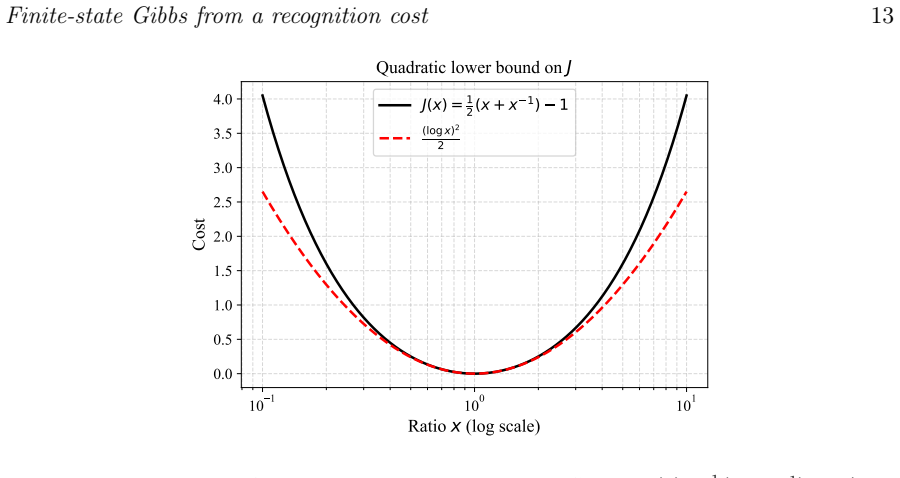
The Recognition Composition Law with J(x) = ½(x + x^{-1}) - 1, which turns reference ratios r_ω into the cost vector X_ω that drives the recovery of Gibbs weights via counting and duality.
If this is right
- The entropy maximization procedure yields the Gibbs law in the usual way after the RCL cost is substituted for energy.
- Non-asymptotic Stirling bounds apply to the multinomial coefficients with real-valued costs.
- Soft-shell constrained-type theorems characterize the large-deviation behavior for these costs.
- The three-state example demonstrates how the RCL Gibbs law differs from squared-log, affinity, and Tsallis forms at equal mean cost, along with sample-size power estimates.
Where Pith is reading between the lines
- If the axioms hold more generally, similar cost-based derivations might apply to other equilibrium distributions beyond finite states.
- The free-energy to KL identity provides a direct bridge between recognition costs and information-theoretic measures that could be explored in inference problems.
- A natural extension would be to examine whether physical systems with measurable ratio costs exhibit the predicted sample-size scaling in their fluctuation statistics.
Load-bearing premise
The framework requires that axioms (A1) through (A3) are accepted without further derivation and that the normalized d'Alembert degree-two closure is the appropriate Recognition Composition Law with unit log-curvature calibration.
What would settle it
A direct computation or measurement in a finite-state system showing that the frequencies minimizing the recognition free energy at fixed mean cost do not coincide with the multinomial-derived Gibbs probabilities would falsify the central recovery claim.
Figures

read the original abstract
On a finite outcome space, the canonical Gibbs distribution is usually obtained by maximizing Shannon entropy at fixed mean of an externally supplied energy functional. This paper studies the finite-state consequences of a ratio-cost construction instead: after adopting the normalized d'Alembert degree-two closure called the Recognition Composition Law (RCL), with unit log-curvature calibration at the reference ratio, the continuous nontrivial positive branch is $J(x)=\tfrac12(x+x^{-1})-1=\cosh(\log x)-1$. Given the induced cost vector $X_\omega=J(r_\omega)$, multinomial counting and convex duality recover the finite-state Gibbs weights and the identity $F_{\mathrm{R}}(q)-F_{\mathrm{R}}(p)=T_{\mathrm{R}}\,D_{\mathrm{KL}}(q\Vert p)$; the entropy-maximization steps are classical once the cost is fixed. New technical content includes a non-asymptotic Stirling bound and soft-shell constrained-type theorems for real-valued costs. A three-state example compares the Gibbs law to squared-log, affinity-as-energy, and Tsallis alternatives at the same cost vector and mean-cost constraint, with sample-size power calculations at fixed RCL ground truth. The framework is conditional on axioms (A1)--(A3) and restricted to finite outcome spaces with strictly positive weights; it does not derive the composition law from a more primitive principle.
Editorial analysis
A structured set of objections, weighed in public.
Referee Report
Summary. The paper claims that on a finite outcome space, adopting the normalized d'Alembert degree-two closure as the Recognition Composition Law (RCL) with unit log-curvature calibration yields the cost function J(x) = ½(x + x^{-1}) - 1. Given the induced cost vector X_ω = J(r_ω), standard multinomial counting and convex duality then recover the finite-state Gibbs weights together with the identity F_R(q) - F_R(p) = T_R D_KL(q || p). New technical contributions include a non-asymptotic Stirling bound and soft-shell constrained-type theorems; a three-state example compares the resulting Gibbs law to squared-log, affinity-as-energy, and Tsallis alternatives under the same mean-cost constraint, with accompanying sample-size power calculations. The framework is explicitly conditional on axioms (A1)-(A3) and restricted to finite spaces with strictly positive weights.
Significance. If the adopted RCL and axioms are accepted, the work supplies an alternative route to the canonical Gibbs distribution that begins from a ratio-cost functional rather than an externally supplied energy. It supplies concrete new technical tools (non-asymptotic Stirling bound, soft-shell theorems) and a worked three-state comparison that quantifies distinguishability from other distributions at fixed cost vector. These elements could be useful for finite-state models in which ratio-based costs arise naturally.
major comments (2)
- [Abstract] Abstract and the section defining the RCL: the recovery of the Gibbs weights and the KL identity is obtained by classical multinomial counting plus convex duality once the cost vector X_ω = J(r_ω) is fixed by the chosen J. Because the paper states that axioms (A1)-(A3) are adopted rather than derived from a more primitive principle, the central claim is an equivalence under a specific cost rather than a derivation of the Gibbs measure from ratio costs alone. A load-bearing justification or independent motivation for this particular composition law is therefore required.
- [Section on non-asymptotic Stirling bound] Section presenting the non-asymptotic Stirling bound: the abstract highlights this bound as new technical content, yet the reader's assessment notes that soundness cannot be confirmed without the full derivation or verification. If the bound is used to support the finite-state construction, an explicit statement of the error term and its dependence on the cost vector should be supplied.
minor comments (2)
- [Introduction] Notation for F_R, T_R and the reference ratio should be introduced with a single consolidated definition early in the text to avoid repeated cross-referencing.
- [Three-state example] The three-state example would benefit from an explicit table listing the numerical values of the cost vector, mean-cost constraint, and resulting probabilities for each alternative distribution.
Simulated Author's Rebuttal
We thank the referee for the careful reading and constructive comments on our manuscript. We address each major comment below and describe the revisions we will make to strengthen the presentation.
read point-by-point responses
-
Referee: [Abstract] Abstract and the section defining the RCL: the recovery of the Gibbs weights and the KL identity is obtained by classical multinomial counting plus convex duality once the cost vector X_ω = J(r_ω) is fixed by the chosen J. Because the paper states that axioms (A1)-(A3) are adopted rather than derived from a more primitive principle, the central claim is an equivalence under a specific cost rather than a derivation of the Gibbs measure from ratio costs alone. A load-bearing justification or independent motivation for this particular composition law is therefore required.
Authors: We agree that the central contribution is an equivalence obtained once the normalized d'Alembert degree-two RCL is adopted together with axioms (A1)-(A3), rather than a derivation of the RCL itself from more primitive axioms. The manuscript already states that it does not derive the composition law from a more primitive principle. In revision we will add a dedicated paragraph in the RCL-definition section that supplies independent motivation for this particular closure: it arises naturally when costs are defined on ratios (as in certain recognition or relative-likelihood models) and yields a strictly convex J that recovers the classical Gibbs form and KL identity via standard multinomial counting and convex duality. We will also clarify the scope of the claim in the abstract. revision: yes
-
Referee: [Section on non-asymptotic Stirling bound] Section presenting the non-asymptotic Stirling bound: the abstract highlights this bound as new technical content, yet the reader's assessment notes that soundness cannot be confirmed without the full derivation or verification. If the bound is used to support the finite-state construction, an explicit statement of the error term and its dependence on the cost vector should be supplied.
Authors: We accept the point that the non-asymptotic Stirling bound is advertised as new technical content and that its derivation must be verifiable. In the revised manuscript we will move the full proof to a self-contained appendix, state the explicit error term (including its dependence on the cost vector X_ω and on sample size n), and add a short remark on how the bound is applied in the soft-shell theorems. This will allow readers to assess soundness directly. revision: yes
Circularity Check
No circularity; derivation conditional on explicit axioms but self-contained
full rationale
The paper states that it adopts axioms (A1)-(A3) to define the Recognition Composition Law without deriving the composition law from a more primitive principle, then applies the resulting J(x) to induce the cost vector X_ω = J(r_ω). From there it invokes classical multinomial counting and convex duality to recover the Gibbs weights and the identity F_R(q) - F_R(p) = T_R D_KL(q || p). This recovery is presented as standard once the cost is fixed, with no equation reducing the output to the input by construction, no fitted parameter renamed as prediction, and no load-bearing self-citation. The framework is therefore an equivalence under chosen axioms rather than a tautological loop, making the derivation self-contained against external benchmarks.
Axiom & Free-Parameter Ledger
free parameters (1)
- unit log-curvature calibration at the reference ratio
axioms (1)
- domain assumption Axioms (A1)--(A3)
invented entities (1)
-
Recognition Composition Law (RCL)
no independent evidence
Lean theorems connected to this paper
-
IndisputableMonolith/Cost/FunctionalEquation.leanwashburn_uniqueness_aczel matches?
matchesMATCHES: this paper passage directly uses, restates, or depends on the cited Recognition theorem or module.
after adopting the normalized d’Alembert degree-two closure called the Recognition Composition Law (RCL), with unit log-curvature calibration at the reference ratio, the continuous nontrivial positive branch is J(x)=½(x+x^{-1})−1=cosh(logx)−1
-
IndisputableMonolith/Foundation/ArithmeticFromLogic.leanabsolute_floor_iff_bare_distinguishability echoes?
echoesECHOES: this paper passage has the same mathematical shape or conceptual pattern as the Recognition theorem, but is not a direct formal dependency.
Given the induced cost vector X_ω = J(r_ω), multinomial counting and convex duality recover the finite-state Gibbs weights and the identity F_R(q) - F_R(p) = T_R D_KL(q || p)
What do these tags mean?
- matches
- The paper's claim is directly supported by a theorem in the formal canon.
- supports
- The theorem supports part of the paper's argument, but the paper may add assumptions or extra steps.
- extends
- The paper goes beyond the formal theorem; the theorem is a base layer rather than the whole result.
- uses
- The paper appears to rely on the theorem as machinery.
- contradicts
- The paper's claim conflicts with a theorem or certificate in the canon.
- unclear
- Pith found a possible connection, but the passage is too broad, indirect, or ambiguous to say the theorem truly supports the claim.
Reference graph
Works this paper leans on
-
[1]
Ludwig Boltzmann. Über die Beziehung zwischen dem zweiten Hauptsatze der mechanischen Wärmetheorie und der Wahrscheinlichkeitsrechnung respektive den Sätzen über das Wärmegleichgewicht.Wiener Berichte, 76:373–435, 1877
-
[2]
Willard Gibbs.Elementary Principles in Statistical Mechanics
J. Willard Gibbs.Elementary Principles in Statistical Mechanics. Yale University Press, 1902
work page 1902
-
[3]
David Ruelle.Statistical Mechanics: Rigorous Results. W. A. Benjamin, 1969
work page 1969
-
[4]
E. T. Jaynes. Information theory and statistical mechanics.Phys. Rev., 106:620–630, 1957
work page 1957
-
[5]
E. T. Jaynes. Information theory and statistical mechanics. II.Phys. Rev., 108:171–190, 1957
work page 1957
-
[6]
Steve Presse, Kingshuk Ghosh, Julian Lee, and Ken A. Dill. Principles of maximum entropy and maximum caliber in statistical physics.Rev. Mod. Phys., 85:1115–1141, 2013
work page 2013
-
[7]
John E. Shore and Rodney W. Johnson. Axiomatic derivation of the principle of maximum entropy and the principle of minimum cross-entropy.IEEE Trans. Inform. Theory, 26(1):26–37, 1980
work page 1980
-
[8]
Ariel Caticha.Entropic Inference and the Foundations of Physics. EBL-Schweitzer (USP / EBEB),
-
[9]
Lecture notes available athttps://www.albany.edu/physics/faculty/ariel-caticha
-
[10]
Possible generalization of Boltzmann–Gibbs statistics.J
Constantino Tsallis. Possible generalization of Boltzmann–Gibbs statistics.J. Stat. Phys., 52(1– 2):479–487, 1988
work page 1988
- [11]
-
[12]
The large deviation approach to statistical mechanics.Phys
Hugo Touchette. The large deviation approach to statistical mechanics.Phys. Rep., 478:1–69, 2009
work page 2009
-
[13]
Oscar E. Lanford. Entropy and equilibrium states in classical statistical mechanics. InStatistical Mechanics and Mathematical Problems, volume 20 ofLecture Notes in Physics, pages 1–113. Springer, 1973
work page 1973
-
[14]
Uniqueness of the canonical reciprocal cost
Jonathan Washburn and Milan Zlatanović. Uniqueness of the canonical reciprocal cost. Mathematics, 14(6):935, 2026. Also available as arXiv:2602.05753 [math.CA]
-
[15]
Aczél.Lectures on Functional Equations and Their Applications
J. Aczél.Lectures on Functional Equations and Their Applications. Academic Press, 1966
work page 1966
-
[16]
Cambridge University Press, 2009
Marek Kuczma, Bogdan Choczewski, and Roman Ger.Iterative Functional Equations, volume 32 ofEncyclopedia of Mathematics and Its Applications. Cambridge University Press, 2009. Reprint of the 1990 original
work page 2009
-
[17]
The coercive projection theorem for canonical reciprocal costs, 2026
Jonathan Washburn and Amir Rahnamai Barghi. The coercive projection theorem for canonical reciprocal costs, 2026. Preprint, arXiv:2603.20205
-
[18]
A remark on Stirling’s formula.Amer
Herbert Robbins. A remark on Stirling’s formula.Amer. Math. Monthly, 62(1):26–29, 1955
work page 1955
-
[19]
Ellis.Entropy, Large Deviations, and Statistical Mechanics
Richard S. Ellis.Entropy, Large Deviations, and Statistical Mechanics. Springer, 1985
work page 1985
-
[20]
J. Schnakenberg. Network theory of microscopic and macroscopic behavior of master equation systems.Rev. Mod. Phys., 48:571–585, 1976
work page 1976
-
[21]
Thomas M. Cover and Joy A. Thomas.Elements of Information Theory. Wiley, 2 edition, 2006
work page 2006
-
[22]
Imre Csiszár and János Körner.Information Theory: Coding Theorems for Discrete Memoryless Systems. Academic Press, 1981
work page 1981
-
[23]
Amir Dembo and Ofer Zeitouni.Large Deviations Techniques and Applications. Springer, 2 edition,
-
[24]
Corrected reprint of the 1998 edition
work page 1998
-
[25]
Levin, Yuval Peres, and Elizabeth L
David A. Levin, Yuval Peres, and Elizabeth L. Wilmer.Markov Chains and Mixing Times. American Mathematical Society, 2 edition, 2017
work page 2017
-
[26]
Dario Lucente, Marco Baldovin, Andrea Puglisi, and Angelo Vulpiani.H-theorem at negative temperature: the random exchange model with bounds.J. Stat. Mech., 2025(1):013210, 2025
work page 2025
-
[27]
Solomon Kullback and Richard A. Leibler. On information and sufficiency.Ann. Math. Statist., 22:79–86, 1951
work page 1951
-
[28]
Imre Csiszár. Information-type measures of difference of probability distributions and indirect observations.Studia Sci. Math. Hungar., 2:299–318, 1967
work page 1967
-
[29]
S. M. Ali and S. D. Silvey. A general class of coefficients of divergence of one distribution from another.J. Roy. Statist. Soc. Ser. B Methodol., 28(1):131–142, 1966
work page 1966
-
[30]
Alexander Schrijver.Theory of Linear and Integer Programming. Wiley, 1998. Finite-state Gibbs from a recognition cost50
work page 1998
-
[31]
I. N. Sanov. On the probability of large deviations of random magnitudes.Mat. Sb. (N.S.), 42(1):11–44, 1957
work page 1957
-
[32]
Stochastic operators, information, and entropy.Comm
Jürgen Voigt. Stochastic operators, information, and entropy.Comm. Math. Phys., 81:31–38, 1981
work page 1981
-
[33]
J. R. Norris.Markov Chains. Cambridge Series in Statistical and Probabilistic Mathematics. Cambridge University Press, 1997
work page 1997
-
[34]
Stochastic thermodynamics, fluctuation theorems and molecular machines.Rep
Udo Seifert. Stochastic thermodynamics, fluctuation theorems and molecular machines.Rep. Prog. Phys., 75(12):126001, 2012
work page 2012
-
[35]
Riccardo Rao and Massimiliano Esposito. Nonequilibrium thermodynamics of chemical reaction networks: Wisdom from stochastic thermodynamics.Phys. Rev. X, 6:041064, 2016
work page 2016
-
[36]
Relative Entropy and Inductive Inference
Ariel Caticha. Relative entropy and inductive inference. InBayesian Inference and Maximum Entropy Methods in Science and Engineering, volume 707 ofAIP Conference Proceedings, pages 75–96. American Institute of Physics, 2004. Also available as arXiv:physics/0311093
work page internal anchor Pith review Pith/arXiv arXiv 2004
-
[37]
Shun-ichi Amari.Differential-Geometrical Methods in Statistics, volume 28 ofLecture Notes in Statistics. Springer, 1985
work page 1985
-
[38]
American Mathematical Society, 2000
Shun-ichi Amari and Hiroshi Nagaoka.Methods of Information Geometry, volume 191 of Translations of Mathematical Monographs. American Mathematical Society, 2000
work page 2000
-
[39]
Fumitada Itakura and Shuzo Saito. Analysis synthesis telephony based on the maximum likelihood method.Reports of the 6th International Congress on Acoustics, pages C–17–C–20, 1968
work page 1968
-
[40]
Zeineb Chebbi and Maher Moakher. Means of Hermitian positive-definite matrices based on the log-determinantα-divergence function.Linear Algebra Appl., 436:1872–1889, 2012
work page 2012
-
[41]
A new metric on the manifold of kernel matrices with application to matrix geometric means.Adv
Suvrit Sra. A new metric on the manifold of kernel matrices with application to matrix geometric means.Adv. Neural Inf. Process. Syst., 25:144–152, 2012
work page 2012
-
[42]
Cambridge University Press, 1989
János Aczél and Jean Dhombres.Functional Equations in Several Variables, volume 31 of Encyclopedia of Mathematics and its Applications. Cambridge University Press, 1989
work page 1989
-
[43]
Massimiliano Esposito and Christian Van den Broeck. Three faces of the second law. I. Master equation formulation.Phys. Rev. E, 82:011143, 2010
work page 2010
-
[44]
Irreversible thermodynamics of open chemical networks
Matteo Polettini and Massimiliano Esposito. Irreversible thermodynamics of open chemical networks. I. Emergent cycles and broken conservation laws.J. Chem. Phys., 141(2):024117, 2014
work page 2014
-
[45]
Stochastic thermodynamic interpretation of information geometry.Phys
Sosuke Ito. Stochastic thermodynamic interpretation of information geometry.Phys. Rev. Lett., 121:030605, 2018
work page 2018
-
[46]
Andre C. Barato and Udo Seifert. Thermodynamic uncertainty relation for biomolecular processes. Phys. Rev. Lett., 114:158101, 2015
work page 2015
-
[47]
Estimators, escort probabilities, andϕ-exponential families in statistical physics.J
Jan Naudts. Estimators, escort probabilities, andϕ-exponential families in statistical physics.J. Inequal. Pure Appl. Math., 5(4):Article 102, 2004
work page 2004
discussion (0)
Sign in with ORCID, Apple, or X to comment. Anyone can read and Pith papers without signing in.