Centralized vs Decentralized Federated Learning: A trade-off performance analysis
Pith reviewed 2026-05-20 20:10 UTC · model grok-4.3
The pith
Experiments using Fedstellar simulator on MNIST with MLP reveal performance trade-offs across centralized, decentralized, and semi-decentralized federated learning.
A machine-rendered reading of the paper's core claim, the machinery that carries it, and where it could break.
Core claim
This paper overcomes the lack of experimental comparisons by conducting analyses using the Fedstellar simulator, MNIST dataset, and MLP classifier to understand the respective strengths and limitations of Centralized (CFL), Decentralized (DFL), and Semi-decentralized (SDFL) federated learning, as well as trade-offs between different performance indicators.
What carries the argument
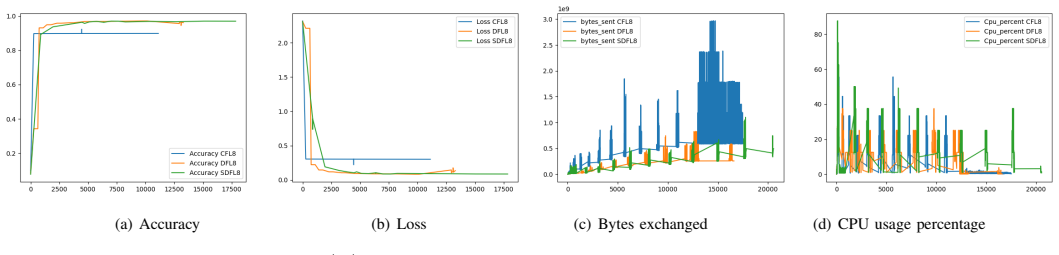
Side-by-side experimental runs in the Fedstellar simulator that measure accuracy, communication cost, and convergence speed for the three architectures on the same MNIST classification task with an MLP model.
If this is right
- Centralized federated learning tends to reach higher final accuracy when a reliable central coordinator is available.
- Decentralized federated learning reduces single-point failures and communication bottlenecks at the cost of slower or less stable convergence.
- Semi-decentralized federated learning supplies an intermediate option that trades some accuracy for lower communication overhead and better fault tolerance.
- Application designers can select the architecture by matching their priorities for privacy, scalability, and latency to the observed trade-offs.
Where Pith is reading between the lines
- If the simulator's network and data-partition models match real edge environments, the reported trade-offs could directly guide early architecture decisions in IoT projects.
- Testing the same setups under non-independent and identically distributed data partitions would likely expose additional convergence and accuracy penalties not captured in the current MNIST runs.
- The comparison method itself could be reused to benchmark federated learning against other privacy-preserving distributed training approaches.
Load-bearing premise
The performance differences seen in the Fedstellar simulator with MNIST and MLP reflect the trade-offs that would appear in real-world federated learning deployments with varied data, models, and network conditions.
What would settle it
Repeating the same comparison on a different dataset such as CIFAR-10 or with a convolutional neural network and finding that the relative ranking of the three architectures reverses on key metrics.
Figures



read the original abstract
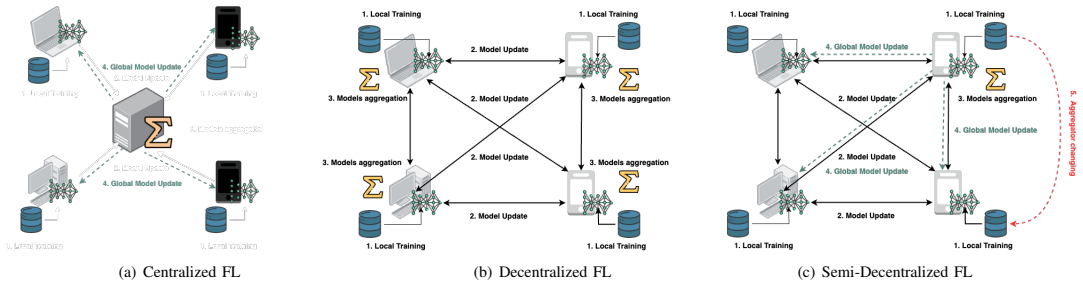
Federated Learning (FL) has emerged as a promising paradigm for collaborative model training across distributed edge devices while preserving data privacy especially with the huge increase amount of data due to the adoption of technologies which contributes to the growing number of IoT devices. Storing this amount of data centrally is challenging due to issues like limited communication, privacy, and regulations. FL can be Centralized (CFL), Decentralized (DFL), and Semi-decentralized (SDFL). Choosing the right FL architecture depends on the application's needs. However, very few research studies have experimentally compared these three types of architectures to not only understand the respective strengths and limitations, but also trade-offs between different performance indicators. This paper overcome this lack of analysis, conducting experimental analyses using the Fedstellar simulator, MNIST dataset, and MLP classifier.
Editorial analysis
A structured set of objections, weighed in public.
Referee Report
Summary. The paper claims to address a gap in the literature by experimentally comparing Centralized Federated Learning (CFL), Decentralized Federated Learning (DFL), and Semi-decentralized Federated Learning (SDFL) architectures. It conducts this analysis using the Fedstellar simulator on the MNIST dataset with an MLP classifier to identify respective strengths, limitations, and trade-offs across performance indicators such as accuracy and efficiency.
Significance. If the results hold under broader conditions, the work would provide useful empirical guidance for selecting among CFL, DFL, and SDFL based on application-specific trade-offs. The reliance on a public simulator and standard dataset is a positive step toward reproducibility.
major comments (2)
- [§4 (Experimental Setup)] §4 (Experimental Setup): The central claim that the experiments reveal general performance trade-offs among the three architectures rests on the assumption that MNIST + MLP + Fedstellar produces representative differences. However, MNIST is homogeneous and low-complexity while MLP is shallow; this minimizes data heterogeneity, model size, and communication bottlenecks that dominate real FL deployments, so observed rankings or curves may be artifacts of the narrow regime rather than intrinsic architectural properties.
- [Results section] Results section (e.g., accuracy and communication tables): Without reported statistical significance, error bars, or multiple random seeds, it is unclear whether the measured differences between CFL/DFL/SDFL exceed experimental noise, weakening the trade-off conclusions.
minor comments (2)
- [Abstract] Abstract: 'huge increase amount of data' is grammatically incomplete and should read 'huge increase in the amount of data'.
- [Abstract] Abstract: 'This paper overcome this lack of analysis' should be 'This paper overcomes this lack of analysis'.
Simulated Author's Rebuttal
We thank the referee for the constructive comments on our manuscript. We address each major comment below and indicate the changes we will make in the revised version.
read point-by-point responses
-
Referee: [§4 (Experimental Setup)] §4 (Experimental Setup): The central claim that the experiments reveal general performance trade-offs among the three architectures rests on the assumption that MNIST + MLP + Fedstellar produces representative differences. However, MNIST is homogeneous and low-complexity while MLP is shallow; this minimizes data heterogeneity, model size, and communication bottlenecks that dominate real FL deployments, so observed rankings or curves may be artifacts of the narrow regime rather than intrinsic architectural properties.
Authors: We selected MNIST and the MLP architecture to establish a controlled, reproducible baseline using the public Fedstellar simulator, as the referee correctly notes is a positive step for reproducibility. This choice isolates the effects of the three FL architectures (CFL, DFL, SDFL) from confounding factors such as data heterogeneity or large model sizes, allowing clearer attribution of observed trade-offs in accuracy and efficiency. While we acknowledge that real deployments often involve greater heterogeneity and complexity, the current results provide initial empirical guidance in a standardized setting. In the revised manuscript we will expand Section 4 and add a dedicated limitations paragraph to explicitly discuss the scope of the present experiments and outline extensions to more complex datasets and models. revision: partial
-
Referee: Results section (e.g., accuracy and communication tables): Without reported statistical significance, error bars, or multiple random seeds, it is unclear whether the measured differences between CFL/DFL/SDFL exceed experimental noise, weakening the trade-off conclusions.
Authors: We agree that reporting variability and statistical significance would strengthen the reliability of the trade-off conclusions. In the revised manuscript we will rerun all experiments with multiple random seeds, report mean performance together with standard deviation (error bars) in tables and figures, and include appropriate statistical tests to confirm that observed differences between architectures are significant. revision: yes
Circularity Check
No circularity: empirical comparison using external simulator and public dataset
full rationale
The paper conducts an experimental analysis comparing CFL, DFL, and SDFL architectures via the Fedstellar simulator on the MNIST dataset with an MLP classifier. No equations, derivations, fitted parameters renamed as predictions, or load-bearing self-citations appear in the text. The central claim of filling a research gap rests on running standard simulations and reporting observed performance trade-offs, which is self-contained against external benchmarks and does not reduce to any self-definition or input-by-construction.
Axiom & Free-Parameter Ledger
axioms (1)
- domain assumption Federated learning preserves data privacy by sharing only model updates rather than raw data.
Lean theorems connected to this paper
-
IndisputableMonolith/Foundation/AbsoluteFloorClosure.leanreality_from_one_distinction unclear?
unclearRelation between the paper passage and the cited Recognition theorem.
conducting experimental analyses using the Fedstellar simulator, MNIST dataset, and MLP classifier
-
IndisputableMonolith/Cost/FunctionalEquation.leanwashburn_uniqueness_aczel unclear?
unclearRelation between the paper passage and the cited Recognition theorem.
over 40 KPIs … Node, Communications, Model categories
What do these tags mean?
- matches
- The paper's claim is directly supported by a theorem in the formal canon.
- supports
- The theorem supports part of the paper's argument, but the paper may add assumptions or extra steps.
- extends
- The paper goes beyond the formal theorem; the theorem is a base layer rather than the whole result.
- uses
- The paper appears to rely on the theorem as machinery.
- contradicts
- The paper's claim conflicts with a theorem or certificate in the canon.
- unclear
- Pith found a possible connection, but the passage is too broad, indirect, or ambiguous to say the theorem truly supports the claim.
Reference graph
Works this paper leans on
-
[1]
Li, Tian, et al. ”Federated learning: Challenges, methods, and future directions.” IEEE signal processing magazine 37.3 (2020): 50-60
work page 2020
-
[2]
Zhang, Jiale, et al. ”Poisoning attack in federated learning using generative adversarial nets.” 2019 18th IEEE international conference on trust, security and privacy in computing and communications/13th IEEE international conference on big data science and engineering (TrustCom/BigDataSE). IEEE, 2019
work page 2019
-
[3]
Kairouz, Peter, et al. ”Advances and open problems in federated learn- ing.” Foundations and trends® in machine learning 14.1–2 (2021): 1- 210
work page 2021
-
[4]
”Fully decentralized federated learning.” Third workshop on bayesian deep learning (NeurIPS)
Lalitha, Anusha, et al. ”Fully decentralized federated learning.” Third workshop on bayesian deep learning (NeurIPS). V ol. 2. 2018
work page 2018
-
[5]
Beltr ´an, Enrique Tom ´as Mart´ınez, et al. ”Decentralized federated learn- ing: Fundamentals, state of the art, frameworks, trends, and challenges.” IEEE Communications Surveys & Tutorials (2023)
work page 2023
-
[6]
”Decentralized federated learning: A survey and perspective.” arXiv preprint arXiv:2306.01603 (2023)
Yuan, Liangqi, et al. ”Decentralized federated learning: A survey and perspective.” arXiv preprint arXiv:2306.01603 (2023)
-
[7]
Elmrabit, Nebrase, et al. ”Evaluation of machine learning algorithms for anomaly detection.” 2020 international conference on cyber security and protection of digital services (cyber security). IEEE, 2020
work page 2020
-
[8]
Ait Mahammed, Fatima. ”Approches d’apprentissage automatique pour la d ´etection du Spam Web: exploration de diverses caract ´eristiques.” (2018)
work page 2018
-
[9]
Rainio, O., Teuho, J. & Kl ´en, R. Evaluation metrics and statistical tests for machine learning. Sci Rep 14, 6086 (2024)
work page 2024
-
[10]
Martinez, M., & Stiefelhagen, R. Taming the cross entropy loss. In Pattern Recognition: 40th German Conference, GCPR 2018, Stuttgart, Germany, October 9-12, 2018, Proceedings 628–637, V ol. 40. Springer (2019)
work page 2018
-
[11]
Beltr ´an, Enrique Tom ´as Mart ´ınez, et al. ”Fedstellar: A platform for decentralized federated learning.” Expert Systems with Applications 242 (2024): 122861
work page 2024
-
[12]
Popescu, Marius-Constantin, et al. ”Multilayer perceptron and neural networks.” WSEAS Transactions on Circuits and Systems 8.7 (2009): 579-588
work page 2009
-
[13]
Federated Learning: Strategies for Improving Communication Efficiency
Konecn ´y, Jakub, et al. ”Federated learning: Strategies for improving communication efficiency.” arXiv preprint arXiv:1610.05492 8 (2016)
work page internal anchor Pith review Pith/arXiv arXiv 2016
-
[14]
Towards Federated Learning at Scale: System Design
Bonawitz, K., Eichner, H., Grieskamp, W., et al.: Towards federated learning at scale: System design. arXiv preprint arXiv:1902.01046 (2019)
work page internal anchor Pith review Pith/arXiv arXiv 1902
-
[15]
In: Proceedings of the 2017 ACM SIGSAC Conference on Computer and Communications Security
Bonawitz, K., Ivanov, V ., Kreuter, B., Marcedone, A., McMahan, H.B., Patel, S., Ramage, D., Segal, A., Seth, K.: Practical secure aggregation for privacy-preserving machine learning. In: Proceedings of the 2017 ACM SIGSAC Conference on Computer and Communications Security. pp. 1175–1191. ACM (2017)
work page 2017
-
[16]
Federated learning: Challenges, methods, and future directions,
T. Li, A. K. Sahu, A. Talwalkar, and V . Smith, “Federated learning: Challenges, methods, and future directions,” IEEE Signal Processing Magazine, vol. 37, no. 3, pp. 50–60, 2020
work page 2020
-
[17]
Federated learning in mobile edge networks: A comprehensive survey,
W. Y . B. Lim et al., “Federated learning in mobile edge networks: A comprehensive survey,” IEEE Communications Surveys & Tutorials, vol. 22, no. 3, pp. 2031–2063, 2020
work page 2031
-
[18]
Federated learning for Internet of Things: A comprehensive survey,
D. C. Nguyen, M. Ding, P. N. Pathirana, A. Seneviratne, J. Li, and H. V . Poor, “Federated learning for Internet of Things: A comprehensive survey,” IEEE Communications Surveys & Tutorials, vol. 23, no. 3, pp. 1622–1658, 2021
work page 2021
-
[19]
Federated learning for Internet of Things: Recent advances, taxonomy, and open challenges,
L. U. Khan, W. Saad, Z. Han, E. Hossain, and C. S. Hong, “Federated learning for Internet of Things: Recent advances, taxonomy, and open challenges,” IEEE Communications Surveys & Tutorials, vol. 23, no. 3, pp. 1759–1799, 2021
work page 2021
-
[20]
A survey on security and privacy of federated learning,
V . Mothukuri, R. M. Parizi, S. Pouriyeh, Y . Huang, A. Dehghantanha, and G. Srivastava, “A survey on security and privacy of federated learning,” Future Generation Computer Systems, vol. 115, pp. 619– 640, 2021
work page 2021
-
[21]
Fusion of federated learning and industrial Internet of Things: A survey,
P. Boobalan et al., “Fusion of federated learning and industrial Internet of Things: A survey,” Computer Networks, vol. 212, p. 109048, 2022
work page 2022
-
[22]
Joshi, Madhura, Ankit Pal, and Malaikannan Sankarasubbu. ”Federated learning for healthcare domain-pipeline, applications and challenges.” ACM Transactions on Computing for Healthcare 3.4 (2022): 1-36
work page 2022
-
[23]
Decentral and incentivized federated learning frameworks: A systematic literature review,
L. Witt, M. Heyer, K. Toyoda, W. Samek, and D. Li, “Decentral and incentivized federated learning frameworks: A systematic literature review,” arXiv preprint arXiv:2205.07855, 2022
-
[24]
Qu, Youyang, et al. ”Decentralized privacy using blockchain-enabled federated learning in fog computing.” IEEE Internet of Things Journal 7.6 (2020): 5171-5183
work page 2020
-
[25]
M. Billah, S. T. Mehedi, A. Anwar, Z. Rahman, and R. Islam, “A systematic literature review on blockchain enabled federated learning framework for Internet of Vehicles,” arXiv preprint arXiv:2203.05192, 2022
-
[26]
Survey on federated-learning approaches in distributed environment,
R. Gupta and T. Alam, “Survey on federated-learning approaches in distributed environment,” Wireless Personal Communications, Mar 2022
work page 2022
-
[27]
D. Saraswat et al., “Blockchain-based federated learning in UA Vs beyond 5G networks: A solution taxonomy and future directions,” IEEE Access, vol. 10, pp. 33 154–33 182, 2022
work page 2022
-
[28]
”Blockchain-enabled federated learning: A survey.” ACM Computing Surveys 55.4 (2022): 1-35
Qu, Youyang, et al. ”Blockchain-enabled federated learning: A survey.” ACM Computing Surveys 55.4 (2022): 1-35
work page 2022
-
[29]
Yemini, Michal, et al. ”Semi-decentralized federated learning with collaborative relaying.” 2022 IEEE International Symposium on Infor- mation Theory (ISIT). IEEE, 2022
work page 2022
-
[30]
BrainTorrent: A Peer-to-Peer Environment for Decentralized Federated Learning
Roy, Abhijit Guha, et al. ”Braintorrent: A peer-to-peer environment for decentralized federated learning.” arXiv preprint arXiv:1905.06731 (2019)
work page internal anchor Pith review Pith/arXiv arXiv 1905
-
[31]
”Trustworthy artificial intelligence: a review.” ACM computing surveys (CSUR) 55.2 (2022): 1-38
Kaur, Davinder, et al. ”Trustworthy artificial intelligence: a review.” ACM computing surveys (CSUR) 55.2 (2022): 1-38
work page 2022
discussion (0)
Sign in with ORCID, Apple, or X to comment. Anyone can read and Pith papers without signing in.