ULYSSES the Third: An Odyssey Towards a Unified Python Toolkit for Leptogenesis
Pith reviewed 2026-05-20 16:03 UTC · model grok-4.3
The pith
ULYSSES now implements density matrix equations for resonant leptogenesis with three quasi-degenerate right-handed neutrinos.
A machine-rendered reading of the paper's core claim, the machinery that carries it, and where it could break.
Core claim
By including neutrino production rates valid in both the relativistic and non-relativistic regimes, the density matrix equations for low-scale leptogenesis with three quasi-degenerate right-handed neutrinos can now be solved accurately beyond the 100 GeV mass scale and into the resonant regime. In the high-scale vanilla scenario the package supplies Delta L = 1 scattering processes that permit full phase-space evolution of the right-handed neutrino and lepton asymmetry. The new extended interface allows model-specific inputs to be passed without changes to the core infrastructure.
What carries the argument
Density matrix equations for the evolution of right-handed neutrino and lepton asymmetry, extended by production rates covering both relativistic and non-relativistic regimes.
If this is right
- Accurate numerical evaluation of the baryon asymmetry becomes feasible for resonant leptogenesis at right-handed neutrino masses below previous limits.
- High-scale leptogenesis calculations can now track the full phase-space evolution including Delta L = 1 scatterings.
- Users can supply custom model parameters through the extended interface and combine leptogenesis with other processes such as dark matter freeze-in.
- Standard runs benefit from the updated neutrino oscillation parameters and alternative Casas-Ibarra parametrization.
Where Pith is reading between the lines
- The public GitHub and PyPI availability may encourage community extensions that couple leptogenesis to additional early-universe phenomena.
- Exploration of viable parameter spaces for models with multiple nearly degenerate neutrinos becomes more straightforward for non-expert users.
- Cross-checks against benchmarks suggest the toolkit could serve as a reference implementation for testing new analytical approximations in the resonant regime.
Load-bearing premise
The implemented density matrix equations and production rates remain accurate in the resonant regime without missing higher-order corrections or numerical instabilities.
What would settle it
A numerical discrepancy between the package output and an independent code or published benchmark result for the final baryon asymmetry at a specific point in the resonant regime with three quasi-degenerate right-handed neutrinos would falsify the claimed extension.
Figures


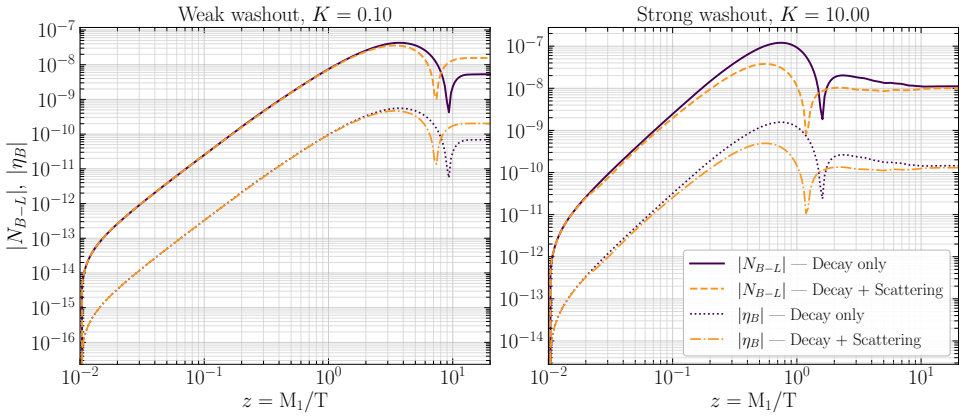


read the original abstract
We present the third release of $\texttt{ULYSSES}$, a Python package for the numerical evaluation of the baryon asymmetry generated through leptogenesis. This version includes code implementing state-of-the-art density matrix equations for low-scale leptogenesis with three quasi-degenerate right-handed neutrinos. We extend the validity of the code in this scenario beyond the 100 GeV right-handed neutrino mass scale, into the regime of resonant leptogenesis, by including neutrino production rates valid in both the relativistic and non-relativistic regimes. In addition, in the high-scale vanilla scenario, we provide routines for computing $\Delta L = 1$ scattering processes, enabling full phase-space evolution of the right-handed neutrino and lepton asymmetry. A new $\texttt{--extended}$ parameter interface allows users to pass model-specific inputs beyond the standard leptogenesis runcard without modifying the core infrastructure and demonstrate its use with a toy module that simultaneously solves the vanilla leptogenesis equations and the freeze-in production of dark matter. On top of these improvements, we introduce an alternative parametrisation of the Casas-Ibarra matrix, update the default neutrino oscillation parameters and report cross-checks of the new low-scale leptogenesis module against published benchmarks and independent codes. $\texttt{ULYSSES}$ is publicly available on $\href{https://github.com/earlyuniverse/ulysses}{\texttt{GitHub}}$ and pip-installable from PyPI.
Editorial analysis
A structured set of objections, weighed in public.
Referee Report
Summary. The manuscript presents the third release of the ULYSSES Python package for numerical evaluation of the baryon asymmetry in leptogenesis. Key additions include density-matrix equations for low-scale leptogenesis with three quasi-degenerate right-handed neutrinos, production rates valid across relativistic and non-relativistic regimes to reach the resonant regime, ΔL=1 scattering processes for the high-scale vanilla case, a new --extended parameter interface (demonstrated via a toy model combining leptogenesis with dark-matter freeze-in), an alternative Casas-Ibarra parametrization, updated neutrino oscillation parameters, and cross-checks of the new module against published benchmarks and independent codes. The code remains publicly available on GitHub and via PyPI.
Significance. If the implementations hold, the release supplies the leptogenesis community with a maintained, open-source toolkit that incorporates current density-matrix methods for low-scale and resonant scenarios while remaining extensible for model-specific physics. Public availability of the code together with reported cross-checks directly supports reproducibility and allows users to inspect or build upon the new modules.
major comments (1)
- [Low-scale leptogenesis module] Low-scale leptogenesis module: the central claim that the new production rates extend validity into the resonant regime rests on cross-checks against published benchmarks. The manuscript should explicitly state how the relativistic and non-relativistic rates are matched or interpolated (including any smoothing or switching criterion) to demonstrate continuity and absence of numerical artifacts at the transition.
minor comments (2)
- [Results and validation] The abstract states that cross-checks are reported, yet the main text would be strengthened by a dedicated subsection or table that tabulates quantitative agreement metrics (e.g., relative differences in final asymmetry) for each benchmark.
- [Extended parameter interface] The description of the --extended interface would benefit from an explicit example of the additional input dictionary or runcard syntax so that readers can immediately reproduce the dark-matter toy-model demonstration.
Simulated Author's Rebuttal
We thank the referee for their positive assessment of the manuscript and for the recommendation of minor revision. We address the single major comment below and will incorporate the requested clarification in the revised version.
read point-by-point responses
-
Referee: Low-scale leptogenesis module: the central claim that the new production rates extend validity into the resonant regime rests on cross-checks against published benchmarks. The manuscript should explicitly state how the relativistic and non-relativistic rates are matched or interpolated (including any smoothing or switching criterion) to demonstrate continuity and absence of numerical artifacts at the transition.
Authors: We agree that an explicit description of the matching procedure would improve clarity. In the current implementation the relativistic rate is used for T ≫ M_N and the non-relativistic rate for T ≪ M_N; these are joined by a smooth interpolation (a tanh-based switching function centered at T = M_N with width set by the relative size of the two rates) that guarantees continuity of both the rate and its first derivative. The cross-checks against published benchmarks already confirm that no visible discontinuities or artifacts appear in the final asymmetry, but we acknowledge that the manuscript does not currently document the interpolation details. We will add a short subsection (or paragraph in the low-scale module description) that states the functional form of the interpolator, the precise switching criterion, and an additional figure showing the rate and its derivative across the transition. This revision will be made without altering any numerical results. revision: yes
Circularity Check
No significant circularity identified
full rationale
The paper is a software release describing the implementation of established density matrix equations and neutrino production rates for leptogenesis drawn from prior literature. It reports cross-checks against published benchmarks and independent codes, with public GitHub availability enabling external inspection. No new first-principles derivations or predictions are presented that reduce by construction to parameters fitted or defined within this work; updates such as the alternative Casas-Ibarra parametrisation and default oscillation parameters are straightforward code extensions rather than load-bearing claims. The central contributions remain self-contained against external benchmarks.
Axiom & Free-Parameter Ledger
axioms (1)
- domain assumption Density matrix formalism accurately describes the evolution of lepton asymmetry for three quasi-degenerate right-handed neutrinos in the resonant regime.
Lean theorems connected to this paper
-
IndisputableMonolith/Cost/FunctionalEquation.leanwashburn_uniqueness_aczel unclear?
unclearRelation between the paper passage and the cited Recognition theorem.
state-of-the-art density matrix equations for low-scale leptogenesis with three quasi-degenerate right-handed neutrinos... neutrino production rates valid in both the relativistic and non-relativistic regimes
-
IndisputableMonolith/Foundation/AlexanderDuality.leanalexander_duality_circle_linking unclear?
unclearRelation between the paper passage and the cited Recognition theorem.
routines for computing ΔL=1 scattering processes, enabling full phase-space evolution
What do these tags mean?
- matches
- The paper's claim is directly supported by a theorem in the formal canon.
- supports
- The theorem supports part of the paper's argument, but the paper may add assumptions or extra steps.
- extends
- The paper goes beyond the formal theorem; the theorem is a base layer rather than the whole result.
- uses
- The paper appears to rely on the theorem as machinery.
- contradicts
- The paper's claim conflicts with a theorem or certificate in the canon.
- unclear
- Pith found a possible connection, but the passage is too broad, indirect, or ambiguous to say the theorem truly supports the claim.
Reference graph
Works this paper leans on
-
[1]
M. Fukugita and T. Yanagida,Baryogenesis Without Grand Unification,Physics Letters B174(1986) 45
work page 1986
-
[2]
Minkowski,µ→eγat a Rate of One Out of10 9 Muon Decays?,Physics Letters B67 (1977) 421
P. Minkowski,µ→eγat a Rate of One Out of10 9 Muon Decays?,Physics Letters B67 (1977) 421
work page 1977
-
[3]
Yanagida,Horizontal Symmetry and Masses Of Neutrinos,Conference Proceedings C7902131(1979) 95
T. Yanagida,Horizontal Symmetry and Masses Of Neutrinos,Conference Proceedings C7902131(1979) 95
work page 1979
-
[4]
Complex Spinors and Unified Theories
M. Gell-Mann, P. Ramond and R. Slansky,Complex Spinors and Unified Theories, Conference ProceedingsC790927(1979) 315 [1306.4669]
work page internal anchor Pith review Pith/arXiv arXiv 1979
-
[5]
Glashow,The Future of Elementary Particle Physics,NATO Advanced Study Institutes Series61(1980) 687
S. Glashow,The Future of Elementary Particle Physics,NATO Advanced Study Institutes Series61(1980) 687
work page 1980
-
[6]
R. N. Mohapatra and G. Senjanovic,Neutrino Mass and Spontaneous Parity Violation, Physical Review Letters44(1980) 912
work page 1980
-
[7]
V. A. Kuzmin, V. A. Rubakov and M. E. Shaposhnikov,On the Anomalous Electroweak Baryon Number Nonconservation in the Early Universe,Physics Letters B155(1985) 36
work page 1985
-
[8]
The Sphaleron Rate in the Minimal Standard Model
M. D’Onofrio, K. Rummukainen and A. Tranberg,Sphaleron Rate in the Minimal Standard Model,Physical Review Letters113(2014) 141602 [1404.3565]
work page internal anchor Pith review Pith/arXiv arXiv 2014
-
[9]
CP Violation and Baryogenesis due to Heavy Majorana Neutrinos
A. Pilaftsis,CP violation and baryogenesis due to heavy Majorana neutrinos,Physical Review D56(1997) 5431 [hep-ph/9707235]. 43
work page internal anchor Pith review Pith/arXiv arXiv 1997
-
[10]
A. Pilaftsis and T. E. J. Underwood,Resonant leptogenesis,Nuclear Physics B692 (2004) 303 [hep-ph/0309342]
work page internal anchor Pith review Pith/arXiv arXiv 2004
-
[11]
E. K. Akhmedov, V. A. Rubakov and A. Y. Smirnov,Baryogenesis via neutrino oscillations,Physical Review Letters81(1998) 1359 [hep-ph/9803255]
work page internal anchor Pith review Pith/arXiv arXiv 1998
-
[12]
The $\nu$MSM, Dark Matter and Baryon Asymmetry of the Universe
T. Asaka and M. Shaposhnikov,TheνMSM, dark matter and baryon asymmetry of the universe,Physics Letters B620(2005) 17 [hep-ph/0505013]
work page internal anchor Pith review Pith/arXiv arXiv 2005
-
[13]
Leptogenesis with small violation of B-L
J. Racker, M. Pena and N. Rius,Leptogenesis with small violation of B-L,Journal of Cosmology and Astroparticle Physics07(2012) 030 [1205.1948]
work page internal anchor Pith review Pith/arXiv arXiv 2012
-
[14]
A. Granelli, K. Moffat, Y. F. Perez-Gonzalez, H. Schulz and J. Turner,ULYSSES: Universal LeptogeneSiS Equation Solver,Computer Physics Communications262(2021) 107813 [2007.09150]
-
[15]
A. Granelli, C. Leslie, Y. F. Perez-Gonzalez, H. Schulz, B. Shuve, J. Turner et al., ULYSSES, universal LeptogeneSiS equation solver: Version 2,Computer Physics Communications291(2023) 108834 [2301.05722]
- [16]
- [17]
- [18]
- [19]
-
[20]
NuFit-6.0: Updated global analysis of three-flavor neutrino oscillations
I. Esteban, M. C. Gonzalez-Garcia, M. Maltoni, I. Martinez-Soler, J. P. Pinheiro and T. Schwetz,NuFit-6.0: updated global analysis of three-flavor neutrino oscillations, Journal of High Energy Physics12(2024) 216 [2410.05380]
work page internal anchor Pith review Pith/arXiv arXiv 2024
-
[21]
A facility to Search for Hidden Particles at the CERN SPS: the SHiP physics case
S. Alekhin et al.,A facility to Search for Hidden Particles at the CERN SPS: the SHiP physics case,Reports on Progress in Physics79(2016) 124201 [1504.04855]
work page internal anchor Pith review Pith/arXiv arXiv 2016
-
[22]
Heavy Neutral Leptons at FASER
F. Kling and S. Trojanowski,Heavy Neutral Leptons at FASER,Physical Review D97 (2018) 095016 [1801.08947]
work page internal anchor Pith review Pith/arXiv arXiv 2018
-
[23]
J. L. Feng, I. Galon, F. Kling and S. Trojanowski,ForwArd Search ExpeRiment at the LHC,Physical Review D97(2018) 035001 [1708.09389]
work page internal anchor Pith review Pith/arXiv arXiv 2018
-
[24]
D. Curtin et al.,Long-Lived Particles at the Energy Frontier: The MATHUSLA Physics Case,Reports on Progress in Physics82(2019) 116201 [1806.07396]
- [25]
-
[26]
A. Blondel et al.,Searches for long-lived particles at the future FCC-ee,Frontiers in Physics10(2022) 967881 [2203.05502]
- [27]
-
[28]
A. Boyarsky, O. Mikulenko, M. Ovchynnikov and L. Shchutska,Exploring the potential of FCC-hh to search for particles from B mesons,Journal of High Energy Physics01(2023) 042 [2204.01622]
- [29]
-
[30]
P. Hernandez, J. Lopez-Pavon, N. Rius and S. Sandner,Bounds on right-handed neutrino parameters from observable leptogenesis,Journal of High Energy Physics12(2022) 012 [2207.01651]
-
[31]
Low-scale leptogenesis with three heavy neutrinos
A. Abada, G. Arcadi, V. Domcke, M. Drewes, J. Klaric and M. Lucente,Low-scale leptogenesis with three heavy neutrinos,Journal of High Energy Physics01(2019) 164 [1810.12463]
work page internal anchor Pith review Pith/arXiv arXiv 2019
- [32]
- [33]
-
[34]
D. Bodeker and W. Buchmuller,Baryogenesis from the weak scale to the grand unification scale,Reviews of Modern Physics93(2021) 035004 [2009.07294]
-
[35]
J. A. Casas and A. Ibarra,Oscillating neutrinos andµ→e, γ,Nuclear Physics B618 (2001) 171 [hep-ph/0103065]
work page internal anchor Pith review Pith/arXiv arXiv 2001
-
[36]
J. Lopez-Pavon, E. Molinaro and S. T. Petcov,Radiative Corrections to Light Neutrino Masses in Low Scale Type I Seesaw Scenarios and Neutrinoless Double Beta Decay, Journal of High Energy Physics11(2015) 030 [1506.05296]
work page internal anchor Pith review Pith/arXiv arXiv 2015
-
[37]
A. Pilaftsis,Radiatively induced neutrino masses and large Higgs-neutrino couplings in the Standard Model with Majorana fields,Zeitschrift für Physik C - Particles and Fields 55(1992) 275–282 [hep-ph/9901206]
work page internal anchor Pith review Pith/arXiv arXiv 1992
-
[38]
One-loop corrections to the seesaw mechanism in the multi-Higgs-doublet Standard Model
W. Grimus and L. Lavoura,One-loop corrections to the seesaw mechanism in the multi-Higgs-doublet Standard Model,Physics Letters B546(2002) 86–95 [hep-ph/0207229]
work page internal anchor Pith review Pith/arXiv arXiv 2002
-
[39]
On the importance of the 1-loop finite corrections to seesaw neutrino masses
D. Aristizabal Sierra and C. E. Yaguna,On the importance of the 1-loop finite corrections to seesaw neutrino masses,Journal of High Energy Physics2011(2011) [1106.3587]. 45
work page internal anchor Pith review Pith/arXiv arXiv 2011
-
[40]
Can heavy neutrinos dominate neutrinoless double beta decay?
J. Lopez-Pavon, S. Pascoli and C.-f. Wong,Can heavy neutrinos dominate neutrinoless double beta decay?,Physical Review D87(2013) [1209.5342]
work page internal anchor Pith review Pith/arXiv arXiv 2013
-
[41]
K. Nakamura and S.T. Petcov, in M. Tanabashi et al. (Particle Data Group collaboration),Review of Particle Physics,Physical Review D98(2018) 030001
work page 2018
-
[42]
S. M. Bilenky, J. Hosek and S. T. Petcov,On Oscillations of Neutrinos with Dirac and Majorana Masses,Physics Letters B94(1980) 495
work page 1980
- [43]
- [44]
-
[45]
Leptogenesis from first principles in the resonant regime
M. Garny, A. Kartavtsev and A. Hohenegger,Leptogenesis from first principles in the resonant regime,Annals of Physics328(2013) 26 [1112.6428]
work page internal anchor Pith review Pith/arXiv arXiv 2013
-
[46]
Effective Theory of Resonant Leptogenesis in the Closed-Time-Path Approach
B. Garbrecht and M. Herranen,Effective Theory of Resonant Leptogenesis in the Closed-Time-Path Approach,Nuclear Physics B861(2012) 17 [1112.5954]
work page internal anchor Pith review Pith/arXiv arXiv 2012
-
[47]
P. S. Bhupal Dev, P. Millington, A. Pilaftsis and D. Teresi,Flavour Covariant Transport Equations: an Application to Resonant Leptogenesis,Nuclear Physics B886(2014) 569 [1404.1003]
work page internal anchor Pith review Pith/arXiv arXiv 2014
- [48]
-
[49]
Testable Baryogenesis in Seesaw Models
P. Hernández, M. Kekic, J. López-Pavón, J. Racker and J. Salvado,Testable Baryogenesis in Seesaw Models,Journal of High Energy Physics08(2016) 157 [1606.06719]
work page internal anchor Pith review Pith/arXiv arXiv 2016
-
[50]
GeV-scale hot sterile neutrino oscillations: a derivation of evolution equations
J. Ghiglieri and M. Laine,GeV-scale hot sterile neutrino oscillations: a derivation of evolution equations,Journal of High Energy Physics05(2017) 132 [1703.06087]
work page internal anchor Pith review Pith/arXiv arXiv 2017
-
[51]
Fermion number violating effects in low scale leptogenesis
S. Eijima and M. Shaposhnikov,Fermion number violating effects in low scale leptogenesis,Physics Letters B771(2017) 288 [1703.06085]
work page internal anchor Pith review Pith/arXiv arXiv 2017
-
[52]
Probing Leptogenesis at Future Colliders
S. Antusch, E. Cazzato, M. Drewes, O. Fischer, B. Garbrecht, D. Gueter et al.,Probing Leptogenesis at Future Colliders,Journal of High Energy Physics09(2018) 124 [1710.03744]
work page internal anchor Pith review Pith/arXiv arXiv 2018
-
[53]
GeV-scale hot sterile neutrino oscillations: a numerical solution
J. Ghiglieri and M. Laine,GeV-scale hot sterile neutrino oscillations: a numerical solution,Journal of High Energy Physics02(2018) 078 [1711.08469]. [54]Particle Data Groupcollaboration,Review of particle physics,Physical Review D 110(2024) 030001
work page internal anchor Pith review Pith/arXiv arXiv 2018
-
[54]
SciPy 1.0--Fundamental Algorithms for Scientific Computing in Python
P. Virtanen et al.,SciPy 1.0–Fundamental Algorithms for Scientific Computing in Python,Nature Methods17(2020) 261 [1907.10121]. 46
work page internal anchor Pith review Pith/arXiv arXiv 2020
-
[55]
Flavour Matters in Leptogenesis
A. Abada, S. Davidson, A. Ibarra, F. X. Josse-Michaux, M. Losada and A. Riotto, Flavour Matters in Leptogenesis,Journal of High Energy Physics09(2006) 010 [hep-ph/0605281]
work page internal anchor Pith review Pith/arXiv arXiv 2006
-
[56]
A. Granelli, K. Moffat and S. T. Petcov,Aspects of high scale leptogenesis with low-energy leptonic CP violation,Journal of High Energy Physics11(2021) 149 [2107.02079]
-
[57]
A. De Simone and A. Riotto,On Resonant Leptogenesis,JCAP08(2007) 013 [0705.2183]
work page internal anchor Pith review Pith/arXiv arXiv 2007
-
[58]
P. S. Bhupal Dev, P. Millington, A. Pilaftsis and D. Teresi,Kadanoff–Baym approach to flavour mixing and oscillations in resonant leptogenesis,Nuclear Physics B891(2015) 128 [1410.6434]
work page internal anchor Pith review Pith/arXiv arXiv 2015
-
[59]
B. Dev, M. Garny, J. Klaric, P. Millington and D. Teresi,Resonant enhancement in leptogenesis,International Journal of Modern Physics A33(2018) 1842003 [1711.02863]
work page internal anchor Pith review Pith/arXiv arXiv 2018
-
[60]
H. Jukkala, K. Kainulainen and P. M. Rahkila,Flavour mixing transport theory and resonant leptogenesis,Journal of High Energy Physics09(2021) 119 [2104.03998]
-
[61]
S. Sandner, P. Hernandez, J. Lopez-Pavon and N. Rius,Predicting the baryon asymmetry with degenerate right-handed neutrinos,Journal of High Energy Physics11(2023) 153 [2305.14427]
-
[62]
G. F. Giudice, A. Notari, M. Raidal, A. Riotto and A. Strumia,Towards a complete theory of thermal leptogenesis in the SM and MSSM,Nuclear Physics B685(2004) 89 [hep-ph/0310123]
work page internal anchor Pith review Pith/arXiv arXiv 2004
-
[63]
Full Boltzmann equations for leptogenesis including scattering
F. Hahn-Woernle, M. Plumacher and Y. Y. Y. Wong,Full Boltzmann equations for leptogenesis including scattering,Journal of Cosmology and Astroparticle Physics08 (2009) 028 [0907.0205]
work page internal anchor Pith review Pith/arXiv arXiv 2009
-
[64]
W. Buchmüller, P. Di Bari and M. Plümacher,Leptogenesis for pedestrians,Annals of Physics315(2005) 305 [hep-ph/0401240]
work page internal anchor Pith review Pith/arXiv arXiv 2005
-
[65]
Systematic approach to thermal leptogenesis
T. Frossard, M. Garny, A. Hohenegger, A. Kartavtsev and D. Mitrouskas,Systematic approach to thermal leptogenesis,Physical Review D87(2013) 085009 [1211.2140]
work page internal anchor Pith review Pith/arXiv arXiv 2013
-
[66]
Higgs doublet decay as the origin of the baryon asymmetry
T. Hambye and D. Teresi,Higgs doublet decay as the origin of the baryon asymmetry, Physical Review Letters117(2016) 091801 [1606.00017]
work page internal anchor Pith review Pith/arXiv arXiv 2016
-
[67]
Neutrino dynamics below the electroweak crossover
J. Ghiglieri and M. Laine,Neutrino dynamics below the electroweak crossover,Journal of Cosmology and Astroparticle Physics07(2016) 015 [1605.07720]
work page internal anchor Pith review Pith/arXiv arXiv 2016
-
[68]
Fermionic Dispersion Relations in the Standard Model at Finite Temperature
C. Quimbay and S. Vargas-Castrillon,Fermionic dispersion relations in the standard model at finite temperature,Nuclear Physics B451(1995) 265 [hep-ph/9504410]
work page internal anchor Pith review Pith/arXiv arXiv 1995
-
[69]
Precision study of GeV-scale resonant leptogenesis
J. Ghiglieri and M. Laine,Precision study of GeV-scale resonant leptogenesis,Journal of High Energy Physics02(2019) 014 [1811.01971]. 47
work page internal anchor Pith review Pith/arXiv arXiv 2019
discussion (0)
Sign in with ORCID, Apple, or X to comment. Anyone can read and Pith papers without signing in.