Charged-current neutrino opacity within the relativistic Hartree-Fock framework for astrophysical simulations of core-collapse supernovae and binary neutron star mergers
Pith reviewed 2026-05-19 22:27 UTC · model grok-4.3
The pith
Relativistic Hartree-Fock neutrino opacities reveal large discrepancies with relativistic mean-field models in dense matter.
A machine-rendered reading of the paper's core claim, the machinery that carries it, and where it could break.
Core claim
Incorporating explicitly momentum-dependent nuclear interactions through the relativistic Hartree-Fock framework yields neutrino and antineutrino opacities that differ substantially from those of commonly used relativistic mean-field models, with a notable shift in the magnitude of medium-dependent modifications that had been associated with the mean-field treatment.
What carries the argument
Relativistic Hartree-Fock approach with momentum-dependent nucleon self-energies used to evaluate charged-current weak rates.
If this is right
- Revised neutrino heating and cooling rates in supernova simulations alter the predicted explosion dynamics.
- Changed lepton-number transport modifies the electron fraction and nucleosynthesis yields in merger ejecta.
- Updated neutrino spectra affect detection rates at neutrino observatories.
- Medium effects in other weak processes must be recomputed consistently within the same framework.
Where Pith is reading between the lines
- The shift may reduce or enhance the neutrino-driven wind conditions that set the neutron-to-proton ratio in outflows.
- Similar revisions could appear in calculations of neutrino mean free paths inside cold neutron stars.
- Simulations that adopt the new rates can be checked against multi-messenger signals from nearby supernovae.
Load-bearing premise
The relativistic Hartree-Fock framework with the chosen momentum-dependent interactions and self-energies provides a sufficiently accurate description of the nuclear medium effects on charged-current weak rates without requiring additional corrections from correlations beyond Hartree-Fock.
What would settle it
Numerical evaluation of charged-current opacities at representative densities around 0.1 fm^{-3} and temperatures of a few tens of MeV, followed by direct side-by-side comparison with relativistic mean-field results to confirm or refute the reported substantial shift in medium modifications.
Figures


read the original abstract
Neutrinos and their weak interactions play a vital role in the physics of core-collapse supernovae and binary neutron star mergers. Their description within astrophysical simulations, including the weak rates, is of pivotal importance not only for the prediction of accurate neutrino fluxes and spectra, including the associated conditions relevant to nucleosynthesis, neutrinos are also responsible for heating and cooling of the stellar plasma as well as the transport of lepton number and entropy. In the present article, we develop an essential improvement of the description of the underlying nuclear medium, necessary for the calculations of charged-current weak rates, with the inclusion of explicitly momentum-dependent nuclear interactions. To this end, we introduce the relativistic Hartree-Fock (RHF) approach and the associated momentum-dependent nucleon self-energies. We discuss the resulting neutrino and antineutrino opacities and find large discrepancies comparing the weak rates at the RHF level with those of commonly used relativistic mean-field (RMF) models; in particular, we observe a substantial shift of previously reported large medium-dependent modifications associated with the RMF approach.
Editorial analysis
A structured set of objections, weighed in public.
Referee Report
Summary. The paper introduces a relativistic Hartree-Fock (RHF) framework that incorporates explicitly momentum-dependent nucleon self-energies to compute charged-current neutrino and antineutrino opacities. These are intended for use in simulations of core-collapse supernovae and binary neutron star mergers. The central result is a comparison showing large discrepancies with opacities obtained from standard relativistic mean-field (RMF) models, including a substantial shift in the previously reported medium-dependent modifications to the weak rates.
Significance. If the reported differences are shown to originate specifically from the inclusion of Fock terms and momentum dependence rather than from variations in the underlying meson couplings, the work would provide a more consistent treatment of nuclear medium effects on weak interactions. This could affect neutrino heating, lepton-number transport, and nucleosynthesis yields in astrophysical environments.
major comments (1)
- The attribution of the observed shift in medium modifications to the RHF framework (rather than to differences in parametrization) is load-bearing for the central claim. The manuscript must demonstrate that the same Lagrangian density and density-dependent couplings are employed in both the RHF and RMF calculations; otherwise the discrepancies cannot be cleanly ascribed to the explicit Fock terms and momentum-dependent self-energies.
minor comments (1)
- The abstract would benefit from a concise statement of the specific interaction (e.g., which meson-exchange model or parameter set) adopted for the RHF self-energies.
Simulated Author's Rebuttal
We thank the referee for their careful reading of the manuscript and for identifying a key point that strengthens the central claim. We address the major comment below and are happy to revise the manuscript accordingly.
read point-by-point responses
-
Referee: The attribution of the observed shift in medium modifications to the RHF framework (rather than to differences in parametrization) is load-bearing for the central claim. The manuscript must demonstrate that the same Lagrangian density and density-dependent couplings are employed in both the RHF and RMF calculations; otherwise the discrepancies cannot be cleanly ascribed to the explicit Fock terms and momentum-dependent self-energies.
Authors: We agree that this attribution is essential and that the manuscript should make the consistency explicit. The RHF calculations employ the identical meson-exchange Lagrangian density and the same density-dependent meson-nucleon coupling functions as the RMF models to which they are compared; the only structural difference is the explicit evaluation of the Fock (exchange) terms, which generate the momentum-dependent components of the nucleon self-energies. To remove any ambiguity, we will add a dedicated paragraph (and, if helpful, a short table) in Section II that states the common Lagrangian, lists the shared coupling parameters, and notes that the RMF results are recovered by dropping the exchange contributions while keeping all other ingredients fixed. This revision will allow readers to attribute the reported shifts unambiguously to the momentum dependence arising from the Fock terms. revision: yes
Circularity Check
No circularity: standard RHF application yields independent opacity results
full rationale
The paper applies the established relativistic Hartree-Fock formalism with momentum-dependent self-energies to compute charged-current weak rates and opacities, then compares the outputs to existing RMF calculations. No step reduces a derived quantity to a fitted parameter defined from the same observable, nor does any load-bearing premise rest on a self-citation chain whose validity is presupposed. The reported discrepancies emerge as calculational outcomes rather than being enforced by construction or renaming. The derivation chain remains self-contained against external nuclear-physics benchmarks.
Axiom & Free-Parameter Ledger
axioms (1)
- domain assumption The relativistic Hartree-Fock approximation with momentum-dependent nucleon self-energies is adequate for computing charged-current weak rates in dense nuclear matter.
Lean theorems connected to this paper
-
IndisputableMonolith/Cost/FunctionalEquation.leanwashburn_uniqueness_aczel unclear?
unclearRelation between the paper passage and the cited Recognition theorem.
We introduce the relativistic Hartree-Fock (RHF) approach and the associated momentum-dependent nucleon self-energies... find large discrepancies comparing the weak rates at the RHF level with those of commonly used relativistic mean-field (RMF) models
-
IndisputableMonolith/Foundation/RealityFromDistinction.leanreality_from_one_distinction unclear?
unclearRelation between the paper passage and the cited Recognition theorem.
the essential difference... is the presence of momentum-dependent interactions, expressed in terms of the nucleon self-energies
What do these tags mean?
- matches
- The paper's claim is directly supported by a theorem in the formal canon.
- supports
- The theorem supports part of the paper's argument, but the paper may add assumptions or extra steps.
- extends
- The paper goes beyond the formal theorem; the theorem is a base layer rather than the whole result.
- uses
- The paper appears to rely on the theorem as machinery.
- contradicts
- The paper's claim conflicts with a theorem or certificate in the canon.
- unclear
- Pith found a possible connection, but the passage is too broad, indirect, or ambiguous to say the theorem truly supports the claim.
Reference graph
Works this paper leans on
-
[1]
Vector: ΛV Q = 4 ˜q2µ h − m∗2 2 −m ∗ 2m∗ 4 ˜q2 µ + 2(p∗ 2 ·˜q)2 + (p∗ 2 ·˜q)˜q2 µ i ,(51a) ΛV L =− 4 ˜q2µ h m∗2 2 −m ∗ 2m∗ 4 ˜q2 µ + (p∗ 2 ·˜q)˜q2 µ + 2(p∗ 2 ·˜n)2 i ,(51b) ΛV T+ = 1 2 n 8 −m ∗2 2 + 2m∗ 2m∗ 4 −(p ∗ 2 ·˜q) −Λ V L −Λ V Q o , (51c) ΛV M+ =− 4 ˜q2µ 2(p∗ 2 ·˜q)(p∗ 2 ·˜n) + (p∗ 2 ·˜n)˜q2 µ .(51d) 4 p1 a =p a sinθ a cosϕ a,p 2 a =p a sinθ a sinϕ...
-
[2]
Axial-vector: ΛA Q = 4 ˜q2µ h − m∗2 2 +m ∗ 2m∗ 4 ˜q2 µ + 2(p∗ 2 ·˜q)2 + (p∗ 2 ·˜q)˜q2 µ i ,(52a) ΛA L =− 4 ˜q2µ h m∗2 2 +m ∗ 2m∗ 4 ˜q2 µ + (p∗ 2 ·˜q)˜q2 µ + 2(p∗ 2 ·˜n)2 i ,(52b) ΛA T+ = 1 2 n 8 −m∗2 2 −2m ∗ 2m∗ 4 −(p ∗ 2 ·˜q) −Λ A L −Λ A Q o , (52c) ΛA M+ =− 4 ˜q2µ 2(p∗ 2 ·˜q)(p∗ 2 ·˜n) + (p∗ 2 ·˜n)˜q2 µ .(52d)
-
[3]
Tensor: ΛT L = 1 M2 N n m∗2 2 +m ∗ 2m∗ 4 ˜q2 µ −(p ∗ 2 ·˜q) ˜q2 µ + 2(p∗ 2 ·˜q) + 2(p ∗ 2 ·˜n)2 o ,(53a) ΛT T+ = 1 2 1 M2 N m∗2 2 + 3m∗ 2m∗ 4 ˜q2 µ −3(p ∗ 2 ·˜q)˜q2 µ −4(p ∗ 2 ·˜q)2 −Λ T L .(53b)
-
[4]
Pseudoscalar: ΛP Q = 4 ˜q2 µ M2 N m∗2 2 −m ∗ 2m∗ 4 + (p∗ 2 ·˜q) .(54)
-
[5]
Vector axial-vector: ΛV A T− =−8i(p ∗ 2 ·˜n).(55)
-
[6]
Vector tensor: ΛV T L =−4∆(p ∗ 2 ·˜q) + 4m∗ 2 MN ˜q2 µ ,(56a) ΛV T T+ =−6∆(p ∗ 2 ·˜q) + 6m∗ 2 MN ˜q2 µ − 1 2ΛV T L ,(56b) ΛV T M+ =−2∆(p ∗ 2 ·˜n),(56c) where ∆ = (m ∗ 4 −m ∗ 2)/MN and we note here that the denominator of ∆ containsM N, notM ∗ 2 as given in the denominator in Ref. [24]
-
[7]
Axial-vector tensor: ΛAT T− =−4i ∆ + 2 m∗ 2 MN (p∗ 2 ·˜n).(57)
-
[8]
(36)) is the interchange of the labels 2↔4 in the non-zero com- ponents
Axial-vector pseudoscalar: ΛAP Q = 8 ∆(p∗ 2 ·˜q)−˜q2 µ m∗ 2 MN ,(58a) ΛAP M+ =−4∆(p ∗ 2 ·˜n).(58b) When considering the process ¯νe +p→e + +n, the only modification required in the hadron tensor (Eq. (36)) is the interchange of the labels 2↔4 in the non-zero com- ponents. Before writing the expression for neutrino absorption rate within the RHF approximat...
-
[9]
From Eq. (59), considering the allowed range forE 3 ∈[m 3,∞), one finds thatq 0 is constrained by−∞< q 0 < E 1 −m 3. Moreover, from Eq. (60), taking the extreme values ofµ 13 =±1, the momentum transferqsatisfies|E 1 −p 3|< q < E 1 +p 3. Finally, since the contracted 4-momenta given in Eqs. (47) and (50) within the RHF approximation in- volve all the possi...
-
[10]
the expressions of the lepton and hadron tensors are identical to the ones for the antineutrinos as introduced in Sec. III
-
[11]
replacement of the lepton Pauli blocking, 1− f3(E3)→f 3(E3)
-
[12]
the energy transfer of leptons becomesq 0 =E 1 − E3 →E 1 +E 3
- [13]
-
[14]
the integration limits ofq 0 are fromE 1 +m 3 to∞
-
[15]
ˆMa(q) X i∈A Bi,aa(p, q) + 1 2 ˆPa(q)Daa(q, p) # + 2 Z ∞ 0 dqqf b(Eb)
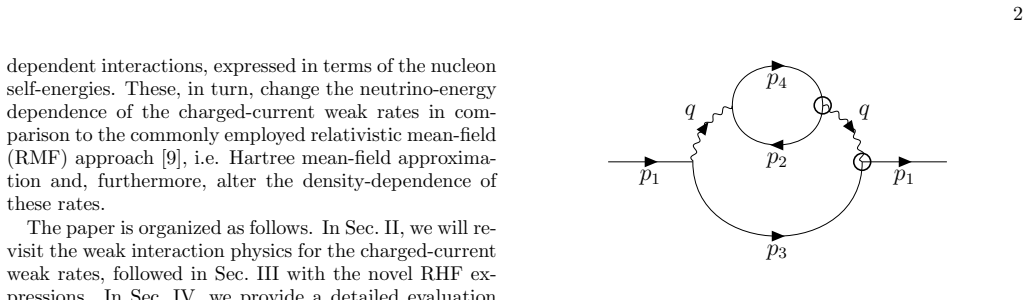
since the process considered is described by Fig. 1 but with an arrow forp 3 in the opposite direction, which implies the usage ofG < 3 (p3), it introduces a global minus sign. Since the integration overq 0 is limited from above by E1 −m 3 (only forν e and ¯νe absorptions), the most rel- evant for the behavior of Γ(E 1) is the dependence of dΓ/dq0 below t...
work page 2023
-
[16]
= δ(µ−µ 0) p2q |E∗ 2 + ˜q0|.(B13) To ensure thatµ 0 is the correct root ofg(µ), it must be in the range of−1≤µ 0 ≤1, which, after integrating overµ, imposes the new limit Θ(E ∗ 2 −e −) forE ∗ 2, where e− =−β ˜q0 2 + q 2 s β2 − 4m∗2 2 ˜q2µ .(B14) Applying Eqs. (B11) and (B13), Eq. (B4) can be rewritten as I µν = 1 (4π)2 Z dΩ24 Z ∞ 0 dp2p2 2 f2 −f 4 E∗ 2 E∗...
-
[17]
Vector: I V Q = (λ2 +σ − −1)I Q ,(B23) I V L =I L +σ −IQ ,(B24) I V T+ =I T +σ −IQ ,(B25) I V M+ =λI M ,(B26) whereλ=β−1 andσ ± = 1−(m ∗ 2 ±m ∗ 4)2/˜q2 µ
-
[18]
Axial-vector: I A Q = (λ2 +σ + −1)I Q ,(B27) 22 10-5 10-4 10-3 10-2 10-1 100 101 10-3 10-2 10-1 100 RHF RHF* TMA Γ(E1) [m-1] nB/n0 (a)ν e 10-8 10-7 10-6 10-5 10-4 10-3 10-2 10-1 100 Γ(E1) [m-1] nB/n0 (b) ¯νe FIG. 9. Neutrino opacity, at the leading-order hadronic vertex contributions, as a function of the normalized number density, nB, in units of the sat...
-
[19]
Tensor: I T L = ˜q2 µ 4M2 N σ− −β 2 + 4m∗2 2 ˜q2µ IQ −I L ,(B31) I T T+ = ˜q2 µ 4M2 N σ− −β 2 + 4m∗2 2 ˜q2µ IQ −I T ,(B32) with small differences arising, compared to Eqs. (57) and (58) in Ref. [24] 9
-
[20]
Pseudoscalar: I P Q =− q2 µ M2 N IQ .(B33)
-
[21]
Vector axial-vector: I V A T− =−2iI M .(B34)
-
[22]
I V T T+ = 2 m∗ 2 MN + ∆β IQ ,(B36) I V T M+ =− ∆ 2 IM ,(B37) where ∆ is given below Eq
Vector tensor: I V T L = 2 m∗ 2 MN + ∆β IQ ,(B35) 9 We find ˜q2 µ instead ofq 2 µ,M 2 N instead ofm 2 2 in the denominator outside the brackets, andm ∗2 2 instead ofm 2 2 in the numera- tor [24]. I V T T+ = 2 m∗ 2 MN + ∆β IQ ,(B36) I V T M+ =− ∆ 2 IM ,(B37) where ∆ is given below Eq. (56c)
-
[23]
Axial-vector tensor: I AT T− =−i 2 m∗ 2 MN + ∆ IM ,(B38) We note that also here for the vector tensor and axial-vector tensor terms, we find small differences compared to the literature 10
-
[24]
Axial-vector pseudoscalar: I AP Q =−2 ∆β+ 2 m∗ 2 MN IQ ,(B39) I AP M+ =−∆I M .(B40) From the differential absorption rate, Eq. (B3), we can calculate the neutrino opacity by expressing it in terms of the integrals overq 0 andq, which are connected toE 3 via Eq. (59) and throughµ 13 via Eq. (60), respectively, (cf. Ref. [9]), Γ(E1) = G2 F C2 32π2E2 1 Z E1−...
- [25]
-
[26]
R. M. Bionta, G. Blewitt, C. B. Bratton, D. Casper, and A. Ciocio, Physical Review Letters58, 1494 (1987)
work page 1987
-
[27]
C. B. Bratton, D. Casper, A. Ciocio, R. Claus, M. Crouch, S. T. Dye, S. Errede, W. Gajewski, M. Gold- haber, T. J. Haines, T. W. Jones, D. Kielczewska, W. R. Kropp, J. G. Learned, J. M. Losecco, J. Matthews, R. Miller, M. Mudan, L. R. Price, F. Reines, J. Schultz, S. Seidel, D. Sinclair, H. W. Sobel, J. L. Stone, L. Su- lak, R. Svoboda, G. Thornton, and J...
work page 1988
-
[28]
E. N. Alexeyev, L. N. Alexeyeva, I. V. Krivosheina, and V. I. Volchenko, Physics Letters B205, 209 (1988)
work page 1988
-
[29]
M. Aglietta, G. Badino, G. Bologna, C. Castagnoli, A. Castellina, V. L. Dadykin, W. Fulgione, P. Galeotti, F. F. Kalchukov, F. F. Khalchukov, V. B. Kortchaguin, V. B. Korchagin, P. V. Kortchaguin, P. V. Korchagin, A. S. Malguin, A. S. Mal’Gin, V. G. Ryassny, V. G. Ryas- nyj, O. G. Ryazhskaya, O. Saavedra, V. P. Talochkin, G. Trinchero, S. Vernetto, G. T. ...
work page 1987
-
[30]
Janka, Long-Term Multidimensional Models of Core- Collapse Supernovae: Progress and Challenges, Ann
H.-T. Janka, Annual Review of Nuclear and Particle Sci- ence75, 425 (2025), arXiv:2502.14836 [astro-ph.HE]
-
[31]
T. Fischer, G. Guo, K. Langanke, G. Mart´ ınez-Pinedo, Y.-Z. Qian, and M.-R. Wu, Progress in Particle and Nuclear Physics137, 104107 (2024), arXiv:2308.03962 [astro-ph.HE]
-
[32]
Tamborra, Neutrinos from explosive transients at the dawn of multi-messenger astronomy, Nature Rev
I. Tamborra, Nature Reviews Physics7, 285 (2025), arXiv:2412.09699 [astro-ph.HE]
-
[33]
Neutrino Interactions in Hot and Dense Matter
S. Reddy, M. Prakash, and J. M. Lattimer, Phys. Rev. D58, 013009 (1998), arXiv:astro-ph/9710115 [astro-ph]
work page internal anchor Pith review Pith/arXiv arXiv 1998
-
[34]
G. Mart´ ınez-Pinedo, T. Fischer, A. Lohs, and L. Huther, Phys. Rev. Lett.109, 251104 (2012), arXiv:1205.2793 [astro-ph.HE]
work page internal anchor Pith review Pith/arXiv arXiv 2012
-
[35]
L. F. Roberts, S. Reddy, and G. Shen, Phys. Rev. C86, 065803 (2012), arXiv:1205.4066 [astro-ph.HE]
work page internal anchor Pith review Pith/arXiv arXiv 2012
-
[36]
T. Fischer, S. C. Whitehouse, A. Mezzacappa, F. K. Thielemann, and M. Liebend¨ orfer, Astron. Astrophys. 517, A80 (2010), arXiv:0908.1871 [astro-ph.HE]
work page internal anchor Pith review Pith/arXiv arXiv 2010
-
[37]
Neutrino Signal of Electron-Capture Supernovae from Core Collapse to Cooling
L. H¨ udepohl, B. M¨ uller, H. T. Janka, A. Marek, and G. G. Raffelt, Phys. Rev. Lett.104, 251101 (2010), arXiv:0912.0260 [astro-ph.SR]
work page internal anchor Pith review Pith/arXiv arXiv 2010
-
[38]
T. Fischer, G. Guo, A. A. Dzhioev, G. Mart´ ınez-Pinedo, M.-R. Wu, A. Lohs, and Y.-Z. Qian, Phys. Rev. C101, 025804 (2020), arXiv:1804.10890 [astro-ph.HE]
- [39]
-
[40]
L. F. Roberts, G. Shen, V. Cirigliano, J. A. Pons, S. Reddy, and S. E. Woosley, Phys. Rev. Lett.108, 061103 (2012), arXiv:1112.0335 [astro-ph.HE]
work page internal anchor Pith review Pith/arXiv arXiv 2012
-
[41]
Supernova Neutrinos: Production, Oscillations and Detection
A. Mirizzi, I. Tamborra, H.-T. Janka, N. Sa- viano, K. Scholberg, R. Bollig, L. H¨ udepohl, and S. Chakraborty, Nuovo Cimento Rivista Serie39, 1 (2016), arXiv:1508.00785 [astro-ph.HE]
work page internal anchor Pith review Pith/arXiv arXiv 2016
-
[42]
A. Rusakov, A. S. Burrows, T. Wang, and D. Var- tanyan, arXiv e-prints , arXiv:2602.09025 (2026), arXiv:2602.09025 [astro-ph.HE]
work page internal anchor Pith review Pith/arXiv arXiv 2026
-
[43]
B. D. Serot and J. D. Walecka,The relativistic nuclear many-body problem, edited by J. W. Negele and E. Vogt, Adv. Nucl. Phys., Vol. 16 (Plenum Press, New York, 1986)
work page 1986
-
[44]
Le Bellac,Thermal field theory(Cambridge university press, 2000)
M. Le Bellac,Thermal field theory(Cambridge university press, 2000)
work page 2000
-
[45]
R. L. Kobes and G. W. Semenoff, Nuclear Physics B272, 329 (1986)
work page 1986
-
[46]
S. Navas, C. Amsler, T. Gutsche, C. Hanhart, J. J. Hern´ andez-Rey, C. Louren¸ co, A. Masoni, M. Mikhasenko, R. E. Mitchell, C. Patrignani, C. Schwanda, S. Spanier, G. Venanzoni, C. Z. Yuan, K. Agashe, G. Aielli, B. C. Allanach, J. Alvarez-Mu˜ niz, M. Antonelli, E. C. Aschenauer, D. M. Asner, K. Assam- agan, H. Baer, S. Banerjee, R. M. Barnett, L. Baudis,...
work page 2024
-
[47]
A. Bouyssy, J.-F. Mathiot, N. Van Giai, and S. Marcos, Phys. Rev. C36, 380 (1987)
work page 1987
-
[49]
L. F. Roberts and S. Reddy, Phys. Rev. C95, 045807 (2017), arXiv:1612.02764 [astro-ph.HE]
work page internal anchor Pith review Pith/arXiv arXiv 2017
- [50]
- [51]
-
[52]
H. Toki, D. Hirata, Y. Sugahara, K. Sumiyoshi, and I. Tanihata, Nucl. Phys. A588, c357 (1995), proceed- ings of the Fifth International Symposium on Physics of Unstable Nuclei
work page 1995
-
[53]
G. A. Lalazissis, J. K¨ onig, and P. Ring, Phys. Rev. C 55, 540 (1997)
work page 1997
- [54]
- [55]
-
[56]
Statistical Model for a Complete Supernova Equation of State
M. Hempel and J. Schaffner-Bielich, Nucl. Phys. A837, 210 (2010), arXiv:0911.4073 [nucl-th]
work page internal anchor Pith review Pith/arXiv arXiv 2010
-
[57]
T. Fischer, S. Typel, G. R¨ opke, N.-U. F. Bastian, and G. Mart´ ınez-Pinedo, Phys. Rev. C102, 055807 (2020), arXiv:2008.13608 [astro-ph.HE]
-
[58]
Symmetry energy impact in simulations of core-collapse supernovae
T. Fischer, M. Hempel, I. Sagert, Y. Suwa, and J. Schaffner-Bielich, European Physical Journal A50, 46 (2014), arXiv:1307.6190 [astro-ph.HE]
work page internal anchor Pith review Pith/arXiv arXiv 2014
-
[59]
New Equations of State in Simulations of Core-Collapse Supernovae
M. Hempel, T. Fischer, J. Schaffner-Bielich, and M. Liebend¨ orfer, Astrophys. J.748, 70 (2012), arXiv:1108.0848 [astro-ph.HE]
work page internal anchor Pith review Pith/arXiv arXiv 2012
-
[60]
A. W. Steiner, J. M. Lattimer, and E. F. Brown, Astro- phys. J.765, L5 (2013), arXiv:1205.6871 [nucl-th]
work page internal anchor Pith review Pith/arXiv arXiv 2013
-
[61]
T. Fischer, N.-U. Bastian, D. Blaschke, M. Cierniak, M. Hempel, T. Kl¨ ahn, G. Mart´ ınez-Pinedo, W. G. New- ton, G. R¨ opke, and S. Typel, Publ. Astron. Soc. Austr. 34, e067 (2017), arXiv:1711.07411 [astro-ph.HE]
work page internal anchor Pith review Pith/arXiv arXiv 2017
-
[62]
Nuclear Matter in Relativistic Mean Field Theory with Isovector Scalar Meson
S. Kubis and M. Kutschera, Physics Letters B399, 191 (1997), arXiv:astro-ph/9703049 [astro-ph]
work page internal anchor Pith review Pith/arXiv arXiv 1997
-
[63]
Muon Creation in Supernova Matter Facilitates Neutrino-driven Explosions
R. Bollig, H.-T. Janka, A. Lohs, G. Mart´ ınez-Pinedo, C. J. Horowitz, and T. Melson, Phys. Rev. Lett.119, 242702 (2017), arXiv:1706.04630 [astro-ph.HE]
work page internal anchor Pith review Pith/arXiv arXiv 2017
-
[64]
J. M. Lattimer and F. Swesty, Nuclear Physics A535, 331 (1991)
work page 1991
-
[65]
S. W. Bruenn, Astrophys. J. Suppl.58, 771 (1985)
work page 1985
-
[66]
Neutrino spectra evolution during proto-neutron star deleptonization
T. Fischer, G. Mart´ ınez-Pinedo, M. Hempel, and M. Liebend¨ orfer, Phys. Rev. D85, 083003 (2012), arXiv:1112.3842 [astro-ph.HE]
work page internal anchor Pith review Pith/arXiv arXiv 2012
- [67]
-
[68]
J. D. Bjorken and S. D. Drell,Relativistic quantum me- chanics, edited by L. I. Schiff, International series in pure and applied physics (McGraw-Hill, New York, 1964)
work page 1964
-
[69]
B. Y. Sun, W. H. Long, J. Meng, and U. Lombardo, Phys. Rev. C78, 065805 (2008)
work page 2008
- [70]
-
[71]
S. Yang, B. N. Zhang, and B. Y. Sun, Phys. Rev. C100, 054314 (2019)
work page 2019
-
[72]
S. Yang, X. D. Sun, J. Geng, B. Y. Sun, and W. H. Long, Phys. Rev. C103, 014304 (2021)
work page 2021
discussion (0)
Sign in with ORCID, Apple, or X to comment. Anyone can read and Pith papers without signing in.