PULSE: Agentic Investigation with Passive Sensing for Proactive Intervention in Cancer Survivorship
Pith reviewed 2026-05-19 22:00 UTC · model grok-4.3
The pith
Agentic LLM investigation of passive smartphone sensing data raises prediction accuracy for when cancer survivors need mental health support.
A machine-rendered reading of the paper's core claim, the machinery that carries it, and where it could break.
Core claim
PULSE replaces static feature extraction with agentic sensing investigation in which LLM agents equipped with eight purpose-built tools decide which data streams to examine, how far back to look, and how to calibrate current behavior against personalized baselines plus retrieval-augmented population comparisons, yielding balanced accuracy of 0.743 for emotion regulation desire when diary data are available and 0.713 for intervention availability from passive sensing data only.
What carries the argument
LLM agents with eight purpose-built tools that autonomously query smartphone sensing streams, compare behavior to personalized baselines, and perform retrieval-augmented population-level calibration.
If this is right
- Agentic reasoning outperforms structured reasoning architectures across both sensing-only and multimodal conditions.
- Passive sensing alone can support prediction of intervention availability at 0.713 balanced accuracy.
- Just-in-time mental health support becomes more feasible because agents can act on continuous data without waiting for diary entries.
- The accuracy ceiling reported in prior sensing work is at least partly due to interpretation methods rather than data limitations.
Where Pith is reading between the lines
- The same agentic querying approach could be tested on passive data streams for other fluctuating conditions such as chronic pain or anxiety disorders.
- Longer-term studies could measure whether the higher prediction accuracy translates into fewer distress episodes when interventions are triggered automatically.
- Combining the agents with privacy-preserving on-device execution would address deployment barriers not examined in the current lab evaluation.
Load-bearing premise
The LLM agents will generate reliable, unbiased inferences directly from raw sensing streams without hallucinating patterns or systematically misreading behavioral signals.
What would settle it
A deployment study in which agent predictions are compared in real time against subsequent clinical assessments or self-reported intervention uptake, checking whether accuracy falls below 0.65 or produces more false positives than a fixed pipeline baseline.
Figures
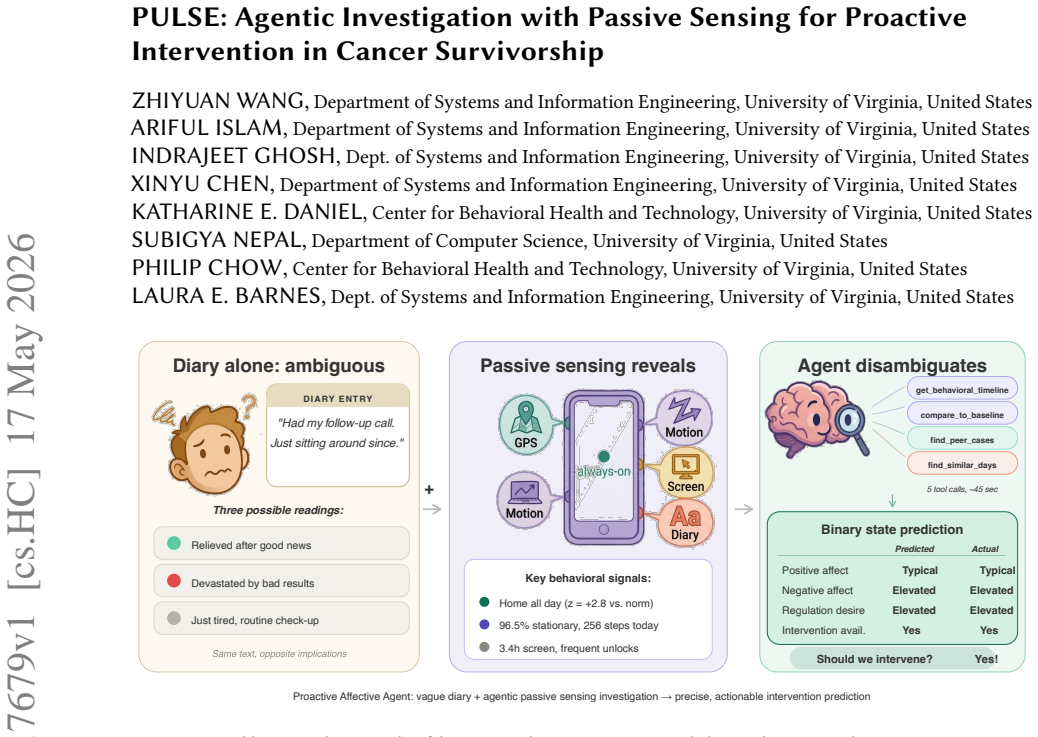


read the original abstract
Cancer survivors face elevated rates of depression, anxiety, and general emotional distress, yet the precise moments they most need support are often the moments when self-report is sparse, a phenomenon we term the diary paradox. Passive smartphone sensing offers a continuous, unobtrusive alternative, but prior sensing-based affect prediction has been limited by an accuracy ceiling, suggesting a bottleneck not only in available data, but in how behavioral signals are interpreted. We present PULSE, a system that shifts from fixed feature pipelines to agentic sensing investigation: LLM agents equipped with eight purpose-built tools autonomously query smartphone sensing data, compare current behavior against personalized baselines, and calibrate inferences through retrieval-augmented population-level comparisons. Rather than receiving pre-formatted feature summaries, agents decide which modalities to inspect, how far back to look, and how deeply to investigate, mirroring hypothesis-driven clinical reasoning. We evaluate PULSE through a 2*2 factorial design crossing reasoning architecture (structured vs. agentic) with data modality (sensing-only vs. with diary) on 50 cancer survivors from a longitudinal study of cancer survivors. Agentic reasoning is the primary driver of performance: agentic multimodal agent achieves balanced accuracy of 0.743 for emotion regulation desire with diary and sensing data, while agentic agents predict intervention availability at 0.713 with passive sensing data only. These results suggest that agentic investigation may be a cornerstone for unlocking the clinical value of passive sensing, advancing the feasibility of proactive just-in-time mental health support.
Editorial analysis
A structured set of objections, weighed in public.
Referee Report
Summary. The paper introduces PULSE, a system that uses LLM agents equipped with eight purpose-built tools to autonomously investigate passive smartphone sensing data for predicting emotion regulation desire and intervention availability among cancer survivors. It contrasts this agentic approach against structured baselines in a 2x2 factorial design (reasoning architecture × data modality) with 50 participants from a longitudinal study, reporting balanced accuracies of 0.743 (agentic multimodal) and 0.713 (agentic sensing-only) and attributing gains primarily to agentic reasoning over fixed feature pipelines to address the diary paradox and enable proactive just-in-time support.
Significance. If the central performance claims hold after verification, the work has moderate significance for human-computer interaction and health sensing by showing how dynamic, hypothesis-driven agentic investigation can potentially exceed the accuracy ceiling of traditional passive sensing pipelines. The factorial design isolating reasoning architecture is a positive element. The results, if robust, could support feasibility of proactive mental health interventions, but the significance depends on confirming that gains arise from improved signal interpretation rather than unexamined LLM behaviors.
major comments (3)
- [Abstract/Evaluation] Abstract and Evaluation: The reported balanced accuracies (0.743 multimodal agentic; 0.713 sensing-only agentic) attribute performance primarily to agentic reasoning, yet no baseline accuracies for the structured condition, error bars, cross-validation procedure, or statistical tests are provided. This information is required to verify that the gains are load-bearing evidence for the agentic advantage rather than artifacts of the experimental setup.
- [Methods/Evaluation] Methods/Evaluation: The manuscript provides no error analysis of tool calls, qualitative review of agent reasoning traces against raw sensor values, or checks for hallucinated baselines/population comparisons. Because the central claim requires that the eight purpose-built tools enable reliable, unbiased inferences from sensing streams, the absence of such validation leaves open whether reported gains reflect improved behavioral interpretation or LLM priors.
- [Results] Results: The 2×2 design claims agentic reasoning as the primary driver, but without details on how post-hoc decisions were handled or how the structured baseline was implemented, it is not possible to rule out that performance differences arise from differences in prompt structure or data formatting rather than the agentic investigation mechanism itself.
minor comments (2)
- [Introduction] The term 'diary paradox' is introduced without a formal definition or citation to related concepts in experience sampling literature; a brief operationalization would improve clarity.
- [Methods] Notation for the eight tools and their inputs/outputs could be presented more systematically (e.g., in a table) to aid reproducibility.
Simulated Author's Rebuttal
We thank the referee for their constructive feedback, which has helped us strengthen the presentation of our results and evaluation methodology. We have made revisions to address the concerns regarding missing details in the abstract, methods, and results sections. Our responses to each major comment are provided below.
read point-by-point responses
-
Referee: [Abstract/Evaluation] Abstract and Evaluation: The reported balanced accuracies (0.743 multimodal agentic; 0.713 sensing-only agentic) attribute performance primarily to agentic reasoning, yet no baseline accuracies for the structured condition, error bars, cross-validation procedure, or statistical tests are provided. This information is required to verify that the gains are load-bearing evidence for the agentic advantage rather than artifacts of the experimental setup.
Authors: We agree that the full results of the 2×2 factorial design should be reported to substantiate the claim that agentic reasoning is the primary driver. In the revised manuscript, we have expanded the abstract and added a new table in the Results section that reports balanced accuracies for all four conditions (structured sensing-only, structured with diary, agentic sensing-only, and agentic with diary). We have also included error bars representing standard error across participants, detailed the cross-validation procedure (leave-one-participant-out to account for the longitudinal nature), and added statistical tests (paired t-tests on per-participant accuracies) showing significant differences favoring the agentic conditions. These additions confirm the robustness of our findings. revision: yes
-
Referee: [Methods/Evaluation] Methods/Evaluation: The manuscript provides no error analysis of tool calls, qualitative review of agent reasoning traces against raw sensor values, or checks for hallucinated baselines/population comparisons. Because the central claim requires that the eight purpose-built tools enable reliable, unbiased inferences from sensing streams, the absence of such validation leaves open whether reported gains reflect improved behavioral interpretation or LLM priors.
Authors: We acknowledge the importance of validating the reliability of the agentic tool use. In the revised version, we have added a dedicated 'Error Analysis and Validation' subsection in the Methods and Results. This includes quantitative metrics on tool call accuracy (e.g., 92% of time-window queries matched expected ranges), a qualitative analysis of 15 sampled reasoning traces with direct comparison to raw sensor logs and diary entries, and explicit checks confirming that population baselines were computed from the 50-participant cohort without external data leakage. These analyses indicate that the performance improvements arise from dynamic, context-aware investigation rather than LLM priors or hallucinations. revision: yes
-
Referee: [Results] Results: The 2×2 design claims agentic reasoning as the primary driver, but without details on how post-hoc decisions were handled or how the structured baseline was implemented, it is not possible to rule out that performance differences arise from differences in prompt structure or data formatting rather than the agentic investigation mechanism itself.
Authors: To clarify the implementation details and rule out confounds from prompt structure, we have revised the Methods section to provide a detailed description of the structured baseline: it uses a fixed prompt template that receives pre-computed feature summaries (mean, variance, etc.) for each modality without allowing dynamic querying. For the agentic condition, the eight tools enable on-demand data retrieval and hypothesis testing. We also describe how post-hoc decisions (e.g., when to stop investigation) were handled via a fixed iteration limit and confidence threshold in both conditions to ensure fair comparison. These details are now explicitly stated to demonstrate that differences are due to the agentic mechanism. revision: yes
Circularity Check
No circularity: empirical evaluation with independent experimental results
full rationale
The paper reports results from a 2x2 factorial experiment comparing structured vs. agentic reasoning on sensing-only vs. multimodal data from 50 cancer survivors. Balanced accuracies (0.743 multimodal, 0.713 sensing-only) are direct empirical measurements, not quantities derived from equations or parameters fitted within the paper itself. No self-definitional steps, fitted inputs renamed as predictions, or load-bearing self-citations appear in the derivation chain; the central claim rests on observed performance differences rather than construction from inputs.
Axiom & Free-Parameter Ledger
axioms (1)
- domain assumption LLM agents can autonomously select relevant sensing modalities and time windows to form accurate inferences about emotional states
invented entities (1)
-
Eight purpose-built tools for agentic sensing investigation
no independent evidence
Lean theorems connected to this paper
-
IndisputableMonolith/Foundation/AlexanderDuality.leanalexander_duality_circle_linking unclear?
unclearRelation between the paper passage and the cited Recognition theorem.
LLM agents equipped with eight purpose-built tools autonomously query smartphone sensing data, compare current behavior against personalized baselines, and calibrate inferences through retrieval-augmented population-level comparisons.
What do these tags mean?
- matches
- The paper's claim is directly supported by a theorem in the formal canon.
- supports
- The theorem supports part of the paper's argument, but the paper may add assumptions or extra steps.
- extends
- The paper goes beyond the formal theorem; the theorem is a base layer rather than the whole result.
- uses
- The paper appears to rely on the theorem as machinery.
- contradicts
- The paper's claim conflicts with a theorem or certificate in the canon.
- unclear
- Pith found a possible connection, but the passage is too broad, indirect, or ambiguous to say the theorem truly supports the claim.
Reference graph
Works this paper leans on
-
[1]
Alaa Abd-Alrazaq, Mohannad Alajlani, Nashva Ali, Kerstin Denecke, Bridgette M. Bewick, and Mowafa Househ. 2023. Systematic Review and Meta-Analysis of AI-Based Conversational Agents for Promoting Mental Health and Well-Being.npj Digital Medicine6, 1 (2023), 236. doi:10.1038/s41746-023-00979-5
-
[2]
Daniel A. Adler, Fei Wang, David C. Mohr, and Tanzeem Choudhury. 2022. Machine Learning for Passive Mental Health Symptom Prediction: Generalization Across Different Longitudinal Mobile Sensing Studies.PLOS ONE17, 4 (2022), e0266516. doi:10.1371/journal. pone.0266516
-
[3]
Adler, Yuewen Yang, Thalia Viranda, Xuhai Xu, David C
Daniel A. Adler, Yuewen Yang, Thalia Viranda, Xuhai Xu, David C. Mohr, Anna R. Van Meter, Julia C. Tartaglia, Nicholas C. Jacobson, Fei Wang, Deborah Estrin, and Tanzeem Choudhury. 2024. Beyond Detection: Towards Actionable Sensing Research in Clinical Mental Healthcare.Proceedings of the ACM on Interactive, Mobile, Wearable and Ubiquitous Technologies8, ...
-
[4]
Lameck Mbangula Amugongo et al. 2025. Retrieval-Augmented Generation for Large Language Models in Healthcare: A Systematic Review.PLOS Digital Health(2025). doi:10.1371/journal.pdig.0000877
-
[5]
Tuo An et al. 2025. IoT-LLM: Enhancing Real-World IoT Task Reasoning with Large Language Models.Patterns6, 1 (2025), 101131
work page 2025
-
[6]
Andersen, Christina Lacchetti, Kimlin Ashing, Jonathan S
Barbara L. Andersen, Christina Lacchetti, Kimlin Ashing, Jonathan S. Berek, Barbara S. Berman, Samantha Bolte, Don S. Dizon, Barbara Given, Larissa Nekhlyudov, William Pirl, Julia H. Rowland, and Charles L. Shapiro. 2023. Management of Anxiety and Depression in Adult Survivors of Cancer: ASCO Guideline Update.Journal of Clinical Oncology41, 18 (2023), 342...
-
[7]
Anthropic. 2024. Introducing the Model Context Protocol.Anthropic Blog(2024)
work page 2024
-
[8]
Brian, Geneva Jonathan, Lisa Roncone, Irene Darmawan, Kelly Aschbrenner, Junia Lopez, Joseph A
Dror Ben-Zeev, Rachel M. Brian, Geneva Jonathan, Lisa Roncone, Irene Darmawan, Kelly Aschbrenner, Junia Lopez, Joseph A. Hartwick, and Colin Depp. 2018. Mobile Health (mHealth) Versus Clinic-Based Group Intervention for People With Serious Mental Illness: A Randomized Controlled Trial.Psychiatric Services69, 9 (2018), 978–985. doi:10.1176/appi.ps.201800063
-
[9]
Kaplan, Prafulla Dhariwal, Arvind Neelakantan, Pranav Shyam, Girish Sastry, Amanda Askell, et al
Tom Brown, Benjamin Mann, Nick Ryder, Melanie Subbiah, Jared D. Kaplan, Prafulla Dhariwal, Arvind Neelakantan, Pranav Shyam, Girish Sastry, Amanda Askell, et al. 2020. Language Models are Few-Shot Learners. InAdvances in Neural Information Processing Systems (NeurIPS 2020), Vol. 33. 1877–1901
work page 2020
-
[10]
Luca Canzian and Mirco Musolesi. 2015. Trajectories of Depression: Unobtrusive Monitoring of Depressive States by means of Smartphone Mobility Traces Analysis. InProceedings of the 2015 ACM International Joint Conference on Pervasive and Ubiquitous Computing. 1293–1304
work page 2015
-
[11]
Prerna Chikersal, Afsaneh Doryab, Michael Tumminia, Daniella K Villalba, Janine M Dutcher, Xinwen Liu, Sheldon Cohen, Kasey G Creswell, Jennifer Mankoff, J David Creswell, et al. 2021. Detecting depression and predicting its onset using longitudinal symptoms captured by passive sensing: a machine learning approach with robust feature selection.ACM Transac...
work page 2021
-
[12]
Adrien Choi, Aysel Ooi, and Danielle Lottridge. 2024. Digital Phenotyping for Stress, Anxiety, and Mild Depression: Systematic Literature Review.JMIR mHealth and uHealth12 (2024), e40689. doi:10.2196/40689
-
[13]
Akshat Choube, Ha Le, Jiachen Li, Kaixin Ji, Vedant Das Swain, and Varun Mishra. 2025. GLOSS: Group of LLMs for Open-Ended Sensemaking of Passive Sensing Data for Health and Wellbeing.Proceedings of the ACM on Interactive, Mobile, Wearable and Ubiquitous Technologies9, 3, Article 76 (2025). doi:10.1145/3749474
-
[14]
Andrea Coravos, Sean Khozin, and Kenneth D. Mandl. 2019. Developing and Adopting Safe and Effective Digital Biomarkers to Improve Patient Outcomes.npj Digital Medicine2, 1 (2019), 14. doi:10.1038/s41746-019-0090-4
-
[15]
Justin Cosentino, Ankur Soni, Enzo Capobianco, Daniel McDuff, Anup Majmundar, et al. 2025. A Personal Health Large Language Model.Nature Medicine(2025). doi:10.1038/s41591-024-03408-6
-
[16]
Katharine E. Daniel, James W. Kinchen, Angela Chang, Patrick H. Finan, and Philip I. Chow. 2025. Identifying Time-Variant Predictors of Interest in Completing Brief Digital Mental Health Interventions Among Adult Survivors of Cancer: Ecological Momentary Assessment Study.JMIR mHealth and uHealth13 (2025), e69244. doi:10.2196/69244
-
[17]
Laura M. de Jong et al. 2025. Effectiveness of Just-in-Time Adaptive Interventions for Improving Mental Health and Psychological Well-Being: A Systematic Review and Meta-Analysis.Internet Interventions(2025). doi:10.1016/j.invent.2025.100814 23 studies, 2563 individuals; small between-group effect g=0.15
-
[18]
Kaidong Feng, Zhu Sun, Roy Ka-Wei Lee, Xun Jiang, Yin-Leng Theng, and Yi Ding. 2026. A Comparative Study of Traditional Machine Learning, Deep Learning, and Large Language Models for Mental Health Forecasting using Smartphone Sensing Data.Proceedings of the ACM on Interactive, Mobile, Wearable and Ubiquitous Technologies(2026). https://arxiv.org/abs/2601....
-
[19]
Denzil Ferreira, Vassilis Kostakos, and Anind K. Dey. 2015. AWARE: Mobile Context Instrumentation Framework.Frontiers in ICT2 (2015), 6. doi:10.3389/fict.2015.00006
-
[20]
Simon B Goldberg, Daniel M Bolt, and Richard J Davidson. 2021. Data Missing Not at Random in Mobile Health Research: Assessment of the Problem and a Case for Sensitivity Analyses.Journal of Medical Internet Research23, 6 (2021), e26749. doi:10.2196/26749 0:28•Zhiyuan Wang, Ariful Islam, Indrajeet Ghosh, Xinyu Chen, Katharine E. Daniel, Subigya Nepal, Phil...
-
[21]
Samantha P. Goldstein, J. Graham Thomas, Gary D. Foster, Gabrielle M. Turner-McGrievy, Rena R. Wing, and Dale S. Bond. 2023. How Notifications Affect Engagement With a Behavior Change App: Results From a Micro-Randomized Trial.JMIR mHealth and uHealth11 (2023), e38342. doi:10.2196/38342
- [22]
-
[23]
Xu Huang, Weiwen Liu, Xiaolong Chen, Xingmei Wang, Hao Wang, Defu Lian, Yasheng Wang, Ruiming Chen, and Fei Huang. 2024. Understanding the Planning of LLM Agents: A Survey.arXiv preprint arXiv:2402.02716(2024). https://arxiv.org/abs/2402.02716
work page internal anchor Pith review Pith/arXiv arXiv 2024
-
[24]
Jeremy F. Huckins, Alex W. daSilva, Weichen Wang, Elin Hedlund, Courtney Rogers, Subigya K. Nepal, Jialing Wu, Mikio Obuchi, Eilis I. Murphy, Meghan L. Meyer, Dylan D. Wagner, Paul E. Holtzheimer, and Andrew T. Campbell. 2020. Mental Health and Behavior of College Students During the Early Phases of the COVID-19 Pandemic: Longitudinal Smartphone and Ecolo...
-
[25]
Jacobson, Hilary Weingarden, and Sabine Wilhelm
Nicholas C. Jacobson, Hilary Weingarden, and Sabine Wilhelm. 2019. Digital Biomarkers of Mood Disorders and Symptom Change.npj Digital Medicine2, 1 (2019), 3. doi:10.1038/s41746-019-0078-0
-
[26]
Yubin Kim, Xuhai Xu, Daniel McDuff, Cynthia Breazeal, and Hae Won Park. 2024. Health-LLM: Large Language Models for Health Prediction via Wearable Sensor Data. InProceedings of Machine Learning Research (CHIL), Vol. 248. 522–539
work page 2024
-
[27]
Predrag Klasnja, Eric B Hekler, Saul Shiffman, Audrey Boruvka, Daniel Almirall, Ambuj Tewari, and Susan A Murphy. 2015. Mi- crorandomized Trials: An Experimental Design for Developing Just-in-Time Adaptive Interventions.Health Psychology34, S (2015), 1220–1228
work page 2015
-
[28]
Seewald, Andy Lee, Kelly Hall, Bryan Luers, Eric B
Predrag Klasnja, Shawna Smith, Nicholas J. Seewald, Andy Lee, Kelly Hall, Bryan Luers, Eric B. Hekler, and Susan A. Murphy. 2019. Efficacy of Contextually Tailored Suggestions for Physical Activity: A Micro-randomized Optimization Trial of HeartSteps.Annals of Behavioral Medicine53, 6 (2019), 573–582. doi:10.1093/abm/kay067
-
[29]
Florian Kunzler, Varun Mishra, Jan-Niklas Kramer, David Kotz, Elgar Fleisch, and Tobias Kowatsch. 2019. Exploring the State-of- Receptivity for mHealth Interventions.Proceedings of the ACM on Interactive, Mobile, Wearable and Ubiquitous Technologies3, 4 (2019), 1–27
work page 2019
-
[30]
Patrick Lewis, Ethan Perez, Aleksandra Piktus, Fabio Petroni, Vladimir Karpukhin, Naman Goyal, Heinrich Küttler, Mike Lewis, Wen-tau Yih, Tim Rocktäschel, et al. 2020. Retrieval-augmented generation for knowledge-intensive nlp tasks.Advances in Neural Information Processing Systems33 (2020), 9459–9474
work page 2020
-
[31]
Jiachen Li, Akshat Choube, et al. 2025. Vital Insight: Assisting Experts’ Context-Driven Sensemaking of Multi-modal Personal Tracking Data Using Visualization and Human-in-the-Loop LLM.Proceedings of the ACM on Interactive, Mobile, Wearable and Ubiquitous Technologies(2025). doi:10.1145/3749508
-
[32]
Zechen Li, Shohreh Deldari, Linyao Chen, Hao Xue, and Flora D Salim. 2025. SensorLLM: Aligning Large Language Models with Motion Sensors for Human Activity Recognition. InProceedings of the 2025 Conference on Empirical Methods in Natural Language Processing (EMNLP 2025). https://aclanthology.org/2025.emnlp-main.19
work page 2025
- [33]
-
[34]
Lakmal Meegahapola, William Droz, Peter Kun, Numa de Lara, Damien Erber, Florian Flöck, Anna Giménez-Laudo, Kristóf Reyero, Duc Phan, Donghwi Shin, Anind K. Dey, and Daniel Gatica-Perez. 2023. Generalization and Personalization of Mobile Sensing-Based Mood Inference Models: An Analysis of College Students in Eight Countries.Proceedings of the ACM on Inter...
-
[35]
João Pedro S. Mendes, Ivo R. Moura, Peter Van de Ven, Davi Viana, Luciano R. Coutinho, and Carla Flora. 2023. Digital Phenotyping for Monitoring Mental Disorders: Systematic Review.Journal of Medical Internet Research25 (2023), e46778. doi:10.2196/46778
-
[36]
Mike A Merrill, Akshay Paruchuri, Naghmeh Rezaei, Geza Kovacs, Melissa Perez, Md Mobashir Hasan Shandhi, et al. 2026. Transforming Wearable Data into Health Insights using Large Language Model Agents.Nature Communications17 (2026), 1265. doi:10.1038/s41467- 025-67922-y PHIA system
-
[37]
Munib Mesinovic, Peter Watkinson, and Tingting Zhu. 2025. Explainability in the Age of Large Language Models for Healthcare. Communications Engineering(2025). doi:10.1038/s44172-025-00453-y
-
[38]
Varun Mishra, Florian Kunzler, Jan-Niklas Kramer, Elgar Fleisch, Tobias Kowatsch, and David Kotz. 2021. Detecting Receptivity for mHealth Interventions in the Natural Environment. InProceedings of the ACM on Interactive, Mobile, Wearable and Ubiquitous Technologies, Vol. 5. 1–24
work page 2021
-
[39]
Alex J. Mitchell, Melissa Chan, Hina Bhatti, Marie Halton, Luigi Grassi, Christoffer Johansen, and Nicholas Meader. 2011. Prevalence of Depression, Anxiety, and Adjustment Disorder in Oncological, Haematological, and Palliative-Care Settings: A Meta-Analysis of 94 Interview-Based Studies.The Lancet Oncology12, 2 (2011), 160–174. doi:10.1016/S1470-2045(11)70002-X
-
[40]
Mohr, Kathryn Noth Tomasino, Emily G
David C. Mohr, Kathryn Noth Tomasino, Emily G. Lattie, Hannah L. Palac, Mary J. Kwasny, Kenneth Weingardt, Chris J. Karr, Susan M. Kaiser, Rebecca C. Rossom, Leland R. Bardsley, Lauren Caccamo, Colleen Stiles-Shields, and Stephen M. Schueller. 2017. IntelliCare: An Eclectic, Skills-Based App Suite for the Treatment of Depression and Anxiety.Journal of Med...
-
[41]
Aja Louise Murray, Ruth Brown, Xinxin Zhu, Lydia Gabriela Speyer, Yi Yang, Zhouni Xiao, Denis Ribeaud, and Manuel Eisner. 2023. Prompt-level predictors of compliance in an ecological momentary assessment study of young adults’ mental health.Journal of Affective Disorders322 (2023), 125–131. doi:10.1016/j.jad.2022.11.014
-
[42]
Inbal Nahum-Shani, Shawna N Smith, Bonnie J Spring, Linda M Collins, Katie Witkiewitz, Ambuj Tewari, and Susan A Murphy. 2018. Just-in-Time Adaptive Interventions (JITAI) in Mobile Health: Key Components and Design Principles for Ongoing Health Behavior Support.Annals of Behavioral Medicine52, 6 (2018), 446–462
work page 2018
-
[43]
Smith, Ambuj Tewari, Katie Witkiewitz, Linda M
Inbal Nahum-Shani, Shawna N. Smith, Ambuj Tewari, Katie Witkiewitz, Linda M. Collins, Bonnie J. Spring, and Susan A. Murphy. 2014. Just-in-Time Adaptive Interventions (JITAIs): An Organizing Framework for Ongoing Health Behavior Support. Technical Report 14-126. The Methodology Center, Penn State University
work page 2014
-
[44]
Shrikanth Narayanan and Panayiotis G. Georgiou. 2013. Behavioral Signal Processing: Deriving Human Behavioral Informatics from Speech and Language.Proc. IEEE101, 5 (2013), 1203–1233. doi:10.1109/JPROC.2012.2236291
-
[45]
HUCKINS, COURTNEY ROGERS, MEGHAN L
Subigya Nepal, Wenjun Liu, Arvind Pillai, Weichen Wang, Vlado Vojdanovski, Jeremy F. Huckins, Courtney Rogers, Meghan L. Meyer, and Andrew T. Campbell. 2024. Capturing the College Experience: A Four-Year Mobile Sensing Study of Mental Health, Resilience and Behavior of College Students during the Pandemic.Proceedings of the ACM on Interactive, Mobile, Wea...
-
[46]
HEINZ, ASHMITA KUNWAR, EUNSOL SOUL CHOI, XUHAI XU, JOANNA KUC, JEREMY F
Subigya Nepal, Arvind Pillai, William Campbell, Marvin Heinz, Talie Griffin, Daniel Mackin, Amanda Collins, Nicholas C. Jacobson, and Andrew T. Campbell. 2024. MindScape Study: Integrating LLM and Behavioral Sensing for Personalized AI-Driven Journaling Experiences.Proceedings of the ACM on Interactive, Mobile, Wearable and Ubiquitous Technologies8, 4 (20...
-
[47]
Subigya Nepal, Weichen Wang, Vlado Vojdanovski, Jeremy F Huckins, Alex Dasilva, Meghan Meyer, and Andrew Campbell. 2022. COVID student study: A year in the life of college students during the COVID-19 pandemic through the lens of mobile phone sensing. InProceedings of the 2022 CHI conference on human factors in computing systems. 1–19
work page 2022
-
[48]
Jukka-Pekka Onnela and Scott L. Rauch. 2016. Harnessing Smartphone-Based Digital Phenotyping to Enhance Behavioral and Mental Health.Neuropsychopharmacology41, 7 (2016), 1691–1696. doi:10.1038/npp.2016.7
-
[49]
Long Ouyang, Jeffrey Wu, Xu Jiang, Diogo Almeida, Carroll Wainwright, Pamela Mishkin, Chong Zhang, Sandhini Agarwal, Katarina Slama, Alex Ray, et al. 2022. Training Language Models to Follow Instructions with Human Feedback. InAdvances in Neural Information Processing Systems (NeurIPS 2022), Vol. 35. 27730–27744
work page 2022
-
[50]
Sarthak Pati, Sourav Kumar, Amokh Varma, Brandon Edwards, Charles Lu, Liangqiong Qu, Justin J Wang, Anantharaman Lakshmi- narayanan, Shih-Han Wang, Micah J Sheller, Ken Chang, Praveer Singh, Daniel L Rubin, Jayashree Kalpathy-Cramer, and Spyridon Bakas. 2024. Privacy Preservation for Federated Learning in Health Care.Patterns5, 7 (2024), 100974. doi:10.10...
-
[51]
Gorilla: Large Language Model Connected with Massive APIs
Shishir G. Patil, Tianjun Zhang, Xin Wang, and Joseph E. Gonzalez. 2024. Gorilla: Large Language Model Connected with Massive APIs. InAdvances in Neural Information Processing Systems (NeurIPS 2024), Vol. 37. https://arxiv.org/abs/2305.15334
work page internal anchor Pith review Pith/arXiv arXiv 2024
-
[52]
Arvind Pillai, Subigya Nepal, William Campbell, Michael V. Heinz, Tess Z. Griffin, Nicholas C. Jacobson, and Andrew T. Campbell
-
[53]
In Proceedings of the Conference on Health, Inference, and Learning (CHIL)
Beyond Prompting: Time2Lang—Bridging Time-Series Foundation Models and Large Language Models for Health Sensing. In Proceedings of the Conference on Health, Inference, and Learning (CHIL). PMLR. https://arxiv.org/abs/2502.07608
-
[54]
Emilio Qiu et al . 2024. Large Language Models for Wearable Sensor-Based Human Activity Recognition, Health Monitoring, and Behavioral Modeling: A Survey of Early Trends, Datasets, and Challenges.Sensors24, 15 (2024), 5045. doi:10.3390/s24155045
- [55]
-
[56]
Sohrab Saeb, Mi Zhang, Christopher J Karr, Stephen M Schueller, Marya E Corden, Konrad P Kording, and David C Mohr. 2015. Mobile Phone Sensor Correlates of Depressive Symptom Severity in Daily-Life Behavior: An Exploratory Study.Journal of Medical Internet Research17, 7 (2015), e175
work page 2015
-
[57]
Timo Schick, Jane Dwivedi-Yu, Roberto Dessì, Roberta Raileanu, Maria Lomeli, Eric Hambro, Luke Zettlemoyer, Nicola Cancedda, and Thomas Scialom. 2023. Toolformer: Language Models Can Teach Themselves to Use Tools. InAdvances in Neural Information Processing Systems (NeurIPS 2023). https://arxiv.org/abs/2302.04761 Oral presentation
work page internal anchor Pith review Pith/arXiv arXiv 2023
-
[58]
Saul Shiffman, Arthur A Stone, and Michael R Hufford. 2008. Ecological momentary assessment.Annual Review of Clinical Psychology4, 1 (2008), 1–32
work page 2008
-
[59]
Karan Singhal, Shekoofeh Azizi, Tao Tu, S. Sara Mahdavi, Jason Wei, Hyung Won Chung, Nathan Scales, Ajay Tanwani, Heather Cole-Lewis, Stephen Pfohl, et al . 2023. Large Language Models Encode Clinical Knowledge.Nature620, 7972 (2023), 172–180. doi:10.1038/s41586-023-06291-2
-
[60]
Bonnie Spring, Tammy Stump, Frank Penedo, Angela Fidler Pfammatter, and June K. Robinson. 2019. Toward a Health-Promoting System for Cancer Survivors: Patient and Provider Multiple Behavior Change.Health Psychology38, 9 (2019), 840–850. doi:10.1037/hea0000760
-
[61]
John Torous, Jukka-Pekka Onnela, and Matcheri Keshavan. 2017. New Dimensions and New Tools to Realize the Potential of RDoC: Digital Phenotyping via Smartphones and Connected Devices.Translational Psychiatry7, 3 (2017), e1075. doi:10.1038/tp.2017.25 0:30•Zhiyuan Wang, Ariful Islam, Indrajeet Ghosh, Xinyu Chen, Katharine E. Daniel, Subigya Nepal, Philip Ch...
-
[62]
Hugo Touvron, Thibaut Lavril, Gautier Izacard, Xavier Martinet, Marie-Anne Lachaux, Timothée Lacroix, Baptiste Rozière, Naman Goyal, Eric Hambro, Faisal Azhar, Aurelien Rodriguez, Armand Joulin, Edouard Grave, and Guillaume Lample. 2023. LLaMA: Open and Efficient Foundation Language Models.arXiv preprint arXiv:2302.13971(2023). https://arxiv.org/abs/2302.13971
work page internal anchor Pith review Pith/arXiv arXiv 2023
- [63]
-
[64]
The Canadian Journal of Psychiatry64(7), 456–464 (2019).https: //doi.org/10.1177/0706743719828977
Aditya Nrusimha Vaidyam, Hannah Wisniewski, John David Halamka, Matcheri S. Kashavan, and John Blake Torous. 2019. Chatbots and Conversational Agents in Mental Health: A Review of the Psychiatric Landscape.The Canadian Journal of Psychiatry64, 7 (2019), 456–464. doi:10.1177/0706743719828977
-
[65]
Gomez, Łukasz Kaiser, and Illia Polosukhin
Ashish Vaswani, Noam Shazeer, Niki Parmar, Jakob Uszkoreit, Llion Jones, Aidan N. Gomez, Łukasz Kaiser, and Illia Polosukhin. 2017. Attention Is All You Need. InAdvances in Neural Information Processing Systems (NeurIPS 2017), Vol. 30. 5998–6008
work page 2017
-
[66]
Guanzhi Wang, Yuqi Xie, Yunfan Jiang, Ajay Mandlekar, Chaowei Xiao, Yuke Zhu, Linxi Fan, and Anima Anandkumar. 2023. Voyager: An Open-Ended Embodied Agent with Large Language Models. InAdvances in Neural Information Processing Systems (NeurIPS 2023). https://arxiv.org/abs/2305.16291
work page internal anchor Pith review Pith/arXiv arXiv 2023
-
[67]
Lei Wang, Chen Ma, Xueyang Feng, Zeyu Zhang, Hao Yang, Jingsen Zhang, Zhiyuan Chen, Jiakai Tang, Xu Chen, Yankai Lin, et al. 2024. A survey on large language model based autonomous agents.Frontiers of Computer Science18, 6 (2024), 186345
work page 2024
-
[68]
Rui Wang, Min S. H. Aung, Saeed Abdullah, Rachel Brian, Andrew T. Campbell, Tanzeem Choudhury, Marta Hauser, John Kane, Michael Merrill, Emily A. Scherer, Vincent W. S. Tseng, and Dror Ben-Zeev. 2016. CrossCheck: Toward Passive Sensing and Detection of Mental Health Changes in People with Schizophrenia. InProceedings of the 2016 ACM International Joint Co...
-
[69]
Rui Wang, Fanglin Chen, Zhenyu Chen, Tianxing Li, Gabriella Harari, Stefanie Tignor, Xia Zhou, Dror Ben-Zeev, and Andrew T Campbell
-
[70]
In Proceedings of the 2014 ACM international joint conference on pervasive and ubiquitous computing
StudentLife: assessing mental health, academic performance and behavioral trends of college students using smartphones. In Proceedings of the 2014 ACM international joint conference on pervasive and ubiquitous computing. 3–14
work page 2014
-
[71]
Rui Wang, Weichen Wang, Alex DaSilva, Jeremy F Huckins, William M Kelley, Todd F Heatherton, and Andrew T Campbell. 2018. Tracking depression dynamics in college students using mobile phone and wearable sensing.Proceedings of the ACM on Interactive, Mobile, Wearable and Ubiquitous Technologies2, 1 (2018), 1–26
work page 2018
-
[72]
Xin Wang, Ting Dang, Vassilis Kostakos, and Hong Jia. 2024. Efficient and Personalized Mobile Health Event Prediction via Small Language Models. InProceedings of the 30th Annual International Conference on Mobile Computing and Networking (MobiCom ’24). ACM, 2353–2358. doi:10.1145/3636534.3698123
-
[73]
Zhiyuan Wang, Katharine E Daniel, Laura E. Barnes, and Philip Chow. 2026. Inferring Affect and Intervention Opportunities for Cancer Survivors from Digital Diaries with Context-Aware LLMs. InProceedings of the 2026 CHI Conference on Human Factors in Computing Systems(Barcelona, Spain)(CHI ’26). Association for Computing Machinery, New York, NY, USA, Artic...
-
[74]
David Watson, Lee Anna Clark, and Auke Tellegen. 1988. Development and validation of brief measures of positive and negative affect: The PANAS scales.Journal of Personality and Social Psychology54, 6 (1988), 1063–1070
work page 1988
-
[75]
Jason Wei, Xuezhi Wang, Dale Schuurmans, Maarten Bosma, Brian Ichter, Fei Xia, Ed Chi, Quoc Le, and Denny Zhou. 2022. Chain- of-Thought Prompting Elicits Reasoning in Large Language Models.Advances in Neural Information Processing Systems35 (2022), 24824–24837
work page 2022
-
[76]
Huatao Xu, Liying Han, Qirui Yang, Mo Li, and Mani Srivastava. 2024. Penetrative AI: Making LLMs Comprehend the Physical World. InFindings of the Association for Computational Linguistics: ACL 2024. 7324–7341
work page 2024
-
[77]
Wenxuan Xu, Arvind Pillai, Subigya Nepal, Amanda C Collins, Daniel M Mackin, Michael V Heinz, Tess Z Griffin, Nicholas C Jacobson, and Andrew Campbell. 2025. LENS: LLM-Enabled Narrative Synthesis for Mental Health by Aligning Multimodal Sensing with Language Models.arXiv preprint arXiv:2512.23025(2025)
work page internal anchor Pith review Pith/arXiv arXiv 2025
-
[78]
Xuhai Xu, Xin Liu, Han Zhang, Weichen Wang, Subigya Nepal, Yasaman Sefidgar, Woosuk Seo, Kevin S. Kuehn, Jeremy F. Huckins, Margaret E. Morris, Paula S. Nurius, Eve A. Riskin, Shwetak Patel, Tim Althoff, Andrew Campbell, Anind K. Dey, and Jennifer Mankoff
-
[79]
GLOBEM: Cross-Dataset Generalization of Longitudinal Human Behavior Modeling.Proceedings of the ACM on Interactive, Mobile, Wearable and Ubiquitous Technologies6, 4, Article 190 (2022), 34 pages. doi:10.1145/3569485 Distinguished Paper Award, UbiComp 2023
-
[80]
Xuhai Xu, Bingsheng Yao, Yuanzhe Dong, Saadia Gabriel, Hong Yu, James Hendler, Marzyeh Ghassemi, Anind K Dey, and Dakuo Wang
discussion (0)
Sign in with ORCID, Apple, or X to comment. Anyone can read and Pith papers without signing in.