CodeBind: Decoupled Representation Learning for Multimodal Alignment with Unified Compositional Codebook
Pith reviewed 2026-05-20 10:36 UTC · model grok-4.3
The pith
CodeBind uses shared and specific codebooks to align multimodal representations without needing complete data pairings.
A machine-rendered reading of the paper's core claim, the machinery that carries it, and where it could break.
Core claim
CodeBind optimizes multimodal representation spaces through a modality-shared-specific codebook design. By incrementally aligning target and bridging modalities, it bypasses the need for fully paired data. Unlike traditional hard alignment, it decomposes features into shared components for semantic consistency and specific components for modality-unique details. This utilizes a compositional vector quantization scheme where a shared codebook bridges modality gaps and modality-specific codebooks mitigate representation bias.
What carries the argument
The modality-shared-specific codebook combined with compositional vector quantization that decomposes features into shared semantic components and modality-specific details.
If this is right
- Improved performance in multimodal classification and retrieval across diverse tasks.
- Successful operation with nine different modalities including text, image, video, audio, depth, thermal, tactile, 3D point cloud and EEG.
- Reduced requirement for fully paired multimodal datasets.
- Decreased representation bias where one modality overshadows others.
Where Pith is reading between the lines
- Such a decoupled approach could facilitate training on real-world datasets that often lack complete cross-modal pairings.
- Applying this to dynamic environments like robotics might improve sensor fusion with varying data availability.
- Future work could test if the codebook size or composition affects scalability to more modalities.
Load-bearing premise
That the shared codebook can capture consistent semantics across all modalities and the specific codebooks can retain unique details without introducing new biases or performance losses.
What would settle it
A comparison experiment showing no performance gain or even degradation when using the incremental bridging alignment versus requiring full pairings, or when specific codebooks are removed.
Figures


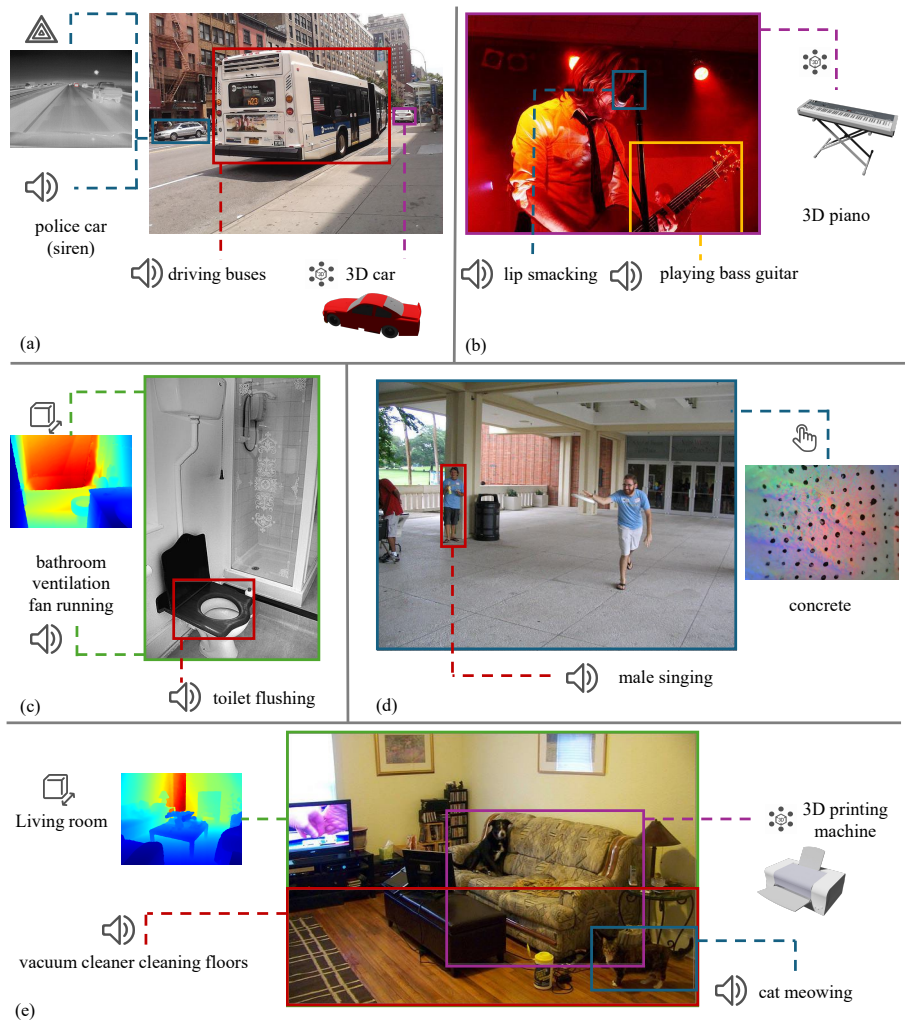
read the original abstract
Multimodal representation alignment is pivotal for large language models and robotics. Traditional methods are often hindered by cross-modal information discrepancies and data scarcity, leading to suboptimal alignment spaces that overlook modality-unique features. We propose CodeBind, a framework that optimizes multimodal representation spaces through a modality-shared-specific codebook design. By incrementally aligning target and bridging modalities, CodeBind bypasses the need for fully paired data. Unlike traditional hard alignment, CodeBind decomposes features into shared components for semantic consistency and specific components for modality-unique details. This design utilizes a compositional vector quantization scheme, where a shared codebook bridges modality gaps and modality-specific codebooks mitigate representation bias by preventing dominant modalities from overshadowing others. Validated across nine modalities (text, image, video, audio, depth, thermal, tactile, 3D point cloud, EEG), CodeBind achieves state-of-the-art performance in multimodal classification and retrieval tasks.
Editorial analysis
A structured set of objections, weighed in public.
Referee Report
Summary. The paper proposes CodeBind, a framework for multimodal representation alignment that employs a modality-shared-specific codebook design combined with compositional vector quantization. Features are decomposed into shared components (for semantic consistency across modalities) and modality-specific components (to preserve unique details and avoid bias). The method incrementally aligns target and bridging modalities to bypass the need for fully paired data, and is validated across nine modalities (text, image, video, audio, depth, thermal, tactile, 3D point cloud, EEG) with claimed state-of-the-art results on multimodal classification and retrieval tasks.
Significance. If the central claim holds—that compositional VQ with a shared codebook can enforce cross-modal consistency from unpaired data alone while modality-specific codebooks prevent dominance—this would represent a meaningful advance for data-scarce multimodal settings in robotics and large models. The explicit decoupling of shared and specific representations is a clear strength over hard-alignment baselines, and the breadth of nine modalities tested is notable.
major comments (2)
- [§3.2 and Eq. (5)] The skeptic concern lands: the abstract and method description assert that incremental alignment via the shared codebook bypasses fully paired data, yet no explicit statement clarifies whether paired bridging batches, indirect correspondence signals, or auxiliary contrastive losses are still present in the optimization (see the training procedure in §3.2 and the loss formulation in Eq. (5)). Without this, the claim that the approach works in truly unpaired regimes remains unverified and load-bearing for the robustness claim across modalities.
- [Table 2] Table 2 (main results) reports SOTA numbers on classification and retrieval, but the text provides no error bars, statistical significance tests, or details on how many random seeds were used; this weakens the cross-modality generalization claim when nine modalities are involved.
minor comments (2)
- [§3.1] The notation for the compositional codebook (shared vs. specific indices) is introduced without a clear diagram or pseudocode; adding a small figure illustrating one forward pass would improve readability.
- [§2] A few references to prior unpaired multimodal methods (e.g., recent contrastive or generative alignment works) are missing from the related-work section; these should be added for proper positioning.
Simulated Author's Rebuttal
We thank the referee for the detailed and constructive review. The comments identify important areas for clarification regarding data pairing assumptions and statistical reporting. We address each point below and have prepared revisions to strengthen the manuscript without altering its core claims.
read point-by-point responses
-
Referee: [§3.2 and Eq. (5)] The skeptic concern lands: the abstract and method description assert that incremental alignment via the shared codebook bypasses fully paired data, yet no explicit statement clarifies whether paired bridging batches, indirect correspondence signals, or auxiliary contrastive losses are still present in the optimization (see the training procedure in §3.2 and the loss formulation in Eq. (5)). Without this, the claim that the approach works in truly unpaired regimes remains unverified and load-bearing for the robustness claim across modalities.
Authors: We appreciate the referee drawing attention to this ambiguity. The incremental alignment procedure in §3.2 relies on bridging modalities that provide indirect correspondences (partial pairings between target and bridge, then bridge and source), rather than requiring complete cross-modal pairs for all nine modalities simultaneously. The loss in Eq. (5) combines compositional VQ reconstruction terms with alignment objectives that operate on these bridge-mediated batches; no direct contrastive loss between arbitrary unpaired pairs is used. We agree that the manuscript should state this data requirement more precisely to avoid implying a fully unpaired regime. In the revised version we will insert a new paragraph in §3.2 that explicitly describes the bridging data construction, the absence of fully paired tuples, and the precise form of the alignment signals present in the optimization. revision: yes
-
Referee: [Table 2] Table 2 (main results) reports SOTA numbers on classification and retrieval, but the text provides no error bars, statistical significance tests, or details on how many random seeds were used; this weakens the cross-modality generalization claim when nine modalities are involved.
Authors: The referee is correct that variability measures are necessary to support the generalization claims. All reported results in Table 2 were obtained by averaging over three independent random seeds with different initializations; standard deviations were computed but omitted from the table. We will revise Table 2 to report mean ± std across the three seeds for every entry. In addition, we will add a short paragraph in the experimental setup section describing the seed count, the use of fixed data splits, and the results of paired t-tests (p < 0.05) confirming statistical significance against the strongest baseline in each task. These changes will be included in the next manuscript version. revision: yes
Circularity Check
No significant circularity; constructive method proposal
full rationale
The paper presents CodeBind as an original architectural proposal using modality-shared-specific codebooks and compositional vector quantization to enable incremental alignment without fully paired data. No equations or steps in the abstract or described design reduce a claimed prediction or result to a fitted input, self-definition, or self-citation chain by construction. The central claims rest on the proposed decomposition into shared and specific components plus empirical validation across nine modalities, which are independent of any load-bearing self-references. This is a standard constructive contribution in multimodal learning research with no detectable circular reduction.
Axiom & Free-Parameter Ledger
Lean theorems connected to this paper
-
IndisputableMonolith/Cost/FunctionalEquation.leanwashburn_uniqueness_aczel unclear?
unclearRelation between the paper passage and the cited Recognition theorem.
modality-shared-specific codebook design... shared codebook bridges modality gaps and modality-specific codebooks mitigate representation bias... compositional vector quantization
-
IndisputableMonolith/Foundation/ArithmeticFromLogic.leanLogicNat embedding and orbit structure unclear?
unclearRelation between the paper passage and the cited Recognition theorem.
decomposes features into shared components for semantic consistency and specific components for modality-unique details
What do these tags mean?
- matches
- The paper's claim is directly supported by a theorem in the formal canon.
- supports
- The theorem supports part of the paper's argument, but the paper may add assumptions or extra steps.
- extends
- The paper goes beyond the formal theorem; the theorem is a base layer rather than the whole result.
- uses
- The paper appears to rely on the theorem as machinery.
- contradicts
- The paper's claim conflicts with a theorem or certificate in the canon.
- unclear
- Pith found a possible connection, but the passage is too broad, indirect, or ambiguous to say the theorem truly supports the claim.
Reference graph
Works this paper leans on
-
[1]
Oneencoder: A lightweight framework for progressive alignment of modalities.arXiv preprint arXiv:2409.11059. Teledyne FLIR. 2018. Teledyne flir adas thermal dataset v2. https:// www.kaggle.com/datasets/samdazel/ teledyne-flir-adas-thermal-dataset-v2/. Letian Fu, Gaurav Datta, Huang Huang, William Chung- Ho Panitch, Jaimyn Drake, Joseph Ortiz, Mustafa Muka...
-
[2]
With limited data for multimodal alignment, let the structure guide you. InNeurIPS. Andrey Guzhov, Federico Raue, Jörn Hees, and Andreas Dengel. 2022. Audioclip: Extending clip to image, text and audio. InICASSP. Jiaming Han, Kaixiong Gong, Yiyuan Zhang, Jiaqi Wang, Kaipeng Zhang, Dahua Lin, Yu Qiao, Peng Gao, and Xiangyu Yue. 2024. Onellm: One frame- wor...
-
[3]
Unim-ov3d: Uni-modality open-vocabulary 3d scene understanding with fine-grained feature rep- resentation. InIJCAI. Edward J Hu, yelong shen, Phillip Wallis, Zeyuan Allen- Zhu, Yuanzhi Li, Shean Wang, Lu Wang, and Weizhu Chen. 2022. LoRA: Low-rank adaptation of large language models. InICLR. Hai Huang, Yan Xia, Shengpeng Ji, Shulei Wang, Hant- ing Wang, M...
work page internal anchor Pith review Pith/arXiv arXiv 2022
-
[4]
Blip-2: Bootstrapping language-image pre- training with frozen image encoders and large lan- guage models. InICML. Junnan Li, Dongxu Li, Caiming Xiong, and Steven Hoi. 2022a. Blip: Bootstrapping language-image pre- training for unified vision-language understanding and generation. InICML. Wei Li, Can Gao, Guocheng Niu, Xinyan Xiao, Hao Liu, Jiachen Liu, H...
-
[5]
Cross-modal discrete representation learning. InACL. Haotian Liu, Chunyuan Li, Qingyang Wu, and Yong Jae Lee. 2023. Visual instruction tuning. InNeurIPS. Shilong Liu, Zhaoyang Zeng, Tianhe Ren, Feng Li, Hao Zhang, Jie Yang, Qing Jiang, Chunyuan Li, Jianwei Yang, Hang Su, and 1 others. 2024. Grounding dino: Marrying dino with grounded pre-training for open...
-
[6]
Deep learning human mind for automated visual classification. InCVPR. Yixuan Su, Tian Lan, Huayang Li, Jialu Xu, Yan Wang, and Deng Cai. 2023. Pandagpt: One model to instruction-follow them all. InProceedings of the 1st Workshop on Taming Large Language Models: Controllability in the era of Interactive Assistants! Yapeng Tian, Jing Shi, Bochen Li, Zhiyao ...
work page 2023
-
[7]
Achieving cross modal generalization with multimodal unified representation. InNeurIPS. Jun Xu, Tao Mei, Ting Yao, and Yong Rui. 2016. Msr- vtt: A large video description dataset for bridging video and language. InCVPR. Fengyu Yang, Chao Feng, Daniel Wang, Tianye Wang, Ziyao Zeng, Zhiyang Xu, Hyoungseob Park, Pengliang Ji, Hanbin Zhao, Yuanning Li, and 1 ...
-
[8]
Enhancing multimodal retrieval via comple- mentary information extraction and alignment. In ACL. 12 Xiaohua Zhai, Basil Mustafa, Alexander Kolesnikov, and Lucas Beyer. 2023. Sigmoid loss for language image pre-training. InICCV. Renrui Zhang, Ziyu Guo, Wei Zhang, Kunchang Li, Xu- peng Miao, Bin Cui, Yu Qiao, Peng Gao, and Hong- sheng Li. 2022. Pointclip: P...
-
[9]
with rank 4 on the final 6 layers of the Trans- former structure, along with trainable projection heads. Reconstruction decoderThe reconstruction is used to impose constraints on the specific embed- dings to preserve the comprehensive information of the initial data, in conjunction with the shared embeddings. The reconstruction decoder consists of a ViT s...
-
[10]
We do not use the unbalanced training split with 2M clips
is used for both training and evaluation, in- cluding 10-second videos sourced from YouTube that have been annotated into 527 classes. We do not use the unbalanced training split with 2M clips. Instead, we employ the balanced training split, which includes about 20K videos. And we use the test split of around 18K videos for evalua- tion. The prepared data...
work page 2024
-
[11]
consists of about 200K video clips, with about 15K in the test split and others in the training split. These clips are 10 seconds in length and are labeled with 309 sound classes, including human actions, sound-emitting objects, and human-object interactions.AudioCaps(Kim et al., 2019) in- cludes about 46K audio clips to human-written text pairs collected...
work page 2019
-
[12]
dataset is utilized, consisting of EEG recordings obtained from six human subjects using a 128-channel human brain activity record- ing system. Each subject is exposed to 2,000 images from 40 categories sourced from the ImageNet (Russakovsky et al., 2015) dataset. With each category comprising 50 unique images, a total of 12,000 EEG sequences are recorded...
work page 2015
discussion (0)
Sign in with ORCID, Apple, or X to comment. Anyone can read and Pith papers without signing in.