Detecting nonclassicality in randomly-displaced copies of a squeezed state
Pith reviewed 2026-05-20 11:17 UTC · model grok-4.3
The pith
An interaction Hamiltonian converts quadrature squeezing into number squeezing, enabling its detection in randomly displaced copies.
A machine-rendered reading of the paper's core claim, the machinery that carries it, and where it could break.
Core claim
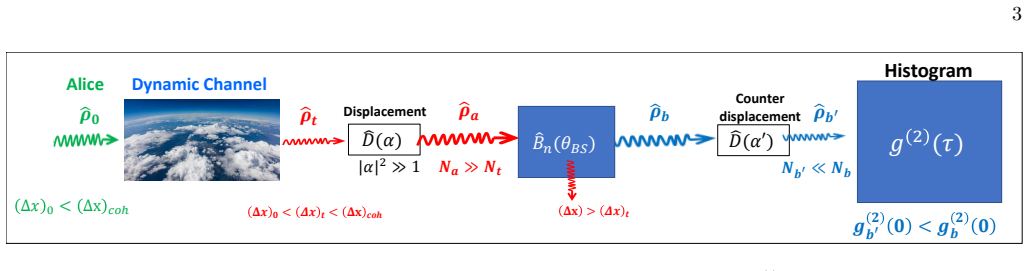
We address a fundamental question: Can one determine whether a received signal is squeezed when each copy arrives with a different displacement/amplitude? We introduce an interaction Hamiltonian that converts quadrature squeezing into number squeezing. Using this conversion, we test whether the copies satisfy g^(2)(0)<1. The Hamiltonian itself does not create nonclassicality; it only transfers it from quadrature squeezing to number squeezing. This allows us to identify squeezing even when individual copies have random displacements.
What carries the argument
Interaction Hamiltonian that converts quadrature squeezing into number squeezing
If this is right
- The g^(2)(0)<1 condition confirms nonclassicality after the conversion even with random displacements.
- No further correction for individual displacements is needed to apply the test.
- The approach works because the Hamiltonian transfers nonclassicality without introducing invalidating noise.
Where Pith is reading between the lines
- This method might apply to other nonclassical features like entanglement in displaced states.
- It could impact designs of quantum receivers that handle fluctuating inputs.
Load-bearing premise
The conversion via the Hamiltonian preserves the nonclassical signature so that g^(2)(0) less than one reliably indicates the original squeezing without extra noise or loss of the effect due to displacements.
What would settle it
Finding that g^(2)(0) is greater than or equal to one in the output state for inputs known to be squeezed with random displacements would show the conversion does not allow detection of the nonclassicality.
Figures
read the original abstract
We address a fundamental question: Can one determine whether a received signal is squeezed when each copy arrives with a different displacement/amplitude? We introduce an interaction Hamiltonian that converts quadrature squeezing into number squeezing. Using this conversion, we test whether the copies satisfy $g^{(2)}(0)<1$. The Hamiltonian itself does not create nonclassicality; it only transfers it from quadrature squeezing to number squeezing. This allows us to identify squeezing even when individual copies have random displacements.
Editorial analysis
A structured set of objections, weighed in public.
Referee Report
Summary. The paper addresses detecting quadrature squeezing when each received copy of a squeezed state has an independent random displacement. It introduces a specific interaction Hamiltonian claimed to convert quadrature squeezing into number squeezing without creating nonclassicality, enabling use of the g^{(2)}(0)<1 witness on the output to identify the original squeezing despite the unknown displacements.
Significance. If the Hamiltonian mapping is shown to preserve the nonclassicality signature invariantly under arbitrary displacements, the result would provide a practical transfer mechanism for nonclassicality witnesses in scenarios with uncontrolled amplitudes, relevant to quantum optics and communication where displacement noise is common.
major comments (2)
- [Hamiltonian definition and evolution] The central claim rests on the interaction Hamiltonian transferring quadrature squeezing to number squeezing such that g^{(2)}(0)<1 remains a valid witness after evolution. However, no explicit form of the Hamiltonian is provided in the abstract, and the manuscript must include a derivation (e.g., in the section defining the Hamiltonian and the evolved number operator) showing that cross terms do not make the output photon statistics displacement-dependent.
- [Random displacement analysis] The robustness under random displacements is load-bearing: if the conversion couples to the displacement operator, some realizations may yield g^{(2)}(0)≥1 even when quadrature squeezing is present. The paper needs an explicit proof or calculation that the mapping commutes with displacements or that the witness holds after averaging or for each copy independently.
minor comments (2)
- Specify the distribution of the random displacements (e.g., Gaussian width or range) and how many copies are assumed in the protocol.
- Add error analysis or numerical verification that the transferred signature survives for realistic displacement strengths.
Simulated Author's Rebuttal
We thank the referee for the careful reading and constructive feedback on our manuscript. We address each major comment below and have revised the manuscript to incorporate the requested clarifications and derivations.
read point-by-point responses
-
Referee: [Hamiltonian definition and evolution] The central claim rests on the interaction Hamiltonian transferring quadrature squeezing to number squeezing such that g^{(2)}(0)<1 remains a valid witness after evolution. However, no explicit form of the Hamiltonian is provided in the abstract, and the manuscript must include a derivation (e.g., in the section defining the Hamiltonian and the evolved number operator) showing that cross terms do not make the output photon statistics displacement-dependent.
Authors: We agree that the explicit form of the Hamiltonian and a derivation are essential for rigor. In the revised manuscript we have added a dedicated subsection that defines the interaction Hamiltonian explicitly, derives it from the underlying physical model, and computes the evolved number operator. The calculation demonstrates that cross terms arising from the displacement do not appear in the final photon-number statistics, which remain governed solely by the squeezing parameter transferred by the Hamiltonian. This ensures g^{(2)}(0)<1 continues to serve as a valid witness. revision: yes
-
Referee: [Random displacement analysis] The robustness under random displacements is load-bearing: if the conversion couples to the displacement operator, some realizations may yield g^{(2)}(0)≥1 even when quadrature squeezing is present. The paper needs an explicit proof or calculation that the mapping commutes with displacements or that the witness holds after averaging or for each copy independently.
Authors: We have expanded the random-displacement section with an explicit calculation for an arbitrarily displaced squeezed input. The evolved state is obtained by applying the unitary generated by the Hamiltonian; because the Hamiltonian is constructed to act on the squeezing quadrature independently of the coherent amplitude, the resulting photon statistics (and thus g^{(2)}(0)) depend only on the squeezing strength and are identical for every displacement realization. We therefore prove that the witness holds for each copy independently, without requiring averaging. revision: yes
Circularity Check
No significant circularity; derivation self-contained
full rationale
The paper introduces a new interaction Hamiltonian claimed to convert quadrature squeezing into number squeezing while transferring nonclassicality without creating it. The central result—that g^(2)(0)<1 remains a valid witness even under independent random displacements per copy—rests on the explicit construction and properties of this Hamiltonian rather than on any fitted parameter renamed as a prediction, self-definition of the output in terms of the input, or load-bearing self-citation. No equation or step in the abstract or described method reduces by construction to its own inputs; the mapping is presented as an independent mechanism whose validity can be checked against external benchmarks such as the standard g^(2) test and displacement operators. This is the normal case of a self-contained proposal.
Axiom & Free-Parameter Ledger
axioms (1)
- standard math Standard quantum mechanics and quantum optics framework for defining quadrature and number squeezing.
invented entities (1)
-
Specific interaction Hamiltonian for quadrature-to-number squeezing conversion
no independent evidence
Lean theorems connected to this paper
-
IndisputableMonolith/Cost/FunctionalEquation.leanwashburn_uniqueness_aczel unclear?
unclearRelation between the paper passage and the cited Recognition theorem.
We introduce an interaction Hamiltonian that converts quadrature squeezing into number squeezing... The Hamiltonian itself does not create nonclassicality; it only transfers it from quadrature squeezing to number squeezing.
-
IndisputableMonolith/Foundation/RealityFromDistinction.leanreality_from_one_distinction unclear?
unclearRelation between the paper passage and the cited Recognition theorem.
ˆBn(θ) cannot generate nonclassicality unless it is already present in the â input mode.
What do these tags mean?
- matches
- The paper's claim is directly supported by a theorem in the formal canon.
- supports
- The theorem supports part of the paper's argument, but the paper may add assumptions or extra steps.
- extends
- The paper goes beyond the formal theorem; the theorem is a base layer rather than the whole result.
- uses
- The paper appears to rely on the theorem as machinery.
- contradicts
- The paper's claim conflicts with a theorem or certificate in the canon.
- unclear
- Pith found a possible connection, but the passage is too broad, indirect, or ambiguous to say the theorem truly supports the claim.
Reference graph
Works this paper leans on
-
[1]
Detecting nonclassicality in randomly-displaced copies of a squeezed state
into number squeezing (ˆbn = (ˆn+iγ0 ˆΦ)/√2γ0). The state after this conversion is denoted by ˆρ b in Fig. 1. The second output port of the ˆBn(θ) operation (red vertical arrow) carries reduced quadrature squeez- ing. We show that the increase in nonclassicality of the ˆbn mode in Fig. 2a is accompanied by a corresponding decrease of nonclassicality in th...
work page internal anchor Pith review Pith/arXiv arXiv 2026
-
[2]
Circuit QEC and Microwave The operator ˆbn can be naturally realized in cir- cuit quantum electrodynamics (cQED) [16, 56, 57]. In particular, the Hamiltonian ˆBn(θ) can be implemented through the interaction of superconducting circuits with microwave drives [57]. In the harmonic (small-fluctuation) regime, i.e., when EJ ≫E C, the Josephson potential of a ...
-
[3]
Optical regime using atomic ensembles The Hamiltonian ˆBn(θ) can also be engineered through the interaction of a single-mode optical field ˆawith an ensemble of bosonic atoms. To obtain full control over the effective interaction, we consider a four-level atomic system with two ground states|g 1⟩,|g 2⟩and two excited states|e 1⟩,|e 2⟩. The optical mode ˆa...
-
[4]
Nonlinear optics One can also obtain a similar Hamiltonian using non- linear optical components, such as optical parametric am- plifiers that rely on Kerr or other nonlinearities. When these devices operate above threshold—i.e., in the limit- cycle regime [68]—the optical annihilation operators can be linearized around stable bright states. By tuning the ...
-
[5]
Jonathan P Dowling and Gerard J Milburn. Quantum technology: the second quantum revolution.Philosoph- ical Transactions of the Royal Society of London. Series A: Mathematical, Physical and Engineering Sciences, 361 (1809):1655–1674, 2003
work page 2003
-
[6]
Photonic quantum technologies.Nature photonics, 3(12): 687–695, 2009
Jeremy L O’brien, Akira Furusawa, and Jelena Vuˇ ckovi´ c. Photonic quantum technologies.Nature photonics, 3(12): 687–695, 2009
work page 2009
-
[7]
Wenchao Ge, Mehmet Emre Tasgin, and M Suhail Zubairy. Conservation relation of nonclassicality and en- tanglement for gaussian states in a beam splitter.Phys- ical Review A, 92(5):052328, 2015
work page 2015
-
[8]
A Kuzmich, Klaus Mølmer, and ES Polzik. Spin squeez- ing in an ensemble of atoms illuminated with squeezed light.Physical review letters, 79(24):4782, 1997
work page 1997
-
[9]
Mehmet Emre Ta¸ sgın and Pierre Meystre. Spin squeezing with coherent light via entanglement swapping.Physical Review A—Atomic, Molecular, and Optical Physics, 83 (5):053848, 2011
work page 2011
-
[10]
MS Kim, W Son, Vladim´ ır Buˇ zek, and PL Knight. En- tanglement by a beam splitter: Nonclassicality as a pre- requisite for entanglement.Physical Review A, 65(3): 032323, 2002
work page 2002
-
[11]
Computable measure of nonclassicality for light.Phys
J´ anos K Asb´ oth, John Calsamiglia, and Helmut Ritsch. Computable measure of nonclassicality for light.Phys. Rev. Lett., 94(17):173602, 2005. URL https://journals.aps.org/prl/abstract/10.1103/ PhysRevLett.94.173602
work page 2005
-
[12]
Classical- nonclassical polarity of gaussian states.Physical Review Letters, 132(24):240201, 2024
Jiru Liu, Wenchao Ge, and M Suhail Zubairy. Classical- nonclassical polarity of gaussian states.Physical Review Letters, 132(24):240201, 2024
work page 2024
-
[13]
Quantifi- cations for multimode entanglement.Physical Review A, 101(1):012324, 2020
Mehmet Emre Tasgin and M Suhail Zubairy. Quantifi- cations for multimode entanglement.Physical Review A, 101(1):012324, 2020
work page 2020
-
[14]
Ievgen I Arkhipov, Jan Peˇ rina Jr, Jan Peˇ rina, and Adam Miranowicz. Interplay of nonclassicality and entangle- ment of two-mode gaussian fields generated in optical parametric processes.Physical Review A, 94(1):013807, 2016
work page 2016
-
[15]
Gener- ation of squeezed states by parametric down conversion
Ling-An Wu, HJ Kimble, JL Hall, and Huifa Wu. Gener- ation of squeezed states by parametric down conversion. Physical Review Letters, 57(20):2520, 1986
work page 1986
-
[16]
Taewon Park, Hubert Stokowski, Vahid Ansari, Samuel Gyger, Kevin KS Multani, Oguz Tolga Celik, Alexan- der Y Hwang, Devin J Dean, Felix Mayor, Timothy P McKenna, et al. Single-mode squeezed-light generation and tomography with an integrated optical parametric oscillator.Science Advances, 10(11):eadl1814, 2024
work page 2024
-
[17]
Athena Karsa, Alasdair Fletcher, Gaetana Spedalieri, and Stefano Pirandola. Quantum illumination and quan- tum radar: A brief overview.Reports on progress in physics, 87(9):094001, 2024
work page 2024
-
[18]
Akash Nag Oruganti, Ivan Derkach, Radim Filip, and Vladyslav C Usenko. Continuous-variable quantum key distribution with noisy squeezed states.Quantum Science and Technology, 2025
work page 2025
-
[19]
Florian Fesquet, Fabian Kronowetter, Michael Renger, Qiming Chen, Kedar Honasoge, Oscar Gargiulo, Yuki Nojiri, Achim Marx, Frank Deppe, Rudolf Gross, et al. Perspectives of microwave quantum key distribution in the open air.Physical Review A, 108(3):032607, 2023
work page 2023
-
[20]
Sh Barzanjeh, D Vitali, P Tombesi, and GJ Mil- burn. Entangling optical and microwave cavity modes by means of a nanomechanical resonator.Physical Re- view A—Atomic, Molecular, and Optical Physics, 84(4): 042342, 2011
work page 2011
-
[21]
Tian Li, Vsevolod Cheburkanov, Vladislav V Yakovlev, Girish S Agarwal, and Marlan O Scully. Harnessing quan- tum light for microscopic biomechanical imaging of cells and tissues.Proceedings of the National Academy of Sci- ences, 121(45):e2413938121, 2024
work page 2024
-
[22]
Biological measurement beyond the quantum limit.Nature Photonics, 7(3):229–233, 2013
Michael A Taylor, Jiri Janousek, Vincent Daria, Joachim Knittel, Boris Hage, Hans-A Bachor, and Warwick P Bowen. Biological measurement beyond the quantum limit.Nature Photonics, 7(3):229–233, 2013
work page 2013
-
[23]
Quan- tum distribution of gaussian keys using squeezed states
Nicolas J Cerf, Marc Levy, and Gilles Van Assche. Quan- tum distribution of gaussian keys using squeezed states. Physical Review A, 63(5):052311, 2001
work page 2001
-
[24]
Encoding classical data into the squeezing of noisy-states for nanowire communication
Mehmet Emre Tasgin. Encoding classical data into the squeezing of noisy-states for nanowire communication. arXiv preprint arXiv:2505.04516, 2025
work page internal anchor Pith review arXiv 2025
-
[25]
Springer Science & Business Media, 2004
Crispin Gardiner, Peter Zoller, and Peter Zoller.Quan- tum noise: a handbook of Markovian and non-Markovian quantum stochastic methods with applications to quantum optics. Springer Science & Business Media, 2004. URL https://link.springer.com/book/9783540223016
-
[26]
R. Simon, N. Mukunda, and Biswadeb Dutta. Quantum- noise matrix for multimode systems: U(n) invariance, squeezing, and normal forms.Phys. Rev. A, 49: 1567–1583, Mar 1994. doi:10.1103/PhysRevA.49.1567. URLhttps://link.aps.org/doi/10.1103/PhysRevA. 49.1567
-
[27]
Rajiah Simon, Narasimhaiengar Mukunda, and Biswadeb Dutta. Quantum-noise matrix for multi- mode systems: U (n) invariance, squeezing, and normal forms.Physical Review A, 49(3):1567, 1994
work page 1994
-
[28]
Gerardo Adesso and Animesh Datta. Quantum versus classical correlations in gaussian states.Physical Review Letters, 105(3):030501, 2010
work page 2010
-
[29]
Extremal entanglement and mixedness in contin- uous variable systems.Phys
Gerardo Adesso, Alessio Serafini, and Fabrizio Illumi- nati. Extremal entanglement and mixedness in contin- uous variable systems.Phys. Rev. A, 70:022318, Aug
-
[30]
URLhttps: //link.aps.org/doi/10.1103/PhysRevA.70.022318
doi:10.1103/PhysRevA.70.022318. URLhttps: //link.aps.org/doi/10.1103/PhysRevA.70.022318
-
[31]
Alessio Serafini, Fabrizio Illuminati, and Silvio De Siena. Symplectic invariants, entropic measures and correlations of gaussian states.Journal of Physics B: Atomic, Molec- ular and Optical Physics, 37(2):L21, 2004
work page 2004
-
[32]
Marlan O. Scully and M. Suhail Zubairy.Quantum Op- tics. Cambridge University Press, 1997
work page 1997
-
[33]
JA Vaccaro and DT Pegg. Physical number-phase intel- ligent and minimum-uncertainty states of light.Journal of Modern Optics, 37(1):17–39, 1990
work page 1990
-
[34]
Anatomy of entanglement and nonclassicality criteria
Mehmet Emre Tasgin. Anatomy of entanglement and 14 nonclassicality criteria.arXiv preprint arXiv:1901.04045, 2019
work page internal anchor Pith review Pith/arXiv arXiv 1901
-
[35]
DT Pegg and SMf Barnett. Phase properties of the quan- tized single-mode electromagnetic field.Physical Review A, 39(4):1665, 1989
work page 1989
-
[36]
On the hermitian optical phase operator.Journal of Modern Optics, 36(1):7–19, 1989
SM Barnett and DT Pegg. On the hermitian optical phase operator.Journal of Modern Optics, 36(1):7–19, 1989
work page 1989
-
[37]
The quantum phase operator: a review
Stephen M Barnett and John A Vaccaro. The quantum phase operator: a review. 2007
work page 2007
-
[38]
M. O. Scully and M. S. Zubairy.Quantum Optics. Cambridge University Press, New York,
-
[39]
URLhttps://www.cambridge.org/core/books/ quantum-optics/08DC53888452CBC6CDC0FD8A1A1A4DD7
-
[40]
Ox- ford University Press, Oxford, third edition, 2000
Rodney Loudon.The Quantum Theory of Light. Ox- ford University Press, Oxford, third edition, 2000. ISBN 0198501765. see Chapter 7
work page 2000
-
[41]
Oxford University Press, Oxford, 2006
Mark Fox.Quantum Optics: An Introduction. Oxford University Press, Oxford, 2006. ISBN 0198566735. see the chapter Photon Statistics
work page 2006
-
[42]
Academic Press, Lon- don, 2013
Alan Migdall, John Vallerga, and Stefania Castel- letto, editors.Single-Photon Generation and Detection: Physics and Applications, volume 45 ofExperimental Methods in the Physical Sciences. Academic Press, Lon- don, 2013. ISBN 9780123876959. see Chapter 5, ”Single- Photon Detection,” and Chapter 7, ”Characterization of Single-Photon Sources.”
work page 2013
-
[43]
Brahim Lounis and Michel Orrit. Single-photon sources. Reports on Progress in Physics, 68(5):1129, 2005
work page 2005
-
[44]
Giuliana Di Martino, Yannick Sonnefraud, St´ ephane K´ ena-Cohen, Mark Tame, Sahin K Ozdemir, MS Kim, and Stefan A Maier. Quantum statistics of surface plas- mon polaritons in metallic stripe waveguides.Nano Lett., 12(5):2504–2508, 2012. URLhttps://pubs.acs.org/ doi/10.1021/nl300671w#
-
[45]
Experi- mental realization of quantum illumination.Physical Re- view Letters, 110(15):153603, 2013
ED Lopaeva, Ivano Ruo Berchera, Ivo Pietro Degiovanni, S Olivares, Giorgio Brida, and Marco Genovese. Experi- mental realization of quantum illumination.Physical Re- view Letters, 110(15):153603, 2013
work page 2013
-
[46]
Pavel Sekatski, N Sangouard, F´ elix Bussieres, Christoph Clausen, Nicolas Gisin, and Hugo Zbinden. Detector im- perfections in photon-pair source characterization.Jour- nal of Physics B: Atomic, Molecular and Optical Physics, 45(12):124016, 2012
work page 2012
-
[47]
On intelligent spin states.Journal of Mathematical Physics, 17(11): 1963–1971, 1976
C Aragone, E Chalbaud, and S Salamo. On intelligent spin states.Journal of Mathematical Physics, 17(11): 1963–1971, 1976
work page 1963
-
[48]
J. J. Sakurai.Advanced Quantum Mechanics. Addison- Wesley, Reading, MA, 1967
work page 1967
-
[49]
Peter D Drummond and Crispin W Gardiner. Gener- alised p-representations in quantum optics.Journal of Physics A: Mathematical and General, 13(7):2353, 1980
work page 1980
-
[50]
T Kiesel and W Vogel. Nonclassicality filters and quasiprobabilities.Physical Review A—Atomic, Molecu- lar, and Optical Physics, 82(3):032107, 2010
work page 2010
-
[51]
Many-particle entanglement with bose–einstein condensates.Nature, 409(6816):63–66, 2001
Anders Sørensen, L-M Duan, J Ignacio Cirac, and Peter Zoller. Many-particle entanglement with bose–einstein condensates.Nature, 409(6816):63–66, 2001
work page 2001
-
[52]
Lu-Ming Duan, G´ eza Giedke, Juan Ignacio Cirac, and Peter Zoller. Inseparability criterion for continuous vari- able systems.Physical review letters, 84(12):2722, 2000
work page 2000
-
[53]
Single-and two-mode quantumness at a beam splitter.Physical Re- view A, 91(6):062315, 2015
Matteo Brunelli, Claudia Benedetti, Stefano Olivares, Alessandro Ferraro, and Matteo GA Paris. Single-and two-mode quantumness at a beam splitter.Physical Re- view A, 91(6):062315, 2015
work page 2015
-
[54]
Optical coherence and quantum optics
Leonard Mandel and Emil Wolf. Optical coherence and quantum optics. 1995
work page 1995
-
[55]
Louisell.Quantum Statistical Properties of Radiation
William H. Louisell.Quantum Statistical Properties of Radiation. John Wiley & Sons, New York, NY, 1973. ISBN 0471547859
work page 1973
-
[56]
Coherent and incoherent states of the radiation field.Physical Review, 131(6):2766, 1963
Roy J Glauber. Coherent and incoherent states of the radiation field.Physical Review, 131(6):2766, 1963
work page 1963
-
[57]
S Sempere-Llagostera, GS Thekkadath, RB Patel, WS Kolthammer, and IA Walmsley. Reducing g (2)(0) of a parametric down-conversion source via photon-number resolution with superconducting nanowire detectors.Op- tics Express, 30(2):3138–3147, 2022
work page 2022
-
[58]
Measurement of photon number statistics using photon-number resolving detectors
Nicholas Low, Sai Sreesh Venuturumilli, and Michal Ba- jcsy. Measurement of photon number statistics using photon-number resolving detectors. InPhotonics for Quantum 2025, volume 13563, pages 161–165. SPIE, 2025
work page 2025
-
[59]
Quantum illumination with gaus- sian states.Physical review letters, 101(25):253601, 2008
Si-Hui Tan, Baris I Erkmen, Vittorio Giovannetti, Saikat Guha, Seth Lloyd, Lorenzo Maccone, Stefano Pirandola, and Jeffrey H Shapiro. Quantum illumination with gaus- sian states.Physical review letters, 101(25):253601, 2008
work page 2008
-
[60]
Demonstration of quadrature-squeezed surface plasmons in a gold waveguide.Phys
Alexander Huck, Stephan Smolka, Peter Lodahl, Anders S Sørensen, Alexandra Boltasseva, Jiri Janousek, and Ulrik L Andersen. Demonstration of quadrature-squeezed surface plasmons in a gold waveguide.Phys. Rev. Lett., 102(24):246802, 2009. URL https://journals.aps.org/prl/abstract/10.1103/ PhysRevLett.102.246802
work page 2009
-
[61]
Mark S Tame, KR McEnery, S ¸K ¨Ozdemir, Jinhyoung Lee, Stefan A Maier, and MS Kim. Quantum plas- monics.Nat. Phys., 9(6):329–340, 2013. URLhttps: //www.nature.com/articles/nphys2615
work page 2013
-
[62]
Manipulating the quantum state of an electrical circuit.Science, 296(5569):886–889, 2002
Denis Vion, A Aassime, Audrey Cottet, Pl Joyez, H Pothier, C Urbina, Daniel Esteve, and Michel H De- voret. Manipulating the quantum state of an electrical circuit.Science, 296(5569):886–889, 2002
work page 2002
-
[63]
Circuit quantum electrodynamics.Re- views of Modern Physics, 93(2):025005, 2021
Alexandre Blais, Arne L Grimsmo, Steven M Girvin, and Andreas Wallraff. Circuit quantum electrodynamics.Re- views of Modern Physics, 93(2):025005, 2021
work page 2021
-
[64]
Joseph- son photonics with simultaneous resonances.Physical Review B, 104(15):155424, 2021
Kieran Wood, Andrew D Armour, and Ben Lang. Joseph- son photonics with simultaneous resonances.Physical Review B, 104(15):155424, 2021
work page 2021
-
[65]
J Lepp¨ akangas, E Thuneberg, R Lindell, and P Hako- nen. Tunneling of cooper pairs across voltage-biased asymmetric single-cooper-pair transistors.Physical Re- view B—Condensed Matter and Materials Physics, 74(5): 054504, 2006
work page 2006
-
[66]
Juha Lepp¨ akangas, Mikael Fogelstr¨ om, Alexander Grimm, Max Hofheinz, Michael Marthaler, and G¨ oran Johansson. Antibunched photons from inelastic cooper- pair tunneling.Physical Review Letters, 115(2):027004, 2015
work page 2015
-
[67]
M Saffman, D Oblak, J Appel, and ES Polzik. Spin squeezing of atomic ensembles by multicolor quan- tum nondemolition measurements.Physical Review A—Atomic, Molecular, and Optical Physics, 79(2): 023831, 2009
work page 2009
-
[68]
Shuai Gao, Shuang Li, Manish Chaudhary, Matthew Prest, Ebubechukwu O Ilo-Okeke, Valentin Ivannikov, and Tim Byrnes. Optical and atomic decoherence in quantum nondemolition measurement induced atomic ensemble entanglement.A VS Quantum Sci., 5(3):035003, Sep 2023. doi:10.1116/5.0168590. 15
-
[69]
PhD thesis, Massachusetts Institute of Technology, 2011
Monika Helene Schleier-Smith.Cavity-enabled spin squeezing for a quantum-enhanced atomic clock. PhD thesis, Massachusetts Institute of Technology, 2011
work page 2011
-
[70]
Klemens Hammerer, Anders S Sørensen, and Eugene S Polzik. Quantum interface between light and atomic en- sembles.Reviews of Modern Physics, 82(2):1041–1093, 2010
work page 2010
-
[71]
Ming Xue, Zheshen Zhang, Xu Zou, Bin Fang, Ziyu Chen, L. You, and Xiang Zhang. Control- ling atomic spin mixing via multiphoton transi- tions in a cavity.Phys. Rev. A, 106:033708, Sep
-
[72]
URL https://journals.aps.org/pra/abstract/10.1103/ PhysRevA.106.033708
doi:10.1103/PhysRevA.106.033708. URL https://journals.aps.org/pra/abstract/10.1103/ PhysRevA.106.033708
-
[73]
Op- tomechanical entanglement between a movable mirror and a cavity field.Phys
David Vitali, Sylvain Gigan, Anderson Ferreira, HR B¨ ohm, Paolo Tombesi, Ariel Guerreiro, Vlatko Ve- dral, Anton Zeilinger, and Markus Aspelmeyer. Op- tomechanical entanglement between a movable mirror and a cavity field.Phys. Rev. Lett., 98(3):030405,
-
[74]
URLhttps://journals.aps.org/prl/abstract/ 10.1103/PhysRevLett.98.030405
- [75]
-
[76]
URLhttps: //link.aps.org/doi/10.1103/PhysRevA.78.032316
doi:10.1103/PhysRevA.78.032316. URLhttps: //link.aps.org/doi/10.1103/PhysRevA.78.032316
-
[77]
General linearized theory of quantum fluctuations around arbitrary limit cycles
Carlos Navarrete-Benlloch, Talitha Weiss, Stefan Walter, and Germ´ an J de Valc´ arcel. General linearized theory of quantum fluctuations around arbitrary limit cycles. Physical Review Letters, 119(13):133601, 2017
work page 2017
-
[78]
Cavity optomechanics.Reviews of Modern Physics, 86(4):1391–1452, 2014
Markus Aspelmeyer, Tobias J Kippenberg, and Florian Marquardt. Cavity optomechanics.Reviews of Modern Physics, 86(4):1391–1452, 2014
work page 2014
-
[79]
Neill Lambert, Clive Emary, and Tobias Brandes. Entan- glement and the phase transition in single-mode super- radiance.Physical Review Letters, 92(7):073602, 2004
work page 2004
-
[80]
N Lambert, C Emary, and T Brandes. Entanglement and entropy in a spin-boson quantum phase transition.Phys- ical Review A—Atomic, Molecular, and Optical Physics, 71(5):053804, 2005
work page 2005
discussion (0)
Sign in with ORCID, Apple, or X to comment. Anyone can read and Pith papers without signing in.