MoCo-EA: Exploiting Adversarial Mode Connectivity for Efficient Evolutionary Attacks
Pith reviewed 2026-05-20 10:08 UTC · model grok-4.3
The pith
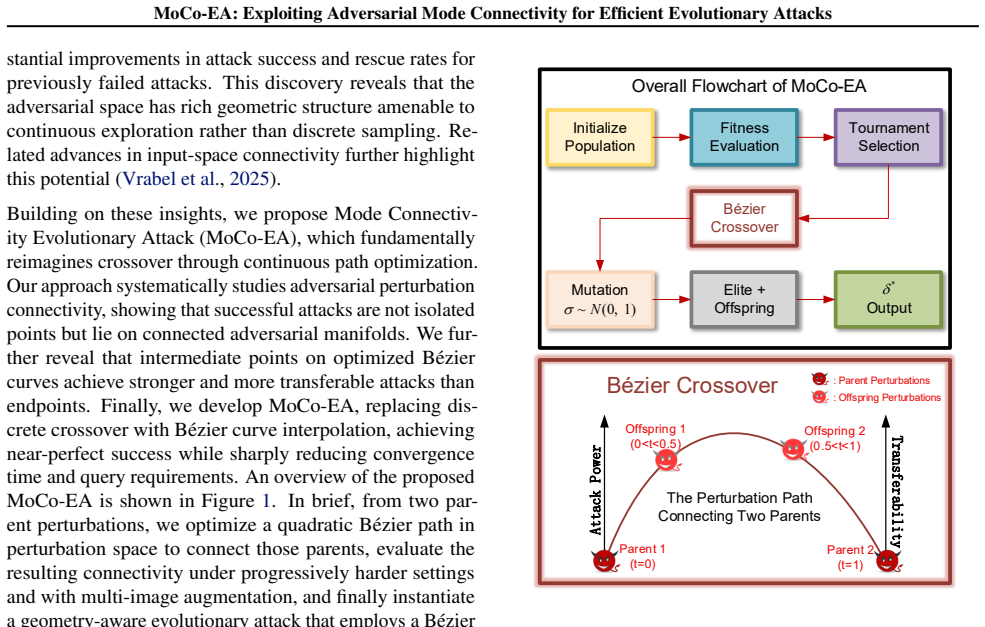
Adversarial perturbations connect along continuous paths where intermediate points often transfer better than the endpoints themselves.
A machine-rendered reading of the paper's core claim, the machinery that carries it, and where it could break.
Core claim
The paper claims that successful adversarial perturbations exhibit mode connectivity, so intermediate points along optimized continuous paths achieve higher transferability than the endpoint perturbations. By introducing a Bézier crossover operator that optimizes perturbations along a continuous curve between parents instead of discrete interpolation, the evolutionary algorithm exploits this structure to produce stronger attacks with reduced query requirements and quicker convergence.
What carries the argument
Bézier crossover operator that optimizes perturbations along a continuous curve between parent perturbations to exploit mode connectivity.
If this is right
- Evolutionary attacks converge in fewer generations and require fewer queries to the target model.
- The generated adversarial examples transfer more effectively to unseen models.
- Adversarial space is better modeled as having manifold structure with useful intermediate points rather than discrete isolated successes.
- Defense research can target the connecting paths instead of single perturbation points.
Where Pith is reading between the lines
- Defenses might improve by sampling or disrupting likely paths between known adversarial examples rather than isolated points.
- The connectivity insight could extend to other black-box optimization problems where discrete recombination wastes useful intermediate structure.
- Hybrid methods that combine path optimization with limited gradient information may further reduce query budgets on complex models.
Load-bearing premise
Adversarial examples lie on connected manifolds where intermediate points maintain and often enhance attack effectiveness.
What would settle it
Select pairs of successful adversarial perturbations, compute intermediate points along the Bézier curve connecting them, and measure whether those points show lower attack success or transferability than the endpoints.
Figures
read the original abstract
Evolutionary algorithms for adversarial attacks leverage population-based search to discover perturbations without gradient information, but suffer from inefficient crossover operations that destroy adversarial properties through discrete interpolation. We introduce Mode Connectivity Evolutionary Attack (MoCo-EA), which replaces traditional crossover with a novel B\'ezier crossover operator that optimizes perturbations along a continuous B\'ezier curve between parent perturbations. Our key insight is that adversarial examples lie on connected manifolds where intermediate points maintain and often enhance attack effectiveness. We demonstrate three findings: (1) Successful adversarial perturbations exhibit mode connectivity; (2) Intermediate points along optimized paths achieve higher transferability than endpoints; (3) B\'ezier crossover dramatically outperforms discrete genetic operations while reducing convergence time and query requirements. By exploiting the geometric structure of adversarial space through path optimization, MoCo-EA provides an efficient and reliable method. Our work challenges the traditional view of adversarial examples as isolated points and opens new directions for both attack generation and defense research.
Editorial analysis
A structured set of objections, weighed in public.
Referee Report
Summary. The manuscript introduces MoCo-EA, an evolutionary algorithm for black-box adversarial attacks that replaces discrete crossover with a Bézier curve operator. It claims that successful adversarial perturbations exhibit mode connectivity on connected manifolds, that intermediate points along optimized paths achieve higher transferability than the endpoints, and that the Bézier crossover yields faster convergence and fewer queries than traditional genetic operations.
Significance. If the geometric claims are substantiated, the work reframes adversarial space as having exploitable connectivity rather than isolated points and supplies a practical efficiency gain for gradient-free attacks. This could inform both stronger attack generation and defenses that account for manifold structure.
major comments (1)
- [Abstract and §4] Abstract and §4 (Mode Connectivity Experiments): the claim that 'adversarial examples lie on connected manifolds where intermediate points maintain and often enhance attack effectiveness' lacks direct supporting measurements. No loss or attack-success curves are shown for the raw Bézier path (t ∈ (0,1)) prior to auxiliary optimization; without these, it remains possible that reported transferability gains arise from the path-optimization step rather than intrinsic connectivity, weakening the justification for replacing discrete crossover.
minor comments (2)
- [§5] The experimental section should include ablation tables that isolate the contribution of the Bézier operator from the rest of the evolutionary loop, with statistical significance reported across runs.
- [§3] Notation for the Bézier curve parameterization and the auxiliary optimization objective should be stated explicitly with equations.
Simulated Author's Rebuttal
We are grateful to the referee for the thorough review and valuable suggestions. The major comment highlights an important aspect of our experimental validation, which we address in detail below. We have prepared revisions to incorporate additional supporting evidence as outlined in our response.
read point-by-point responses
-
Referee: [Abstract and §4] Abstract and §4 (Mode Connectivity Experiments): the claim that 'adversarial examples lie on connected manifolds where intermediate points maintain and often enhance attack effectiveness' lacks direct supporting measurements. No loss or attack-success curves are shown for the raw Bézier path (t ∈ (0,1)) prior to auxiliary optimization; without these, it remains possible that reported transferability gains arise from the path-optimization step rather than intrinsic connectivity, weakening the justification for replacing discrete crossover.
Authors: We thank the referee for pointing out this potential gap in our presentation of the mode connectivity results. Upon review, we confirm that the experiments in Section 4 primarily report on the performance after optimizing the Bézier curve parameters to find effective paths. To directly substantiate the intrinsic connectivity of adversarial perturbations, we will revise the manuscript to include new experimental results: specifically, attack success rate and loss curves for raw (unoptimized) Bézier interpolations between pairs of parent adversarial examples, for t ranging from 0 to 1. These curves will demonstrate that a significant portion of intermediate points along the raw paths are successful adversarial examples, supporting our claim that the connectivity is a property of the adversarial manifold rather than solely resulting from the auxiliary optimization. This revision will be added to Section 4 and referenced in the abstract if necessary. We believe this will fully address the concern and strengthen the justification for our Bézier crossover approach. revision: yes
Circularity Check
Derivation self-contained; mode connectivity treated as empirical premise, not derived by construction
full rationale
The paper states its key insight directly as an assumption about adversarial manifolds and then reports experimental outcomes from Bézier path optimization. No equations, fitted parameters, or self-citations are presented in the provided text that would reduce the central claims (mode connectivity, improved transferability of intermediates, or superiority of Bézier crossover) to tautological redefinitions or inputs. The findings are framed as demonstrations rather than predictions forced by prior definitions within the work itself. This matches the default expectation of no significant circularity.
Axiom & Free-Parameter Ledger
axioms (1)
- domain assumption Adversarial examples lie on connected manifolds where intermediate points maintain and often enhance attack effectiveness
Reference graph
Works this paper leans on
-
[1]
Alzantot, M., Sharma, Y., Chakraborty, S., Zhang, H., Hsieh, C.-J., and Srivastava, M. B. Genattack: Practical black-box attacks with gradient-free optimization. In Genetic and Evolutionary Computation Conference (GECCO), pp.\ 111--119, 2019
work page 2019
-
[2]
Obfuscated gradients give a false sense of security: Circumventing defenses to adversarial examples
Athalye, A., Carlini, N., and Wagner, D. Obfuscated gradients give a false sense of security: Circumventing defenses to adversarial examples. In International Conference on Machine Learning (ICML), pp.\ 274--283, 2018
work page 2018
-
[3]
Decision-based adversarial attacks: Reliable attacks against black-box machine learning models
Brendel, W., Rauber, J., and Bethge, M. Decision-based adversarial attacks: Reliable attacks against black-box machine learning models. In International Conference on Learning Representations (ICLR), 2018
work page 2018
-
[4]
Carlini, N. and Wagner, D. Towards evaluating the robustness of neural networks. In IEEE Symposium on Security and Privacy (SP), pp.\ 39--57, 2017
work page 2017
-
[5]
Poba-ga: Perturbation optimized black-box adversarial attacks via genetic algorithm
Chen, J., Su, M., Shen, S., Xiong, H., and Zheng, H. Poba-ga: Perturbation optimized black-box adversarial attacks via genetic algorithm. In Computers & Security, pp.\ 89--106, 2019
work page 2019
-
[6]
Chen, J., Jordan, M. I., and Wainwright, M. J. Hopskipjumpattack: A query-efficient decision-based attack. In IEEE Symposium on Security and Privacy (SP), pp.\ 1277--1294. IEEE, 2020
work page 2020
-
[7]
Chen, P.-Y., Zhang, H., Sharma, Y., Yi, J., and Hsieh, C.-J. Zoo: Zeroth order optimization based black-box attacks to deep neural networks without training substitute models. In Proceedings of the 10th ACM workshop on artificial intelligence and security, pp.\ 15--26, 2017
work page 2017
-
[8]
C., Roxo, T., Proen c a, H., and Inacio, P
Costa, J. C., Roxo, T., Proen c a, H., and Inacio, P. R. M. How deep learning sees the world: A survey on adversarial attacks & defenses. IEEE Access, 12: 0 61113--61136, 2024
work page 2024
-
[9]
Croce, F. and Hein, M. Reliable evaluation of adversarial robustness with an ensemble of diverse parameter-free attacks. In International Conference on Machine Learning (ICML), pp.\ 2206--2216, 2020
work page 2020
-
[10]
Imagenet: A large-scale hierarchical image database
Deng, J., Dong, W., Socher, R., Li, L.-J., Li, K., and Fei-Fei, L. Imagenet: A large-scale hierarchical image database. In IEEE Conference on Computer Vision and Pattern Recognition (CVPR), 2009
work page 2009
-
[11]
Boosting adversarial attacks with momentum
Dong, Y., Liao, F., Pang, T., Su, H., Zhu, J., Hu, X., and Li, J. Boosting adversarial attacks with momentum. In IEEE Conference on Computer Vision and Pattern Recognition (CVPR), pp.\ 9185--9193, 2018
work page 2018
-
[12]
Evading defenses to transferable adversarial examples by translation-invariant attacks
Dong, Y., Pang, T., Su, H., and Zhu, J. Evading defenses to transferable adversarial examples by translation-invariant attacks. In IEEE Conference on Computer Vision and Pattern Recognition (CVPR), pp.\ 4312--4321, 2019
work page 2019
-
[13]
An image is worth 16x16 words: Transformers for image recognition at scale
Dosovitskiy, A., Beyer, L., Kolesnikov, A., Weissenborn, D., Zhai, X., Unterthiner, T., Dehghani, M., Minderer, M., Heigold, G., Gelly, S., Uszkoreit, J., and Houlsby, N. An image is worth 16x16 words: Transformers for image recognition at scale. In International Conference on Learning Representations (ICLR), 2021
work page 2021
-
[14]
Essentially no barriers in neural network energy landscape
Draxler, F., Veschgini, K., Salmhofer, M., and Hamprecht, F. Essentially no barriers in neural network energy landscape. In International Conference on Machine Learning (ICML), 2018
work page 2018
-
[15]
Robustness (python library), 2019
Engstrom, L., Ilyas, A., Salman, H., Santurkar, S., and Tsipras, D. Robustness (python library), 2019. URL https://github.com/MadryLab/robustness
work page 2019
-
[16]
Freeman, C. D. and Bruna, J. Topology and geometry of half-rectified network optimization. In International Conference on Learning Representations (ICLR), 2017
work page 2017
-
[17]
Garipov, T., Izmailov, P., Podoprikhin, D., Vetrov, D. P., and Wilson, A. G. Loss surfaces, mode connectivity, and fast ensembling of dnns. In Advances in Neural Information Processing Systems (NeurIPS), 2018
work page 2018
-
[18]
J., Shlens, J., and Szegedy, C
Goodfellow, I. J., Shlens, J., and Szegedy, C. Explaining and harnessing adversarial examples. In International Conference on Learning Representations (ICLR), 2015
work page 2015
-
[19]
Deep residual learning for image recognition
He, K., Zhang, X., Ren, S., and Sun, J. Deep residual learning for image recognition. In IEEE Conference on Computer Vision and Pattern Recognition (CVPR), pp.\ 770--778, 2016
work page 2016
-
[20]
Kingma, D. P. and Ba, J. Adam: A method for stochastic optimization. In International Conference on Learning Representations (ICLR), 2015
work page 2015
-
[21]
Learning multiple layers of features from tiny images
Krizhevsky, A. Learning multiple layers of features from tiny images. Technical report, University of Toronto, 2009
work page 2009
-
[22]
Li, W., Deka, D., Wang, R., and Paternina, M. R. A. Physics-constrained adversarial training for neural networks in stochastic power grids. IEEE Transactions on Artificial Intelligence, 5 0 (3): 0 1121--1131, 2023
work page 2023
-
[23]
Practical evaluation of adversarial robustness via adaptive auto attack
Liu, Y., Cheng, Y., Gao, L., Liu, X., Zhang, Q., and Song, J. Practical evaluation of adversarial robustness via adaptive auto attack. In IEEE Conference on Computer Vision and Pattern Recognition (CVPR), pp.\ 15105--15114, 2022
work page 2022
-
[24]
Towards deep learning models resistant to adversarial attacks
Madry, A., Makelov, A., Schmidt, L., Tsipras, D., and Vladu, A. Towards deep learning models resistant to adversarial attacks. In International Conference on Learning Representations (ICLR), 2018
work page 2018
-
[25]
Boosting the transferability of adversarial attacks with reverse adversarial perturbation
Qin, Z., Fan, Y., Liu, Y., Shen, L., Zhang, Y., Wang, J., and Wu, B. Boosting the transferability of adversarial attacks with reverse adversarial perturbation. In Advances in Neural Information Processing Systems (NeurIPS), pp.\ 29845--29858, 2022
work page 2022
-
[26]
Revisiting mode connectivity in neural networks with bezier surface
Ren, J., Chen, P.-Y., and Wang, R. Revisiting mode connectivity in neural networks with bezier surface. In The Thirteenth International Conference on Learning Representations, 2025
work page 2025
-
[27]
Shi, Y. and Wang, R. Exploring nonlinear pathway in parameter space for machine unlearning. Forty-third International Conference on Machine Learning, 2026
work page 2026
-
[28]
Su, J., Vargas, D. V., and Sakurai, K. One pixel attack for fooling deep neural networks. IEEE Transactions on Evolutionary Computation, 23 0 (5): 0 828--841, 2019
work page 2019
-
[29]
Input space mode connectivity in deep neural networks
Vrabel, J., Shem-Ur, O., Oz, Y., and Krueger, D. Input space mode connectivity in deep neural networks. In International Conference on Learning Representations (ICLR), 2025
work page 2025
-
[30]
On fast adversarial robustness adaptation in model-agnostic meta-learning
Wang, R., Xu, K., Liu, S., Chen, P.-Y., Weng, T.-W., Gan, C., and Wang, M. On fast adversarial robustness adaptation in model-agnostic meta-learning. In International Conference on Learning Representations, 2021
work page 2021
-
[31]
Wang, R., Chen, T., Lindsly, S. M., Stansbury, C. M., Rehemtulla, A., Rajapakse, I., and Hero, A. O. Rails: A robust adversarial immune-inspired learning system. IEEE Access, 10: 0 22061--22078, 2022 a
work page 2022
-
[32]
Wang, R., Chen, T., Yao, P., Liu, S., Rajapakse, I., and Hero, A. O. Ask: Adversarial soft k-nearest neighbor attack and defense. IEEE Access, 10: 0 103074--103088, 2022 b
work page 2022
-
[33]
Exploring diversified adversarial robustness in neural networks via robust mode connectivity
Wang, R., Li, Y., and Liu, S. Exploring diversified adversarial robustness in neural networks via robust mode connectivity. In Proceedings of the IEEE/CVF Conference on Computer Vision and Pattern Recognition, pp.\ 2346--2352, 2023
work page 2023
-
[34]
Deep adversarial defense against multilevel-lp attacks
Wang, R., Li, Y., and Hero, A. Deep adversarial defense against multilevel-lp attacks. IEEE International Workshop on Machine Learning for Signal Processing (MLSP), 2024
work page 2024
-
[35]
Xie, C., Zhang, Z., Zhou, Y., Bai, S., Wang, J., Ren, Z., and Yuille, A. L. Improving transferability of adversarial examples with input diversity. In IEEE Conference on Computer Vision and Pattern Recognition (CVPR), pp.\ 2730--2739, 2019
work page 2019
-
[36]
Optimizing robustness and accuracy in mixture of experts: A dual-model approach
Zhang, X., Xu, K., Hu, Z., and Wang, R. Optimizing robustness and accuracy in mixture of experts: A dual-model approach. In Forty-second International Conference on Machine Learning, 2025
work page 2025
discussion (0)
Sign in with ORCID, Apple, or X to comment. Anyone can read and Pith papers without signing in.