VarWISE: Infrared Variability via NEOWISE Single Exposure Photometry
Pith reviewed 2026-05-20 07:13 UTC · model grok-4.3
The pith
VarWISE catalogs 457,080 high-confidence infrared variable objects from NEOWISE data, nearly half new.
A machine-rendered reading of the paper's core claim, the machinery that carries it, and where it could break.
Core claim
VarWISE applies spatial clustering of apparitions together with the VARnet detection model and XGBoost classification model to NEOWISE single-exposure infrared photometry. The resulting Pure Catalog holds 457,080 objects of highest confidence, 49.81 percent of them new discoveries, while the Extended Catalog contains 1,918,082 objects, 82.02 percent new. Each entry carries a predicted variable type, a best-fit period when the variations appear cyclical, and additional parameters that characterize the variability.
What carries the argument
Spatial clustering of apparitions combined with the VARnet model for variability detection and the XGBoost model for type classification and period fitting, all run on NEOWISE 3.4 and 4.6 micron single-exposure photometry.
If this is right
- The catalogs supply type predictions and period values that let researchers select objects for targeted follow-up studies.
- The large fraction of new discoveries expands the available sample of infrared variables for population and evolution work.
- Explicit caveats listed for each variable type guide users on where the classifications are most or least secure.
- The Pure versus Extended distinction lets applications choose between highest reliability and broadest coverage.
Where Pith is reading between the lines
- Similar machine-learning pipelines could be adapted to other ongoing or future infrared time-domain surveys to increase discovery rates.
- Cross-matching the new candidates with optical or X-ray catalogs might reveal wavelength-dependent behaviors not captured here.
- The released catalogs could serve as training data to improve automated variability searches in upcoming large-scale surveys.
Load-bearing premise
The VARnet and XGBoost models, trained or tuned on NEOWISE single-exposure photometry, produce reliable variability detections and type classifications with low contamination when applied to the full dataset.
What would settle it
Independent follow-up photometry or cross-checks against existing variable catalogs that find a substantial fraction of Pure Catalog objects lack the reported variability or have incorrect types would show the models are not working as claimed.
Figures




read the original abstract
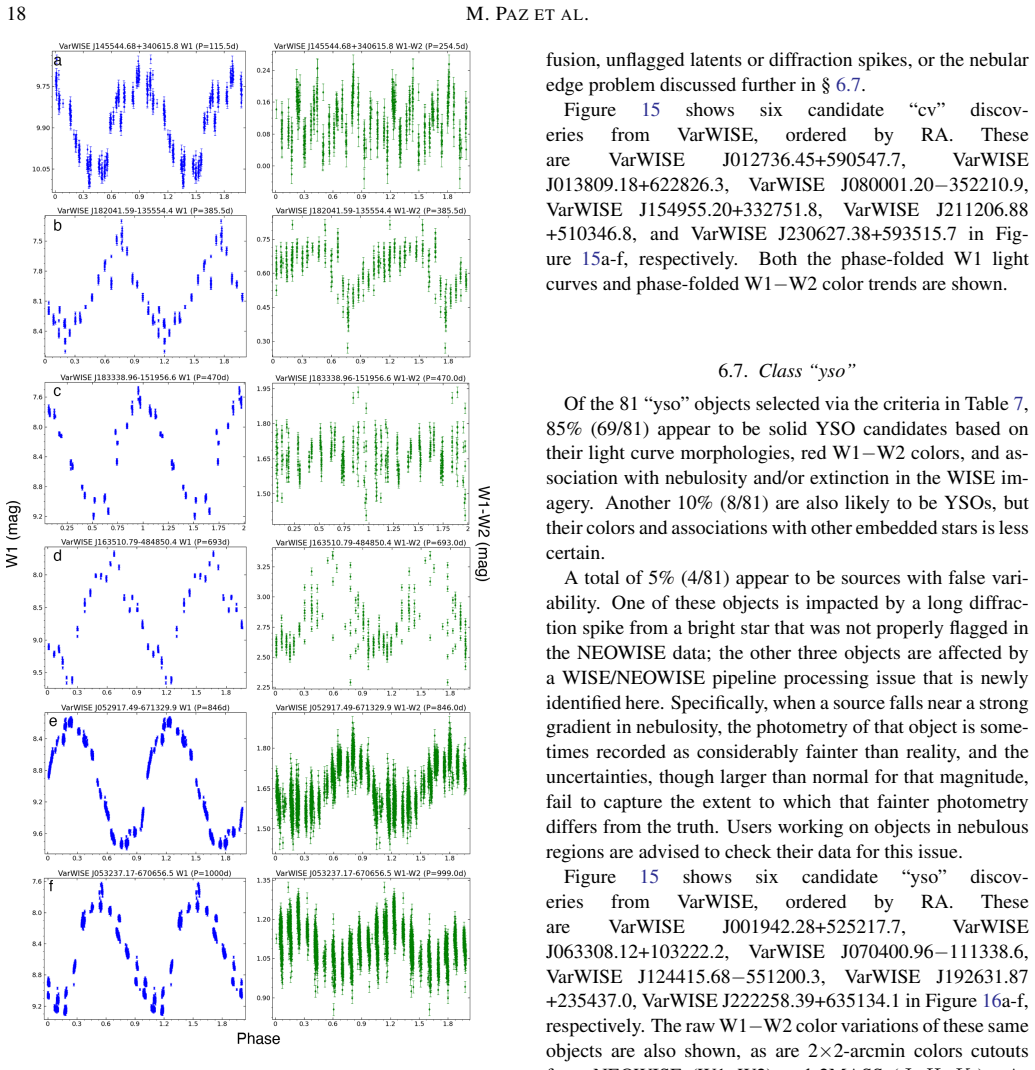
The Near-Earth Object Wide-field Infrared Explorer (NEOWISE) mission provides a decade of all-sky time-series data at 3.4 and 4.6um and an unprecedented opportunity for the discovery and characterization of variable objects. This paper presents VarWISE, a catalog of infrared-variable objects discovered within the NEOWISE single-exposure data. We employ unique methodologies, including the spatial clustering of apparitions and the adoption of novel machine learning-based variable detection (VARnet) and classification (XGBoost) to identify and characterize significant variability. The catalog includes a prediction of variable object type and best-fit period values for each object, if its variations are cyclical, along with other calculated parameters to characterize the nature of the variability. The VarWISE Pure Catalog, containing only variables of highest confidence, has 457,080 objects, 49.81% of which are new discoveries; the VarWISE Extended Catalog, containing all sources, has 1,918,082 objects, 82.02% of which are new. We discuss caveats for each variable type and highlight a few new objects found during a quick perusal of the catalogs' contents.
Editorial analysis
A structured set of objections, weighed in public.
Referee Report
Summary. The paper presents VarWISE, a catalog of infrared-variable objects extracted from NEOWISE single-exposure photometry at 3.4 and 4.6 μm. It describes a pipeline that uses spatial clustering of apparitions together with two machine-learning components—VARnet for variability detection and XGBoost for type classification—then reports a Pure Catalog of 457,080 highest-objects (49.81 % new discoveries) and an Extended Catalog of 1,918,082 objects (82.02 % new), each entry supplied with a predicted variable type and, when applicable, a best-fit period.
Significance. If the claimed low-contamination performance of VARnet and XGBoost can be demonstrated, the resulting catalogs would constitute a substantial increase in the known population of mid-infrared variables and would provide a valuable resource for time-domain studies of stars, AGN, and other transients. The methodological combination of single-exposure photometry with spatial clustering and modern ML classifiers is novel and, if validated, could be adopted by future all-sky infrared surveys.
major comments (3)
- [§4] §4 (VARnet and XGBoost description): the manuscript states that the models were trained or tuned on NEOWISE photometry and then applied at scale, yet provides no quantitative validation—neither training-set composition and size, nor held-out precision/recall, nor false-positive rate measured on single-exposure artifacts or non-variables. These metrics are required to support the headline catalog sizes and novelty fractions.
- [§5.1] §5.1 and Table 1: the Pure Catalog count (457,080) and the 49.81 % new-discovery fraction are presented as direct outputs of the pipeline; without an independent cross-match to existing variability catalogs (e.g., ASAS-SN, ZTF, or prior WISE variability lists) or a quantified contamination estimate, it is impossible to assess whether the reported numbers are inflated by misclassified artifacts.
- [§3.2] §3.2 (spatial clustering step): the paper claims that clustering of apparitions reliably isolates true variables, but does not report the false-positive rate of the clustering algorithm when applied to regions of high source density or to known non-variable sources; this step is load-bearing for both catalog definitions.
minor comments (2)
- [Figure 2] Figure 2: the color bar and axis labels are too small to read in the printed version; please enlarge and add a brief description of what the plotted quantity represents.
- Throughout: the term “Pure Catalog” is used before it is formally defined; a short parenthetical definition on first use would improve readability.
Simulated Author's Rebuttal
We thank the referee for their thorough and constructive review of our manuscript on the VarWISE catalog. We address each major comment in detail below, providing clarifications and indicating where revisions have been made to strengthen the validation of our methods and results.
read point-by-point responses
-
Referee: [§4] §4 (VARnet and XGBoost description): the manuscript states that the models were trained or tuned on NEOWISE photometry and then applied at scale, yet provides no quantitative validation—neither training-set composition and size, nor held-out precision/recall, nor false-positive rate measured on single-exposure artifacts or non-variables. These metrics are required to support the headline catalog sizes and novelty fractions.
Authors: We agree that the original manuscript would benefit from more explicit quantitative validation of the machine-learning components. In the revised version we have expanded §4 with the exact composition and size of the training sets for both VARnet and XGBoost, together with held-out precision, recall, and false-positive rates obtained from cross-validation. We have also added a dedicated test of false-positive rates on single-exposure artifacts and on a control sample of known non-variables drawn from the literature. These new metrics are presented to directly support the reported catalog sizes and novelty fractions. revision: yes
-
Referee: [§5.1] §5.1 and Table 1: the Pure Catalog count (457,080) and the 49.81 % new-discovery fraction are presented as direct outputs of the pipeline; without an independent cross-match to existing variability catalogs (e.g., ASAS-SN, ZTF, or prior WISE variability lists) or a quantified contamination estimate, it is impossible to assess whether the reported numbers are inflated by misclassified artifacts.
Authors: We have performed additional cross-matches against ASAS-SN, ZTF, and previously published WISE variability catalogs and now report the overlap statistics and the resulting adjusted new-discovery fraction in the revised §5.1 and Table 1. We have also added a quantified contamination estimate derived from the classifier performance on the validation set and from discrepancies observed in the cross-matches. While a complete ground-truth contamination rate for every infrared variable remains unavailable, the new cross-match and validation results provide a concrete basis for assessing the reliability of the headline numbers. revision: yes
-
Referee: [§3.2] §3.2 (spatial clustering step): the paper claims that clustering of apparitions reliably isolates true variables, but does not report the false-positive rate of the clustering algorithm when applied to regions of high source density or to known non-variable sources; this step is load-bearing for both catalog definitions.
Authors: We recognize that an explicit false-positive assessment of the spatial-clustering step is necessary. In the revised manuscript we have added a quantitative evaluation in §3.2: the clustering algorithm was run on both high-density fields and on a control sample of spectroscopically confirmed non-variable sources. The measured false-positive rate is reported and shown to be low, thereby supporting the use of this step in defining both the Pure and Extended catalogs. revision: yes
Circularity Check
No circularity: catalog generated by direct application of ML models to observational data
full rationale
The paper constructs the VarWISE catalogs by training VARnet and XGBoost on NEOWISE single-exposure photometry and then applying the models to identify variables, assign types, and fit periods across the full dataset. No equations, derivations, or self-citations are presented that reduce the headline counts (457k pure objects with 49.81% new; 1.9M extended with 82% new) or the variability predictions to fitted inputs by construction. The process is empirical and data-driven, with outputs depending on the independent observational inputs rather than tautological redefinitions or load-bearing self-references. This is the most common honest finding for catalog papers that apply trained algorithms to new data without internal self-definition.
Axiom & Free-Parameter Ledger
Reference graph
Works this paper leans on
-
[1]
Explanatory Supplement to the AllWISE Data Release Products
-
[2]
Estimating Distances from Parallaxes. V. Geometric and Photogeometric Distances to 1.47 Billion Stars in Gaia Early Data Release 3. , keywords =. doi:10.3847/1538-3881/abd806 , archivePrefix =. 2012.05220 , primaryClass =
work page internal anchor Pith review Pith/arXiv arXiv doi:10.3847/1538-3881/abd806 2012
-
[3]
The Zwicky Transient Facility: System Overview, Performance, and First Results
The Zwicky Transient Facility: System Overview, Performance, and First Results. , keywords =. doi:10.1088/1538-3873/aaecbe , archivePrefix =. 1902.01932 , primaryClass =
work page internal anchor Pith review Pith/arXiv arXiv doi:10.1088/1538-3873/aaecbe 1902
-
[4]
The Relationship between Infrared, Optical, and Ultraviolet Extinction. , keywords =. doi:10.1086/167900 , adsurl =
-
[5]
The Pan-STARRS1 Surveys. arXiv e-prints , keywords =. doi:10.48550/arXiv.1612.05560 , archivePrefix =. 1612.05560 , primaryClass =
work page internal anchor Pith review Pith/arXiv arXiv doi:10.48550/arxiv.1612.05560
-
[6]
Overview of the DESI Legacy Imaging Surveys
Overview of the DESI Legacy Imaging Surveys. , keywords =. doi:10.3847/1538-3881/ab089d , archivePrefix =. 1804.08657 , primaryClass =
work page internal anchor Pith review Pith/arXiv arXiv doi:10.3847/1538-3881/ab089d
-
[7]
All-sky three-dimensional dust density and extinction Maps of the Milky Way out to 2.8 kpc. , keywords =. doi:10.1093/mnras/stae1474 , archivePrefix =. 2406.06740 , primaryClass =
-
[8]
First Results from the Catalina Real-time Transient Survey
First Results from the Catalina Real-Time Transient Survey. , keywords =. doi:10.1088/0004-637X/696/1/870 , archivePrefix =. 0809.1394 , primaryClass =
work page internal anchor Pith review Pith/arXiv arXiv doi:10.1088/0004-637x/696/1/870
-
[9]
Three Dimensional Structure of the Milky Way Disk
Three-dimensional Structure of the Milky Way Disk: The Distribution of Stars and Dust beyond 0.35 R _ solar. , keywords =. doi:10.1086/321556 , archivePrefix =. astro-ph/0101259 , primaryClass =
work page internal anchor Pith review Pith/arXiv arXiv doi:10.1086/321556
-
[10]
Correcting for the Effects of Interstellar Extinction
Correcting for the Effects of Interstellar Extinction. , keywords =. doi:10.1086/316293 , archivePrefix =. astro-ph/9809387 , primaryClass =
work page internal anchor Pith review Pith/arXiv arXiv doi:10.1086/316293
-
[11]
Multiband analysis of the O'Connell effect in 14 eclipsing binaries. , keywords =. doi:10.1051/0004-6361/202554150 , archivePrefix =. 2506.19754 , primaryClass =
-
[12]
The Gaia mission. , keywords =. doi:10.1051/0004-6361/201629272 , archivePrefix =. 1609.04153 , primaryClass =
work page internal anchor Pith review Pith/arXiv arXiv doi:10.1051/0004-6361/201629272
-
[13]
HEALPix: A Framework for High-Resolution Discretization and Fast Analysis of Data Distributed on the Sphere. , keywords =. doi:10.1086/427976 , archivePrefix =. astro-ph/0409513 , primaryClass =
work page internal anchor Pith review Pith/arXiv arXiv doi:10.1086/427976
-
[14]
General catalogue of variable stars: Version GCVS 5.1 , author=. Astronomy Reports , volume=. 2017 , publisher=
work page 2017
-
[15]
A 3D Dust Map Based on Gaia, Pan-STARRS 1 and 2MASS
A 3D Dust Map Based on Gaia, Pan-STARRS 1, and 2MASS. , keywords =. doi:10.3847/1538-4357/ab5362 , archivePrefix =. 1905.02734 , primaryClass =
work page internal anchor Pith review Pith/arXiv arXiv doi:10.3847/1538-4357/ab5362 1905
-
[16]
, year = 1926, month = jun, volume =
On the relation between period and form of the light-curve of variable stars of the Cephei type. , year = 1926, month = jun, volume =
work page 1926
-
[17]
, year = 1929, month = mar, volume =
A spiral nebula as a stellar system, Messier 31. , year = 1929, month = mar, volume =. doi:10.1086/143167 , adsurl =
-
[18]
LSST: from Science Drivers to Reference Design and Anticipated Data Products
LSST: From Science Drivers to Reference Design and Anticipated Data Products. , keywords =. doi:10.3847/1538-4357/ab042c , archivePrefix =. 0805.2366 , primaryClass =
work page internal anchor Pith review Pith/arXiv arXiv doi:10.3847/1538-4357/ab042c
-
[19]
SkyMapper and the Southern Sky Survey
The SkyMapper Telescope and The Southern Sky Survey. , keywords =. doi:10.1071/AS07001 , archivePrefix =. astro-ph/0702511 , primaryClass =
work page internal anchor Pith review Pith/arXiv arXiv doi:10.1071/as07001
-
[20]
Resolving nearby dust clouds. , keywords =. doi:10.1051/0004-6361/202038169 , archivePrefix =. 2004.06732 , primaryClass =
-
[21]
Initial Performance of the NEOWISE Reactivation Mission
Initial Performance of the NEOWISE Reactivation Mission. , keywords =. doi:10.1088/0004-637X/792/1/30 , archivePrefix =. 1406.6025 , primaryClass =
work page internal anchor Pith review Pith/arXiv arXiv doi:10.1088/0004-637x/792/1/30
-
[22]
Modelling the Galactic Interstellar Extinction Distribution in Three Dimensions
Modelling the Galactic interstellar extinction distribution in three dimensions. , keywords =. doi:10.1051/0004-6361:20053842 , archivePrefix =. astro-ph/0604427 , primaryClass =
work page internal anchor Pith review Pith/arXiv arXiv doi:10.1051/0004-6361:20053842
-
[23]
Commmunications of the Konkoly Observatory Hungary , year = 1969, month = jan, volume =
The O'Connell-effect in some eclipsing variables. Commmunications of the Konkoly Observatory Hungary , year = 1969, month = jan, volume =
work page 1969
-
[24]
The Initial Mass Function Based on the Full-sky 20 pc Census of 3600 Stars and Brown Dwarfs. , keywords =. doi:10.3847/1538-4365/ad24e2 , archivePrefix =. 2312.03639 , primaryClass =
-
[25]
The first Gaia catalogue of eclipsing-binary candidates
Gaia Data Release 3. The first Gaia catalogue of eclipsing-binary candidates. , keywords =. doi:10.1051/0004-6361/202245330 , archivePrefix =. 2211.00929 , primaryClass =
-
[26]
SkyMapper Southern Survey: Data release 4. , keywords =. doi:10.1017/pasa.2024.53 , archivePrefix =. 2402.02015 , primaryClass =
-
[27]
KIC 7284688: A Solar-type Eclipsing Binary with Rapidly Varying O'Connell Effect. , keywords =. doi:10.3847/1538-3881/accfa1 , adsurl =
-
[28]
The All Sky Automated Survey. , keywords =. doi:10.48550/arXiv.astro-ph/9712146 , archivePrefix =. astro-ph/9712146 , primaryClass =
work page internal anchor Pith review Pith/arXiv arXiv doi:10.48550/arxiv.astro-ph/9712146
-
[29]
Transiting Exoplanet Survey Satellite (TESS). Journal of Astronomical Telescopes, Instruments, and Systems , year = 2015, month = jan, volume =. doi:10.1117/1.JATIS.1.1.014003 , adsurl =
work page internal anchor Pith review doi:10.1117/1.jatis.1.1.014003 2015
-
[30]
The Astronomical Journal , year = 1998, volume = 116, pages =
Observational Evidence from Supernovae for an Accelerating Universe and a Cosmological Constant. , keywords =. doi:10.1086/300499 , archivePrefix =. astro-ph/9805201 , primaryClass =
work page internal anchor Pith review Pith/arXiv arXiv doi:10.1086/300499
-
[31]
Measuring Reddening with SDSS Stellar Spectra and Recalibrating SFD
Measuring Reddening with Sloan Digital Sky Survey Stellar Spectra and Recalibrating SFD. , keywords =. doi:10.1088/0004-637X/737/2/103 , archivePrefix =. 1012.4804 , primaryClass =
work page internal anchor Pith review Pith/arXiv arXiv doi:10.1088/0004-637x/737/2/103
-
[32]
ATLAS: A High-Cadence All-Sky Survey System
ATLAS: A High-cadence All-sky Survey System. , keywords =. doi:10.1088/1538-3873/aabadf , archivePrefix =. 1802.00879 , primaryClass =
work page internal anchor Pith review Pith/arXiv arXiv doi:10.1088/1538-3873/aabadf
-
[33]
Accurate masses and radii of normal stars: modern results and applications
Accurate masses and radii of normal stars: modern results and applications. , keywords =. doi:10.1007/s00159-009-0025-1 , archivePrefix =. 0908.2624 , primaryClass =
work page internal anchor Pith review Pith/arXiv arXiv doi:10.1007/s00159-009-0025-1
-
[34]
The Optical Gravitational Lensing Experiment. Search for Planetary and Low-Luminosity Object Transits in the Galactic Disk. Results of 2001 Campaign. , keywords =. doi:10.48550/arXiv.astro-ph/0202320 , archivePrefix =. astro-ph/0202320 , primaryClass =
work page internal anchor Pith review Pith/arXiv arXiv doi:10.48550/arxiv.astro-ph/0202320 2001
-
[35]
The Viewing Geometry of Brown Dwarfs Influences Their Observed Colours and Variability Properties
The Viewing Geometry of Brown Dwarfs Influences Their Observed Colors and Variability Amplitudes. , keywords =. doi:10.3847/1538-4357/aa73cf , archivePrefix =. 1705.06045 , primaryClass =
work page internal anchor Pith review Pith/arXiv arXiv doi:10.3847/1538-4357/aa73cf
-
[36]
Society for Astronomical Sciences Annual Symposium , year = 2009, month = may, volume =
Revisiting the O'Connell Effect in Eclipsing Binary Systems. Society for Astronomical Sciences Annual Symposium , year = 2009, month = may, volume =
work page 2009
-
[37]
A Sub-Millisecond Fourier and Wavelet Based Model to Extract Variable Candidates from the NEOWISE Single-Exposure Database. arXiv e-prints , keywords =. doi:10.48550/arXiv.2409.15499 , archivePrefix =. 2409.15499 , primaryClass =
-
[38]
All-sky classification of 12.4 million variable sources into 25 classes
Gaia Data Release 3. All-sky classification of 12.4 million variable sources into 25 classes. , keywords =. doi:10.1051/0004-6361/202245591 , archivePrefix =. 2211.17238 , primaryClass =
-
[39]
The Zwicky Transient Facility Catalog of Periodic Variable Stars. , keywords =. doi:10.3847/1538-4365/ab9cae , archivePrefix =. 2005.08662 , primaryClass =
-
[40]
Wide-field Infrared Survey Explorer (WISE) Catalog of Periodic Variable Stars
Wide-field Infrared Survey Explorer (WISE) Catalog of Periodic Variable Stars. , keywords =. doi:10.3847/1538-4365/aad32b , archivePrefix =. 1807.03448 , primaryClass =
work page internal anchor Pith review Pith/arXiv arXiv doi:10.3847/1538-4365/aad32b
-
[41]
Variability, periodicity, and contact binaries in WISE. , keywords =. doi:10.1093/mnras/stab592 , archivePrefix =. 2012.04690 , primaryClass =
-
[42]
Rotational modulation and patterns of colour variation in solar-like variables
Gaia Data Release 3. Rotational modulation and patterns of colour variation in solar-like variables. , keywords =. doi:10.1051/0004-6361/202244178 , archivePrefix =. 2206.05500 , primaryClass =
-
[43]
Specific processing and validation of all sky RR Lyrae and Cepheid stars: The Cepheid sample
Gaia Data Release 3. Specific processing and validation of all sky RR Lyrae and Cepheid stars: The Cepheid sample. , keywords =. doi:10.1051/0004-6361/202243990 , archivePrefix =. 2206.06212 , primaryClass =
-
[44]
Specific processing and validation of all-sky RR Lyrae and Cepheid stars: The RR Lyrae sample
Gaia Data Release 3. Specific processing and validation of all-sky RR Lyrae and Cepheid stars: The RR Lyrae sample. , keywords =. doi:10.1051/0004-6361/202243964 , archivePrefix =. 2206.06278 , primaryClass =
-
[45]
Gaia Data Release 3. The extragalactic content. , keywords =. doi:10.1051/0004-6361/202243232 , archivePrefix =. 2206.05681 , primaryClass =
-
[46]
Variable stars in the colour-absolute magnitude diagram
Gaia Data Release 2. Variable stars in the colour-absolute magnitude diagram. , keywords =. doi:10.1051/0004-6361/201833304 , archivePrefix =. 1804.09382 , primaryClass =
-
[47]
A density-based algorithm for discovering clusters in large spatial databases with noise , year =
Ester, Martin and Kriegel, Hans-Peter and Sander, J\". A density-based algorithm for discovering clusters in large spatial databases with noise , year =. Proceedings of the Second International Conference on Knowledge Discovery and Data Mining , pages =
-
[48]
XGBoost: A Scalable Tree Boosting System
Tianqi Chen and Carlos Guestrin , title =. CoRR , volume =. 2016 , url =. 1603.02754 , timestamp =
work page internal anchor Pith review Pith/arXiv arXiv 2016
-
[49]
On the advantage of using analysis of variance for period search. , keywords =. doi:10.1093/mnras/241.2.153 , adsurl =
-
[50]
Using conditional entropy to identify periodicity
Using conditional entropy to identify periodicity. , keywords =. doi:10.1093/mnras/stt1206 , archivePrefix =. 1306.6664 , primaryClass =
work page internal anchor Pith review Pith/arXiv arXiv doi:10.1093/mnras/stt1206
-
[51]
Lomb, N. R. , year =. Least-squares frequency analysis of unequally spaced data , volume =. Astrophysics and Space Science , publisher =. doi:10.1007/bf00648343 , number =
-
[52]
Near-Infrared Variability in the 2MASS Calibration Fields: A Search for Planetary Transit Candidates
Near-Infrared Variability in the 2MASS Calibration Fields: A Search for Planetary Transit Candidates. , keywords =. doi:10.1086/523644 , archivePrefix =. 0709.1182 , primaryClass =
work page internal anchor Pith review Pith/arXiv arXiv doi:10.1086/523644
-
[53]
The Astronomical Journal , author =
The Two Micron All Sky Survey (2MASS). , keywords =. doi:10.1086/498708 , adsurl =
-
[54]
The PSCz catalogue. , keywords =. doi:10.1046/j.1365-8711.2000.03528.x , archivePrefix =. astro-ph/0001117 , primaryClass =
-
[55]
Publications of the Warner & Swasey Observatory , keywords =
Luminous stars in the Southern Milky Way. Publications of the Warner & Swasey Observatory , keywords =
-
[56]
Robust Variable Star Detection Techniques Suitable for Automated searches: New Results for NGC 1866. , keywords =. doi:10.1086/116556 , adsurl =
-
[57]
On the Automatic Determination of Light-Curve Parameters for Cepheid Variables. , keywords =. doi:10.1086/133808 , adsurl =
-
[58]
unTimely: a Full-sky, Time-domain unWISE Catalog. , keywords =. doi:10.3847/1538-3881/aca2ab , archivePrefix =. 2209.14327 , primaryClass =
-
[59]
The unWISE Catalog: Two Billion Infrared Sources from Five Years of WISE Imaging
The unWISE Catalog: Two Billion Infrared Sources from Five Years of WISE Imaging. , keywords =. doi:10.3847/1538-4365/aafbea , archivePrefix =. 1901.03337 , primaryClass =
work page internal anchor Pith review Pith/arXiv arXiv doi:10.3847/1538-4365/aafbea 1901
-
[60]
The Sloan Digital Sky Survey: Technical Summary
The Sloan Digital Sky Survey: Technical Summary. , keywords =. doi:10.1086/301513 , archivePrefix =. astro-ph/0006396 , primaryClass =
work page internal anchor Pith review Pith/arXiv arXiv doi:10.1086/301513
-
[61]
Journal of Open Source Software , author =
McInnes, Leland and Healy, John and Astels, Steve , title =. 2017 , publisher =. doi:10.21105/joss.00205 , url =
-
[62]
and Kriegel, Hans-Peter and Sander, J\"
Ankerst, Mihael and Breunig, Markus M. and Kriegel, Hans-Peter and Sander, J\". OPTICS: ordering points to identify the clustering structure , year =. SIGMOD Rec. , month = jun, pages =. doi:10.1145/304181.304187 , abstract =
-
[63]
and Kriegel, Hans-Peter and Sander, J\"
Ankerst, Mihael and Breunig, Markus M. and Kriegel, Hans-Peter and Sander, J\". OPTICS: ordering points to identify the clustering structure , year =. Proceedings of the 1999 ACM SIGMOD International Conference on Management of Data , pages =. doi:10.1145/304182.304187 , abstract =
-
[64]
A Catalogue of Mid-infrared Variable Sources from unTimely , author=. 2025 , eprint=
work page 2025
-
[65]
Gaia DR3 Part 1. Main source , publisher =. 2022 , copyright =. doi:10.26093/CDS/VIZIER.1355 , url =
-
[66]
VISTA Variables in the Via Lactea (VVV): The public ESO near-IR variability survey of the Milky Way
VISTA Variables in the Via Lactea (VVV): The public ESO near-IR variability survey of the Milky Way. , keywords =. doi:10.1016/j.newast.2009.12.002 , archivePrefix =. 0912.1056 , primaryClass =
work page internal anchor Pith review Pith/arXiv arXiv doi:10.1016/j.newast.2009.12.002 2009
discussion (0)
Sign in with ORCID, Apple, or X to comment. Anyone can read and Pith papers without signing in.