Active Galactic Nucleus Tori: Potential Birthplace to Millions of Planets
Pith reviewed 2026-05-20 03:20 UTC · model grok-4.3
The pith
AGN dust tori can form tens of millions of planets via streaming instability.
A machine-rendered reading of the paper's core claim, the machinery that carries it, and where it could break.
Core claim
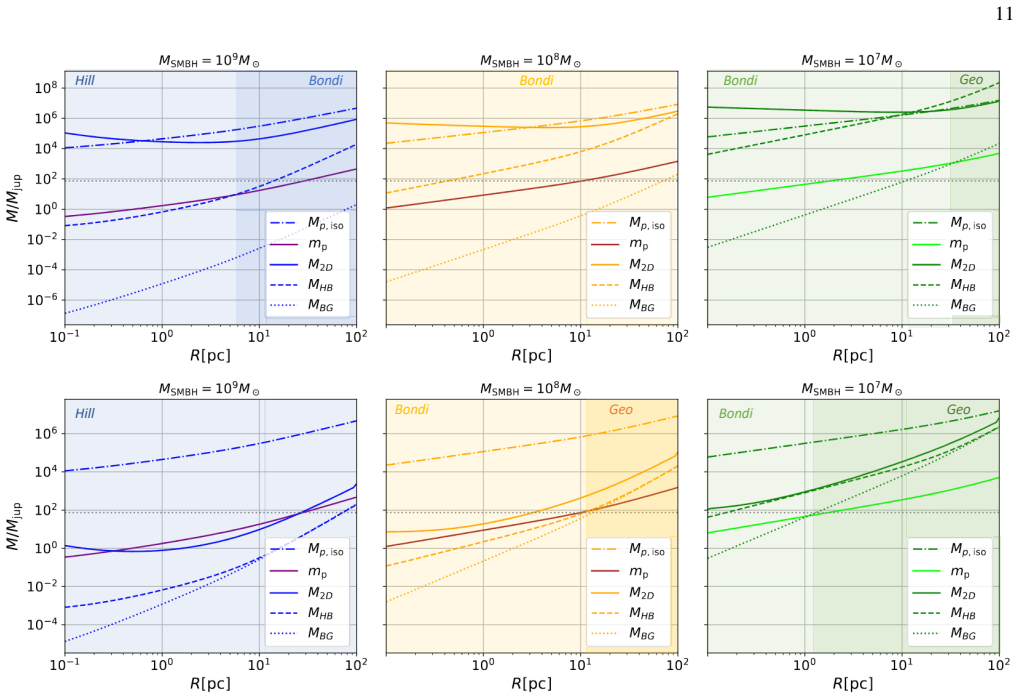
In AGN dust tori, dust grains coagulate to sizes enabling streaming instability, producing filaments of solar mass that fragment into tens of millions of planetesimals ranging from Earth to super-Jupiter masses. These bodies typically form in the 3D Bondi regime of pebble accretion with mass-doubling times between 10^3 and 10^7 years, and can undergo concurrent gas accretion to reach crossover mass. The pebble isolation mass exceeds the hydrogen burning limit, allowing growth to stellar masses limited by feedback rather than gap opening, and the model also predicts pure-dust objects formed directly above that limit.
What carries the argument
Streaming instability triggered by coagulated dust in a magnetized, gravitationally stable AGN disk model, forming filaments that collapse into planetesimals followed by pebble and gas accretion.
If this is right
- Coagulation readily produces the dust grain sizes required to trigger streaming instability.
- Dust filaments contain solar masses and collapse into tens of millions of planetesimals spanning Earth to super-Jupiter masses.
- Planets form mainly in the 3D Bondi regime of pebble accretion with mass-doubling times from 10^3 to 10^7 years.
- Gas accretion proceeds to crossover mass and can produce stellar-mass objects, creating a core-accretion channel for star formation.
- Growth is limited by stellar feedback because the pebble isolation mass lies above the hydrogen-burning limit.
Where Pith is reading between the lines
- If correct, AGN tori would represent a previously unrecognized dominant site of planet formation that could dominate the cosmic census of planets.
- The rapid formation of many massive bodies might alter the long-term structure and stability of AGN disks through dynamical interactions.
- Signatures of embedded planets or unusual dust evolution in AGN observations could provide a direct test of the predicted timescales.
Load-bearing premise
The outer regions of AGN disks have temperatures low enough for dust to condense like in circumstellar disks, and a strongly magnetized disk model keeps the structure gravitationally stable.
What would settle it
A direct measurement of outer AGN disk temperatures above the dust condensation threshold or grain sizes remaining below the threshold for streaming instability would show the process cannot occur.
Figures




read the original abstract
The outer regions of AGN disks have temperatures similar to those of circumstellar disks, permitting dust condensation. Therefore, planet formation and growth could be active in these dust tori through similar mechanisms. We aim at quantifying the parameter space for the occurrence of streaming instability, and its outcomes in terms of the masses of the objects formed, their total number, and their continued growth via pebble accretion. We use a a recently proposed disk model with strong magnetization to keep the disk gravitationally stable. We find that the dust grain sizes required for streaming instability are easily attained through coagulation; the dust filaments it produces can contain solar masses, collapsing into tens of millions of planetesimals ranging from Earth to super-Jupiter masses. These planets are usually born in the 3D Bondi regime of pebble accretion, and have mass-doubling times from 10^3 to 10^7 yrs, though 3D Hill and geometric accretion are also realized. Gas accretion occurs concurrently, and crossover mass can be attained while still in the planetary mass range. As a result, vigorous accretion can occur, leading to objects with stellar masses -- defining a core accretion channel for star formation. The pebble isolation mass is beyond the hydrogen burning limit, so accretion is limited by stellar feedback instead of gap carving. Our model also predicts a population of exotic objects directly formed above the hydrogen burning limit, yet of pure dust. Our approximate model suggests that AGN dust tori host the largest populations of planets in the universe.
Editorial analysis
A structured set of objections, weighed in public.
Referee Report
Summary. The manuscript claims that the outer regions of AGN dust tori have temperatures similar to circumstellar disks, enabling dust condensation and planet formation via streaming instability. Using a recently proposed strongly magnetized disk model to ensure gravitational stability, the authors estimate that dust filaments contain solar masses and collapse into tens of millions of planetesimals (Earth to super-Jupiter masses). These objects grow via pebble accretion (primarily in the 3D Bondi regime) with mass-doubling times of 10^3–10^7 yr, concurrent gas accretion can reach crossover mass, and the pebble isolation mass exceeds the hydrogen-burning limit, so stellar feedback limits growth instead of gap carving. The model also predicts exotic pure-dust objects formed above the hydrogen-burning limit and concludes that AGN tori host the largest planetary populations in the universe.
Significance. If the temperature and stability assumptions hold, the work identifies a previously unrecognized channel for both planet and star formation in AGN environments, with quantitative predictions for planetesimal numbers, accretion timescales, and exotic objects that could be tested observationally. It would substantially expand the parameter space of known planet-forming sites and link core accretion to stellar-mass outcomes.
major comments (2)
- [Methods and model choice] The load-bearing assumption that outer AGN tori reach T ~ 100–300 K (permitting dust condensation) and remain Toomre-stable via the adopted strongly magnetized disk model is stated in the abstract and methods paragraph but is not validated against standard AGN radiative-transfer calculations or observed B-field strengths at large radii. If AGN heating raises T or weaker magnetization yields Q < 1, the streaming-instability channel collapses; a direct comparison or sensitivity test is required.
- [Results on streaming instability and planetesimal formation] The quantitative outcomes (solar-mass filaments, tens of millions of planetesimals, mass-doubling times 10^3–10^7 yr, crossover while still planetary) are presented in the results section without explicit equations, adopted parameter values, or verification that the numbers reduce independently of the external disk model rather than being inherited from it.
minor comments (2)
- [Abstract] Abstract contains a typographical error: 'We use a a recently proposed' should read 'We use a recently proposed'.
- [Abstract and conclusions] The strong concluding claim that AGN tori host 'the largest populations of planets in the universe' would be strengthened by a brief quantitative comparison to the total planet inventory expected from circumstellar disks or galactic-field populations.
Simulated Author's Rebuttal
We thank the referee for the constructive review and recommendation for major revision. We address the two major comments point by point below, agreeing to incorporate additional validations and explicit derivations in the revised manuscript.
read point-by-point responses
-
Referee: [Methods and model choice] The load-bearing assumption that outer AGN tori reach T ~ 100–300 K (permitting dust condensation) and remain Toomre-stable via the adopted strongly magnetized disk model is stated in the abstract and methods paragraph but is not validated against standard AGN radiative-transfer calculations or observed B-field strengths at large radii. If AGN heating raises T or weaker magnetization yields Q < 1, the streaming-instability channel collapses; a direct comparison or sensitivity test is required.
Authors: We agree that further validation strengthens the central assumptions. The adopted temperature range follows from the outer tori being shielded from intense central radiation in standard AGN disk models, and the strongly magnetized framework is taken from the recently proposed model referenced in the manuscript to ensure Q > 1. To address the comment directly, we will add a dedicated methods subsection that compares our T and magnetization values against published radiative-transfer calculations for AGN disks and discusses available constraints on B-field strengths at large radii from observations. We will also include a brief sensitivity test varying T by factors of two and magnetization strength to show the robustness of the streaming instability regime. These additions will appear in the revised version. revision: yes
-
Referee: [Results on streaming instability and planetesimal formation] The quantitative outcomes (solar-mass filaments, tens of millions of planetesimals, mass-doubling times 10^3–10^7 yr, crossover while still planetary) are presented in the results section without explicit equations, adopted parameter values, or verification that the numbers reduce independently of the external disk model rather than being inherited from it.
Authors: We acknowledge that the results would be clearer with explicit derivations. The quoted quantities are obtained by applying standard streaming-instability thresholds (critical dust-to-gas ratio and stopping time) and pebble-accretion rate formulas to the local surface density, temperature, and dust properties supplied by the magnetized disk model. Filament mass follows from the most unstable wavelength, planetesimal count from total dust mass divided by characteristic planetesimal mass, and doubling times from the 3D Bondi regime expression. In the revision we will insert an expanded methods or appendix section containing the governing equations, a table of all adopted numerical values (e.g., dust fraction, grain size, viscosity parameter), and a short demonstration that the outcomes scale directly with the local disk quantities rather than depending on global model details beyond those quantities. This will make the calculations fully reproducible. revision: yes
Circularity Check
No significant circularity; derivation applies standard mechanisms to externally adopted disk conditions.
full rationale
The paper adopts temperatures and gravitational stability from a recently proposed external disk model with strong magnetization, then applies standard streaming instability, coagulation, pebble accretion, and core accretion calculations to those conditions. No equations or results within the paper reduce by construction to fitted inputs, self-definitions, or load-bearing self-citations that lack independent verification. The central claim follows from mapping known planet-formation physics onto the AGN torus parameter space under the stated assumptions, remaining self-contained against external benchmarks for those processes.
Axiom & Free-Parameter Ledger
free parameters (1)
- magnetization strength in disk model
axioms (1)
- domain assumption Outer AGN disk regions have temperatures similar to circumstellar disks, permitting dust condensation
Lean theorems connected to this paper
-
IndisputableMonolith/Cost/FunctionalEquation.leanwashburn_uniqueness_aczel unclear?
unclearRelation between the paper passage and the cited Recognition theorem.
We use a recently proposed disk model with strong magnetization to keep the disk gravitationally stable... β_m=0.01... St_frag, St_drift, pebble accretion rates (Eqs. 11-43)
-
IndisputableMonolith/Foundation/AlexanderDuality.leanalexander_duality_circle_linking unclear?
unclearRelation between the paper passage and the cited Recognition theorem.
filament mass m_f = η r H Σ Z_f ... characteristic planetesimal mass m_p scaling with h^3 M_SMBH
What do these tags mean?
- matches
- The paper's claim is directly supported by a theorem in the formal canon.
- supports
- The theorem supports part of the paper's argument, but the paper may add assumptions or extra steps.
- extends
- The paper goes beyond the formal theorem; the theorem is a base layer rather than the whole result.
- uses
- The paper appears to rely on the theorem as machinery.
- contradicts
- The paper's claim conflicts with a theorem or certificate in the canon.
- unclear
- Pith found a possible connection, but the passage is too broad, indirect, or ambiguous to say the theorem truly supports the claim.
Reference graph
Works this paper leans on
-
[1]
Abbott,R.,Abbott,T.D.,Abraham,S.,etal.2020,Phys.Rev.Lett., 125, 101102, doi: 10.1103/PhysRevLett.125.101102
-
[2]
The Astrophysical Journal , abstract =
Agol, E. 2002, ApJ, 579, 430, doi: 10.1086/342880 Alarcón, F., Casassus, S., Lyra, W., Pérez, S., & Cieza, L. 2024, MNRAS, 527, 9655, doi: 10.1093/mnras/stad3734
-
[3]
1993, ARA&A, 31, 473, doi: 10.1146/annurev.aa.31.090193.002353
Antonucci, R. 1993, ARA&A, 31, 473, doi: 10.1146/annurev.aa.31.090193.002353
-
[4]
Antonucci, R. R. J., & Miller, J. S. 1985, ApJ, 297, 621, doi: 10.1086/163559
-
[5]
Armitage, P. J. 2020, Astrophysics of planet formation, Second Edition
work page 2020
-
[6]
Annual Review of Astronomy and Astrophysics , keywords =
Arnett, W. D., Bahcall, J. N., Kirshner, R. P., & Woosley, S. E. 1989, ARA&A, 27, 629, doi: 10.1146/annurev.aa.27.090189.003213
-
[7]
2013, ApJ, 772, 96, doi: 10.1088/0004-637X/772/2/96
Bai, X.-N. 2013, ApJ, 772, 96, doi: 10.1088/0004-637X/772/2/96
-
[8]
Bai, X.-N., & Stone, J. M. 2010, ApJL, 722, L220, doi: 10.1088/2041-8205/722/2/L220
-
[9]
Balbus, S. A., & Hawley, J. F. 1991, ApJ, 376, 214, doi: 10.1086/170270
-
[10]
Begelman, M. C., & Pringle, J. E. 2007, MNRAS, 375, 1070, doi: 10.1111/j.1365-2966.2006.11372.x Béky, B., & Kocsis, B. 2013, ApJ, 762, 35, doi: 10.1088/0004-637X/762/1/35
-
[11]
Birnstiel, T., Andrews, S. M., & Ercolano, B. 2012, A&A, 544, A79, doi: 10.1051/0004-6361/201219262
-
[12]
Brauer, F., Dullemond, C. P., Johansen, A., et al. 2007, A&A, 469, 1169, doi: 10.1051/0004-6361:20066865
-
[13]
Cantiello, M., Jermyn, A. S., & Lin, D. N. C. 2021, ApJ, 910, 94, doi: 10.3847/1538-4357/abdf4f
-
[14]
Carrera, D., Johansen, A., & Davies, M. B. 2015, A&A, 579, A43, doi: 10.1051/0004-6361/201425120
-
[15]
Chiang, E. I., & Goldreich, P. 1997, ApJ, 490, 368, doi: 10.1086/304869
-
[16]
2006, ApJL, 648, L101, doi: 10.1086/508158
Elitzur, M., & Shlosman, I. 2006, ApJL, 648, L101, doi: 10.1086/508158
-
[17]
Epstein, P. S. 1924, Physical Review, 23, 710, doi: 10.1103/PhysRev.23.710
-
[18]
J., Cantiello, M., Perna, R., & Samsing, J
Fabj, G., Dittmann, A. J., Cantiello, M., Perna, R., & Samsing, J. 2025, ApJ, 981, 16, doi: 10.3847/1538-4357/ada896
-
[19]
Ford, K. E. S., & McKernan, B. 2025, arXiv e-prints, arXiv:2506.08801, doi: 10.48550/arXiv.2506.08801
-
[20]
Fragile, P. C., Anninos, P., Roth, N., & Mishra, B. 2023, ApJ, 959, 59, doi: 10.3847/1538-4357/ad096b
-
[21]
2013, Progress of Theoretical and Experimental Physics, 2013, 053E02, doi: 10.1093/ptep/ptt028
Fukue, J. 2013, Progress of Theoretical and Experimental Physics, 2013, 053E02, doi: 10.1093/ptep/ptt028
-
[22]
2014, ApJ, 782, 88, doi: 10.1088/0004-637X/782/2/88
Fung, J., Shi, J.-M., & Chiang, E. 2014, ApJ, 782, 88, doi: 10.1088/0004-637X/782/2/88
- [23]
-
[24]
Gressel, O., Turner, N. J., Nelson, R. P., & McNally, C. P. 2015, ApJ, 801, 84, doi: 10.1088/0004-637X/801/2/84
-
[25]
1999a, ARA&A, 37, 487, doi: 10.1146/annurev.astro.37.1.487 15 —
Hamann, F., & Ferland, G. 1999a, ARA&A, 37, 487, doi: 10.1146/annurev.astro.37.1.487 15 —. 1999b, ARA&A, 37, 487, doi: 10.1146/annurev.astro.37.1.487
-
[26]
2015, ApJ, 803, 110, doi: 10.1088/0004-637X/803/2/110
Ferrer, N. 2015, ApJ, 803, 110, doi: 10.1088/0004-637X/803/2/110
-
[27]
Heger, A., & Woosley, S. E. 2002, ApJ, 567, 532, doi: 10.1086/338487 Hönig, S. F., Beckert, T., Ohnaka, K., & Weigelt, G. 2006, A&A, 452, 459, doi: 10.1051/0004-6361:20054622 Hönig, S. F., & Kishimoto, M. 2017, ApJL, 838, L20, doi: 10.3847/2041-8213/aa6838
-
[28]
Hopkins, P. F. 2014, ApJ, 797, 59, doi: 10.1088/0004-637X/797/1/59
-
[29]
F., Squire, J., Quataert, E., et al
Hopkins, P. F., Squire, J., Quataert, E., et al. 2024, The Open Journal of Astrophysics, 7, 20, doi: 10.21105/astro.2310.04507
-
[30]
, archivePrefix = "arXiv", eprint =
Hosokawa, T., & Omukai, K. 2009a, ApJ, 691, 823, doi: 10.1088/0004-637X/691/1/823 —. 2009b, ApJ, 703, 1810, doi: 10.1088/0004-637X/703/2/1810
-
[31]
Jaffe, W., Meisenheimer, K., Röttgering, H. J. A., et al. 2004, Nature, 429, 47, doi: 10.1038/nature02531
-
[32]
Annual Review of Nuclear and Particle Science , author=
Janka, H.-T. 2012, Annual Review of Nuclear and Particle Science, 62, 407, doi: 10.1146/annurev-nucl-102711-094901
-
[33]
2022, ApJ, 929, 133, doi: 10.3847/1538-4357/ac5d40
Cantiello, M. 2022, ApJ, 929, 133, doi: 10.3847/1538-4357/ac5d40
-
[34]
Jiang, Y.-F., Stone, J. M., & Davis, S. W. 2013, ApJ, 778, 65, doi: 10.1088/0004-637X/778/1/65
-
[35]
2011, A&A, 529, A62, doi: 10.1051/0004-6361/201015979
Johansen, A., Klahr, H., & Henning, T. 2011, A&A, 529, A62, doi: 10.1051/0004-6361/201015979
-
[36]
Annual Review of Earth and Planetary Sciences , year = 2017, month = aug, volume = 45, pages =
Johansen, A., & Lambrechts, M. 2017, Annual Review of Earth and Planetary Sciences, 45, 359, doi: 10.1146/annurev-earth-063016-020226
-
[37]
, archivePrefix = "arXiv", eprint =
Johansen, A., Oishi, J. S., Mac Low, M.-M., et al. 2007, Nature, 448, 1022, doi: 10.1038/nature06086
-
[38]
1755, Universal Natural History and Theory of the Heavens (in Theoretical Philosophy, 1755–1770, ed
Kant, I. 1755, Universal Natural History and Theory of the Heavens (in Theoretical Philosophy, 1755–1770, ed. and trans. David Walford and Ralf Meerbote, Cambridge: Cambridge University Press, 1992.)
work page 1992
-
[39]
2020, ApJ, 901, 54, doi: 10.3847/1538-4357/abac58
Klahr, H., & Schreiber, A. 2020, ApJ, 901, 54, doi: 10.3847/1538-4357/abac58
-
[40]
Krolik, J. H., & Begelman, M. C. 1988, ApJ, 329, 702, doi: 10.1086/166414
-
[41]
, archivePrefix = "arXiv", eprint =
Lambrechts, M., & Johansen, A. 2012, A&A, 544, A32, doi: 10.1051/0004-6361/201219127
-
[42]
, archivePrefix = "arXiv", eprint =
Lambrechts, M., Johansen, A., & Morbidelli, A. 2014, A&A, 572, A35, doi: 10.1051/0004-6361/201423814
-
[43]
2023, in Astronomical Society of the Pacific Conference Series, Vol
Lesur, G., Flock, M., Ercolano, B., et al. 2023, in Astronomical Society of the Pacific Conference Series, Vol. 534, Protostars and Planets VII, ed. S. Inutsuka, Y. Aikawa, T. Muto, K. Tomida, & M. Tamura, 465, doi: 10.48550/arXiv.2203.09821
-
[44]
Li, R., & Youdin, A. N. 2021, ApJ, 919, 107, doi: 10.3847/1538-4357/ac0e9f LIGO Scientific Collaboration, Aasi, J., Abbott, B. P., et al. 2015, Classical and Quantum Gravity, 32, 074001, doi: 10.1088/0264-9381/32/7/074001
-
[45]
Lim, J., Simon, J. B., Li, R., et al. 2026, ApJ, 1000, 156, doi: 10.3847/1538-4357/ae47e9 —. 2025, ApJ, 981, 160, doi: 10.3847/1538-4357/adb311 —. 2024, ApJ, 969, 130, doi: 10.3847/1538-4357/ad47a2
-
[46]
Liska, M., Tchekhovskoy, A., & Quataert, E. 2020, MNRAS, 494, 3656, doi: 10.1093/mnras/staa955
-
[47]
2020, A&A, 638, A88, doi: 10.1051/0004-6361/202037720
Liu, B., Lambrechts, M., Johansen, A., Pascucci, I., & Henning, T. 2020, A&A, 638, A88, doi: 10.1051/0004-6361/202037720
-
[48]
Lyra, W., Johansen, A., Cañas, M. H., & Yang, C.-C. 2023, arXiv e-prints, arXiv:2301.03825, doi: 10.48550/arXiv.2301.03825
-
[49]
2008, A&A, 491, L41, doi: 10.1051/0004-6361:200810626 —
Lyra, W., Johansen, A., Klahr, H., & Piskunov, N. 2008, A&A, 491, L41, doi: 10.1051/0004-6361:200810626 —. 2009a, A&A, 493, 1125, doi: 10.1051/0004-6361:200810797
-
[50]
2009b, A&A, 497, 869, doi: 10.1051/0004-6361/200811265
Lyra, W., Johansen, A., Zsom, A., Klahr, H., & Piskunov, N. 2009b, A&A, 497, 869, doi: 10.1051/0004-6361/200811265
-
[51]
Lyra, W., & Umurhan, O. M. 2019, PASP, 131, 072001, doi: 10.1088/1538-3873/aaf5ff
-
[52]
Lyra, W., Yang, C.-C., Simon, J. B., Umurhan, O. M., & Youdin, A. N. 2024, ApJL, 970, L19, doi: 10.3847/2041-8213/ad5af6
-
[53]
McKernan, B., Ford, K. E. S., Lyra, W., & Perets, H. B. 2012, MNRAS, 425, 460, doi: 10.1111/j.1365-2966.2012.21486.x
-
[54]
1998, ApJL, 501, L29, doi: 10.1086/311457
McKernan, B., & Yaqoob, T. 1998, ApJL, 501, L29, doi: 10.1086/311457
-
[55]
Mishra, B., Begelman, M. C., Armitage, P. J., & Simon, J. B. 2020, MNRAS, 492, 1855, doi: 10.1093/mnras/stz3572
-
[56]
Mishra, B., Fragile, P. C., Anderson, J., et al. 2022, ApJ, 939, 31, doi: 10.3847/1538-4357/ac938b
-
[57]
Moranchel-Basurto, A., Sánchez-Salcedo, F. J., Chametla, R. O., & Velázquez, P. F. 2021, ApJ, 906, 15, doi: 10.3847/1538-4357/abca88
-
[58]
2006a, A&A, 447, 863, doi: 10.1051/0004-6361:20054127 —
Nagao, T., Maiolino, R., & Marconi, A. 2006a, A&A, 447, 863, doi: 10.1051/0004-6361:20054127 —. 2006b, A&A, 447, 863, doi: 10.1051/0004-6361:20054127
-
[59]
Nayakshin, S., Sazonov, S., & Sunyaev, R. 2012, MNRAS, 419, 1238, doi: 10.1111/j.1365-2966.2011.19777.x
-
[60]
and Nikutta, Robert and Ivezić, Željko and Elitzur, Moshe , month = sep, year =
Nenkova, M., Sirocky, M. M., Nikutta, R., Ivezić, Ž., & Elitzur, M. 2008, ApJ, 685, 160, doi: 10.1086/590483
-
[61]
Ormel, C. W. 2017, in Astrophysics and Space Science Library, Vol. 445, Astrophysics and Space Science Library, ed. M. Pessah & O. Gressel, 197, doi: 10.1007/978-3-319-60609-5_7 16
-
[62]
Ormel, C. W., & Klahr, H. H. 2010, A&A, 520, A43, doi: 10.1051/0004-6361/201014903
-
[63]
2023, ApJ, 943, 125, doi: 10.3847/1538-4357/aca58f
Polak, B., & Klahr, H. 2023, ApJ, 943, 125, doi: 10.3847/1538-4357/aca58f
-
[64]
doi:10.1006/icar.1996.0190 , number =
Pollack, J. B., Hubickyj, O., Bodenheimer, P., et al. 1996, Icarus, 124, 62, doi: 10.1006/icar.1996.0190
-
[65]
2024, arXiv e-prints, arXiv:2407.16113, 10.48550/arXiv.2407.16113
Renzo, M., & Smith, N. 2024, arXiv e-prints, arXiv:2407.16113, doi: 10.48550/arXiv.2407.16113 Schäfer, U., Johansen, A., Haugbølle, T., & Nordlund, Å. 2024a, A&A, 691, A258, doi: 10.1051/0004-6361/202450639 —. 2024b, A&A, 691, A258, doi: 10.1051/0004-6361/202450639 Schäfer, U., Yang, C.-C., & Johansen, A. 2017, A&A, 597, A69, doi: 10.1051/0004-6361/201629561
-
[66]
2005, A&A, 437, 861, doi: 10.1051/0004-6361:20042363
Henning, T. 2005, A&A, 437, 861, doi: 10.1051/0004-6361:20042363
-
[67]
Simon, J. B., Armitage, P. J., Li, R., & Youdin, A. N. 2016a, ApJ, 822, 55, doi: 10.3847/0004-637X/822/1/55
-
[68]
N., Pascucci, I., Edwards, S., et al
Simon, M. N., Pascucci, I., Edwards, S., et al. 2016b, ApJ, 831, 169, doi: 10.3847/0004-637X/831/2/169
-
[69]
Sirko, E., & Goodman, J. 2003, MNRAS, 341, 501, doi: 10.1046/j.1365-8711.2003.06431.x Sądowski, A. 2016, MNRAS, 459, 4397, doi: 10.1093/mnras/stw913
-
[70]
Soltan, A. 1982, MNRAS, 200, 115, doi: 10.1093/mnras/200.1.115
-
[71]
A., Quataert , E., & Murray , N
Thompson, T. A., Quataert, E., & Murray, N. 2005, ApJ, 630, 167, doi: 10.1086/431923
-
[72]
Gerling-Dunsmore, H. J. 2025, MNRAS, doi: 10.1093/mnras/staf1261 von Weizsäcker, C. F. 1944, Die Weltformel (Göttingen: Vandenhoeck & Ruprecht)
-
[73]
2019, ApJ, 886, 107, doi: 10.3847/1538-4357/ab4cf0 —
Wada, K., Tsukamoto, Y., & Kokubo, E. 2019, ApJ, 886, 107, doi: 10.3847/1538-4357/ab4cf0 —. 2021, ApJ, 909, 96, doi: 10.3847/1538-4357/abd40a
-
[74]
Woosley, S. E. 2017, ApJ, 836, 244, doi: 10.3847/1538-4357/836/2/244
-
[75]
Woosley, S. E., & Heger, A. 2021, ApJL, 912, L31, doi: 10.3847/2041-8213/abf2c4
-
[76]
Youdin, A. N., & Goodman, J. 2005, ApJ, 620, 459, doi: 10.1086/426895
-
[77]
Zhu, Z., & Stone, J. M. 2018, ApJ, 857, 34, doi: 10.3847/1538-4357/aaafc9
discussion (0)
Sign in with ORCID, Apple, or X to comment. Anyone can read and Pith papers without signing in.