Non-invertible Symmetries in Weyl Fermions, and Applications to Fermion-Boundary Scattering Problem
Pith reviewed 2026-05-20 04:43 UTC · model grok-4.3
pith:7GUGMIWC Add to your LaTeX paper
What is a Pith Number?\usepackage{pith}
\pithnumber{7GUGMIWC}
Prints a linked pith:7GUGMIWC badge after your title and writes the identifier into PDF metadata. Compiles on arXiv with no extra files. Learn more
The pith
Non-invertible topological defects in two-dimensional Weyl fermion theories are constructed by unfolding G-symmetric conformal boundary conditions from Dirac fermions.
A machine-rendered reading of the paper's core claim, the machinery that carries it, and where it could break.
Core claim
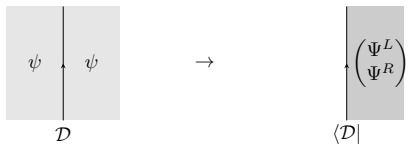
We construct a family of non-invertible topological defects in two-dimensional theories of n Weyl fermions. The construction relies on the existence of G-symmetric conformal boundary conditions for n Dirac fermions. Upon unfolding, these boundary conditions become topological defects D of n Weyl fermions that intertwine the two G-representations, and they are generically non-invertible. For G=U(1)^n, we show that D is a duality defect associated with gauging a finite Abelian group Γ, and we give an explicit algorithm for determining Γ and its action on the fermions. We also show that the same finite-Abelian gauging description applies in certain restricted examples with non-Abelian G. By the
What carries the argument
The non-invertible topological defect D obtained upon unfolding G-symmetric conformal boundary conditions for n Dirac fermions into n Weyl fermions, which intertwines G-representations.
If this is right
- For U(1)^n symmetries, the defect D is realized as a duality defect from gauging a finite Abelian group Γ.
- An explicit algorithm determines Γ and its action on the fermions.
- The finite-Abelian gauging description extends to some restricted non-Abelian G cases.
- For G=SU(2) in the 1-5-7-8-9 problem, D cannot be a duality defect from gauging any finite Abelian group.
- The duality perspective streamlines the derivation of fermion scattering from a conformal boundary.
Where Pith is reading between the lines
- This method could be extended to classify non-invertible symmetries in other two-dimensional conformal field theories with fermions.
- Applications might include understanding boundary states in condensed matter systems with Weyl fermions.
- The distinction between abelian and non-abelian cases suggests different physical realizations for these defects.
Load-bearing premise
That G-symmetric conformal boundary conditions exist for the n Dirac fermions and can be unfolded to produce the topological defects in the Weyl fermion theory.
What would settle it
An explicit example of a symmetry G for which no G-symmetric conformal boundary conditions exist for the Dirac fermions, or a calculation showing the unfolded defect is invertible rather than non-invertible.
Figures


read the original abstract
We construct a family of non-invertible topological defects in two-dimensional theories of $n$ Weyl fermions. The construction relies on the existence of $G$-symmetric conformal boundary conditions for $n$ Dirac fermions. Upon unfolding, these boundary conditions become topological defects $\mathcal D$ of $n$ Weyl fermions that intertwine the two $G$-representations, and they are generically non-invertible. For $G=U(1)^n$, we show that $\mathcal D$ is a duality defect associated with gauging a finite Abelian group $\Gamma$, and we give an explicit algorithm for determining $\Gamma$ and its action on the fermions. We also show that the same finite-Abelian gauging description applies in certain restricted examples with non-Abelian $G$. By contrast, for certain non-Abelian symmetry structures, including the $G=SU(2)$ symmetry appearing in the $1$-$5$-$7$-$8$-$9$ problem, we prove that $\mathcal D$ cannot be realized as a duality defect for gauging any finite Abelian group. Finally, we explain how the duality-defect perspective gives a streamlined derivation of fermion scattering from a conformal boundary.
Editorial analysis
A structured set of objections, weighed in public.
Referee Report
Summary. The paper constructs a family of non-invertible topological defects D in two-dimensional theories of n Weyl fermions. The construction starts from the existence of G-symmetric conformal boundary conditions on n Dirac fermions; upon unfolding, these become defects that intertwine the two G-representations and are generically non-invertible. For G = U(1)^n the defects are shown to be duality defects obtained by gauging a finite Abelian group Γ, with an explicit algorithm given to determine Γ and its action. The same description applies in certain restricted non-Abelian examples. For G = SU(2) in the 1-5-7-8-9 problem the paper proves that D cannot be realized as an Abelian duality defect. The duality-defect viewpoint is used to streamline the derivation of fermion scattering off a conformal boundary.
Significance. If the central constructions hold, the work supplies a systematic route to non-invertible defects in free-fermion theories and clarifies their relation to duality defects and boundary states. The explicit algorithm for determining Γ in the U(1)^n case and the proof that the SU(2) defect in the 1-5-7-8-9 problem is not an Abelian duality defect are concrete, falsifiable contributions that strengthen the paper. The streamlined scattering derivation is a useful application.
major comments (2)
- [§2] The central construction (abstract and §2) assumes the existence of G-symmetric conformal boundary conditions for n Dirac fermions without providing a general construction or classification for arbitrary G. This assumption is load-bearing: if such boundary conditions do not exist or fail to be conformal while preserving the full G action, the unfolding step does not produce the claimed topological defects D. The paper supplies an explicit algorithm only for G = U(1)^n and a counter-example for one non-Abelian case; a general existence proof or additional explicit constructions would be required to support the family of defects for general G.
- [§4.2] §4.2, the proof that the SU(2) defect in the 1-5-7-8-9 problem cannot be realized as an Abelian duality defect: the argument relies on representation-theoretic obstructions, but the precise matching between the unfolded defect and the would-be gauging data is not spelled out in sufficient detail to verify that all possible finite Abelian groups have been ruled out.
minor comments (2)
- [§3] Notation for the two G-representations that the defect intertwines is introduced without a dedicated table or diagram; adding one would improve readability when comparing Abelian and non-Abelian cases.
- [§5] The scattering derivation in §5 re-derives known results; a short comparison table with the original boundary-state calculation would make the streamlining benefit more transparent.
Simulated Author's Rebuttal
We thank the referee for the careful reading of our manuscript and the constructive comments. We respond to each major comment below and indicate the revisions we will make.
read point-by-point responses
-
Referee: [§2] The central construction (abstract and §2) assumes the existence of G-symmetric conformal boundary conditions for n Dirac fermions without providing a general construction or classification for arbitrary G. This assumption is load-bearing: if such boundary conditions do not exist or fail to be conformal while preserving the full G action, the unfolding step does not produce the claimed topological defects D. The paper supplies an explicit algorithm only for G = U(1)^n and a counter-example for one non-Abelian case; a general existence proof or additional explicit constructions would be required to support the family of defects for general G.
Authors: We agree that the general construction is conditional on the existence of G-symmetric conformal boundary conditions. The manuscript provides a complete, explicit algorithm for the case G = U(1)^n (the primary family) together with concrete non-Abelian illustrations and one counter-example. A full classification of such boundaries for arbitrary G is a separate, extensive problem that lies beyond the present scope. In the revision we will add an explicit statement that the defects D are constructed whenever G-symmetric conformal boundaries exist, and we will emphasize the concrete results already obtained for U(1)^n and the restricted non-Abelian examples. revision: partial
-
Referee: [§4.2] §4.2, the proof that the SU(2) defect in the 1-5-7-8-9 problem cannot be realized as an Abelian duality defect: the argument relies on representation-theoretic obstructions, but the precise matching between the unfolded defect and the would-be gauging data is not spelled out in sufficient detail to verify that all possible finite Abelian groups have been ruled out.
Authors: We thank the referee for this observation. In the revised manuscript we will expand §4.2 to spell out the matching in greater detail: we will explicitly compare the representation content and fusion rules of the unfolded SU(2) defect against the possible actions of any finite Abelian group Γ, showing why no such Γ can reproduce the required intertwining. This will make the representation-theoretic obstructions fully explicit and confirm that all candidate Abelian gaugings are excluded. revision: yes
Circularity Check
No significant circularity; construction is one-way from assumed boundary conditions
full rationale
The paper's central construction explicitly takes the existence of G-symmetric conformal boundary conditions on n Dirac fermions as an external input, then unfolds them to produce the claimed non-invertible defects D on n Weyl fermions. This is a forward derivation rather than a self-referential loop. For G=U(1)^n an explicit algorithm determines the gauging group Gamma; for selected non-Abelian cases the paper proves non-realizability as Abelian duality defects. No quoted step reduces a prediction or first-principles result to a fitted parameter, self-citation, or definitional renaming of the output itself. The derivation therefore remains self-contained against the stated external benchmark of boundary-condition existence.
Axiom & Free-Parameter Ledger
axioms (1)
- domain assumption Existence of G-symmetric conformal boundary conditions for n Dirac fermions
Lean theorems connected to this paper
-
IndisputableMonolith/Foundation/AlexanderDuality.leanalexander_duality_circle_linking unclear?
unclearRelation between the paper passage and the cited Recognition theorem.
The construction relies on the existence of G-symmetric conformal boundary conditions for n Dirac fermions. Upon unfolding, these boundary conditions become topological defects D of n Weyl fermions that intertwine the two G-representations
-
IndisputableMonolith/Cost/FunctionalEquation.leanwashburn_uniqueness_aczel unclear?
unclearRelation between the paper passage and the cited Recognition theorem.
D is a duality defect associated with gauging a finite Abelian group Γ, and we give an explicit algorithm for determining Γ
What do these tags mean?
- matches
- The paper's claim is directly supported by a theorem in the formal canon.
- supports
- The theorem supports part of the paper's argument, but the paper may add assumptions or extra steps.
- extends
- The paper goes beyond the formal theorem; the theorem is a base layer rather than the whole result.
- uses
- The paper appears to rely on the theorem as machinery.
- contradicts
- The paper's claim conflicts with a theorem or certificate in the canon.
- unclear
- Pith found a possible connection, but the passage is too broad, indirect, or ambiguous to say the theorem truly supports the claim.
Reference graph
Works this paper leans on
-
[1]
D. Gaiotto, A. Kapustin, N. Seiberg, and B. Willett,Generalized Global Symmetries, JHEP02(2015) 172, [arXiv:1412.5148]
work page internal anchor Pith review Pith/arXiv arXiv 2015
-
[2]
Lectures on Generalized Symmetries
L. Bhardwaj, L. E. Bottini, L. Fraser-Taliente, L. Gladden, D. S. W. Gould, A. Platschorre, and H. Tillim,Lectures on generalized symmetries,Phys. Rept.1051 (2024) 1–87, [arXiv:2307.07547]
work page internal anchor Pith review Pith/arXiv arXiv 2024
-
[3]
S.-H. Shao,What’s Done Cannot Be Undone: TASI Lectures on Non-Invertible Symmetries, inTheoretical Advanced Study Institute in Elementary Particle Physics 2023: Aspects of Symmetry, 8, 2023.arXiv:2308.00747
work page internal anchor Pith review Pith/arXiv arXiv 2023
- [4]
-
[5]
ICTP Lectures on (Non-)Invertible Generalized Symmetries
S. Schafer-Nameki,ICTP lectures on (non-)invertible generalized symmetries,Phys. Rept.1063(2024) 1–55, [arXiv:2305.18296]
work page internal anchor Pith review Pith/arXiv arXiv 2024
-
[6]
Iqbal,Lectures on Generalized Global Symmetries
N. Iqbal,Lectures on Generalized Global Symmetries. SpringerBriefs in Physics. Springer Cham, 8, 2025
work page 2025
-
[7]
Kaidi,Introduction to Generalized Symmetries,arXiv:2603.08798
J. Kaidi,Introduction to Generalized Symmetries,arXiv:2603.08798
-
[8]
E. P. Verlinde,Fusion Rules and Modular Transformations in 2D Conformal Field Theory,Nucl. Phys. B300(1988) 360–376
work page 1988
-
[9]
P. H. Ginsparg,Curiosities at c = 1,Nucl. Phys. B295(1988) 153–170
work page 1988
-
[10]
P. H. Ginsparg,APPLIED CONFORMAL FIELD THEORY, inLes Houches Summer School in Theoretical Physics: Fields, Strings, Critical Phenomena, 9, 1988. hep-th/9108028
work page internal anchor Pith review Pith/arXiv arXiv 1988
-
[11]
R. Thorngren and Y. Wang,Fusion Category Symmetry II: Categoriosities atc= 1 and Beyond,arXiv:2106.12577
-
[12]
Topological defects for the free boson CFT
J. Fuchs, M. R. Gaberdiel, I. Runkel, and C. Schweigert,Topological defects for the free boson CFT,J. Phys. A40(2007) 11403, [arXiv:0705.3129]
work page internal anchor Pith review Pith/arXiv arXiv 2007
-
[13]
D. Delmastro, A. Sharon, and Y. Zheng,Non-local conserved currents and continuous non-invertible symmetries,JHEP11(2025) 072, [arXiv:2507.22976]
-
[14]
S. M¨ oller and B. C. Rayhaun,Equivalence Relations on Vertex Operator Algebras, II: Witt Equivalence and Orbifolds,arXiv:2410.18166. 34
- [15]
-
[16]
B. Rayhaun,When can two QFTs be separated by a topological interface?,YITP-IAS (Kyushu Univ.) Workshop: Interfaces and Symmetry.(2026)
work page 2026
-
[17]
Holomorphic Vertex Operator Algebras of Small Central Charges
C. Dong and G. Mason,Holomorphic Vertex Operator Algebras of Small Central Charges,arXiv Mathematics e-prints(Feb., 2002) math/0203005, [math/0203005]
work page internal anchor Pith review Pith/arXiv arXiv 2002
-
[18]
A. N. Schellekens,Meromorphic C = 24 conformal field theories,Commun. Math. Phys.153(1993) 159–186, [hep-th/9205072]
work page internal anchor Pith review Pith/arXiv arXiv 1993
-
[19]
J. van Ekeren, S. M¨ oller, and N. R. Scheithauer,Construction and classification of holomorphic vertex operator algebras,J. Reine Angew. Math.2020(2020), no. 759 61–99
work page 2020
-
[20]
S. M¨ oller and N. R. Scheithauer,Dimension formulae and generalised deep holes of the Leech lattice vertex operator algebra.,Ann. Math. (2)197(2023), no. 1 221–288, [arXiv:1910.04947]
-
[21]
J. van Ekeren, C. H. Lam, S. M¨ oller, and H. Shimakura,Schellekens’ list and the very strange formula,Adv. Math.380(2021) 107567, [arXiv:2005.12248]
-
[22]
G. H¨ ohn and S. M¨ oller,Systematic orbifold constructions of Schellekens’ vertex operator algebras from Niemeier lattices,J. Lond. Math. Soc.106(2022), no. 4 3162–3207, [arXiv:2010.00849]
-
[23]
P. Boyle Smith, Y.-H. Lin, Y. Tachikawa, and Y. Zheng,Classification of chiral fermionic CFTs of central charge≤16,SciPost Phys.16(2024), no. 2 058, [arXiv:2303.16917]
- [24]
-
[25]
G. H¨ ohn and S. M¨ oller,Classification of Self-Dual Vertex Operator Superalgebras of Central Charge at Most 24,arXiv:2303.17190
-
[26]
Y. Tachikawa, K. Tsuji, and M. Watanabe,What happens to wavepackets of fermions when scattered by the Maldacena-Ludwig wall?,arXiv:2603.25508
-
[27]
C. Cordova, D. Garc´ ıa-Sep´ ulveda, and J. A. Harvey,Generalized Level-Rank Duality, Holomorphic Conformal Field Theory, and Non-Invertible Anyon Condensation, arXiv:2512.24419
- [28]
- [29]
-
[30]
A. Antinucci, C. Copetti, G. Galati, and G. Rizi,Defect Conformal Manifolds from Phantom Noninvertible Symmetries,Phys. Rev. Lett.135(2025), no. 21 211602, [arXiv:2505.09668]
- [31]
-
[32]
Watanabe,IPMU seminar: Callan-Rubakov effect and non-invertible defects.,
M. Watanabe,IPMU seminar: Callan-Rubakov effect and non-invertible defects.,
-
[33]
Non-Invertible Symmetries and Boundaries for Two-Dimensional Fermions
G. Arias-Tamargo, P. Boyle Smith, R. Mouland, and M. L. V. C. Hutt,Non-Invertible Symmetries and Boundaries for Two-Dimensional Fermions,arXiv:2605.13952
work page internal anchor Pith review Pith/arXiv arXiv
-
[34]
A Twist on Scattering from Defect Anomalies
A. Antinucci, C. Copetti, G. Galati, and G. Rizi,A Twist on Scattering from Defect Anomalies,arXiv:2605.13961
work page internal anchor Pith review Pith/arXiv arXiv
-
[35]
J. M. Maldacena and A. W. W. Ludwig,Majorana fermions, exact mapping between quantum impurity fixed points with four bulk fermion species, and solution of the ’unitarity puzzle’,Nucl. Phys. B506(1997) 565–588, [cond-mat/9502109]
work page internal anchor Pith review Pith/arXiv arXiv 1997
- [36]
- [37]
- [38]
-
[39]
M. van Beest, P. Boyle Smith, D. Delmastro, Z. Komargodski, and D. Tong, Monopoles, scattering, and generalized symmetries,JHEP03(2025) 014, [arXiv:2306.07318]
-
[40]
B. Han, A. Tiwari, C.-T. Hsieh, and S. Ryu,Boundary conformal field theory and symmetry protected topological phases in2 + 1dimensions,Phys. Rev. B96(2017), no. 12 125105, [arXiv:1704.01193]
work page internal anchor Pith review Pith/arXiv arXiv 2017
- [41]
- [42]
-
[43]
't Hooft anomalies and boundaries
K. Jensen, E. Shaverin, and A. Yarom,’t Hooft anomalies and boundaries,JHEP01 (2018) 085, [arXiv:1710.07299]
work page internal anchor Pith review Pith/arXiv arXiv 2018
-
[44]
K. Kikuchi and Y. Zhou,Two-dimensional Anomaly, Orbifolding, and Boundary States,arXiv:1908.02918. 36
-
[45]
R. Thorngren and Y. Wang,Anomalous symmetries end at the boundary,JHEP09 (2021) 017, [arXiv:2012.15861]
- [46]
-
[47]
M. van Beest, P. Boyle Smith, D. Delmastro, R. Mouland, and D. Tong, Fermion-monopole scattering in the Standard Model,JHEP08(2024) 004, [arXiv:2312.17746]
- [48]
- [49]
- [50]
- [51]
-
[52]
C. G. Callan, Jr.,Monopole Catalysis of Baryon Decay,Nucl. Phys. B212(1983) 391–400
work page 1983
-
[53]
V. A. Rubakov,Adler-Bell-Jackiw Anomaly and Fermion Number Breaking in the Presence of a Magnetic Monopole,Nucl. Phys. B203(1982) 311–348
work page 1982
- [54]
- [55]
-
[56]
S. Bolognesi, B. Bucciotti, and A. Luzio,Monopole-fermion scattering in a chiral gauge theory,Phys. Rev. D110(2024), no. 12 125017, [arXiv:2406.15552]
-
[57]
O. Diatlyk, C. Luo, Y. Wang, and Q. Weller,Gauging non-invertible symmetries: topological interfaces and generalized orbifold groupoid in 2d QFT,JHEP03(2024) 127, [arXiv:2311.17044]
-
[58]
J. Wang and X.-G. Wen,A Solution to the 1+1D Gauged Chiral Fermion Problem, Phys. Rev. D99(7, 2018) 111501, [arXiv:1807.05998]
-
[59]
Y. Fukusumi, Y. Tachikawa, and Y. Zheng,Fermionization and boundary states in 1+1 dimensions,SciPost Phys.11(2021), no. 4 082, [arXiv:2103.00746]
- [60]
-
[61]
H. Ebisu and M. Watanabe,Fermionization of conformal boundary states,Phys. Rev. B104(2021), no. 19 195124, [arXiv:2103.01101]
-
[62]
A classifying algebra for boundary conditions
J. Fuchs and C. Schweigert,A Classifying algebra for boundary conditions,Phys. Lett. B414(1997) 251–259, [hep-th/9708141]
work page internal anchor Pith review Pith/arXiv arXiv 1997
-
[63]
Boundaries, crosscaps and simple currents
J. Fuchs, L. R. Huiszoon, A. N. Schellekens, C. Schweigert, and J. Walcher, Boundaries, crosscaps and simple currents,Phys. Lett. B495(2000) 427–434, [hep-th/0007174]
work page internal anchor Pith review Pith/arXiv arXiv 2000
-
[64]
TFT construction of RCFT correlators III: Simple currents
J. Fuchs, I. Runkel, and C. Schweigert,TFT construction of RCFT correlators. 3. Simple currents,Nucl. Phys. B694(2004) 277–353, [hep-th/0403157]
work page internal anchor Pith review Pith/arXiv arXiv 2004
-
[65]
P. Boyle Smith,SMG=MG,Symmetric mass generation, topological phases and lattice chiral gauge theories, SCGP workshop(2024)
work page 2024
-
[66]
K. Hori, S. Katz, A. Klemm, R. Pandharipande, R. Thomas, C. Vafa, R. Vakil, and E. Zaslow,Mirror symmetry, vol. 1 ofClay mathematics monographs. AMS, Providence, USA, 2003. 38
work page 2003
discussion (0)
Sign in with ORCID, Apple, or X to comment. Anyone can read and Pith papers without signing in.