Quantum End-to-End Learning for Contextual Combinatorial Optimization
Pith reviewed 2026-05-21 09:02 UTC · model grok-4.3
The pith
A quantum end-to-end learning framework solves contextual combinatorial optimization with substantially fewer parameters than classical methods.
A machine-rendered reading of the paper's core claim, the machinery that carries it, and where it could break.
Core claim
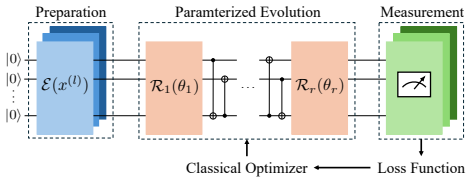
QEL is the first quantum computing-based end-to-end learning framework for CCO that leverages Quantum Approximate Optimization Algorithms. Inspired by data re-uploading, it proposes a context re-uploading phase-separator that jointly captures the complex relations among contexts, uncertain coefficients, and optimal solutions. This allows a contextual encoder to be seamlessly integrated within a quantum surrogate policy, enabling joint end-to-end training with a stationarity guarantee while directly training on task loss despite discreteness and nonconvexity and avoiding calls to NP-hard optimization solvers.
What carries the argument
Context re-uploading phase-separator that jointly encodes relations among contexts, uncertain coefficients, and optimal solutions inside a quantum surrogate policy for QAOA-based end-to-end training.
If this is right
- Direct training on task loss becomes possible even when the underlying combinatorial problem is discrete and nonconvex.
- Competitive solution quality is obtained with substantially fewer parameters than classical end-to-end or surrogate baselines.
- Calls to NP-hard optimization solvers are avoided throughout the training loop.
- An optimization-aware structure grounded in physical principles of quantum evolution is exploited that classical networks do not access as directly.
Where Pith is reading between the lines
- If hardware noise remains manageable, the same re-uploading construction could be tested on larger-scale logistics or scheduling instances where parameter count is a practical bottleneck.
- The stationarity guarantee may allow the method to serve as a stable policy inside larger reinforcement-learning loops for sequential decision making under uncertainty.
- Hybrid pipelines could combine the quantum surrogate with classical feature extractors to handle very high-dimensional context vectors before feeding them into the phase-separator.
Load-bearing premise
The context re-uploading phase-separator can jointly capture complex relations among contexts, uncertain coefficients, and optimal solutions.
What would settle it
A controlled benchmark experiment in which QEL is trained on the same CCO instances as classical baselines and is found to require more parameters or lower solution quality while still needing external solver calls during training.
Figures

read the original abstract
Contextual combinatorial optimization (CCO) plays a critical role in decision-making under uncertainty, yet remains a significant challenge. We present Quantum End-to-End Learning (QEL), the first quantum computing-based end-to-end learning framework for CCO that leverages Quantum Approximate Optimization Algorithms. Inspired by the integration of state preparation and evolution in data re-uploading, we propose a context re-uploading phase-separator that jointly captures the complex relations among contexts, uncertain coefficients, and optimal solutions. This allows a contextual encoder to be seamlessly integrated within a quantum surrogate policy, enabling joint end-to-end training with a stationarity guarantee. Exploiting an optimization-aware structure grounded in physical principles that classical methods cannot readily leverage, our approach demonstrates practicality by directly training on task loss despite the discreteness and nonconvexity, while avoiding calls to NP-hard optimization solvers. QEL empirically achieves competitive performance while requiring substantially fewer parameters than classical benchmarks, highlighting its industrial-level potential for the future quantum era.
Editorial analysis
A structured set of objections, weighed in public.
Referee Report
Summary. The paper proposes Quantum End-to-End Learning (QEL), the first quantum end-to-end framework for contextual combinatorial optimization (CCO) based on QAOA. It introduces a context re-uploading phase-separator to jointly encode contexts, uncertain coefficients, and solutions within a quantum surrogate policy, enabling direct training on task loss with a claimed stationarity guarantee while avoiding external NP-hard solvers and achieving competitive performance with substantially fewer parameters than classical benchmarks.
Significance. If the stationarity guarantee and the joint encoding capability of the context re-uploading phase-separator are rigorously established, the work could offer a meaningful route toward parameter-efficient, differentiable quantum policies for decision-making under uncertainty that classical methods cannot easily replicate. The grounding in physical principles and avoidance of solver calls would be notable strengths for practical quantum optimization.
major comments (2)
- [Method section (context re-uploading phase-separator)] The central claim that the context re-uploading phase-separator enables a differentiable quantum surrogate policy supporting direct end-to-end training on task loss with a stationarity guarantee (despite discreteness and nonconvexity) is load-bearing, yet the manuscript provides no explicit characterization of the representable function class, no derivation of the stationarity condition, and no proof sketch that the QAOA evolution yields stationary points under the chosen loss. This appears in the method description following the abstract.
- [Empirical results / Experiments] The empirical claim of competitive performance with substantially fewer parameters than classical benchmarks is presented without specific datasets, quantitative metrics, error bars, ablation studies isolating the re-uploading component, or cross-validation details. This undermines assessment of the performance and parameter-efficiency advantages reported in the abstract.
minor comments (1)
- [Preliminaries / Model definition] Notation for the variational parameters and QAOA layer depth is introduced without a clear table or equation summarizing the free parameters versus the invented context re-uploading operator.
Simulated Author's Rebuttal
We thank the referee for their detailed and constructive comments on our manuscript. We believe the suggested revisions will help clarify the key contributions of the Quantum End-to-End Learning (QEL) framework. We address each major comment below.
read point-by-point responses
-
Referee: [Method section (context re-uploading phase-separator)] The central claim that the context re-uploading phase-separator enables a differentiable quantum surrogate policy supporting direct end-to-end training on task loss with a stationarity guarantee (despite discreteness and nonconvexity) is load-bearing, yet the manuscript provides no explicit characterization of the representable function class, no derivation of the stationarity condition, and no proof sketch that the QAOA evolution yields stationary points under the chosen loss. This appears in the method description following the abstract.
Authors: We thank the referee for highlighting this important point. While the manuscript introduces the context re-uploading phase-separator and states the stationarity guarantee, we agree that an explicit characterization and derivation would strengthen the presentation. In the revised manuscript, we will add a new subsection detailing the representable function class for the phase-separator, provide a derivation of the stationarity condition derived from the QAOA circuit and the task-specific loss, and include a proof sketch demonstrating that the quantum evolution under this setup yields stationary points. This will rigorously support the end-to-end training claims. revision: yes
-
Referee: [Empirical results / Experiments] The empirical claim of competitive performance with substantially fewer parameters than classical benchmarks is presented without specific datasets, quantitative metrics, error bars, ablation studies isolating the re-uploading component, or cross-validation details. This undermines assessment of the performance and parameter-efficiency advantages reported in the abstract.
Authors: We appreciate the referee's feedback on the empirical evaluation. The current manuscript does include experimental results demonstrating competitive performance with fewer parameters, but we acknowledge that additional details would improve clarity and reproducibility. In the revised version, we will expand the experimental section to specify the datasets used, report quantitative metrics with error bars from multiple independent runs, include ablation studies that isolate the effect of the context re-uploading phase-separator, and provide details on the cross-validation procedure employed. These additions will better substantiate the reported advantages. revision: yes
Circularity Check
No significant circularity; derivation is self-contained and externally benchmarked.
full rationale
The paper constructs a new QEL framework by extending QAOA with a proposed context re-uploading phase-separator, grounding the stationarity guarantee and end-to-end training directly in the circuit architecture and physical principles rather than any fitted parameter renamed as prediction or self-citation chain. Performance claims rest on empirical comparisons to external classical benchmarks with fewer parameters, not on quantities defined in terms of themselves. No load-bearing step reduces by construction to its own inputs, and the central architectural assumption is presented as a novel proposal open to verification rather than imported uniqueness or ansatz from overlapping prior work.
Axiom & Free-Parameter Ledger
free parameters (1)
- QAOA layer depth and variational parameters
axioms (1)
- domain assumption QAOA can be extended via context re-uploading to serve as a trainable surrogate policy for contextual combinatorial problems.
invented entities (1)
-
context re-uploading phase-separator
no independent evidence
Lean theorems connected to this paper
-
IndisputableMonolith/Cost/FunctionalEquation.leanwashburn_uniqueness_aczel unclear?
unclearRelation between the paper passage and the cited Recognition theorem.
We propose a context re-uploading phase-separator that jointly captures the complex relations among contexts, uncertain coefficients, and optimal solutions... U(θ_I, θ_F) = ∏ exp[-i θ_k^I H_I] exp[-i θ_k^F Ĥ_F]
-
IndisputableMonolith/Foundation/RealityFromDistinction.leanreality_from_one_distinction unclear?
unclearRelation between the paper passage and the cited Recognition theorem.
Theorem 3.2 (Convergence to stationarity)... lim E[‖∇L(ϕ_t)‖²] = 0
What do these tags mean?
- matches
- The paper's claim is directly supported by a theorem in the formal canon.
- supports
- The theorem supports part of the paper's argument, but the paper may add assumptions or extra steps.
- extends
- The paper goes beyond the formal theorem; the theorem is a base layer rather than the whole result.
- uses
- The paper appears to rely on the theorem as machinery.
- contradicts
- The paper's claim conflicts with a theorem or certificate in the canon.
- unclear
- Pith found a possible connection, but the passage is too broad, indirect, or ambiguous to say the theorem truly supports the claim.
Reference graph
Works this paper leans on
-
[1]
Akshay Agrawal, Robin Verschueren, Steven Diamond, and Stephen Boyd. A rewriting system for convex optimization problems.Journal of Control and Decision, 5(1):42–60, 2018
work page 2018
-
[2]
Akshay Agrawal, Brandon Amos, Shane Barratt, Stephen Boyd, Steven Diamond, and J. Zico Kolter. Differentiable convex optimization layers. In H. Wallach, H. Larochelle, A. Beygelzimer, F. d'Alché-Buc, E. Fox, and R. Garnett, editors,Advances in Neural Information Processing Systems, volume 32. Curran Associates, Inc., 2019
work page 2019
-
[3]
Adiabatic quantum computation.Reviews of Modern Physics, 90(1):015002, 2018
Tameem Albash and Daniel A Lidar. Adiabatic quantum computation.Reviews of Modern Physics, 90(1):015002, 2018
work page 2018
-
[4]
Brandon Amos and J. Zico Kolter. OptNet: Differentiable optimization as a layer in neural networks. In Doina Precup and Yee Whye Teh, editors,Proceedings of the 34th International Conference on Machine Learning, volume 70 ofProceedings of Machine Learning Research, pages 136–145. PMLR, 06–11 Aug 2017
work page 2017
-
[5]
Gah-Yi Ban and Cynthia Rudin. The big data newsvendor: Practical insights from machine learning.Operations Research, 67(1):90–108, 2019
work page 2019
-
[6]
Francisco Barahona. On the computational complexity of Ising spin glass models.Journal of Physics A: Mathematical and General, 15(10):3241, 1982
work page 1982
-
[7]
PennyLane: Automatic differentiation of hybrid quantum-classical computations
Ville Bergholm, Josh Izaac, Maria Schuld, Christian Gogolin, Shahnawaz Ahmed, Vishnu Ajith, M. Sohaib Alam, Guillermo Alonso-Linaje, B. AkashNarayanan, Ali Asadi, Juan Miguel Arrazola, Utkarsh Azad, Sam Banning, Carsten Blank, Thomas R Bromley, Benjamin A. Cordier, Jack Ceroni, Alain Delgado, Olivia Di Matteo, Amintor Dusko, Tanya Garg, Diego Guala, Antho...
work page internal anchor Pith review Pith/arXiv arXiv 2018
-
[8]
Kostas Blekos, Dean Brand, Andrea Ceschini, Chiao-Hui Chou, Rui-Hao Li, Komal Pandya, and Alessandro Summer. A review on quantum approximate optimization algorithm and its variants.Physics Reports, 1068:1–66, 2024
work page 2024
-
[9]
Sebastian Brandhofer, Daniel Braun, Vanessa Dehn, Gerhard Hellstern, Matthias Hüls, Yanjun Ji, Ilia Polian, Amandeep Singh Bhatia, and Thomas Wellens. Benchmarking the performance of portfolio optimization with QAOA.Quantum Information Processing, 22(1):25, 2022
work page 2022
-
[10]
Variational quantum algorithms.Nature Reviews Physics, 3(9):625–644, 2021
Marco Cerezo, Andrew Arrasmith, Ryan Babbush, Simon C Benjamin, Suguru Endo, Keisuke Fujii, Jarrod R McClean, Kosuke Mitarai, Xiao Yuan, Lukasz Cincio, et al. Variational quantum algorithms.Nature Reviews Physics, 3(9):625–644, 2021
work page 2021
-
[11]
Kottmann, and Alán Aspuru-Guzik
Alba Cervera-Lierta, Jakob S. Kottmann, and Alán Aspuru-Guzik. Meta-variational quantum eigensolver: Learning energy profiles of parameterized hamiltonians for quantum simulation. PRX Quantum, 2:020329, May 2021
work page 2021
-
[12]
Nicholas Chancellor, Stefan Zohren, and Paul A Warburton. Circuit design for multi-body interactions in superconducting quantum annealing systems with applications to a scalable architecture.npj Quantum Information, 3(1):21, 2017
work page 2017
-
[13]
Steven Diamond and Stephen Boyd. CVXPY: A Python-embedded modeling language for convex optimization.Journal of Machine Learning Research, 17(83):1–5, 2016. 10
work page 2016
-
[14]
Priya Donti, Brandon Amos, and J. Zico Kolter. Task-based end-to-end model learning in stochastic optimization. In I. Guyon, U. V on Luxburg, S. Bengio, H. Wallach, R. Fergus, S. Vishwanathan, and R. Garnett, editors,Advances in Neural Information Processing Systems, volume 30. Curran Associates, Inc., 2017
work page 2017
-
[15]
Adam N. Elmachtoub and Paul Grigas. Smart “predict, then optimize”.Management Science, 68(1):9–26, 2022
work page 2022
-
[16]
Quantum Computation by Adiabatic Evolution
Edward Farhi, Jeffrey Goldstone, Sam Gutmann, and Michael Sipser. Quantum computation by adiabatic evolution.arXiv preprint quant-ph/0001106, 2000
work page internal anchor Pith review Pith/arXiv arXiv 2000
-
[17]
A Quantum Approximate Optimization Algorithm
Edward Farhi, Jeffrey Goldstone, and Sam Gutmann. A quantum approximate optimization algorithm.arXiv preprint arXiv:1411.4028, 2014
work page internal anchor Pith review Pith/arXiv arXiv 2014
-
[18]
SurCo: Learning linear SURrogates for COmbinatorial nonlinear optimization problems
Aaron M Ferber, Taoan Huang, Daochen Zha, Martin Schubert, Benoit Steiner, Bistra Dilk- ina, and Yuandong Tian. SurCo: Learning linear SURrogates for COmbinatorial nonlinear optimization problems. In Andreas Krause, Emma Brunskill, Kyunghyun Cho, Barbara En- gelhardt, Sivan Sabato, and Jonathan Scarlett, editors,Proceedings of the 40th International Confe...
work page 2023
-
[19]
Benchmarking PtO and PnO methods in the predictive combinatorial optimization regime
Haoyu Geng, Hang Ruan, Runzhong Wang, Yang Li, Yang Wang, Lei Chen, and Junchi Yan. Benchmarking PtO and PnO methods in the predictive combinatorial optimization regime. In A. Globerson, L. Mackey, D. Belgrave, A. Fan, U. Paquet, J. Tomczak, and C. Zhang, editors, Advances in Neural Information Processing Systems, volume 37, pages 65944–65971. Curran Asso...
work page 2024
-
[20]
Adam Glos, Aleksandra Krawiec, and Zoltán Zimborás. Space-efficient binary optimization for variational quantum computing.npj Quantum Information, 8(1):39, 2022
work page 2022
-
[21]
Cambridge University Press, third edition edition, 2018
David J Griffiths and Darrell F Schroeter.Introduction to quantum mechanics. Cambridge University Press, third edition edition, 2018
work page 2018
-
[22]
Gurobi Optimizer Reference Manual, 2025
Gurobi Optimization, LLC. Gurobi Optimizer Reference Manual, 2025. URL https://www. gurobi.com
work page 2025
-
[23]
Stuart Hadfield, Tad Hogg, and Eleanor G Rieffel. Analytical framework for quantum alternating operator ansätze.Quantum Science and Technology, 8(1):015017, dec 2022
work page 2022
-
[24]
Supervised learning with quantum-enhanced feature spaces.Nature, 567(7747):209–212, 2019
V ojtˇech Havlíˇcek, Antonio D Córcoles, Kristan Temme, Aram W Harrow, Abhinav Kandala, Jerry M Chow, and Jay M Gambetta. Supervised learning with quantum-enhanced feature spaces.Nature, 567(7747):209–212, 2019
work page 2019
-
[25]
Multi-angle quantum approximate optimization algorithm.Scientific Reports, 12(1):6781, 2022
Rebekah Herrman, Phillip C Lotshaw, James Ostrowski, Travis S Humble, and George Siopsis. Multi-angle quantum approximate optimization algorithm.Scientific Reports, 12(1):6781, 2022
work page 2022
-
[26]
Angel A. Juan, Javier Faulin, Scott E. Grasman, Markus Rabe, and Gonçalo Figueira. A review of simheuristics: Extending metaheuristics to deal with stochastic combinatorial optimization problems.Operations Research Perspectives, 2:62–72, 2015
work page 2015
-
[27]
Adam: A Method for Stochastic Optimization
Diederik P. Kingma and Jimmy Ba. Adam: A method for stochastic optimization.arXiv preprint arXiv:1412.6980, 2017
work page internal anchor Pith review Pith/arXiv arXiv 2017
-
[28]
Katerina Lepenioti, Alexandros Bousdekis, Dimitris Apostolou, and Gregoris Mentzas. Prescrip- tive analytics: Literature review and research challenges.International Journal of Information Management, 50:57–70, 2020
work page 2020
-
[29]
Junyu Liu, Frederik Wilde, Antonio Anna Mele, Xin Jin, Liang Jiang, and Jens Eisert. Stochastic noise can be helpful for variational quantum algorithms.Physical Review A, 111:052441, 2025
work page 2025
-
[30]
Yunchao Liu, Srinivasan Arunachalam, and Kristan Temme. A rigorous and robust quantum speed-up in supervised machine learning.Nature Physics, 17(9):1013–1017, 2021
work page 2021
-
[31]
Universal quantum simulators.Science, 273(5278):1073–1078, 1996
Seth Lloyd. Universal quantum simulators.Science, 273(5278):1073–1078, 1996. 11
work page 1996
-
[32]
Quantum approximate optimization is computationally universal
Seth Lloyd. Quantum approximate optimization is computationally universal.arXiv preprint arXiv:1812.11075, 2018
work page internal anchor Pith review Pith/arXiv arXiv 2018
-
[33]
Quantum algorithms for supervised and unsupervised machine learning
Seth Lloyd, Masoud Mohseni, and Patrick Rebentrost. Quantum algorithms for supervised and unsupervised machine learning.arXiv preprint arXiv:1307.0411, 2013
work page internal anchor Pith review Pith/arXiv arXiv 2013
-
[34]
Ising formulations of many NP problems.Frontiers in Physics, 2:5, 2014
Andrew Lucas. Ising formulations of many NP problems.Frontiers in Physics, 2:5, 2014
work page 2014
-
[35]
Jayanta Mandi, Emir Demirovi ´c, Peter J. Stuckey, and Tias Guns. Smart predict-and-optimize for hard combinatorial optimization problems.Proceedings of the AAAI Conference on Artificial Intelligence, 34(02):1603–1610, Apr. 2020
work page 2020
-
[36]
Decision- focused learning: Through the lens of learning to rank
Jayanta Mandi, Víctor Bucarey, Maxime Mulamba Ke Tchomba, and Tias Guns. Decision- focused learning: Through the lens of learning to rank. In Kamalika Chaudhuri, Stefanie Jegelka, Le Song, Csaba Szepesvari, Gang Niu, and Sivan Sabato, editors,Proceedings of the 39th International Conference on Machine Learning, volume 162 ofProceedings of Machine Learning...
work page 2022
-
[37]
Jayanta Mandi, James Kotary, Senne Berden, Maxime Mulamba, Victor Bucarey, Tias Guns, and Ferdinando Fioretto. Decision-focused learning: Foundations, state of the art,benchmark and future opportunities.Journal of Artificial Intelligence Research, 80:1623–1701, 2024
work page 2024
-
[38]
Andrea Mari, Thomas R. Bromley, and Nathan Killoran. Estimating the gradient and higher- order derivatives on quantum hardware.Phys. Rev. A, 103:012405, 2021
work page 2021
-
[39]
Jarrod R McClean, Jonathan Romero, Ryan Babbush, and Alán Aspuru-Guzik. The theory of variational hybrid quantum-classical algorithms.New Journal of Physics, 18(2):023023, feb 2016
work page 2016
-
[40]
Mauro ES Morales, Jacob D Biamonte, and Zoltán Zimborás. On the universality of the quantum approximate optimization algorithm.Quantum Information Processing, 19(9):291, 2020
work page 2020
-
[41]
PyTorch: An imperative style, high- performance deep learning library
Adam Paszke, Sam Gross, Francisco Massa, Adam Lerer, James Bradbury, Gregory Chanan, Trevor Killeen, Zeming Lin, Natalia Gimelshein, Luca Antiga, Alban Desmaison, Andreas Kopf, Edward Yang, Zachary DeVito, Martin Raison, Alykhan Tejani, Sasank Chilamkurthy, Benoit Steiner, Lu Fang, Junjie Bai, and Soumith Chintala. PyTorch: An imperative style, high- perf...
work page 2019
-
[42]
Elijah Pelofske, Andreas Bärtschi, and Stephan Eidenbenz. Short-depth QAOA circuits and quantum annealing on higher-order ising models.npj Quantum Information, 10(1):30, 2024
work page 2024
-
[43]
Data re- uploading for a universal quantum classifier.Quantum, 4:226, 2020
Adrián Pérez-Salinas, Alba Cervera-Lierta, Elies Gil-Fuster, and José I Latorre. Data re- uploading for a universal quantum classifier.Quantum, 4:226, 2020
work page 2020
-
[44]
One qubit as a universal approximant.Physical Review A, 104(1):012405, 2021
Adrián Pérez-Salinas, David López-Núñez, Artur García-Sáez, Pol Forn-Díaz, and José I Latorre. One qubit as a universal approximant.Physical Review A, 104(1):012405, 2021
work page 2021
-
[45]
A convergence theorem for non negative almost supermartingales and some applications
Herbert Robbins and David Siegmund. A convergence theorem for non negative almost supermartingales and some applications. In Jagdish S. Rustagi, editor,Optimizing Methods in Statistics, pages 233–257. Academic Press, 1971. ISBN 978-0-12-604550-5. doi: 10.1016/ B978-0-12-604550-5.50015-8
work page 1971
-
[46]
Tyrrell Rockafellar and Roger J.-B
R. Tyrrell Rockafellar and Roger J.-B. Wets.Variational Analysis, volume 317 ofGrundlehren der mathematischen Wissenschaften. Springer-Verlag, 1998
work page 1998
-
[47]
H. H. Rosenbrock. An automatic method for finding the greatest or least value of a function. The Computer Journal, 3(3):175–184, 01 1960
work page 1960
-
[48]
End-to-end learning for stochastic optimization: A Bayesian perspective
Yves Rychener, Daniel Kuhn, and Tobias Sutter. End-to-end learning for stochastic optimization: A Bayesian perspective. In Andreas Krause, Emma Brunskill, Kyunghyun Cho, Barbara Engelhardt, Sivan Sabato, and Jonathan Scarlett, editors,Proceedings of the 40th International Conference on Machine Learning, volume 202 ofProceedings of Machine Learning Researc...
work page 2023
-
[49]
Utsav Sadana, Abhilash Chenreddy, Erick Delage, Alexandre Forel, Emma Frejinger, and Thibaut Vidal. A survey of contextual optimization methods for decision-making under uncer- tainty.European Journal of Operational Research, 320(2):271–289, 2025
work page 2025
-
[50]
Evaluating analytic gradients on quantum hardware.Physical Review A, 99(3):032331, 2019
Maria Schuld, Ville Bergholm, Christian Gogolin, Josh Izaac, and Nathan Killoran. Evaluating analytic gradients on quantum hardware.Physical Review A, 99(3):032331, 2019
work page 2019
-
[51]
Maria Schuld, Ryan Sweke, and Johannes Jakob Meyer. Effect of data encoding on the expressive power of variational quantum-machine-learning models.Physical Review A, 103(3): 032430, 2021
work page 2021
-
[52]
Decision-focused learning without decision-making: Learning locally optimized decision losses
Sanket Shah, Kai Wang, Bryan Wilder, Andrew Perrault, and Milind Tambe. Decision-focused learning without decision-making: Learning locally optimized decision losses. InAdvances in Neural Information Processing Systems, volume 35, pages 1320–1332. Curran Associates, Inc., 2022
work page 2022
-
[53]
OpenQAOA – an SDK for QAOA.arXiv preprint arXiv:2210.08695, 2022
Vishal Sharma, Nur Shahidee Bin Saharan, Shao-Hen Chiew, Ezequiel Ignacio Rodríguez Chiacchio, Leonardo Disilvestro, Tommaso Federico Demarie, and Ewan Munro. OpenQAOA – an SDK for QAOA.arXiv preprint arXiv:2210.08695, 2022
-
[54]
Ruslan Shaydulin, Changhao Li, Shouvanik Chakrabarti, Matthew DeCross, Dylan Herman, Niraj Kumar, Jeffrey Larson, Danylo Lykov, Pierre Minssen, Yue Sun, Yuri Alexeev, Joan M. Dreiling, John P. Gaebler, Thomas M. Gatterman, Justin A. Gerber, Kevin Gilmore, Dan Gresh, Nathan Hewitt, Chandler V . Horst, Shaohan Hu, Jacob Johansen, Mitchell Matheny, Tanner Me...
work page 2024
-
[55]
S. Surjanovic and D. Bingham. Virtual library of simulation experiments: Test functions and datasets. Retrieved January 26, 2026, from https://www.sfu.ca/~ssurjano/goldpr. html, 2013
work page 2026
-
[56]
Faehrmann, Barthélémy Meynard-Piganeau, and Jens Eisert
Ryan Sweke, Frederik Wilde, Johannes Meyer, Maria Schuld, Paul K. Faehrmann, Barthélémy Meynard-Piganeau, and Jens Eisert. Stochastic gradient descent for hybrid quantum-classical optimization.Quantum, 4:314, 2020
work page 2020
-
[57]
Pascal Van Hentenryck and Russell Bent.Online Stochastic Combinatorial Optimization. The MIT Press, 10 2006. ISBN 9780262257152
work page 2006
-
[58]
Johannes Weidenfeller, Lucia C Valor, Julien Gacon, Caroline Tornow, Luciano Bello, Stefan Woerner, and Daniel J Egger. Scaling of the quantum approximate optimization algorithm on superconducting qubit based hardware.Quantum, 6:870, 2022
work page 2022
-
[59]
General parameter-shift rules for quantum gradients.Quantum, 6:677, 2022
David Wierichs, Josh Izaac, Cody Wang, and Cedric Yen-Yu Lin. General parameter-shift rules for quantum gradients.Quantum, 6:677, 2022
work page 2022
-
[60]
Bryan Wilder, Bistra Dilkina, and Milind Tambe. Melding the data-decisions pipeline: Decision- focused learning for combinatorial optimization.Proceedings of the AAAI Conference on Artificial Intelligence, 33(01):1658–1665, Jul. 2019
work page 2019
-
[61]
Sheir Yarkoni, Elena Raponi, Thomas Bäck, and Sebastian Schmitt. Quantum annealing for industry applications: introduction and review.Reports on Progress in Physics, 85(10):104001, 2022
work page 2022
-
[62]
Leo Zhou, Sheng-Tao Wang, Soonwon Choi, Hannes Pichler, and Mikhail D. Lukin. Quantum approximate optimization algorithm: Performance, mechanism, and implementation on near- term devices.Physical Review X, 10(2):021067, 2020. 13 A Mathematical Formulation for Contextual Optimization For a more detailed review of mathematical settings for contextual optimi...
work page 2020
-
[63]
Then there exists ε >0 and infinitely many indices at which ∥∇t∥2 ≥2ε
implies ∞X t=0 ηt∥∇t∥2 2 <∞almost surely.(35) On the same probability-one event, suppose for contradiction that ∥∇t∥2 does not converge to zero. Then there exists ε >0 and infinitely many indices at which ∥∇t∥2 ≥2ε . Since P t ηt =∞ , relation (35) also implies that ∥∇t∥2 < ε infinitely often. Thus there are infinitely many disjoint excursions that start ...
-
[64]
E.2 Data Generation For MaxCut and QAP, we generate synthetic datasets with N= 512 instances
in accordance with the original study. E.2 Data Generation For MaxCut and QAP, we generate synthetic datasets with N= 512 instances. For MaxCut, covari- ates xij ∈R 2 are sampled uniformly from [−2.048,2.048] 2 for each edge (i, j)∈E . The uncertain edge weights yij are generated by applying the Rosenbrock function [47] to the covariates, followed by a lo...
discussion (0)
Sign in with ORCID, Apple, or X to comment. Anyone can read and Pith papers without signing in.