Physics-informed convolutional neural networks for fluid flow through porous media
Pith reviewed 2026-05-21 08:16 UTC · model grok-4.3
The pith
A convolutional neural network predicts pore-scale fluid velocity fields directly from porous sample geometry while enforcing physical laws via a custom loss function.
A machine-rendered reading of the paper's core claim, the machinery that carries it, and where it could break.
Core claim
We present a neural-network-based framework for predicting pore-scale velocity fields directly from sample geometry. The method uses a convolutional encoder-decoder architecture with skip connections. Physical consistency is encouraged through a custom loss function combining velocity reconstruction with incompressibility, no-flow conditions inside solids, periodicity constraints, and agreement with the global tortuosity index. We demonstrate that the predicted velocity fields can be used as initial conditions for Lattice-Boltzmann simulations, accelerating solver convergence in over 90 percent of tested cases.
What carries the argument
Convolutional encoder-decoder network with skip connections driven by a multi-term loss that adds physics-based penalties for divergence-free flow, solid boundaries, periodicity, and tortuosity matching to the velocity reconstruction error.
If this is right
- The network produces usable velocity fields on samples whose obstacle shapes, boundary conditions, and porosities differ from those seen in training.
- Feeding the network output as an initial guess reduces Lattice-Boltzmann iteration count in more than 90 percent of the tested porous samples.
- Different CNN backbones yield varying robustness, and the contribution of each loss term to final accuracy can be measured.
- The framework supports both direct prediction and warm-start use for traditional solvers.
Where Pith is reading between the lines
- The same warm-start approach could shorten convergence for other grid-based flow solvers that accept an initial velocity guess.
- Extending the input to include three-dimensional geometries would allow the method to address more realistic engineering problems.
- If the loss weights prove stable across domains, the trained model might serve as a fast surrogate for repeated flow queries in optimization loops.
Load-bearing premise
A fixed weighted sum of velocity reconstruction, incompressibility, no-flow, periodicity, and tortuosity terms produces fields whose accuracy and generalization do not depend critically on the exact choice of weights or on the distribution of training geometries and porosities.
What would settle it
Train the network on one family of obstacle shapes and porosities, then evaluate velocity prediction error against full Navier-Stokes solutions on a large collection of samples whose obstacle geometry and porosity lie well outside the training range.
Figures




read the original abstract
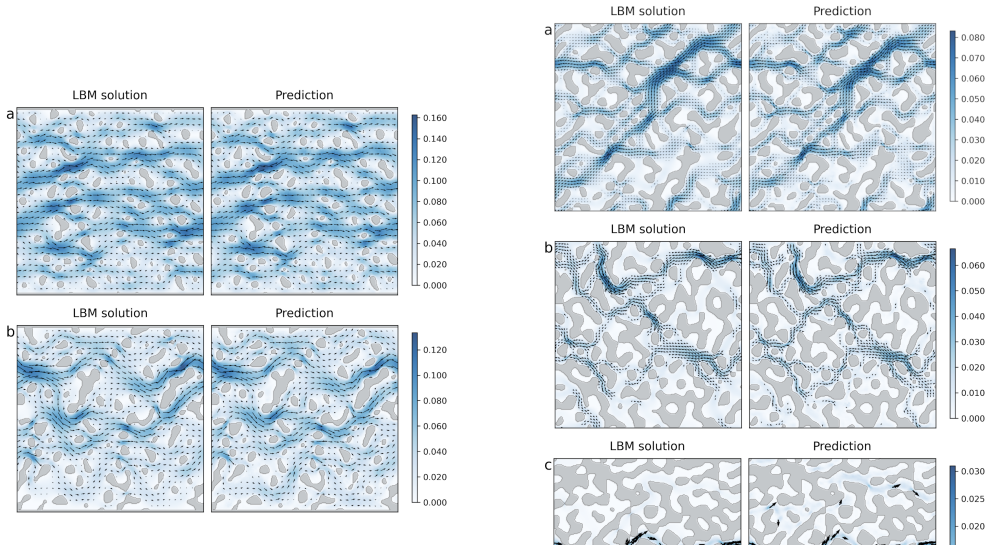
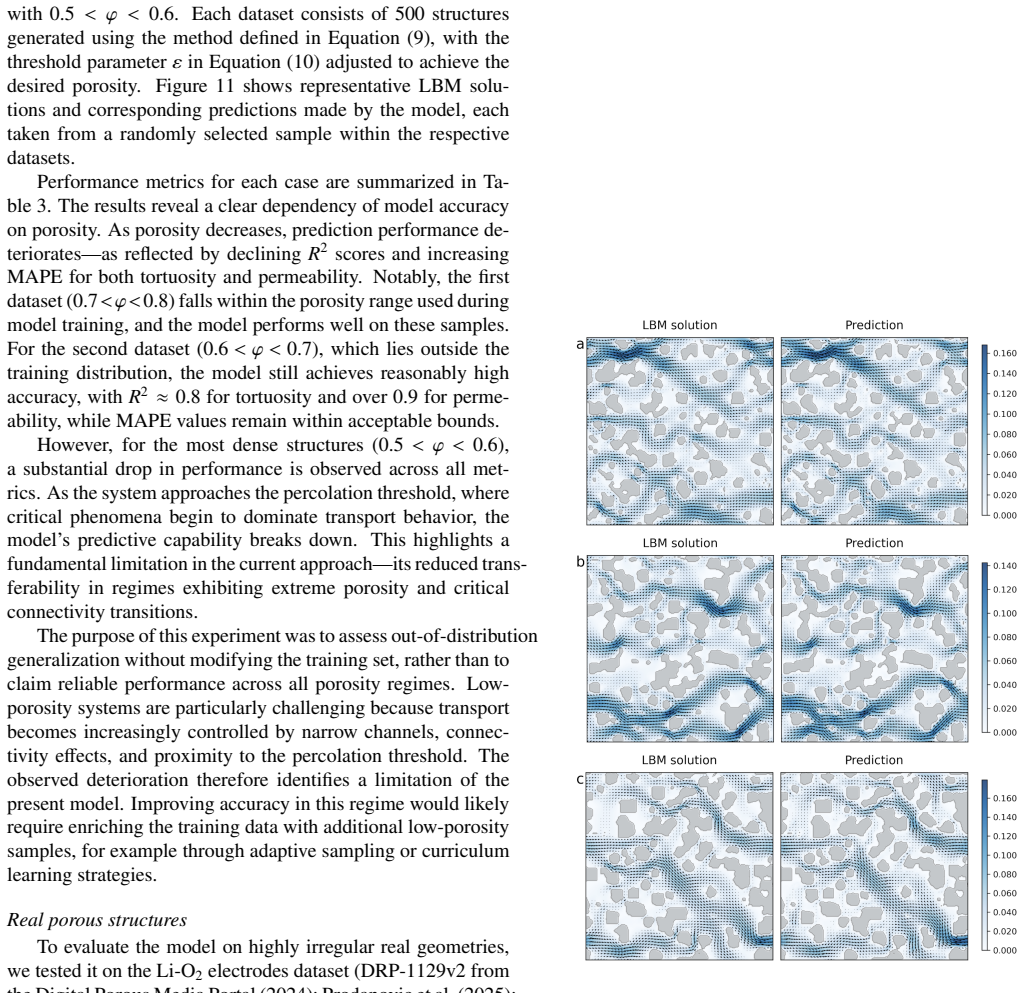
Accurate simulation of fluid flow in porous media is challenging due to complex pore-space geometries and the computational cost of solving the Navier-Stokes equations. This difficulty is particularly important when repeated simulations are required, as standard numerical solvers may converge slowly in intricate porous domains. We present a neural-network-based framework for predicting pore-scale velocity fields directly from sample geometry. The method uses a convolutional encoder-decoder architecture with skip connections to preserve spatial detail while extracting multi-scale features. Physical consistency is encouraged through a custom loss function combining velocity reconstruction with incompressibility, no-flow conditions inside solids, periodicity constraints, and agreement with the global tortuosity index. We analyze the influence of the corresponding loss weights and quantify the contribution of individual loss components to prediction accuracy. Several CNN backbones are evaluated to identify architectures providing accurate and robust predictions. The generalization ability of the trained model is tested on samples outside the training distribution, including changes in obstacle geometry, boundary conditions, porosity, and realistic porous structures. Finally, we demonstrate a practical use of the predicted velocity fields as initial conditions for Lattice-Boltzmann simulations. This warm-start strategy accelerates solver convergence, reducing the number of iterations in over 90% of tested cases.
Editorial analysis
A structured set of objections, weighed in public.
Referee Report
Summary. The manuscript presents a physics-informed convolutional neural network framework for predicting pore-scale velocity fields in porous media directly from geometry. It employs a convolutional encoder-decoder architecture with skip connections and a custom loss function that combines velocity reconstruction, incompressibility (divergence-free), no-flow conditions inside solids, periodicity constraints, and agreement with a global tortuosity index. The authors analyze loss-weight influences, compare multiple CNN backbones, test generalization on out-of-distribution samples (different obstacle geometries, porosities, boundary conditions, and realistic structures), and demonstrate that the predicted fields serve as effective initial conditions for Lattice-Boltzmann simulations, reducing iterations in over 90% of tested cases.
Significance. If the quantitative results and generalization claims hold, the work offers a practical contribution to accelerating repeated fluid-flow simulations in complex porous domains by supplying fast, physically consistent warm starts for traditional solvers. The multi-term physics-informed loss and the empirical LBM acceleration demonstration are clear strengths; the loss-component analysis and out-of-distribution tests further support the central claim when properly documented.
major comments (2)
- [paragraph describing the custom loss function] The tortuosity-matching term in the loss is defined from the predicted velocity field itself. If tortuosity is computed directly from the same velocity that the network is trained to match, the term risks becoming a self-referential constraint rather than an independent physical anchor. Please clarify the exact computation of tortuosity (including any auxiliary fields or averaging) and demonstrate independence, for example by reporting accuracy with and without this term.
- [section on loss weight analysis and generalization tests] The central claim that the weighted combination of velocity reconstruction, divergence-free, no-flow, periodicity, and tortuosity terms yields accurate and generalizable velocity fields rests on the assumption that performance is not dominated by the particular choice of loss weights or the training distribution of geometries and porosities. The manuscript analyzes weight influence but does not show that the chosen weights remain effective across substantially different test distributions; this is load-bearing for the generalization results.
minor comments (2)
- [loss function description] Explicit equations for each loss term (with weighting coefficients) would improve clarity and reproducibility.
- [results figures] Figure captions should state the exact error metric (e.g., relative L2 velocity error) and the number of test samples used for each reported statistic.
Simulated Author's Rebuttal
We thank the referee for the constructive feedback on our manuscript. We address each major comment below and will revise the manuscript to incorporate clarifications and additional analyses where appropriate.
read point-by-point responses
-
Referee: The tortuosity-matching term in the loss is defined from the predicted velocity field itself. If tortuosity is computed directly from the same velocity that the network is trained to match, the term risks becoming a self-referential constraint rather than an independent physical anchor. Please clarify the exact computation of tortuosity (including any auxiliary fields or averaging) and demonstrate independence, for example by reporting accuracy with and without this term.
Authors: We appreciate this observation on the tortuosity term. Tortuosity is computed as a global scalar τ = L_path / L_straight, where L_path is obtained by integrating the magnitude of the velocity field along streamlines (or equivalently via a volume-averaged path length derived from the velocity components) and L_straight is the domain length in the flow direction; no auxiliary fields beyond the velocity are used, and averaging is performed over the fluid domain. While derived from the predicted velocity, the term acts as an independent macroscopic constraint because it enforces agreement with a known physical property of porous media that is not directly optimized by the local velocity reconstruction loss. To demonstrate its contribution, we will add an ablation study in the revised manuscript comparing velocity prediction accuracy (MSE, divergence error, and boundary condition satisfaction) with and without the tortuosity term. revision: yes
-
Referee: The central claim that the weighted combination of velocity reconstruction, divergence-free, no-flow, periodicity, and tortuosity terms yields accurate and generalizable velocity fields rests on the assumption that performance is not dominated by the particular choice of loss weights or the training distribution of geometries and porosities. The manuscript analyzes weight influence but does not show that the chosen weights remain effective across substantially different test distributions; this is load-bearing for the generalization results.
Authors: We thank the referee for this point on robustness. The manuscript reports loss-weight sensitivity on the training distribution and applies the selected weights to out-of-distribution tests covering different obstacle geometries, porosities, boundary conditions, and realistic structures, where the model maintains accuracy. We agree, however, that an explicit check of whether these fixed weights remain near-optimal on the new distributions would strengthen the generalization claims. In the revision we will add results evaluating the chosen weights on the OOD test sets and include a short sensitivity table for a subset of the OOD cases. revision: yes
Circularity Check
No circularity: composite loss uses independent physical constraints
full rationale
The paper presents a supervised CNN for velocity prediction from geometry, augmented by a composite loss containing velocity reconstruction (presumably against ground-truth fields), divergence-free enforcement, solid no-flow, periodicity, and tortuosity matching. The tortuosity term matches a scalar property of the predicted field to an external global index (precomputed from data or geometry), which does not reduce the output to a function of itself by construction. No equation or training step is shown to be tautological; the authors explicitly analyze loss-weight sensitivity and test generalization on out-of-distribution samples, indicating the method retains independent content. The warm-start use for Lattice-Boltzmann is a downstream application, not a self-referential derivation. No self-citations or imported uniqueness theorems appear load-bearing in the provided description.
Axiom & Free-Parameter Ledger
free parameters (1)
- loss weights for velocity reconstruction, incompressibility, no-flow, periodicity, and tortuosity terms
axioms (2)
- domain assumption Fluid is incompressible and flow satisfies no-slip or no-flow inside solid obstacles
- domain assumption Periodic boundary conditions apply to the domain
Lean theorems connected to this paper
-
IndisputableMonolith/Cost/FunctionalEquation.leanwashburn_uniqueness_aczel unclear?
unclearRelation between the paper passage and the cited Recognition theorem.
custom loss function combining velocity reconstruction with incompressibility, no-flow conditions inside solids, periodicity constraints, and agreement with the global tortuosity index
-
IndisputableMonolith/Foundation/BranchSelection.leanbranch_selection unclear?
unclearRelation between the paper passage and the cited Recognition theorem.
ResNet-101 backbone with U-Net skip connections; two-stage training with fixed weights α=5, β=1, γ=0.1, δ=0.01
What do these tags mean?
- matches
- The paper's claim is directly supported by a theorem in the formal canon.
- supports
- The theorem supports part of the paper's argument, but the paper may add assumptions or extra steps.
- extends
- The paper goes beyond the formal theorem; the theorem is a base layer rather than the whole result.
- uses
- The paper appears to rely on the theorem as machinery.
- contradicts
- The paper's claim conflicts with a theorem or certificate in the canon.
- unclear
- Pith found a possible connection, but the passage is too broad, indirect, or ambiguous to say the theorem truly supports the claim.
Reference graph
Works this paper leans on
-
[1]
author Alguacil, A. , author Pinto, W.G. , author Bauerheim, M. , author Jacob, M.C. , author Moreau, S. , year 2021 . title Effects of boundary conditions in fully convolutional networks for learning spatio-temporal dynamics . https://arxiv.org/abs/2106.11160, http://arxiv.org/abs/2106.11160 arXiv:2106.11160
-
[2]
author Anderson, J.D. , year 2002 . title Computational fluid dynamics: the basics with applications . publisher McGraw-Hill New York
work page 2002
-
[3]
author Cossins, T. , author Mishra, A. , author Haese, R.R. , year 2023 . title The feasibility of enhanced pore space utilization in co2 storage reservoirs using an artificially emplaced si-gel flow barrier . journal Scientific Reports volume 13 , pages 9334
work page 2023
-
[4]
author Digital Porous Media Portal , year 2024 . title DRP-1129v2 dataset . https://doi.org/10.17612/dpm/DRP-1129v2, doi:10.17612/dpm/DRP-1129v2
-
[5]
author Duda, A. , author Koza, Z. , author Matyka, M. , year 2011 . title Hydraulic tortuosity in arbitrary porous media flow . journal Physical Review E—Statistical, Nonlinear, and Soft Matter Physics volume 84 , pages 036319
work page 2011
-
[6]
author Fong, C.W. , year 2015 . title Permeability of the blood--brain barrier: molecular mechanism of transport of drugs and physiologically important compounds . journal The Journal of membrane biology volume 248 , pages 651--669
work page 2015
-
[7]
author Gao, H. , author Sun, L. , author Wang, J.X. , year 2021 . title Phygeonet: Physics-informed geometry-adaptive convolutional neural networks for solving parameterized steady-state pdes on irregular domain . journal Journal of Computational Physics volume 428 , pages 110079 . :https://doi.org/10.1016/j.jcp.2020.110079
-
[8]
author Graczyk, K.M. , author Matyka, M. , year 2020 . title Predicting porosity, permeability, and tortuosity of porous media from images by deep learning . journal Scientific reports volume 10 , pages 21488
work page 2020
-
[9]
author Graczyk, K.M. , author Strzelczyk, D. , author Matyka, M. , year 2023 . title Deep learning for diffusion in porous media . journal Scientific Reports volume 13 , pages 9769
work page 2023
-
[10]
author Guo, C. , author Wang, Y. , author Han, Y. , author Ji, M. , author Wu, Y. , year 2024 . title Unsteady flow-field forecasting leveraging a hybrid deep-learning architecture . journal Physics of Fluids volume 36
work page 2024
-
[11]
author Guo, X. , author Li, W. , author Iorio, F. , year 2016 . title Convolutional neural networks for steady flow approximation , in: booktitle Proceedings of the 22nd ACM SIGKDD international conference on knowledge discovery and data mining , pp. pages 481--490
work page 2016
-
[12]
author Guo, Z. , author Shu, C. , year 2013 . title Lattice Boltzmann method and its application in engineering . volume volume 3 . publisher World Scientific
work page 2013
-
[13]
Deep Residual Learning for Image Recognition
author He, K. , author Zhang, X. , author Ren, S. , author Sun, J. , year 2015 . title Deep residual learning for image recognition . https://arxiv.org/abs/1512.03385, http://arxiv.org/abs/1512.03385 arXiv:1512.03385
work page internal anchor Pith review Pith/arXiv arXiv 2015
-
[14]
author Howard, A. , author Sandler, M. , author Chu, G. , author Chen, L.-C. , author Chen, B. , author Tan, M. , author Wang, W. , author Zhu, Y. , author Pang, R. , author Vasudevan, V. , author Le, Q.V. , author Adam, H. , year 2019 . title Searching for MobileNetV3 . https://arxiv.org/abs/1905.02244, http://arxiv.org/abs/1905.02244 arXiv:1905.02244
-
[15]
Densely Connected Convolutional Networks
author Huang, G. , author Liu, Z. , author van der Maaten, L. , author Weinberger, K.Q. , year 2018 . title Densely connected convolutional networks . https://arxiv.org/abs/1608.06993, http://arxiv.org/abs/1608.06993 arXiv:1608.06993
work page internal anchor Pith review Pith/arXiv arXiv 2018
-
[16]
author Innamorati, C. , author Ritschel, T. , author Weyrich, T. , author Mitra, N.J. , year 2019 . title Learning on the edge: Investigating boundary filters in cnns . journal International Journal of Computer Vision volume 128 , pages 773--782 . :10.1007/s11263-019-01223-y
-
[17]
Adam: A Method for Stochastic Optimization
author Kingma, D.P. , author Ba, J. , year 2017 . title Adam: A method for stochastic optimization . https://arxiv.org/abs/1412.6980, http://arxiv.org/abs/1412.6980 arXiv:1412.6980
work page internal anchor Pith review Pith/arXiv arXiv 2017
-
[18]
author Koponen, A. , author Kataja, M. , author Timonen, J. , year 1996 . title Tortuous flow in porous media . journal Physical Review E volume 54 , pages 406
work page 1996
-
[19]
author Koponen, A. , author Kataja, M. , author Timonen, J. , year 1997 . title Permeability and effective porosity of porous media . journal Physical Review E volume 56 , pages 3319
work page 1997
-
[20]
author Kovachki, N. , author Li, Z. , author Azizzadenesheli, K. , author Liu, B. , author Bhattacharya, K. , author Stuart, A. , author Anandkumar, A. , year 2023 . title Neural Operator: Learning Maps Between Function Spaces . journal Journal of Machine Learning Research volume 24 , pages 1--97
work page 2023
-
[21]
author Koza, Z. , author Matyka, M. , author Khalili, A. , year 2009 . title Finite-size anisotropy in statistically uniform porous media . journal Physical Review E—Statistical, Nonlinear, and Soft Matter Physics volume 79 , pages 066306
work page 2009
-
[22]
author Lehmann, M. , author Krause, M.J. , author Amati, G. , author Sega, M. , author Harting, J. , author Gekle, S. , year 2022 . title Accuracy and performance of the lattice boltzmann method with 64-bit, 32-bit, and customized 16-bit number formats . journal Physical Review E volume 106 , pages 015308
work page 2022
-
[23]
Fourier Neural Operator for Parametric Partial Differential Equations
author Li, Z. , author Kovachki, N. , author Azizzadenesheli, K. , author Liu, B. , author Bhattacharya, K. , author Stuart, A. , author Anandkumar, A. , year 2021 . title Fourier Neural Operator for Parametric Partial Differential Equations . https://arxiv.org/abs/2010.08895, http://arxiv.org/abs/2010.08895 arXiv:2010.08895
work page internal anchor Pith review Pith/arXiv arXiv 2021
-
[24]
author Lin, Y. , author Wu, Z. , author You, S. , author Yang, C. , author Wang, Q. , author Yin, W. , author Qiu, T. , year 2025 . title Deep learning-based prediction of velocity and temperature distributions in metal foam with hierarchical pore structure . journal Green Chemical Engineering volume 6 , pages 209--222
work page 2025
-
[25]
author Liu, Z. , author Mao, H. , author Wu, C.-Y. , author Feichtenhofer, C. , author Darrell, T. , author Xie, S. , year 2022 . title A ConvNet for the 2020s . https://arxiv.org/abs/2201.03545, http://arxiv.org/abs/2201.03545 arXiv:2201.03545
-
[26]
author Matyka, M. , author Khalili, A. , author Koza, Z. , year 2008 . title Tortuosity-porosity relation in porous media flow . journal Physical Review E—Statistical, Nonlinear, and Soft Matter Physics volume 78 , pages 026306
work page 2008
-
[27]
author Matyka, M. , author Koza, Z. , year 2012 . title How to calculate tortuosity easily? , in: booktitle AIP Conference Proceedings 4 , organization American Institute of Physics . pp. pages 17--22
work page 2012
-
[28]
On the difficulty of training Recurrent Neural Networks
author Pascanu, R. , author Mikolov, T. , author Bengio, Y. , year 2013 . title On the difficulty of training recurrent neural networks . https://arxiv.org/abs/1211.5063, http://arxiv.org/abs/1211.5063 arXiv:1211.5063
work page internal anchor Pith review Pith/arXiv arXiv 2013
-
[29]
author Prodanovic, M. , author Esteva, M. , author Ketcham, R. , author Chang, B. , author Turhan, C. , author Gentle, J. , author Khan, S. , author Belcher, V. , year 2025 . title Digital Porous Media Portal (DPMP) for publication, analysis, and simulation of porous media images . publisher Digital Porous Media Portal . :10.17612/FGMN-D889
-
[30]
U-Net: Convolutional Networks for Biomedical Image Segmentation
author Ronneberger, O. , author Fischer, P. , author Brox, T. , year 2015 . title U-net: Convolutional networks for biomedical image segmentation . https://arxiv.org/abs/1505.04597, http://arxiv.org/abs/1505.04597 arXiv:1505.04597
work page internal anchor Pith review Pith/arXiv arXiv 2015
-
[31]
Very Deep Convolutional Networks for Large-Scale Image Recognition
author Simonyan, K. , author Zisserman, A. , year 2015 . title Very deep convolutional networks for large-scale image recognition . https://arxiv.org/abs/1409.1556, http://arxiv.org/abs/1409.1556 arXiv:1409.1556
work page internal anchor Pith review Pith/arXiv arXiv 2015
-
[32]
author Succi, S. , year 2001 . title The lattice Boltzmann equation: for fluid dynamics and beyond . publisher Oxford university press
work page 2001
-
[33]
author Tan, M. , author Le, Q.V. , year 2019 . title EfficientNet: Rethinking Model Scaling for Convolutional Neural Networks , in: booktitle Proceedings of the 36th International Conference on Machine Learning . pages 6105--6114
work page 2019
-
[34]
author Tomczak, T. , author Szafran, R.G. , year 2019 . title A new gpu implementation for lattice-boltzmann simulations on sparse geometries . journal Computer Physics Communications volume 235 , pages 258--278
work page 2019
-
[35]
author Turhan, C . , author Chang, B. , author Mohamed, A. , author Esteva, M. , author Ketcham, R. , author McClure, J. , author Prodanovic, M. , year 2024 . title Digital Porous Media Portal for image curation, characterization, visualization, and transport simulation in porous media , in: booktitle International Symposium of the Society of Core Analyst...
work page 2024
-
[36]
author Zhao, X. , author Gong, Z. , author Zhang, Y. , author Yao, W. , author Chen, X. , year 2023 . title Physics-informed convolutional neural networks for temperature field prediction of heat source layout without labeled data . journal Engineering Applications of Artificial Intelligence volume 117 , pages 105516
work page 2023
-
[37]
author Zhong, L. , author Han, X. , author Yuan, X. , author Liu, Y. , author Zou, J. , author Wang, Q. , year 2021 . title Permeability variation and its impact on oil recovery from unconsolidated sand heavy-oil reservoirs during steamflooding process . journal SPE Reservoir Evaluation & Engineering volume 24 , pages 159--173
work page 2021
-
[38]
author Fritsch, F.N. , author Carlson, R.E. , year 1980 . title Monotone Piecewise Cubic Interpolation . journal SIAM Journal on Numerical Analysis volume 17 , pages 238--246 . doi:10.1137/0717021
-
[39]
author Fritsch, F.N. , author Butland, J. , year 1984 . title A Method for Constructing Local Monotone Piecewise Cubic Interpolants . journal SIAM Journal on Scientific and Statistical Computing volume 5 , pages 300--304 . doi:10.1137/0905021
-
[40]
author Li, Z. , author Kovachki, N. , author Azizzadenesheli, K. , author Liu, B. , author Bhattacharya, K. , author Stuart, A. , author Anandkumar, A. , year 2021 . title Fourier Neural Operator for Parametric Partial Differential Equations . journal International Conference on Learning Representations (ICLR)
work page 2021
discussion (0)
Sign in with ORCID, Apple, or X to comment. Anyone can read and Pith papers without signing in.