Difference Between Half-mass Radius and Half-light Radius of Galaxies at 0.2 < z < 2.5 Revealed by JWST/NIRCam Data
Pith reviewed 2026-05-21 03:37 UTC · model grok-4.3
The pith
Half-light radii exceed half-mass radii for galaxies at 0.2 < z < 2.5, with the ratio rising for star-forming systems above z=1.7
A machine-rendered reading of the paper's core claim, the machinery that carries it, and where it could break.
Core claim
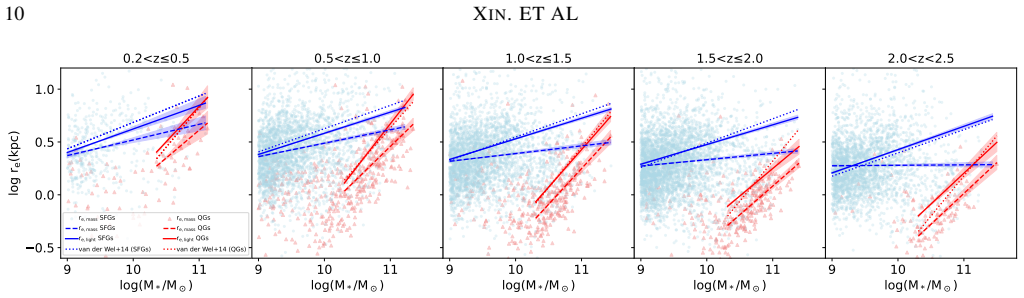
Analysis of JWST/NIRCam photometry in CANDELS fields establishes that r_e,light is larger than r_e,mass for both quiescent and star-forming galaxies above 10^9 solar masses at 0.2 < z < 2.5. The r_e,mass/r_e,light ratio increases markedly for star-forming galaxies at z > 1.7 while quiescent galaxies show no clear increase at z > 1 and a slight decrease from 0.2 to 1. Linear fits yield a slope for the size-stellar mass relation that is 0.1-0.3 dex larger for half-light radii than for half-mass radii, and half-mass radii grow by factors of 3-5 for quiescent galaxies and ~2 for star-forming galaxies from z~2.5 to z~0.2.
What carries the argument
Half-mass radius derived by mapping multi-band light profiles to stellar mass profiles through stellar population synthesis and mass-to-light ratio maps
Load-bearing premise
Half-mass radii can be accurately derived from multi-band photometry via standard stellar population synthesis and mass-to-light ratio maps without large systematic biases from dust attenuation, star-formation history assumptions, or spatial variations in stellar populations.
What would settle it
Independent half-mass radius measurements from resolved integral-field spectroscopy or dynamical modeling for a subset of the same galaxies at comparable redshifts would test whether the photometric differences hold.
Figures






read the original abstract
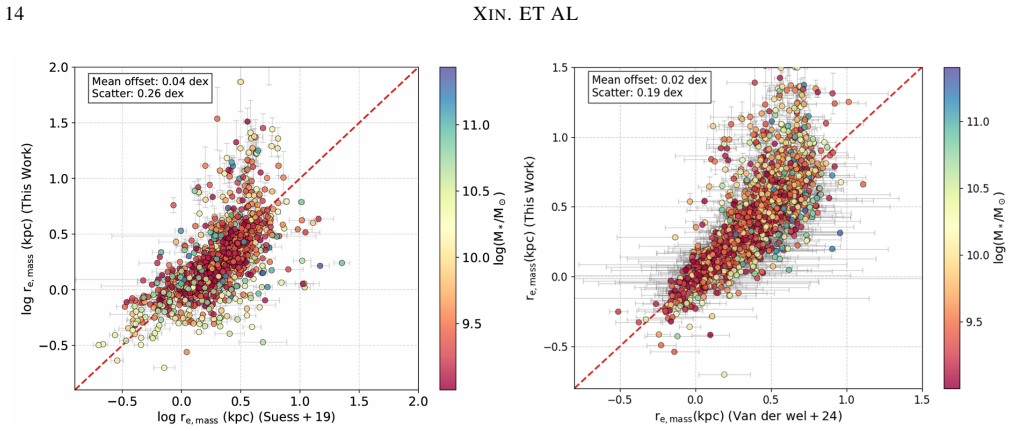
Using JWST observations in CANDELS fields, we measure the half-light radius ($r_{\rm e,light}$) and half-mass radius ($r_{\rm e,mass}$) for 14,333 galaxies with stellar masses $M_* > 10^9 M_\odot$ at redshifts $0.2 < z < 2.5$. To investigate the difference between $r_{\rm e,light}$ and $r_{\rm e,mass}$, we find that $r_{\rm e,light}$ is larger than $r_{\rm e,mass}$ for both quiescent galaxies (QGs) and star-forming galaxies (SFGs). Moreover, the difference between these two radii is clearly correlated with galaxy stellar mass, $r_{\rm e,light}$, and the rest-frame $U - V$ color. When examining the evolution of the $r_{\rm e,mass}/r_{\rm e,light}$ ratio, we observe a significant increase for SFGs at $z > 1.7$. In contrast, no clear increase is observed for QGs at $z > 1$, though a slight decreasing trend is seen between $0.2 < z < 1.0$. By fitting a linear relationship between galaxy size and stellar mass, we find that the slope for $r_{\rm e,light}$ is $\sim$ 0.1 to 0.3 dex larger than that for $r_{\rm e,mass}$. In terms of galaxy size evolution at a fixed stellar mass, the $r_{\rm e,mass}$ of QGs increases by a factor of $\sim$ 3 to 5 from $z \sim 2.5$ to $z \sim 0.2$. In contrast, the $r_{\rm e,mass}$ of SFGs increases by a factor of approximately 2 over the same redshift range, with this growth trend closely following that of their $r_{\rm e,light}$. These results indicate that previous insights into galaxy evolution based on $r_{\rm e,light}$ remain valid when considering $r_{\rm e,mass}$, although the specific slopes show some variations.
Editorial analysis
A structured set of objections, weighed in public.
Referee Report
Summary. The manuscript reports measurements of half-light (r_e,light) and half-mass (r_e,mass) radii for 14,333 galaxies with M_* > 10^9 M_⊙ at 0.2 < z < 2.5 using JWST/NIRCam data in CANDELS fields. It finds r_e,light > r_e,mass for both quiescent galaxies (QGs) and star-forming galaxies (SFGs), with the difference correlated to stellar mass, r_e,light, and rest-frame U-V color. The r_e,mass/r_e,light ratio shows a significant increase for SFGs at z > 1.7 but no clear increase (with a slight decrease at 0.2 < z < 1) for QGs. Linear fits to the size-mass relation yield slopes ~0.1-0.3 dex steeper for r_e,light than r_e,mass. Size evolution at fixed mass shows r_e,mass of QGs growing by a factor of ~3-5 and SFGs by ~2 from z ~ 2.5 to z ~ 0.2, with SFG growth tracking their r_e,light trend. The authors conclude that prior light-based insights into galaxy evolution largely remain valid when using mass radii, albeit with variations in specific slopes.
Significance. With a sample of over 14,000 galaxies spanning a wide redshift range, the work has the potential to provide statistically robust constraints on the structural differences between stellar light and mass distributions if the half-mass measurements prove reliable. The reported redshift-dependent trends in the radius ratio for SFGs and the differential size evolution between QGs and SFGs could inform models of inside-out growth, quenching, and the impact of dust and stellar population gradients. The JWST/NIRCam multi-band approach for mass mapping is a timely strength, though its robustness determines the overall impact.
major comments (1)
- [Methods (mass map construction and radius fitting pipeline)] The methods description of constructing stellar mass maps from multi-band SED fitting (and subsequent r_e,mass measurement) does not include end-to-end mock tests with realistic dust geometries or variable SFHs. This directly bears on the central novel claim of a significant increase in the r_e,mass/r_e,light ratio for SFGs at z > 1.7, since under-corrected central dust attenuation could artificially concentrate the inferred mass distribution and inflate the reported trend.
minor comments (3)
- [Abstract] The abstract states correlations of the radius difference with stellar mass, r_e,light, and U-V color but provides no quantitative measures (e.g., Spearman coefficients or fit slopes) of these relations.
- [Sample selection and classification] Clarify the precise criteria (color, sSFR threshold, or other) used to classify galaxies as QGs versus SFGs, and test sensitivity of the reported trends to this choice.
- [Results figures and associated text] Figure captions and text should explicitly state the fitting method (e.g., Sérsic index fixed or free) and any assumptions about PSF convolution when deriving both r_e,light and r_e,mass.
Simulated Author's Rebuttal
We thank the referee for their constructive and detailed review of our manuscript. The comments have prompted us to strengthen the presentation of our methods. We respond point by point below and have incorporated revisions to address the concerns.
read point-by-point responses
-
Referee: [Methods (mass map construction and radius fitting pipeline)] The methods description of constructing stellar mass maps from multi-band SED fitting (and subsequent r_e,mass measurement) does not include end-to-end mock tests with realistic dust geometries or variable SFHs. This directly bears on the central novel claim of a significant increase in the r_e,mass/r_e,light ratio for SFGs at z > 1.7, since under-corrected central dust attenuation could artificially concentrate the inferred mass distribution and inflate the reported trend.
Authors: We appreciate the referee drawing attention to the need for rigorous validation of the mass-mapping procedure. Our stellar mass maps were derived from multi-band JWST/NIRCam photometry using SED fitting that already incorporates a range of dust attenuation curves and flexible SFH parameterizations to capture population gradients. Nevertheless, we acknowledge that the submitted manuscript did not present dedicated end-to-end mocks with fully realistic three-dimensional dust geometries. To address this directly, we have generated additional mock catalogs that include spatially varying dust distributions and diverse SFHs matched to the observed redshift and mass range. These tests demonstrate that any residual central dust bias is insufficient to produce the observed redshift-dependent rise in the r_e,mass/r_e,light ratio for SFGs at z > 1.7; the trend persists at high significance. We will add a new subsection (and associated figure) describing the mock setup, recovery statistics, and robustness checks in the revised manuscript. revision: yes
Circularity Check
No significant circularity; results are direct measurements and empirical fits on external data
full rationale
The paper's chain consists of applying standard stellar population synthesis to JWST/NIRCam multi-band photometry to derive r_e,light and r_e,mass, then reporting observed correlations with mass, color, and redshift plus ordinary linear regressions of size versus stellar mass. These steps are self-contained against the external CANDELS dataset; no equations reduce a claimed prediction to a fitted input by construction, no self-citation is invoked as a uniqueness theorem or load-bearing premise, and no ansatz is smuggled in. The reported trends (r_e,light > r_e,mass, differential slopes, redshift evolution) are therefore independent outputs rather than tautological restatements of the measurement pipeline.
Axiom & Free-Parameter Ledger
axioms (1)
- domain assumption Stellar masses and half-mass radii can be reliably estimated from multi-band JWST photometry using standard SED fitting and mass-to-light ratio assumptions.
Lean theorems connected to this paper
-
IndisputableMonolith/Foundation/RealityFromDistinction.leanreality_from_one_distinction unclear?
unclearRelation between the paper passage and the cited Recognition theorem.
We measure the half-light radius (r_e,light) and half-mass radius (r_e,mass) for 14,333 galaxies... using pixel-by-pixel SED fitting... fit the 2D stellar mass map with a single Sersic model using GALFIT
-
IndisputableMonolith/Foundation/AbsoluteFloorClosure.leanabsolute_floor_iff_bare_distinguishability unclear?
unclearRelation between the paper passage and the cited Recognition theorem.
the slope for r_e,light is ~0.1-0.3 dex larger than that for r_e,mass... r_e,mass of QGs increases by a factor of ~3 to 5 from z~2.5 to z~0.2
What do these tags mean?
- matches
- The paper's claim is directly supported by a theorem in the formal canon.
- supports
- The theorem supports part of the paper's argument, but the paper may add assumptions or extra steps.
- extends
- The paper goes beyond the formal theorem; the theorem is a base layer rather than the whole result.
- uses
- The paper appears to rely on the theorem as machinery.
- contradicts
- The paper's claim conflicts with a theorem or certificate in the canon.
- unclear
- Pith found a possible connection, but the passage is too broad, indirect, or ambiguous to say the theorem truly supports the claim.
Reference graph
Works this paper leans on
-
[1]
ET AL Abdurro’uf, Coe, D., Jung, I., et al
16 XIN. ET AL Abdurro’uf, Coe, D., Jung, I., et al. 2023, ApJ, 945, 117, doi: 10.3847/1538-4357/acba06
-
[2]
Aniano, G., Draine, B. T., Gordon, K. D., & Sandstrom, K. 2011, Publications of the Astronomical Society of the Pacific, 123, 1218, doi: 10.1086/662219
-
[3]
Barbera, F. L., & de Carvalho, R. R. 2009, The Astrophysical Journal, 699, L76, doi: 10.1088/0004-637X/699/2/L76
-
[4]
Bezanson, R., van Dokkum, P. G., Tal, T., et al. 2009, The Astrophysical Journal, 697, 1290, doi: 10.1088/0004-637X/697/2/1290
-
[5]
Boquien,et al., CIGALE: a python Code Investigating GALaxy Emission.Astron
Boquien, M., Burgarella, D., Roehlly, Y ., et al. 2019, Astronomy & Astrophysics, 622, A103, doi: 10.1051/0004-6361/201834156
work page internal anchor Pith review doi:10.1051/0004-6361/201834156 2019
-
[6]
2022, Astropy/Photutils: 1.5.0, 1.5.0, Zenodo, Zenodo, doi: 10.5281/zenodo.6825092
Bradley, L., Sip˝ocz, B., Robitaille, T., et al. 2022, Astropy/Photutils: 1.5.0, 1.5.0, Zenodo, Zenodo, doi: 10.5281/zenodo.6825092
-
[7]
doi:10.1046/j.1365-8711.2003.06637.x , eprint =
Bruzual, G., & Charlot, S. 2003, Monthly Notices of the Royal Astronomical Society, 344, 1000, doi: 10.1046/j.1365-8711.2003.06897.x
-
[8]
2024, A&A, 682, A110, doi: 10.1051/0004-6361/202346133
Buitrago, Fernando, & Trujillo, Ignacio. 2024, A&A, 682, A110, doi: 10.1051/0004-6361/202346133
-
[9]
Carollo, C. M., Bschorr, T. J., Renzini, A., et al. 2013, The Astrophysical Journal, 773, 112, doi: 10.1088/0004-637X/773/2/112
-
[10]
Chabrier, Galactic Stellar and Substellar Initial Mass Function.Publ
Chabrier, G. 2003, Publications of the Astronomical Society of the Pacific, 115, 763, doi: 10.1086/376392
work page internal anchor Pith review doi:10.1086/376392 2003
-
[11]
2024, A&A, 689, A28, doi: 10.1051/0004-6361/202348536
Chamba, Nushkia, Hayes, Matthew J., & The LSST Dark Energy Science Collaboration. 2024, A&A, 689, A28, doi: 10.1051/0004-6361/202348536
-
[12]
Chan, J. C. C., Beifiori, A., Mendel, J. T., et al. 2016, Monthly Notices of the Royal Astronomical Society, 458, 3181, doi: 10.1093/mnras/stw502
-
[13]
Charlot, S., & Fall, S. M. 2000, The Astrophysical Journal, 539, 718, doi: 10.1086/309250
work page internal anchor Pith review doi:10.1086/309250 2000
- [14]
-
[15]
Clausen, M., Whitaker, K. E., Momcheva, I., et al. 2024, The Astrophysical Journal, 971, 99, doi: 10.3847/1538-4357/ad528a
-
[16]
Costantin, L., P´erez-Gonz´alez, P. G., Vega-Ferrero, J., et al. 2023, ApJ, 946, 71, doi: 10.3847/1538-4357/acb926
-
[17]
Davis, M., Guhathakurta, P., Konidaris, N. P., et al. 2007, ApJL, 660, L1, doi: 10.1086/517931
-
[18]
2018, MNRAS, 478, 5410, doi: 10.1093/mnras/sty1379
Dimauro, P., Huertas-Company, M., Daddi, E., et al. 2018, MNRAS, 478, 5410, doi: 10.1093/mnras/sty1379
-
[19]
Dunlop, J. S., Abraham, R. G., Ashby, M. L. N., et al. 2021, PRIMER: Public Release IMaging for Extragalactic Research, JWST Proposal. Cycle 1, ID. #1837
work page 2021
-
[20]
Overview of the JWST Advanced Deep Extragalactic Survey (JADES)
Eisenstein, D. J., Willott, C., Alberts, S., et al. 2023, Overview of the JWST Advanced Deep Extragalactic Survey (JADES). https://arxiv.org/abs/2306.02465
work page internal anchor Pith review Pith/arXiv arXiv 2023
-
[21]
C., Dickinson, M., Giavalisco, M., et al
Ferguson, H. C., Dickinson, M., Giavalisco, M., et al. 2004, The Astrophysical Journal, 600, L107, doi: 10.1086/378578
-
[22]
Finkelstein, S. L., Bagley, M. B., Ferguson, H. C., et al. 2023, The Astrophysical Journal Letters, 946, L13, doi: 10.3847/2041-8213/acade4
-
[23]
Fitzpatrick, E. L. 1999, Publications of the Astronomical Society of the Pacific, 111, 63, doi: 10.1086/316293
-
[24]
2003, The Astrophysical Journal, 587, L79, doi: 10.1086/375155
Franx, M., Labb´e, I., Rudnick, G., et al. 2003, The Astrophysical Journal, 587, L79, doi: 10.1086/375155
-
[25]
Furlong, M., Bower, R. G., Crain, R. A., et al. 2016, Monthly Notices of the Royal Astronomical Society, 465, 722, doi: 10.1093/mnras/stw2740
-
[26]
2017, Monthly Notices of the Royal Astronomical Society, 474, 3976, doi: 10.1093/mnras/stx3078
Genel, S., Nelson, D., Pillepich, A., et al. 2017, Monthly Notices of the Royal Astronomical Society, 474, 3976, doi: 10.1093/mnras/stx3078
-
[27]
Giavalisco, M., Ferguson, H. C., Koekemoer, A. M., et al. 2004, ApJL, 600, L93, doi: 10.1086/379232
-
[28]
Grogin, N. A., Kocevski, D. D., Faber, S. M., et al. 2011, ApJS, 197, 35, doi: 10.1088/0067-0049/197/2/35
-
[29]
S., Akiyama, M., Abdurro’uf, et al
Haryana, N. S., Akiyama, M., Abdurro’uf, et al. 2025, Stellar Mass Assembly History of Massive Quiescent Galaxies sincez∼4: Insights from Spatially Resolved SED Fitting with JWST Data. https://arxiv.org/abs/2508.19170
-
[30]
Hemmati, S., Miller, S. H., Mobasher, B., et al. 2014, The Astrophysical Journal, 797, 108, doi: 10.1088/0004-637X/797/2/108 H¨aussler, B., McIntosh, D. H., Barden, M., et al. 2007, The Astrophysical Journal Supplement Series, 172, 615, doi: 10.1086/518836
-
[31]
Inoue, A. K. 2011, Monthly Notices of the Royal Astronomical Society, 415, 2920, doi: 10.1111/j.1365-2966.2011.18906.x
-
[32]
2019, The Astrophysical Journal, 887, 204, doi: 10.3847/1538-4357/ab5526
Jafariyazani, M., Mobasher, B., Hemmati, S., et al. 2019, The Astrophysical Journal, 887, 204, doi: 10.3847/1538-4357/ab5526
-
[33]
Ji, Z., Williams, C. C., Suess, K. A., et al. 2024, JADES: Rest-frame UV-to-NIR Size Evolution of Massive Quiescent Galaxies from Redshift z=5 to z=0.5. https://arxiv.org/abs/2401.00934
-
[34]
2024, The Astrophysical Journal, 977, 165, doi: 10.3847/1538-4357/ad919a
Jia, C., Wang, E., Wang, H., et al. 2024, The Astrophysical Journal, 977, 165, doi: 10.3847/1538-4357/ad919a
-
[35]
2019, Monthly Notices of the Royal Astronomical Society, 488, 4801, doi: 10.1093/mnras/stz1952
Jiang, F., Dekel, A., Kneller, O., et al. 2019, Monthly Notices of the Royal Astronomical Society, 488, 4801, doi: 10.1093/mnras/stz1952
-
[36]
Jin, B., Ho, L. C., & Sun, W. 2024, arXiv e-prints, arXiv:2412.03455, doi: 10.48550/arXiv.2412.03455
-
[37]
Koekemoer, A. M., Faber, S. M., Ferguson, H. C., et al. 2011, ApJS, 197, 36, doi: 10.1088/0067-0049/197/2/36
-
[38]
Kravtsov, A. V . 2013, The Astrophysical Journal Letters, 764, L31, doi: 10.1088/2041-8205/764/2/L31 JWST/CANDELS HALF MASS RADIUS 17
-
[39]
Lange, R., Driver, S. P., Robotham, A. S. G., et al. 2015, Monthly Notices of the Royal Astronomical Society, 447, 2603, doi: 10.1093/mnras/stu2467
-
[40]
Lanyon-Foster, M. M., Conselice, C. J., & Merrifield, M. R. 2007, Monthly Notices of the Royal Astronomical Society, 380, 571, doi: 10.1111/j.1365-2966.2007.12132.x —. 2012, Monthly Notices of the Royal Astronomical Society, 424, 1852, doi: 10.1111/j.1365-2966.2012.21287.x
-
[41]
Lawrence, A., Warren, S. J., Almaini, O., et al. 2007, MNRAS, 379, 1599, doi: 10.1111/j.1365-2966.2007.12040.x
-
[42]
2014, The Astrophysical Journal, 794, 65, doi: 10.1088/0004-637X/794/1/65 Mart´ınez-Garc´ıa, E
Marchesini, D., Muzzin, A., Stefanon, M., et al. 2014, The Astrophysical Journal, 794, 65, doi: 10.1088/0004-637X/794/1/65 Mart´ınez-Garc´ıa, E. E., Gonz´alez-L´opezlira, R. A., Magris C., G., & Bruzual A., G. 2017, ApJ, 835, 93, doi: 10.3847/1538-4357/835/1/93
-
[43]
2024, The Astrophysical Journal, 972, 134, doi: 10.3847/1538-4357/ad5c6a
Martorano, M., van der Wel, A., Baes, M., et al. 2024, The Astrophysical Journal, 972, 134, doi: 10.3847/1538-4357/ad5c6a
-
[44]
2024, A&A, 691, A240, doi: 10.1051/0004-6361/202451409
Merlin, E., Santini, P., Paris, D., et al. 2024, A&A, 691, A240, doi: 10.1051/0004-6361/202451409
-
[45]
B., van Dokkum, P., & Mowla, L
Miller, T. B., van Dokkum, P., & Mowla, L. 2023, The Astrophysical Journal, 945, 155, doi: 10.3847/1538-4357/acbc74
-
[46]
B., van Dokkum, P., Mowla, L., & van der Wel, A
Miller, T. B., van Dokkum, P., Mowla, L., & van der Wel, A. 2019, The Astrophysical Journal Letters, 872, L14, doi: 10.3847/2041-8213/ab0380
-
[47]
Mo, H. J., Mao, S., & White, S. D. M. 1998, Monthly Notices of the Royal Astronomical Society, 295, 319, doi: 10.1046/j.1365-8711.1998.01227.x
-
[48]
2020, The Astrophysical Journal, 905, 170, doi: 10.3847/1538-4357/abc7cc
Tacchella, S. 2020, The Astrophysical Journal, 905, 170, doi: 10.3847/1538-4357/abc7cc
-
[49]
Mosleh, M., Riahi-Zamin, M., & Tacchella, S. 2025, Reconstructing Star Formation Histories of High-Redshift Galaxies: A Comparison of Resolved Parametric and Non-Parametric Models. https://arxiv.org/abs/2503.14591
-
[50]
2017, The Astrophysical Journal, 837, 2, doi: 10.3847/1538-4357/aa5f14
Mosleh, M., Tacchella, S., Renzini, A., et al. 2017, The Astrophysical Journal, 837, 2, doi: 10.3847/1538-4357/aa5f14
-
[51]
A., van Dokkum, P., Brammer, G
Mowla, L. A., van Dokkum, P., Brammer, G. B., et al. 2019, The Astrophysical Journal, 880, 57, doi: 10.3847/1538-4357/ab290a
-
[52]
2013, The Astrophysical Journal Supplement Series, 206, 8, doi: 10.1088/0067-0049/206/1/8
Muzzin, A., Marchesini, D., Stefanon, M., et al. 2013, The Astrophysical Journal Supplement Series, 206, 8, doi: 10.1088/0067-0049/206/1/8
-
[53]
Naab, T., Johansson, P. H., & Ostriker, J. P. 2009, The Astrophysical Journal, 699, L178, doi: 10.1088/0004-637X/699/2/L178
-
[54]
Ormerod, K., Conselice, C. J., Adams, N. J., et al. 2024, MNRAS, 527, 6110, doi: 10.1093/mnras/stad3597
-
[55]
Oser, L., Naab, T., Ostriker, J. P., & Johansson, P. H. 2011, The Astrophysical Journal, 744, 63, doi: 10.1088/0004-637X/744/1/63
-
[56]
Pacifici, C., Kassin, S. A., Weiner, B. J., et al. 2016, The Astrophysical Journal, 832, 79, doi: 10.3847/0004-637X/832/1/79
-
[57]
Papovich, C., Cole, J. W., Yang, G., et al. 2023, ApJL, 949, L18, doi: 10.3847/2041-8213/acc948
-
[58]
Peng, C. Y ., Ho, L. C., Impey, C. D., & Rix, H.-W. 2010, The Astronomical Journal, 139, 2097, doi: 10.1088/0004-6256/139/6/2097
work page internal anchor Pith review doi:10.1088/0004-6256/139/6/2097 2010
-
[59]
M., Moretti, A., Calvi, R., et al
Poggianti, B. M., Moretti, A., Calvi, R., et al. 2013, The Astrophysical Journal, 777, 125, doi: 10.1088/0004-637X/777/2/125
-
[60]
Schlafly, E. F., & Finkbeiner, D. P. 2011, The Astrophysical Journal, 737, 103, doi: 10.1088/0004-637X/737/2/103
work page internal anchor Pith review doi:10.1088/0004-637x/737/2/103 2011
-
[61]
Scoville, N., Aussel, H., Brusa, M., et al. 2007, ApJS, 172, 1, doi: 10.1086/516585
-
[62]
2024, ApJL, 963, L49, doi: 10.3847/2041-8213/ad28bd
Shen, L., Papovich, C., Matharu, J., et al. 2024, ApJL, 963, L49, doi: 10.3847/2041-8213/ad28bd
-
[63]
doi:10.1046/j.1365-8711.2003.06637.x , eprint =
Shen, S., Mo, H. J., White, S. D. M., et al. 2003, Monthly Notices of the Royal Astronomical Society, 343, 978, doi: 10.1046/j.1365-8711.2003.06740.x
-
[64]
Skelton, R. E., Whitaker, K. E., Momcheva, I. G., et al. 2014, ApJS, 214, 24, doi: 10.1088/0067-0049/214/2/24
-
[65]
2023, The Astrophysical Journal, 958, 82, doi: 10.3847/1538-4357/ad0365
Song, J., Fang, G., Lin, Z., Gu, Y ., & Kong, X. 2023, The Astrophysical Journal, 958, 82, doi: 10.3847/1538-4357/ad0365
-
[66]
2018, MNRAS, 476, 1532, doi: 10.1093/mnras/sty186
Sorba, R., & Sawicki, M. 2018, MNRAS, 476, 1532, doi: 10.1093/mnras/sty186
-
[67]
Suess, K. A., Kriek, M., Price, S. H., & Barro, G. 2019, The Astrophysical Journal, 877, 103, doi: 10.3847/1538-4357/ab1bda
-
[68]
Suess, K. A., Bezanson, R., Nelson, E. J., et al. 2022, ApJL, 937, L33, doi: 10.3847/2041-8213/ac8e06
-
[69]
Szomoru, D., Franx, M., van Dokkum, P. G., et al. 2013, The Astrophysical Journal, 763, 73, doi: 10.1088/0004-637X/763/2/73
-
[70]
Tacchella, S., Dekel, A., Carollo, C. M., et al. 2016, MNRAS, 458, 242, doi: 10.1093/mnras/stw303
-
[71]
Trujillo, I., Schreiber, N. M. F., Rudnick, G., et al. 2006, The Astrophysical Journal, 650, 18, doi: 10.1086/506464
-
[72]
Valentino, F., Brammer, G., Gould, K. M. L., et al. 2023, The Astrophysical Journal, 947, 20, doi: 10.3847/1538-4357/acbefa van de Sande, J., Kriek, M., Franx, M., et al. 2013, The Astrophysical Journal, 771, 85, doi: 10.1088/0004-637X/771/2/85 van der Wel, A., Franx, M., van Dokkum, P. G., et al. 2014, The Astrophysical Journal, 788, 28, doi: 10.1088/000...
-
[73]
2025, ApJL, 988, L35, doi: 10.3847/2041-8213/adebe7
Wang, T., Sun, H., Zhou, L., et al. 2025, ApJL, 988, L35, doi: 10.3847/2041-8213/adebe7
-
[74]
The Star-formation Mass Sequence out to z=2.5
Whitaker, K. E., van Dokkum, P. G., Brammer, G., & Franx, M. 2012, The Astrophysical Journal Letters, 754, L29, doi: 10.1088/2041-8205/754/2/L29
work page internal anchor Pith review doi:10.1088/2041-8205/754/2/l29 2012
-
[75]
Whitaker, K. E., van Dokkum, P. G., Brammer, G., et al. 2013, ApJL, 770, L39, doi: 10.1088/2041-8205/770/2/L39
-
[76]
C., Alberts, S., Ji, Z., et al
Williams, C. C., Alberts, S., Ji, Z., et al. 2024, ApJ, 968, 34, doi: 10.3847/1538-4357/ad3f17
-
[77]
Williams, R. J., Quadri, R. F., Franx, M., et al. 2010, The Astrophysical Journal, 713, 738, doi: 10.1088/0004-637X/713/2/738
-
[78]
Wu, H., Shao, Z., Mo, H. J., Xia, X., & Deng, Z. 2005, The Astrophysical Journal, 622, 244, doi: 10.1086/427821
-
[79]
Research in Astronomy and Astrophysics , abstract =
Zhang, S., Fang, G., Song, J., et al. 2024, Research in Astronomy and Astrophysics, 24, 095012, doi: 10.1088/1674-4527/ad6fe6
-
[80]
doi:10.1111/j.1365-2966.2009.14548.x , eprint =
Zibetti, S., Charlot, S., & Rix, H.-W. 2009, Monthly Notices of the Royal Astronomical Society, 400, 1181, doi: 10.1111/j.1365-2966.2009.15528.x
discussion (0)
Sign in with ORCID, Apple, or X to comment. Anyone can read and Pith papers without signing in.