Frontier: Towards Comprehensive and Accurate LLM Inference Simulation
Pith reviewed 2026-05-21 03:43 UTC · model grok-4.3
The pith
Frontier simulator models disaggregated LLM serving with under 4% throughput error.
A machine-rendered reading of the paper's core claim, the machinery that carries it, and where it could break.
Core claim
Frontier features a disaggregated abstraction that models co-location, Prefill-Decode Disaggregation (PDD), and Attention-FFN Disaggregation (AFD) with role-specific cluster workers. It incorporates key runtime optimizations such as CUDA Graphs and speculative decoding within the scheduler-batch-engine loop and supports stateful requests for emerging workloads. It provides accurate and generalizable predictions of computation, communication, and memory costs. On a 16-H800 GPU testbed, Frontier achieves an average throughput error below 4%, reducing end-to-end latency error from 44.9% to 6.4% under co-location and from 51.7% to 2.6% under disaggregation compared with state-of-the-art tools.}
What carries the argument
disaggregated abstraction that models co-location, Prefill-Decode Disaggregation (PDD), and Attention-FFN Disaggregation (AFD) using role-specific cluster workers inside a discrete-event scheduler-batch-engine loop
If this is right
- It scales to simulations of over 1K GPUs on commodity CPUs.
- It enables SLA-dependent Pareto frontier exploration for serving configurations.
- It supports validation of agentic reasoning scheduling.
- It allows reconfiguration analysis for RL post-training.
- It facilitates studies of heterogeneous disaggregated allocation.
Where Pith is reading between the lines
- The same cost-model structure could be used to predict energy or power draw under the same disaggregated setups without new hardware runs.
- Accuracy on the reported testbed suggests the simulator might support what-if studies for next-generation accelerators or network fabrics.
- Production traces with bursty or multi-tenant traffic could serve as an independent check on whether the current cost models need refinement.
Load-bearing premise
The cost models for computation, communication, and memory generalize accurately to diverse workload compositions and serving scenarios beyond the specific testbed configurations used for validation.
What would settle it
Run Frontier predictions on a fresh hardware platform or workload mix (for example, a cluster with different GPU interconnects or a combined agentic-reasoning plus RL-rollout trace) and check whether throughput and latency errors remain below 4% and 7% respectively.
Figures




read the original abstract
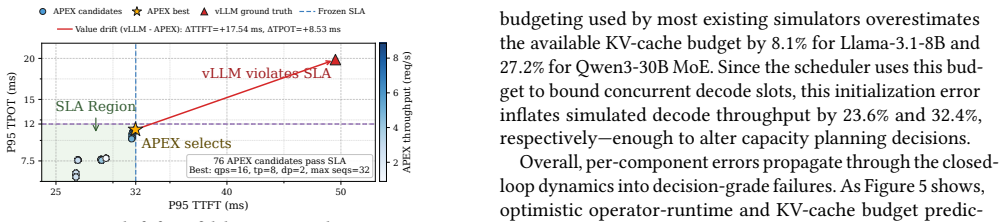
Modern LLM serving is no longer homogeneous or monolithic. Production systems now combine disaggregated execution, complex parallelism, runtime optimizations, and stateful workloads such as reasoning, agents, and RL rollouts. Simulation is attractive for exploring this growing design space, yet existing simulators lack the architectural completeness and decision-grade fidelity it demands. Their monolithic-replica abstractions are ill-suited to disaggregated serving, while average-case analytical proxies can distort SLA predictions and even reverse optimization conclusions. We present Frontier, a discrete-event simulator for modern LLM inference serving. Frontier features a disaggregated abstraction. It captures the structure and dynamics of modern serving systems by modeling co-location, Prefill-Decode Disaggregation (PDD), and Attention-FFN Disaggregation (AFD) with role-specific cluster workers, incorporating key runtime optimizations (e.g., CUDA Graphs, speculative decoding) within the scheduler-batch-engine loop, and supporting stateful requests for emerging workloads. It further provides accurate and generalizable predictions of computation, communication, and memory costs across diverse serving scenarios with complex workload compositions. On 16-H800 GPU testbed, Frontier achieves an average throughput error below 4%. Compared with state-of-the-art simulators, it reduces end-to-end latency error from 44.9% to 6.4% under co-location and from 51.7% to 2.6% under disaggregation. It scales to over 1K GPUs on commodity CPUs and enables new use cases such as SLA-dependent Pareto frontier exploration, heterogeneous disaggregated allocation, agentic reasoning scheduling validation, and RL post-training reconfiguration.
Editorial analysis
A structured set of objections, weighed in public.
Referee Report
Summary. The paper presents Frontier, a discrete-event simulator for modern LLM inference serving. It introduces disaggregated abstractions for co-location, Prefill-Decode Disaggregation (PDD), and Attention-FFN Disaggregation (AFD), models role-specific workers, incorporates runtime optimizations such as CUDA Graphs and speculative decoding in the scheduler-batch-engine loop, and supports stateful requests. On a 16-H800 GPU testbed, it reports average throughput error below 4%, reducing end-to-end latency error from 44.9% to 6.4% under co-location and from 51.7% to 2.6% under disaggregation relative to prior simulators. It claims scalability to over 1K GPUs and enables new use cases including SLA-dependent Pareto exploration and RL post-training reconfiguration.
Significance. If the reported accuracy holds with proper separation of calibration and validation data, Frontier would be a useful tool for design-space exploration in disaggregated and stateful LLM serving systems, addressing gaps in monolithic abstractions of existing simulators. The concrete hardware error metrics and explicit support for PDD/AFD are positive features. The significance is tempered by the need to confirm that the cost models for computation, communication, and memory are predictive rather than fitted to the reported testbed runs.
major comments (2)
- [§5] §5 (Evaluation): The central accuracy claims (throughput error <4%, latency reductions to 6.4% and 2.6%) rest on cost models whose derivation is not explicitly separated from the validation traces on the 16-H800 testbed. Without held-out workloads, cross-validation, or independent calibration data, the low errors risk measuring fit quality rather than generalization, directly affecting the claim of 'accurate and generalizable predictions across diverse serving scenarios.'
- [§4.2] §4.2 (Cost Models): The models for computation, communication, and memory are presented as generalizable, yet the manuscript provides no explicit parameter counts, fitting procedure, or sensitivity analysis showing independence from the specific 16-H800 configurations used for the error metrics. This is load-bearing for the disaggregation and optimization claims.
minor comments (2)
- [Abstract] The abstract states scalability to over 1K GPUs on commodity CPUs, but the main text should include concrete simulation runtime or memory usage figures for that scale to support the claim.
- [Figures/Tables] Figure captions and table legends should clarify whether error bars represent standard deviation across multiple runs or workload variations.
Simulated Author's Rebuttal
We thank the referee for the constructive and detailed review. The comments on evaluation methodology and cost model transparency are well-taken and point to areas where additional clarity will strengthen the manuscript. We respond to each major comment below.
read point-by-point responses
-
Referee: [§5] §5 (Evaluation): The central accuracy claims (throughput error <4%, latency reductions to 6.4% and 2.6%) rest on cost models whose derivation is not explicitly separated from the validation traces on the 16-H800 testbed. Without held-out workloads, cross-validation, or independent calibration data, the low errors risk measuring fit quality rather than generalization, directly affecting the claim of 'accurate and generalizable predictions across diverse serving scenarios.'
Authors: We agree that explicit separation of derivation from validation is essential to support generalization claims. The cost models combine analytical formulations (FLOPs, bandwidth, memory access patterns) with micro-benchmark measurements collected on smaller-scale hardware prior to the 16-H800 end-to-end runs; the latter serve strictly as validation. To address the concern directly, we will revise §5 to document this separation, add held-out workload results, and include a brief cross-validation summary. These additions will better substantiate the reported accuracy figures as predictive rather than fitted. revision: yes
-
Referee: [§4.2] §4.2 (Cost Models): The models for computation, communication, and memory are presented as generalizable, yet the manuscript provides no explicit parameter counts, fitting procedure, or sensitivity analysis showing independence from the specific 16-H800 configurations used for the error metrics. This is load-bearing for the disaggregation and optimization claims.
Authors: We thank the referee for highlighting this gap in presentation. The models are constructed from hardware-derived analytical expressions supplemented by limited empirical calibration on non-overlapping small-scale traces. We will expand §4.2 (and add an appendix if space requires) with explicit parameter counts, the precise fitting procedure, and a sensitivity analysis demonstrating robustness across GPU counts and configurations. This revision will make the independence from the 16-H800 testbed explicit and reinforce the generalizability needed for the disaggregation claims. revision: yes
Circularity Check
No significant circularity: accuracy claims rest on external hardware measurements
full rationale
The paper's central results are empirical error metrics (throughput <4%, latency reductions to 6.4%/2.6%) obtained by running the simulator against direct measurements on a physical 16-H800 GPU testbed. These comparisons use held-out execution traces rather than internal equations or parameters fitted to the same validation runs. No self-definitional steps, fitted-input predictions, or load-bearing self-citations appear in the derivation of the cost models or disaggregation abstractions; the simulator's fidelity is presented as an external benchmark outcome, not a closed loop.
Axiom & Free-Parameter Ledger
axioms (1)
- domain assumption Discrete-event simulation with role-specific workers can faithfully capture dynamics of co-location, PDD, and AFD in LLM serving
Lean theorems connected to this paper
-
IndisputableMonolith/Cost/FunctionalEquation.lean (washburn_uniqueness_aczel, Jcost definition)reality_from_one_distinction unclear?
unclearRelation between the paper passage and the cited Recognition theorem.
Frontier introduces a fidelity plane that replaces coarse average-case proxies with calibrated, hardware-aware predictors. Operator runtimes, collective costs, transfer delays, and KV-cache budgets are each resolved through profiled models grounded in actual CUDA kernel behavior
What do these tags mean?
- matches
- The paper's claim is directly supported by a theorem in the formal canon.
- supports
- The theorem supports part of the paper's argument, but the paper may add assumptions or extra steps.
- extends
- The paper goes beyond the formal theorem; the theorem is a base layer rather than the whole result.
- uses
- The paper appears to rely on the theorem as machinery.
- contradicts
- The paper's claim conflicts with a theorem or certificate in the canon.
- unclear
- Pith found a possible connection, but the passage is too broad, indirect, or ambiguous to say the theorem truly supports the claim.
Reference graph
Works this paper leans on
- [1]
- [2]
-
[3]
2025. dynamo. Website.https://www.nvidia.com/en-us/ai/dynamo/
work page 2025
-
[4]
2025. htsim Network Simulator. Website.https://github.com/ Broadcom/csg-htsim
work page 2025
- [5]
-
[6]
2025. Llama-3.1-405B-FP8. Website.https://huggingface.co/meta- llama/Llama-3.1-405B-FP8
work page 2025
-
[7]
2025. Llama-3.1-8B. Website.https://huggingface.co/meta-llama/ Llama-3.1-8B
work page 2025
-
[8]
2025. Llama-3.3-70B-Instruct. Website.https://huggingface.co/meta- llama/Llama-3.3-70B-Instruct
work page 2025
-
[9]
2025. NCCL workspace buffer. Website.https://docs.nvidia.com/ deeplearning/nccl/user-guide/docs/usage/bufferreg.html
work page 2025
-
[10]
2025. Nvidia CUDA Graph. Website.https://docs.nvidia.com/cuda/ cuda-programming-guide/04-special-topics/cuda-graphs.html
work page 2025
-
[11]
2025. Nvidia TensorRT-LLM. Website.https://github.com/NVIDIA/ TensorRT-LLM
work page 2025
-
[12]
2025. Qwen3-235B-A22B. Website.https://huggingface.co/Qwen/ Qwen3-235B-A22B
work page 2025
-
[13]
2025. Qwen3-30B-A3B. Website.https://huggingface.co/Qwen/ Qwen3-30B-A3B
work page 2025
-
[14]
2025. sglang admission. Website.https://github.com/sgl-project/ sglang/blob/main/docs/advanced_features/server_arguments.md
work page 2025
-
[15]
2025. SharedGPT trace. Website.https://docs.vllm.ai/en/v0.12.0/ benchmarking/cli/
work page 2025
-
[16]
2025. vllm watermark. Website.https://docs.vllm.ai/en/v0.9.0/api/ vllm/core/block_manager.html
work page 2025
-
[17]
Amey Agrawal, Nitin Kedia, Jayashree Mohan, Ashish Panwar, Nipun Kwatra, Bhargav S Gulavani, Ramachandran Ramjee, and Alexey Tu- manov. 2024. Vidur: A large-scale simulation framework for llm inference.Proceedings of Machine Learning and Systems6 (2024), 351– 366
work page 2024
-
[18]
Amey Agrawal, Nitin Kedia, Ashish Panwar, Jayashree Mohan, Nipun Kwatra, Bhargav Gulavani, Alexey Tumanov, and Ramachandran Ram- jee. 2024. Taming {Throughput-Latency} tradeoff in {LLM} inference with {Sarathi-Serve}. In18th USENIX Symposium on Operating Sys- tems Design and Implementation (OSDI 24). 117–134
work page 2024
-
[19]
Amey Agrawal, Ashish Panwar, Jayashree Mohan, Nipun Kwatra, Bhargav S Gulavani, and Ramachandran Ramjee. 2023. Sarathi: Effi- cient llm inference by piggybacking decodes with chunked prefills. arXiv preprint arXiv:2308.16369(2023)
work page internal anchor Pith review Pith/arXiv arXiv 2023
-
[20]
Amey Agrawal, Mayank Yadav, Sukrit Kumar, Anirudha Agrawal, Garv Ghai, Souradeep Bera, Elton Pinto, Sirish Gambhira, Mohammad Adain, Kasra Sohrab, Chus Antonanzas, and Alexey Tumanov. 2026. Revati: Transparent GPU-Free Time-Warp Emulation for LLM Serving. arXiv:2601.00397 [cs.DC]https://arxiv.org/abs/2601.00397
- [21]
-
[22]
Fernando J Corbató, Marjorie Merwin-Daggett, and Robert C Daley
-
[23]
InProceedings of the May 1-3, 1962, spring joint computer conference
An experimental time-sharing system. InProceedings of the May 1-3, 1962, spring joint computer conference. 335–344
work page 1962
-
[24]
Tri Dao. 2024. Flashattention-2: Faster attention with better paral- lelism and work partitioning. InInternational Conference on Learning Representations, Vol. 2024. 35549–35562. 13
work page 2024
-
[25]
Jiangfei Duan, Xiuhong Li, Ping Xu, Xingcheng Zhang, Shengen Yan, Yun Liang, and Dahua Lin. 2024. Proteus: Simulating the performance of distributed DNN training.IEEE Transactions on parallel and dis- tributed systems35, 10 (2024), 1867–1878
work page 2024
-
[26]
Yicheng Feng, Yuetao Chen, Kaiwen Chen, Jingzong Li, Tianyuan Wu, Peng Cheng, Chuan Wu, Wei Wang, Tsung-Yi Ho, and Hong Xu
- [27]
-
[28]
Daya Guo, Dejian Yang, Haowei Zhang, Junxiao Song, Ruoyu Zhang, Runxin Xu, Qihao Zhu, Shirong Ma, Peiyi Wang, Xiao Bi, et al. 2025. Deepseek-r1: Incentivizing reasoning capability in llms via reinforce- ment learning.arXiv preprint arXiv:2501.12948(2025)
work page internal anchor Pith review Pith/arXiv arXiv 2025
-
[29]
Mahmoud Khairy, Zhesheng Shen, Tor M Aamodt, and Timothy G Rogers. 2020. Accel-sim: An extensible simulation framework for validated gpu modeling. In2020 ACM/IEEE 47th Annual International Symposium on Computer Architecture (ISCA). IEEE, 473–486
work page 2020
-
[30]
Woosuk Kwon, Zhuohan Li, Siyuan Zhuang, Ying Sheng, Lianmin Zheng, Cody Hao Yu, Joseph Gonzalez, Hao Zhang, and Ion Stoica
-
[31]
InProceedings of the 29th symposium on operating systems principles
Efficient memory management for large language model serving with pagedattention. InProceedings of the 29th symposium on operating systems principles. 611–626
-
[32]
Dmitry Lepikhin, HyoukJoong Lee, Yuanzhong Xu, Dehao Chen, Orhan Firat, Yanping Huang, Maxim Krikun, Noam Shazeer, and Zhifeng Chen. 2020. Gshard: Scaling giant models with conditional computation and automatic sharding.arXiv preprint arXiv:2006.16668 (2020)
work page internal anchor Pith review Pith/arXiv arXiv 2020
-
[33]
Yaniv Leviathan, Matan Kalman, and Yossi Matias. 2023. Fast Inference from Transformers via Speculative Decoding. arXiv:2211.17192 [cs.LG]https://arxiv.org/abs/2211.17192
work page internal anchor Pith review Pith/arXiv arXiv 2023
-
[34]
Jiamin Li, Yimin Jiang, Yibo Zhu, Cong Wang, and Hong Xu. 2023. Accelerating distributed {MoE} training and inference with lina. In 2023 USENIX Annual Technical Conference (USENIX ATC 23). 945–959
work page 2023
- [35]
-
[36]
Aixin Liu, Bei Feng, Bing Xue, Bingxuan Wang, Bochao Wu, Chengda Lu, Chenggang Zhao, Chengqi Deng, Chenyu Zhang, Chong Ruan, et al . 2024. Deepseek-v3 technical report.arXiv preprint arXiv:2412.19437(2024)
work page internal anchor Pith review Pith/arXiv arXiv 2024
- [37]
-
[38]
Deepak Narayanan, Aaron Harlap, Amar Phanishayee, Vivek Seshadri, Nikhil R Devanur, Gregory R Ganger, Phillip B Gibbons, and Matei Zaharia. 2019. PipeDream: Generalized pipeline parallelism for DNN training. InProceedings of the 27th ACM symposium on operating sys- tems principles. 1–15
work page 2019
-
[39]
Adam Paszke, Sam Gross, Francisco Massa, Adam Lerer, James Bradbury, Gregory Chanan, Trevor Killeen, Zeming Lin, Natalia Gimelshein, Luca Antiga, et al. 2019. Pytorch: An imperative style, high-performance deep learning library.Advances in neural informa- tion processing systems32 (2019)
work page 2019
-
[40]
Ananda Samajdar, Yuhao Zhu, Paul Whatmough, Matthew Mattina, and Tushar Krishna. 2018. Scale-sim: Systolic cnn accelerator simula- tor.arXiv preprint arXiv:1811.02883(2018)
work page internal anchor Pith review Pith/arXiv arXiv 2018
-
[41]
Mohammad Shoeybi, Mostofa Patwary, Raul Puri, Patrick LeGresley, Jared Casper, and Bryan Catanzaro. 2019. Megatron-lm: Training multi-billion parameter language models using model parallelism. arXiv preprint arXiv:1909.08053(2019)
work page internal anchor Pith review Pith/arXiv arXiv 2019
-
[42]
Siddharth Singh, Olatunji Ruwase, Ammar Ahmad Awan, Samyam Rajbhandari, Yuxiong He, and Abhinav Bhatele. 2023. A hybrid tensor- expert-data parallelism approach to optimize mixture-of-experts train- ing. InProceedings of the 37th International Conference on Supercom- puting. 203–214
work page 2023
-
[43]
StepFun, :, Bin Wang, Bojun Wang, Changyi Wan, Guanzhe Huang, Hanpeng Hu, Haonan Jia, Hao Nie, Mingliang Li, Nuo Chen, Siyu Chen, Song Yuan, Wuxun Xie, Xiaoniu Song, Xing Chen, Xingping Yang, Xuelin Zhang, Yanbo Yu, Yaoyu Wang, Yibo Zhu, Yimin Jiang, Yu Zhou, Yuanwei Lu, Houyi Li, Jingcheng Hu, Ka Man Lo, Ailin Huang, Binxing Jiao, Bo Li, Boyu Chen, Chang...
- [44]
-
[45]
Lei Wang, Chen Ma, Xueyang Feng, Zeyu Zhang, Hao Yang, Jingsen Zhang, Zhiyuan Chen, Jiakai Tang, Xu Chen, Yankai Lin, et al. 2024. A survey on large language model based autonomous agents.Frontiers of Computer Science18, 6 (2024), 186345
work page 2024
-
[46]
William Won, Taekyung Heo, Saeed Rashidi, Srinivas Sridharan, Su- darshan Srinivasan, and Tushar Krishna. 2023. Astra-sim2. 0: Model- ing hierarchical networks and disaggregated systems for large-model training at scale. In2023 IEEE International Symposium on Performance Analysis of Systems and Software (ISPASS). IEEE, 283–294
work page 2023
-
[47]
Bingyang Wu, Yinmin Zhong, Zili Zhang, Shengyu Liu, Fangyue Liu, Yuanhang Sun, Gang Huang, Xuanzhe Liu, and Xin Jin. 2023. Fast distributed inference serving for large language models.arXiv preprint arXiv:2305.05920(2023)
work page internal anchor Pith review Pith/arXiv arXiv 2023
-
[48]
Tianhao Xu, Yiming Liu, Xianglong Lu, Yijia Zhao, Xuting Zhou, Aichen Feng, Yiyi Chen, Yi Shen, Qin Zhou, Xumeng Chen, Ilya Sher- styuk, Haorui Li, Rishi Thakkar, Ben Hamm, Yuanzhe Li, Xue Huang, Wenpeng Wu, Anish Shanbhag, Harry Kim, Chuan Chen, and Junjie 14 Lai. 2026. AIConfigurator: Lightning-Fast Configuration Optimiza- tion for Multi-Framework LLM S...
-
[49]
Shunyu Yao, Jeffrey Zhao, Dian Yu, Nan Du, Izhak Shafran, Karthik Narasimhan, and Yuan Cao. 2022. React: Synergizing reasoning and acting in language models.arXiv preprint arXiv:2210.03629(2022)
work page internal anchor Pith review Pith/arXiv arXiv 2022
-
[50]
Zihao Ye, Lequn Chen, Ruihang Lai, Wuwei Lin, Yineng Zhang, Stephanie Wang, Tianqi Chen, Baris Kasikci, Vinod Grover, Arvind Krishnamurthy, et al. 2025. Flashinfer: Efficient and customizable attention engine for llm inference serving.Proceedings of Machine Learning and Systems7 (2025)
work page 2025
- [51]
-
[52]
Lianmin Zheng, Zhuohan Li, Hao Zhang, Yonghao Zhuang, Zhifeng Chen, Yanping Huang, Yida Wang, Yuanzhong Xu, Danyang Zhuo, Eric P Xing, et al. 2022. Alpa: Automating inter-and {Intra-Operator} parallelism for distributed deep learning. In16th USENIX Symposium on Operating Systems Design and Implementation (OSDI 22). 559–578
work page 2022
-
[53]
Lianmin Zheng, Liangsheng Yin, Zhiqiang Xie, Chuyue Livia Sun, Jeff Huang, Cody Hao Yu, Shiyi Cao, Christos Kozyrakis, Ion Stoica, Joseph E Gonzalez, et al. 2024. Sglang: Efficient execution of structured language model programs.Advances in neural information processing systems37 (2024), 62557–62583
work page 2024
-
[54]
Yinmin Zhong, Shengyu Liu, Junda Chen, Jianbo Hu, Yibo Zhu, Xu- anzhe Liu, Xin Jin, and Hao Zhang. 2024. {DistServe}: Disaggregating prefill and decoding for goodput-optimized large language model serving. In18th USENIX Symposium on Operating Systems Design and Implementation (OSDI 24). 193–210
work page 2024
-
[55]
In19th USENIX Symposium on Operating Systems Design and Implementation (OSDI 25), pp
Ruidong Zhu, Ziheng Jiang, Chao Jin, Peng Wu, Cesar A Stuardo, Dongyang Wang, Xinlei Zhang, Huaping Zhou, Haoran Wei, Yang Cheng, et al . 2025. MegaScale-Infer: Serving Mixture-of-Experts at Scale with Disaggregated Expert Parallelism.arXiv preprint arXiv:2504.02263(2025). 15 0 10 20 30 40 Frontier APE (%) 0.0 0.2 0.4 0.6 0.8 1.0CDF p90 H20 BF16 Attention...
discussion (0)
Sign in with ORCID, Apple, or X to comment. Anyone can read and Pith papers without signing in.