Multi-Dimensional Matching in Market Design
Pith reviewed 2026-05-25 06:28 UTC · model grok-4.3
The pith
SVD reduces multi-dimensional matching to an effectively one-dimensional problem that approximately maximizes Nash social welfare under low effective dimensionality.
A machine-rendered reading of the paper's core claim, the machinery that carries it, and where it could break.
Core claim
When preference data exhibit low effective dimensionality, the SVD-based reduction of a multi-dimensional matching market to a one-dimensional problem along the principal direction approximately maximizes Nash social welfare, satisfies distributional truthfulness, achieves symmetry, and supplies robustness guarantees through a novel connection to geometric distributionally robust optimization.
What carries the argument
Singular Value Decomposition applied to the matrix of reported object features to extract the single principal direction along which agents and objects are then matched.
If this is right
- The matching runs in O(N log N) time rather than requiring exponential search over the full preference space.
- The mechanism inherits distributional truthfulness and symmetry from the underlying one-dimensional assignment rule.
- Robustness guarantees follow directly from the established link between Nash social welfare and geometric distributionally robust optimization.
- The same feature-based elicitation and reduction apply to school choice, labor markets, and course allocation without requiring agents to report complete utility vectors.
Where Pith is reading between the lines
- If the low-dimensionality assumption fails in practice, the method could be hybridized with a small number of additional directions to recover lost welfare at modest extra cost.
- The geometric DRO connection may allow the same SVD reduction technique to be reused in other mechanism-design settings that require robustness to distributional shifts.
- Because agents report only features rather than full utilities, the approach lowers cognitive burden and may increase participation rates in large-scale assignment markets.
Load-bearing premise
The reported preference data must exhibit low effective dimensionality so that one principal direction captures nearly all welfare-relevant variation.
What would settle it
Run the mechanism on preference data whose effective dimensionality is high (many singular values of comparable magnitude) and measure whether realized Nash social welfare falls substantially below 99 percent of the optimum obtained by direct optimization.
Figures

read the original abstract
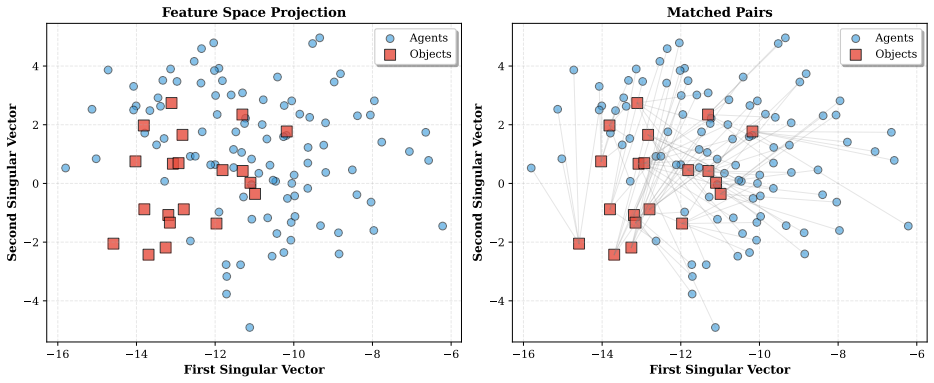
This paper proposes a computationally efficient mechanism for multi-dimensional matching markets where agents report preferences over object features rather than complete utility assessments. We use Singular Value Decomposition (SVD) to identify the principal direction of variation in feature space and match agents to objects along this dimension, reducing a complex multi-dimensional problem to an effectively one-dimensional problem solvable in $O(N \log N)$ time. We show that when data exhibit low effective dimensionality, our mechanism approximately maximizes Nash Social Welfare, satisfies distributional truthfulness, and achieves symmetry. We establish a novel connection between Nash Social Welfare and Geometric Distributionally Robust Optimization, providing robustness guaranties. Numerical experiments demonstrate that our approach achieves 99\% optimal welfare while running three orders of magnitude faster than direct optimization. The framework applies naturally to school choice, labor markets, and course allocation, where feature-based elicitation reduces the cognitive burden on agents.
Editorial analysis
A structured set of objections, weighed in public.
Referee Report
Summary. The paper proposes using SVD on agent-reported object features to identify a principal direction, reducing multi-dimensional matching to a one-dimensional problem solvable in O(N log N) time. It claims that under low effective dimensionality, the resulting mechanism approximately maximizes Nash Social Welfare (NSW), satisfies distributional truthfulness and symmetry, and establishes a novel connection to Geometric Distributionally Robust Optimization for robustness guarantees. Numerical experiments are reported to achieve 99% of optimal welfare while running three orders of magnitude faster than direct optimization, with applications to school choice, labor markets, and course allocation.
Significance. If the approximation guarantees, the NSW-DRO connection, and the experimental claims can be made rigorous with explicit bounds, the work would offer a computationally attractive approach to feature-based preference elicitation in matching markets. The O(N log N) runtime and potential robustness properties could be practically relevant where full utility elicitation is burdensome, provided the low-dimensionality assumption holds with quantifiable welfare loss.
major comments (3)
- [Abstract / mechanism section] Abstract and mechanism description: The central claim that the SVD-based reduction 'approximately maximizes Nash Social Welfare' and satisfies distributional truthfulness when data exhibit low effective dimensionality is load-bearing, yet no explicit approximation bound or error term is provided relating welfare loss (or truthfulness violation) to the ratio of the second singular value to the first, or to the effective rank. Without such a bound, it is unclear for which decay rates the O(N log N) procedure remains approximately optimal rather than arbitrarily suboptimal.
- [Abstract] Abstract: The novel connection between Nash Social Welfare and Geometric Distributionally Robust Optimization is asserted without any derivation, proof sketch, or detail on independence from fitted parameters, preventing verification of whether the robustness guarantees follow from the reduction or require additional assumptions.
- [Numerical experiments] Numerical experiments paragraph: The claims of 99% optimal welfare and three-orders-of-magnitude speedup rest on unshown experiments; no data description, baseline definitions, method for ensuring or measuring low effective dimensionality, or statistical details are supplied, making the performance numbers unverifiable and the cross-claim of practical superiority unsupported.
Simulated Author's Rebuttal
We thank the referee for their thoughtful review and constructive suggestions. We will revise the manuscript to provide the requested explicit bounds, derivation details, and experimental information. Our point-by-point responses follow.
read point-by-point responses
-
Referee: [Abstract / mechanism section] The central claim that the SVD-based reduction 'approximately maximizes Nash Social Welfare' and satisfies distributional truthfulness when data exhibit low effective dimensionality is load-bearing, yet no explicit approximation bound or error term is provided relating welfare loss (or truthfulness violation) to the ratio of the second singular value to the first, or to the effective rank. Without such a bound, it is unclear for which decay rates the O(N log N) procedure remains approximately optimal rather than arbitrarily suboptimal.
Authors: We agree that an explicit bound would strengthen the claims. The current manuscript provides a qualitative argument based on the dominance of the first singular vector under low effective dimensionality, but does not quantify the approximation error. We will add a theorem in the mechanism section that bounds the NSW approximation ratio in terms of σ₂/σ₁ and the effective rank, along with a similar bound for the truthfulness violation. revision: yes
-
Referee: [Abstract] The novel connection between Nash Social Welfare and Geometric Distributionally Robust Optimization is asserted without any derivation, proof sketch, or detail on independence from fitted parameters, preventing verification of whether the robustness guarantees follow from the reduction or require additional assumptions.
Authors: We acknowledge that the current version asserts the connection without a full derivation in the main text. We will add a detailed derivation and proof sketch showing how the NSW-DRO equivalence arises from the SVD reduction, and clarify that the guarantees are independent of specific parameter fits under the low-dimensionality assumption. revision: yes
-
Referee: [Numerical experiments] The claims of 99% optimal welfare and three-orders-of-magnitude speedup rest on unshown experiments; no data description, baseline definitions, method for ensuring or measuring low effective dimensionality, or statistical details are supplied, making the performance numbers unverifiable and the cross-claim of practical superiority unsupported.
Authors: The experiments section in the full paper uses both synthetic data with controlled singular value decay and real datasets from school choice and course allocation. We will expand this section to include: (i) explicit description of data generation and dimensionality measurement via singular value ratios, (ii) definition of baselines (e.g., exact NSW solver via convex optimization), (iii) statistical details such as number of runs and variance, and (iv) additional tables showing welfare ratios for varying effective ranks. This will make the 99% claim and speedup verifiable. revision: yes
Circularity Check
No significant circularity detected in derivation chain.
full rationale
The paper's core reduction applies SVD to project onto the principal direction under the explicit assumption of low effective dimensionality, then states conditional approximate properties for NSW maximization, distributional truthfulness, and symmetry. This is not a self-definitional equivalence (the output is not the SVD input by construction) nor a fitted parameter relabeled as prediction. The claimed novel connection to Geometric Distributionally Robust Optimization is asserted without any quoted reduction to prior self-citations, fitted inputs, or ansatzes from the authors' own prior work. No uniqueness theorems, self-citation load-bearing steps, or renaming of known results appear in the provided text. The mechanism's O(N log N) runtime and numerical claims (99% welfare) are presented as empirical outcomes rather than tautological. The derivation remains self-contained against its stated assumptions and external benchmarks.
Axiom & Free-Parameter Ledger
Reference graph
Works this paper leans on
-
[1]
doi:10.1257/ aer.20172741 Atila Abdulkadiro˘ glu, Parag A
Do Parents Value School Effectiveness?American Economic Review110, 5 (2020), 1502–1539. doi:10.1257/ aer.20172741 Atila Abdulkadiro˘ glu, Parag A. Pathak, and Alvin E. Roth
work page 2020
-
[2]
American Economic Review95, 2 (May 2005), 364–367
The New York City High School Match. American Economic Review95, 2 (May 2005), 364–367. doi:10.1257/000282805774670167 Rediet Abebe, Richard Cole, Vasilis Gkatzelis, and Jason D. Hartline
-
[3]
arXiv:1903.07797 [cs.GT] Nikhil Agarwal and Paulo Somaini
A Truthful Cardinal Mechanism for One-Sided Matching. arXiv:1903.07797 [cs.GT] Nikhil Agarwal and Paulo Somaini
-
[4]
Revealed Preference Analysis of School Choice Models.Annual Review of Economics12 (2020), 471–510. doi:10.1146/annurev-economics-082019-112339 24 Amine Allouah, Omar Besbes, Josu´ e D Figueroa, Yash Kanoria, and Akshit Kumar
-
[5]
arXiv:2508.02630 [cs.AI]https://arxiv.org/abs/2508.02630 Eric Budish
What Is Your AI Agent Buying? Evaluation, Biases, Model Dependence, and Emerging Implications for Agentic E- Commerce. arXiv:2508.02630 [cs.AI]https://arxiv.org/abs/2508.02630 Eric Budish
-
[6]
doi:10.1086/664613 Simon Burgess, Ellen Greaves, Anna Vignoles, and Deborah Wilson
The Combinatorial Assignment Problem: Approximate Competitive Equilibrium from Equal Incomes.Journal of Political Economy119, 6 (2011), 1061–1103. doi:10.1086/664613 Simon Burgess, Ellen Greaves, Anna Vignoles, and Deborah Wilson
-
[7]
doi:10.1111/ecoj.12153 Caterina Calsamiglia and Maia G¨ uell
What Parents Want: School Preferences and School Choice.Economic Journal125, 587 (2015), 1262–1289. doi:10.1111/ecoj.12153 Caterina Calsamiglia and Maia G¨ uell. 2014.The Illusion of School Choice: Empirical Evidence from Barcelona. Discussion Paper
-
[8]
The Unreasonable Fairness of Maximum Nash Welfare.ACM Trans. Econ. Comput.7, 3, Article 12 (Sept. 2019), 32 pages. doi:10.1145/3355902 Shuchi Chawla, Jason D. Hartline, David L. Malec, and Balasubramanian Sivan
-
[9]
Multi-parameter mechanism design and sequential posted pricing. InProceedings of the Forty-Second ACM Symposium on Theory of Computing(Cambridge, Massachusetts, USA)(STOC ’10). Association for Computing Machinery, New York, NY, USA, 311–320. doi:10.1145/1806689.1806733 Thomas Chen, Xi Chen, Binghui Peng, and Mihalis Yannakakis
-
[10]
InProceedings of the 2022 ACM-SIAM Symposium on Discrete Algorithms (SODA)
Computational Hardness of the Hylland–Zeckhauser Scheme. InProceedings of the 2022 ACM-SIAM Symposium on Discrete Algorithms (SODA). 2253–2268. Raj Chetty, John N. Friedman, and Jonah E. Rockoff
work page 2022
-
[11]
Measuring the Impacts of Teachers I: Evaluating Bias in Teacher Value-Added Estimates.American Economic Review104, 9 (2014), 2593–2632. doi:10. 1257/aer.104.9.2593 Richard Cole and Vasilis Gkatzelis
work page 2014
-
[12]
Approximating the Nash Social Welfare with Indivisible Items. SIAM J. Comput.47, 3 (2018), 1211–1236. arXiv:https://doi.org/10.1137/15M1053682 doi:10.1137/ 15M1053682 Nikhil R. Devanur, Jason D. Hartline, and Qiqi Yan
-
[13]
Journal of Economic Theory156 (2015), 103–143
Envy freedom and prior-free mechanism design. Journal of Economic Theory156 (2015), 103–143. doi:10.1016/j.jet.2014.08.001Computer Science and Economic Theory. A. Dvoretzky, J. Kiefer, and J. Wolfowitz
- [14]
-
[15]
The approximation of one matrix by another of lower rank.Psychometrika 1, 3 (September 1936), 211–218. doi:10.1007/BF02288367 D. Gale and L. S. Shapley
-
[16]
College Admissions and the Stability of Marriage.The American Mathe- matical Monthly69, 1 (1962), 9–15.http://www.jstor.org/stable/2312726 25 Joshua S. Gans and Scott Duke Kominers
-
[17]
Informative Grading Requires Cross-Course Comparabil- ity. (2026).https://www.scottkom.com/assets/articles/Gans_r_Kominers_Informative_Grading_ Requires_Cross-Course_Comparability.pdfWorking paper, Rotman School of Management, Univer- sity of Toronto, and Harvard Business School. G. H. Golub and C. Reinsch
work page 2026
-
[18]
Singular value decomposition and least squares solutions.Numer. Math. 14, 5 (April 1970), 403–420. doi:10.1007/BF02163027 Faruk Gul, Wolfgang Pesendorfer, and Mu Zhang
-
[19]
Efficient Allocation of Indivisible Goods in Pseudo- markets with Constraints.Journal of Political Economy132, 11 (2024), 3708–3736. doi:10.1086/730561 Justine S. Hastings, Thomas J. Kane, and Douglas O. Staiger. 2006.Preferences and Heterogeneous Treat- ment Effects in a Public School Choice Lottery. Working Paper 12145. National Bureau of Economic Resea...
-
[20]
arXiv:https://doi.org/10.1086/260757 doi:10.1086/260757 Alexander S
The Efficient Allocation of Individuals to Positions.Journal of Political Economy87, 2 (1979), 293–314. arXiv:https://doi.org/10.1086/260757 doi:10.1086/260757 Alexander S. Kelso and Vincent P. Crawford
-
[21]
Job Matching, Coalition Formation, and Gross Substi- tutes.Econometrica50, 6 (1982), 1483–1504. Jacob D. Leshno
work page 1982
-
[22]
doi:10.1257/aer.20201111 Ilse Lindenlaub
Dynamic Matching in Overloaded Waiting Lists.American Economic Review112, 12 (December 2022), 3876–3910. doi:10.1257/aer.20201111 Ilse Lindenlaub
-
[23]
doi:10.1093/restud/rdw036 Ilse Lindenlaub and Fabien Postel-Vinay
Sorting Multidimensional Types: Theory and Application.Review of Economic Studies84, 2 (2017), 718–789. doi:10.1093/restud/rdw036 Ilse Lindenlaub and Fabien Postel-Vinay
-
[24]
Multi-Dimensional Sorting in the Data. (2023). Working Paper, Institute for Fiscal Studies. Jeremy Lise and Fabien Postel-Vinay
work page 2023
-
[25]
doi:10.1257/aer.20162002 Jiashuo Liu, Jiayun Wu, Bo Li, and Peng Cui
Multidimensional Skills, Sorting, and Human Capital Accumu- lation.American Economic Review110, 8 (2020), 2328–2376. doi:10.1257/aer.20162002 Jiashuo Liu, Jiayun Wu, Bo Li, and Peng Cui
-
[26]
Mullen, David Powell, Till von Wachter, and Jeffrey B
Curran As- sociates, Inc., 33689–33701.https://proceedings.neurips.cc/paper_files/paper/2022/file/ da535999561b932f56efdd559498282e-Paper-Conference.pdf Nicole Maestas, Kathleen J. Mullen, David Powell, Till von Wachter, and Jeffrey B. Wenger
work page 2022
-
[27]
The Value of Working Conditions in the United States and the Implications for the Structure of Wages.American Economic Review113, 7 (2023), 2007–2047. doi:10.1257/aer.20190846 P. Massart
- [28]
-
[29]
repec.org/RePEc:ecm:emetrp:v:18:y:1950:i:2:p:155-162 26 Samarendra Nath Roy
The Bargaining Problem.Econometrica18, 2 (1950), 155–162.https://EconPapers. repec.org/RePEc:ecm:emetrp:v:18:y:1950:i:2:p:155-162 26 Samarendra Nath Roy
work page 1950
-
[30]
Effective rank concept later formalised by Vershynin (2018)
On a Heuristic Method of Test Construction and its use in Multivariate Analysis.The Annals of Mathematical Statistics24, 2 (1953), 220–238. Effective rank concept later formalised by Vershynin (2018). Jae Song, David J. Price, Fatih Guvenen, Nicholas Bloom, and Till von Wachter
work page 1953
-
[31]
Quarterly Journal of Economics134, 1 (2019), 1–50
Firming Up Inequality. Quarterly Journal of Economics134, 1 (2019), 1–50. doi:10.1093/qje/qjy025 Vijay V. Vazirani and Mihalis Yannakakis
-
[32]
Computational Complexity of the Hylland–Zeckhauser Mechanism for One-Sided Matching Markets.SIAM J. Comput.54, 2 (2025), 193–232. doi:10.1137/ 23M157586X Roman Vershynin. 2018.High-Dimensional Probability: An Introduction with Applications in Data Science. Cambridge University Press. doi:10.1017/9781108231596 Matthew Wiswall and Basit Zafar
-
[33]
doi:10.1093/qje/qjx035 Lin Zhou
Preference for the Workplace, Investment in Human Capital, and Gender.Quarterly Journal of Economics133, 1 (2018), 457–507. doi:10.1093/qje/qjx035 Lin Zhou
-
[34]
doi:10.1016/0022-0531(90)90070-Z 27
On a conjecture by gale about one-sided matching problems.Journal of Economic Theory 52, 1 (1990), 123–135. doi:10.1016/0022-0531(90)90070-Z 27
discussion (0)
Sign in with ORCID, Apple, or X to comment. Anyone can read and Pith papers without signing in.