Long-term optical and near-infrared photometric evolution of SN 2019vxm, an interacting Type IIn supernova
Pith reviewed 2026-05-25 03:45 UTC · model grok-4.3
The pith
SN 2019vxm photometry indicates a massive progenitor with extremely high pre-supernova mass-loss rates
A machine-rendered reading of the paper's core claim, the machinery that carries it, and where it could break.
Core claim
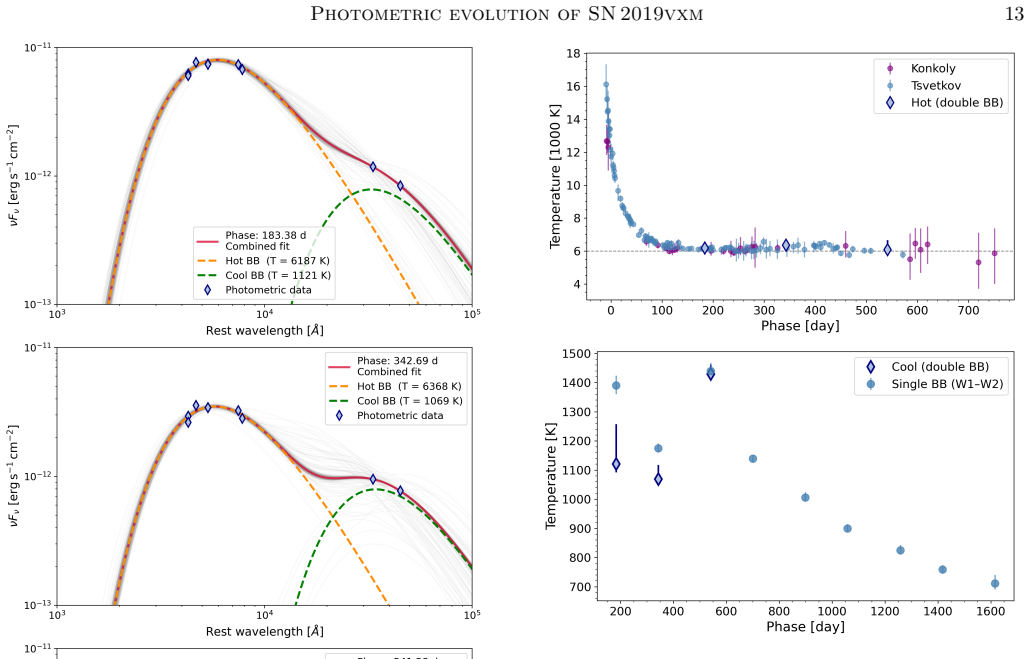
The evolution of the spectral energy distribution and bolometric luminosity, as well as the effective temperature and radius of the photosphere, indicates that the supernova was initially surrounded by an optically thick CSM, which was heated and pushed outward by the forward shock of the impacting ejecta. About 80-100 days after the explosion the forward shock and the photosphere decouples, and we observe the receding photosphere of the H-recombination front within the now thinned CSM. Near-IR measurements reveal long-lasting, slowly cooling emission from circumstellar dust around SN 2019vxm and an IR rebrightening about one year after explosion, which we tentatively identify as a signature
What carries the argument
The multicolor photometric evolution of the spectral energy distribution, bolometric luminosity, photospheric temperature and radius, together with the tentative identification of the one-year infrared rebrightening as outer CSM emission.
If this is right
- The diversity of Type IIn supernovae is largely driven by the properties of their circumstellar material.
- The supernova began surrounded by an optically thick CSM that the forward shock heated and expanded outward.
- After roughly 80-100 days the photosphere recedes within the now thinned CSM, revealing the H-recombination front.
- Long-lasting near-infrared emission traces slowly cooling circumstellar dust, with a possible outer CSM region causing the one-year rebrightening.
- High inferred masses and mass-loss rates imply the progenitor was massive and experienced intense pre-explosion mass loss.
Where Pith is reading between the lines
- Long-term infrared monitoring of other interacting supernovae may similarly reveal layered CSM structures.
- Refined models that explicitly track the photosphere motion could tighten the mass and rate estimates for this class of events.
- The reported difficulties in modeling suggest that future work on shock propagation through thinning material will be needed to confirm the mass-loss values.
Load-bearing premise
The assumption that progenitor and CSM masses can still be inferred despite the moving photosphere, the thick-to-thin transition, and the tentative link of the infrared rebrightening to an outer circumstellar region.
What would settle it
A hydrodynamic model or additional multi-epoch spectroscopy that yields substantially lower mass-loss rates after fully incorporating the recession of the photosphere and the change from optically thick to partially thin CSM.
Figures




read the original abstract
The diversity of Type IIn supernovae is largely driven by the properties of the circumstellar material (CSM) they explode into. We examine the temporal evolution of SN 2019vxm, an interacting supernova that belongs to the class of long-lasting Type IIn events, using multicolor photometry spanning the ultraviolet, optical and near-infrared wavelengths, including over 650 days of optical and 1500 days of IR coverage. The evolution of the spectral energy distribution and bolometric luminosity, as well as the effective temperature and radius of the photosphere, indicates that the supernova was initially surrounded by an optically thick CSM, which was heated and pushed outward by the forward shock of the impacting ejecta. About 80-100 days after the explosion the forward shock and the photosphere decouples, and we observe the receding photosphere of the H-recombination front within the now thinned CSM. Near-IR measurements reveal long-lasting, slowly cooling emission from circumstellar dust around SN 2019vxm and an IR rebrightening about one year after explosion, which we tentatively identify as a signature of an outer CSM region. We find that due to the moving photosphere and the transition from optically thick to partially thin inner CSM, modeling the explosion and subsequent interaction of the ejecta with the CSM to infer progenitor and CSM masses faces difficulties. Nevertheless, the inferred high masses and extremely high mass-loss rates point to a massive progenitor undergoing intense pre-supernova mass loss.
Editorial analysis
A structured set of objections, weighed in public.
Referee Report
Summary. The paper reports multi-wavelength (UV/optical/NIR) photometric monitoring of the Type IIn supernova SN 2019vxm spanning >650 days in the optical and >1500 days in the IR. It describes an initial optically thick CSM phase, decoupling of the forward shock from the photosphere at ~80-100 days, subsequent recession of the H-recombination front, persistent NIR dust emission, and a tentative one-year IR rebrightening attributed to an outer CSM shell. Despite explicit caveats that the moving photosphere and thick-to-thin CSM transition complicate ejecta-CSM interaction modeling, the authors still infer high progenitor and CSM masses together with extremely high pre-explosion mass-loss rates, concluding that the event arose from a massive star with intense pre-SN mass loss.
Significance. The long temporal baseline and dense multi-band coverage constitute a valuable observational resource for the subclass of long-lasting Type IIn events. If the mass and mass-loss inferences can be placed on a firmer footing, the results would strengthen the empirical link between extreme pre-supernova mass loss and the diversity of interacting supernovae. The dataset itself is a clear strength; the quantitative progenitor conclusions remain limited by the modeling difficulties the authors themselves flag.
major comments (1)
- [Abstract] Abstract: The manuscript states that 'modeling the explosion and subsequent interaction of the ejecta with the CSM to infer progenitor and CSM masses faces difficulties' because of the moving photosphere and the optically thick-to-partially thin transition, yet proceeds to report 'inferred high masses and extremely high mass-loss rates.' No robustness checks against these dynamical and optical-depth effects are described, leaving the central quantitative claim under-constrained.
Simulated Author's Rebuttal
We thank the referee for their thoughtful review and for recognizing the value of the long-term multi-band dataset. We agree that the modeling challenges limit the precision of the progenitor and CSM mass inferences, and we address the specific concern about the abstract below.
read point-by-point responses
-
Referee: [Abstract] Abstract: The manuscript states that 'modeling the explosion and subsequent interaction of the ejecta with the CSM to infer progenitor and CSM masses faces difficulties' because of the moving photosphere and the optically thick-to-partially thin transition, yet proceeds to report 'inferred high masses and extremely high mass-loss rates.' No robustness checks against these dynamical and optical-depth effects are described, leaving the central quantitative claim under-constrained.
Authors: We accept this criticism. Although the abstract already notes the modeling difficulties, the subsequent claim of 'inferred high masses and extremely high mass-loss rates' is insufficiently qualified. In the revised manuscript we will rephrase the abstract to state that the observations are consistent with high progenitor and CSM masses together with extreme pre-explosion mass-loss rates, while explicitly underscoring that these are order-of-magnitude indications only. We will also add a short paragraph in the discussion section that qualitatively explores how the recession of the photosphere and the thick-to-thin transition affect simple analytic estimates of CSM mass and mass-loss rate, referencing the same caveats already present in the text. These changes will be made without introducing new numerical modeling. revision: yes
Circularity Check
No circularity: purely observational photometry and SED analysis with explicit modeling caveats
full rationale
The paper presents multicolor photometry, derives observed quantities (SED evolution, bolometric luminosity, photospheric temperature and radius) directly from data, and notes modeling difficulties from moving photosphere and thick-to-thin transition without claiming a closed derivation or prediction that reduces to fitted inputs by construction. No equations, self-citations, or ansatzes are invoked in a load-bearing way that would create circularity; the mass and mass-loss inferences are presented as tentative despite acknowledged limitations, keeping the chain self-contained against external benchmarks.
Axiom & Free-Parameter Ledger
axioms (1)
- domain assumption Type IIn supernovae explode into circumstellar material lost by the progenitor
Reference graph
Works this paper leans on
-
[1]
Anders , F., Khalatyan , A., Queiroz , A. B. A., et al. 2022, title Photo-astrometric distances, extinctions, and astrophysical parameters for Gaia EDR3 stars brighter than G = 18.5 , , 658, A91, 10.1051/0004-6361/202142369
-
[2]
G., Dwek , E., Bouchet , P., et al
Arendt , R. G., Dwek , E., Bouchet , P., et al. 2016, title Infrared Continuum and Line Evolution of the Equatorial Ring around SN 1987A , , 151, 62, 10.3847/0004-6256/151/3/62
-
[3]
Arnett , W. D. 1980, title Analytic solutions for light curves of supernovae of Type II , , 237, 541, 10.1086/157898
-
[4]
Arnett , W. D. 1982, title Type I supernovae. I - Analytic solutions for the early part of the light curve , , 253, 785, 10.1086/159681
-
[5]
Barna , B., Nagy , A. P., Bora , Z., et al. 2023, title Three is the magic number: Distance measurement of NGC 3147 using SN 2021hpr and its siblings , , 677, A183, 10.1051/0004-6361/202346395
-
[6]
Bersten , M. C., & Hamuy , M. 2009, title Bolometric Light Curves for 33 Type II Plateau Supernovae , , 701, 200, 10.1088/0004-637X/701/1/200
-
[7]
S., Castelli , F., & Plez , B
Bessell , M. S., Castelli , F., & Plez , B. 1998, title Model atmospheres broad-band colors, bolometric corrections and temperature calibrations for O - M stars , , 333, 231
1998
-
[8]
Bilinski , C., Smith , N., Williams , G. G., et al. 2024, title Multi-epoch spectropolarimetry for a sample of Type IIn Supernovae: persistent asymmetry in dusty circumstellar material , , 529, 1104, 10.1093/mnras/stae380
-
[9]
Bilinski , C., Smith , N., Williams , G. G., et al. 2020, title SN 2014ab: an aspherical Type IIn supernova with low polarization , , 498, 3835, 10.1093/mnras/staa2617
-
[10]
2022, title Initial Ni-56 Masses in Type Ia Supernovae , , 134, 054201, 10.1088/1538-3873/ac63e7
Bora , Z., Vink \'o , J., & K \"o nyves-T \'o th , R. 2022, title Initial Ni-56 Masses in Type Ia Supernovae , , 134, 054201, 10.1088/1538-3873/ac63e7
-
[11]
2022, title The Pantheon+ Analysis: Cosmological Constraints , , 938, 110, 10.3847/1538-4357/ac8e04
Brout , D., Scolnic , D., Popovic , B., et al. 2022, title The Pantheon+ Analysis: Cosmological Constraints , , 938, 110, 10.3847/1538-4357/ac8e04
-
[12]
Brown , T. M., Baliber , N., Bianco , F. B., et al. 2013, title Las Cumbres Observatory Global Telescope Network , , 125, 1031, 10.1086/673168
work page internal anchor Pith review doi:10.1086/673168 2013
-
[13]
2019, title ASASSN-19acc: Discovery of A Bright Type IIn Supernova in the TESS Field , The Astronomer's Telegram, 13326, 1
Cacella , P., Cruz , I., Brimacombe , J., et al. 2019, title ASASSN-19acc: Discovery of A Bright Type IIn Supernova in the TESS Field , The Astronomer's Telegram, 13326, 1
2019
-
[14]
Cendes , Y., Gaensler , B. M., Ng , C.-Y., et al. 2018, title The Reacceleration of the Shock Wave in the Radio Remnant of SN 1987A , , 867, 65, 10.3847/1538-4357/aae261
-
[15]
Chambers , K. C., Magnier , E. A., Metcalfe , N., et al. 2016, title The Pan-STARRS1 Surveys , arXiv e-prints, arXiv:1612.05560, 10.48550/arXiv.1612.05560
work page internal anchor Pith review Pith/arXiv arXiv doi:10.48550/arxiv.1612.05560 2016
-
[16]
Chandra , P., Chevalier , R. A., James , N. J. H., & Fox , O. D. 2022, title The luminous type IIn supernova SN 2017hcc: Infrared bright, X-ray, and radio faint , , 517, 4151, 10.1093/mnras/stac2915
-
[17]
Chatzopoulos , E., Wheeler , J. C., & Vink\'o , J. 2012, title Generalized Semi-analytical Models of Supernova Light Curves , , 746, 121, 10.1088/0004-637X/746/2/121
-
[18]
Chatzopoulos , E., Wheeler , J. C., Vink\'o , J., Horvath , Z. L., & Nagy , A. 2013, title Analytical Light Curve Models of Superluminous Supernovae: ^ 2 -minimization of Parameter Fits , , 773, 76, 10.1088/0004-637X/773/1/76
-
[19]
Chatzopoulos , E., Wheeler , J. C., Vinko , J., et al. 2011, title SN 2008am: A Super-luminous Type IIn Supernova , , 729, 143, 10.1088/0004-637X/729/2/143
-
[20]
Chevalier , R. A. 1982, title Self-similar solutions for the interaction of stellar ejecta with an external medium. , , 258, 790, 10.1086/160126
-
[21]
Chevalier , R. A., & Fransson , C. 1994, title Emission from Circumstellar Interaction in Normal Type II Supernovae , , 420, 268, 10.1086/173557
-
[22]
Chevalier, R. A., & Fransson, C. 2003, Supernova Interaction with a Circumstellar Medium (Springer Berlin Heidelberg), 171–194, 10.1007/3-540-45863-8_10
-
[23]
Cleveland, W. S. 1979, title Robust Locally Weighted Regression and Smoothing Scatterplots, Journal of the American Statistical Association, 74, 829, 10.1080/01621459.1979.10481038
-
[24]
Cold , C., & Hjorth , J. 2023, title Cosmic rate of type IIn supernovae and its evolution with redshift , , 670, A48, 10.1051/0004-6361/202244867
-
[25]
Dukiya , N., Gangopadhyay , A., Misra , K., et al. 2024, title Probing the Circumstellar Environment of the Highly Luminous Type IIn Supernova ASASSN-14il , , 976, 86, 10.3847/1538-4357/ad7e11
-
[26]
2019, title Recombination Effects on Supernova Light Curves , , 879, 20, 10.3847/1538-4357/ab218a
Faran , T., Goldfriend , T., Nakar , E., & Sari , R. 2019, title Recombination Effects on Supernova Light Curves , , 879, 20, 10.3847/1538-4357/ab218a
-
[27]
Foreman-Mackey , D., Hogg , D. W., Lang , D., & Goodman , J. 2013, title emcee: The MCMC Hammer , , 125, 306, 10.1086/670067
-
[28]
Fox , O. D., Chevalier , R. A., Dwek , E., et al. 2010, title Disentangling the Origin and Heating Mechanism of Supernova Dust: Late-time Spitzer Spectroscopy of the Type IIn SN 2005ip , , 725, 1768, 10.1088/0004-637X/725/2/1768
-
[29]
Fransson , C., Ergon , M., Challis , P. J., et al. 2014, title High-density Circumstellar Interaction in the Luminous Type IIn SN 2010jl: The First 1100 Days , , 797, 118, 10.1088/0004-637X/797/2/118
-
[30]
Gaia Collaboration , Prusti , T., de Bruijne , J. H. J., et al. 2016, title The Gaia mission , , 595, A1, 10.1051/0004-6361/201629272
-
[31]
2023, title Gaia Data Release 3
Gaia Collaboration , Montegriffo , P., Bellazzini , M., et al. 2023, title Gaia Data Release 3. The Galaxy in your preferred colours: Synthetic photometry from Gaia low-resolution spectra , , 674, A33, 10.1051/0004-6361/202243709
-
[32]
Gall , C., Hjorth , J., Watson , D., et al. 2014, title Rapid formation of large dust grains in the luminous supernova 2010jl , , 511, 326, 10.1038/nature13558
-
[33]
Gehrels , N., Chincarini , G., Giommi , P., et al. 2004, title The Swift Gamma-Ray Burst Mission , , 611, 1005, 10.1086/422091
-
[34]
Hart , K., Shappee , B. J., Hey , D., et al. 2023, title ASAS-SN Sky Patrol V2.0 , arXiv e-prints, arXiv:2304.03791, 10.48550/arXiv.2304.03791
-
[35]
Hillenkamp , E., Baer-Way , R., Chandra , P., et al. 2026, title Fading Echoes of Interaction: Probing Centuries of Preexplosion Mass Loss in Four Type IIn Supernovae , , 1001, 111, 10.3847/1538-4357/ae4e22
-
[36]
Hiramatsu , D., Matsumoto , T., Berger , E., et al. 2024, title Multiple Peaks and a Long Precursor in the Type IIn Supernova 2021qqp: An Energetic Explosion in a Complex Circumstellar Environment , , 964, 181, 10.3847/1538-4357/ad2854
-
[37]
Hodgkin , S. T., Harrison , D. L., Breedt , E., et al. 2021, title Gaia Early Data Release 3. Gaia photometric science alerts , , 652, A76, 10.1051/0004-6361/202140735
-
[38]
Humphreys , R. M., & Davidson , K. 1994, title The Luminous Blue Variables: Astrophysical Geysers , , 106, 1025, 10.1086/133478
-
[39]
M., Davidson , K., & Smith , N
Humphreys , R. M., Davidson , K., & Smith , N. 1999, title Carinae's Second Eruption and the Light Curves of the Carinae Variables , , 111, 1124, 10.1086/316420
-
[40]
Kangas , T., Ahola , A., Fransson , C., et al. 2023, title Near-infrared evolution of the equatorial ring of SN 1987A , , 675, A166, 10.1051/0004-6361/202245829
-
[41]
Khatami , D. K., & Kasen , D. N. 2024, title The Landscape of Thermal Transients from Supernovae Interacting with a Circumstellar Medium , , 972, 140, 10.3847/1538-4357/ad60c0
-
[42]
Kiewe , M., Gal-Yam , A., Arcavi , I., et al. 2012, title Caltech Core-Collapse Project (CCCP) Observations of Type IIn Supernovae: Typical Properties and Implications for Their Progenitor Stars , , 744, 10, 10.1088/0004-637X/744/1/10
-
[43]
Kochanek , C. S., Shappee , B. J., Stanek , K. Z., et al. 2017, title The All-Sky Automated Survey for Supernovae (ASAS-SN) Light Curve Server v1.0 , , 129, 104502, 10.1088/1538-3873/aa80d9
-
[44]
Kokubo , M., Mitsuda , K., Morokuma , T., et al. 2019, title A Long-duration Luminous Type IIn Supernova KISS15s: Strong Recombination Lines from the Inhomogeneous Ejecta-CSM Interaction Region and Hot Dust Emission from Newly Formed Dust , , 872, 135, 10.3847/1538-4357/aaff6b
-
[45]
Lamers , H. J. G. L. M., & Cassinelli , J. P. 1999, Introduction to Stellar Winds ( Cambridge University Press )
1999
-
[46]
G., Ridden-Harper , R., Rest , S., et al
Lane , Z. G., Ridden-Harper , R., Rest , S., et al. 2026, title SN 2019vxm: A Shocking Coincidence between Fermi and TESS , , 1003, 10.3847/1538-4357/ae6245
-
[47]
2019, title Transient Classification Report for 2019-12-02 , Transient Name Server Classification Report, 2019-2506, 1
Leadbeater , R. 2019, title Transient Classification Report for 2019-12-02 , Transient Name Server Classification Report, 2019-2506, 1
2019
-
[48]
Li , W., Leaman , J., Chornock , R., et al. 2011, title Nearby supernova rates from the Lick Observatory Supernova Search - II. The observed luminosity functions and fractions of supernovae in a complete sample , , 412, 1441, 10.1111/j.1365-2966.2011.18160.x
-
[49]
Lyman , J. D., Bersier , D., & James , P. A. 2014, title Bolometric corrections for optical light curves of core-collapse supernovae , , 437, 3848, 10.1093/mnras/stt2187
-
[50]
Mainzer , A., Bauer , J., Grav , T., et al. 2011, title Preliminary Results from NEOWISE: An Enhancement to the Wide-field Infrared Survey Explorer for Solar System Science , , 731, 53, 10.1088/0004-637X/731/1/53
-
[51]
Mainzer , A., Bauer , J., Cutri , R. M., et al. 2014, title Initial Performance of the NEOWISE Reactivation Mission , , 792, 30, 10.1088/0004-637X/792/1/30
-
[52]
Martinez , L., Bersten , M. C., Anderson , J. P., et al. 2022, title Type II supernovae from the Carnegie Supernova Project-I. I. Bolometric light curves of 74 SNe II using uBgVriYJH photometry , , 660, A40, 10.1051/0004-6361/202142075
-
[53]
Meegan , C., Lichti , G., Bhat , P. N., et al. 2009, title The Fermi Gamma-ray Burst Monitor , , 702, 791, 10.1088/0004-637X/702/1/791
-
[54]
1941, title Spectra of Supernovae , , 53, 224, 10.1086/125315
Minkowski , R. 1941, title Spectra of Supernovae , , 53, 224, 10.1086/125315
-
[55]
Moran , S., Fraser , M., Kotak , R., et al. 2023, title A long life of excess: The interacting transient SN 2017hcc , , 669, A51, 10.1051/0004-6361/202244565
-
[56]
Moriya , T., Tominaga , N., Blinnikov , S. I., Baklanov , P. V., & Sorokina , E. I. 2011, title Supernovae from red supergiants with extensive mass loss , , 415, 199, 10.1111/j.1365-2966.2011.18689.x
-
[57]
Moriya , T. J. 2014, title On the 'snow-plow' phase of supernovae interacting with dense circumstellar media , arXiv e-prints, arXiv:1402.2519, 10.48550/arXiv.1402.2519
work page internal anchor Pith review Pith/arXiv arXiv doi:10.48550/arxiv.1402.2519 2014
-
[58]
Moriya , T. J., Stritzinger , M. D., Taddia , F., et al. 2020, title The Carnegie Supernova Project II. Observations of SN 2014ab possibly revealing a 2010jl-like SN IIn with pre-existing dust , , 641, A148, 10.1051/0004-6361/202038118
-
[59]
J., Galbany , L., Jim \'e nez-Palau , C., et al
Moriya , T. J., Galbany , L., Jim \'e nez-Palau , C., et al. 2023, title Environmental dependence of Type IIn supernova properties , , 677, A20, 10.1051/0004-6361/202346703
-
[60]
Nomoto , K., Tominaga , N., Umeda , H., Kobayashi , C., & Maeda , K. 2006, title Nucleosynthesis yields of core-collapse supernovae and hypernovae, and galactic chemical evolution , , 777, 424, 10.1016/j.nuclphysa.2006.05.008
-
[61]
Nyholm , A., Sollerman , J., Tartaglia , L., et al. 2020, title Type IIn supernova light-curve properties measured from an untargeted survey sample , , 637, A73, 10.1051/0004-6361/201936097
-
[62]
K., Fransson , C., & Kozma , C
Nymark , T. K., Fransson , C., & Kozma , C. 2006, title X-ray emission from radiative shocks in type II supernovae , , 449, 171, 10.1051/0004-6361:20054169
-
[63]
Ofek , E. O., Sullivan , M., Cenko , S. B., et al. 2013, title An outburst from a massive star 40 days before a supernova explosion , , 494, 65, 10.1038/nature11877
-
[64]
Ofek , E. O., Sullivan , M., Shaviv , N. J., et al. 2014 a , title Precursors Prior to Type IIn Supernova Explosions are Common: Precursor Rates, Properties, and Correlations , , 789, 104, 10.1088/0004-637X/789/2/104
-
[65]
Ofek , E. O., Zoglauer , A., Boggs , S. E., et al. 2014 b , title SN 2010jl: Optical to Hard X-Ray Observations Reveal an Explosion Embedded in a Ten Solar Mass Cocoon , , 781, 42, 10.1088/0004-637X/781/1/42
-
[66]
Ponte P \'e rez , A. I., Smith , G. P., Nicholl , M., et al. 2026, title The impact of ultraviolet suppression on the rates and properties of strongly lensed Type IIn supernovae detected by LSST , , 546, stag009, 10.1093/mnras/stag009
-
[67]
Poole , T. S., Breeveld , A. A., Page , M. J., et al. 2008, title Photometric calibration of the Swift ultraviolet/optical telescope , , 383, 627, 10.1111/j.1365-2966.2007.12563.x
-
[68]
Ransome , C. L., & Villar , V. A. 2025, title Unveiling the Diversity of Type IIn Supernovae via Systematic Light-curve Modeling , , 987, 13, 10.3847/1538-4357/adce03
-
[69]
Ricker , G. R., Winn , J. N., Vanderspek , R., et al. 2015, title Transiting Exoplanet Survey Satellite (TESS) , Journal of Astronomical Telescopes, Instruments, and Systems, 1, 014003, 10.1117/1.JATIS.1.1.014003
work page internal anchor Pith review doi:10.1117/1.jatis.1.1.014003 2015
-
[70]
G., Casertano , S., Yuan , W., et al
Riess , A. G., Casertano , S., Yuan , W., et al. 2021, title Cosmic Distances Calibrated to 1\
2021
-
[71]
Roming , P. W. A., Pritchard , T. A., Prieto , J. L., et al. 2012, title The Unusual Temporal and Spectral Evolution of the Type IIn Supernova 2011ht , , 751, 92, 10.1088/0004-637X/751/2/92
-
[72]
Sana , H., de Mink , S. E., de Koter , A., et al. 2012, title Binary Interaction Dominates the Evolution of Massive Stars , Science, 337, 444, 10.1126/science.1223344
-
[73]
Sarangi , A., Dwek , E., & Arendt , R. G. 2018, title Delayed Shock-induced Dust Formation in the Dense Circumstellar Shell Surrounding the Type IIn Supernova SN 2010jl , , 859, 66, 10.3847/1538-4357/aabfc3
-
[74]
Schlafly , E. F., & Finkbeiner , D. P. 2011, title Measuring Reddening with Sloan Digital Sky Survey Stellar Spectra and Recalibrating SFD , , 737, 103, 10.1088/0004-637X/737/2/103
work page internal anchor Pith review doi:10.1088/0004-637x/737/2/103 2011
-
[75]
Schlegel , D. J., Finkbeiner , D. P., & Davis , M. 1998, title Maps of Dust Infrared Emission for Use in Estimation of Reddening and Cosmic Microwave Background Radiation Foregrounds , , 500, 525, 10.1086/305772
work page internal anchor Pith review doi:10.1086/305772 1998
-
[76]
Schlegel , E. M. 1990, title A new subclass of type II supernovae ? , , 244, 269
1990
-
[77]
Shappee , B. J., Prieto , J. L., Grupe , D., et al. 2014, title The Man behind the Curtain: X-Rays Drive the UV through NIR Variability in the 2013 Active Galactic Nucleus Outburst in NGC 2617 , , 788, 48, 10.1088/0004-637X/788/1/48
work page internal anchor Pith review doi:10.1088/0004-637x/788/1/48 2014
-
[78]
Smith , N. 2014, title Mass Loss: Its Effect on the Evolution and Fate of High-Mass Stars , , 52, 487, 10.1146/annurev-astro-081913-040025
-
[79]
2017, title Interacting Supernovae: Types IIn and Ibn , in Handbook of Supernovae, ed
Smith , N. 2017, title Interacting Supernovae: Types IIn and Ibn , in Handbook of Supernovae, ed. A. W. Alsabti & P. Murdin , 403, 10.1007/978-3-319-21846-5_38
-
[80]
Smith , N., Andrews , J. E., Milne , P., et al. 2024, title SN 2015da: late-time observations of a persistent superluminous Type IIn supernova with post-shock dust formation , , 530, 405, 10.1093/mnras/stae726
discussion (0)
Sign in with ORCID, Apple, or X to comment. Anyone can read and Pith papers without signing in.