The negativity core of a 1+1D massless scalar quantum field
Pith reviewed 2026-05-25 03:55 UTC · model grok-4.3
The pith
The entanglement between two spacelike regions in a 1+1D massless scalar field is completely characterized by negativity cores.
A machine-rendered reading of the paper's core claim, the machinery that carries it, and where it could break.
Core claim
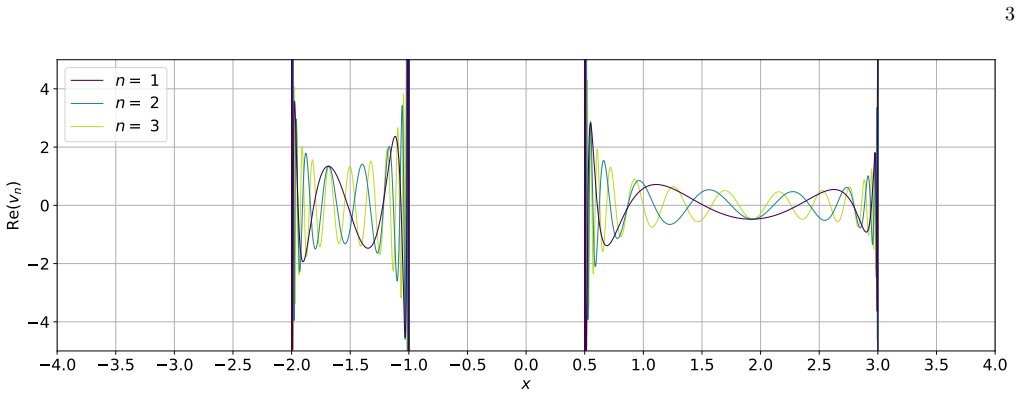
Employing Gaussian state methods, the logarithmic negativity between two bounded spacelike-separated regions is analytically computed, and closed-form solutions are constructed for the localized modes carrying it, called negativity cores, providing a complete characterization of the entanglement in the vacuum of the (1+1)-dimensional free massless real scalar field.
What carries the argument
Negativity cores: the localized modes that carry the logarithmic negativity between the regions.
If this is right
- The logarithmic negativity admits an exact analytical expression for these configurations.
- The entanglement structure is fully determined by these specific modes.
- Gaussian methods suffice for the complete entanglement characterization in this free field case.
- Similar characterizations may be possible in related field theories.
Where Pith is reading between the lines
- These cores could serve as a basis for understanding entanglement in higher-dimensional fields.
- The method might extend to cases with boundaries or different field types if the Gaussian property holds.
- Experimental analogs in condensed matter systems could test the predicted negativity values.
Load-bearing premise
That the entanglement is entirely captured by the Gaussian part of the vacuum state with no additional contributions from non-Gaussian effects.
What would settle it
A calculation using full non-Gaussian methods or lattice simulation that yields a different value for the logarithmic negativity than the analytical Gaussian result.
Figures

read the original abstract
Vacuum entanglement is a fundamental feature of quantum field theory exhibiting rich structure that is not completely understood. Here, we provide a complete characterization of the entanglement between two bounded spacelike-separated regions in a (1+1)-dimensional free massless real scalar field. Employing Gaussian state methods, we analytically compute the logarithmic negativity and construct closed-form solutions for the localized modes carrying it, called negativity cores. These results deepen our understanding of quantum fields and suggest extensions to higher dimensions and fermionic fields.
Editorial analysis
A structured set of objections, weighed in public.
Referee Report
Summary. The manuscript claims to provide a complete characterization of the entanglement between two bounded spacelike-separated regions in a (1+1)-dimensional free massless real scalar field. Using Gaussian state methods, the authors analytically compute the logarithmic negativity and construct closed-form solutions for the localized modes carrying the negativity, termed negativity cores. The work is positioned as deepening understanding of vacuum entanglement in QFT with suggested extensions to higher dimensions and fermionic fields.
Significance. If the analytic results hold, the explicit construction of negativity cores would constitute a concrete advance in characterizing vacuum entanglement structure for free fields, leveraging the fact that the vacuum is fully determined by its two-point function. The Gaussian approach is appropriate here and the parameter-free nature of the derivations (no ad-hoc fitting) is a positive feature.
minor comments (2)
- The abstract and introduction would benefit from a brief statement of the precise separation distance and region sizes used in the explicit calculations to allow immediate reproducibility.
- Notation for the negativity cores (e.g., the mode functions) should be cross-referenced to the two-point function definition in §2 to improve readability for readers outside the immediate subfield.
Simulated Author's Rebuttal
We thank the referee for their positive assessment of the manuscript, recognition of the analytic results on negativity cores, and recommendation to accept.
Circularity Check
No significant circularity
full rationale
The paper applies standard Gaussian-state techniques to compute logarithmic negativity for the vacuum of a free massless scalar field in 1+1 dimensions. Because the vacuum of a free field is Gaussian by definition and fully determined by its two-point function, the covariance-matrix construction of negativity follows directly from the known Wightman function without any fitted parameters, self-definitional loops, or load-bearing self-citations. No equations or claims in the provided text reduce a derived quantity to an input by construction, and the central result is an explicit analytic expression rather than a renaming or ansatz smuggled via prior work. The derivation is therefore self-contained against external benchmarks.
Axiom & Free-Parameter Ledger
Reference graph
Works this paper leans on
-
[1]
To ensure thatMis a symplectic transformation, we definep ′ =M −T p, given byp ′ n = PNA ℓ=n pℓ. Finally, to obtain the subsystemA, we trace out the first site 5 (q′ 0, p′ 0), and are left with only discrete derivative quadra- turesq ′ in the interval. After removing (q ′ 0, p′ 0), we can explicitly takeµ→0. Note that linear observablesf T q transform asf...
- [2]
- [3]
- [4]
- [5]
- [6]
- [7]
- [8]
- [9]
-
[10]
C. Cao, S. M. Carroll, and S. Michalakis, Phys. Rev. D 95, 024031 (2017)
work page 2017
-
[11]
R. D. Sorkin, inTenth International Conference on Gen- eral Relativity and Gravitation (held Padova, 4-9 July, 1983), Contributed Papers, Vol. 2 (1983) pp. 734–736, arXiv:1402.3589 [gr-qc]
work page internal anchor Pith review Pith/arXiv arXiv 1983
-
[12]
L. Bombelli, R. K. Koul, J. Lee, and R. D. Sorkin, Phys. Rev. D34, 373 (1986)
work page 1986
- [13]
- [14]
-
[15]
S. N. Solodukhin, Liv. Rev. Rel.14, 8 (2011)
work page 2011
- [16]
- [17]
- [18]
-
[19]
M. Papageorgiou and J. Pye, J. Phys. A: Math. Th.52, 375304 (2019)
work page 2019
-
[20]
S. J. Summers and R. Werner, Comm. Math. Phys.110, 247 (1987)
work page 1987
- [21]
- [22]
- [23]
-
[24]
G. V. Steeg and N. C. Menicucci, Phys. Rev. D79, 044027 (2009)
work page 2009
-
[25]
E. Mart´ ın-Mart´ ınez and N. C. Menicucci, Class. Quant. Grav.31, 214001 (2014)
work page 2014
-
[26]
J. G. A. Carib´ e, R. H. Jonsson, M. Casals, A. Kempf, and E. Mart´ ın-Mart´ ınez, Phys. Rev. D108, 025016 (2023)
work page 2023
-
[27]
P. Calabrese and J. Cardy, J. Stat. Mech.: Th. Exp. 2004, P06002 (2004)
work page 2004
- [28]
- [29]
-
[30]
H. Casini and M. Huerta, arXiv:2201.13310 (2022), arXiv:2201.13310
- [31]
-
[32]
R. Horodecki, P. Horodecki, M. Horodecki, and K. Horodecki, Rev. Mod. Phys.81, 865 (2009)
work page 2009
-
[33]
Serafini,Quantum continuous variables: a primer of theoretical methods, 2nd ed
A. Serafini,Quantum continuous variables: a primer of theoretical methods, 2nd ed. (CRC press, 2023)
work page 2023
-
[34]
S. Marcovitch, A. Retzker, M. B. Plenio, and B. Reznik, Phys. Rev. A80, 012325 (2009)
work page 2009
- [35]
-
[36]
P. Calabrese, J. Cardy, and E. Tonni, Phys. Rev. Lett. 109, 130502 (2012)
work page 2012
-
[37]
P. Calabrese, J. Cardy, and E. Tonni, J. Stat. Mech.: Th. Exp.2013, P02008 (2013)
work page 2013
- [38]
-
[39]
M. Zych, F. Costa, J. Kofler, and C. Brukner, Phys. Rev. D81, 125019 (2010)
work page 2010
-
[40]
N. Klco, D. H. Beck, and M. J. Savage, Phys. Rev. A 107, 012415 (2023). 6
work page 2023
- [41]
- [42]
- [43]
-
[44]
A. Botero and B. Reznik, Phys. Rev. A67, 10.1103/PhysRevA.67.052311 (2003)
- [45]
- [46]
- [47]
- [48]
-
[49]
S. Murciano, V. Vitale, M. Dalmonte, and P. Calabrese, Phys. Rev. Lett.128, 140502 (2022)
work page 2022
-
[50]
R. E. Arias, H. Casini, M. Huerta, and D. Pontello, Phys. Rev. D98, 125008 (2018)
work page 2018
-
[51]
J. Pye, A. Hingane, and R. H. Jonsson, (in preparation)
-
[52]
M. I. Zhurina and L. N. Karmazina,Tables and formulae for the spherical functionsP m −1/2+iτ(z) (Pergamon Press, 1966)
work page 1966
-
[53]
E. W. Hobson,The theory of spherical and ellipsoidal harmonics(Cambridge University Press, 1931)
work page 1931
-
[54]
R. E. Arias, H. Casini, M. Huerta, and D. Pontello, Phys. Rev. D96, 105019 (2017)
work page 2017
-
[55]
M. M. Wolf, Phys. Rev. Lett.100, 070505 (2008)
work page 2008
discussion (0)
Sign in with ORCID, Apple, or X to comment. Anyone can read and Pith papers without signing in.