Metacognition Should Be the Scientific Framework for Bounded and Effective Self-Governance in Generative AI
Pith reviewed 2026-06-30 20:55 UTC · model grok-4.3
The pith
Metacognition should serve as the scientific framework for bounded and effective self-governance in generative AI.
A machine-rendered reading of the paper's core claim, the machinery that carries it, and where it could break.
Core claim
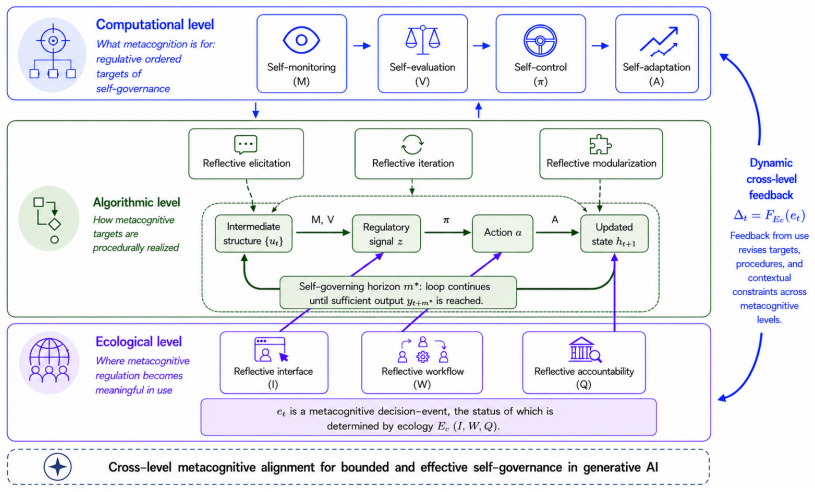
The paper's central claim is that bounded and effective AI self-governance requires metacognitive alignment across computational, algorithmic, and ecological levels. At the computational level, metacognition specifies the meta-level functions a system is meant to serve, such as monitoring, evaluation, control, and adaptation. At the algorithmic level, these functions are realized through procedures such as elicitation, iteration, and modularization. At the ecological level, metacognitive signals become meaningful, actionable, and accountable within the interface, workflow, and accountability arrangements. Metacognition thus makes it possible to conceive generative AI as both capable and well
What carries the argument
Metacognition, consisting of the functions of monitoring, evaluation, control, and adaptation, aligned across computational, algorithmic, and ecological levels to integrate output generation with self-regulation.
If this is right
- Generative AI systems can sustain activity while governing it internally when evidence is missing or context is insufficient.
- Capability and governance become integrated aims instead of competing ones through multi-level alignment.
- Metacognitive signals become actionable within interfaces and workflows rather than remaining abstract.
- Self-governance can be bounded and effective by evaluating generation alongside regulatory capacities.
- AI can be designed to navigate and regulate its own activity at computational, procedural, and interface scales.
Where Pith is reading between the lines
- Designers could create benchmarks that jointly score task performance and internal regulatory consistency.
- The approach may extend to measuring how well AI systems adapt their behavior across different deployment environments.
- It opens questions about whether existing elicitation methods in models already contain partial metacognitive elements that could be strengthened.
- Accountability arrangements in real-world AI use might need to incorporate explicit metacognitive logging for oversight.
Load-bearing premise
The metacognitive functions of monitoring, evaluation, control, and adaptation can be realized at computational, algorithmic, and ecological levels to produce effective self-governance without requiring additional external mechanisms.
What would settle it
An implementation of metacognitive procedures at the three levels that produces no measurable improvement in a generative AI system's ability to regulate its own outputs under uncertainty compared to systems without those procedures.
Figures
read the original abstract
Generative AI research increasingly confronts a shared problem: systems must sustain yet govern their own generative activity when uncertainty is high, evidence is missing, or context is insufficient. This position paper argues that metacognition should become the scientific framework for bounded and effective self governance in generative AI, where output generation is properly evaluated together with the capacities through which generative systems navigate and regulate their own activity. We advance this position by showing that bounded and effective AI self-governance requires metacognitive alignment across computational, algorithmic, and ecological levels. At the computational level, metacognition specifies the meta-level functions a system is meant to serve, such as monitoring, evaluation, control, and adaptation. At the algorithmic level, these functions are realized through procedures such as elicitation, iteration, and modularization. At the ecological level, metacognitive signals become meaningful, actionable, and accountable within the interface, workflow, and accountability arrangements. Metacognition thus makes it possible to conceive generative AI as both capable and well-governed, rather than treating capability and governance as competing aims.
Editorial analysis
A structured set of objections, weighed in public.
Referee Report
Summary. The manuscript is a position paper arguing that metacognition should serve as the scientific framework for bounded and effective self-governance in generative AI. It claims that output generation must be evaluated jointly with the system's capacities for navigating and regulating its own activity, achieved via metacognitive alignment across computational (meta-functions: monitoring, evaluation, control, adaptation), algorithmic (procedures: elicitation, iteration, modularization), and ecological (signals in interfaces, workflows, accountability) levels. This integration treats capability and governance as compatible rather than competing aims.
Significance. If the advocated framework can be operationalized, it could supply a unifying conceptual structure for AI self-governance drawn from cognitive science, encouraging designs that address high-uncertainty generation through internal regulatory capacities. The tri-level mapping offers a lens for considering both generative output and its oversight mechanisms together. As a purely conceptual position paper without formal derivations, empirical tests, or concrete implementations, its significance would lie in prompting further research rather than delivering immediate predictive or engineering advances.
major comments (2)
- [Abstract] Abstract: The framework is defined by the meta-functions (monitoring, evaluation, control, adaptation) it is intended to supply at the computational level. This creates a definitional loop in which metacognition is both the proposed organizing framework and the set of capacities whose realization must be demonstrated, weakening the claim that it provides an independent scientific basis for self-governance.
- [Algorithmic level description] The paragraph describing the algorithmic level: The procedures of elicitation, iteration, and modularization are asserted to realize the meta-functions, yet no argument, example, or mapping is supplied showing how these procedures produce measurable governance improvements or operate without external constraints. This assumption is load-bearing for the tri-level alignment claim that enables bounded self-governance.
minor comments (1)
- The manuscript would benefit from explicit citations to prior work on metacognition in computational systems or AI safety to situate the proposed framework relative to existing approaches.
Simulated Author's Rebuttal
We thank the referee for their constructive comments on our position paper. The feedback identifies opportunities to clarify the framework's presentation and strengthen the tri-level alignment argument. We respond to each major comment below, indicating where revisions will be made.
read point-by-point responses
-
Referee: [Abstract] Abstract: The framework is defined by the meta-functions (monitoring, evaluation, control, adaptation) it is intended to supply at the computational level. This creates a definitional loop in which metacognition is both the proposed organizing framework and the set of capacities whose realization must be demonstrated, weakening the claim that it provides an independent scientific basis for self-governance.
Authors: We acknowledge that the abstract's phrasing can be read as creating a definitional loop. Metacognition is intended as an independent organizing framework drawn from cognitive science, with the meta-functions as specific computational-level components it organizes rather than as its definition. We will revise the abstract to first present metacognition as the tri-level framework and then describe the meta-functions as its realizations at the computational level, thereby reinforcing the claim of an independent scientific basis. revision: yes
-
Referee: [Algorithmic level description] The paragraph describing the algorithmic level: The procedures of elicitation, iteration, and modularization are asserted to realize the meta-functions, yet no argument, example, or mapping is supplied showing how these procedures produce measurable governance improvements or operate without external constraints. This assumption is load-bearing for the tri-level alignment claim that enables bounded self-governance.
Authors: The manuscript is a conceptual position paper and does not claim to deliver empirical measurements or full implementations. We agree that the link between the listed procedures and meta-functions requires explicit support to carry the alignment claim. We will add a brief illustrative mapping (e.g., elicitation to monitoring via uncertainty signaling, iteration to control via refinement loops) in the algorithmic-level section, while noting that demonstrations of measurable governance improvements and operation independent of external constraints remain open questions for future work. revision: partial
Circularity Check
No significant circularity; position paper advocacy is self-contained
full rationale
This is a normative position paper advocating metacognition as an organizing framework for AI self-governance. It presents no equations, formal derivations, fitted parameters, or predictive claims that reduce to inputs by construction. The tri-level structure (computational functions, algorithmic procedures, ecological signals) is introduced conceptually to align capability and governance, without any self-citation chain, uniqueness theorem, or ansatz that bears the central load. The definitional elements (monitoring, evaluation, control, adaptation) are explicitly part of the proposed framework rather than a hidden loop that forces a result. As a result the argument remains independent of its own outputs and contains no load-bearing reduction of the kind required for a positive circularity finding.
Axiom & Free-Parameter Ledger
Reference graph
Works this paper leans on
-
[1]
Retrieval-Augmented Generation for Large Language Models: A Survey
In Proceedings of the 61st Annual Meeting of the Association for Computational Linguis- tics, 16477–16508. Association for Computational Linguistics. Y unfan Gao, Y un Xiong, Xinyu Gao, Kangxiang Jia, Jinliu Pan, Y uxi Bi, et al. Retrieval-Augmented Generation for Large Language Models: A Survey, 2024. arXiv:2312.10997. Timnit Gebru, Jamie Morgenstern, Br...
work page internal anchor Pith review Pith/arXiv arXiv 2024
-
[2]
Proceedings of the ACM on Human-Computer Interaction 3(CSCW): Article 50, 1–24. Thomas L. Griffiths, Falk Lieder, and Noah D Goodman. Rational Use of Cognitive Resources: Levels of Analysis between the Computational and the Algorithmic, 2015. Topics in Cognitive Science 7(2): 217-229. Igor Grossmann. Wisdom in Context, 2017. Perspectives on Psychological S...
-
[3]
Li Ji-An, Hua-Dong Xiong, Robert C
American Journal of Political Science, 1–20. Li Ji-An, Hua-Dong Xiong, Robert C. Wilson, Marcelo G. Mattar, and Marcus K Benna. Language Models Are Capable of Metacognitive Monitoring and Control of Their Internal Activations, 2025. arXiv:2505.13763. Samuel G. B. Johnson, Amir-Hossein Karimi, Y oshua Bengio, Nick Chater, Tobias Gerstenberg, Kate Larson, K...
-
[4]
New Y ork: Association for Computing Machinery
In Proceedings of the 2020 CHI Conference on Human Factors in Computing Systems, 1–14. New Y ork: Association for Computing Machinery. David Marr. Vision: A Computational Investigation into the Human Representation and Processing of Visual Information, 1982. W. H. Freeman. Janet Metcalfe and Arthur P Shimamura. Metacognition: Knowing about Knowing, 1994. ...
-
[5]
In The Psychology of Learning and Motivation. Academic Press, pages 125-173. Victor Ojewale, Ryan Steed, Briana V ecchione, Abeba Birhane, and Inioluwa Deborah Raji. To- wards AI Accountability Infrastructure: Gaps and Opportunities in AI Audit Tooling, 2025. In Proceedings of the 2025 CHI Conference on Human Factors in Computing Systems, Article 815, 1–2...
-
[6]
Harini Suresh and John V Guttag
Cambridge University Press. Harini Suresh and John V Guttag. A Framework for Understanding Sources of Harm throughout the Machine Learning Life Cycle, 2021. In Proceedings of the 1st ACM Conference on Equity and Access in Algorithms, Mechanisms, and Optimization. ACM. Katherine Tian, Eric Mitchell, Allan Zhou, Archit Sharma, Rafael Rafailov, Huaxiu Y ao, ...
2021
-
[7]
15 Miao Xiong, Zhiyuan Hu, Xinyang Lu, Yifei Li, Jie Fu, Junxian He, et al
arXiv:2311.11829. 15 Miao Xiong, Zhiyuan Hu, Xinyang Lu, Yifei Li, Jie Fu, Junxian He, et al. Can LLMs Express Their Uncertainty? An Empirical Evaluation of Confidence Elicitation in LLMs, 2024. In Proceedings of the Twelfth International Conference on Learning Representations. John Y ang, Carlos E. Jimenez, Alexander Wettig, Kilian Lieret, Shunyu Y ao, Ka...
discussion (0)
Sign in with ORCID, Apple, or X to comment. Anyone can read and Pith papers without signing in.