REVIEW 3 major objections 41 references
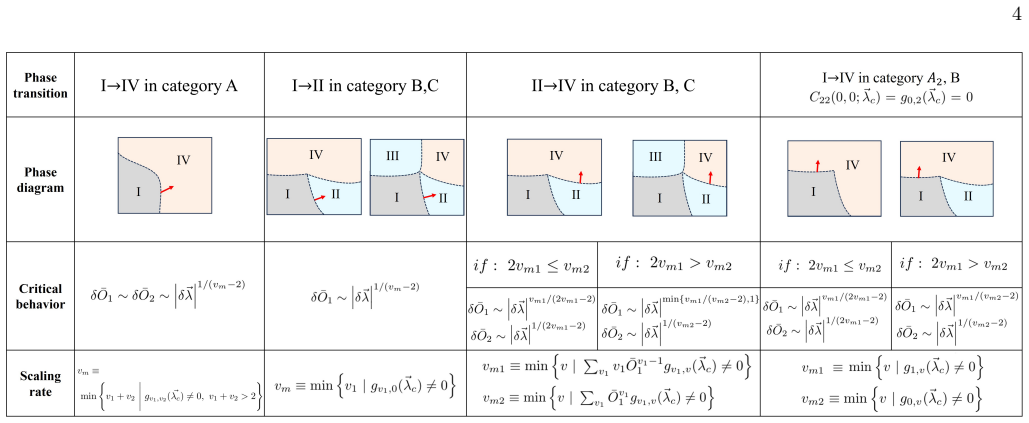
Coupling terms of the free energy classify continuous phase transitions with two order parameters into categories with distinct phase diagrams and critical scalings.
Reviewed by Pith at T0; open to challenge. T0 means a machine referee read the full paper against a public rubric. the ladder, T0–T4 →
T0 review · grok-4.3
2026-06-30 15:14 UTC pith:LDKCUUVO
load-bearing objection The paper proposes classifying two-order-parameter transitions by free-energy couplings but delivers no actual terms, derivations, or examples. the 3 major comments →
Universal classification of continuous phase transitions with two order parameters
The pith
A machine-rendered reading of the paper's core claim, the machinery that carries it, and where it could break.
Core claim
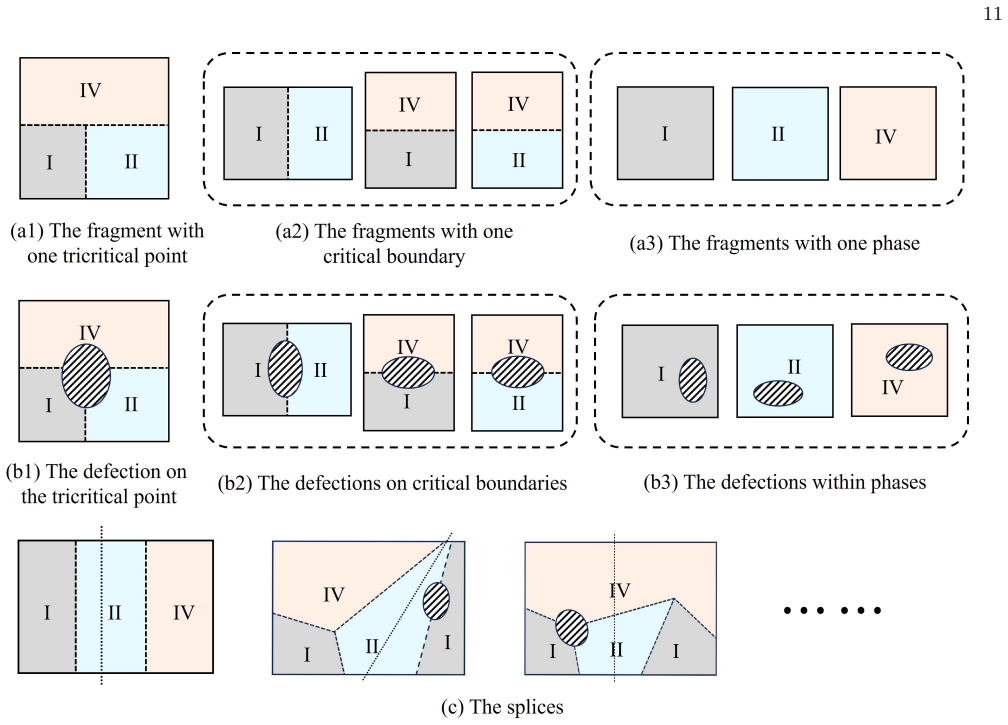
According to coupling terms of the free energy, systems with two order parameters are classified into several categories, each featuring different patterns of phase diagrams and critical scalings. This classification proposes a new avenue to studying and evaluating complex systems only based on the coupling terms in expressions of free energy.
What carries the argument
Coupling terms in the Ginzburg-Landau free energy for two order parameters, which dictate the interactions and determine the structure of the phase diagram and critical behavior.
Load-bearing premise
The Ginzburg-Landau mean-field theory captures all essential behavior and the considered coupling terms cover every possible case without influence from higher-order terms or microscopic specifics.
What would settle it
Finding a two-order-parameter system whose observed phase diagram or critical exponents do not correspond to any category defined by its free-energy coupling terms.
If this is right
- Systems fall into categories based on which coupling terms are present in the free energy.
- Each category produces its own characteristic phase diagram patterns.
- Critical scalings differ across the categories.
- The classification allows evaluation of complex systems using only the coupling terms.
Where Pith is reading between the lines
- The method might predict transition types in materials with two competing orders by inspecting the form of their free energy.
- Fluctuations could alter the categories in low dimensions, requiring checks beyond mean-field.
- A parallel classification might apply to systems with three or more order parameters.
Editorial analysis
A structured set of objections, weighed in public.
Referee Report
Summary. The manuscript proposes a classification of continuous phase transitions in systems with two order parameters, grouped according to the coupling terms appearing in the Ginzburg-Landau free-energy functional. Different categories are asserted to produce distinct phase-diagram topologies and critical scaling behaviors, thereby providing a route to analyze complex systems solely from the structure of the free energy.
Significance. If the classification can be shown to be exhaustive within a given symmetry class and if mean-field minimization correctly captures the global topology, the work would supply a compact organizing scheme for multicritical points in condensed-matter systems that possess two competing or coupled order parameters. Such a taxonomy could streamline the interpretation of experiments on materials with multiple broken symmetries.
major comments (3)
- [Abstract] Abstract: the central claim is that 'coupling terms of the free energy' determine the categories, yet no explicit list of allowed invariants, no underlying symmetry group, and no spatial dimension are supplied. Without these, it cannot be verified whether the enumerated couplings are complete or whether an omitted higher-order term (e.g., a sixth-order invariant permitted by the representation) would generate additional multicritical points or alter the reported scalings.
- [Abstract / main text] No section or equation provides the explicit free-energy functionals, the minimization procedure, or the resulting phase boundaries and order-parameter scalings. The manuscript therefore offers no concrete derivation that would allow a reader to reproduce the claimed patterns of phase diagrams or critical exponents from the coupling terms.
- [Abstract] The stress-test concern is not addressed: the classification assumes that mean-field minimization of the listed quartic couplings suffices even when coefficients change sign and that fluctuations or microscopic details never rearrange the topology. No argument or counter-example is given to justify why the mean-field truncation remains globally valid.
Simulated Author's Rebuttal
We thank the referee for the thorough review and constructive suggestions. We address each major comment below and indicate where revisions will be made to strengthen the manuscript.
read point-by-point responses
-
Referee: [Abstract] Abstract: the central claim is that 'coupling terms of the free energy' determine the categories, yet no explicit list of allowed invariants, no underlying symmetry group, and no spatial dimension are supplied. Without these, it cannot be verified whether the enumerated couplings are complete or whether an omitted higher-order term (e.g., a sixth-order invariant permitted by the representation) would generate additional multicritical points or alter the reported scalings.
Authors: The classification is formulated at a general level, applicable across symmetry classes by considering the possible bilinear, biquadratic, and higher-order coupling terms permitted by symmetry. We agree that explicit examples are needed to verify completeness. In revision we will add a dedicated section providing concrete symmetry groups (e.g., O(2)×O(2) and tetragonal cases), the full list of invariants up to sixth order, the spatial dimension (d=3), and checks that omitted terms do not alter the reported topologies within those classes. revision: yes
-
Referee: [Abstract / main text] No section or equation provides the explicit free-energy functionals, the minimization procedure, or the resulting phase boundaries and order-parameter scalings. The manuscript therefore offers no concrete derivation that would allow a reader to reproduce the claimed patterns of phase diagrams or critical exponents from the coupling terms.
Authors: The present manuscript emphasizes the organizing principle rather than exhaustive derivations. We accept that this limits reproducibility. The revised version will include the explicit Ginzburg-Landau functionals for each category, the analytic and numerical minimization steps used to obtain phase boundaries, and the resulting scaling relations for the two order parameters near the multicritical points. revision: yes
-
Referee: [Abstract] The stress-test concern is not addressed: the classification assumes that mean-field minimization of the listed quartic couplings suffices even when coefficients change sign and that fluctuations or microscopic details never rearrange the topology. No argument or counter-example is given to justify why the mean-field truncation remains globally valid.
Authors: The work is performed entirely within mean-field Ginzburg-Landau theory, the conventional framework for such classifications. We will add a limitations paragraph that (i) states the mean-field assumption explicitly, (ii) recalls the regime of validity (above the upper critical dimension), and (iii) cites known counter-examples where fluctuations reorder multicritical topologies, thereby clarifying the scope of the reported phase diagrams. revision: partial
Circularity Check
Classification derived directly from enumeration of free-energy coupling terms
full rationale
The paper classifies two-order-parameter systems by enumerating coupling terms in the Ginzburg-Landau free energy and deriving the resulting phase-diagram topologies and scalings. This is a direct, self-contained enumeration within the mean-field framework; no step reduces a claimed prediction to a fitted input, no self-citation chain is load-bearing, and no uniqueness theorem or ansatz is smuggled in. The central result is the classification itself, which follows from the structure of the expansion without circular reduction to its own outputs.
Axiom & Free-Parameter Ledger
axioms (1)
- domain assumption Ginzburg-Landau paradigm applies to systems with two order parameters
Cite this review
Pith. "Pith review of Universal classification of continuous phase transitions with two order parameters." pith.science (2026). https://pith.science/paper/LDKCUUVO
@misc{pith2026260524061,
  author       = {Pith},
  title        = {Pith review of: Universal classification of continuous phase transitions with two order parameters},
  year         = {2026},
  howpublished = {\url{https://pith.science/paper/LDKCUUVO}},
  note         = {Machine review of arXiv:2605.24061}
}
read the original abstract
The continuous phase transition, indicated by the macroscopic order parameter and the occurrence of the spontaneous symmetry breaking, is well illustrated based on the Ginzburg-Landau's paradigm. In systems described by one order parameter, the phase diagram is only composed of the normal phase and the ordered phase. However, in systems with two or more order parameters, much richer phase diagrams and critical phenomena may emerge. According to coupling terms of the free energy, we classify the systems with two order parameters into several categories, featuring different patterns of phase diagrams and critical scalings respectively. Our work propose the new avenue to studying and evaluating the complex systems only based on the coupling terms in expressions of free energy.
Figures



Reference graph
Works this paper leans on
-
[1]
As the last case, all the four regions might emergy in Category C, with both terms likeg v1,1Ov1 1 O2 and terms g1,v2 O1Ov2 2 absent. According to the Landau’s theory, the disappearance of the 2nd order differentiations indicates the critical boundaries of the continuous phase transitions, hence we give all the critical conditions in the third column, whe...
-
[2]
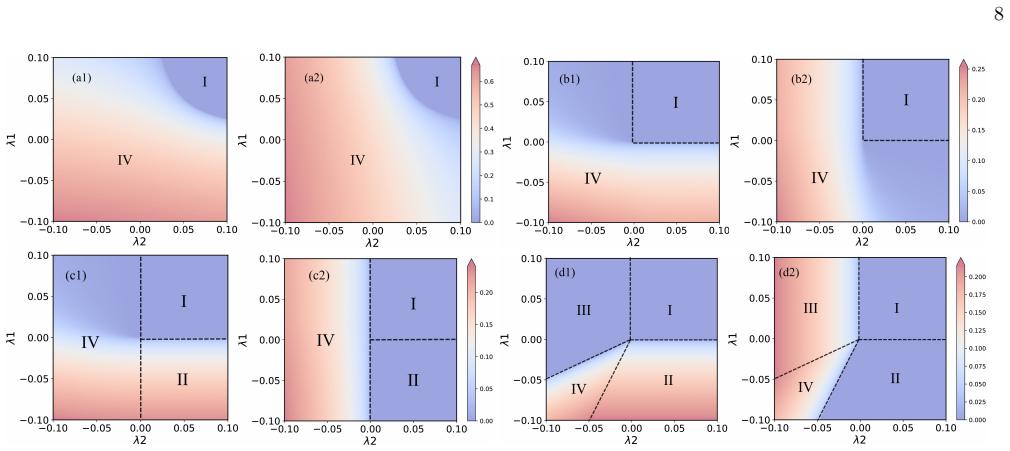
(λ2 c2 −λ 2 2)/(ω a1ωa2),(7) in parametric region. And the analytical phase diagram only contains two regionsN P&N PandSRP&SRP shown in (c), validating our categorization. Consider the special symmetric case whereλ 1 =λ 2, the order parameters are analytically accessible, giving O1 =−O 2 = Reγ e a =± 1 4λ q ( 1 4(Zea)2 −1), andZ e a = 1 8λ2 (2J−1−κ 2), wi...
-
[3]
P. Hohenberg and A. Krekhov, Physics Reports572, 1 (2015), an introduction to the Ginzburg–Landau theory of phase transitions and nonequilibrium patterns
work page 2015
-
[4]
J. Bardeen, L. N. Cooper, and J. R. Schrieffer, Phys. Rev.108, 1175 (1957)
work page 1957
- [5]
-
[6]
M. Greiner, O. Mandel, T. Esslinger, T. W. H¨ ansch, and I. Bloch, Nature415, 39 (2002)
work page 2002
-
[7]
N. Bigagli, W. Yuan, S. Zhang, B. Bulatovic, T. Karman, I. Stevenson, and S. Will, Nature631, 289 (2024)
work page 2024
-
[8]
S. Gopalakrishnan, B. L. Lev, and P. M. Goldbart, Nat. Phys.5, 845 (2009)
work page 2009
-
[9]
K. Baumann, C. Guerlin, F. Brennecke, and T. Esslinger, Nature464, 1301 (2010)
work page 2010
-
[10]
H. E. Stanley, Phys. Rev. Lett.20, 589 (1968)
work page 1968
-
[11]
P. N. Jepsen, J. Amato-Grill, I. Dimitrova, W. W. Ho, E. Demler, and W. Ketterle, Nature588, 403 (2020)
work page 2020
-
[12]
Peierls, Mathematical Proceedings of the Cambridge Philosophical Society32, 477–481 (1936)
R. Peierls, Mathematical Proceedings of the Cambridge Philosophical Society32, 477–481 (1936)
work page 1936
- [13]
-
[14]
M. Liu, S. Chesi, Z.-J. Ying, X. Chen, H.-G. Luo, and H.-Q. Lin, Phys. Rev. Lett.119, 220601 (2017)
work page 2017
-
[15]
Y. K. Wang and F. T. Hioe, Phys. Rev. A7, 831 (1973)
work page 1973
- [16]
- [17]
-
[18]
D. Nagy, G. K´ onya, G. Szirmai, and P. Domokos, Phys. Rev. Lett.104, 130401 (2010)
work page 2010
-
[19]
K. Baumann, R. Mottl, F. Brennecke, and T. Esslinger, Phys. Rev. Lett.107, 140402 (2011)
work page 2011
-
[20]
X.-J. Liu, K. T. Law, and T. K. Ng, Phys. Rev. Lett. 112, 086401 (2014)
work page 2014
-
[21]
M. Soriente, T. Donner, R. Chitra, and O. Zilberberg, Phys. Rev. Lett.120, 183603 (2018)
work page 2018
-
[22]
E. I. R. Chiacchio and A. Nunnenkamp, Phys. Rev. Lett. 122, 193605 (2019)
work page 2019
-
[23]
R. Lin, L. Papariello, P. Molignini, R. Chitra, and A. U. J. Lode, Phys. Rev. A100, 013611 (2019)
work page 2019
-
[24]
M.-Y. Yang, H.-H. Yin, L. Wen, A.-C. Ji, and Q. Sun, Phys. Rev. A104, 053313 (2021)
work page 2021
-
[25]
Y. Xu, “Superradiance enhances and suppresses fermionic pairing based on universal critical scal- ing in two order parameters systems,” (2026), arXiv:2604.07407 [cond-mat.quant-gas]
work page internal anchor Pith review Pith/arXiv arXiv 2026
-
[26]
K. Lozano-M´ endez, A. H. C´ asares, and S. F. Caballero- Ben´ ıtez, Phys. Rev. Lett.128, 080601 (2022)
work page 2022
-
[27]
J. Fan, X. Zhou, W. Zheng, W. Yi, G. Chen, and S. Jia, Phys. Rev. A98, 043613 (2018)
work page 2018
-
[28]
Unilateral criticality and phase transition in the cavity- ising model,
Z. Rao, X. Lin, X. Luo, G. Guo, H. Pu, and M. Gong, “Unilateral criticality and phase transition in the cavity- ising model,” (2025), arXiv:2509.04391 [quant-ph]
-
[29]
A. Camacho-Guardian, R. Paredes, and S. F. Caballero- Ben´ ıtez, Phys. Rev. A96, 051602(R) (2017)
work page 2017
- [30]
-
[31]
P. M¨ unstermann, T. Fischer, P. Maunz, P. W. H. Pinkse, and G. Rempe, Phys. Rev. Lett.84, 4068 (2000)
work page 2000
-
[32]
H. Gao, F. Schlawin, M. Buzzi, A. Cavalleri, and D. Jaksch, Phys. Rev. Lett.125, 053602 (2020)
work page 2020
- [33]
- [34]
-
[35]
E. G. D. Torre, S. Diehl, M. D. Lukin, S. Sachdev, and P. Strack, Phys. Rev. A87, 023831 (2013)
work page 2013
- [36]
-
[37]
See Supplemental Material for further information on the classification of phase diagrams and the derivation of crit- ical scalings
- [38]
-
[39]
A. Baksic and C. Ciuti, Phys. Rev. Lett.112, 173601 (2014). UNIVERSAL CRITICAL SCALING RA TE OF CONTINUOUS PHASE TRANSTION IN TWO ORDER P ARAMETERS COEXISTED SYSTEM In Landau’s paradigm of phase transition, the macroscopic order parameters, such as photon number, magnetism, disorder, can be viewed as the variables in the physical systems, and the free ene...
work page 2014
-
[40]
(18) FA2 =λ 1O2 1 +λ 2O2 2 −O 1O4 2 −O 4 1O2 +O 4 1 +O 4 2 +O 6 1 +O 6 2 (19) FB =λ 1O2 1 +λ 2O2 2 −O 1O4 2 +O 4 1 +O 4 2 +O 6 1 +O 6 2 (20) FC =λ 1O2 1 +λ 2O2 2 +O 2 1O2 2 +O 4 1 +O 4 2 +O 6 1 +O 6 2.(21) Here, we set the coefficients before the quadratic terms as the environmental parametersλ 1,λ 2. According to our classification, the free energyF A gi...
-
[41]
Inserting it into the critical condition, gives the boundary 3λ 2 + √1−3λ 1 = 1 withλ 1 <0
The critical boundary between phase II and IV is obtained as ∂2FB 2∂O2 2 O1= ¯O1,O2=0 =λ 2 + ¯O2 1 = 0, and the ¯O1 is the minimum position asO 2 = 0, obtained by the solution of the following equation ∂FC ∂(O2 1) O2=0 = 3(O2 1)2 + 2O2 1 +λ 1 = 0.(22) It gives the solution ¯O2 1 = −1 + √1−3λ 1 3 . Inserting it into the critical condition, gives the bounda...
discussion (0)
Sign in with ORCID, Apple, or X to comment. Anyone can read and Pith papers without signing in.