REVIEW 1 major objections 1 minor 4 references
Multi-agent RL improves LLM workflows depending jointly on workflow, task, and scale rather than policy sharing alone.
Reviewed by Pith at T0; open to challenge. T0 means a machine referee read the full paper against a public rubric. the ladder, T0–T4 →
T0 review · grok-4.3
2026-06-30 15:43 UTC pith:XXKSVFJ2
load-bearing objection The paper maps multi-agent RL tradeoffs across workflows and scales with a gradient-dynamics account, but that account looks interpretive rather than directly tested. the 1 major comments →
When Does Multi-Agent RL Improve LLM Workflows? Workflow, Scale, and Policy-Sharing Tradeoffs
The pith
A machine-rendered reading of the paper's core claim, the machinery that carries it, and where it could break.
Core claim
End-to-end RL training of multi-agent LLM workflows improves over base models in a manner that depends jointly on workflow, task, and scale, not on policy sharing alone. Isolated-Policy training tends to reach higher peak accuracy yet falls off a terminal accuracy cliff more often because parallel same-role agents on shared prompts amplify per-role gradients. Shared-Policy training does not eliminate failure but redistributes it into qualitatively different patterns because asymmetric per-step gradient mass causes the shared policy to be captured by the dominant role. These patterns are explained by role-level gradient dynamics induced by workflow topology and policy routing.
What carries the argument
Role-level gradient dynamics induced by workflow topology and policy routing, which control how training pressure is distributed across roles in Shared-Policy versus Isolated-Policy setups.
Load-bearing premise
That the tested combinations of workflows, tasks, and scales capture the general conditions under which multi-agent RL succeeds or fails and that the gradient dynamics explain the failures.
What would settle it
A new experiment at an untested scale or task where Isolated-Policy no longer shows terminal cliffs or where Shared-Policy produces no distinct failure patterns would falsify the dependence on workflow, task, and scale.
If this is right
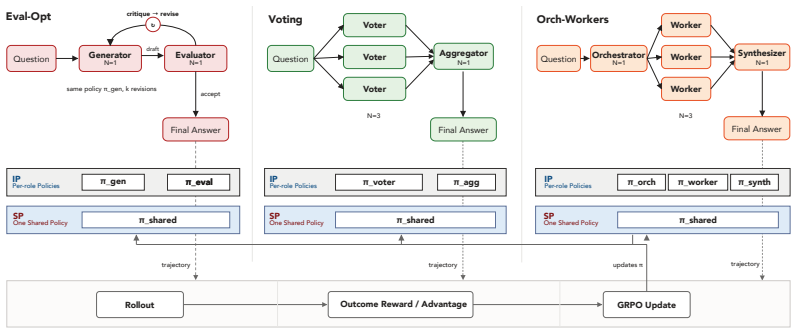
- Multi-agent RL gains vary by workflow (Eval-Opt, Voting, Orch-Workers), so different topologies produce different improvement levels.
- Isolated-Policy amplifies gradients in parallel roles, leading to terminal degradation in Voting and Orch-Workers.
- Shared-Policy causes capture by the dominant role due to asymmetric gradient mass, producing task-specific failure signatures.
- These effects appear across math and code tasks and model scales from 0.6B to 4B.
- Policy sharing routes training pressure differently rather than providing uniform stability.
Where Pith is reading between the lines
- Practitioners should evaluate both policy configurations at their target scale and task instead of assuming shared policies are always more stable.
- The gradient mechanisms imply that altering prompt routing or adding role-specific regularization could reduce the observed failure modes.
- Similar tradeoffs may appear in non-LLM multi-agent RL settings where roles interact through shared environments.
- Future experiments at larger scales could test whether the scale dependence persists or if failures become less pronounced.
Editorial analysis
A structured set of objections, weighed in public.
Referee Report
Summary. The paper empirically studies when end-to-end RL training of multi-agent LLM workflows improves over base models. It compares Shared-Policy (single policy for all roles) versus Isolated-Policy (per-role parameters) training across Eval-Opt, Voting, and Orch-Workers workflows on math and code tasks at three scales (0.6B, 1.7B, 4B). Key claims are that gains depend jointly on workflow, task, and scale rather than policy sharing alone; Isolated-Policy reaches higher peak accuracy but more often exhibits terminal accuracy cliffs, while Shared-Policy redistributes failures into different patterns; and these patterns are explained by role-level gradient dynamics induced by workflow topology and policy routing (parallel amplification under Isolated-Policy; asymmetric per-step mass under Shared-Policy).
Significance. If the empirical map and mechanistic account hold, the work is significant for mapping conditional tradeoffs in multi-agent RL for LLMs and for attempting to link observed accuracy patterns to workflow-induced gradient effects. The experimental matrix spanning multiple workflows, tasks, and scales is a clear strength, as is the focus on failure modes rather than only success cases. This could guide design choices in multi-agent LLM systems.
major comments (1)
- [gradient-dynamics explanation (abstract and analysis section)] The mechanistic explanation in the abstract (role-level gradient dynamics from workflow topology and policy routing, with parallel same-role agents amplifying gradients under Isolated-Policy and asymmetric per-step mass under Shared-Policy) is load-bearing for the central claim that gains 'depend jointly on workflow, task, and scale, not on policy sharing alone.' No indication is given that per-role gradient norms were measured, that ablations decoupled topology from reward sparsity or prompt overlap, or that gradient dynamics were logged; without these the account remains post-hoc interpretation of accuracy curves rather than a tested causal link.
minor comments (1)
- [abstract] The abstract states that multi-agent RL 'usually improves over base models' but provides no quantitative effect sizes, error bars, or details on how 'improvement' and 'failure' are operationalized across the experimental matrix.
Simulated Author's Rebuttal
We thank the referee for the constructive review and for highlighting both the strengths of the experimental matrix and the need for precision around the mechanistic account. We address the major comment below.
read point-by-point responses
-
Referee: The mechanistic explanation in the abstract (role-level gradient dynamics from workflow topology and policy routing, with parallel same-role agents amplifying gradients under Isolated-Policy and asymmetric per-step mass under Shared-Policy) is load-bearing for the central claim that gains 'depend jointly on workflow, task, and scale, not on policy sharing alone.' No indication is given that per-role gradient norms were measured, that ablations decoupled topology from reward sparsity or prompt overlap, or that gradient dynamics were logged; without these the account remains post-hoc interpretation of accuracy curves rather than a tested causal link.
Authors: We agree the gradient-dynamics discussion is interpretive rather than directly tested. The manuscript reports no per-role gradient norm measurements, no ablations separating topology from reward sparsity or prompt overlap, and no logged gradient trajectories. The core empirical claim—that performance gains depend jointly on workflow, task, and scale—is established by the accuracy results across the full matrix of workflows (Eval-Opt, Voting, Orch-Workers), tasks (math, code), and scales (0.6B–4B); this evidence stands independently of the proposed mechanism. The role-level gradient account is presented as a post-hoc explanation that aligns with the observed patterns of terminal cliffs under Isolated-Policy and redistributed failures under Shared-Policy. We will revise the abstract and analysis section to (i) explicitly label the gradient dynamics as an interpretive hypothesis consistent with the accuracy curves and workflow structure, (ii) separate it from the empirical claims, and (iii) note the absence of direct gradient or ablation evidence. This change will be made in the next revision. revision: yes
Circularity Check
No significant circularity; empirical study with independent experimental observations
full rationale
The paper presents an empirical matrix of experiments across workflows (Eval-Opt, Voting, Orch-Workers), tasks (math, code), and scales (0.6B-4B), comparing Shared-Policy vs Isolated-Policy RL. Claims about joint dependence on workflow/task/scale and role-level gradient dynamics are interpretive summaries of observed accuracy curves, not reductions of predictions to fitted inputs or self-definitions by construction. No equations, fitted parameters renamed as predictions, or load-bearing self-citations appear in the provided text. The gradient-dynamics account is post-hoc interpretation rather than a self-referential derivation, satisfying the criteria for a self-contained empirical result (score 0-2).
Axiom & Free-Parameter Ledger
axioms (1)
- domain assumption End-to-end reinforcement learning can be applied to optimize multi-agent LLM workflows for end-task accuracy.
read the original abstract
Multi-agent LLM workflows route inference through specialized roles to lift end-task accuracy, but jointly training those roles with reinforcement learning is unstable in ways that are poorly understood. We study when end-to-end RL training of multi-agent LLM workflows improves over their base models, comparing Shared-Policy training, where all roles update one policy, with Isolated-Policy training, where each role has its own parameters. Our experimental matrix spans Eval-Opt, Voting, and Orch-Workers workflows, math and code tasks, and three model scales (0.6B, 1.7B, 4B). We find that multi-agent RL usually improves over base models, but gains depend jointly on workflow, task, and scale, not on policy sharing alone. Isolated-Policy tends to reach higher peak accuracy yet more often falls off a terminal accuracy cliff, while Shared-Policy training does not eliminate failure; it redistributes failure into qualitatively different patterns. We then explain the strongest of these patterns through role-level gradient dynamics induced by workflow topology and policy routing: under Isolated-Policy, parallel same-role agents on shared prompts amplify per-role gradients and drive terminal degradation in Voting and Orch-Workers workflows; under Shared-Policy, asymmetric per-step gradient mass causes the shared policy to be captured by the dominant role, producing different failure signatures by task and workflow. Together, the empirical map and its underlying mechanisms show that policy sharing routes training pressure through different channels rather than offering uniform stability, making it a design choice with workflow- and task-conditional tradeoffs.
Figures


Reference graph
Works this paper leans on
-
[1]
" write newline "" before.all 'output.state := FUNCTION n.dashify 't := "" t empty not t #1 #1 substring "-" = t #1 #2 substring "--" = not "--" * t #2 global.max substring 't := t #1 #1 substring "-" = "-" * t #2 global.max substring 't := while if t #1 #1 substring * t #2 global.max substring 't := if while FUNCTION format.date year duplicate empty "emp...
-
[2]
\@ifxundefined[1] #1\@undefined \@firstoftwo \@secondoftwo \@ifnum[1] #1 \@firstoftwo \@secondoftwo \@ifx[1] #1 \@firstoftwo \@secondoftwo [2] @ #1 \@temptokena #2 #1 @ \@temptokena \@ifclassloaded agu2001 natbib The agu2001 class already includes natbib coding, so you should not add it explicitly Type <Return> for now, but then later remove the command n...
-
[3]
\@lbibitem[] @bibitem@first@sw\@secondoftwo \@lbibitem[#1]#2 \@extra@b@citeb \@ifundefined br@#2\@extra@b@citeb \@namedef br@#2 \@nameuse br@#2\@extra@b@citeb \@ifundefined b@#2\@extra@b@citeb @num @parse #2 @tmp #1 NAT@b@open@#2 NAT@b@shut@#2 \@ifnum @merge>\@ne @bibitem@first@sw \@firstoftwo \@ifundefined NAT@b*@#2 \@firstoftwo @num @NAT@ctr \@secondoft...
-
[4]
@open @close @open @close and [1] URL: #1 \@ifundefined chapter * \@mkboth \@ifxundefined @sectionbib * \@mkboth * \@mkboth\@gobbletwo \@ifclassloaded amsart * \@ifclassloaded amsbook * \@ifxundefined @heading @heading NAT@ctr thebibliography [1] @ \@biblabel @NAT@ctr \@bibsetup #1 @NAT@ctr @ @openbib .11em \@plus.33em \@minus.07em 4000 4000 `\.\@m @bibit...
discussion (0)
Sign in with ORCID, Apple, or X to comment. Anyone can read and Pith papers without signing in.