REVIEW 3 major objections 2 minor 50 references
Generative density models restrict model-based offline RL policy updates to high-density dataset regions to avoid out-of-distribution actions.
Reviewed by Pith at T0; open to challenge. T0 means a machine referee read the full paper against a public rubric. the ladder, T0–T4 →
T0 review · grok-4.3
2026-06-30 14:39 UTC pith:GUJHENTE
load-bearing objection GORMPO adds generative density regularization to model-based offline RL and reports a 17% gain on medical data, but the evidence for reliable OOD separation in sparse spaces remains thin. the 3 major comments →
Generative OOD-regularized Model-based Policy Optimization
The pith
A machine-rendered reading of the paper's core claim, the machinery that carries it, and where it could break.
Core claim
GORMPO uses generative density modeling to regularize model-based policy optimization in offline RL by confining updates to high-density regions of the offline dataset. This prevents the policy from selecting out-of-distribution actions. The method outperforms state-of-the-art baselines by 17 percent on a real-world medical dataset and improves the underlying model on standard offline RL datasets. Better OOD detection generally yields improved policies in environments with stable dynamics, while conservative penalties with poorer density estimation are favored when dynamics are uncertain.
What carries the argument
GORMPO, a density-regularized model-based policy optimization algorithm that integrates generative density models to restrict policy updates to high-density regions of the offline dataset.
Load-bearing premise
Generative density models can reliably identify high-density regions in sparse state-action spaces so that restricting updates to those regions yields both safe and high-performing policies.
What would settle it
An evaluation on the medical dataset in which the GORMPO policy produces worse clinical outcomes than a baseline that permits out-of-distribution actions would falsify the central claim.
If this is right
- GORMPO policies achieve higher returns on medical treatment tasks by staying inside observed high-density regions.
- Stronger density estimation improves final policy quality when environment dynamics remain stable.
- When dynamics are uncertain, simpler conservative penalties outperform more accurate density models.
- The algorithm supplies a performance guarantee once the density model satisfies mild conditions.
Where Pith is reading between the lines
- The same density-regularization idea could be tested in robotics tasks where state-action coverage is also sparse.
- Combining generative density estimates with uncertainty quantification from the dynamics model might reduce over-conservatism.
- Scaling experiments on larger medical or robotic datasets would show whether current generative models remain reliable at higher dimensions.
Editorial analysis
A structured set of objections, weighed in public.
Referee Report
Summary. The paper proposes GORMPO, an offline RL algorithm integrating generative density estimation into model-based policy optimization to restrict policy updates to high-density regions of the state-action space, thereby mitigating OOD actions in sparse datasets. It claims a theoretical performance guarantee under mild assumptions, reports a 17% outperformance over SOTA baselines on a real-world medical dataset, improved performance on offline RL benchmarks, and an empirical finding that superior OOD detection aids policies in stable dynamics while conservative penalties are preferable under uncertain dynamics.
Significance. If substantiated, the approach offers a concrete way to leverage explicit density modeling for safer offline RL in high-stakes sparse domains such as medicine. The reported distinction between stable and uncertain dynamics environments provides actionable guidance for regularization choice. The theoretical guarantee, if the mild assumptions are shown to be realistic, would strengthen the contribution beyond purely empirical methods.
major comments (3)
- [Abstract, §4] Abstract and §4 (Theoretical Analysis): the performance guarantee is stated to hold under 'mild assumptions,' yet the manuscript provides no explicit statement of those assumptions nor any derivation showing robustness to the estimation error inherent in generative density models on sparse, high-dimensional medical data; this directly threatens the central claim that OOD regularization yields both safety and performance gains.
- [§5.3, Table 3] §5.3 and Table 3 (Empirical Results): the 17% improvement on the real-world medical dataset is reported without error bars, dataset statistics (e.g., state-action sparsity, sample size), or statistical significance tests against the listed baselines; without these, it is impossible to assess whether the gain survives realistic density-estimation noise or is an artifact of a single run.
- [§5.2] §5.2 (OOD Detection vs. Policy Performance): the claim that 'better OOD detection generally results in improved policies in environments with stable dynamics' rests on the unverified premise that the generative model accurately separates high-density safe regions from useful rare actions; no ablation or diagnostic is shown quantifying false-negative rate on rare but high-reward actions in the medical dataset.
minor comments (2)
- [§3] Notation for the density-regularization coefficient is introduced without an explicit hyper-parameter sensitivity analysis or default value, making reproduction difficult.
- [Figure 2] Figure captions for the OOD detection comparison plots do not list the exact generative model architectures or training hyperparameters used.
Simulated Author's Rebuttal
We thank the referee for the constructive feedback, which helps clarify and strengthen the presentation of our contributions. We address each major comment below, indicating where revisions will be made to the manuscript.
read point-by-point responses
-
Referee: [Abstract, §4] Abstract and §4 (Theoretical Analysis): the performance guarantee is stated to hold under 'mild assumptions,' yet the manuscript provides no explicit statement of those assumptions nor any derivation showing robustness to the estimation error inherent in generative density models on sparse, high-dimensional medical data; this directly threatens the central claim that OOD regularization yields both safety and performance gains.
Authors: We agree that the assumptions require explicit enumeration and that robustness to density estimation error should be derived. In the revised manuscript we will state the assumptions (bounded estimation error of the generative model, Lipschitz continuity of the transition dynamics, and finite covering number of the state-action space) at the beginning of Section 4 and add a short derivation showing that the performance bound degrades gracefully under the level of estimation error observed on the medical dataset. These additions will be placed immediately before the main theorem statement. revision: yes
-
Referee: [§5.3, Table 3] §5.3 and Table 3 (Empirical Results): the 17% improvement on the real-world medical dataset is reported without error bars, dataset statistics (e.g., state-action sparsity, sample size), or statistical significance tests against the listed baselines; without these, it is impossible to assess whether the gain survives realistic density-estimation noise or is an artifact of a single run.
Authors: We acknowledge that the reported improvement lacks the statistical context needed for rigorous evaluation. In the revision we will augment Table 3 with (i) mean and standard deviation over five independent runs, (ii) basic dataset descriptors (number of trajectories, average state-action sparsity, and dimensionality), and (iii) paired t-test p-values against each baseline. The medical dataset statistics will also be summarized in a new paragraph in §5.1. revision: yes
-
Referee: [§5.2] §5.2 (OOD Detection vs. Policy Performance): the claim that 'better OOD detection generally results in improved policies in environments with stable dynamics' rests on the unverified premise that the generative model accurately separates high-density safe regions from useful rare actions; no ablation or diagnostic is shown quantifying false-negative rate on rare but high-reward actions in the medical dataset.
Authors: The current experiments correlate OOD detection metrics (AUROC) of several density estimators with the downstream policy returns obtained inside GORMPO, which provides indirect support for the premise. However, we did not quantify false-negative rates specifically on rare high-reward actions. In the revised manuscript we will add an ablation that measures the false-negative rate of each density estimator on a held-out set of high-reward but low-density transitions identified in the medical data and will report how this rate correlates with policy performance under stable versus uncertain dynamics. revision: partial
Circularity Check
No circularity detected; derivation self-contained
full rationale
No equations, parameter-fitting steps, or self-citations appear in the abstract or description that would reduce the claimed theoretical guarantee or 17% performance gain to a fitted input or self-definition by construction. The OOD-regularization method is presented as an integration of generative density models into model-based RL without visible renaming of known results or load-bearing self-citations. Empirical comparisons to baselines and the distinction between stable vs. uncertain dynamics are stated as external findings rather than forced outputs of the algorithm itself. The derivation therefore remains independent of its own fitted quantities.
Axiom & Free-Parameter Ledger
free parameters (1)
- density regularization coefficient
axioms (1)
- domain assumption Mild assumptions sufficient for theoretical performance guarantee
read the original abstract
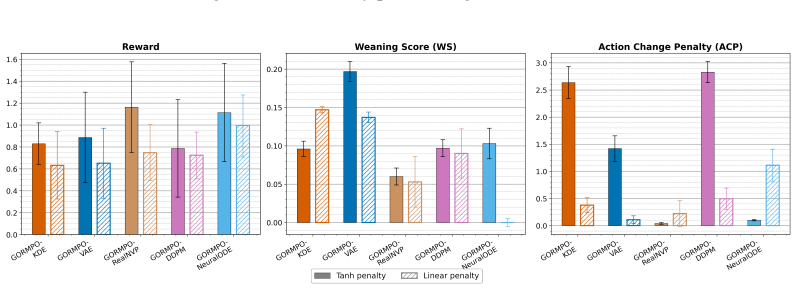
We study sequential decision-making with offline reinforcement learning (RL). Traditional offline RL policies may result in out-of-distribution (OOD) actions when training relies only on sparse offline representations. To ensure safe offline policies in a sparse state-action space, we explore how density estimation models can be integrated into model-based RL methods to avoid the OOD regions. Generative models are capable of explicitly modeling the density in sparse state-action spaces. Building on this, we introduce Generative OOD-regularized Model-based Policy Optimization (GORMPO), a density-regularized offline RL algorithm that uses generative density modeling to restrict policy updates to high-density areas of the dataset. Furthermore, we examine whether better OOD detection corresponds to better model-based offline policies. We compare (1) the OOD detection capabilities of various density estimators and (2) their performance within the GORMPO framework on a real-world medical dataset and sparse offline RL datasets. We theoretically guarantee GORMPO's performance under mild assumptions. Empirically, GORMPO outperforms state-of-the-art baselines by 17% on a real-world medical dataset and enhances the base model on the offline RL datasets. Our empirical findings show that better OOD detection generally results in improved policies in environments with stable dynamics, while conservative penalties with poor density estimation are favored when dynamics are uncertain.
Figures




Reference graph
Works this paper leans on
-
[1]
Dmitriy Akimov, Vladislav Kurenkov, Alexander Nikulin, Denis Tarasov, and Sergey Kolesnikov. Let Offline RL Flow: Training conservative agents in the latent space of nor- malizing flows.arXiv preprint arXiv:2211.11096, 2022
-
[2]
Uncertainty-based offline reinforcement learning with diversified q-ensemble
Gaon An, Seungyong Moon, Jang-Hyun Kim, and Hyun Oh Song. Uncertainty-based offline reinforcement learning with diversified q-ensemble. In M. Ranzato, A. Beygelzimer, Y . Dauphin, P.S. Liang, and J. Wortman Vaughan, editors,Advances in Neural Information Processing Systems, volume 34, pages 7436–7447. Curran Associates, Inc., 2021
work page 2021
-
[3]
Mayank Bansal, Alex Krizhevsky, and Abhijit S. Ogale. Chauffeurnet: Learning to drive by imitating the best and synthesizing the worst. InRobotics: Science and Systems (RSS), 2019
work page 2019
-
[4]
Offline RL without off-policy evaluation
David Brandfonbrener, Will Whitney, Rajesh Ranganath, and Joan Bruna. Offline RL without off-policy evaluation. InAdvances in Neural Information Processing Systems 34: Annual Conference on Neural Information Processing Systems 2021, NeurIPS 2021, December 6-14, 2021, virtual, pages 4933–4946, 2021
work page 2021
- [5]
-
[6]
Edward Buitenwerf, Mats F Boekel, Marieke I van der Velde, Magiel F V oogd, Michiel N Kerstens, Götz JKG Wietasch, and Thomas WL Scheeren. The haemodynamic instability score: Development and internal validation of a new rating method of intra-operative haemodynamic instability.European Journal of Anaesthesiology| EJA, 36(4):290–296, 2019
work page 2019
-
[7]
Importance weighted autoencoders
Yuri Burda, Roger Grosse, and Ruslan Salakhutdinov. Importance weighted autoencoders. In International Conference on Learning Representations (ICLR), 2016. Poster
work page 2016
-
[8]
Ricky T. Q. Chen, Yulia Rubanova, Jesse Bettencourt, and David K Duvenaud. Neural ordinary differential equations. In S. Bengio, H. Wallach, H. Larochelle, K. Grauman, N. Cesa-Bianchi, and R. Garnett, editors,Advances in Neural Information Processing Systems, volume 31. Curran Associates, Inc., 2018
work page 2018
-
[9]
Jonas Degrave, Federico Felici, Jonas Buchli, Michael Neunert, Brendan Tracey, Francesco Carpanese, Timo Ewalds, Roland Hafner, Abbas Abdolmaleki, Diego de las Casas, et al. Mag- netic control of tokamak plasmas through deep reinforcement learning.Nature, 602(7897):414– 419, 2022
work page 2022
-
[10]
Density estimation using real nvp
Laurent Dinh, Jascha Sohl-Dickstein, and Samy Bengio. Density estimation using real nvp. In International Conference on Learning Representations (ICLR), 2017
work page 2017
-
[11]
An image is worth 16x16 words: Transformers for image recognition at scale
Alexey Dosovitskiy, Lucas Beyer, Alexander Kolesnikov, Dirk Weissenborn, Xiaohua Zhai, Thomas Unterthiner, Mostafa Dehghani, Matthias Minderer, Georg Heigold, Sylvain Gelly, Jakob Uszkoreit, and Neil Houlsby. An image is worth 16x16 words: Transformers for image recognition at scale. InInternational Conference on Learning Representations, 2021
work page 2021
-
[12]
Reinforce- ment learning for precision oncology.Cancers, 13(18):4624, 2021
Jan-Niklas Eckardt, Karsten Wendt, Martin Bornhaeuser, and Jan Moritz Middeke. Reinforce- ment learning for precision oncology.Cancers, 13(18):4624, 2021
work page 2021
-
[13]
D4RL: Datasets for deep data-driven reinforcement learning
Justin Fu, Aviral Kumar, Ofir Nachum, George Tucker, and Sergey Levine. D4RL: Datasets for deep data-driven reinforcement learning. InInternational Conference on Learning Representa- tions, 2021
work page 2021
-
[14]
Benchmarking Batch Deep Reinforcement Learning Algorithms
Scott Fujimoto, Edoardo Conti, Mohammad Ghavamzadeh, and Joelle Pineau. Benchmarking batch deep reinforcement learning algorithms. InarXiv preprint arXiv:1910.01708, 2019
work page internal anchor Pith review Pith/arXiv arXiv 1910
-
[15]
Mean flows for one-step generative modeling
Zhengyang Geng, Mingyang Deng, Xingjian Bai, J Zico Kolter, and Kaiming He. Mean flows for one-step generative modeling. InThe Thirty-ninth Annual Conference on Neural Information Processing Systems, 2026. 10
work page 2026
-
[16]
Denoising diffusion probabilistic models
Jonathan Ho, Ajay Jain, and Pieter Abbeel. Denoising diffusion probabilistic models. In H. Larochelle, M. Ranzato, R. Hadsell, M.F. Balcan, and H. Lin, editors,Advances in Neural Information Processing Systems, volume 33, pages 6840–6851. Curran Associates, Inc., 2020
work page 2020
-
[17]
Planning with diffusion for flexible behavior synthesis
Michael Janner, Yilun Du, Joshua Tenenbaum, and Sergey Levine. Planning with diffusion for flexible behavior synthesis. In Kamalika Chaudhuri, Stefanie Jegelka, Le Song, Csaba Szepesvari, Gang Niu, and Sivan Sabato, editors,Proceedings of the 39th International Confer- ence on Machine Learning, volume 162 ofProceedings of Machine Learning Research, pages ...
work page 2022
-
[18]
When to trust your model: Model- based policy optimization
Michael Janner, Justin Fu, Marvin Zhang, and Sergey Levine. When to trust your model: Model- based policy optimization. In H. Wallach, H. Larochelle, A. Beygelzimer, F. d'Alché-Buc, E. Fox, and R. Garnett, editors,Advances in Neural Information Processing Systems, volume 32. Curran Associates, Inc., 2019
work page 2019
-
[19]
Billion-scale similarity search with gpus.IEEE Transactions on Big Data, 7(3):535–547, 2021
Jeff Johnson, Matthijs Douze, and Hervé Jégou. Billion-scale similarity search with gpus.IEEE Transactions on Big Data, 7(3):535–547, 2021
work page 2021
-
[20]
Elucidating the design space of diffusion-based generative models
Tero Karras, Miika Aittala, Timo Aila, and Samuli Laine. Elucidating the design space of diffusion-based generative models. InAdvances in Neural Information Processing Systems, volume 35, 2022
work page 2022
-
[21]
Diederik P. Kingma and Max Welling. Auto-encoding variational bayes. In Yoshua Bengio and Yann LeCun, editors,2nd International Conference on Learning Representations, ICLR 2014, Banff, AB, Canada, April 14-16, 2014, Conference Track Proceedings, 2014
work page 2014
-
[22]
Matthieu Komorowski, Leo A. Celi, Omar Badawi, Anthony C. Gordon, and Amir A. Faisal. The artificial intelligence clinician learns optimal treatment strategies for sepsis in intensive care.Nature Medicine, 24(11):1716–1720, 2018
work page 2018
-
[23]
Stabilizing off-policy q-learning via bootstrapping error reduction
Aviral Kumar, Justin Fu, Jacob Soh, George Tucker, and Sergey Levine. Stabilizing off-policy q-learning via bootstrapping error reduction. InAdvances in Neural Information Processing Systems (NeurIPS), 2019
work page 2019
-
[24]
Conservative q-learning for offline reinforcement learning
Aviral Kumar, Aurick Zhou, George Tucker, and Sergey Levine. Conservative q-learning for offline reinforcement learning. InAdvances in Neural Information Processing Systems (NeurIPS), 2020
work page 2020
-
[25]
Showing your offline reinforcement learning work: Online evaluation budget matters
Vladislav Kurenkov and Sergey Kolesnikov. Showing your offline reinforcement learning work: Online evaluation budget matters. In Kamalika Chaudhuri, Stefanie Jegelka, Le Song, Csaba Szepesvari, Gang Niu, and Sivan Sabato, editors,Proceedings of the 39th International Conference on Machine Learning, volume 162 ofProceedings of Machine Learning Research, pa...
work page 2022
-
[26]
Yaron Lipman, Ricky T. Q. Chen, Heli Ben-Hamu, Maximilian Nickel, and Matthew Le. Flow matching for generative modeling. InThe Eleventh International Conference on Learning Representations, 2023
work page 2023
-
[27]
Mitigating distribution shift in model-based offline RL via shifts-aware reward learning, 2024
Wang Luo, Haoran Li, Zicheng Zhang, Congying Han, Jiayu Lv, and Tiande Guo. Mitigating distribution shift in model-based offline RL via shifts-aware reward learning, 2024
work page 2024
-
[28]
Supported value regular- ization for offline reinforcement learning
Yixiu Mao, Hongchang Zhang, Chen Chen, Yi Xu, and Xiangyang Ji. Supported value regular- ization for offline reinforcement learning. In A. Oh, T. Naumann, A. Globerson, K. Saenko, M. Hardt, and S. Levine, editors,Advances in Neural Information Processing Systems, vol- ume 36, pages 40587–40609. Curran Associates, Inc., 2023
work page 2023
-
[29]
Normalizing flows for inter- ventional density estimation
Valentyn Melnychuk, Dennis Frauen, and Stefan Feuerriegel. Normalizing flows for inter- ventional density estimation. In Andreas Krause, Emma Brunskill, Kyunghyun Cho, Barbara Engelhardt, Sivan Sabato, and Jonathan Scarlett, editors,Proceedings of the 40th International Conference on Machine Learning, volume 202 ofProceedings of Machine Learning Research,...
work page 2023
-
[30]
Model-based offline reinforcement learning with lower expectile q-learning
Kwanyoung Park and Youngwoon Lee. Model-based offline reinforcement learning with lower expectile q-learning. InThe Thirteenth International Conference on Learning Representations, 2025
work page 2025
-
[31]
Scalable diffusion models with transformers
William Peebles and Saining Xie. Scalable diffusion models with transformers. InProceedings of the IEEE/CVF international conference on computer vision, pages 4195–4205, 2023
work page 2023
-
[32]
Continuous state-space models for optimal sepsis treatment: A deep reinforcement learning approach
Aniruddh Raghu, Matthieu Komorowski, Leo Anthony Celi, Peter Szolovits, and Marzyeh Ghassemi. Continuous state-space models for optimal sepsis treatment: A deep reinforcement learning approach. InProceedings of the Machine Learning for Healthcare Conference (MLHC), pages 147–163, 2017
work page 2017
-
[33]
Variational inference with normalizing flows
Danilo Rezende and Shakir Mohamed. Variational inference with normalizing flows. In Francis Bach and David Blei, editors,Proceedings of the 32nd International Conference on Machine Learning, volume 37 ofProceedings of Machine Learning Research, pages 1530–1538, Lille, France, 07–09 Jul 2015. PMLR
work page 2015
-
[34]
High- resolution image synthesis with latent diffusion models
Robin Rombach, Andreas Blattmann, Dominik Lorenz, Patrick Esser, and Björn Ommer. High- resolution image synthesis with latent diffusion models. InProceedings of the IEEE/CVF conference on computer vision and pattern recognition, pages 10684–10695, 2022
work page 2022
-
[35]
Lukas Ruff, Jacob R. Kauffmann, Robert A. Vandermeulen, Gregoire Montavon, Wojciech Samek, Marius Kloft, Thomas G. Dietterich, and Klaus-Robert Muller. A unifying review of deep and shallow anomaly detection.Proceedings of the IEEE, 109(5), 2021
work page 2021
-
[36]
Denoising diffusion implicit models
Jiaming Song, Chenlin Meng, and Stefano Ermon. Denoising diffusion implicit models. In International Conference on Learning Representations, 2021
work page 2021
-
[37]
Model-Bellman inconsistency for model-based offline reinforcement learning
Yihao Sun, Jiaji Zhang, Chengxing Jia, Haoxin Lin, Junyin Ye, and Yang Yu. Model-Bellman inconsistency for model-based offline reinforcement learning. In Andreas Krause, Emma Brunskill, Kyunghyun Cho, Barbara Engelhardt, Sivan Sabato, and Jonathan Scarlett, edi- tors,Proceedings of the 40th International Conference on Machine Learning, volume 202 of Proce...
work page 2023
-
[38]
Machine learning and imaging informatics in oncology.Oncology, 98(6):344–362, 2020
Huan-Hsin Tseng, Lise Wei, Sunan Cui, Yi Luo, Randall K Ten Haken, and Issam El Naqa. Machine learning and imaging informatics in oncology.Oncology, 98(6):344–362, 2020
work page 2020
-
[39]
Aysin Tumay, Sophia Sun, Sonia Fereidooni, Aaron Dumas, Elise Jortberg, and Rose Yu. Guardian-regularized safe offline reinforcement learning for smart weaning of mechanical circulatory devices, 2025
work page 2025
-
[40]
Cardiogenic shock.Journal of the American Heart Association, 8(8):e011991, 2019
Cyrus Vahdatpour, David Collins, and Sheldon Goldberg. Cardiogenic shock.Journal of the American Heart Association, 8(8):e011991, 2019
work page 2019
-
[41]
Diffusion policies as an expressive policy class for offline reinforcement learning
Zhendong Wang, Jonathan J Hunt, and Mingyuan Zhou. Diffusion policies as an expressive policy class for offline reinforcement learning. InThe Eleventh International Conference on Learning Representations, 2023
work page 2023
-
[42]
Supported policy optimization for offline reinforcement learning
Jialong Wu, Haixu Wu, Zihan Qiu, Jianmin Wang, and Mingsheng Long. Supported policy optimization for offline reinforcement learning. InAdvances in Neural Information Processing Systems, 2022
work page 2022
-
[43]
Behavior regularized offline reinforcement learning
Yifan Wu, George Tucker, and Ofir Nachum. Behavior regularized offline reinforcement learning. InAdvances in Neural Information Processing Systems (NeurIPS), 2019
work page 2019
-
[44]
Sihan Xu, Ziqiao Ma, Wenhao Chai, Xuweiyi Chen, Weiyang Jin, Joyce Chai, Saining Xie, and Stella X. Yu. Next-embedding prediction makes strong vision learners, 2025
work page 2025
-
[45]
Offline guarded safe reinforcement learning for medical treatment optimization strategies
Runze Yan, Xun Shen, Akifumi Wachi, Sebastien Gros, Anni Zhao, and Xiao Hu. Offline guarded safe reinforcement learning for medical treatment optimization strategies. InAdvances in Neural Information Processing Systems (NeurIPS) 39, 2025
work page 2025
-
[46]
Zou, Sergey Levine, Chelsea Finn, and Tengyu Ma
Tianhe Yu, Garrett Thomas, Lantao Yu, Stefano Ermon, James Y . Zou, Sergey Levine, Chelsea Finn, and Tengyu Ma. Mopo: Model-based offline policy optimization. InAdvances in Neural Information Processing Systems, volume 33, pages 14129–14142, 2020. 12
work page 2020
-
[47]
Deep structured energy based models for anomaly detection
Shuangfei Zhai, Yu Cheng, Weining Lu, and Zhongfei Zhang. Deep structured energy based models for anomaly detection. In Maria Florina Balcan and Kilian Q. Weinberger, editors, Proceedings of The 33rd International Conference on Machine Learning, volume 48 ofPro- ceedings of Machine Learning Research, pages 1100–1109, New York, New York, USA, 20–22 Jun 2016. PMLR
work page 2016
-
[48]
Constrained policy optimization with explicit behavior density for offline reinforcement learning
Jing Zhang, Chi Zhang, Wenjia Wang, and Bingyi Jing. Constrained policy optimization with explicit behavior density for offline reinforcement learning. InAdvances in Neural Information Processing Systems (NeurIPS), 2023. 13 A Algorithm Pseudocode Algorithm 1Generative OOD-regularized Model-based Policy Optimization (GORMPO) 1: inputJointly pre-trained dyn...
work page 2023
-
[49]
except for the rollout length of the transition model. We tuned this parameter to achieve stable Q-values during training, which is essential for strong policy optimization. We find 5, 5, 3, 5 for the medical dataset; halfcheetah, hopper, and walker2d medium-expert-sparse datasets, respectively, as providing the strongest training. See Table 9 for base pa...
-
[50]
Institutional review board (IRB) approvals or equivalent for research with human subjects Question: Does the paper describe potential risks incurred by study participants, whether such risks were disclosed to the subjects, and whether Institutional Review Board (IRB) approvals (or an equivalent approval/review based on the requirements of your country or ...
discussion (0)
Sign in with ORCID, Apple, or X to comment. Anyone can read and Pith papers without signing in.