Low-lying Λ and Sigma resonances studied with the forward K^* productions off the proton induced by high-momentum π beam
Pith reviewed 2026-06-30 13:31 UTC · model grok-4.3
The pith
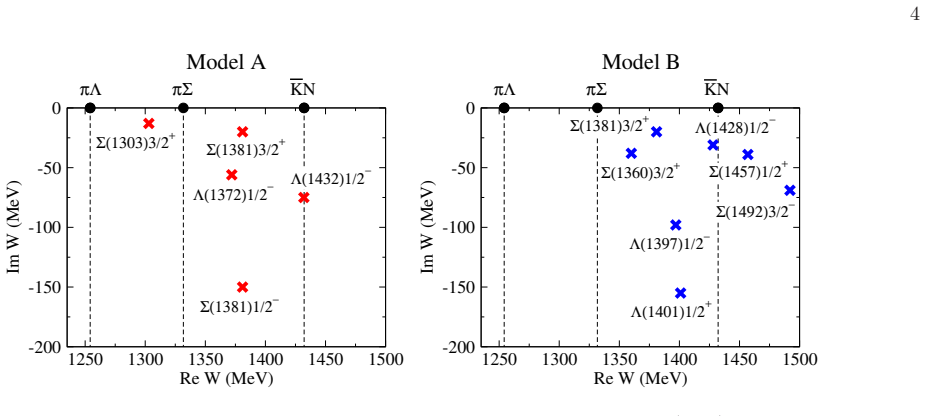
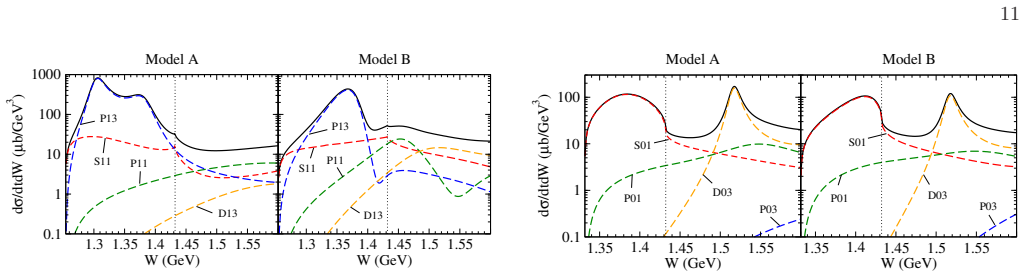
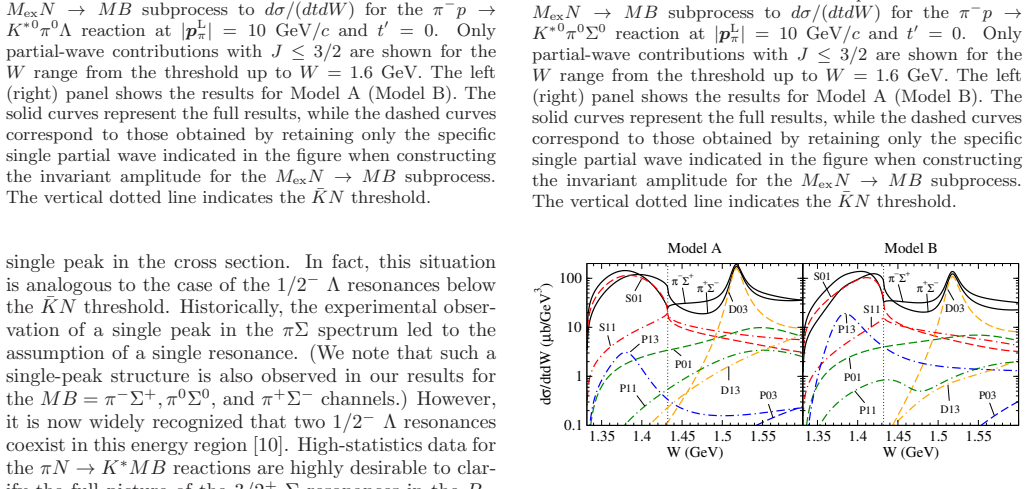
Overlapping resonances can form a single peak in the πΛ mass spectrum from forward K* production.
A machine-rendered reading of the paper's core claim, the machinery that carries it, and where it could break.
Core claim
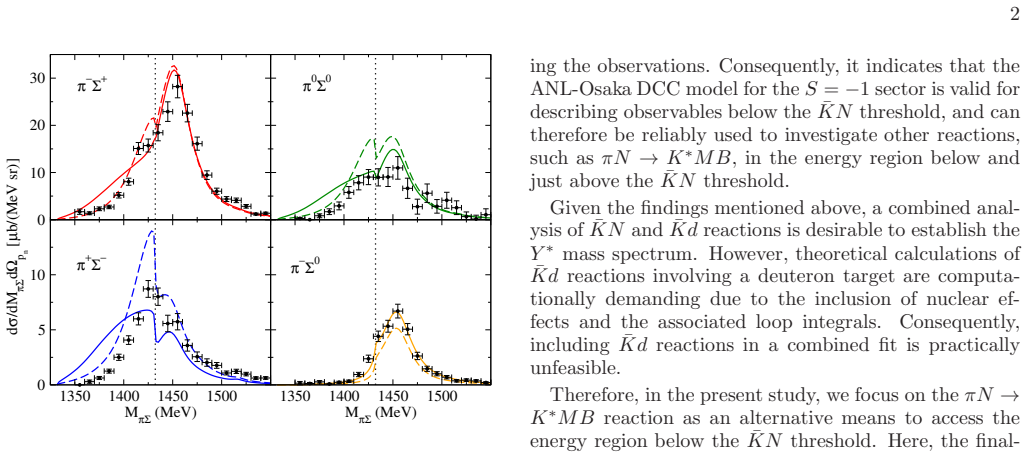
Forward K* production off the proton, induced by a high-momentum π beam, supplies a complementary channel for Y* spectroscopy; when the half-off-shell DCC amplitudes are inserted into the one-meson-exchange framework, overlapping sub-threshold resonances appear as a single peak in the πΛ spectrum, so the absence of structure in existing mass distributions does not exclude additional states.
What carries the argument
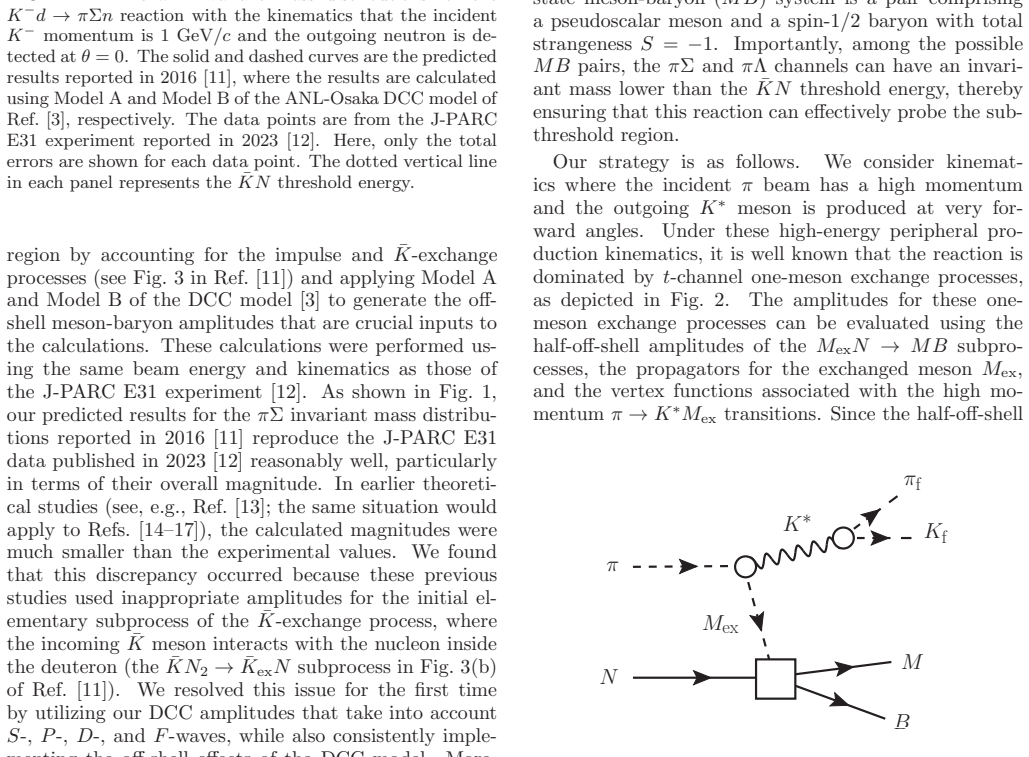
One-meson exchange mechanism combined with half-off-shell scattering amplitudes from the ANL-Osaka DCC models (Model A and Model B).
If this is right
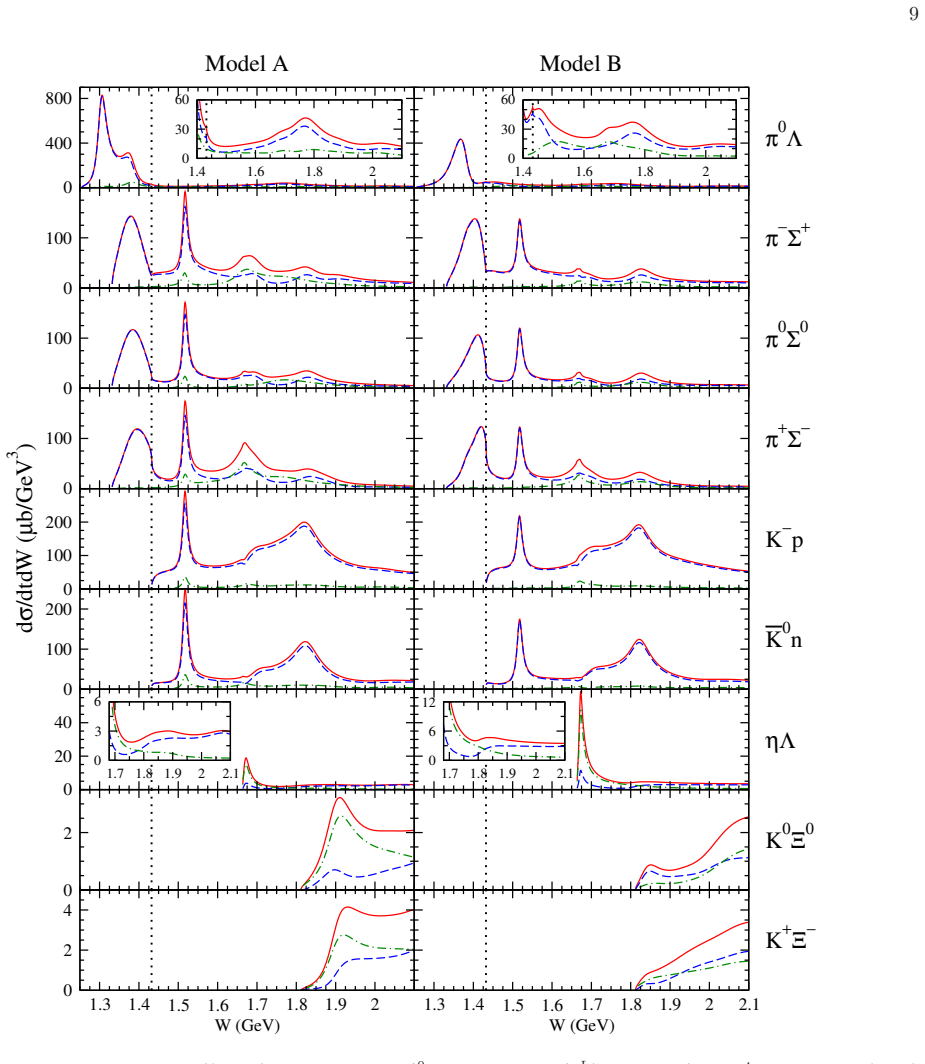
- Significant enhancements appear in the sub-threshold region of invariant-mass spectra.
- Angular distributions discriminate overlapping states via partial-wave interference.
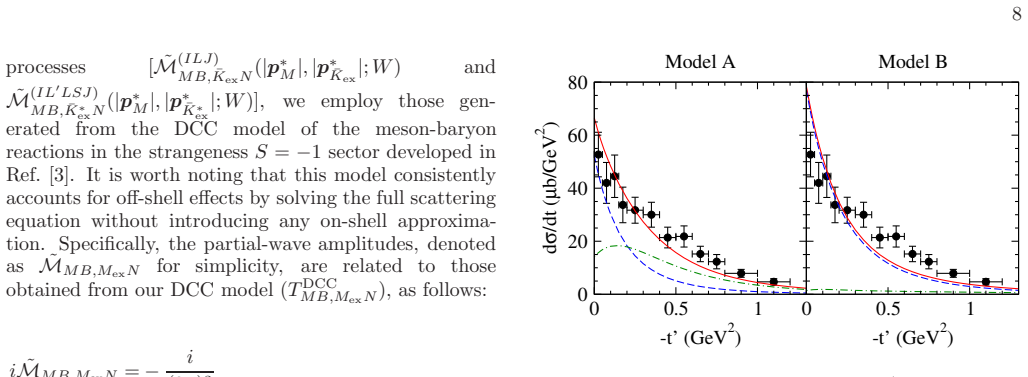
- t' and φ_M* dependencies constrain the high-energy production mechanism.
- Existing mass-spectrum data alone cannot rule out previously unconfirmed sub-threshold states.
Where Pith is reading between the lines
- The same forward-production framework could be applied to other meson beams to access additional hidden states.
- Comparison of Model A versus Model B predictions would quantify how sensitive the single-peak effect is to the underlying coupled-channels dynamics.
Load-bearing premise
One-meson exchange dominates forward-angle K* production at high beam energies, so the half-off-shell DCC amplitudes can be used directly to generate observables.
What would settle it
A high-statistics measurement of the angular distribution in the πΛ channel that shows no partial-wave interference pattern between a new 3/2+ state and Σ(1385).
Figures
read the original abstract
We develop a novel model utilizing the forward $K^*$ production reaction off the nucleon, $\pi N \to K^* MB$, induced by a high-momentum $\pi$ beam, as a tool to study low-lying $Y^*$ resonances below and just above the $\bar{K}N$ threshold. Because conventional $K^- p$ scattering experiments face difficulties in directly accessing this kinematic region, the proposed reaction offers a valuable complementary approach for $Y^*$ spectroscopy. The constructed model is based on the one-meson exchange mechanism, which is known to dominate forward-angle production at high energies, and the half-off-shell scattering amplitudes from the ANL-Osaka dynamical coupled-channels (DCC) models (Model~A and Model~B). We predict various observables, including differential cross sections and angular distributions. Our results demonstrate significant enhancements in the sub-threshold region of the invariant mass spectra. Notably, we show that overlapping resonances, such as a potential new $3/2^+$ $\Sigma$ state and the well-established $\Sigma(1385)3/2^+$, can constitute a single peak in the $\pi\Lambda$ mass spectrum, indicating that the existence of previously unconfirmed sub-threshold states cannot be ruled out by analyzing only the existing mass spectrum data. Furthermore, we find that angular distributions provide strong discriminatory power to disentangle such overlapping states through partial-wave interference effects, while the $t'$ and $\phi_M^*$ dependencies provide crucial constraints on the high-energy production mechanisms.Our predictions for these highly sensitive observables can facilitate high-statistics measurements, which are accessible at modern hadron facilities such as J-PARC, to unravel the $S=-1$ $Y^*$ mass spectrum.
Editorial analysis
A structured set of objections, weighed in public.
Referee Report
Summary. The paper proposes using the forward K* production reaction πN → K* MB induced by high-momentum π beams as a complementary tool to study low-lying Y* resonances below and near the KN threshold. It constructs a model based on the one-meson exchange mechanism combined with half-off-shell amplitudes taken from the authors' prior ANL-Osaka dynamical coupled-channels models (Model A and Model B), and presents predictions for differential cross sections, angular distributions, invariant-mass spectra, t' and φ_M* dependencies. The central results are sub-threshold enhancements in the spectra and the demonstration that overlapping resonances (e.g., a putative new 3/2+ Σ state with the established Σ(1385)3/2+) can merge into a single peak in the πΛ mass spectrum, implying that angular distributions may be needed to resolve such states.
Significance. If the underlying assumptions hold, the work supplies concrete, experimentally accessible predictions that could guide high-statistics measurements at facilities such as J-PARC and underscores the diagnostic value of angular distributions for resolving overlapping partial waves. The approach is potentially useful precisely because direct access to the sub-threshold region via K−p scattering is limited.
major comments (2)
- [Model construction] The model section states that the one-meson exchange mechanism “is known to dominate forward-angle production at high energies” but supplies no explicit check (e.g., t-slope comparison, relative-size estimate of two-meson or contact contributions, or reference specific to the πN→K*MB channel) at the beam momenta and small |t| values used for the predictions. This assumption is load-bearing for the reliability of the generated invariant-mass enhancements and the partial-wave interference patterns invoked to argue for angular-distribution discrimination.
- [Results and discussion of invariant-mass spectra] The demonstration that overlapping resonances can produce a single peak in the πΛ spectrum (and the consequent claim that sub-threshold states cannot be ruled out from mass spectra alone) is obtained by embedding the half-off-shell amplitudes of the prior ANL-Osaka DCC models without new quantitative validation, error estimates, or direct comparison to data in the production channel. Because the resonance content and half-off-shell behavior are taken directly from those earlier fits, the new observables largely propagate rather than independently test the resonance structure.
minor comments (1)
- The text refers to “Model A and Model B” from the ANL-Osaka framework; a short parenthetical reminder of the principal differences between the two models (or an explicit citation to the relevant prior papers) would improve readability for readers unfamiliar with the series.
Simulated Author's Rebuttal
We thank the referee for the careful reading and constructive comments. We address the two major points below, clarifying the scope of the work as a set of model predictions for future experiments rather than a new fit to production data.
read point-by-point responses
-
Referee: [Model construction] The model section states that the one-meson exchange mechanism “is known to dominate forward-angle production at high energies” but supplies no explicit check (e.g., t-slope comparison, relative-size estimate of two-meson or contact contributions, or reference specific to the πN→K*MB channel) at the beam momenta and small |t| values used for the predictions. This assumption is load-bearing for the reliability of the generated invariant-mass enhancements and the partial-wave interference patterns invoked to argue for angular-distribution discrimination.
Authors: We agree that an explicit reference or estimate specific to the πN→K*MB channel at the kinematics of interest would strengthen the manuscript. The statement reflects the standard high-energy phenomenology used in similar vector-meson production reactions, but we will add targeted citations to meson-exchange calculations for forward πN→KY and vector-meson channels and include a short paragraph discussing the expected dominance at small |t| based on existing t-slope data. This will be a clarification rather than a new calculation. revision: partial
-
Referee: [Results and discussion of invariant-mass spectra] The demonstration that overlapping resonances can produce a single peak in the πΛ spectrum (and the consequent claim that sub-threshold states cannot be ruled out from mass spectra alone) is obtained by embedding the half-off-shell amplitudes of the prior ANL-Osaka DCC models without new quantitative validation, error estimates, or direct comparison to data in the production channel. Because the resonance content and half-off-shell behavior are taken directly from those earlier fits, the new observables largely propagate rather than independently test the resonance structure.
Authors: The manuscript is explicitly a prediction study that applies the already-validated ANL-Osaka DCC amplitudes (Models A and B) to a new reaction channel. Its goal is to show how the resonance content already present in those models would appear in forward K* production observables, including the merging of overlapping states into a single πΛ peak and the diagnostic power of angular distributions. We do not perform a new fit or claim independent validation of the resonance parameters from production data; such data do not yet exist. We will revise the text to state this scope more explicitly and to emphasize that the predictions are intended to guide future measurements at J-PARC. revision: partial
Circularity Check
Resonance-overlap demonstration propagates fitted content from authors' prior DCC models
specific steps
-
self citation load bearing
[Abstract]
"the half-off-shell scattering amplitudes from the ANL-Osaka dynamical coupled-channels (DCC) models (Model A and Model B). We predict various observables... Our results demonstrate significant enhancements in the sub-threshold region of the invariant mass spectra. Notably, we show that overlapping resonances, such as a potential new 3/2+ Σ state and the well-established Σ(1385)3/2+, can constitute a single peak in the πΛ mass spectrum"
The resonance parameters and amplitudes (including the 'potential new 3/2+ Σ state') originate in the authors' prior DCC fits; the 'we show' demonstration of single-peak formation is therefore a direct output of those fitted inputs rather than an independent result from the new reaction.
full rationale
The paper's central claim—that overlapping resonances (including a potential new 3/2+ Σ) can form a single peak in the πΛ spectrum, so sub-threshold states cannot be ruled out from mass data alone—rests on embedding half-off-shell amplitudes from the authors' own ANL-Osaka DCC Models A and B. These models were previously fitted to data; the new observables are therefore generated from that fitted resonance content rather than derived independently. The one-meson-exchange assumption is stated as 'known to dominate' without new verification for the specific channel. This matches fitted-input-called-prediction and self-citation-load-bearing patterns but does not reduce the entire derivation to definition.
Axiom & Free-Parameter Ledger
free parameters (1)
- parameters within ANL-Osaka DCC models
axioms (1)
- domain assumption One-meson exchange mechanism dominates forward-angle production at high energies
Reference graph
Works this paper leans on
-
[1]
These resonances are assigned to the three-star Σ(1660)1 / 2+ and the one- star Σ(1580)3 / 2− in the PDG [10], respectively
5 GeV, they are not presented here. These resonances are assigned to the three-star Σ(1660)1 / 2+ and the one- star Σ(1580)3 / 2− in the PDG [10], respectively. On the other hand, the remaining resonances listed in the table are presented here for the first time. A striking feature of our results is that both Model A and Model B exhibit two 3 / 2+ Σ resona...
2014
-
[2]
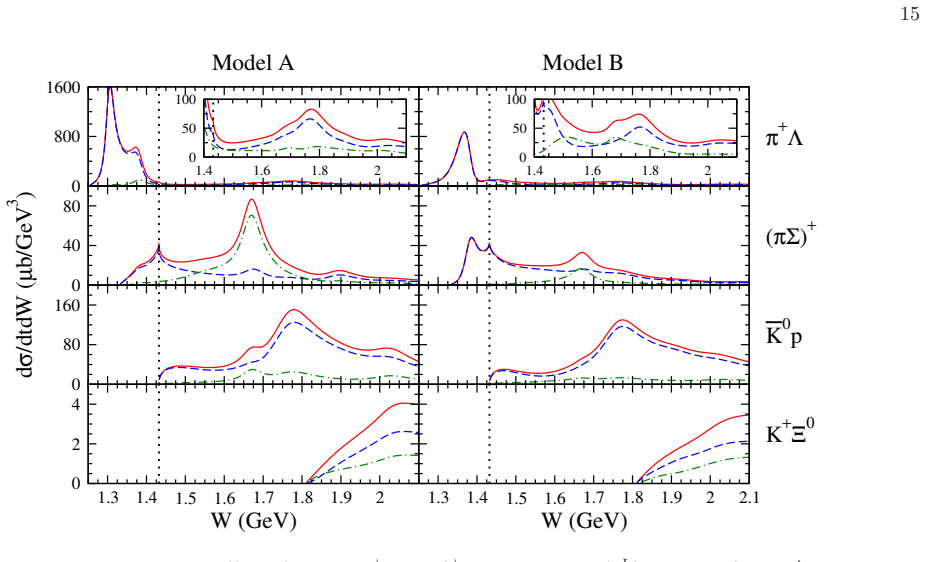
dσ/ (dtdW ) up to W = 2. 1 GeV and pronounced Y ∗ s Figure 6 shows dσ/ (dtdW ) at |pL π | = 10 GeV/ c and t′ = 0 for the π − p → K ∗0M B reactions with various fi- nal M B states: M B = π 0Λ, π − Σ +, π 0Σ 0, π +Σ − , K − p, ¯K 0n, ηΛ, K 0Ξ 0, and K +Ξ − . The results are presented as a function of W from the threshold of each channel up to 2 . 1 GeV. In t...
2014
-
[3]
6, we present in Fig
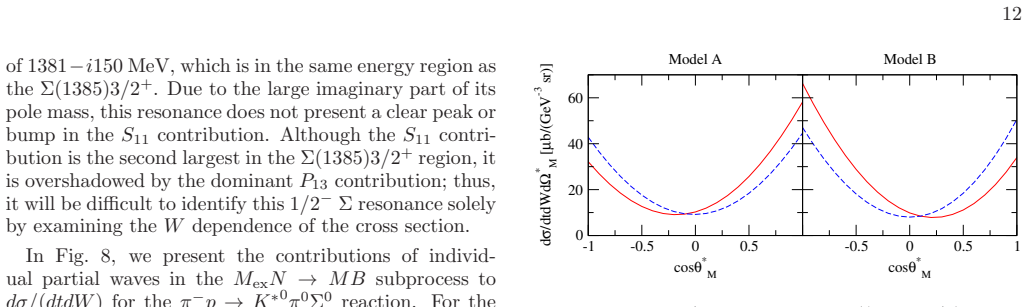
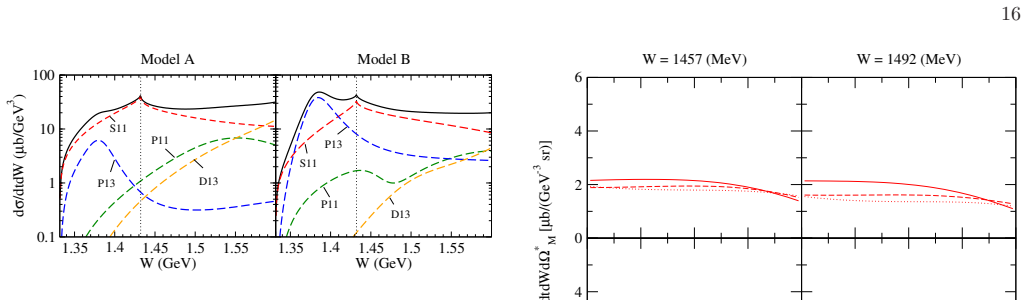
Partial-wave contributions To understand the structure of dσ/ (dtdW ) for the M B = π 0Λ channel shown in Fig. 6, we present in Fig. 7 the contributions of individual partial waves in the MexN → M B subprocess to dσ/ (dtdW ) for the π − p → K ∗ 0π 0Λ reaction. These contributions are ob- tained by retaining only the corresponding partial wave when constru...
-
[4]
It is necessary to examine Y ∗ contributions to the angular distributions
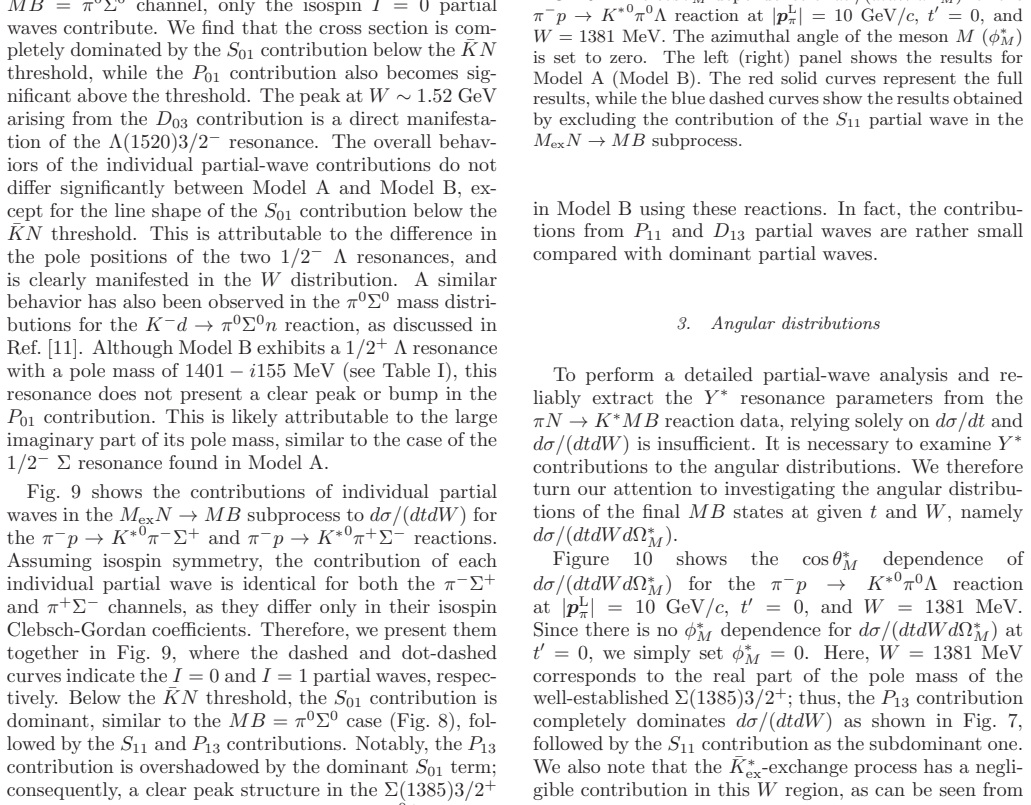
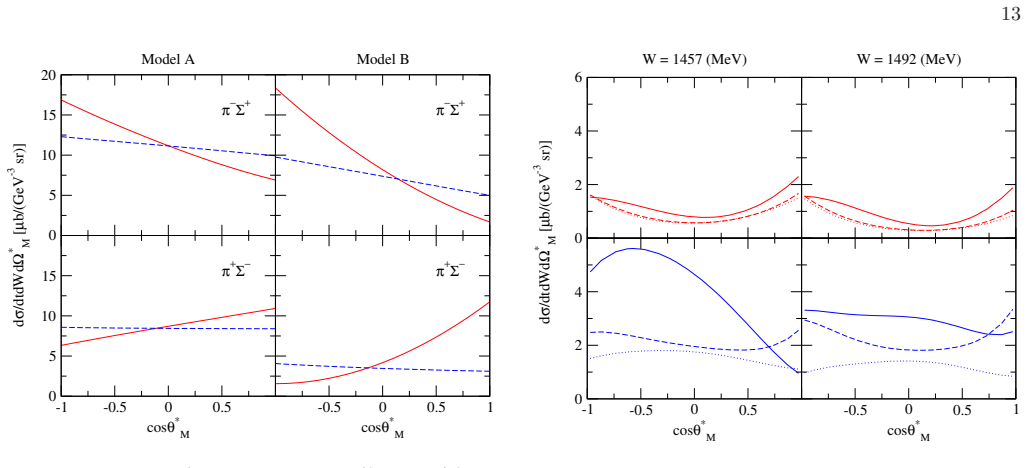
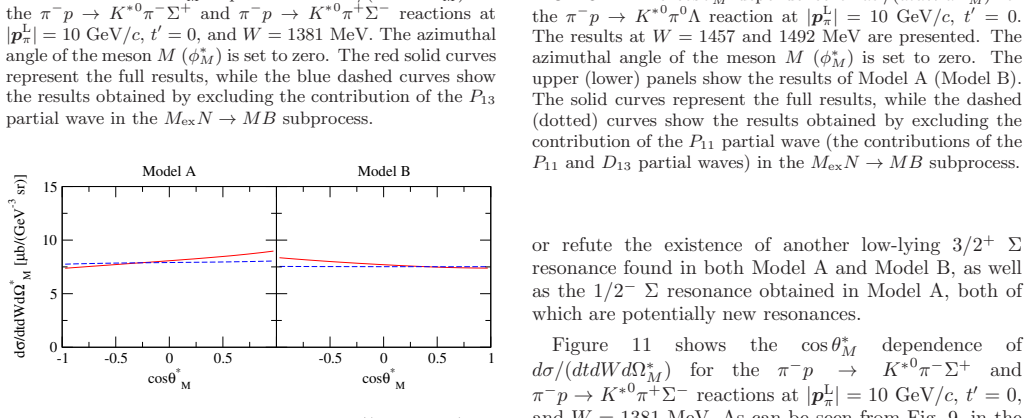
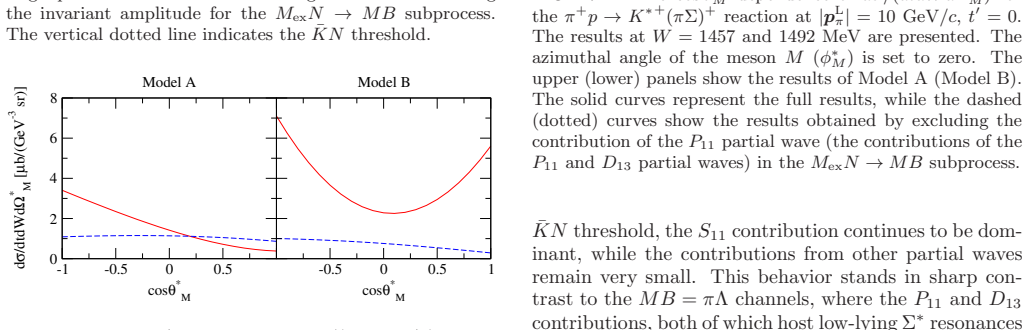
Angular distributions To perform a detailed partial-wave analysis and re- liably extract the Y ∗ resonance parameters from the πN → K ∗ M B reaction data, relying solely on dσ/dt and dσ/ (dtdW ) is insufficient. It is necessary to examine Y ∗ contributions to the angular distributions. We therefore turn our attention to investigating the angular distribu- t...
-
[5]
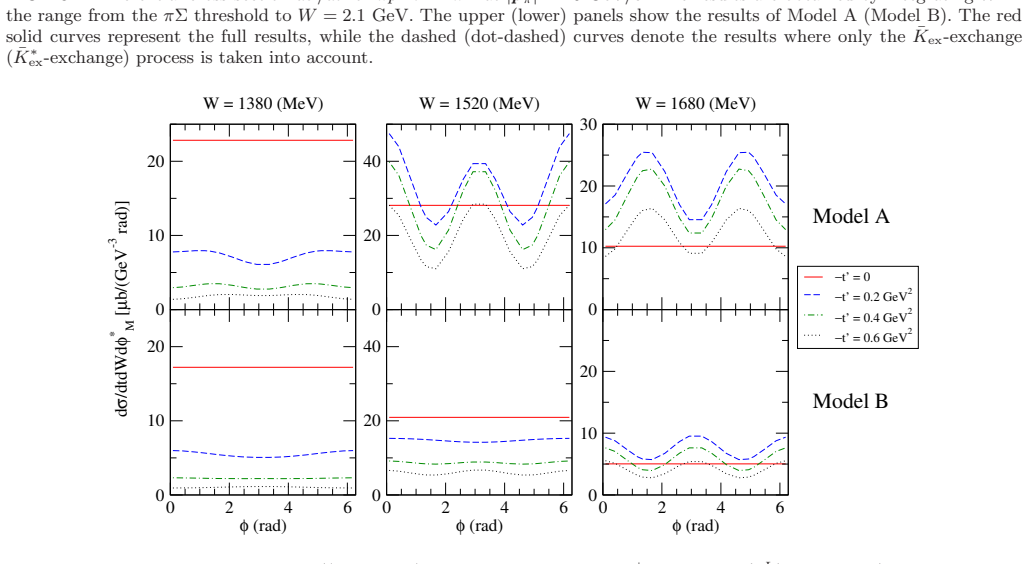
The angular distribution shown in Fig
+ · · ·, where AS11 (AP13 ) generically denotes the quantity encompassing the amplitude and other relevant factors associated with the S11 (P13) contribution of the ¯Kex-exchange process, with its specific cos θ∗ M dependence factored out in each respective term, and the terms involving either the ¯K ∗ ex-exchange process or any partial wave other than S11...
-
[6]
dσ/ (dtdW ) up to W = 2. 1 GeV and pronounced Y ∗ s Figure 14 shows dσ/ (dtdW ) at |pL π | = 10 GeV/ c and t′ = 0 for the π +p → K ∗+M B reactions with various final M B states: M B = π +Λ, π +Σ 0, π 0Σ +, ¯K 0p, and K +Ξ 0. The results are presented as a function of W from the threshold of each channel up to 2.1 GeV. Under isospin symmetry, the cross sect...
-
[7]
Partial-wave contributions We now examine the partial-wave contributions of the MexN → M B subprocess to dσ/ (dtdW ) for the π +p → K ∗ +(π Σ) + reaction. As already mentioned, because the magnitudes of cross sections for the π +p → K ∗ +π +Λ reaction are exactly twice those for the π − p → K ∗ 0π 0Λ reaction within our current model based on the t-channe...
-
[8]
Angular distributions Figure 16 shows the cos θ∗ M dependence of dσ/ (dtdW dΩ ∗ M ) for the π +p → K ∗ +(π Σ) + reac- tions at |pL π |= 10 GeV/ c, t′ = 0, and W = 1381 MeV. It can be seen that the angular dependence is significantly different between Model A and Model B, and this difference originates from the P13 contribution in the MexN → M B subprocess. S...
-
[9]
+ · · ·, where AS11 (AP13 ) generically denotes the quantity encompassing the amplitude and other relevant factors associated with the S11 (P13) contribution of the ¯Kex-exchange process, with its specific cos θ∗ M dependence factored out in each respective term, and the minor terms involving either the ¯K ∗ ex-exchange process or any partial wave other th...
2014
-
[10]
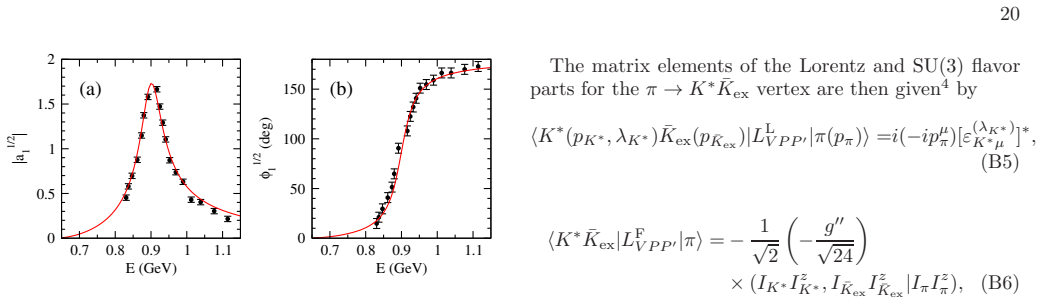
Model for the π → K ∗ ¯Kex vertex The invariant amplitude for the π → K ∗ ¯Kex vertex is given by iMK ∗ (λ K∗ ,I z K∗ ) ¯Kex(I z ¯Kex ),π (I zπ )(pK ∗ , p ¯Kex; pπ ) = ⟨K ∗ (pK ∗ ; λ K ∗ , I z K ∗ ) ¯Kex(p ¯Kex; I z¯Kex )|iLV P P ′|π (pπ ; I z π )⟩. (B1) For the Lagrangian describing the interaction between one octet vector meson and two octet pseudoscala...
-
[11]
Model for the π → K ∗ ¯K ∗ ex vertex The invariant amplitude for the π → K ∗ ¯K ∗ ex vertex is given by iMK ∗ (λ K∗ ,I z K∗ ) ¯K ∗ ex(Sz ¯K∗ex ,I z ¯K∗ex ),π (I z π )(pK ∗ , p ¯K ∗ ex ; pπ ) =⟨K ∗ (pK ∗ ; λ K ∗ , I z K ∗ ) ¯K ∗ ex(p ¯K ∗ ex ; Sz ¯K ∗ex , I z ¯K ∗ex )|iLV V ′P |π (pπ ; I z π )⟩. (B10) For the Lagrangian describing the interaction between t...
-
[12]
Partial-wave analysis of $\bar K N$ scattering reactions
H. Zhang, J. Tulpan, M. Shrestha, and D. M. Manley, Partial-wave analysis of ¯KN scatter- ing reactions, Phys. Rev. C 88, 035204 (2013), arXiv:1305.3598 [hep-ph]
work page internal anchor Pith review Pith/arXiv arXiv 2013
-
[13]
H. Zhang, J. Tulpan, M. Shrestha, and D. M. Manley, Multichannel parametrization of ¯KN scattering amplitudes and extraction of reso- nance parameters, Phys. Rev. C 88, 035205 (2013), arXiv:1305.4575 [hep-ph]
work page internal anchor Pith review Pith/arXiv arXiv 2013
-
[14]
Dynamical coupled-channels model of $K^- p$ reactions (I): Determination of partial-wave amplitudes
H. Kamano, S. X. Nakamura, T.-S. H. Lee, and T. Sato, Dynamical coupled-channels model of K − p reactions: Determination of partial- wave amplitudes, Phys. Rev. C 90, 065204 (2014), arXiv:1407.6839 [nucl-th]
work page internal anchor Pith review Pith/arXiv arXiv 2014
-
[15]
H. Kamano, S. X. Nakamura, T.-S. H. Lee, and T. Sato, Dynamical coupled-channels model of K − p re- actions. II. Extraction of Λ ∗ and Σ ∗ hyperon resonances, Phys. Rev. C 92, 025205 (2015), [Erratum: Phys.Rev.C 95, 049903 (2017)], arXiv:1506.01768 [nucl-th]
work page internal anchor Pith review Pith/arXiv arXiv 2015
-
[16]
Coupled-Channel Model for $\bar{K}N$ Scattering in the Resonant Region
C. Fernandez-Ramirez, I. V. Danilkin, D. M. Manley, V. Mathieu, and A. P. Szczepaniak, Coupled-channel model for ¯KN scattering in the resonant region, Phys. Rev. D 93, 034029 (2016), arXiv:1510.07065 [hep-ph]
work page internal anchor Pith review Pith/arXiv arXiv 2016
-
[17]
M. Matveev, A. V. Sarantsev, V. A. Nikonov, A. V. Anisovich, U. Thoma, and E. Klempt, Hyperon I: Partial-wave amplitudes for K − p scattering, Eur. Phys. J. A 55, 179 (2019), arXiv:1907.03645 [nucl-ex]
- [18]
-
[19]
A. V. Anisovich, A. V. Sarantsev, V. A. Nikonov, V. Burkert, R. A. Schumacher, U. Thoma, and E. Klempt, Hyperon III: K − p-π Σ coupled- channel dynamics in the Λ(1405) mass region, Eur. Phys. J. A 56, 139 (2020)
2020
-
[20]
Dynamical coupled-channel model of meson production reactions in the nucleon resonance region
A. Matsuyama, T. Sato, and T.-S. H. Lee, Dy- namical coupled-channel model of meson produc- tion reactions in the nucleon resonance region, Phys. Rept. 439, 193 (2007), arXiv:nucl-th/0608051
work page internal anchor Pith review Pith/arXiv arXiv 2007
-
[21]
Navas et al
S. Navas et al. (Particle Data Group), Review of particle physics, Phys. Rev. D 110, 030001 (2024)
2024
-
[22]
H. Kamano and T.-S. H. Lee, Toward establishing low- lying Λ and Σ hyperon resonances with the ¯K + d → π + Y + N reaction, Phys. Rev. C 94, 065205 (2016), arXiv:1608.03470 [nucl-th]
work page internal anchor Pith review Pith/arXiv arXiv 2016
-
[23]
S. Aikawa et al. (J-PARC E31), Pole po- sition of Λ(1405) measured in d(K − , n )π Σ reactions, Phys. Lett. B 837, 137637 (2023), arXiv:2209.08254 [nucl-ex]
-
[24]
Structure of the $\Lambda(1405)$ and the $K^-d\rightarrow\pi\Sigma n$ reaction
S. Ohnishi, Y. Ikeda, T. Hyodo, and W. Weise, Structure of the Λ(1405) and the K − d → π Σ n reaction, Phys. Rev. C 93, 025207 (2016), arXiv:1512.00123 [nucl-th]
work page internal anchor Pith review Pith/arXiv arXiv 2016
-
[25]
D. Jido, E. Oset, and T. Sekihara, Kaonic pro- duction of Lambda(1405) off deuteron target in chiral dynamics, Eur. Phys. J. A 42, 257 (2009), 22 arXiv:0904.3410 [nucl-th]
work page internal anchor Pith review Pith/arXiv arXiv 2009
-
[26]
D. Jido, E. Oset, and T. Sekihara, The K − d → π Σ n reaction revisited, Eur. Phys. J. A 49, 95 (2013), arXiv:1207.5350 [nucl-th]
work page internal anchor Pith review Pith/arXiv arXiv 2013
-
[27]
Production of hyperon resonances induced by kaon on a deuteron target
J. Yamagata-Sekihara, T. Sekihara, and D. Jido, Production of hyperon resonances induced by kaon on a deuteron target, PTEP 2013, 043D02 (2013), arXiv:1210.6108 [nucl-th]
work page internal anchor Pith review Pith/arXiv arXiv 2013
-
[28]
K. Miyagawa and J. Haidenbauer, Pre- cise calculation of the two-step process for K − d → π Σ N in the Lambda (1405) reso- nance region, Phys. Rev. C 85, 065201 (2012), arXiv:1202.4272 [nucl-th]
work page internal anchor Pith review Pith/arXiv arXiv 2012
-
[29]
D. B. Lichtenberg, Corrections to the Mass and Width of a Resonance, Phys. Rev. D 10, 3865 (1974)
1974
-
[30]
E. Wang, L.-S. Geng, J.-J. Wu, J.-J. Xie, and B.- S. Zou, Review of the Low-Lying Excited Baryons Σ ∗ (1/ 2− ), Chin. Phys. Lett. 41, 101401 (2024), arXiv:2406.07839 [hep-ph]
- [31]
-
[32]
He, Role of Σ ∗ (1/ 2− ) baryons in Λ c → Λ π +π +π − decay, Phys
J. He, Role of Σ ∗ (1/ 2− ) baryons in Λ c → Λ π +π +π − decay, Phys. Rev. C 112, 015205 (2025), arXiv:2505.04126 [hep-ph]
-
[33]
S.-H. Kim, A. Hosaka, H.-C. Kim, and H. Noumi, Production of strange and charmed baryons in pion induced reactions, Phys. Rev. D 92, 094021 (2015), arXiv:1509.03567 [hep-ph]
work page internal anchor Pith review Pith/arXiv arXiv 2015
-
[34]
Xiang, X.-Y
J. Xiang, X.-Y. Wang, H. Xu, and J. He, Pion- induced K ∗ production with Σ ∗ baryon off proton target, Commun. Theor. Phys. 72, 115303 (2020)
2020
-
[35]
Y. Oh, K. Nakayama, and T.-S. H. Lee, Pen- taquark Θ +(1540) production in γN → K ¯KN , Phys. Rept. 423, 49 (2006), arXiv:hep-ph/0412363
work page internal anchor Pith review Pith/arXiv arXiv 2006
-
[36]
Aguilar-Benitez et al
M. Aguilar-Benitez et al. (CERN-College de France- Madrid-Stockholm), Study of the Reactions π − p → K 0(890)Λ, K 0(890)Σ 0 and K 0(890)Σ 0(1385) at 3.95- GeV/c, Z. Phys. C 6, 195 (1980), [Erratum: Z.Phys.C 8, 188 (1981)]
1980
-
[37]
Noumi, private communications
H. Noumi, private communications
-
[38]
Aston et al., A Study of K − π + Scattering in the Reaction K − p → K − π +n at 11-GeV/ c, Nucl
D. Aston et al., A Study of K − π + Scattering in the Reaction K − p → K − π +n at 11-GeV/ c, Nucl. Phys. B 296, 493 (1988)
1988
-
[39]
J. J. de Swart, The Octet model and its Clebsch-Gordan coefficients, Rev. Mod. Phys. 35, 916 (1963), [Erratum: Rev.Mod.Phys. 37, 326–326 (1965)]
1963
discussion (0)
Sign in with ORCID, Apple, or X to comment. Anyone can read and Pith papers without signing in.